TL;DR: An IT staffing plan is the document that converts an engineering capacity gap into an approved budget and a start date. This page gives you a free PDF template with no email gate, and works through all nine sections with a filled-in example so you can write yours today. The section that decides approval is section 2, where you state the gap as a number.
Teams without a staffing plan hire on reflex. They post roles when the backlog hurts, pay a premium for urgency, and discover in week six that finance budgeted for three engineers while engineering scoped for six. A plan costs an afternoon and removes that argument before it starts.
Download the IT staffing plan template
Download the IT Staffing Plan Template (PDF). No sign-up, no email gate, no attribution required. Print it, fill it in on screen, or copy the structure into your own format.
The rest of this page walks through each section with a worked example, because a blank template only helps if you know what a good answer looks like.
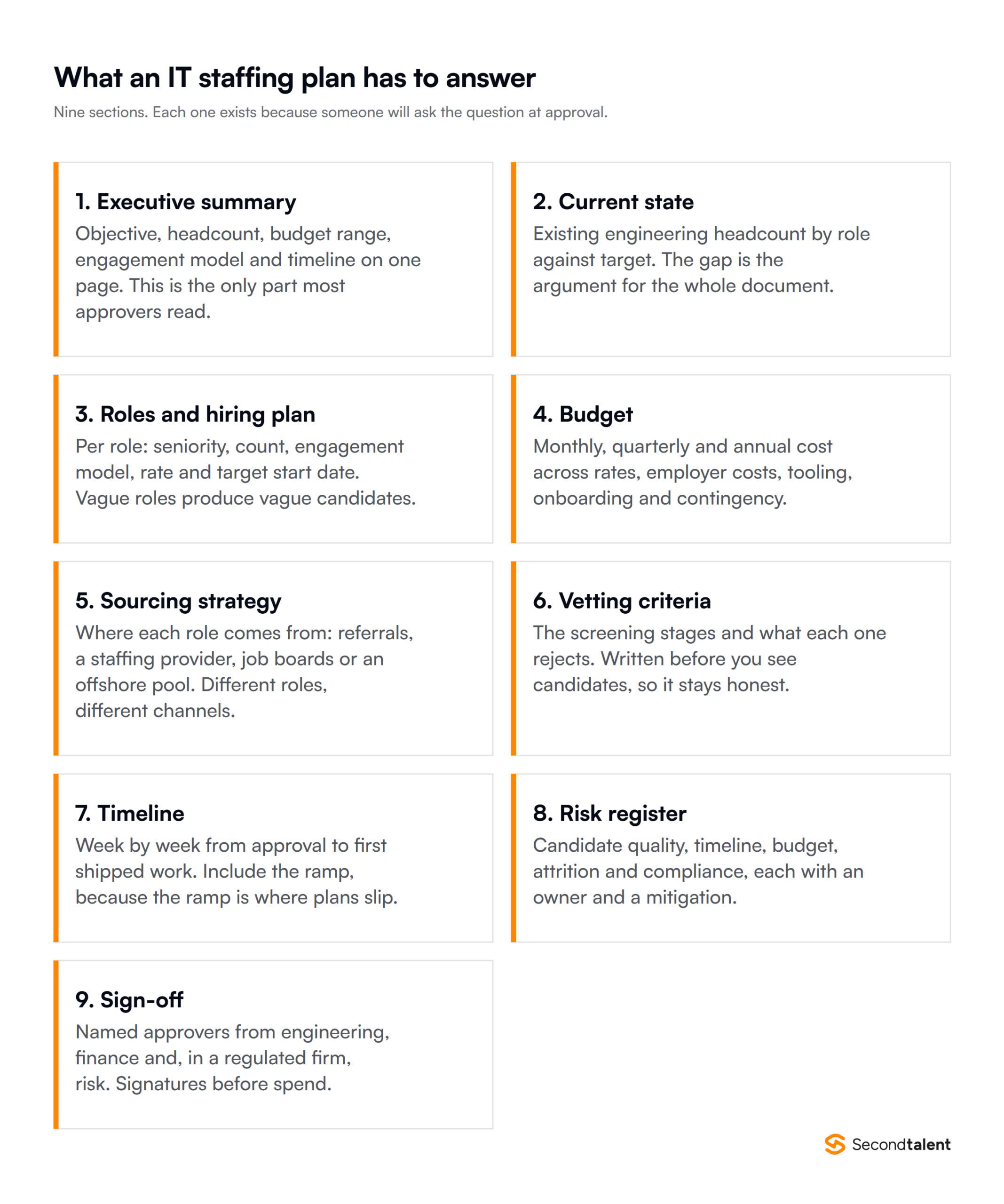
What is an IT staffing plan?
An IT staffing plan is a short document that records your current engineering headcount, the roles you need to add, what they will cost, how you will source and vet them, and when they need to start.
It is narrower than a workforce plan. A workforce plan covers every role across the company on a multi-year horizon. A staffing plan covers technical roles over one project or one fiscal period, and it sits inside the workforce plan rather than beside it.
Write one whenever you are about to commit money to engineering headcount, whether that is one contractor or a team of ten. In regulated industries a documented plan is often the artefact an auditor asks for.
Five situations trigger one in practice:
- A new product initiative needs skills the current team does not hold.
- The backlog is growing faster than the team can clear it.
- Finance wants expensive onshore contractors replaced with offshore capacity.
- A regulator or auditor asks for documented hiring and oversight.
- The board asks where engineering spend is going and what it buys.
The document is the same in all five cases. Only the emphasis moves: cost in the third, evidence in the fourth, delivery dates in the first two.
Section 1: write the summary last
The executive summary carries the objective, the headcount, the budget range, the engagement model and the timeline on a single page. Write it after everything else, because you cannot summarise numbers you have not worked out yet.
Keep it to five sentences a non-engineer can act on. Most approvers read this page and skim the rest, so a summary that opens with architecture rather than with cost and dates loses the room.
One test before you circulate it: hand the page to someone outside engineering and ask what you are asking for. If they cannot say the headcount and the money back to you, rewrite it.
Section 2: state the gap as a number
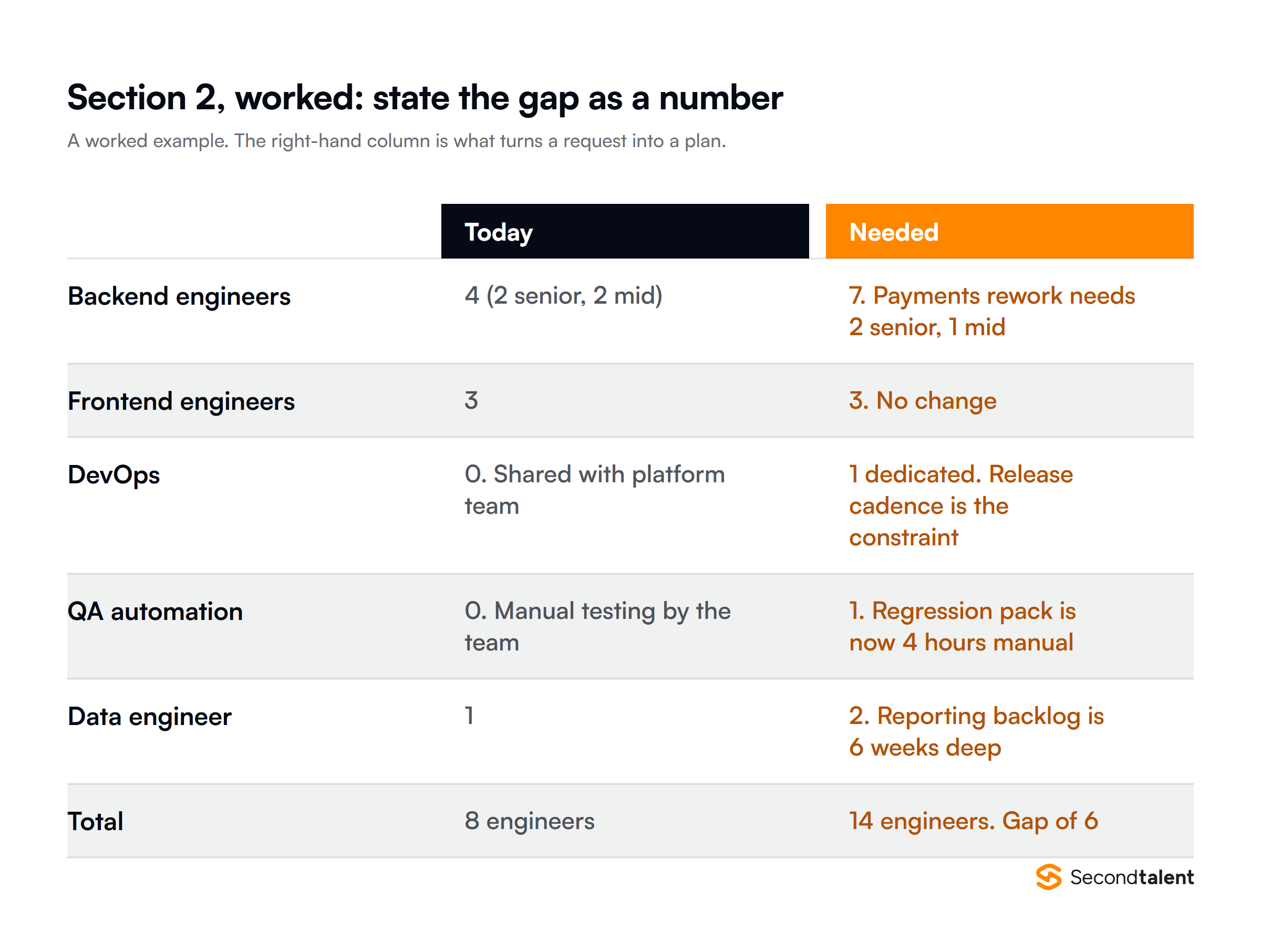
Write your current headcount by role next to your target headcount, and let the difference make the argument. A request for “more backend capacity” gets deferred. A line reading “4 backend engineers today, 7 needed, payments rework starts in March” gets a decision.
Two rules make this section work. Tie each target to a named piece of work, not to a feeling about workload. And count a role you cover on the side, such as a DevOps function borrowed from another team, as zero rather than as one.
The gap is the whole argument. Everything after section 2 is implementation detail. If an approver disputes the gap, no amount of budget precision later in the document will rescue the request, so spend your time here rather than on the cost tables.
Section 3: write role briefs that return the right people
For each role record seniority, headcount, engagement model, target rate and start date. Then add the part most briefs omit: what the person has to be able to do in the first month.
A brief reading “senior backend engineer, payments experience” returns generalists. A brief reading “must have owned reconciliation for a card issuer and can explain an idempotency key strategy” returns a short list you can interview in a week.
The engagement model belongs in this section too, because it changes who employs the person and what you are allowed to direct. Our guide to contract, contract-to-hire and direct hire covers the mechanics, and what IT staffing is covers how the three models differ on risk.
Section 4: build the budget from a rate and an assumption
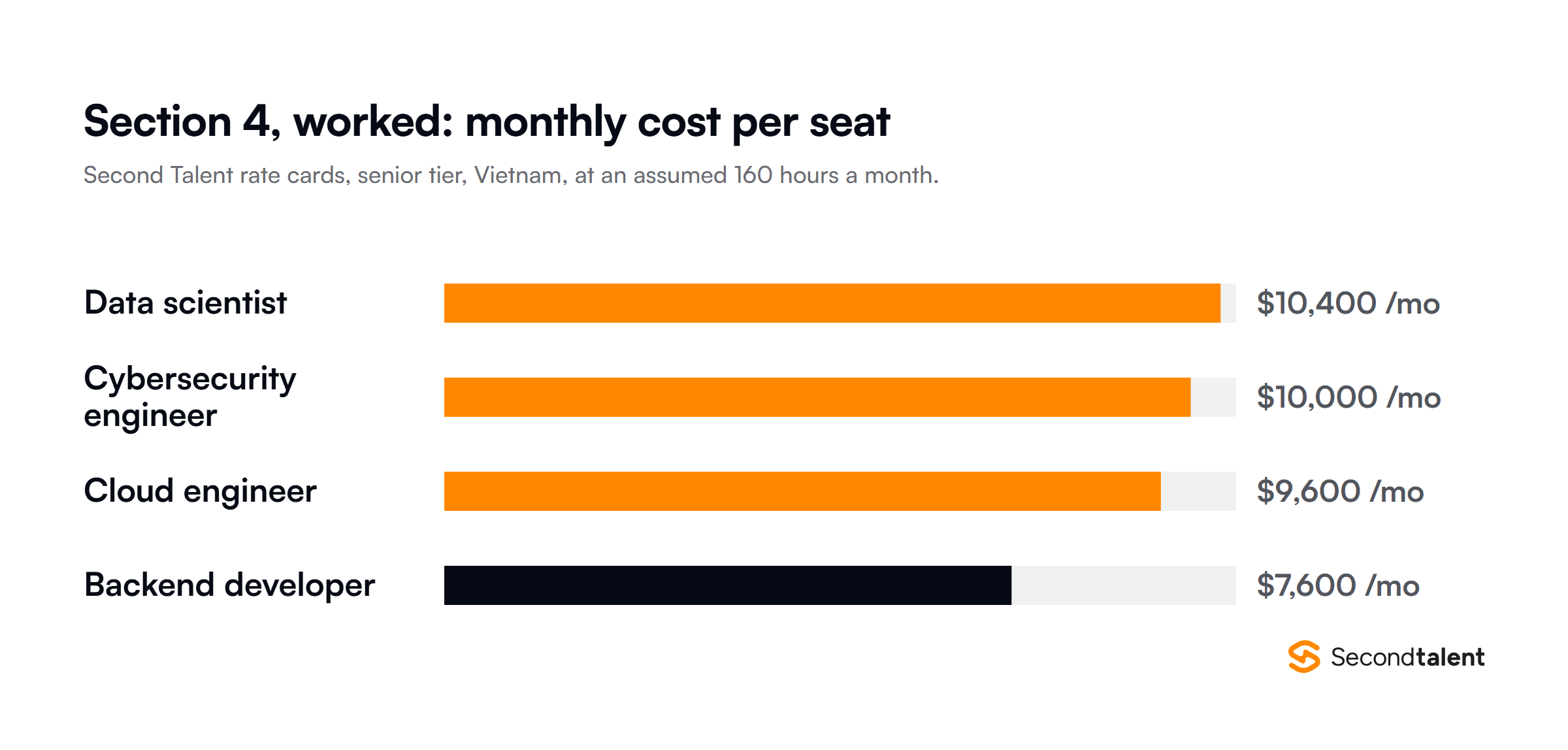
Price each seat from a published rate and a stated utilisation, then show your working so a reviewer can argue with the assumption instead of the total.
Using the Second Talent developer rate cards at a senior tier and 160 hours a month, a Vietnam-based backend developer costs about $7,600 a month, a cloud engineer $9,600, a cybersecurity engineer $10,000 and a data scientist $10,400.
Compare those against the local alternative rather than against each other. The US Bureau of Labor Statistics puts the median wage for software developers at $135,980 in May 2025, before employer taxes and benefits. Security analysts sit at $129,180 and data scientists at $120,230.
Four lines belong in the budget beyond the rates themselves:
- Employer costs and provider margin, if your rate is not already blended. Ask the provider which it is.
- Tooling and licences per seat. Small per head, awkward when unbudgeted across ten.
- The ramp. You pay a full rate for partial output over the first few weeks. Price it.
- Contingency. Ten percent covers one replacement without reopening the approval.
Second Talent clients save $103,000 or more per hire against a comparable Western salary. Our guide to measuring IT staffing ROI covers how to hold that number up after the fact.
Section 5: match the sourcing channel to the role
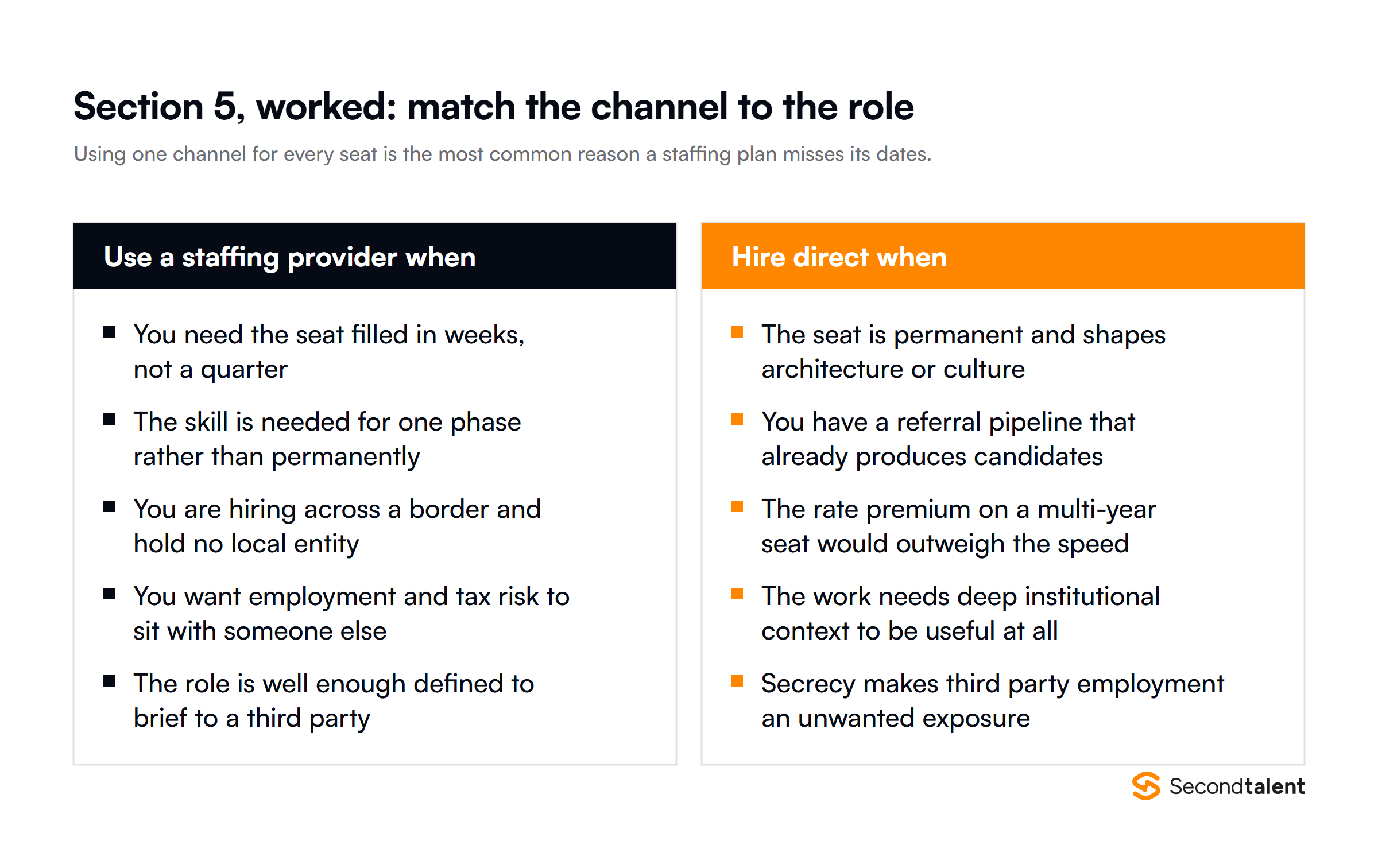
Different roles come from different channels, and running one channel across all of them is the most common reason a plan misses its dates.
Use a staffing provider when you need the seat filled in weeks, when the skill covers one phase rather than the next five years, or when you are hiring across a border with no local entity. Hire direct when the seat is permanent, shapes architecture, and would carry a rate premium compounding over years.
Record which channel each role uses and who owns it. An unowned channel produces no candidates.
Run the channels in parallel rather than in sequence. Teams that exhaust referrals first and only then brief a provider add four to six weeks to every role in the plan, and the delay compounds because the roles were meant to start together.
Section 6: write the vetting criteria before you see candidates
Set out the screening stages and what each one is allowed to reject. Writing this before candidates arrive keeps the bar honest, because a standard you invent while looking at someone’s CV bends to fit them.
Test judgment, not tool familiarity. The 2025 Stack Overflow Developer Survey found 84 percent of developers use or plan to use AI tools, so tool exposure no longer separates anyone. The same survey found 46 percent distrust the accuracy of what those tools produce, with the most experienced developers the most sceptical. Knowing when to reject the generated answer is the skill worth screening for.
Our walkthrough of how IT staffing vetting funnels work covers what a provider should already be doing before candidates reach you.
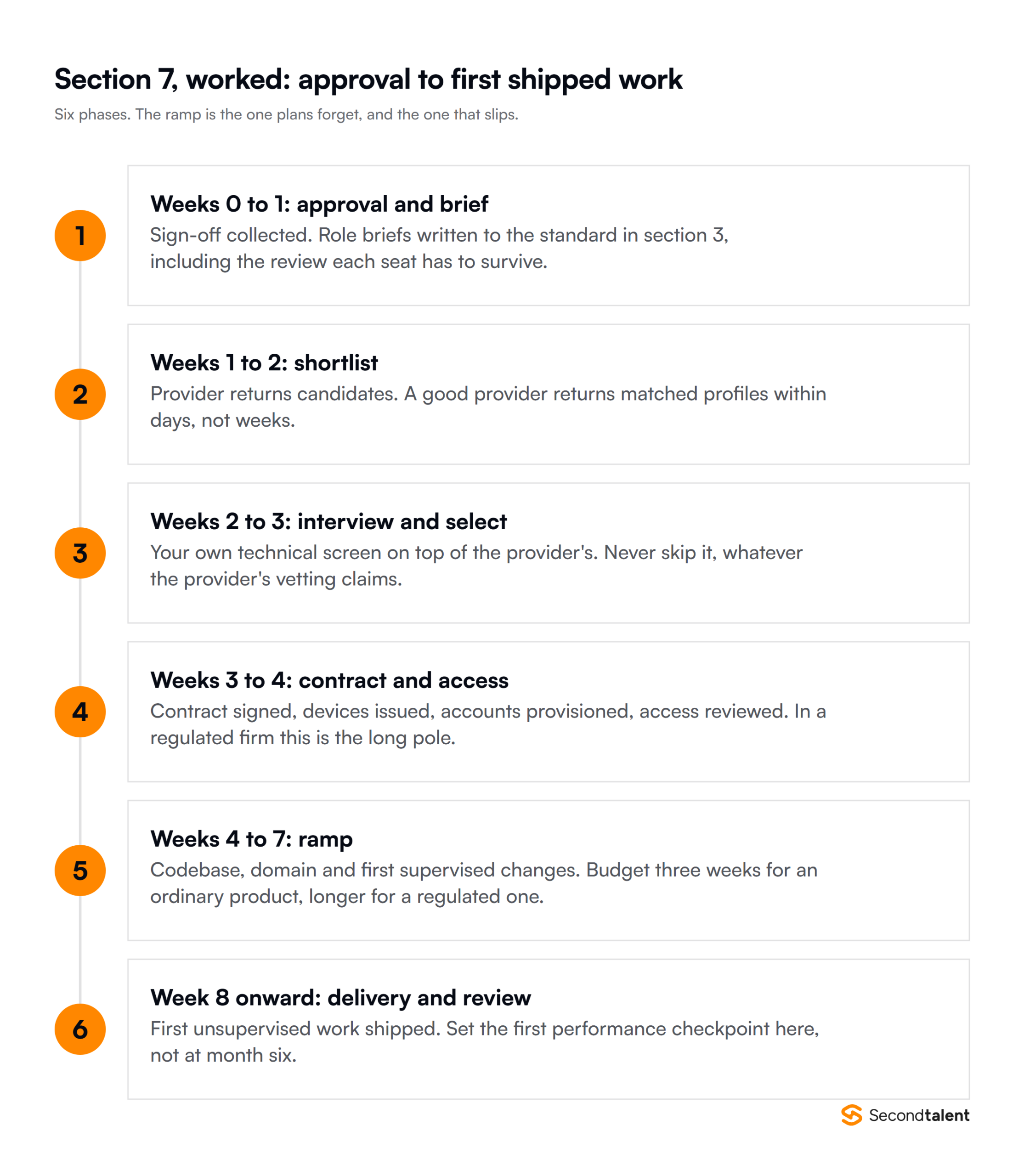
Section 7: build the timeline backwards from the delivery date
Start from when the work has to ship and count back through ramp, contracting, selection and shortlisting. Most plans slip because they count forward from approval and forget two steps.
The first forgotten step is access provisioning. Devices, accounts and permission reviews add days in an ordinary company and weeks in a regulated one, and they sit outside the recruiting process altogether.
The second is the ramp. Budget about three weeks before an engineer ships unsupervised work on an ordinary product, and longer where the domain carries regulatory weight.
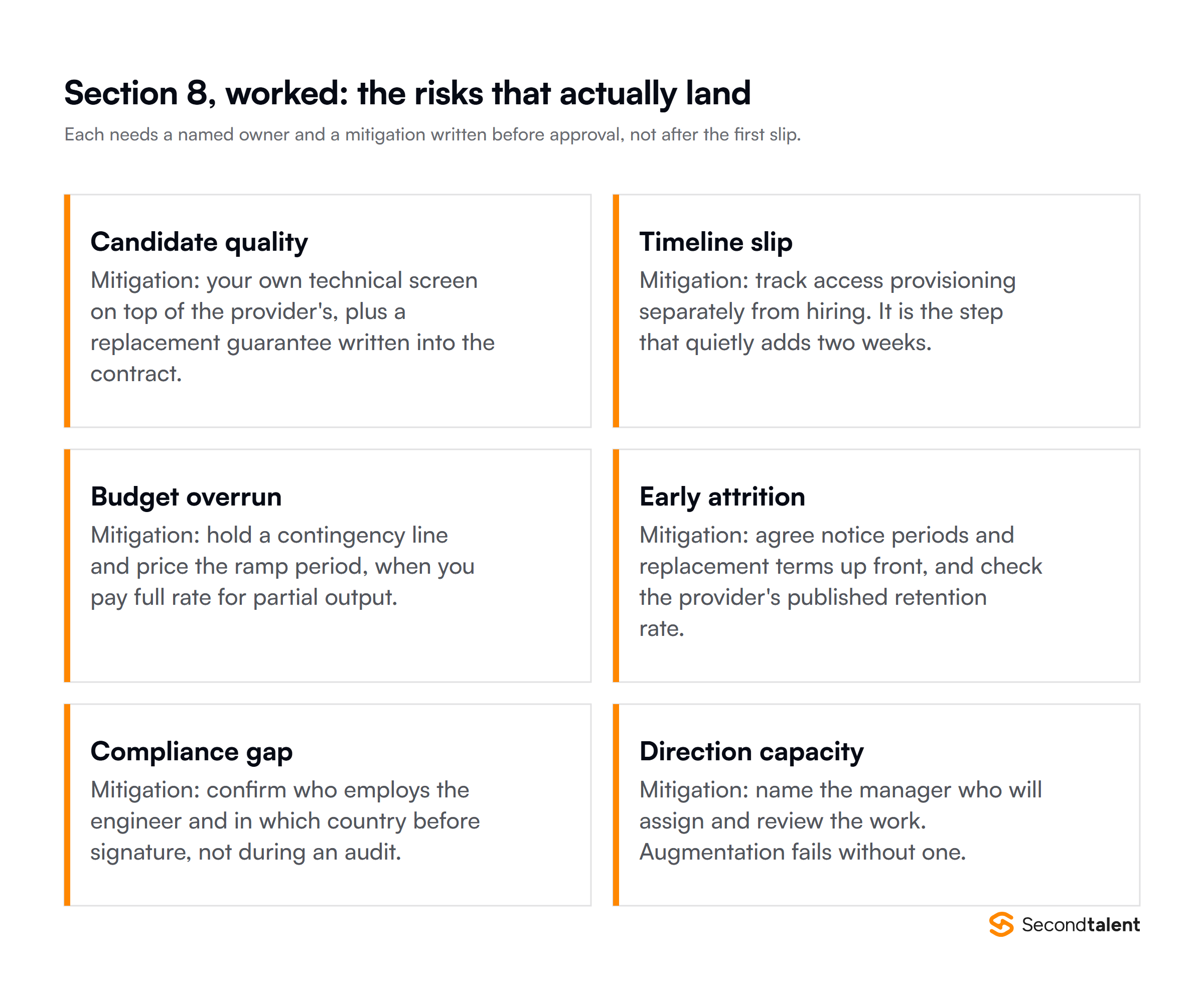
Section 8: give every risk an owner
A risk register without named owners is a list of worries. Give each entry a person and a mitigation you have already agreed, not one you would invent after the fact.
Six risks land often enough to be worth pre-writing: candidate quality, timeline slip, budget overrun, early attrition, a compliance gap, and no capacity on your side to direct the work. That last one kills more augmentation engagements than any of the others, because the model assumes a manager who assigns and reviews.
For cross-border roles add worker classification. The IRS common-law test turns on behavioural control, financial control and the type of relationship, and a contractor working your hours on your systems under your direction often fails it. Our guide to worker classification in cross-border IT staffing covers the detail.
Section 9: get signatures before spend
Name the approvers from engineering and finance, plus risk at a regulated firm. Collect signatures before the first contract. An unsigned plan is a proposal, and a proposal protects nobody when someone reopens the budget in month three.
IT staffing plan FAQs
How long should an IT staffing plan be?
Four to eight pages for most teams. The executive summary should stand alone on one page, because it is the only part most approvers read in full.
How often should it be updated?
Quarterly, or whenever the gap in section 2 changes. A plan that still shows last quarter’s headcount stops being a decision document and becomes a record.
Do I need a separate plan for contractors and employees?
No. Use one plan and record the engagement model per role in section 3. Splitting them hides the total cost of the team, which is the number finance cares about.
What if the budget gets cut after approval?
Go back to section 2 and cut roles, not seniority. Two senior engineers deliver more than three mid-level ones on the same budget, and the ramp cost is lower.
Takeaways
- Section 2 wins or loses the approval. State the gap as a number tied to a piece of work.
- Price each seat from a published rate and a stated utilisation, then show the arithmetic.
- Budget the ramp. You pay a full rate for partial output for about three weeks.
- Count the timeline backwards, and track access provisioning apart from hiring.
- Name a manager who will direct the work, or augmentation will not deliver.
Execute the plan once it is approved
Second Talent fills the roles in your plan with pre-vetted senior engineers from across Asia, matched within 24 hours, with EOR cover across Vietnam, the Philippines, Singapore, Indonesia, Malaysia, Thailand, Hong Kong and China. Retention runs at 92 percent, and there is nothing to pay upfront.
Start a hire, check pricing, or read how to evaluate IT staffing companies before you choose a provider.