TL;DR: Workflow automation engineers from Asia who work for foreign companies earn $1,200 to $8,050+ a month on our Python developer rate cards, and Second Talent shortlists 6-8 pre-vetted candidates within 24 hours. The closest US benchmark, the BLS median for software developers, was $135,980 a year in May 2025.
Apache Airflow 2 stopped receiving fixes of any kind on 22 April 2026, per the project's supported versions table. Airflow 3 blocks task code from opening the metadata database, so any DAG that queries Airflow's models inside a task needs a rewrite. Your automation hire should find those DAGs in week one.
Key takeaways
- Malaysia's Python developer card has the lowest ceiling in the table, $5,500 a month, and the Philippines the highest floor, $2,500.
- A Power Automate cloud flow whose trigger or actions fail continuously for 14 days is turned off.
- Stripe retries an undelivered webhook for up to three days and does not guarantee event order, so handlers must tolerate duplicates.
- Zapier holds polling-trigger batches of 100 or more events until someone confirms them.
What Workflow Automation Engineers Earn Working for International Clients in Asia
We publish no rate card for workflow automation engineers, so the table uses our Python developer rate cards, the closest match, because Airflow pipelines are written in Python and the harder automation work happens in that code. Each range is what developers in that market earn working directly for foreign companies, before any employer or platform costs.
| Market |
Monthly pay working for international clients (USD) |
| Indonesia |
$1,200-$6,500 |
| Vietnam |
$1,800-$7,500 |
| Malaysia |
$2,000-$5,500 |
| India |
$2,090-$8,050+ |
| Philippines |
$2,500-$6,000 |
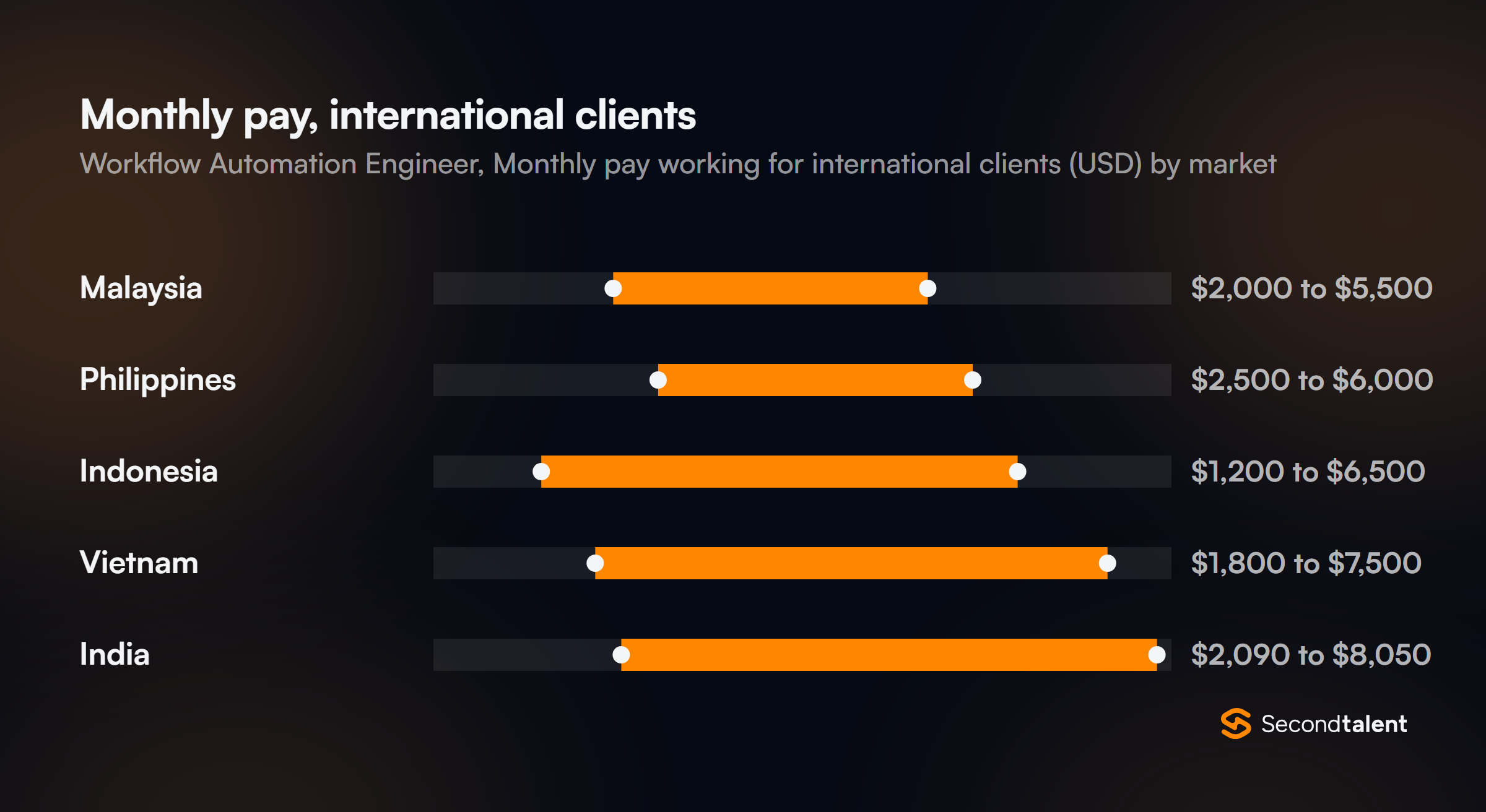
Monthly ranges from the Remote (Working for International Clients) figures on our rate cards for Indonesia, Vietnam, Malaysia, India and the Philippines, converted at ExchangeRate-API mid-market rates for 14 September 2026.
India's card is the only one of the five quoted in local currency, ₹200,000 to ₹770,000+ a month, and the only range left open at the top. The other four publish US dollar figures, so conversion leaves them unchanged.
Second Talent bills a workflow automation engineer as one monthly fee that bundles salary, payroll taxes, statutory contributions and our service fee. The pricing page sets out how the subscription works.
US Pay Benchmark for Workflow Automation Engineers
BLS has no automation engineer title. The role maps to Software Developers (15-1252), because the job is writing and running production code that moves data and triggers actions between systems, even when part of it lives in a visual flow designer.
| BLS OEWS, May 2025, national |
Software Developers (15-1252) |
| Median annual |
$135,980 |
| 10th percentile, monthly |
$6,870 |
| 25th percentile, monthly |
$8,770 |
| Median, monthly |
$11,330 |
| 75th percentile, monthly |
$14,330 |
| 90th percentile, monthly |
$17,890 |
Monthly figures are the annual wages on the OEWS profile for 15-1252 divided by 12, rounded to the nearest $10. The occupation is broad, and an engineer who only assembles Zapier steps sits closer to the lower percentiles than one who runs an Airflow platform.
Salary is only part of the US cost. In the BLS Employer Costs for Employee Compensation release for June 2026, wages and salaries made up 68.5% of employer compensation costs for full-time private industry workers, and benefits the other 31.5%.
Time Zone Overlap with ET, CT and PT
Scheduled pipelines shift when US clocks change. Airflow's time zone documentation gives the example of a DAG in US/Eastern with the cron schedule 0 0 * * *: it runs at 04:00 UTC during daylight saving time and 05:00 UTC otherwise. For an engineer in Manila, that midnight job moves from 12:00 noon to 1:00 pm on 1 November. A DAG on a timedelta schedule does not adjust after its start date. US daylight time runs from 8 March to 1 November 2026, per NIST.
| Engineer's city |
UTC offset |
9:00 am ET (EDT) |
9:00 am CT (CDT) |
9:00 am PT (PDT) |
| Manila, Singapore, Kuala Lumpur, Taipei |
UTC+8 |
9:00 pm |
10:00 pm |
12:00 midnight |
| Ho Chi Minh City, Jakarta, Bangkok |
UTC+7 |
8:00 pm |
9:00 pm |
11:00 pm |
| Bengaluru |
UTC+5:30 |
6:30 pm |
7:30 pm |
9:30 pm |
After 1 November 2026, every time in the table moves one hour later.
A worked example: a Bengaluru shift from 1:30 pm to 10:30 pm runs 08:00 to 17:00 UTC. That is 4:00 am to 1:00 pm EDT, four hours inside a New York workday, three with Chicago and one with San Francisco.
Automation work splits well along that line. Overnight batch runs, retries and backfills finish before your US team starts, and the engineer reads the failure log in the Asian afternoon.
The shared hours go to new requirements from finance or operations and to approving changes in production flows. We agree that schedule before the offer, which is how our placements get 4-6 hours of daily overlap with US hours.
Late hours cost more for employees in two markets: at least 10% extra between 10 pm and 6 am in the Philippines (Labor Code Article 86), and at least 30% between 22:00 and 06:00 in Vietnam (Labor Code Articles 98 and 106).
Workflow Automation Engineer Skills to Screen For
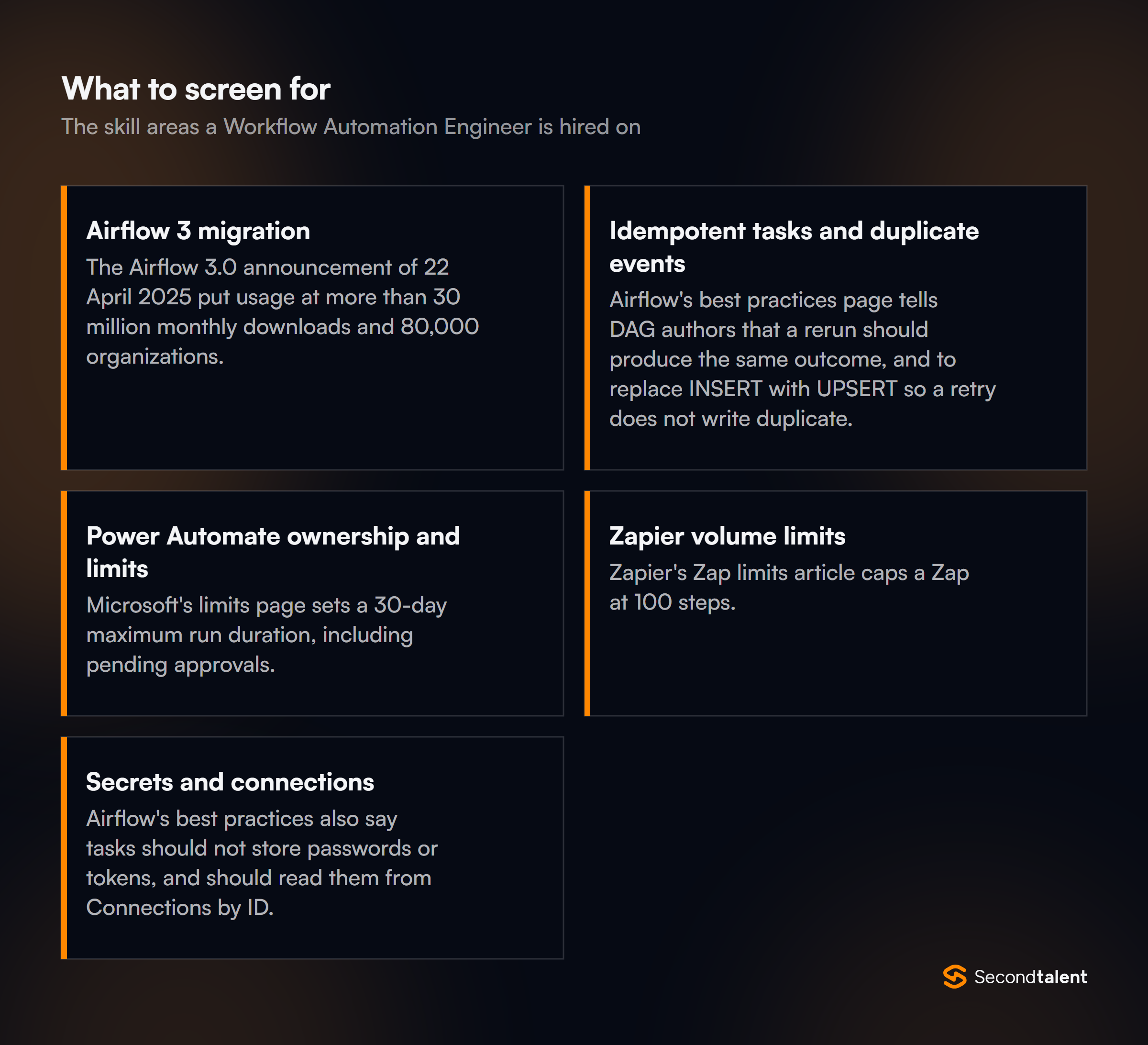
Zapier, Power Automate and Airflow fail in different ways: Zapier throttles volume, Power Automate turns flows off, and Airflow reruns tasks. Screen for each failure mode, then for the credentials that hold the whole system together.
Airflow 3 migration
The Airflow 3.0 announcement of 22 April 2025 put usage at more than 30 million monthly downloads and 80,000 organizations. It added DAG versioning, so a run completes on the version it started with, and moved backfills into the scheduler.
The upgrade guide states that task code "can no longer directly import and use Airflow database sessions or models". Hand the candidate a DAG that reads the metadata database inside a task and ask for the Task SDK version.
Idempotent tasks and duplicate events
Airflow's best practices page tells DAG authors that a rerun should produce the same outcome, and to replace INSERT with UPSERT so a retry does not write duplicate rows.
Webhooks add the same problem from outside. Stripe's webhook documentation says an endpoint "might occasionally receive the same event more than once" and advises logging processed event IDs. Give the candidate an order webhook handler and replay the same event twice, out of order.
Power Automate ownership and limits
Microsoft's limits page sets a 30-day maximum run duration, including pending approvals. A flow that isn't triggered for 90 days might be turned off unless its owner holds a premium or Process license.
Ownership is the harder test. For flows outside a solution, the change-owner documentation says an in-place owner change "isn't available because the owner is part of the flow identity". Ask the candidate how they would move 30 personal flows to a service principal before a colleague leaves.
Zapier volume limits
Zapier's Zap limits article caps a Zap at 100 steps. It errors instant-trigger workflows that exceed 20,000 requests every 5 minutes per user. Held runs replay at about one per second, so 1,000 of them take a little over 15 minutes. Ask what the candidate does when a CRM import pushes 5,000 records into a Zap built for 20 a day.
Secrets and connections
Airflow's best practices also say tasks should not store passwords or tokens, and should read them from Connections by ID. Stripe recommends rolling webhook signing secrets periodically, with the old secret kept active for up to 24 hours. Review one of the candidate's flows or DAGs and count the credentials pasted into steps.
Contractor or Employer of Record for a US Company
Software is not one of the nine categories of commissioned work that can be "work made for hire" under 17 U.S.C. § 101, and a copyright transfer must be in writing and signed under § 204(a). Name DAGs, flow definitions, custom connectors and scripts in the assignment.
Ownership in the platform matters as much as ownership in law. A contractor who builds Power Automate flows in their own account holds flows whose owner Microsoft does not let you change in place, so require builds inside your tenant, in solutions, from day one.
IRS Publication 515 says the place where services are performed determines the source of the income, so an engineer working from Bengaluru or Kuala Lumpur earns foreign-source income. A foreign individual gives the payer Form W-8BEN to certify foreign status.
Local law applies its own employment test. Philippine courts use the four-fold test, and in Atok Big Wedge v. Gison the Supreme Court called the power of control the most important of the four. Article 13 of Vietnam's 2019 Labor Code treats an agreement under another name as a labor contract when it covers a paid job, wages and one party's management and supervision.
|
Independent contractor |
Employer of Record |
| Legal employer |
None; the engineer invoices you |
The EOR's local entity |
| US paperwork |
Form W-8BEN from the engineer |
Service agreement with the EOR |
| IP |
Written assignment naming DAGs, flows, connectors and scripts |
Assignment in the employment contract and your EOR agreement |
| Local labor law |
Classification risk if you set hours and supervise the work |
Night premiums, public holidays and leave apply |
| Pay currency |
Agreed in the contract |
Local currency; Vietnam's Labor Code states wages in dong (Article 95) |
A one-off migration from Zapier to Airflow suits a contractor agreement. An engineer who holds admin rights to your finance and CRM connectors and answers failed-run alerts each morning fits the employment tests above. That is the case our Employer of Record service covers, and our EOR, PEO and contractor comparison sets out the trade-offs. This is a summary, not legal advice.
English Level and Working Norms
Automation engineers turn a process described by a finance or operations lead into steps, conditions and exceptions, so they need to read requirements closely. Malaysia and the Philippines rank 24th and 28th of 123 countries and regions on the EF English Proficiency Index 2025, against a global average of 488.
| Country |
EF EPI 2025 score |
World rank (of 123) |
IT job-function score |
| Malaysia |
581 |
24 |
590 |
| Philippines |
569 |
28 |
581 |
| Vietnam |
500 |
64 |
500 |
| India |
484 |
74 |
487 |
| Indonesia |
471 |
80 |
523 |
Scores come from EF's country pages, such as India and Indonesia. Indonesia's IT workers score 52 points above the national figure.
Test the skill with a short exercise: send a one-paragraph process description with two gaps in it, and score whether the candidate's questions find both.
Month-end and holiday runs need an owner. Thanksgiving on 26 November 2026 is a working day in Asia, so an engineer there can watch the batch jobs and approvals queue while your US team is off.
Article 112 of Vietnam's Labor Code gives five paid days for Lunar New Year, in late January or February. Name a backup for failed-run alerts that week.
Workflow Automation Engineer Hiring Process
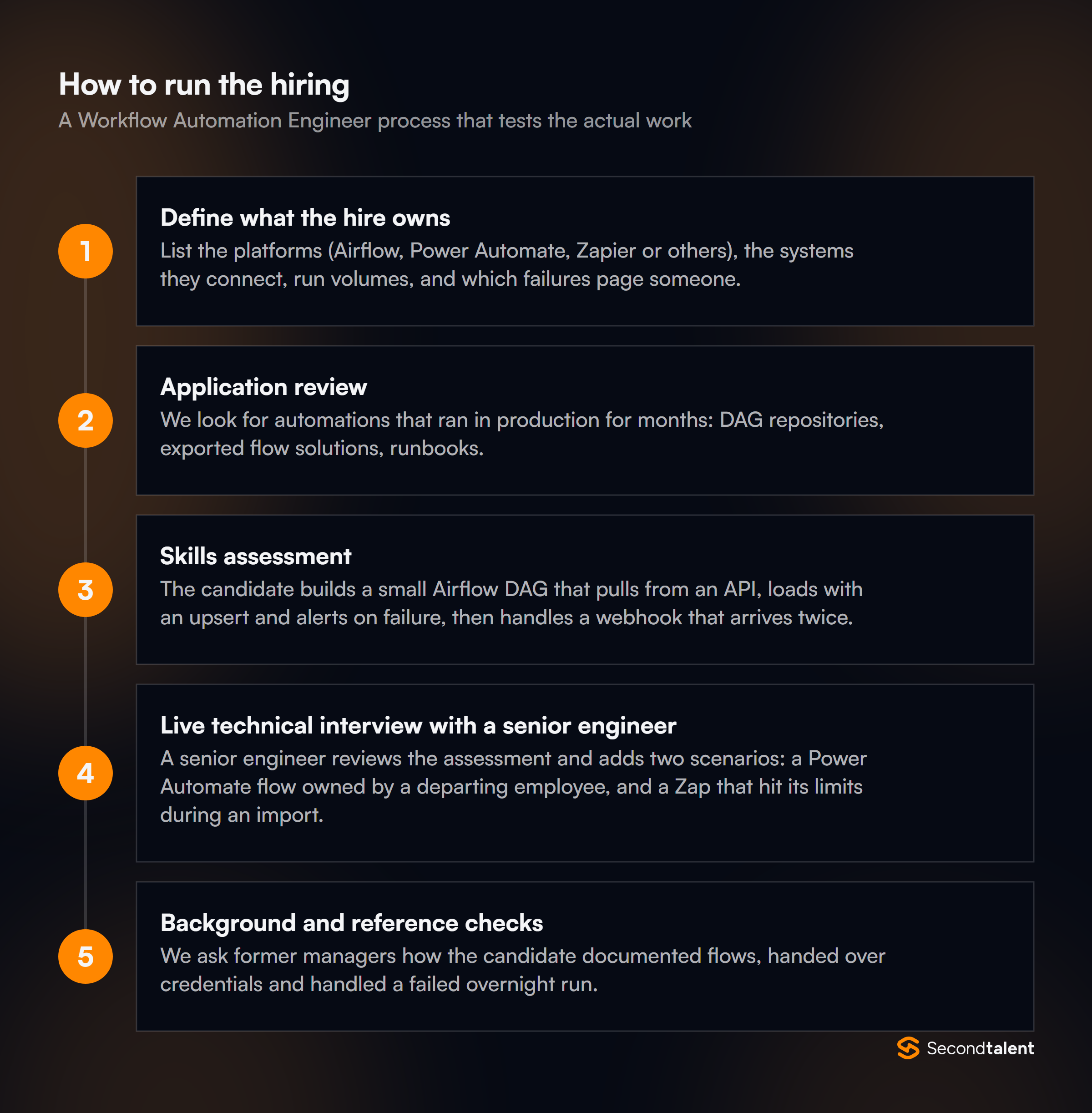
Second Talent's vetting covers stages 2 to 5 before you see a profile. For AI-heavy flows, our AI automation engineer page covers the adjacent role.
Stage 1: Define what the hire owns
List the platforms (Airflow, Power Automate, Zapier or others), the systems they connect, run volumes, and which failures page someone. Say whether the engineer builds new flows, maintains existing ones or migrates between tools.
Stage 2: Application review
We look for automations that ran in production for months: DAG repositories, exported flow solutions, runbooks. We ask for volumes in plain numbers, such as runs a day or records a week, and what the last failure was.
Stage 3: Skills assessment
The candidate builds a small Airflow DAG that pulls from an API, loads with an upsert and alerts on failure, then handles a webhook that arrives twice. We score retry behavior, credential handling and the runbook note as well as the code.
Stage 4: Live technical interview with a senior engineer
A senior engineer reviews the assessment and adds two scenarios: a Power Automate flow owned by a departing employee, and a Zap that hit its limits during an import. The questions test which tool the candidate would move each workload to, and why.
Stage 5: Background and reference checks
We ask former managers how the candidate documented flows, handed over credentials and handled a failed overnight run. You then choose the contractor or EOR route above and grant connector access last.
Hire Workflow Automation Engineers from Asia with Second Talent
We shortlist 6-8 candidates within 24 hours from 100,000+ pre-vetted engineers, accepting only the top 1% of applicants. Workflow automation engineers come with $0 upfront, no lock-in and 4-6 hours of daily overlap with US hours. We handle contracts, payroll and equipment, with compliant EOR contracts and payroll in 9 Asian markets.
Our pricing page covers subscription, direct-hire and EOR pricing, and for n8n-based stacks we also staff n8n developers.