TL;DR: Senior cloud engineers from Asia cost $3,200-$7,500 a month through Second Talent, matched in 24 hours. The closest US benchmark, the BLS median for computer network architects, was $134,050 a year in May 2025.
Kubernetes SIG Network and the Security Response Committee retired Ingress NGINX in March 2026, and their retirement notice rules out further releases, bug fixes and security patches. They told users to move to Gateway API or another Ingress controller. A cloud engineer you hire this year should be able to find each cluster that still runs it and plan the migration in the first month.
Key takeaways
- On our cloud engineer rate cards, pay for work with international clients starts at $1,750 a month in the Philippines and $3,930 in Malaysia.
- A 9:00 am to 6:00 pm day in Ho Chi Minh City runs from 10:00 pm to 7:00 am in New York while US daylight time lasts, which covers US overnight on-call without a night shift.
- In Stack Overflow's 2025 survey, 45.9% of professional developers used AWS, 27.2% Microsoft Azure and 24.3% Google Cloud.
- In the FinOps Foundation's State of FinOps 2026, 98% of respondents manage AI spend, up from 31% two years earlier.
What Cloud Engineers Earn Working for International Clients in Asia
The Indian range tops out at $8,470+, the highest ceiling in the table, while the Philippine range starts lowest. The figure is what cloud engineers in that market earn working for foreign companies as their direct clients, before any employer or platform costs.
| Market |
Monthly pay working for international clients (USD) |
| Philippines |
$1,750-$4,630+ |
| Indonesia |
$1,800-$6,500 |
| Vietnam |
$2,000-$6,500 |
| India |
$2,200-$8,470+ |
| Malaysia |
$3,930-$7,860+ |
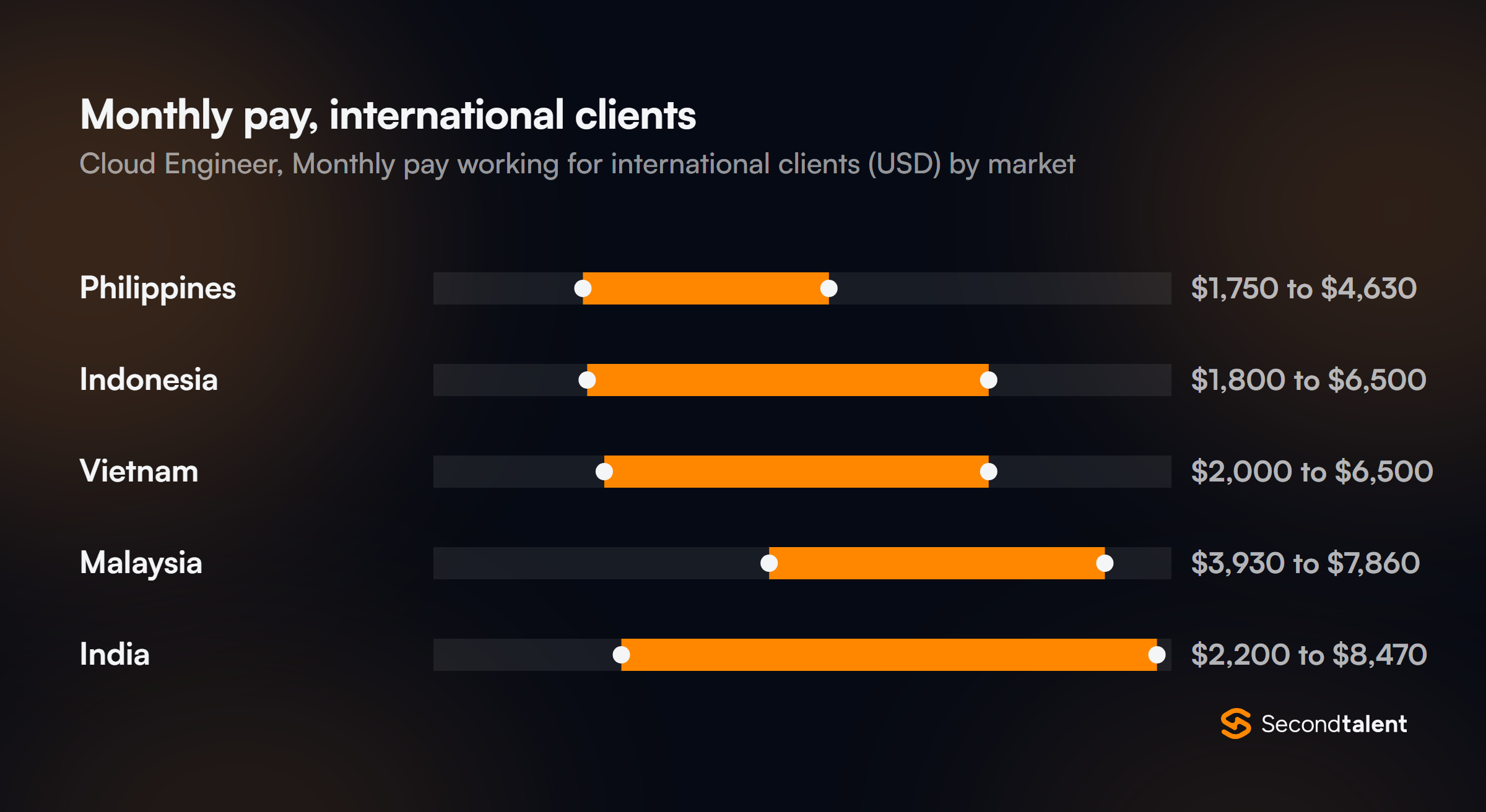
Monthly ranges from the Remote (Working for International Clients) figures on our rate cards for the Philippines, Indonesia, Vietnam, India and Malaysia, converted at ExchangeRate-API mid-market rates for 14 September 2026.
The Indonesia and Vietnam cards publish this figure in US dollars, so those two rows need no conversion, and their ranges have a fixed top. The Philippine, Indian and Malaysian cards quote local currency with an open top.
Through Second Talent, senior cloud engineers cost $3,200-$7,500 a month: one monthly fee that bundles salary, payroll taxes, statutory contributions and our service fee. Our pricing page shows how the subscription works. For narrower briefs we also staff AWS engineers and Kubernetes engineers.
US Pay Benchmark for Cloud Engineers
BLS has no cloud engineer occupation. The role maps to Computer Network Architects (15-1241), because the BLS Occupational Outlook Handbook ties demand for that occupation to the continued expansion of cloud computing. Engineers whose job is running and patching existing systems sit closer to Network and Computer Systems Administrators (15-1244).
| BLS OEWS, May 2025, national |
Computer Network Architects (15-1241) |
Network and Computer Systems Administrators (15-1244) |
| Employment |
179,740 |
314,340 |
| 10th percentile, monthly |
$6,660 |
$5,220 |
| 25th percentile, monthly |
$8,720 |
$6,500 |
| Median, monthly |
$11,170 |
$8,260 |
| 75th percentile, monthly |
$14,020 |
$10,550 |
| 90th percentile, monthly |
$16,890 |
$12,920 |
Monthly figures are the annual wages on the BLS OEWS profiles for 15-1241 and 15-1244 divided by 12 and rounded to the nearest $10. The annual medians are $134,050 and $99,130.
Use the architects column for a hire who designs VPCs, landing zones and Kubernetes platforms. BLS projects employment of computer network architects to grow 8% from 2025 to 2035.
Salary is only part of the US cost. In the BLS Employer Costs for Employee Compensation release for June 2026, wages and salaries made up 68.5% of employer compensation costs for full-time private industry workers, and benefits the other 31.5%.
Time Zone Overlap with ET, CT and PT
A cloud team in Asia can use the time difference for incident coverage as well as for meetings. US clocks stay on daylight time until 1 November 2026, per NIST, and no city below changes its clocks.
| Engineer's city |
UTC offset |
9:00 am ET (EDT) |
9:00 am CT (CDT) |
9:00 am PT (PDT) |
| Manila, Singapore, Kuala Lumpur, Taipei |
UTC+8 |
9:00 pm |
10:00 pm |
12:00 midnight |
| Ho Chi Minh City, Jakarta, Bangkok |
UTC+7 |
8:00 pm |
9:00 pm |
11:00 pm |
| Bengaluru |
UTC+5:30 |
6:30 pm |
7:30 pm |
9:30 pm |
After 1 November 2026, every time in the table moves one hour later.
Two schedules cover the two jobs a cloud engineer does for a US team:
- Overnight on-call, Ho Chi Minh City or Jakarta, 9:00 am to 6:00 pm (02:00 to 11:00 UTC). That is 10:00 pm to 7:00 am in New York and 7:00 pm to 4:00 am in San Francisco, so the engineer answers US night pages during a local day shift.
- Overlap for change windows, Manila, 4:00 pm to 1:00 am (08:00 to 17:00 UTC). That covers 4:00 am to 1:00 pm Eastern: four hours of a 9-to-5 day in New York, three with Chicago and one with San Francisco.
Arithmetic for the first line: 9:00 am in Ho Chi Minh City is 02:00 UTC, and 02:00 UTC minus four hours is 10:00 pm EDT the previous evening. One engineer on each schedule gives you 02:00 to 17:00 UTC between them, 15 hours of the day.
Night hours cost extra for employees. The Philippine Labor Code sets a night shift differential of at least 10% for work between 10 pm and 6 am (Article 86), three hours of the Manila shift. Vietnam's Labor Code adds at least 30% for work between 22:00 and 06:00 (Articles 98 and 106), and the Ho Chi Minh City day shift has none.
Cloud Engineer Skills to Screen For
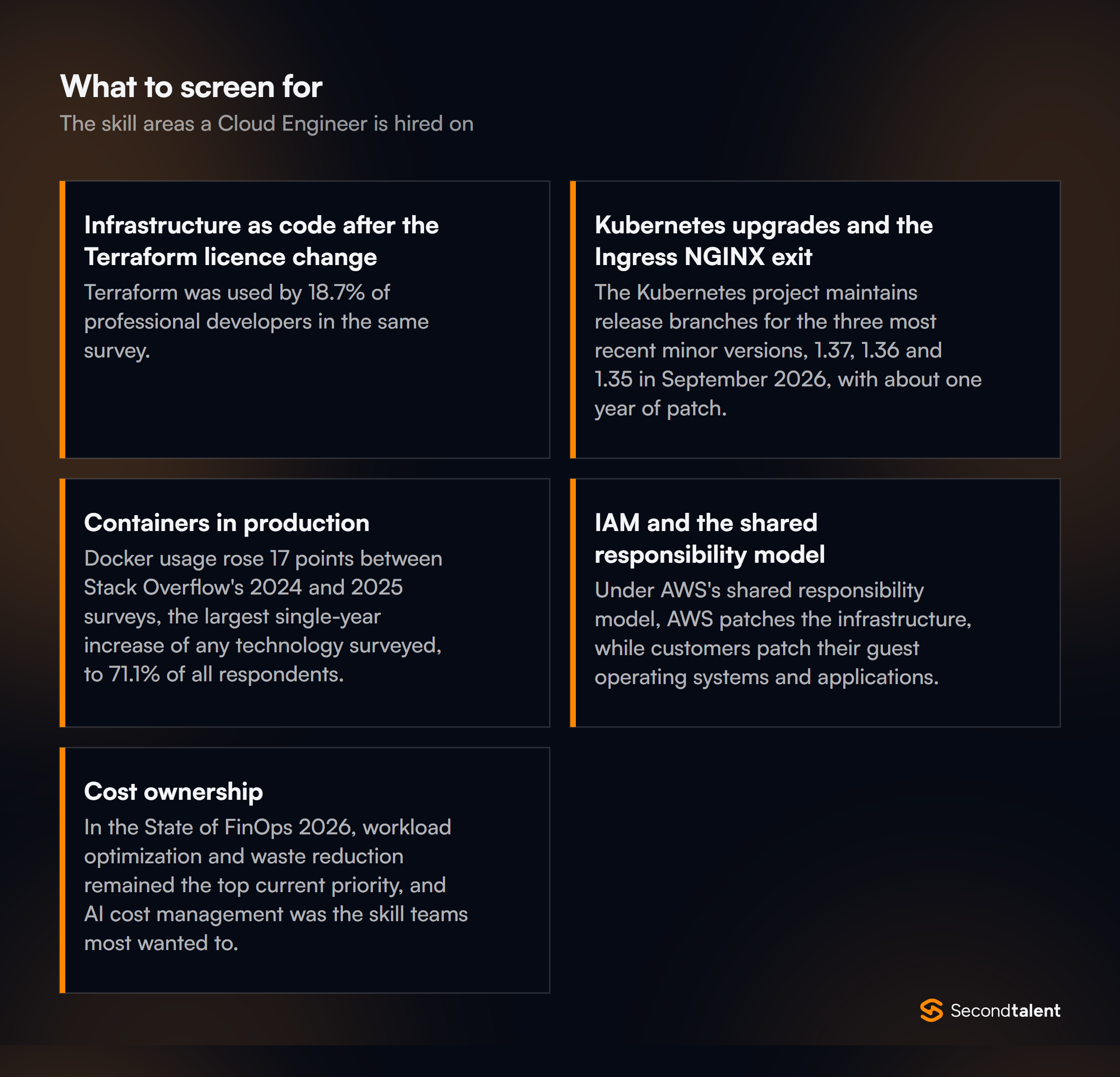
AWS leads Stack Overflow's 2025 cloud platform ranking among professional developers, at 45.9%, with Azure and Google Cloud each used by about a quarter. Hire for the cloud you run, then test the five areas below.
Infrastructure as code after the Terraform license change
Terraform was used by 18.7% of professional developers in the same survey. HashiCorp moved it from the Mozilla Public License to the Business Source License on 10 August 2023, a change the OpenTofu manifesto sets out, and OpenTofu shipped its first stable release as a Linux Foundation project on 10 January 2024. IBM completed its acquisition of HashiCorp on 27 February 2025. Ask which tool the candidate chose on their last project, how they stored and locked state, and how they caught drift.
Kubernetes upgrades and the Ingress NGINX exit
The Kubernetes project maintains release branches for the three most recent minor versions, 1.37, 1.36 and 1.35 in September 2026, with about one year of patch support each, per its releases page. A cluster that skips upgrades falls out of patch support in about a year. Ask the candidate for their last minor-version upgrade, what broke, and how they would move an Ingress NGINX setup to Gateway API.
Containers in production
Docker usage rose 17 points between Stack Overflow's 2024 and 2025 surveys, the largest single-year increase of any technology surveyed, to 71.1% of all respondents. The CNCF Annual Cloud Native Survey, published in January 2026, found 82% of container users running Kubernetes in production. Give the candidate an image that runs as root with a secret baked in and ask for the fixes.
IAM and the shared responsibility model
Under AWS's shared responsibility model, AWS patches the infrastructure, while customers patch their guest operating systems and applications. The same page puts customers in charge of using IAM tools to apply the appropriate permissions. Plant a wildcard permission in a policy review and score whether the candidate narrows it to the resources the service uses.
Cost ownership
In the State of FinOps 2026, workload optimization and waste reduction remained the top current priority, and AI cost management was the skill teams most wanted to add. Ask for one change the candidate made to a cloud bill, the before-and-after monthly figure, and how they kept the saving from drifting back. Our profile of the cloud FinOps engineer covers the specialist version of this role.
Cloud developers building on managed services
Many searches ask for cloud developers or cloud application developers rather than cloud engineers, and the difference changes the screen. A cloud developer writes the application code that runs on managed services such as AWS Lambda, Google Cloud Run or Azure Functions, along with queues and managed databases. A cloud engineer builds the accounts, networks and clusters underneath. Most candidates lean one way, so say which job you are hiring for.
For a developer brief, give the candidate a function that processes uploaded files and ask how it behaves when the same event arrives twice, which most queue and event services allow, and how they would make the handler idempotent. Then ask how they set timeouts and retries between the function and a downstream API, where a dead-letter queue catches failures, and what a cold start adds to the request path. Finish with the bill: which line items grow with traffic, and which setting they would change first if invocations tripled. A cloud developer who has run this in production answers with figures from their own dashboards.
Google Cloud (GCP) engineers
Google Cloud is the third platform in the Stack Overflow ranking above, and GCP shops screen differently from AWS ones. Start with identity. Google's guidance is to avoid downloadable service account keys where possible, using Workload Identity Federation for workloads outside Google Cloud and Workload Identity Federation for GKE for pods. Ask the candidate how a CI pipeline in GitHub Actions deploys to your project without a stored key.
Then test the managed services your team runs. For GKE, ask whether they would pick Autopilot or Standard mode for your workload and what each choice gives up. For BigQuery, ask how on-demand pricing, billed by bytes scanned, compares with capacity pricing through editions, and which partitioning and clustering choices cut the bytes a dashboard query reads. A candidate who has owned a GCP bill can name the query or table that cost the most last month. Our Google Cloud interview questions add a longer question set.
Contractor or Employer of Record for a US Company
Software is not one of the nine categories of commissioned work that can be "work made for hire" under 17 U.S.C. § 101. Terraform modules, Helm charts and pipeline code a contractor writes for you stay theirs until transferred, and § 204(a) requires that transfer in writing, signed.
IRS Publication 515 says the place where someone performs the services determines the source of the income, wherever the parties signed the contract. A foreign individual gives the payer Form W-8BEN to certify foreign status.
Local law applies its own test. Philippine courts use the four-fold test, and in Atok Big Wedge v. Gison the Supreme Court called control over the worker's conduct the most important of the four. Article 13 of Vietnam's 2019 Labor Code treats an agreement under another name as a labor contract when it covers a paid job, wages and management or supervision.
|
Independent contractor |
Employer of Record |
| Legal employer |
None; the engineer invoices you |
The EOR's local entity |
| US paperwork |
Form W-8BEN from the engineer |
Service agreement with the EOR |
| IP |
Written assignment signed by the engineer |
Assignment terms in the employment contract and EOR agreement |
| Local labor law |
Classification risk if the work looks like employment |
Night premiums, public holidays and leave apply |
| Pay currency |
Agreed in the contract |
In Vietnam, wages in the labor contract are stated in dong (Article 95) |
A one-off migration with a fixed end date suits a contractor agreement. An engineer on your on-call rotation, holding standing access to production accounts, meets both tests above, and our Employer of Record service employs that engineer in-country for you. This is a summary, not legal advice.
English Level and Working Norms
Incident work runs on written English: the page, the status update, the postmortem your US team reads when it wakes up. Malaysia and the Philippines rank 24th and 28th of 123 countries and regions on the EF English Proficiency Index 2025, against a global average of 488.
| Country |
EF EPI 2025 score |
World rank (of 123) |
IT job-function score |
| Malaysia |
581 |
24 |
590 |
| Philippines |
569 |
28 |
581 |
| Vietnam |
500 |
64 |
500 |
| India |
484 |
74 |
487 |
| Indonesia |
471 |
80 |
523 |
Scores come from EF's country pages, such as the Philippines and India.
Ask finalists to write a short postmortem from a timeline you provide. It tests the handoff an overnight engineer produces for a US team each morning.
Holidays shape on-call rosters. Thanksgiving on 26 November 2026 is a working day in Asia, so an engineer there can hold the pager while your US team is off. Vietnam's Labor Code gives five paid days for Lunar New Year (Article 112), so book cover for that week before the dates arrive.
Cloud Engineer Hiring Process
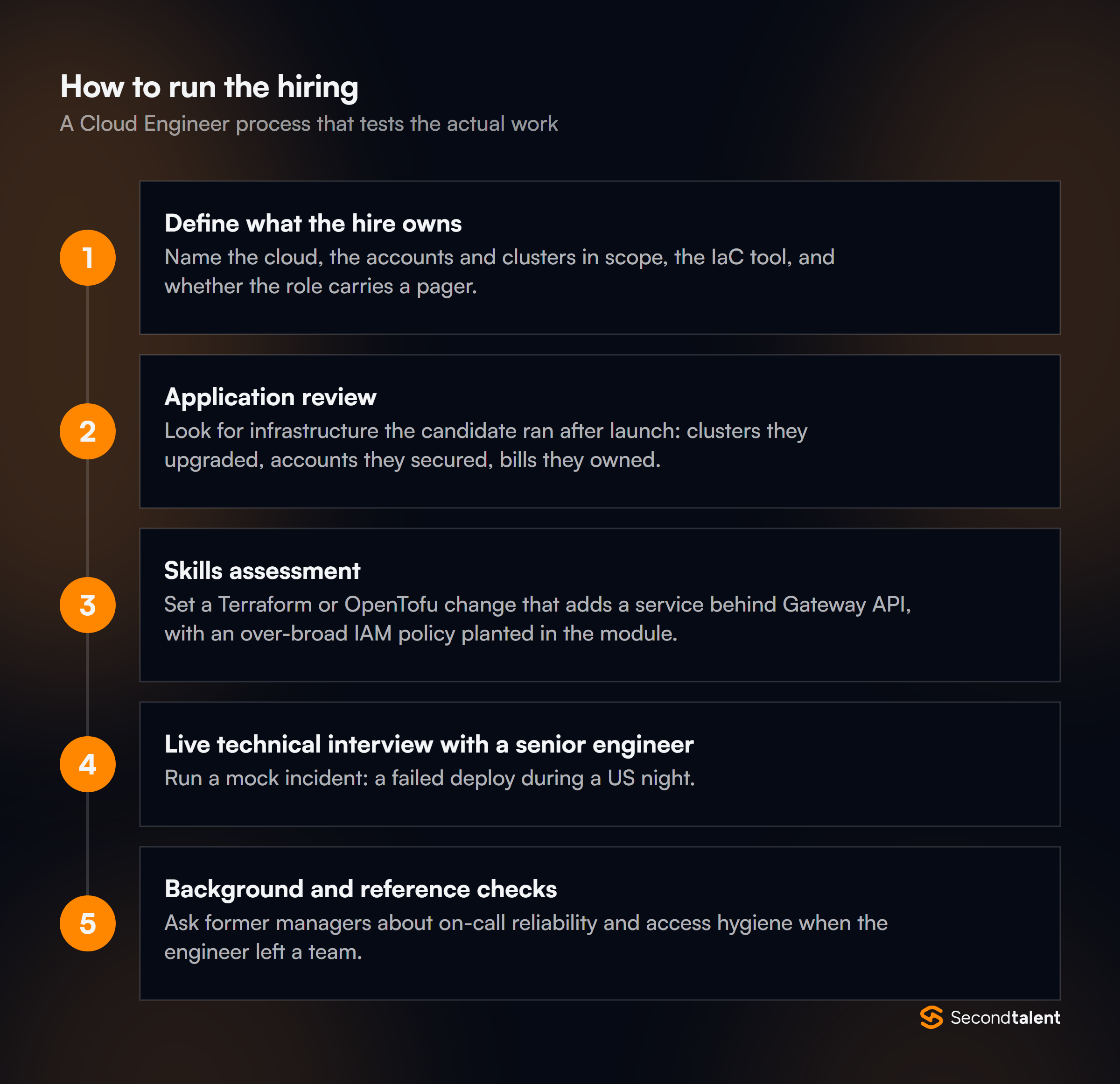
Second Talent's vetting covers stages 2 to 5 before you see a profile. The checks below are the cloud versions to run in your own final round, and our Azure interview guide has question sets for Microsoft shops.
Stage 1: Define what the hire owns
Name the cloud, the accounts and clusters in scope, the IaC tool, and whether the role carries a pager. A platform build and an on-call operations seat need different tests and map to different BLS columns.
Stage 2: Application review
Look for infrastructure the candidate ran after launch: clusters they upgraded, accounts they secured, bills they owned. Ask for the scale in plain numbers, such as node counts or monthly spend.
Stage 3: Skills assessment
Set a Terraform or OpenTofu change that adds a service behind Gateway API, with an over-broad IAM policy planted in the module. Score the plan output review and the pull request description along with the code.
Stage 4: Live technical interview with a senior engineer
Run a mock incident: a failed deploy during a US night. Watch how the candidate reads logs, decides between rollback and fix-forward, and writes the status update.
Stage 5: Background and reference checks
Ask former managers about on-call reliability and access hygiene when the engineer left a team. Then sign a contract that assigns the IP, as a contractor agreement or through an EOR.
Hire Cloud Engineers from Asia with Second Talent
We shortlist 6-8 candidates within 24 hours from 100,000+ pre-vetted engineers, accepting only the top 1% of applicants. Cloud engineers cost $3,200-$7,500 a month, with $0 upfront, no lock-in and 4-6 hours of daily overlap with US hours. We handle contracts, payroll and equipment, with compliant EOR contracts and payroll in 9 Asian markets.
Our pricing page sets out the subscription, and for pipeline-heavy roles we also staff DevOps engineers.