TL;DR: Senior game developers from Asia start from $2,999 a month through Second Talent, matched in 24 hours. The closest US benchmark, the BLS median for software developers, was $135,980 a year in May 2025.
In GDC's 2026 State of the Game Industry survey, 42% of developers named Unreal Engine as their primary engine and 30% named Unity. The split follows studio size: 59% of developers at AA studios work in Unreal, while 54% at older indie studios still use Unity. Match the candidate's engine history to the studio you run before you compare anything else.
Key takeaways
- On our game developer rate cards, pay for international clients starts at $1,130 a month in Indonesia and $2,950 in Malaysia.
- Epic charges a 5% royalty on Unreal Engine games after the first $1,000,000 in lifetime gross revenue per product.
- Steam Deck is the fourth-most-developed-for platform in the GDC survey, at 28% of developers.
- A Kuala Lumpur day shift from 9:00 am to 6:00 pm covers 9:00 pm to 6:00 am in New York, the window for patches and server maintenance.
What Game Developers Earn Working for International Clients in Asia
Indonesia and the Philippines sit far below the other three markets: both ranges top out under $3,000, while the Vietnamese, Thai and Malaysian ranges start near $2,700 or higher. Each figure is what game developers in that market earn working directly for foreign companies, before any employer or platform costs.
| Market |
Monthly pay working for international clients (USD) |
| Indonesia |
$1,130-$2,550+ |
| Philippines |
$1,280-$2,870+ |
| Vietnam |
$2,710-$5,800+ |
| Thailand |
$2,720-$5,440+ |
| Malaysia |
$2,950-$6,140+ |
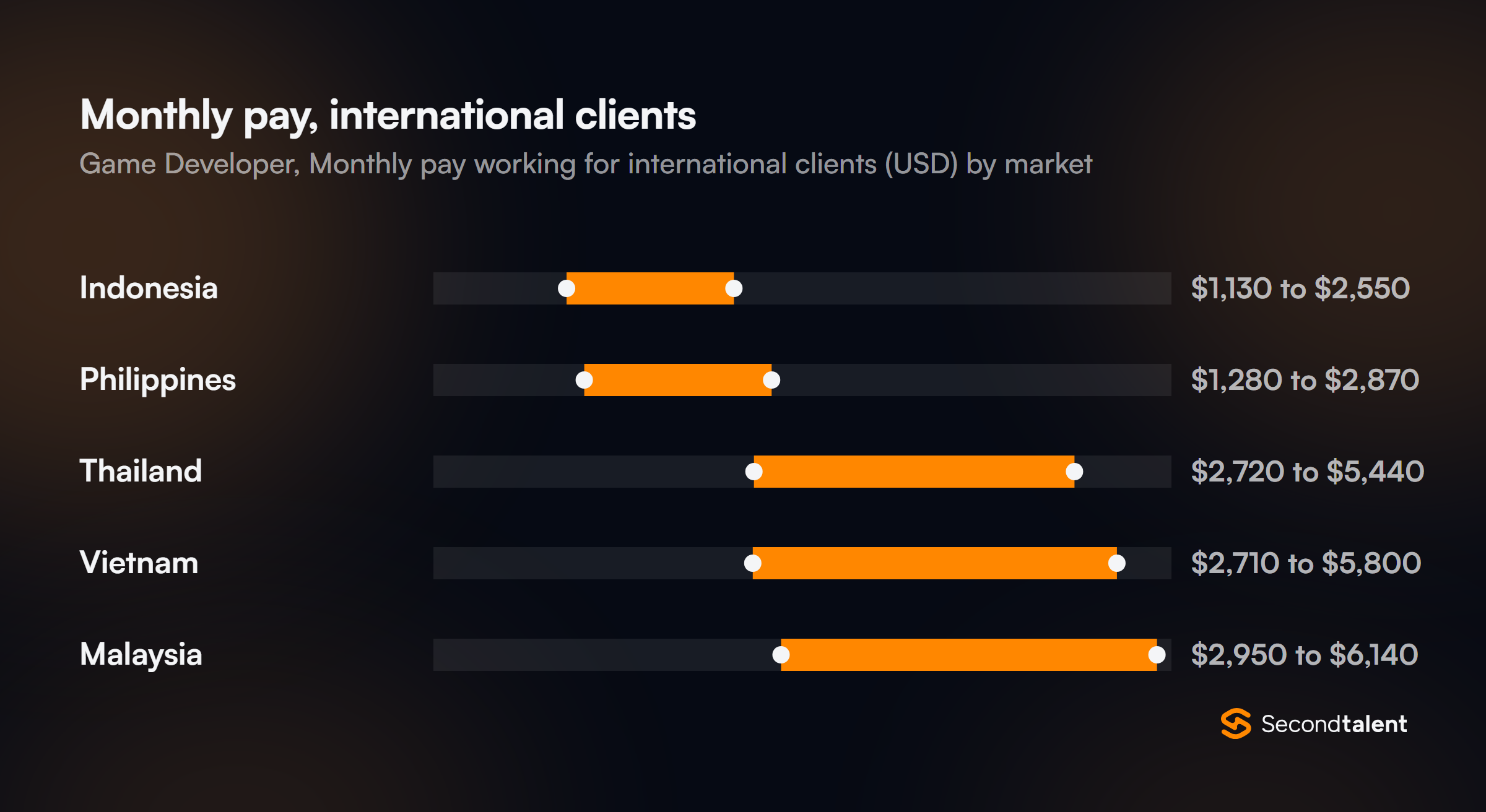
Monthly ranges from the Remote (Working for International Clients) figures on our rate cards for Indonesia, the Philippines, Vietnam, Thailand and Malaysia, converted at ExchangeRate-API mid-market rates for 14 September 2026.
All five cards quote local currency, rupiah, pesos, dong, baht and ringgit, and all five ranges are open at the top. A senior Unreal engineer with shipped console titles can command more than the printed ceiling in any of them.
Through Second Talent, senior game developers start from $2,999 a month: one monthly fee that bundles salary, payroll taxes, statutory contributions and our service fee. Our pricing page shows how the subscription works. Our game developer occupation profile describes the role in more detail.
US Pay Benchmark for Game Developers
BLS publishes no game programmer occupation. The role maps to Software Developers (15-1252), because a game developer writes, profiles and ships software to stores and consoles, the same work BLS counts there.
| BLS OEWS, May 2025, national |
Software Developers (15-1252) |
| Median annual |
$135,980 |
| 10th percentile, monthly |
$6,870 |
| 25th percentile, monthly |
$8,770 |
| Median, monthly |
$11,330 |
| 75th percentile, monthly |
$14,330 |
| 90th percentile, monthly |
$17,890 |
Monthly figures are the annual wages on the OEWS profile for 15-1252 divided by 12, rounded to the nearest $10.
Salary is only part of the US cost. In the BLS Employer Costs for Employee Compensation release for June 2026, wages and salaries made up 68.5% of employer compensation costs for full-time private industry workers, and benefits the other 31.5%.
For a contract hire, our game developer cost-to-hire page puts a mid-level US freelance or contract game developer at $85 to $135 an hour, before payroll, insurance and leave.
Time Zone Overlap with ET, CT and PT
A live game needs two kinds of hours from its engineers: quiet hours for patches and server work, and shared hours for playtests and build reviews. US clocks stay on daylight time until 1 November 2026, per NIST, and the Asian cities below do not change their clocks.
| Engineer's city |
UTC offset |
9:00 am ET (EDT) |
9:00 am CT (CDT) |
9:00 am PT (PDT) |
| Manila, Singapore, Kuala Lumpur, Taipei |
UTC+8 |
9:00 pm |
10:00 pm |
12:00 midnight |
| Ho Chi Minh City, Jakarta, Bangkok |
UTC+7 |
8:00 pm |
9:00 pm |
11:00 pm |
| Bengaluru |
UTC+5:30 |
6:30 pm |
7:30 pm |
9:30 pm |
After 1 November 2026, every time in the table moves one hour later.
Two schedules cover both needs:
- Maintenance and patch deploys: Kuala Lumpur, 9:00 am to 6:00 pm (01:00 to 10:00 UTC). That is 9:00 pm to 6:00 am in New York and 6:00 pm to 3:00 am in San Francisco. A patch that goes live at 3:00 am Eastern ships at 3:00 pm local time, in the middle of the engineer's day.
- Playtests and build reviews: Ho Chi Minh City, 4:00 pm to 1:00 am (09:00 to 18:00 UTC). That is 5:00 am to 2:00 pm EDT: five hours of a 9-to-5 day in New York, four in Chicago and two in San Francisco.
Arithmetic for the second line: 4:00 pm in Ho Chi Minh City is 09:00 UTC, and 09:00 UTC minus four hours is 5:00 am EDT. The shift carries three hours between 22:00 and 01:00, where Vietnam's Labor Code adds at least 30% for employees (Articles 98 and 106).
In the Philippines, the Labor Code sets at least 10% for work between 10 pm and 6 am (Article 86). We set the shift before the offer, which is how our placements get 4-6 hours of daily overlap with US hours.
Game Developer Skills to Screen For
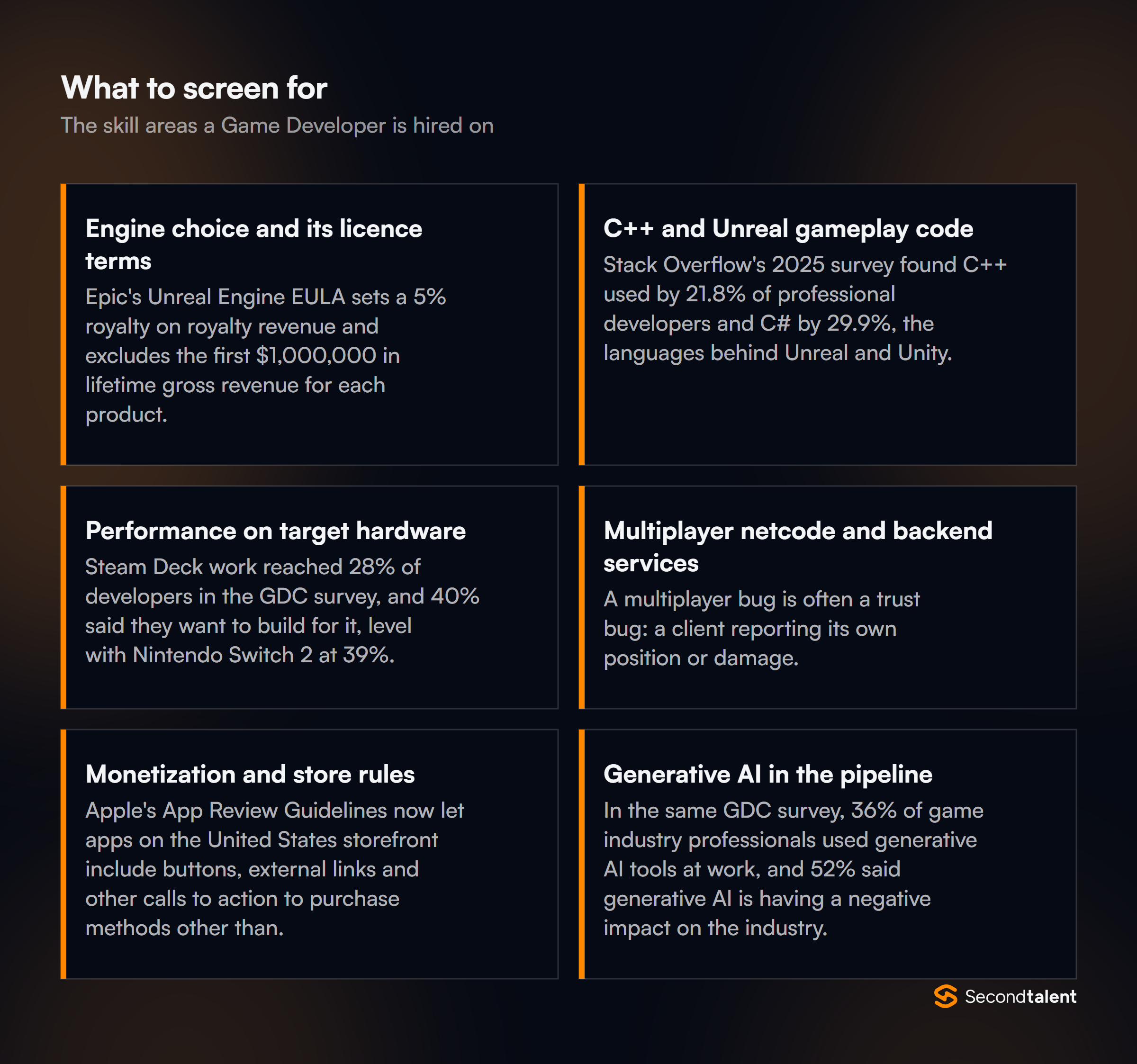
Over one in four respondents to the GDC 2026 survey (28%) were laid off in the past two years, rising to 33% in the United States. Students in the same survey named competition from laid-off developers with more experience, so expect shipped titles on senior CVs and screen for the release, not the demo reel.
Engine choice and its licence terms
Epic's Unreal Engine EULA sets a 5% royalty on royalty revenue and excludes the first $1,000,000 in lifetime gross revenue for each product. A game released on Epic Games Store no later than on other stores, with matching content and features, qualifies for 3.5%.
Unity cancelled its Runtime Fee for games on 12 September 2024, and Unity Pro is now required above $200,000 in annual revenue and funding. Ask the candidate which engine they would pick for your next title and what the licence costs at your revenue.
C++ and Unreal gameplay code
Stack Overflow's 2025 survey found C++ used by 21.8% of professional developers and C# by 29.9%, the languages behind Unreal and Unity. An Unreal hire should know when a system belongs in Blueprints and when it belongs in C++. Give the candidate a Blueprint that runs logic on each tick and ask for the C++ version and the profiler capture that justifies the move.
Performance on target hardware
Steam Deck work reached 28% of developers in the GDC survey, and 40% said they want to build for it, level with Nintendo Switch 2 at 39%. A handheld exposes memory and frame-time budgets that a desktop hides. Ask for a frame the candidate cut from 33 milliseconds to 16, on which device, and which tool showed the cost.
Multiplayer netcode and backend services
A multiplayer bug is often a trust bug: a client reporting its own position or damage. Ask the candidate to explain their last authoritative server model, how they handled 150 milliseconds of latency, and how they would detect a speed hack from server logs. For the service layer behind matchmaking and accounts, we also staff back-end developers.
Monetization and store rules
Apple's App Review Guidelines now let apps on the United States storefront include buttons, external links and other calls to action to purchase methods other than in-app purchase.
Apple added that change on 1 May 2025 after a US court decision, and elsewhere the entitlement rules still apply. Ask how the candidate would build a web checkout for US players while keeping in-app purchase on all other storefronts.
Generative AI in the pipeline
In the same GDC survey, 36% of game industry professionals used generative AI tools at work, and 52% said generative AI is having a negative impact on the industry. Ask what the candidate used AI for on their last project, and what they refused to hand to it, such as art or shipped code under your licence terms.
Mobile and Android game builds
Most game hires from Asia are for mobile titles, and Android brings work that a PC or console build never sees. Screen mobile and Android game developers on four points:
- Device spread. Android games run on a wide range of chipsets and GPUs. Ask which low-end phone the candidate kept as the minimum target on their last title, what frame rate they held on it, and how they set quality tiers for everything above it.
- Graphics APIs. Unity and Unreal can both build for Vulkan or OpenGL ES on Android. Ask when they would ship one, both or a fallback, and which driver bug pushed them to choose.
- Native code and Play rules. Game engines ship native libraries, so the Google Play target API and 16 KB page-size requirements on our Android developer page apply to every engine build. Ask how they confirmed their last build met them.
- Download size and live ops. Ask how they split assets to keep the first install small, how they delivered new content without a store update, and how they tested a live event on a slow connection.
For AR games, add ARCore on Android and ARKit on iOS to the brief, and ask for a shipped title that uses one of them.
Contractor or Employer of Record for a US Company
Software is not one of the nine categories of commissioned work that can be "work made for hire" under 17 U.S.C. § 101, and a transfer of copyright must be in writing and signed under § 204(a). Name the gameplay code, shaders, tools, levels and any art in the assignment.
IRS Publication 515 says the place where services are performed determines the source of the income, so a developer working from Bangkok or Kuala Lumpur earns foreign-source income. A foreign individual gives the payer Form W-8BEN to certify foreign status.
Local law applies its own test. Philippine courts use the four-fold test, and in Atok Big Wedge v. Gison the Supreme Court called control over the employee's conduct the most important of the four. Article 13 of Vietnam's 2019 Labor Code treats an agreement under another name as a labor contract when it covers a paid job, wages and one party's management and supervision.
|
Independent contractor |
Employer of Record |
| Legal employer |
None; the developer invoices you |
The EOR's local entity |
| US paperwork |
Form W-8BEN from the developer |
Service agreement with the EOR |
| IP |
Written assignment covering code, shaders, tools and levels |
Assignment terms in the employment contract and your EOR agreement |
| Local labor law |
Classification risk if you set crunch hours and sprint tasks |
Night premiums, public holidays and leave apply |
| Pay currency |
Agreed in the contract, often USD |
In Vietnam, contract wages are stated in dong (Article 95) |
A port or a fixed milestone suits a contractor agreement. A developer on your live-ops rotation, with access to your build servers and store accounts, fits the employment tests above, and our Employer of Record service employs that developer in-country for you. This is a summary, not legal advice.
English Level and Working Norms
Thailand ranks 116th of 123 countries and regions on the EF English Proficiency Index 2025, with a score of 402, but its IT workers score 459. Indonesia shows a similar gap: 471 overall and 523 in IT. The global average is 488.
| Country |
EF EPI 2025 score |
World rank (of 123) |
IT job-function score |
| Malaysia |
581 |
24 |
590 |
| Philippines |
569 |
28 |
581 |
| Vietnam |
500 |
64 |
500 |
| Indonesia |
471 |
80 |
523 |
| Thailand |
402 |
116 |
459 |
Scores come from EF's country pages for Malaysia, the Philippines, Vietnam, Indonesia and Thailand.
Game teams write bug reports, patch notes and design documents that designers and QA read in another time zone. Ask finalists to write reproduction steps for a physics bug from a video clip. For a team based in one market, our Vietnam game developer page covers that country alone.
Plan live events around both calendars. Thanksgiving on 26 November 2026 is a working day in Asia, so an engineer there can watch servers while your US team is off. Vietnam's Labor Code gives five paid days for Lunar New Year (Article 112), so avoid shipping a major update that week with a Vietnam-based team.
Game Developer Hiring Process
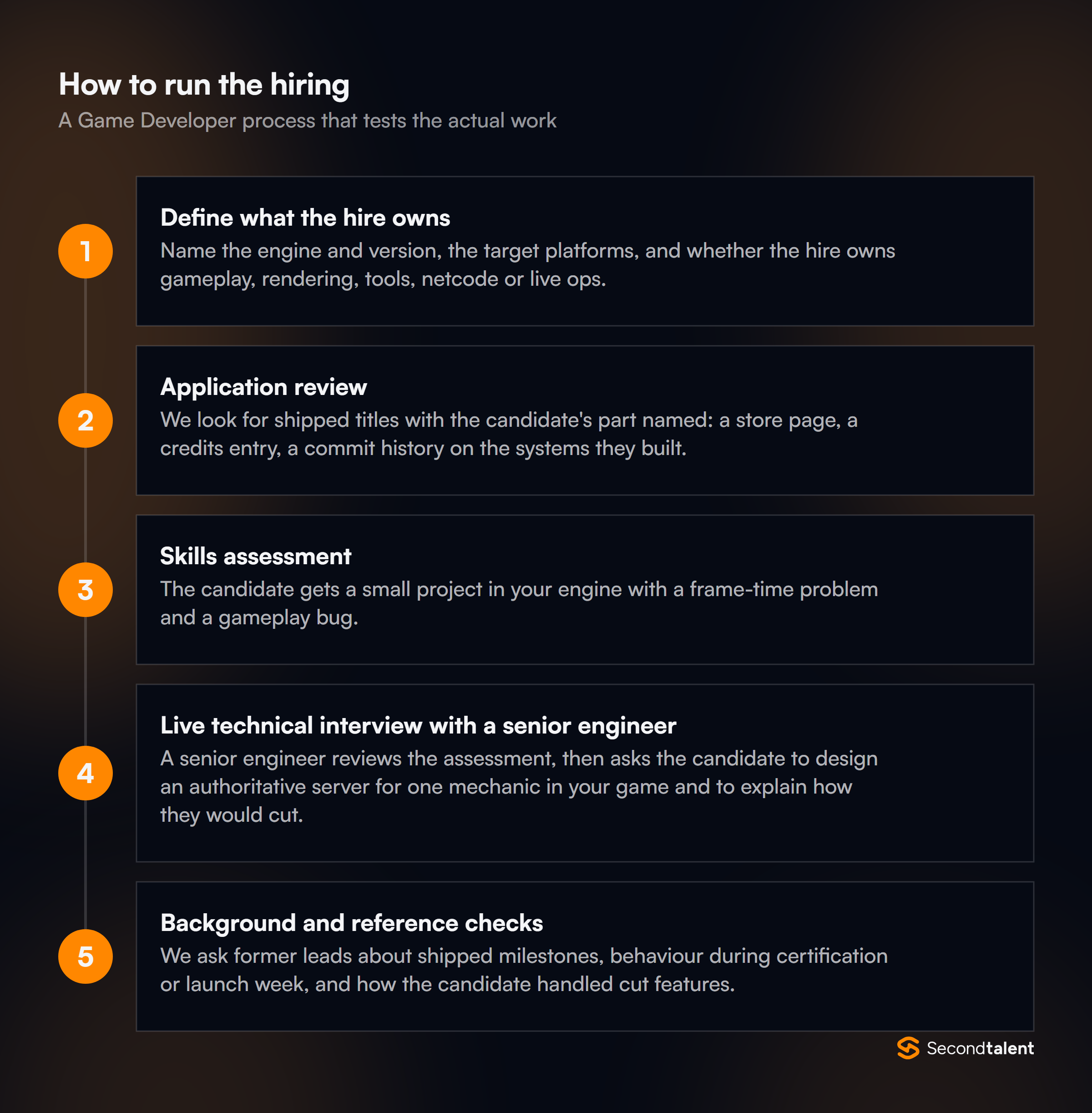
Second Talent's vetting covers stages 2 to 5 before you see a profile.
Stage 1: Define what the hire owns
Name the engine and version, the target platforms, and whether the hire owns gameplay, rendering, tools, netcode or live ops. A mobile live-ops seat and a console port need different tests.
Stage 2: Application review
We look for shipped titles with the candidate's part named: a store page, a credits entry, a commit history on the systems they built. A jam game alone does not pass for a senior seat.
Stage 3: Skills assessment
The candidate gets a small project in your engine with a frame-time problem and a gameplay bug. We score the profiler capture, the fix and the written explanation of what caused both.
Stage 4: Live technical interview with a senior engineer
A senior engineer reviews the assessment, then asks the candidate to design an authoritative server for one mechanic in your game and to explain how they would cut memory for a handheld build.
Stage 5: Background and reference checks
We ask former leads about shipped milestones, behaviour during certification or launch week, and how the candidate handled cut features. You then choose the contractor or EOR route above.
Hire Game Developers from Asia with Second Talent
We shortlist 6-8 candidates within 24 hours from 100,000+ pre-vetted engineers, accepting only the top 1% of applicants. Game developers start from $2,999 a month, with $0 upfront, no lock-in and 4-6 hours of daily overlap with US hours. We handle contracts, payroll and equipment, with compliant EOR contracts and payroll in 9 Asian markets.
Our pricing page sets out subscription, direct-hire and EOR pricing for a first game hire or a full team, and for mobile titles we also staff mobile app developers.