TL;DR: OpenClaw developers from Asia cost $3,000-$7,500 a month through Second Talent, matched in 24 hours. The closest US benchmark, the BLS median for software developers, was $135,980 a year in May 2025.
The project's lore page records three names: Clawdbot until Anthropic asked for a change, Moltbot from 27 January 2026, and OpenClaw from 30 January. One self-hosted Gateway links a model to WhatsApp, Slack, Telegram and other chat apps, then runs tools on its host machine. The developer you hire configures that Gateway, writes its skills and decides what it may execute.
Key takeaways
- On our AI engineer rate cards, pay for work with foreign clients starts near $2,390 a month in the Philippines and $9,680 in China.
- Tools run on the host for the main session until someone configures a sandbox, so hardening is part of the job description.
- Koi Security found 341 malicious skills among 2,857 on ClawHub, the public skills registry, in early 2026.
- China's national CERT warned in March 2026 that OpenClaw's default security configuration was "extremely weak".
What OpenClaw Developers Earn Working for International Clients in Asia
Chinese AI engineers working for foreign clients start at $9,680 a month, about four times the Philippine floor. China is also where OpenClaw use grew fastest. By March 2026 its national CERT reported a surge in downloads, helped by one-click deployment on major domestic cloud platforms. Tencent had launched an OpenClaw-based tool called Work Buddy.
OpenClaw has no rate card of its own, so the table uses our AI engineer rate cards, the closest match. The figure is what engineers in each market earn working directly for foreign companies, before any employer or platform costs.
| Market |
Monthly pay working for international clients (USD) |
| Philippines |
$2,390-$4,790+ |
| India |
$2,610-$10,150+ |
| Malaysia |
$3,690-$7,370+ |
| Vietnam |
$3,870-$7,730+ |
| Indonesia |
$4,540-$10,210+ |
| China |
$9,680-$18,760+ |
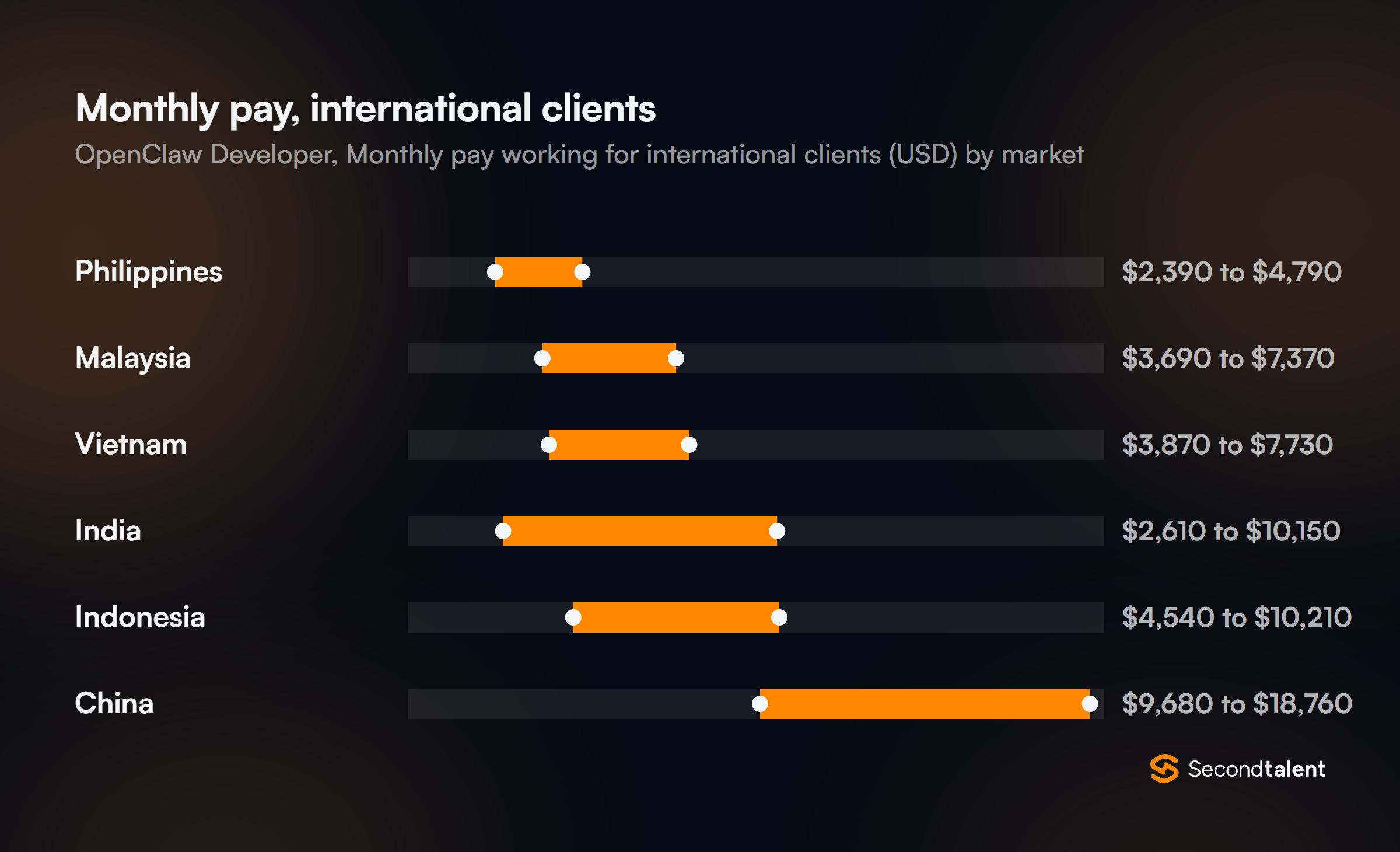
Monthly ranges from the Remote (Working for International Clients) figures on our rate cards for the Philippines, India, Malaysia, Vietnam, Indonesia and China, converted at ExchangeRate-API mid-market rates for 14 September 2026.
All six ranges are open at the top. The Singapore card starts at $14,210, above the US median below, so it stays out of the table.
Through Second Talent, OpenClaw developers cost $3,000-$7,500 a month: one monthly fee that bundles salary, payroll taxes, statutory contributions and our service fee. The pricing page explains the subscription. If your agents run on a framework inside your own product instead of a chat Gateway, our AI agent developer track is the better fit.
US Pay Benchmark for OpenClaw Developers
BLS publishes no agent or assistant occupation. The role maps to Software Developers (SOC 15-1252), since the job is writing and operating production software. GitHub counts 90.9% of the code in the OpenClaw repository as TypeScript, and plugins, skills and Gateway configuration all ship as code.
| BLS OEWS, May 2025, national |
Software Developers (15-1252) |
| Median annual |
$135,980 |
| 10th percentile, monthly |
$6,870 |
| 25th percentile, monthly |
$8,770 |
| Median, monthly |
$11,330 |
| 75th percentile, monthly |
$14,330 |
| 90th percentile, monthly |
$17,890 |
Monthly figures are the annual wages on the OEWS profile for 15-1252 divided by 12, rounded to the nearest $10.
Salary is only part of the US cost. In the BLS Employer Costs for Employee Compensation release for June 2026, wages and salaries made up 68.5% of employer compensation costs for full-time private industry workers, and benefits the other 31.5%.
Our AI agent developer cost-to-hire page prices the contract route at $119 to $185 an hour for a mid-level US freelancer.
Time Zone Overlap with ET, CT and PT
OpenClaw published seven stable releases between 31 August and 11 September 2026, ending with v2026.9.4, on its releases page. A Gateway your team messages all day needs those upgrades applied while your US office is offline. US daylight time runs until 1 November 2026, per NIST, and no city below changes its clocks.
| Engineer's city |
UTC offset |
9:00 am ET (EDT) |
9:00 am CT (CDT) |
9:00 am PT (PDT) |
| Manila, Singapore, Kuala Lumpur, Taipei |
UTC+8 |
9:00 pm |
10:00 pm |
12:00 midnight |
| Ho Chi Minh City, Jakarta, Bangkok |
UTC+7 |
8:00 pm |
9:00 pm |
11:00 pm |
| Bengaluru |
UTC+5:30 |
6:30 pm |
7:30 pm |
9:30 pm |
After 1 November 2026, every time in the table moves one hour later.
Two schedules cover the two halves of the work:
- Upgrades and audits, Manila, 9:00 am to 6:00 pm. That is 01:00 to 10:00 UTC, or 9:00 pm to 6:00 am in New York. The
openclaw update command validates the new version while the old Gateway keeps serving, so the swap lands in the US night.
- Skill reviews and access changes, Bengaluru, 2:00 pm to 11:00 pm. That is 08:30 to 17:30 UTC, or 4:30 am to 1:30 pm EDT. It shares four and a half hours with a New York working day, three and a half with Chicago and one and a half with San Francisco.
Arithmetic for the second line: 2:00 pm in Bengaluru minus 5:30 is 08:30 UTC, and 08:30 UTC minus four hours is 4:30 am EDT. We set that split before the offer, which is how our placements get 4-6 hours of daily overlap with US hours.
Night work costs extra for employees in two markets. The Philippines adds at least 10% between 10 pm and 6 am (Labor Code Article 86), and Vietnam at least 30% between 22:00 and 06:00 (Labor Code Articles 98 and 106). The Manila day shift above has none.
OpenClaw Developer Skills to Screen For
Peter Steinberger, who built OpenClaw, announced on 15 February 2026 that he was joining OpenAI and moving the project to a foundation. The OpenClaw Foundation is now a 501(c)(3) that employs the core team, and OpenAI is a donor, not an owner. The project stays MIT-licensed, models plug in and swap out, and the skills below keep a deployment of it safe.
Gateway exposure and access control
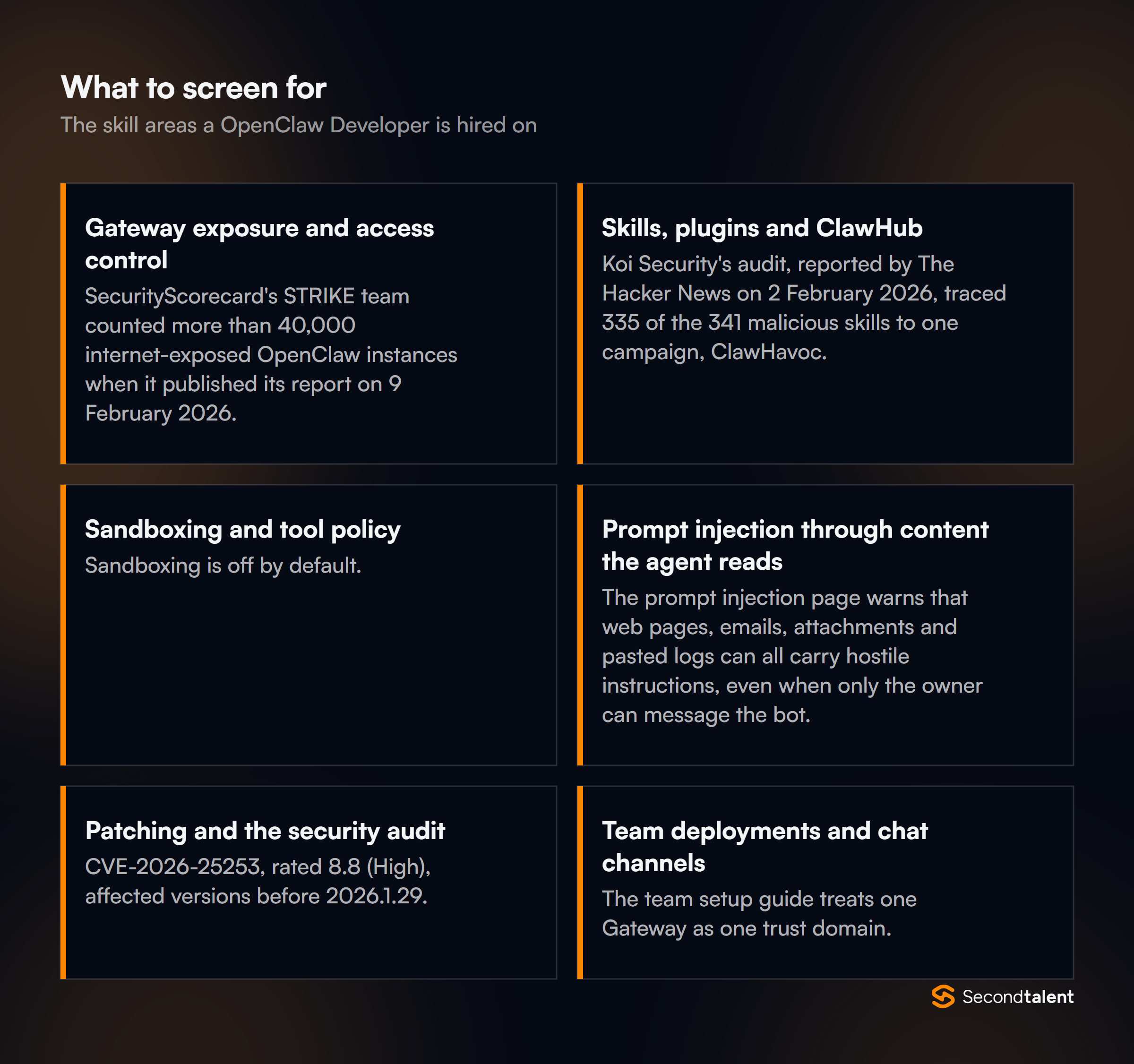
SecurityScorecard's STRIKE team counted more than 40,000 internet-exposed OpenClaw instances when it published its report on 9 February 2026. By the time The Register wrote it up the same day, the live count had passed 135,000. STRIKE blamed a default bind to 0.0.0.0:18789. The current security docs say host installs bind to loopback and answer unknown DM senders with a pairing code. Container images still default to an exposed bind. Ask the candidate how they would give five teammates access, and listen for Tailscale Serve or an identity-aware proxy in place of a public port.
Skills, plugins and ClawHub
Koi Security's audit, reported by The Hacker News on 2 February 2026, traced 335 of the 341 malicious skills to one campaign, ClawHavoc. Its skills used a fake "Prerequisites" step to install the Atomic Stealer malware on macOS. The skills documentation now tells operators to treat third-party skills as untrusted code and read them before enabling, and openclaw skills verify checks a ClawHub skill's trust envelope. Hand the candidate a skill whose setup section pipes a remote script to a shell, and see how long it takes them to flag it.
Sandboxing and tool policy
Sandboxing is off by default. Turning it on moves tool execution into a backend such as Docker, Podman or a remote machine over SSH while the Gateway stays on the host. Tool deny rules apply first, so sandboxing cannot bring back a denied tool, and tools.elevated is the escape hatch that runs exec outside the sandbox. Give the candidate a config with elevated exec enabled in an open group chat and ask what they change first.
Prompt injection through content the agent reads
The prompt injection page warns that web pages, emails, attachments and pasted logs can all carry hostile instructions, even when only the owner can message the bot. One fix it lists is a read-only reader agent that summarizes untrusted content for the main agent.
China's CERT flagged instructions hidden in web pages and poisoned plugins. It told users to run OpenClaw in a container and keep its management port off the public internet, The Register reported. Ask the candidate to design an email triage agent that holds no shell access.
Patching and the security audit
CVE-2026-25253, rated 8.8 (High), affected versions before 2026.1.29. OpenClaw took a gatewayUrl value from a query string and opened a WebSocket connection without prompting, sending a token. The security audit command, openclaw security audit, checks inbound access, tool blast radius, network exposure and plugins loaded without an allowlist. The --deep flag adds a live Gateway probe, and --fix only makes narrow changes. Ask which version the candidate last ran in production and which audit finding they fixed by hand.
Team deployments and chat channels
The team setup guide treats one Gateway as one trust domain. Anyone who can message a tool-enabled agent shares its tool authority, so clients who do not trust each other each need their own Gateway.
For customers in Asia, the channel list includes Feishu, LINE and QQ as official plugins, with WeChat through an external plugin. Ask how the candidate would split a support bot for two clients whose data must stay apart.
Contractor or Employer of Record for a US Company
Software is not one of the nine categories of commissioned work that can be "work made for hire" under 17 U.S.C. § 101, and § 204(a) requires any transfer of copyright in writing, signed. Name private skills, plugins, agent workspace files and Gateway configuration in the assignment. Fixes the developer contributes upstream go out under OpenClaw's MIT license.
IRS Publication 515 says the place where services are performed determines the source of the income, so an engineer working from Manila or Hanoi earns foreign-source income. A foreign individual gives the payer Form W-8BEN to certify foreign status.
Local law runs its own test. Philippine courts apply the four-fold test, and in Atok Big Wedge v. Gison the Supreme Court held the power of control to be the most important element. Article 13 of Vietnam's 2019 Labor Code treats an agreement under any name as a labor contract when it covers paid work, wages and management by one party.
An OpenClaw Gateway holds your model API keys and chat bot tokens. A developer who runs it on your schedule, with standing access to those credentials, fits both employment tests, and an Employer of Record employs that developer in-country for you. Our EOR, PEO and contractor comparison covers the trade-offs. This is a summary, not legal advice.
|
Independent contractor |
Employer of Record |
| Legal employer |
None; the developer invoices you |
The EOR's local entity |
| US paperwork |
Form W-8BEN from the developer |
Service agreement with the EOR |
| IP |
Written assignment covering skills, plugins and configuration |
Assignment in the employment contract and your EOR agreement |
| Local labor law |
Classification risk if you set hours and hold the developer to your methods |
Night premiums, public holidays and leave apply |
| Pay currency |
Agreed in the contract, often USD |
Local currency; Vietnam's Labor Code states wages in dong (Article 95) |
English Level and Working Norms
China scores 464 on the EF English Proficiency Index 2025, below the global average of 488. Its IT job-function score, 491, sits above it. OpenClaw work puts written English under test: a skill is a SKILL.md file of instructions a model follows, and a vague sentence in it becomes a wrong action.
| Country |
EF EPI 2025 score |
World rank (of 123) |
IT job-function score |
| Malaysia |
581 |
24 |
590 |
| Philippines |
569 |
28 |
581 |
| Vietnam |
500 |
64 |
500 |
| India |
484 |
74 |
487 |
| Indonesia |
471 |
80 |
523 |
| China |
464 |
86 |
491 |
Scores come from EF's country pages for 123 countries and regions, such as the Philippines and China. Ask finalists to write a short skill for one of your internal tasks, then run it and read what the model did.
Plan Gateway maintenance around both calendars. Thanksgiving on 26 November 2026 is a working day in Asia, so an engineer there can apply an upgrade while your US team is off. Article 112 of Vietnam's Labor Code gives five paid days for Lunar New Year, so a Vietnam-based developer needs cover that week.
OpenClaw Developer Hiring Process
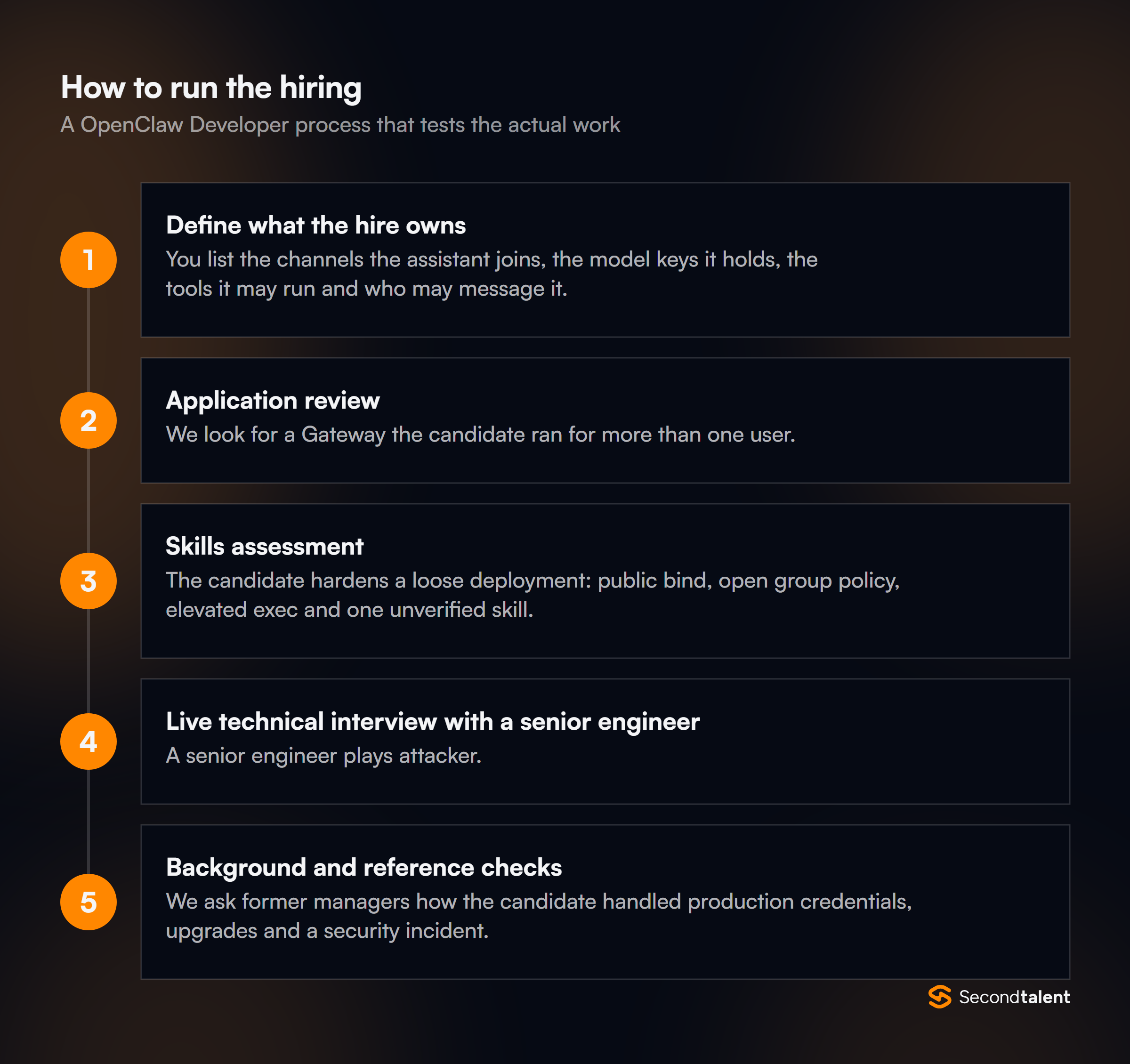
Second Talent's vetting covers stages 2 to 5 before you see a profile.
Stage 1: Define what the hire owns
You list the channels the assistant joins, the model keys it holds, the tools it may run and who may message it. State whether it serves one team or several clients, since that decides how many Gateways you run.
Stage 2: Application review
We look for a Gateway the candidate ran for more than one user. A team bot in Slack or Feishu, a published skill or merged plugin work all count. A local install that only its owner messaged does not pass.
Stage 3: Skills assessment
The candidate hardens a loose deployment: public bind, open group policy, elevated exec and one unverified skill. We score the audit output before and after, and the written note explaining each change.
Stage 4: Live technical interview with a senior engineer
A senior engineer plays attacker. They paste a message with hidden instructions into a group the bot reads, and the candidate explains which layer stops it: allowlist, tool policy, sandbox or a reader agent.
Stage 5: Background and reference checks
We ask former managers how the candidate handled production credentials, upgrades and a security incident. You then choose the contractor or EOR route above.
Hire OpenClaw Developers from Asia with Second Talent
We shortlist 6-8 candidates within 24 hours from 100,000+ pre-vetted engineers, accepting only the top 1% of applicants. OpenClaw developers cost $3,000-$7,500 a month, with $0 upfront, no lock-in and 4-6 hours of daily overlap with US hours. We handle contracts, payroll and equipment, with compliant EOR contracts and payroll in 9 Asian markets.
Our pricing page sets out the subscription, and for workflow automation around the assistant we also staff n8n developers.