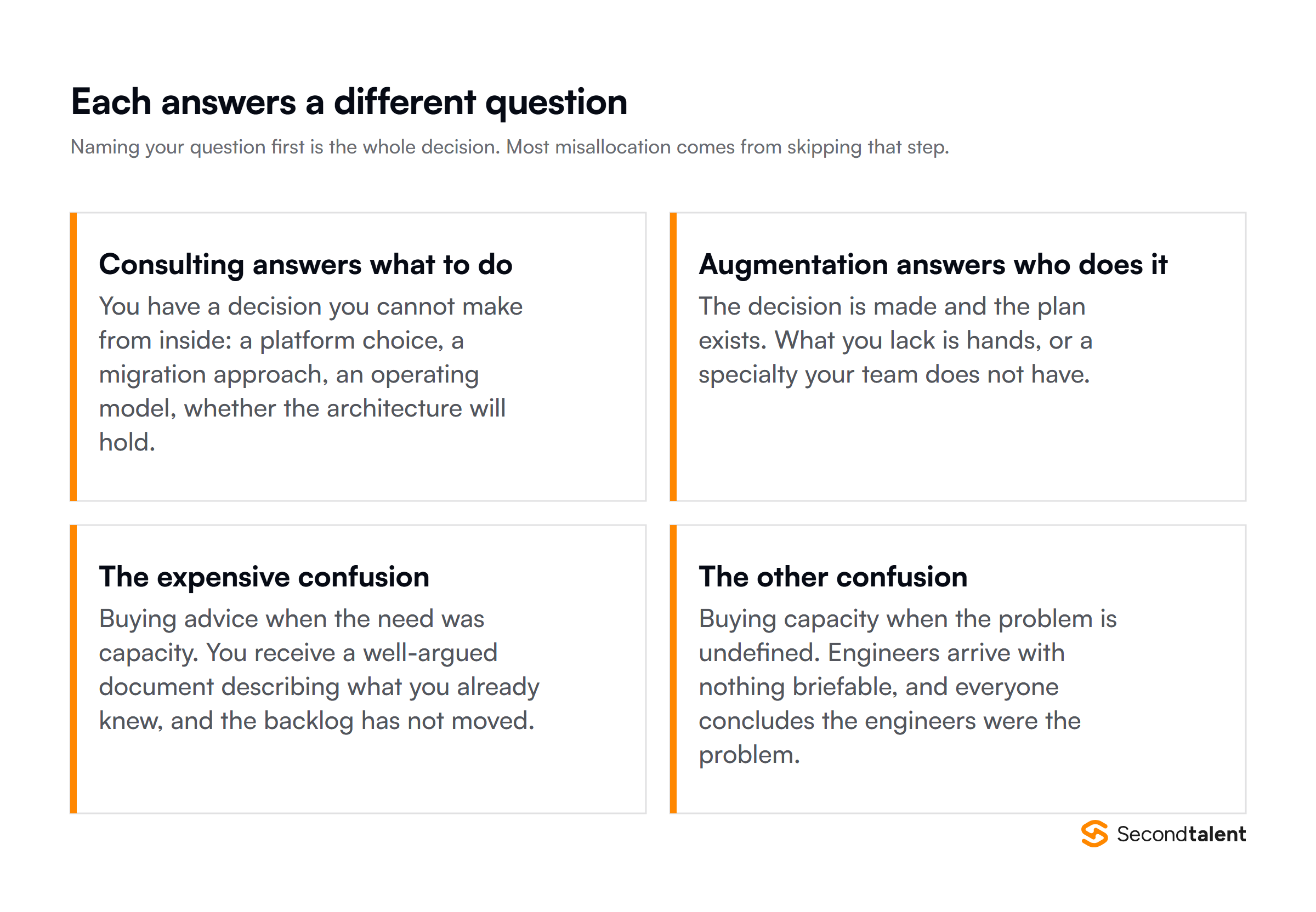
TL;DR: Staff augmentation supplies engineers who build. Consulting supplies advisors who recommend. Both get described as bringing in experts, and the expensive mistake is buying advice when the need was capacity: you get a well-argued document describing what your team already told you, and the backlog has not moved. Name the question first. If the decision is made and you lack hands, you want augmentation. If the decision cannot be made from inside, you want consulting.
When a hard technical problem lands, the instinct is to bring in outside expertise. Which kind you need is worth deciding explicitly, because the two models produce different artefacts, price differently, and leave behind different things.
What is the difference?
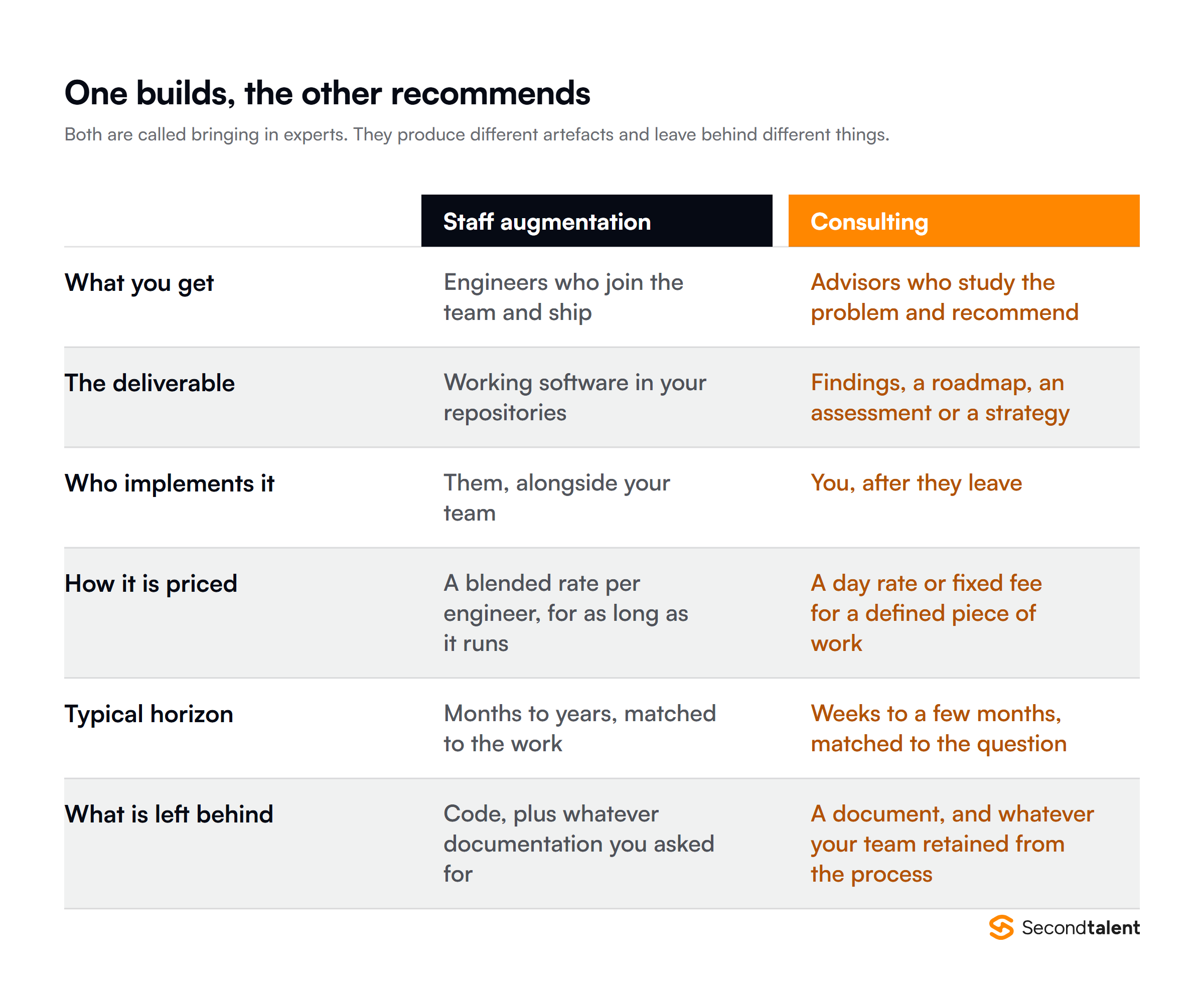
One builds. The other recommends.
Staff augmentation supplies engineers who join your team, take direction from your manager, attend your standups and ship into your repositories. What they leave behind is working software.
Consulting supplies advisors who study your systems, interview your people and produce findings. What they leave behind is a document, and the implementation is yours.
Neither is superior. They answer different questions, and buying one while needing the other is the single most expensive error in this area.
Which question are you actually asking?
Consulting answers “what should we do”. Augmentation answers “who does it”.
You need consulting when a decision has to be made that nobody inside can make: a platform choice, a migration approach, an operating model question, or whether an architecture will hold at the next order of magnitude. Sometimes the value is genuinely the outside view, because internal politics cannot produce an unowned answer.
You need augmentation when the decision is made and the plan exists. What you lack is hands, or a specialty your team does not have.
A third possibility is worth ruling out before either. If the plan does not exist and nobody can write it, the problem is definition rather than expertise, and buying help of any kind postpones it. Neither model performs well against an undefined problem, and the classification questions that come with engaging outside help are worth avoiding entirely until you have something briefable.
Write your question down in one sentence before you talk to anyone. If the sentence contains “should”, you are probably buying advice. If it contains “build”, you are buying capacity.
Both vendors will say yes. A consultancy asked for capacity will propose a delivery engagement, and a staffing provider asked for strategy will propose a senior engineer who can advise. Neither is dishonest, and both will be shaped by what they sell. Deciding your own question before the first call is what stops the vendor deciding it for you.
What each costs
Augmentation is the cheaper of the two by a wide margin, for the straightforward reason that you are buying labour rather than judgment sold at a premium.
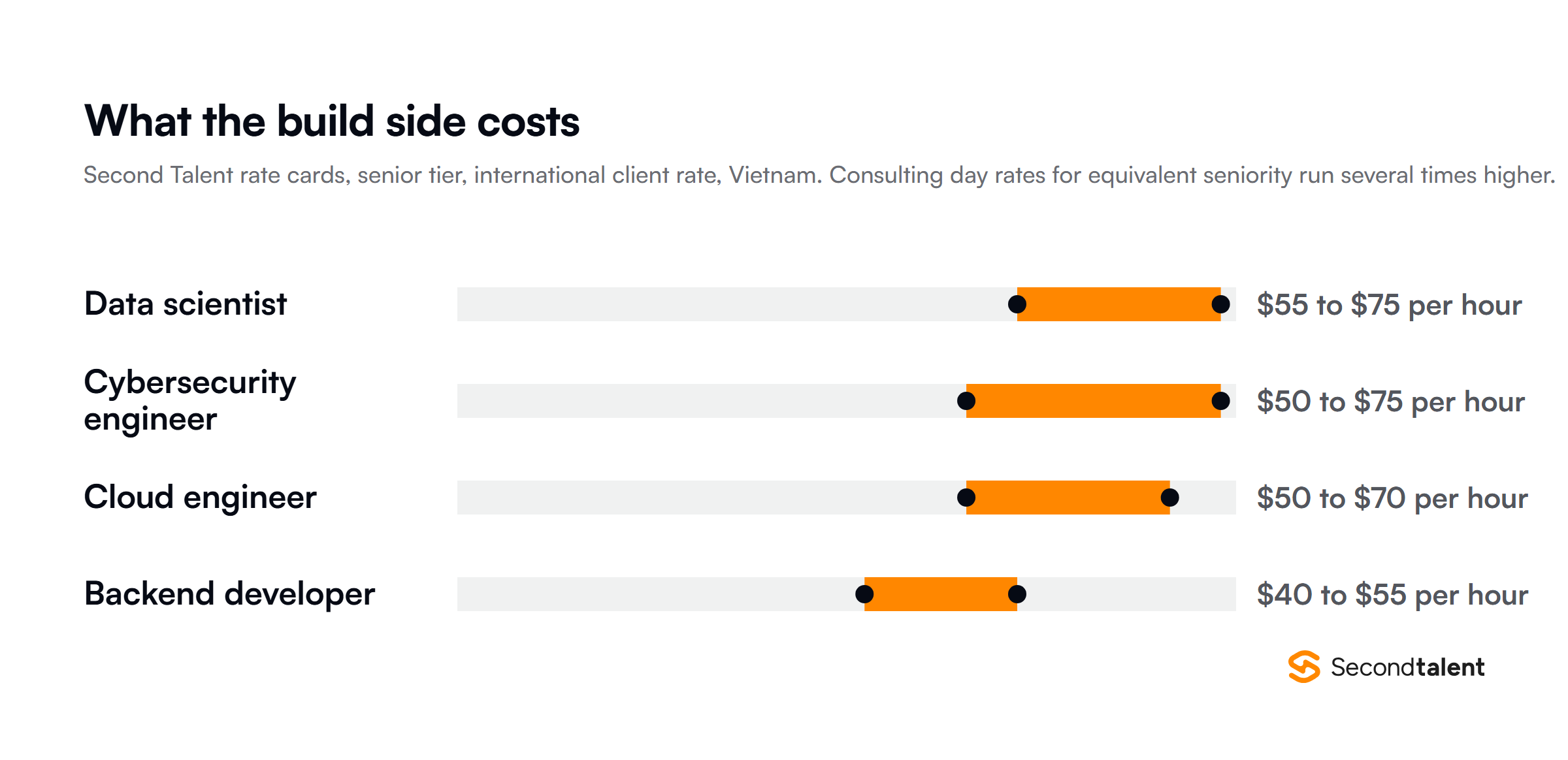
Second Talent publishes senior international client rates in the developer rate cards. In Vietnam, senior backend developers run $40 to $55 per hour, cloud engineers $50 to $70, cybersecurity engineers $50 to $75 and data scientists $55 to $75.
Consulting day rates for equivalent seniority run several times higher. We are not quoting a figure here because we could not source one to a page that publishes it, and a number invented for a comparison is worse than the comparison being qualitative.
The multiple is not the point anyway. Paying a consultancy premium for a decision worth making is good value, and paying it for capacity is not. Compare against the question rather than against the rate.
For the in-house baseline in either comparison, the US Bureau of Labor Statistics puts the median wage for software developers at $135,980 in May 2025, salary before employer taxes and benefits.
Which one you need
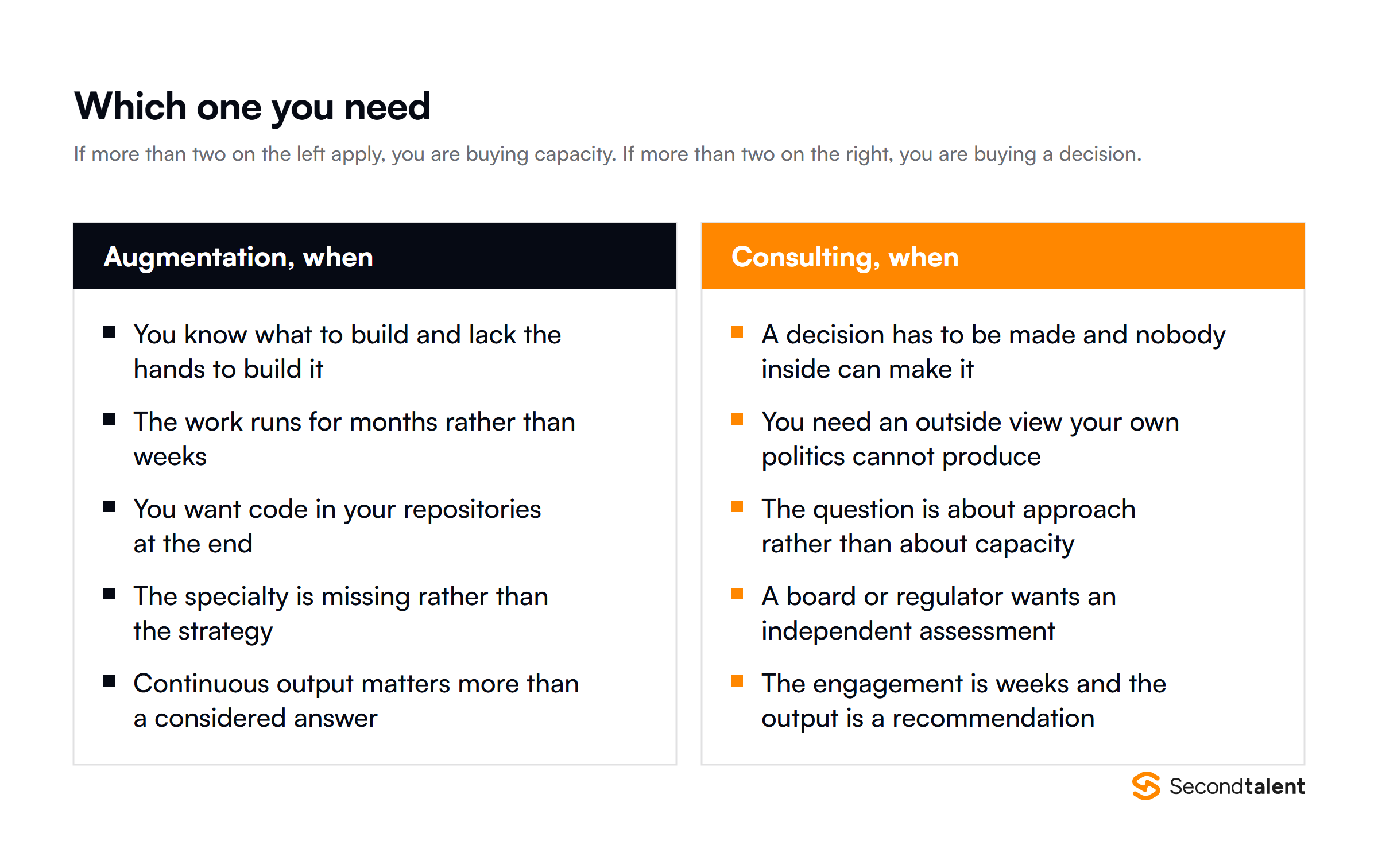
Augmentation fits when you know what to build and lack the hands, when the work runs for months rather than weeks, when you want code in your repositories at the end, when the gap is a specialty rather than a strategy, and when continuous output matters more than a considered answer.
Consulting fits when a decision has to be made and nobody inside can make it, when you need an outside view your own politics cannot produce, when the question is about approach rather than capacity, when a board or regulator wants an independent assessment, and when the engagement is weeks with a recommendation at the end.
If more than two on either side apply, you have your answer.
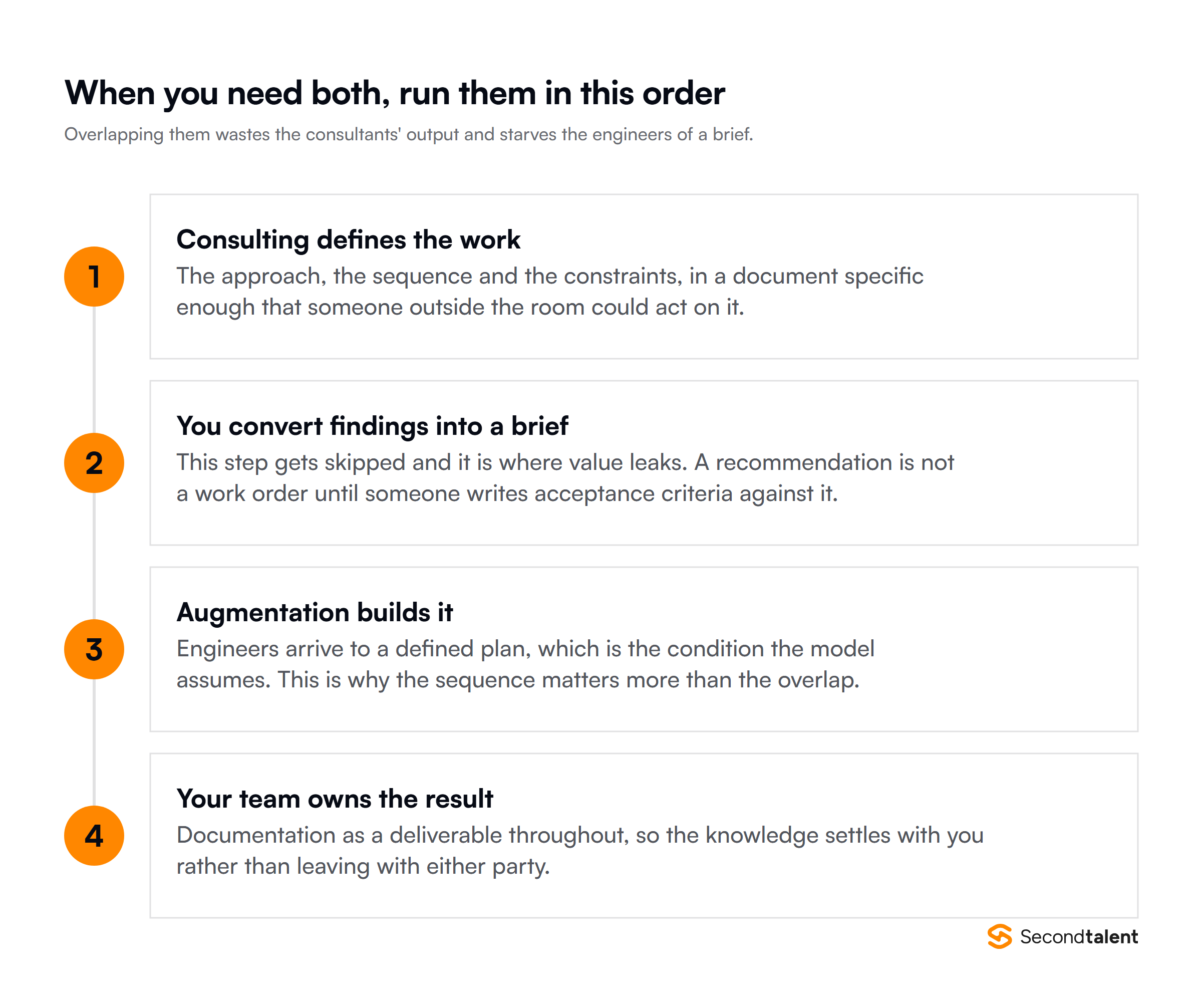
When you need both
Plenty of problems genuinely need a decision and then execution. Run them in sequence rather than in parallel.
Consulting defines the work, producing an approach, a sequence and constraints, specific enough that someone outside the room could act on it.
You convert findings into a brief. This step gets skipped and it is where the value leaks. A recommendation is not a work order until someone has written acceptance criteria against it, and neither vendor will do that for you.
Augmentation builds it, arriving to a defined plan, which is the condition the model assumes.
Your team owns the result. Make documentation a deliverable throughout, so the knowledge settles with you rather than leaving with whichever party produced it.
Overlapping the two wastes the consulting output and starves the engineers of a brief. Our planning template covers writing the brief that sits between them.
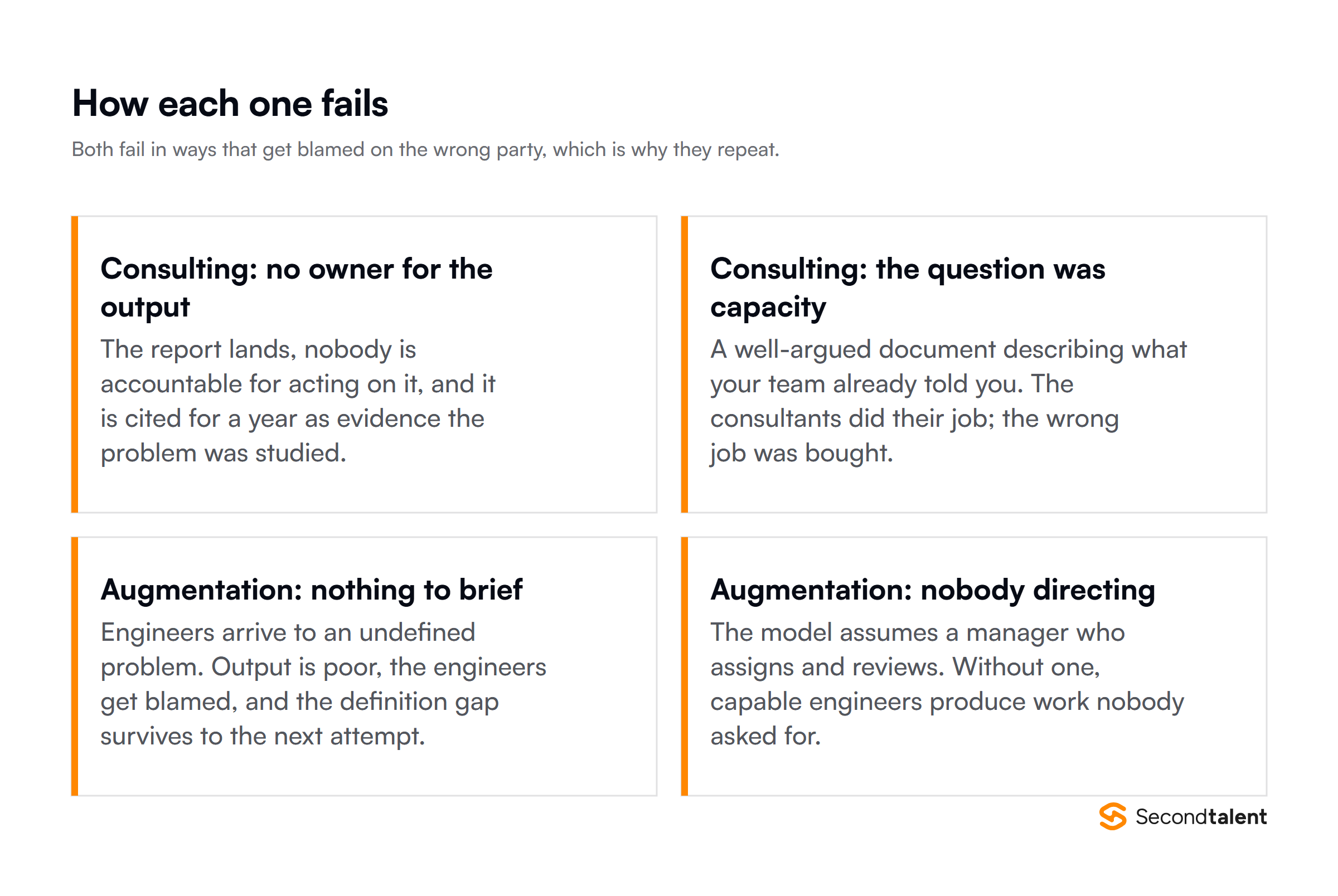
How each one fails
Both fail in ways that get blamed on the wrong party, which is why the same mistakes repeat.
Consulting fails when nobody owns the output, so the report is cited for a year as evidence the problem was studied. It also fails when the real question was capacity: the consultants did their job, the wrong job was bought.
Augmentation fails when there is nothing to brief, so engineers arrive to an undefined problem, produce poor output, and get blamed for a definition gap that survives to the next attempt. It also fails when nobody is directing the work, since the model assumes a manager who assigns and reviews. Our guide to staff augmentation risks and controls covers that failure in detail.
What each model does to your team
The downstream effect on your own engineers rarely appears in a comparison and often matters more than the rate.
Augmentation raises or lowers the standard around it. A senior engineer working inside your codebase, reviewing your team’s changes and being reviewed by them, moves the bar in whichever direction their judgment points. That is a real benefit and a real risk, and it is why your own technical screen matters more than the provider’s.
Consulting can undermine or validate. An outside assessment that confirms what your team already argued for is worth a great deal politically. One that contradicts them without engaging their reasoning tends to be resisted for a year, whatever its merits.
There is a version of the consulting decision that is really about authority rather than knowledge, where an external report exists to make a decision someone already reached feel unowned. That is sometimes a legitimate use of money and it is worth being honest with yourself about which one you are buying.
Where AI tooling changes the comparison
Both models are affected, and not in the same direction.
The 2025 Stack Overflow Developer Survey found 84 percent of developers use or plan to use AI tools, with 50.6 percent of professionals using them daily, while 46 percent distrust the accuracy of the output.
For augmentation, that shifts what you screen for. Tool familiarity no longer separates candidates, so the useful test is judgment about the output. Our guide to AI-native skills assessment covers how to run it.
For consulting, the effect is on the deliverable. A findings document is exactly the artefact these tools produce most fluently and least reliably, so a report that reads well is weaker evidence of thinking than it used to be. Ask what was actually examined: which systems, which data, how many people interviewed. Method has become the differentiator, not prose.
Scarcity affects both sides
The seats that are hard to fill are hard to fill in either model, and a vendor promising otherwise is selling something.
The US Bureau of Labor Statistics projects data scientist employment to grow 35 percent between 2025 and 2035 and information security analysts 21 percent, against roughly 4 percent across all occupations.
For those specialties a consultancy faces the same hiring market you do, which is worth remembering when a proposal implies otherwise. Ask who specifically will do the work and what else they are staffed on.
What about a managed service?
There is a third option that sits between the two and gets missed in this comparison.
A managed service hands a whole function to a provider who directs its own people against agreed service levels. That is neither advice nor hands under your direction. It suits an ongoing operational function you have decided not to build, and it comes with the trade that you stop choosing who does what.
If your question is “who should own this function permanently”, none of consulting or augmentation is the answer. Our comparison of staff augmentation and managed services covers where that line sits, and the three-model guide covers all of them together.
Consulting and augmentation FAQs
Can a staffing provider give architectural advice?
A senior engineer will have opinions and they are usually worth hearing. What they will not do is produce an independent assessment, because they are inside the delivery rather than outside the problem. That independence is what a consultancy is actually selling.
Can a consultancy also build?
Many do, and it is worth being precise about which you are contracting for. Delivery under a consultancy’s own direction is closer to a managed service or a project under a statement of work than to augmentation, and the pricing and accountability follow that.
Do we need the consulting phase at all?
Only where a real decision is open. If your team already knows the approach and disagrees only about sequencing, a week of your own senior engineers writing it down beats a month of external assessment.
Which leaves more knowledge behind?
Augmentation, usually, because the work happens inside your systems under your review. Consulting leaves a document, and how much of it becomes knowledge depends entirely on who owned the output.
Takeaways
- Write your question in one sentence first. “Should” means advice; “build” means capacity.
- Both vendors will say yes to either brief. Decide before the first call.
- Needing both is common. Run them in sequence and write the brief in between.
- Consulting fails without an owner for the output. Augmentation fails without a brief or a manager.
- If the question is who owns a function permanently, consider a managed service instead.
If you need hands rather than advice
Second Talent places pre-vetted senior engineers across Asia with EOR cover, matched within 24 hours, at 92 percent twelve-month retention.
Tell us what you are trying to build, or read what IT staffing is for how the engagement models compare.