TL;DR: Fifteen questions that surface a provider’s structural quality inside an hour. Ask them in order, because sequencing puts the answerable ones first and the revealing ones after some rapport. Three answers should end a conversation rather than score low: they cannot name the employing entity, they will not share funnel data, or they suggest you skip your own technical screen.
Sales calls cover a lot of ground and settle very little. These questions are designed to produce facts rather than positioning, and to be asked of any provider including us.
Disclosure, and a change from the previous version. An earlier version of this page gave a “quality answer” for each question, and those answers were close to Second Talent’s own positioning. That is a marketing piece wearing a buyer’s guide as a costume. This version describes what makes an answer informative instead of prescribing the number a provider should give, because the right acceptance rate or engagement length genuinely varies by model, market and specialty.

The fifteen questions
Vetting (1 to 3). What share of applicants do you accept? Walk me through the funnel stage by stage. How do you assess an engineer working with AI tooling, and can you send the rubric?
Structure (4 to 6). Which legal entities employ your engineers, and in which countries? Is any part of the service subcontracted? How fast does a first matched profile arrive, and what makes that possible?
Commercial (7 to 10). What does conversion to our payroll cost, and does the fee expire? What are the replacement terms? Can you show a sample invoice? What sits outside the quoted rate?
Delivery (11 to 13). What is your twelve-month retention on placed engineers? Can you describe two placements in our specialty from the last six months and what happened afterwards? What is the escalation path when something goes wrong?
Exit (14 to 15). What is the notice period and is handover time billed? What do you return or destroy when the engagement ends?
What makes an answer informative
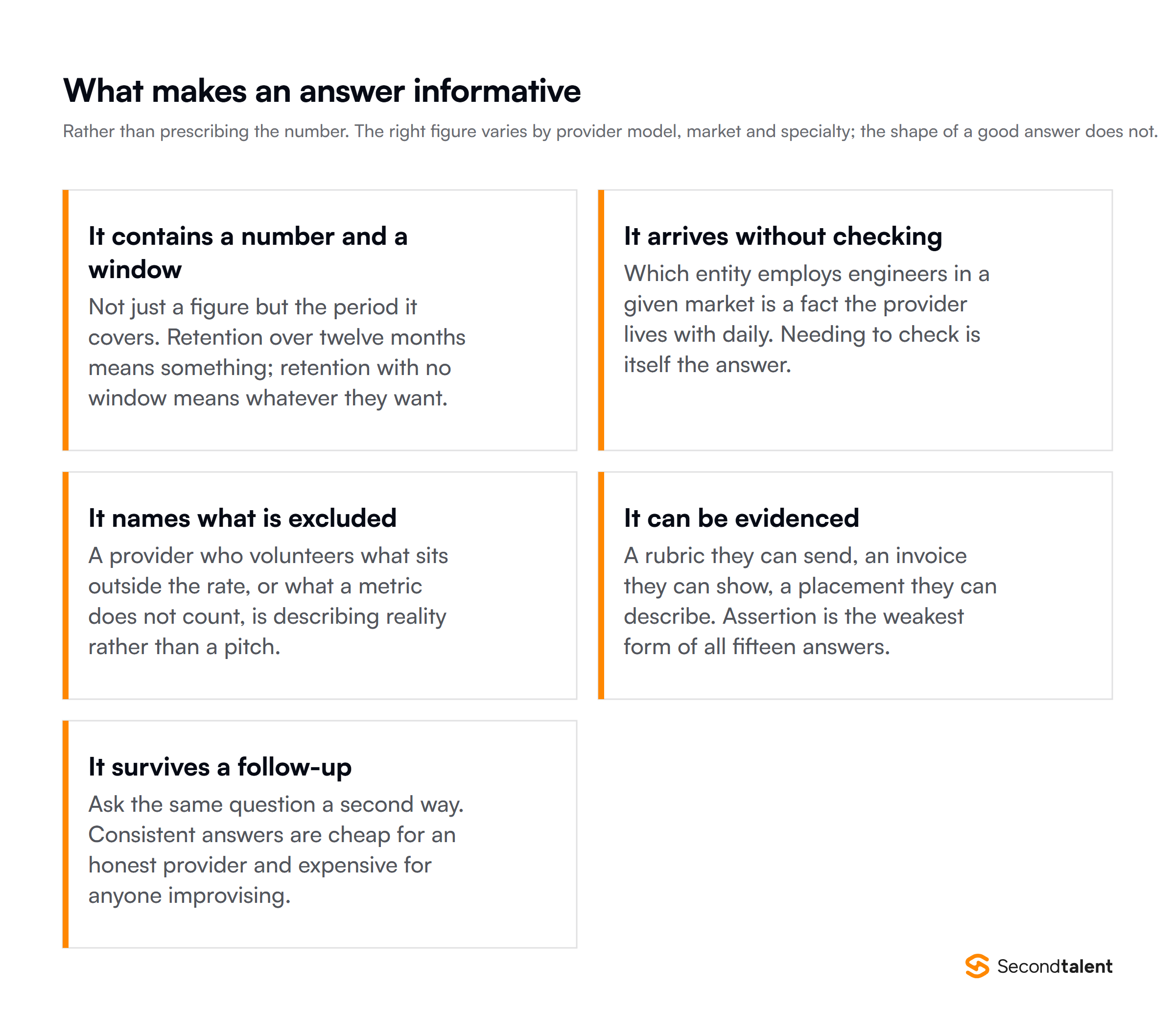
Rather than what the number should be, which depends on the provider’s model.
It contains a number and a window. Retention over twelve months means something. Retention with no period attached means whatever the speaker wants.
It arrives without checking. Which entity employs engineers in a given market is a fact a provider lives with daily. Needing to check is itself informative.
It names what is excluded. A provider who volunteers what sits outside the rate, or what a metric does not count, is describing reality rather than presenting one.
It can be evidenced. A rubric they can send, an invoice they can show, a placement they can describe. Assertion is the weakest form any of these fifteen answers can take.
It survives a follow-up. Ask the same thing a second way later in the call. Consistency is cheap for an honest provider and expensive for anyone improvising.
Why this order
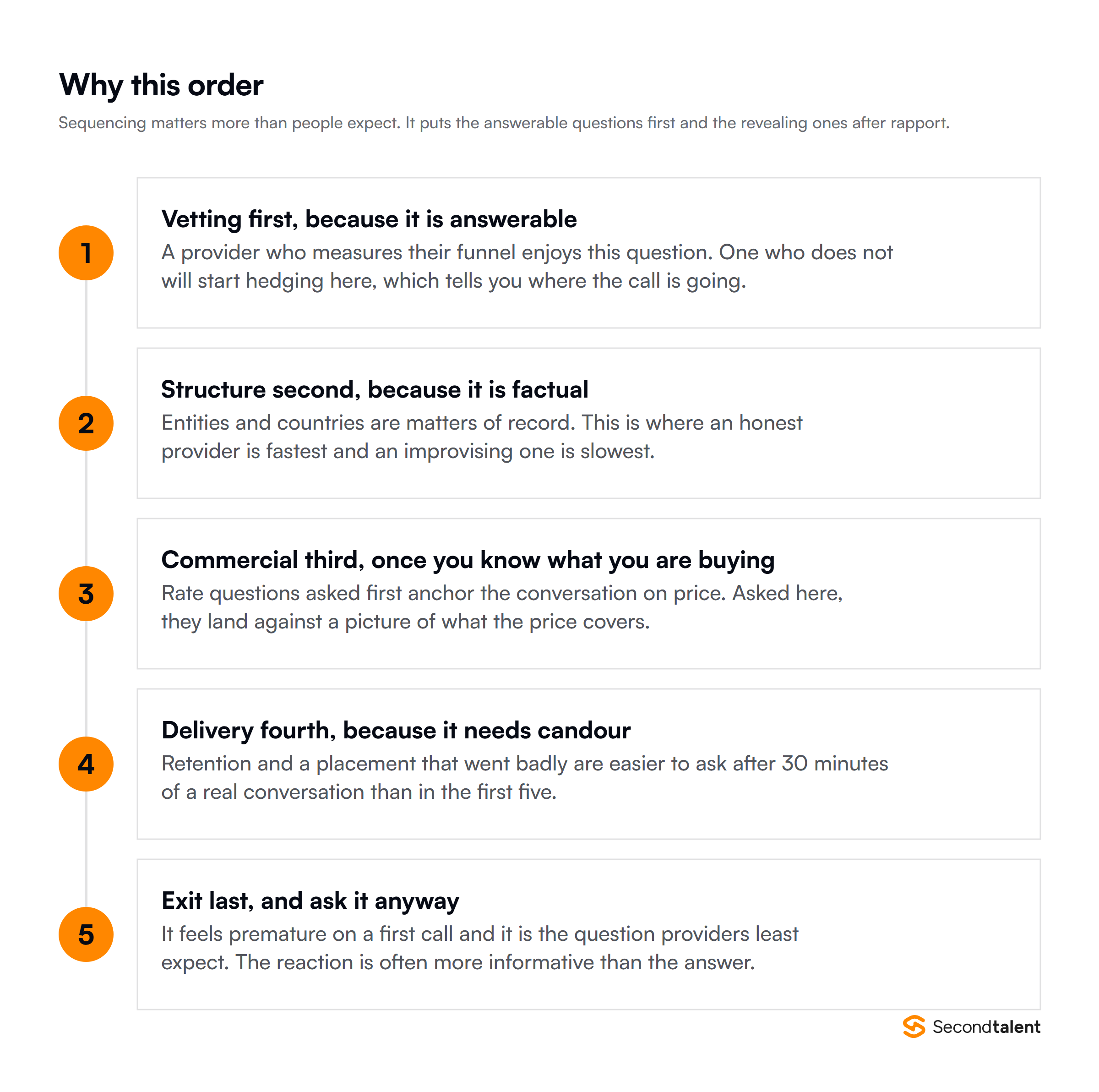
Sequencing matters more than people expect.
Vetting first, because it is answerable. A provider who measures their funnel enjoys this question. One who does not starts hedging here, which tells you early where the call is going.
Structure second, because it is factual. Entities and countries are matters of record, so this is where an honest provider is fastest.
Commercial third. Rate questions asked first anchor everything on price. Asked here, they land against a picture of what the price covers.
Delivery fourth, because it needs candour. Retention, and a placement that went badly, are easier to ask after half an hour of real conversation.
Exit last, and ask it anyway. It feels premature on a first call and providers rarely expect it. The reaction is often more informative than the answer.
Hedges, and what they usually mean
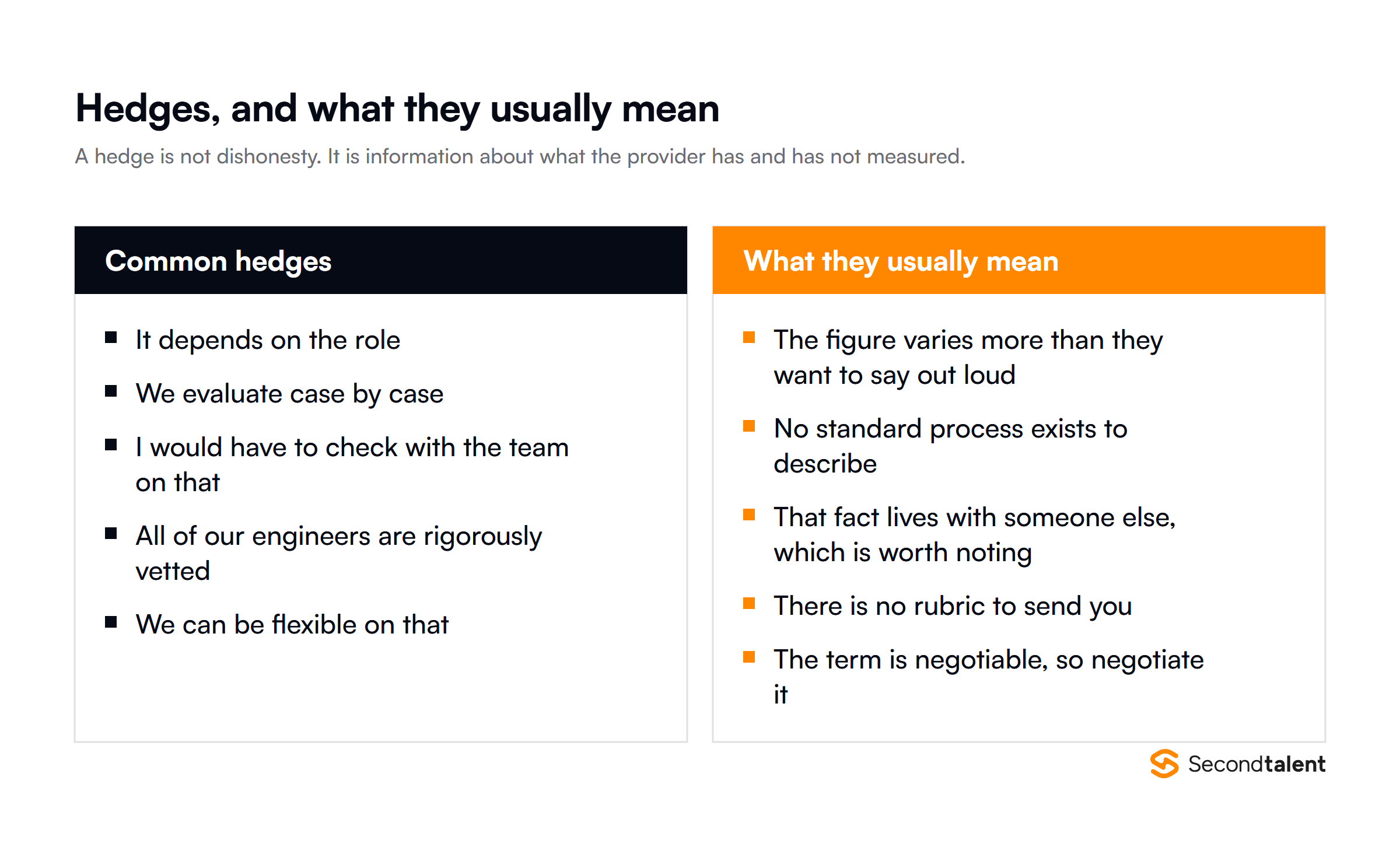
A hedge is not dishonesty. It is information about what a provider has and has not measured.
“It depends on the role” usually means the figure varies more than they want to say. “We evaluate case by case” often means no standard process exists to describe. “I would have to check” tells you that fact lives with someone else, which is worth noting when the question was about who employs your engineer.
“All our engineers are rigorously vetted” means there is no rubric to send. And “we can be flexible on that” means the term is negotiable, so negotiate it.
Follow every hedge up in writing after the call. What comes back, and how quickly, is a second data point that costs you nothing.
Three answers that should end the conversation
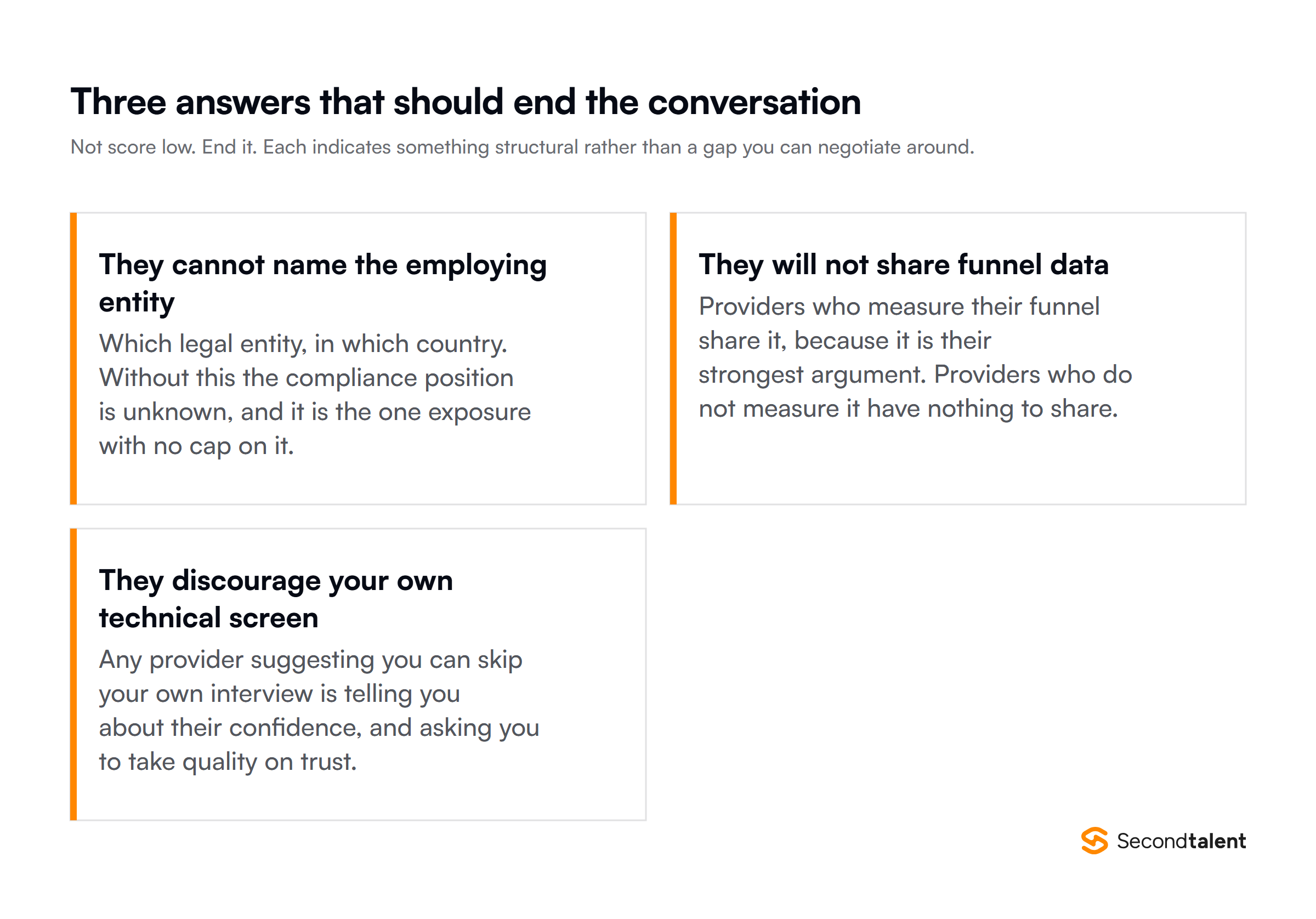
Not score low. End it, because each indicates something structural.
They cannot name the employing entity. Which legal entity, in which country. Without this the compliance position is unknown, and worker classification is the exposure with no cap on it. The IRS common-law test and the HMRC CEST tool both turn on control, and augmentation is control by design. Our guide to worker classification in cross-border IT staffing covers why it matters this much.
They will not share funnel data. Providers who measure their funnel share it, because it is their strongest argument. Providers who do not measure it have nothing to share.
They discourage your own technical screen. Any provider suggesting you can skip your own interview is asking you to take quality on trust, and telling you something about their confidence.
Why question 3 changed
The AI tooling question used to be about whether a provider tested for tool familiarity. It is now about whether they observe judgment, and the reason is measurable.
The 2025 Stack Overflow Developer Survey found 84 percent of developers use or plan to use AI tools, with 50.6 percent of professionals using them daily. Familiarity now describes the majority, so a provider screening on tool names is screening on nothing.
The same survey found 46 percent distrust the accuracy of what those tools produce against 33 percent who trust it, and developers with ten or more years of experience are the most sceptical. That judgment is the scarce part, and it can only be seen by watching someone work.
So the useful version of question 3 is: show me the rubric you assess against, and describe what a candidate does that fails it. A provider with a real assessment answers the second half easily. Our guide to AI-native skills assessment covers the test design.
The three questions that carry the most weight
If a call gets cut short, these are the ones to keep.
Which entity employs the engineer, and where. It decides the compliance position, and it is the only exposure on this list with no ceiling.
What is your twelve-month retention. The one figure a provider cannot control at the point of sale. A cheaper rate attached to poor retention costs more once you count the second search and the second ramp, and that cost arrives in a quarter you did not plan for.
What sits outside the rate. Tooling, overtime, overlap premiums, conversion fees, replacement charges. This is where quotes that looked comparable stop being comparable.
For the rate question specifically, have a baseline in mind before the call. The US Bureau of Labor Statistics puts the median wage for software developers at $135,980 in May 2025, salary before employer taxes and benefits. A provider rate already includes those, so load the salary side before treating any gap as a saving.
The other twelve are worth asking. These three are worth rescheduling for.
The question worth adding for your situation
Fifteen is a general list. One more belongs on it depending on what your engagement rests on.
Regulated buyers should ask what happens when a supervisor asks who touched a given system, and whether audit rights, data locations and exit plans are already in their standard agreement. Our guide to fintech staff augmentation covers what that looks like.
Teams racing a date should ask what the provider’s own bottleneck is. The honest answer is usually your access provisioning rather than their sourcing, and a provider who says so has run this before.
Teams planning to convert should ask what share of placements convert to client payroll, and how that conversation usually goes. It reveals whether conversion is a supported path or a leak they tolerate.
What to do with the answers
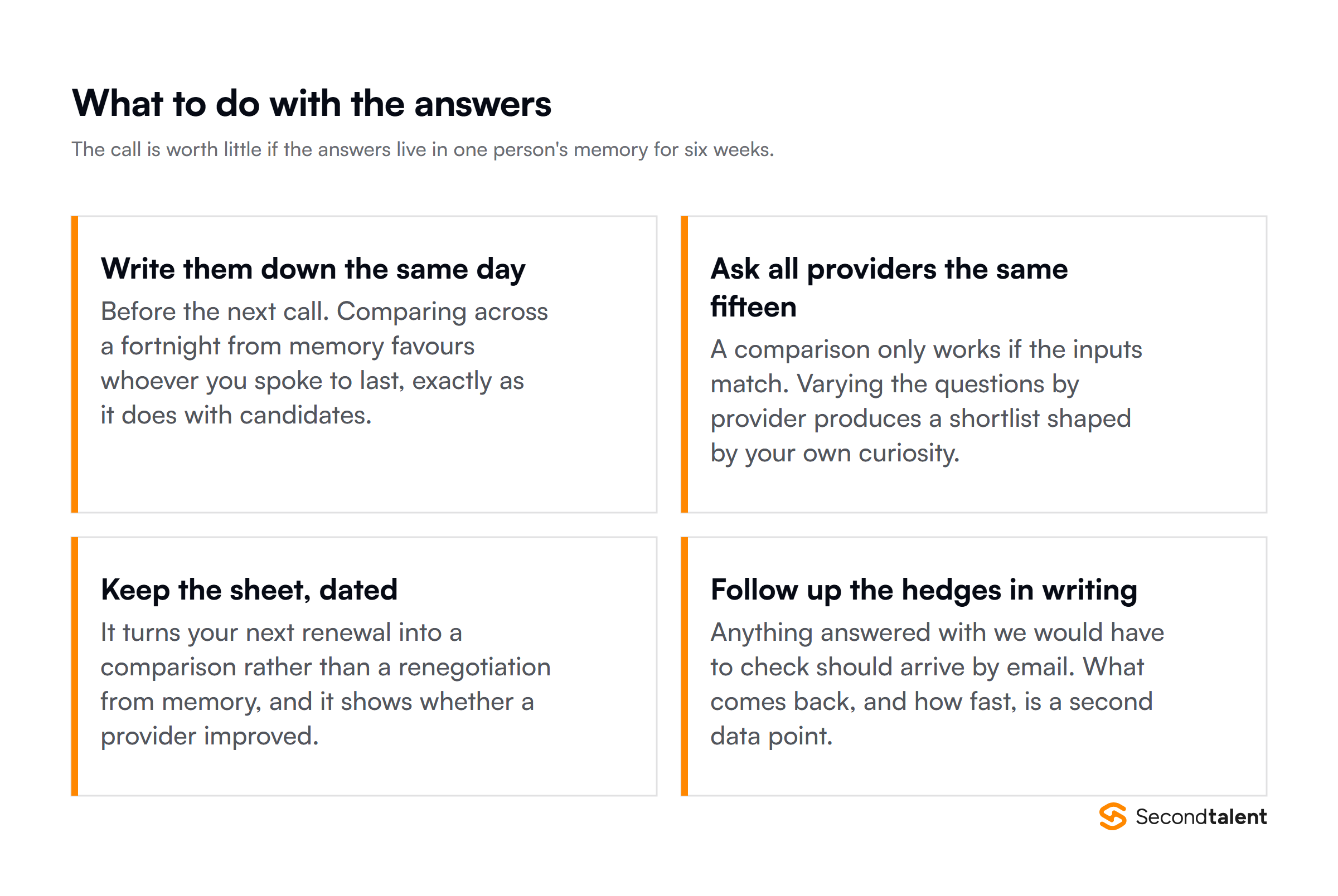
Write them down the same day, before the next call. Ask all providers the same fifteen, because a comparison only works if the inputs match. Keep the sheet dated, so your next renewal is a comparison rather than a renegotiation from memory.
Our checklist on evaluating IT staffing companies turns this into a scoring framework, and the RFP template covers running a formal process.
Questions 14 and 15 in more detail
The exit questions get skipped on a first call and they are the ones that decide what a bad outcome costs.
Notice and handover. How much notice, and is handover time billed on top or included? A provider who bills for handover has an incentive to make it lengthy, and one who offers none has an incentive to make it brief. Both are worth knowing before you need either.
What they return or destroy. Your data, your documentation, and confirmation that nothing survives on their side. Where personal data is involved this is not only good practice: GDPR Article 28 requires the processing terms to cover deletion or return at the end of the engagement.
Ask both even for a three-month engagement. The answers take a minute and the alternative is discovering them during a handover you are already unhappy about.
Provider question FAQs
How long does this take?
About an hour with a prepared provider. Longer with one who is improvising, and the extra time is itself informative.
Is it rude to ask about a placement that went badly?
No, and the answer is one of the most useful in the set. A provider operating for a few years has had placements fail. One who claims otherwise is either very new or not telling you, and the follow-up worth asking is what changed afterwards.
Should we send the questions in advance?
For most, yes, because you want considered answers rather than a memory test. Keep the delivery and exit questions for the call, since the reaction to those carries information a prepared response does not.
What if we only need one engineer?
Ask a shorter version: the employing entity, the replacement terms, twelve-month retention, and what sits outside the rate. Those four cover most of the risk on a single seat.
Takeaways
- Judge the shape of an answer, not whether it matches a number someone published.
- Ask in order: vetting, structure, commercial, delivery, exit.
- Three answers end the conversation: no named entity, no funnel data, skip your own screen.
- Follow every hedge up in writing. The response time is a second data point.
- Same fifteen for every provider, written down the same day, kept and dated.
Put them to us
Second Talent employs engineers through licensed local entities across Asia, matches within 24 hours, and reports 92 percent of placements still in seat a year later across more than 200 companies.
Book the call and ask all fifteen, or read how vetting funnels work so questions 1 to 3 land harder.