TL;DR: Worker classification decides who pays which taxes, who is owed which benefits, and who carries employment obligations when something goes wrong. Every major test turns on control, and staff augmentation is control by design: you assign the work, set the hours and review the output. That is why the arrangement cannot be made safe by contract language. It is made safe by the provider being the employer, through a named legal entity in the engineer’s country.
This is the compliance risk with the largest downside in cross-border IT staffing, because the cost sits entirely outside any rate comparison. This page covers the tests, what decides an augmentation engagement specifically, the four structures and where each puts the exposure, and what to verify before signature.
It is general information rather than legal advice. Classification is jurisdiction-specific and fact-specific, so take advice on your own arrangement.
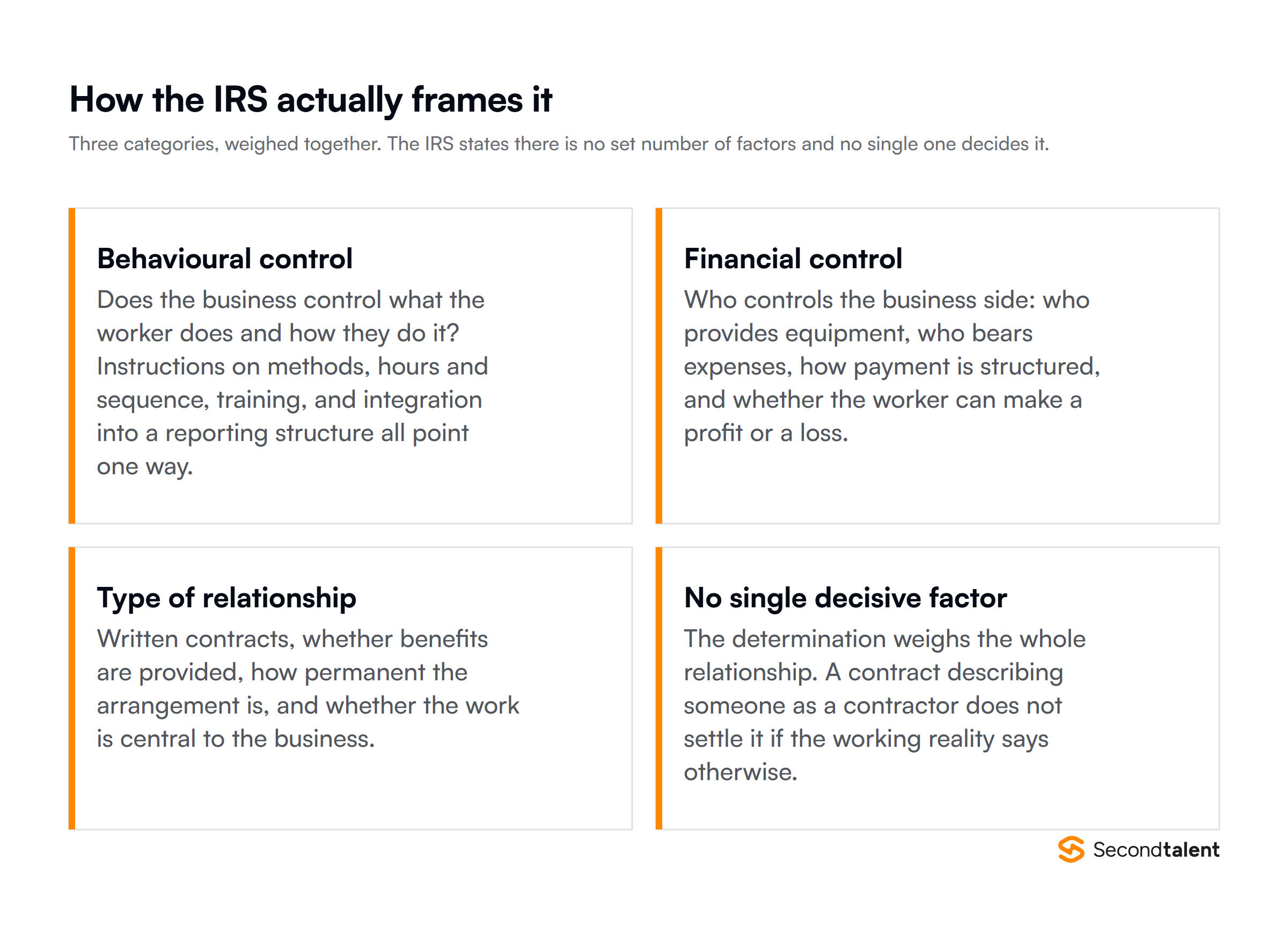
How the IRS actually frames it
Three categories, weighed together, with no fixed number of factors.
The IRS guidance on independent contractor versus employee status names behavioural control (does the business control what the worker does and how), financial control (who provides equipment, who bears expenses, how payment is structured, whether the worker can make a profit or loss), and type of relationship (written contracts, benefits, permanence, and whether the work is central to the business).
The IRS states plainly that there is no magic or set number of factors and that no single factor decides it. You will see this described elsewhere as a twenty-factor test, which is an older formulation. The current framing is the three categories above, weighed as a whole.
An earlier version of this page described a twenty-factor test. We have corrected it. In a compliance article the framing is the substance, and a test described with more precision than the authority itself uses can lead a reader to check boxes rather than weigh a relationship.
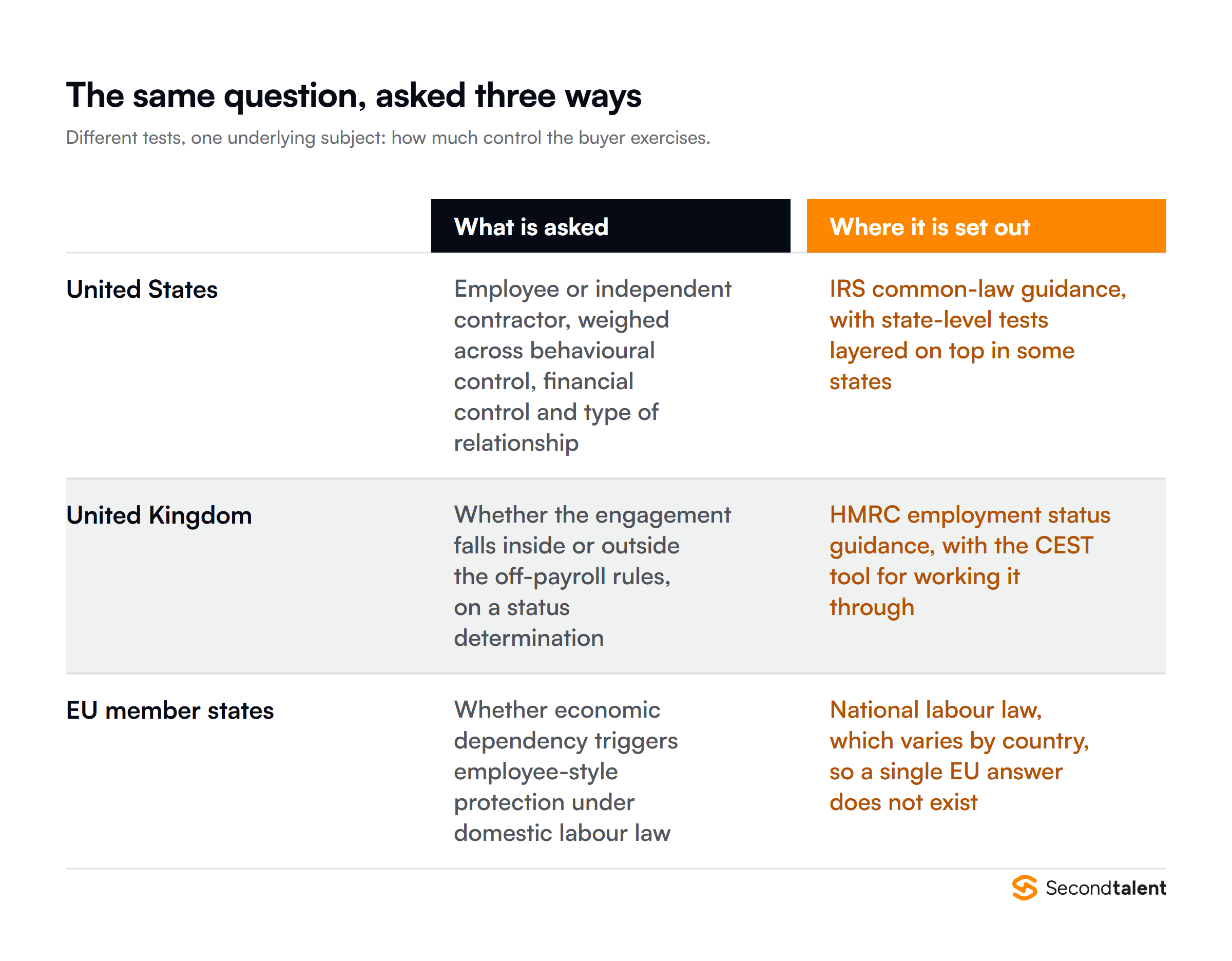
The same question, asked three ways
United States. Employee or independent contractor, weighed across the three categories above, with state-level tests layered on top in some states that can be stricter than the federal position.
United Kingdom. Whether an engagement falls inside or outside the off-payroll working rules, via a status determination. HMRC publishes the Employment Status Manual setting out how status is assessed, and the Check Employment Status for Tax tool for working a specific engagement through.
EU member states. Whether economic dependency triggers employee-style protection under domestic labour law. This varies by country, so there is no single EU answer and a structure that works in one member state may not in another.
Different tests, one underlying subject. All of them are asking how much control the buyer exercises.
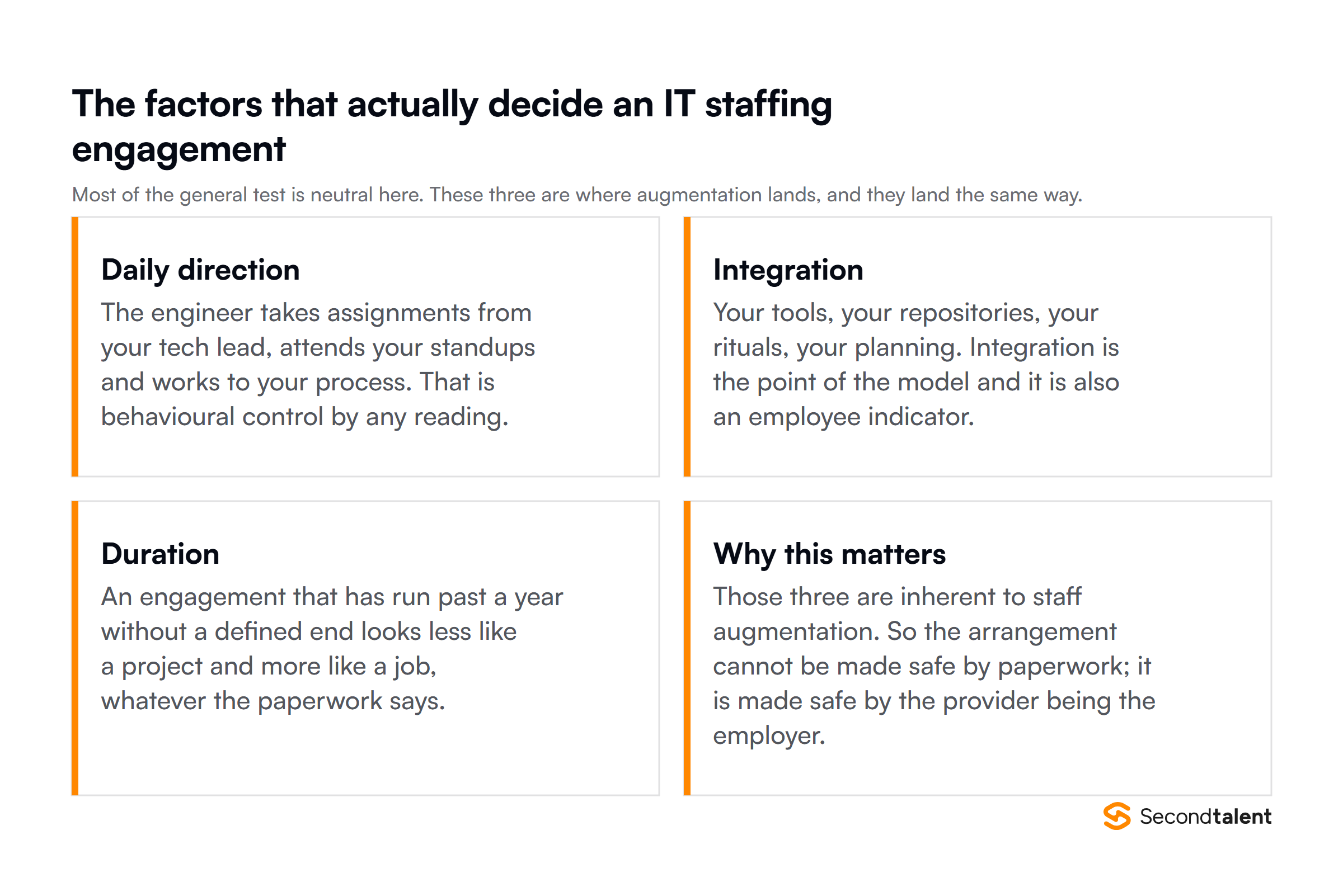
What decides an IT staffing engagement
Most of the general test is neutral for augmentation. Three factors are not, and they all land the same way.
Daily direction. The engineer takes assignments from your tech lead, attends your standups and follows your process. That is behavioural control on any reading.
Integration. Your tools, your repositories, your rituals, your planning. Integration is the point of the model and it is also an employee indicator.
Duration. An engagement running past a year with no defined end looks less like a project and more like a job.
Those three are inherent to staff augmentation rather than incidental to it. Which leads to the conclusion that matters: the arrangement cannot be made safe by paperwork describing the engineer as a contractor. It is made safe by the provider being the employer.
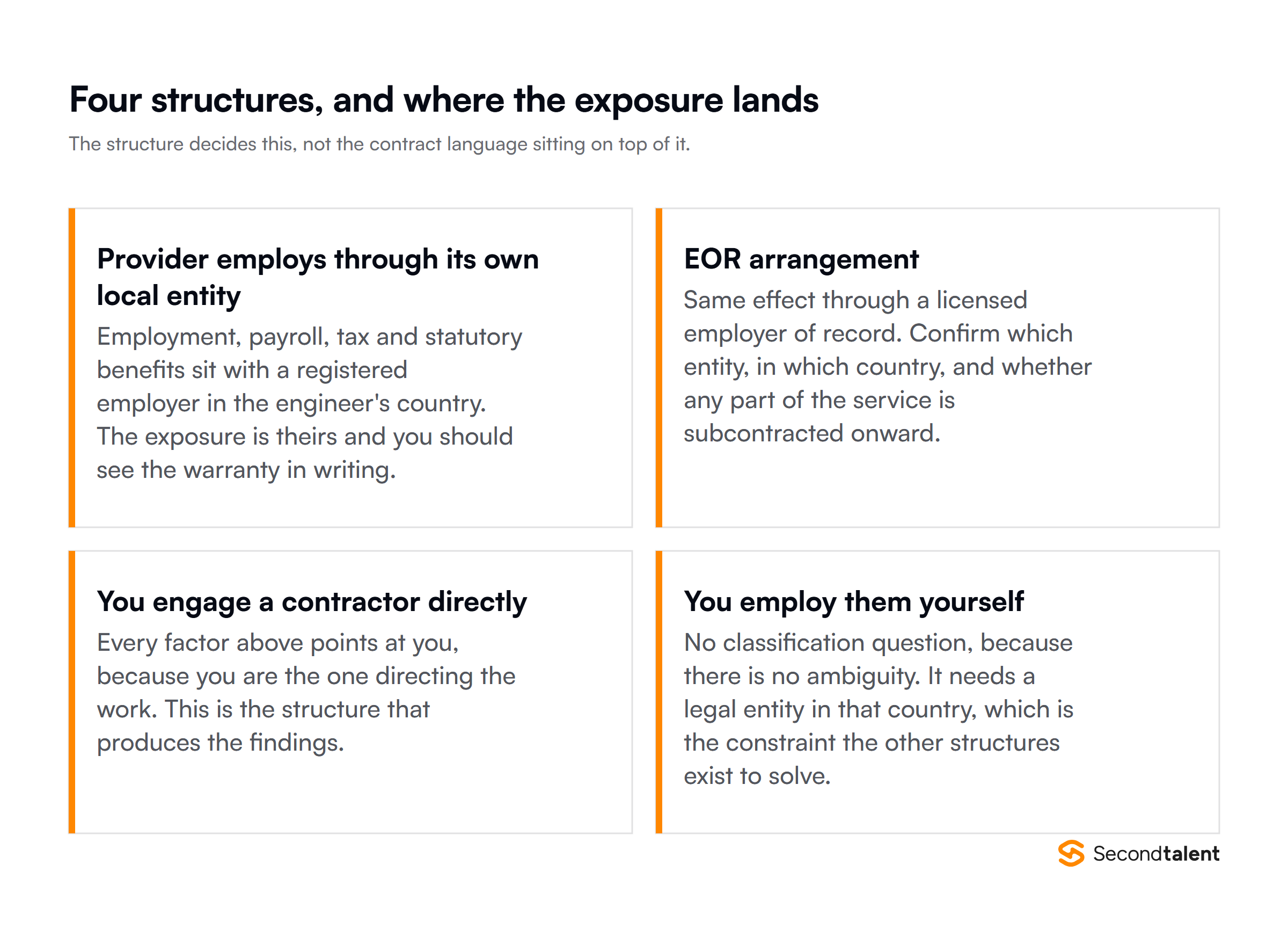
Four structures, and where the exposure lands
The provider employs through its own local entity. Employment, payroll, tax and statutory benefits sit with a registered employer in the engineer’s country. The exposure is theirs, and you should see that warranted in writing.
An EOR arrangement. The same effect through a licensed employer of record. Confirm which entity, in which country, and whether any part of the service is subcontracted onward.
You engage a contractor directly. Every decisive factor above points at you, because you are the one directing the work. This is the structure that produces findings.
You employ them yourself. No classification question at all, since there is no ambiguity. It requires a legal entity in that country, which is the constraint the other structures exist to solve.
The structure decides this. Contract language sitting on top of the wrong structure does not.
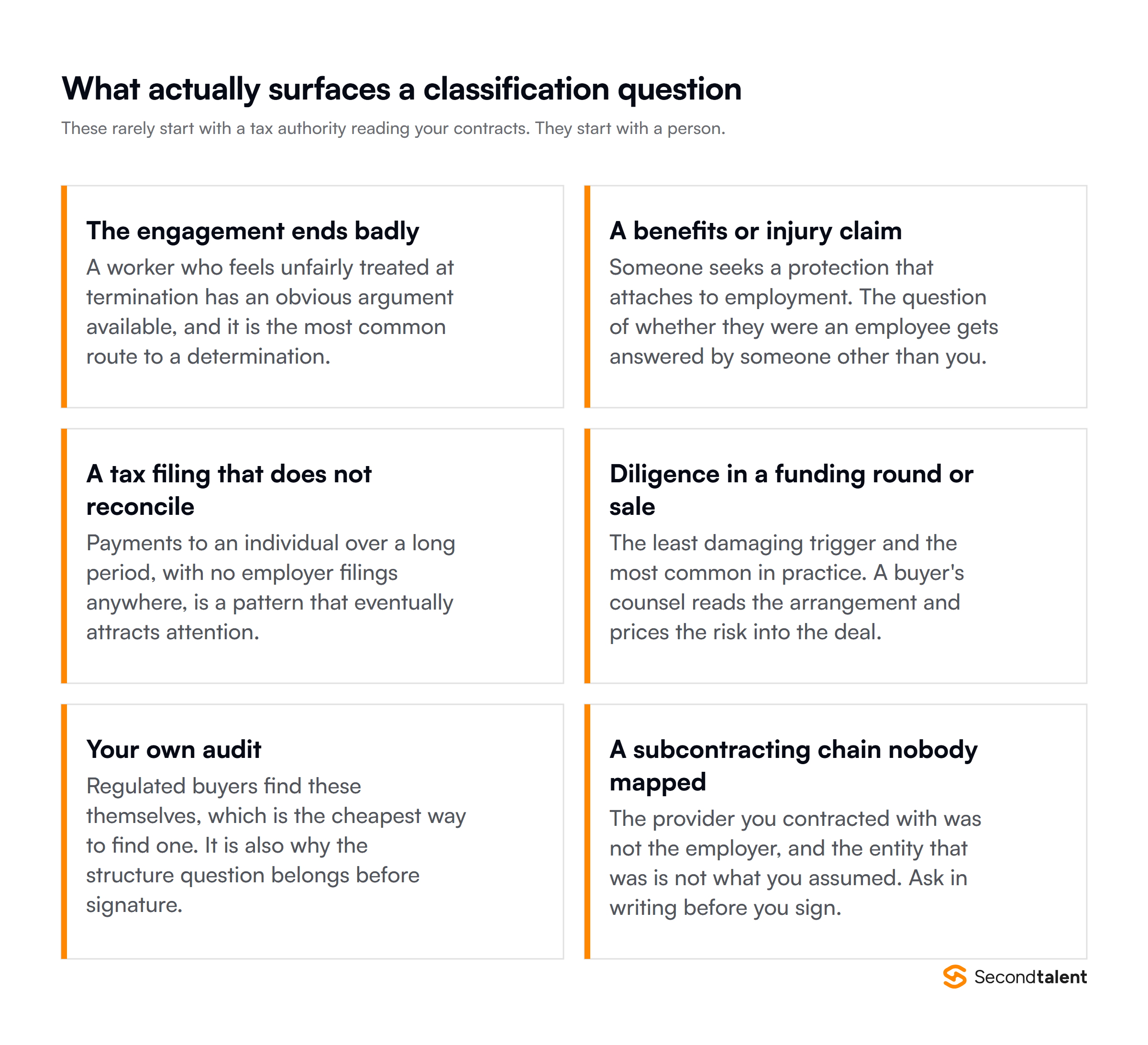
What actually surfaces a classification question
These rarely begin with a tax authority reading your contracts. They begin with a person.
The engagement ends badly. A worker who feels unfairly treated at termination has an obvious argument available, and this is the most common route to a determination.
A benefits or injury claim. Someone seeks a protection that attaches to employment, and the question gets answered by somebody other than you.
A tax filing that does not reconcile. Payments to an individual over a long period with no employer filings anywhere is a pattern that eventually attracts attention.
Diligence in a funding round or sale. The least damaging trigger and the most common in practice. Counsel reads the arrangement and prices the risk into the deal.
Your own audit. Regulated buyers find these themselves, which is the cheapest way to find one.
A subcontracting chain nobody mapped. The provider you contracted with was not the employer, and the entity that was is not what you assumed.
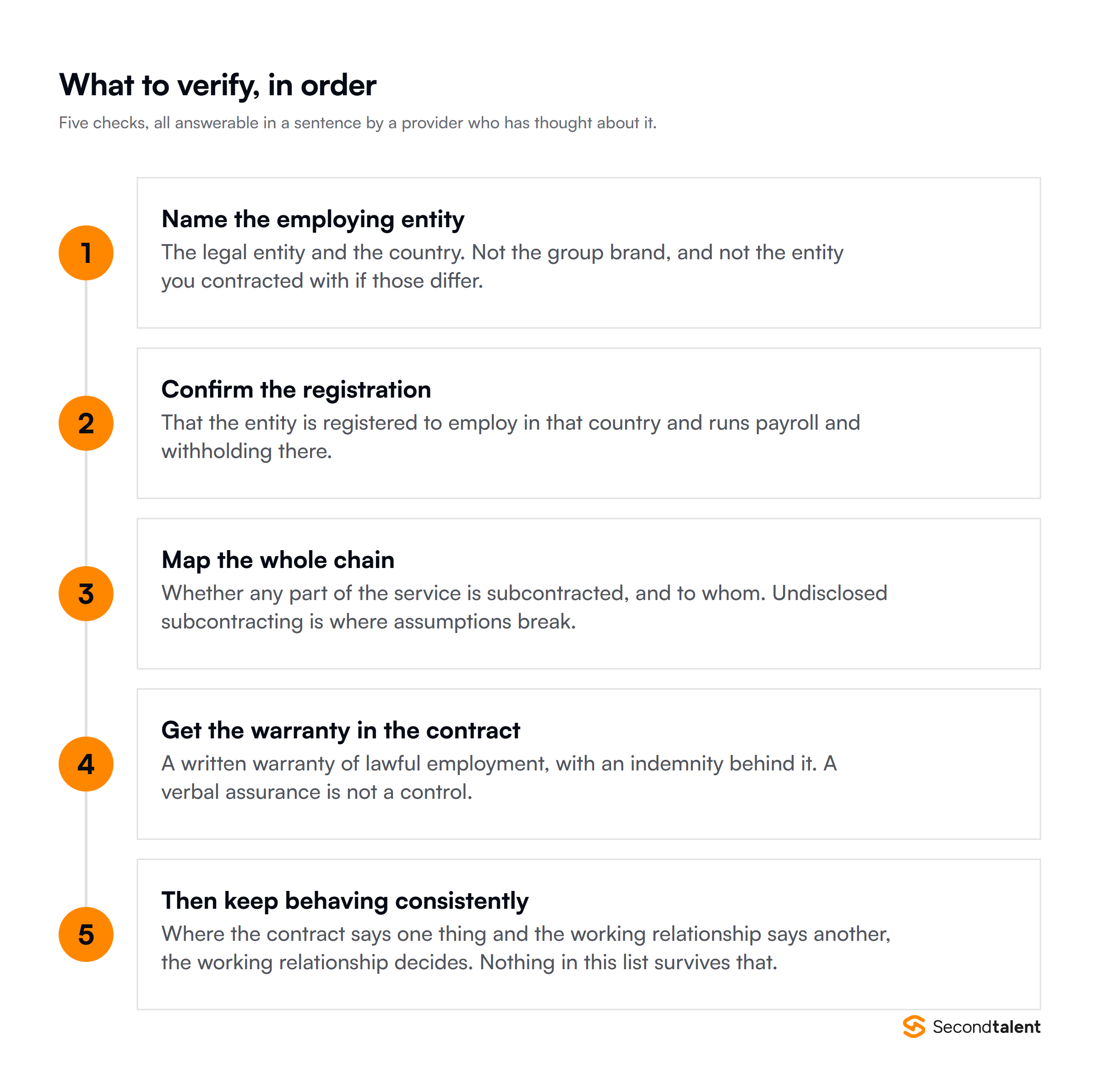
What to verify before signature
Five checks, all answerable in a sentence by a provider who has thought about it.
- Name the employing entity: the legal entity and the country, not the group brand.
- Confirm the registration: that the entity is registered to employ there and runs payroll and withholding.
- Map the whole chain: whether any part of the service is subcontracted, and to whom.
- Get the warranty in writing: lawful employment warranted in the contract, with an indemnity behind it.
- Then behave consistently: where the contract says one thing and the working relationship says another, the relationship decides.
That last point undoes the other four when ignored. A well-drafted agreement paired with a working arrangement that contradicts it protects nobody. Our breakdown of the 12 MSA clauses that shift risk covers the drafting, and the agreement template gives you a starting position.
The data-protection question that travels with it
Cross-border engagement raises a second compliance question that gets handled separately and usually later than it should.
Employing or engaging someone in another country means personal data about them moves across borders: identity documents, payroll data, right-to-work evidence, performance records. Where any of that touches the EU or UK, GDPR governs the basis and the retention, and European Data Protection Board guidance covers transfers outside the EEA.
Two questions cover most of it: which entity holds the employment records, and which countries that data moves through. A provider running a compliant employment structure has usually thought about both, and one that has not thought about the data question often has not thought carefully about the employment one either.
Where classification sits among your other risks
Buyers consistently overweight two concerns and underweight this one, which is worth naming because attention is the scarce resource in procurement.
Quality gets the most scrutiny and is largely fixed by keeping your own technical screen. Security gets the second most and is usually tighter under augmentation than the alternatives, because the engineer works inside your perimeter on your accounts.
Classification gets less attention than either and carries the only genuinely uncapped downside of the three. Back taxes, penalties and retrospective entitlements appear in no rate comparison and can exceed the value of the engagement that produced them.
The practical reallocation is small: one written question about the employing entity, asked before signature rather than after a claim.
What the exposure actually consists of
We are not going to quote an average cost per engineer, because we could not source one to a page that publishes it and a precise-sounding figure would add false confidence to a decision that deserves real advice.
What can be said is what the exposure is made of: unpaid employer taxes and social contributions over a lookback period, interest and penalties, back-dated benefits and leave entitlements, legal costs, and in some jurisdictions a right for the worker to claim employment protections retrospectively. The lookback period and penalty regime differ by country, which is why a single number would mislead anyway.
The asymmetry is the point. Getting the structure right costs the modest overhead of a compliant employer. Getting it wrong costs a multiple of the engagement, and it lands in a quarter you did not plan for. Our guide to staff augmentation risks and controls puts this alongside the other exposures.
Classification FAQs
What if we inherited an arrangement that looks wrong?
Fix it forward rather than papering over it. Moving an existing engagement onto a compliant employment structure is a normal thing to do and providers handle it routinely. What makes it worse is continuing while adding contract language asserting the arrangement was always fine, since that documents awareness without changing the facts a test would weigh.
Take advice on the specific engagement before you restructure, because the right sequence depends on jurisdiction and on how long it has run.
Does a contractor agreement protect us?
Not on its own. Every test weighs the working relationship, and the type-of-relationship category treats a written agreement as one factor among several rather than as the answer.
Does using an EOR eliminate the risk?
It moves employment to a licensed local employer, which is the structural fix. It does not licence you to behave inconsistently with the arrangement, and it does not cover a provider who subcontracts without telling you.
Is there a duration after which a contractor becomes an employee?
No automatic threshold in most jurisdictions, but duration is a factor in every test. A multi-year engagement with no defined end weighs heavily toward employment regardless of what anyone signed.
Who is liable, us or the provider?
It depends on the structure and jurisdiction, and joint liability is possible. That is precisely why the employing entity question belongs before signature rather than after a claim.
Takeaways
- Every test turns on control, and augmentation is control by design.
- The IRS names three categories and says no set number of factors decides it.
- Structure fixes this. Contract language on the wrong structure does not.
- Name the employing entity and map the subcontracting chain before signature.
- Disputes usually start with a person, not with an auditor reading contracts.
Remove the question structurally
Second Talent employs engineers through licensed local entities across Asia, so the entity, country and chain questions above have a one-sentence answer.
Ask us those questions, or read what IT staffing is for how the employment structure sits under each engagement model.