TL;DR: Managing an augmented engineer is mostly just managing an engineer. Two things make the ordinary practices load-bearing rather than optional: much of the work is async, and the engagement has a known end date. Weekly written one-to-ones, a review turnaround you commit to, outcomes rather than hours, and a 30/60/90 plan written before they start. Give feedback in week two, not month two.
Augmentation engineers are team members for the duration, with the management overhead that implies. This is the practical playbook, and it pairs with building a distributed engineering org, which covers the same ground at organisation scale.
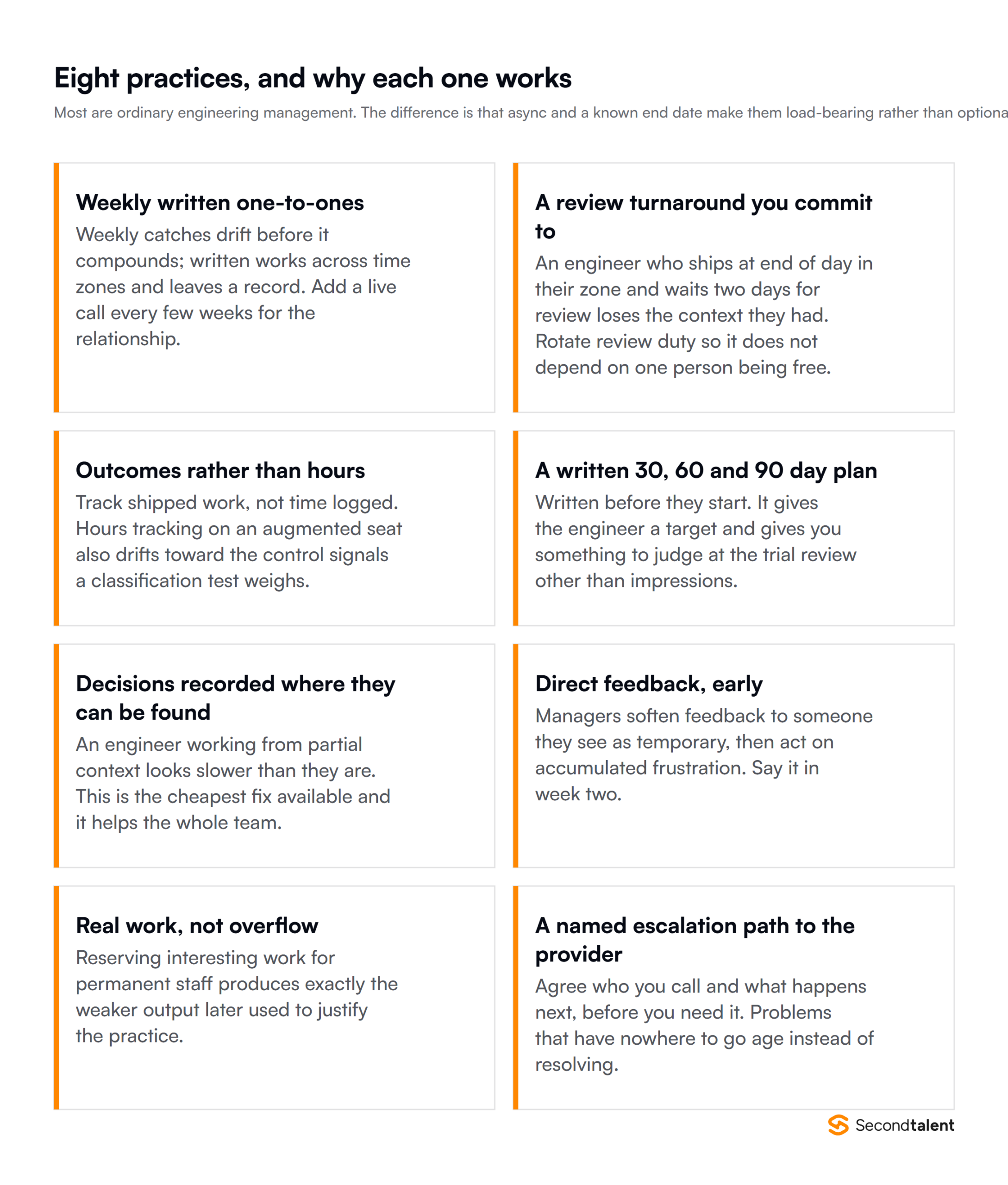
Eight practices worth adopting
None of these are novel. What makes them matter here is that async work and a fixed end date remove the slack that lets ordinary teams get away without them.
Weekly written one-to-ones. Weekly catches drift before it compounds, and written works across time zones while leaving a record. Add a live conversation every few weeks for the relationship, which writing does not replace.
A review turnaround you commit to. An engineer who ships at end of day in their zone and waits two days for review has lost the context they had. Rotate review duty so it does not depend on one person being free.
Outcomes rather than hours. Track shipped work rather than time logged. On an augmented seat this matters for a second reason: hours tracking drifts toward the control signals the IRS common-law test weighs, and the HMRC CEST tool asks the same question in UK terms.
A written 30, 60 and 90 day plan. Written before they start, so the engineer has a target and you have something to judge at the trial review other than an impression.
Decisions recorded where they can be found. An engineer working from partial context looks slower than they are. This is the cheapest fix available and it improves the co-located half of the team too.
Direct feedback, early. Managers soften feedback to someone they see as temporary, then act on accumulated frustration three months later. Say it in week two.
Real work, not overflow. Reserving interesting work for permanent staff produces exactly the weaker output later used to justify the practice.
A named escalation path to the provider. Agree who you call and what happens next, before you need it.
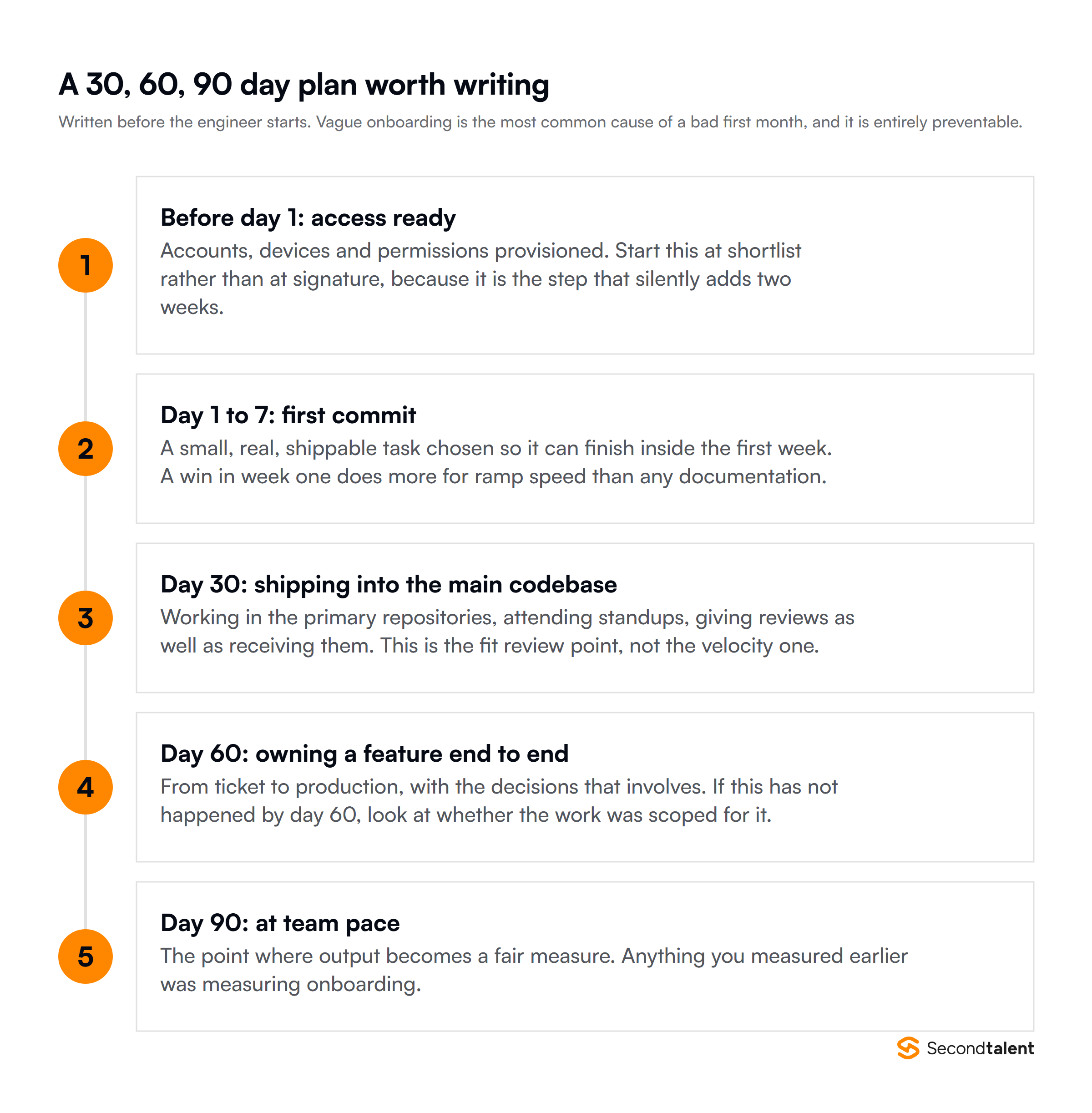
The 30, 60, 90 day plan
Vague onboarding is the most common cause of a poor first month and the most preventable.
Before day one: accounts, devices and permissions ready. Start provisioning at shortlist rather than at signature, because it is the step that silently adds two weeks.
Day one to seven: a small, real, shippable task scoped to finish inside the week. A win in week one does more for ramp speed than any volume of documentation.
Day 30: shipping into the main codebase, attending standups, giving reviews as well as receiving them. This is the fit review point rather than the velocity one.
Day 60: owning a feature end to end, from ticket to production. If that has not happened, check whether the work was scoped to allow it before concluding anything about the engineer.
Day 90: at team pace, and the first point where output is a fair measure. Anything measured earlier was measuring onboarding.
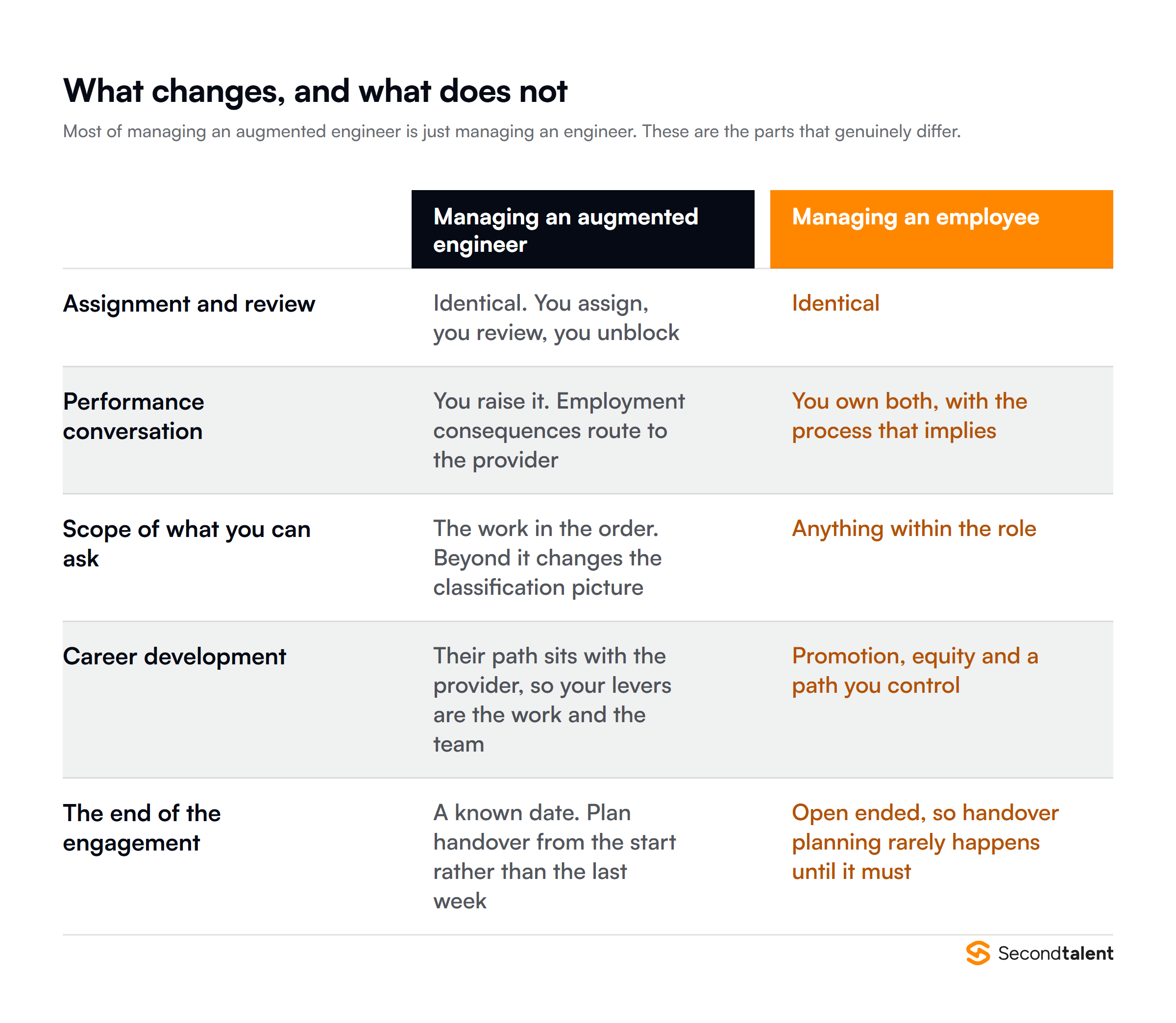
What actually differs from managing an employee
Assignment, review and unblocking are identical. Four things are not.
The performance conversation. You raise it as you would with anyone. Employment consequences route to the provider, which removes work from you and also removes some visibility.
What you can ask. The work in the order. Beyond it changes the classification picture, since control is what those tests weigh. Our guide to worker classification in cross-border IT staffing covers why.
Career development. Their path sits with the provider, so your levers are the work and the team rather than promotion or equity.
The ending. It has a known date, which is an advantage if you use it. Plan handover from the start rather than in the last week.
The most common management failure is softened feedback. Managers hesitate to give hard feedback to someone they think of as temporary, so a small correctable problem in week two becomes a decision not to renew in month five. The engineer never got the chance to fix it, the provider never heard about it, and everyone concludes the placement was poor. Say it early.
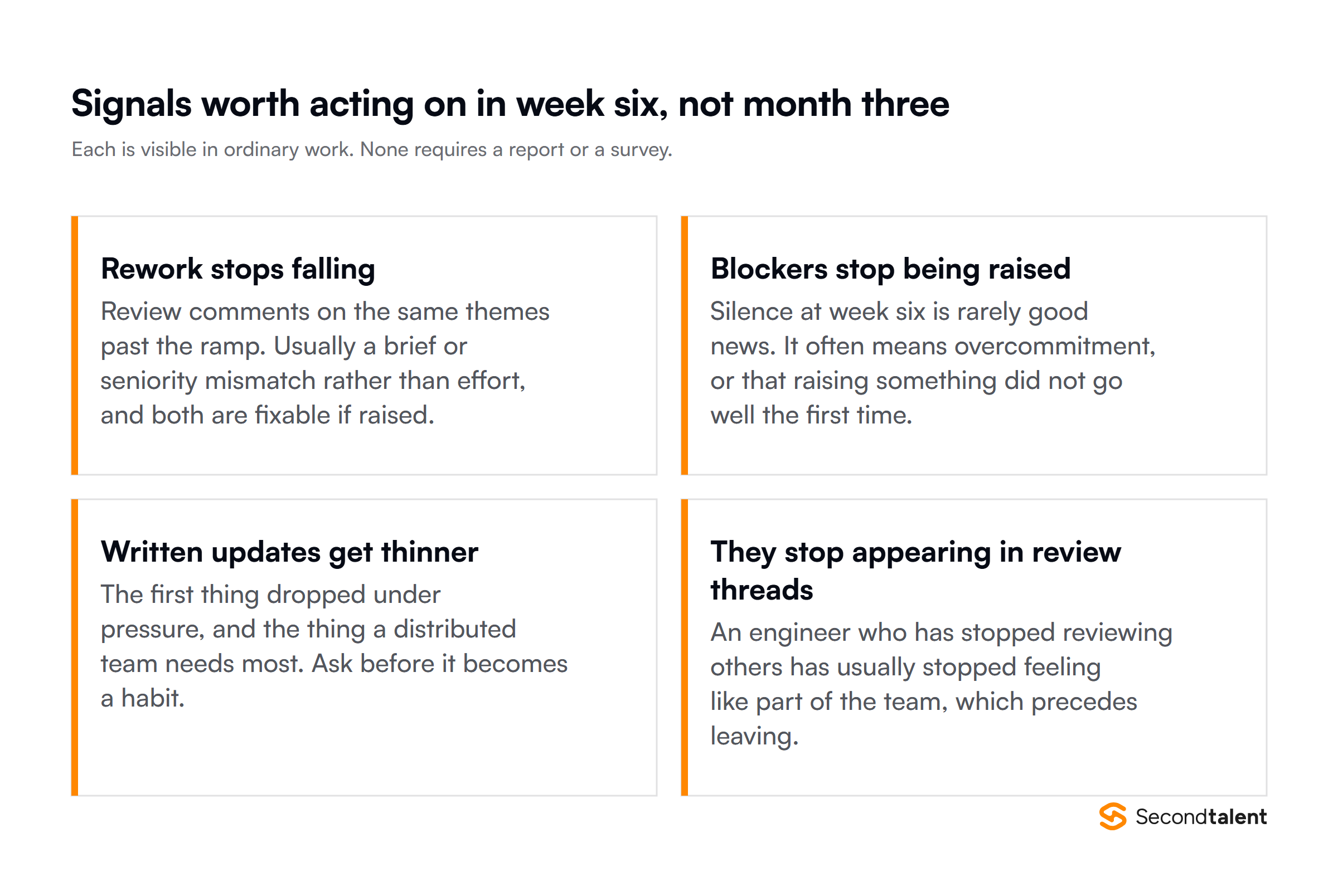
Signals worth acting on early
Four things are visible in ordinary work and precede problems by weeks.
Rework stops falling past the ramp, with review comments returning to the same themes. Usually a brief or seniority mismatch rather than effort, and both are fixable when raised.
Blockers stop being raised. Silence at week six is rarely good news, and often means overcommitment or that raising something did not go well the first time.
Written updates get thinner. The first thing dropped under delivery pressure and the thing a distributed team needs most.
They stop appearing in review threads. An engineer who has stopped reviewing others has usually stopped feeling like part of the team, and that tends to precede leaving.
The mistakes that cost most
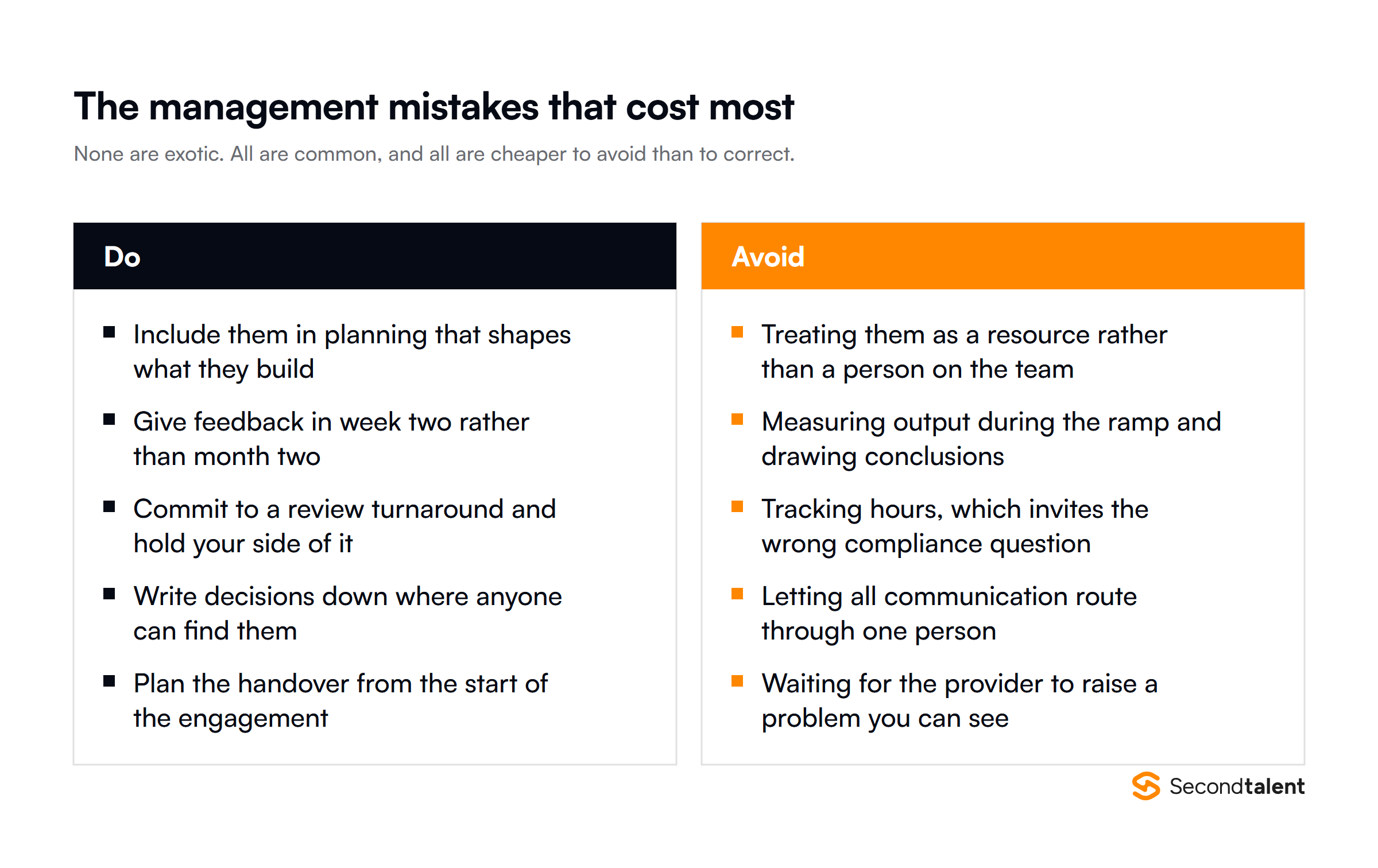
Do: include them in planning that shapes what they build, give feedback in week two, commit to a review turnaround and hold your side of it, write decisions down, and plan the handover from the start.
Avoid: treating them as a resource rather than a person, measuring output during the ramp and drawing conclusions, tracking hours, letting all communication route through one person, and waiting for the provider to raise a problem you can already see.
That last one is worth dwelling on. Providers act on what you tell them. A manager who watches a placement decline for two months and then reports it has removed the provider’s ability to help.
Managing the end
The engagement has a date. Teams still improvise this part, and it is the easiest to get right.
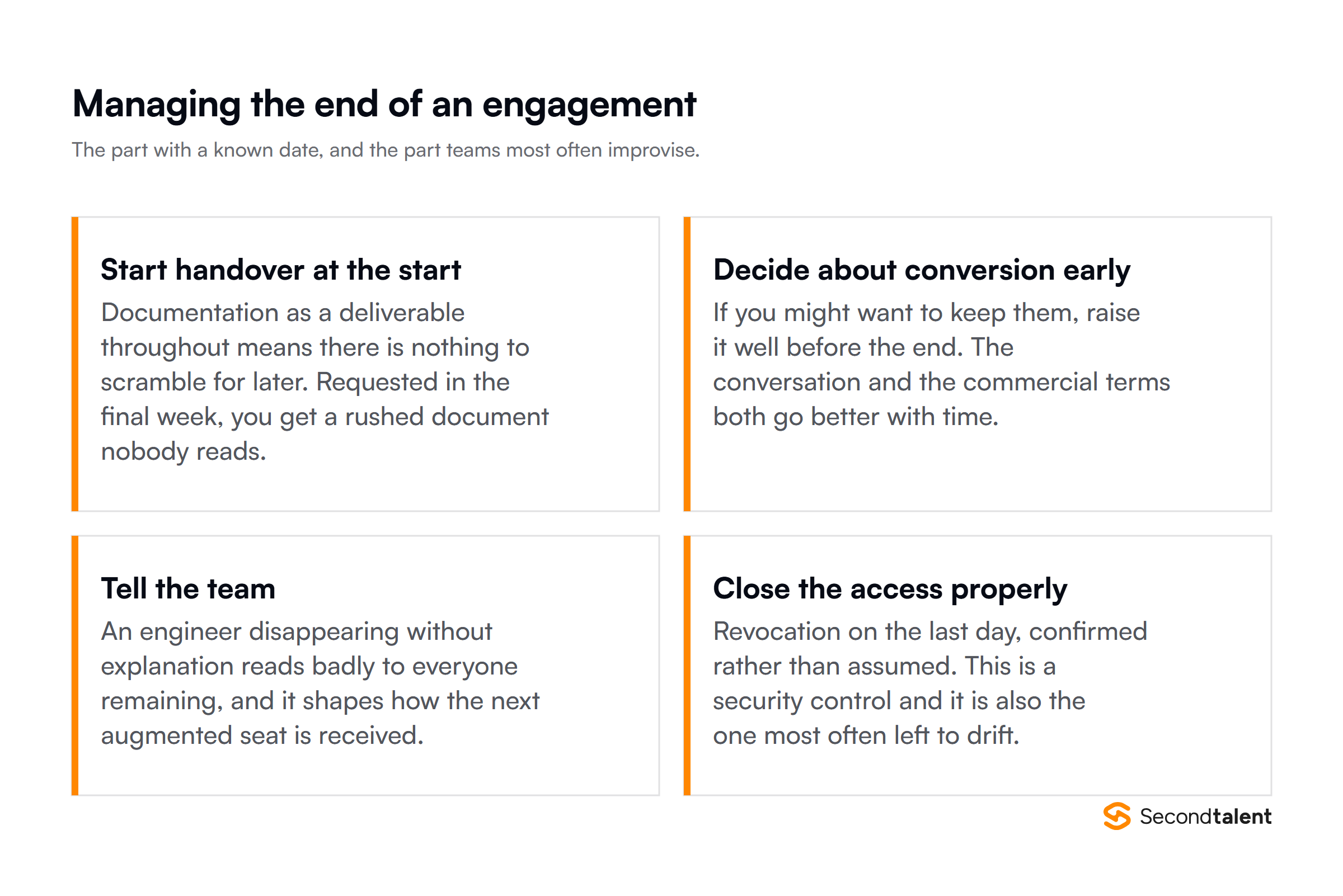
Start handover at the start. Documentation as a deliverable throughout means nothing to scramble for later. Requested in the final week, you get a rushed document nobody reads.
Decide about conversion early. If you might want to keep them, raise it well before the end. Both the conversation and the commercial terms go better with time, as covered in contract, contract-to-hire and direct hire.
Tell the team. An engineer disappearing without explanation reads badly to everyone remaining and shapes how the next augmented seat is received.
Close access properly. Revocation on the last day, confirmed rather than assumed.
What to screen for, since you inherit the result
Management gets harder when the brief was weak, so a word on the upstream step you also control.
Test judgment rather than tool familiarity. The 2025 Stack Overflow Developer Survey found 84 percent of developers use or plan to use AI tools, with 50.6 percent of professionals using them daily, so a CV listing them describes the majority. The same survey found 46 percent distrust the accuracy of the output against 33 percent who trust it, and experienced developers are the most sceptical.
That gap is what you manage around later. An engineer who accepts plausible generated code without verification produces review load rather than throughput, and no amount of weekly one-to-ones fixes it after the fact.
Our guide to AI-native skills assessment covers the screen, and how vetting funnels work covers what the provider should have done first.
Where the seats you manage are hardest to fill
Worth knowing which of your seats will be difficult to replace, because it changes how much effort a retention conversation deserves.
The US Bureau of Labor Statistics projects data scientist employment to grow 34 percent between 2024 and 2034 and information security analysts 29 percent, against roughly 4 percent across all occupations.
For a seat in that band, an engineer who leaves mid-engagement costs you a search, a ramp and a delivery slip. That is the seat where the practices above pay for themselves several times over, and where an unspoken frustration in week two is genuinely expensive by month five.
Managing across time zones
Where overlap is short, the practices above are the only management available. There is no informal channel to fall back on.
Decide who moves before the engagement starts. An overlap window both sides assumed the other would cover exists on paper and gets attended by nobody. Two hours that reliably happen beat four that do not.
Then protect that window for the things that need it: unblocking, decisions and the occasional live conversation. Status does not need it, because status should be readable without a meeting. Our comparison of onshore, nearshore and offshore covers working the overlap out.
Working with the provider, not around them
The provider relationship is a management tool most buyers underuse, treating it as procurement rather than as part of running the seat.
Set a cadence. A short monthly conversation about how the engagement is going beats an annual review and an escalation. It also means the provider hears about small things while they are still small.
Share your side honestly. If your onboarding was thin or the brief moved, say so. A provider who thinks the engineer underperformed will act on that, and acting on a wrong diagnosis costs you the replacement and the ramp.
Ask what they see. Providers talk to their engineers about the engagement, and they hear things you do not. A provider who says everything is fine every month is not passing anything on.
Give them notice of change. A roadmap shift that changes what a seat needs is worth flagging early. Rebriefing an engineer is cheap; replacing one is not.
Our checklist on evaluating IT staffing companies covers what to look for in a provider who can operate this way.
Managing augmentation FAQs
Should augmented engineers attend all our meetings?
The ones that shape what they build, yes. Meetings that exist for organisational reasons, no, and the same is arguably true for your employees. Excluding them from planning while expecting ownership is the combination that does not work.
How do we handle underperformance?
Raise it directly and early, in writing, with specifics. Give the engineer a real chance to correct it. If it does not improve, that is when the provider and the replacement terms come in, and they will act faster on a documented account than on a general impression.
Can we include them in team rituals and social events?
Yes, and it helps. The line to watch is anything implying employment, such as performance review cycles that feed your own promotion process or benefits that only employees receive.
Who gives them career feedback?
You give feedback on the work, because you are the one seeing it. The provider handles progression, and a good one will ask you for input. Feedback that never leaves your head helps nobody.
Takeaways
- Mostly ordinary engineering management, made load-bearing by async and a fixed end date.
- Give feedback in week two. Softened feedback is the most common failure here.
- Track outcomes, not hours. Hours tracking invites the wrong compliance question.
- Judge fit at day 30 and output from day 90. Earlier measurement measures onboarding.
- Plan the handover from the start, because you know the date.
Start with an engineer worth managing well
Second Talent places pre-vetted senior engineers across Asia with EOR cover, matched within 24 hours at 92 percent twelve-month retention.
Tell us which seat you need to fill, or read staff augmentation risks and controls for what to put in place around the engagement.