TL;DR: “Which IT staffing vendor should we use” is the wrong question. Six vendor categories exist, each built around a different operating model, and your constraint usually eliminates four of them before you speak to anyone. Pick the category first, then compare three vendors inside it on the same questions in the same week. This page describes the categories and gives you the method; it does not rank named firms.
Vendor comparison content in this category is mostly written by vendors, which is worth holding in mind while reading any of it, including this. It pairs with how to evaluate IT staffing companies, which covers the scoring.
Disclosure, and what changed here. Second Talent operates in one of the six categories below. An earlier version of this page ranked named competitors and made specific claims about their rates and employment structures that we cannot substantiate about another company. Those are gone. What remains describes how each category is built, so you can compare the model rather than take our word about a rival.
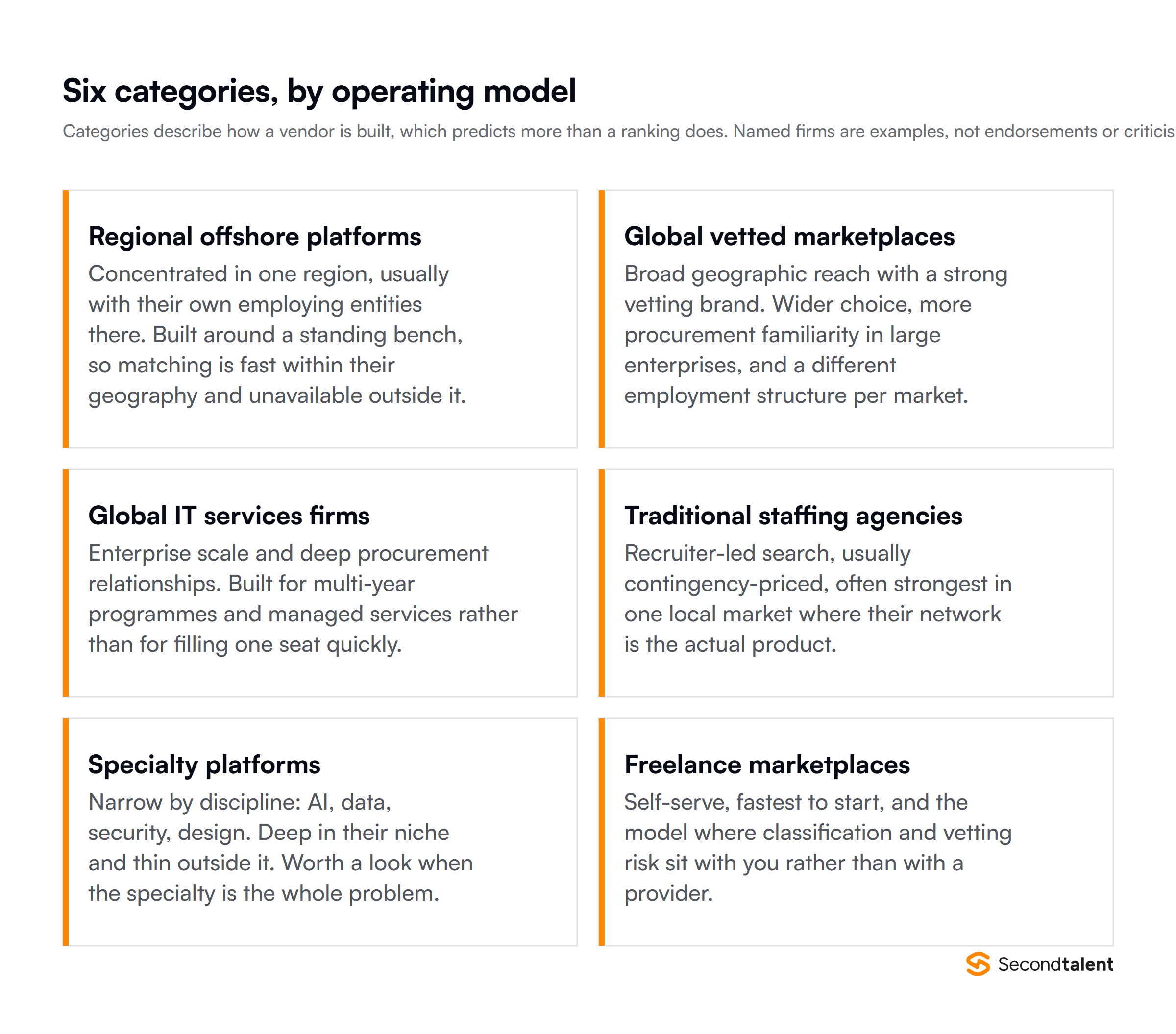
The six categories
Regional offshore platforms. Concentrated in one region, usually with their own employing entities there, built around a standing bench. Fast within their geography and unavailable outside it.
Global vetted marketplaces. Broad geographic reach and a recognisable vetting brand. Wider choice, more familiarity in enterprise procurement, and employment structures that differ by market.
Global IT services firms. Enterprise scale and deep procurement relationships, built for multi-year programmes rather than for filling one seat quickly.
Traditional staffing agencies. Recruiter-led search, usually contingency-priced, often strongest in one local market where the network is the actual product.
Specialty platforms. Narrow by discipline. Deep in their niche and thin outside it.
Freelance marketplaces. Self-serve and fastest to start, and the model where vetting and classification risk sit with you rather than a provider.
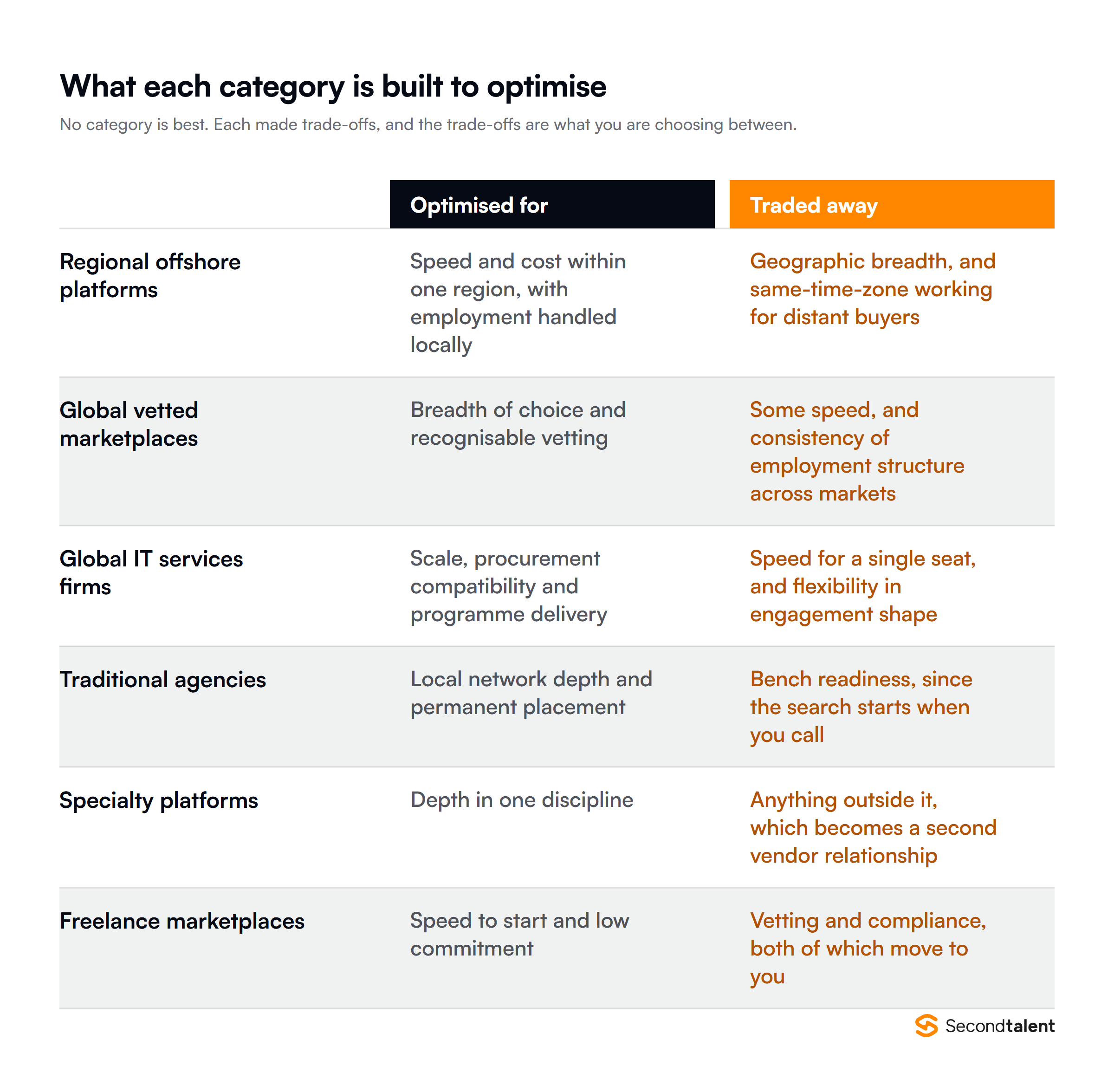
What each category traded away
No category is best. Each made trade-offs, and those are what you are actually choosing between.
Regional offshore platforms optimise speed and cost inside one region and trade geographic breadth. Global marketplaces optimise choice and trade some speed. Services firms optimise scale and procurement compatibility and trade speed for a single seat. Agencies optimise local network depth and trade bench readiness, since their search starts when you call.
Specialty platforms optimise depth in one discipline and trade everything outside it, which becomes a second vendor relationship. Freelance marketplaces optimise speed to start and trade vetting and compliance, both of which move to you.
Read those as descriptions of design decisions rather than as criticism. A firm built for multi-year programmes being slow at filling one seat is that firm working correctly.
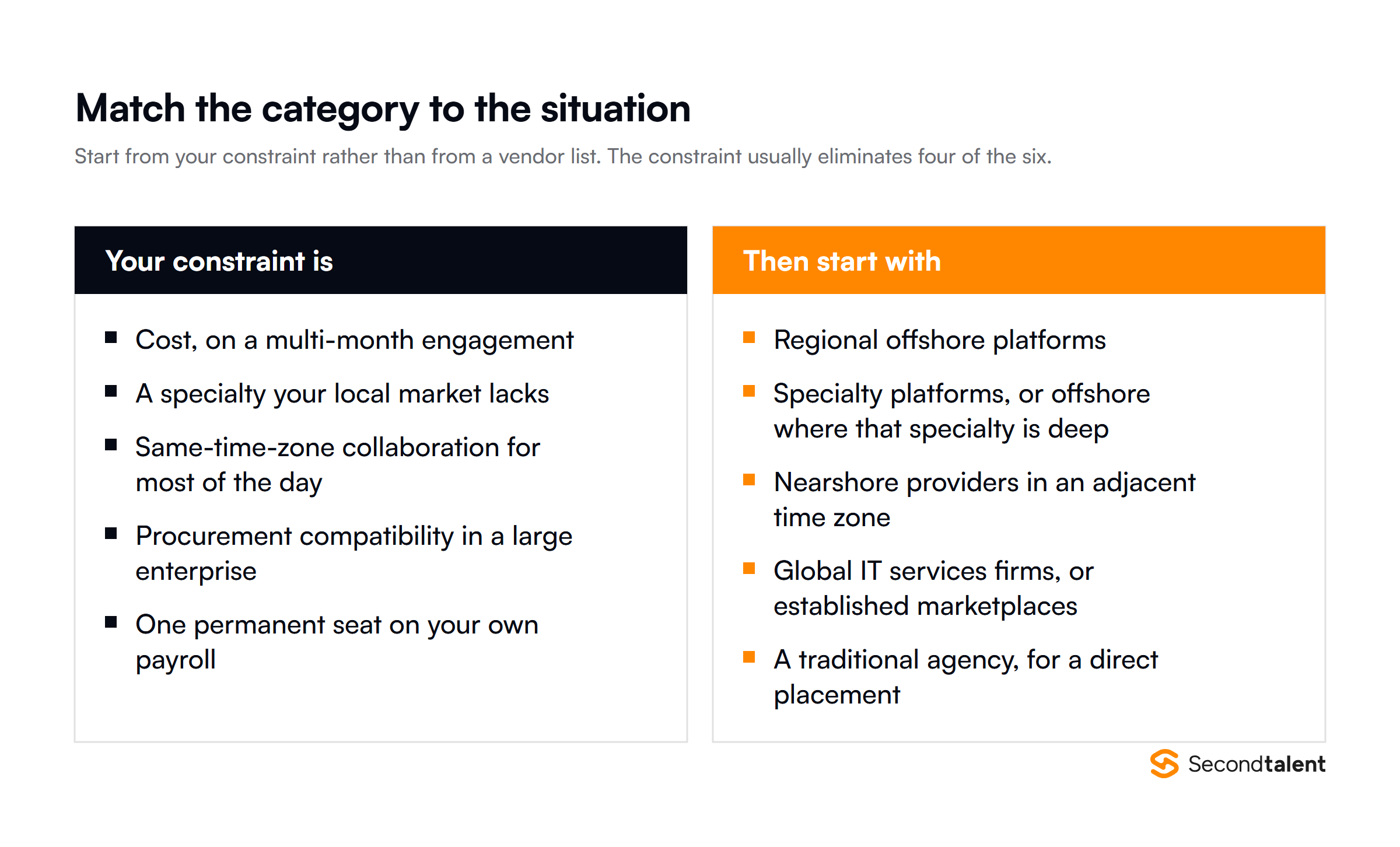
Start from your constraint
Naming your binding constraint eliminates most of the list before you talk to anyone.
If cost on a multi-month engagement is the constraint, start with regional offshore platforms. If it is a specialty your local market lacks, start with specialty platforms or an offshore market where that specialty runs deep. If it is same-time-zone collaboration for most of the day, start nearshore. If it is procurement compatibility inside a large enterprise, start with services firms or established marketplaces. If you want one permanent seat on your own payroll, start with a traditional agency.
Our comparison of onshore, nearshore and offshore covers the geography decision, and staff augmentation versus managed services covers whether you want to keep directing the work.
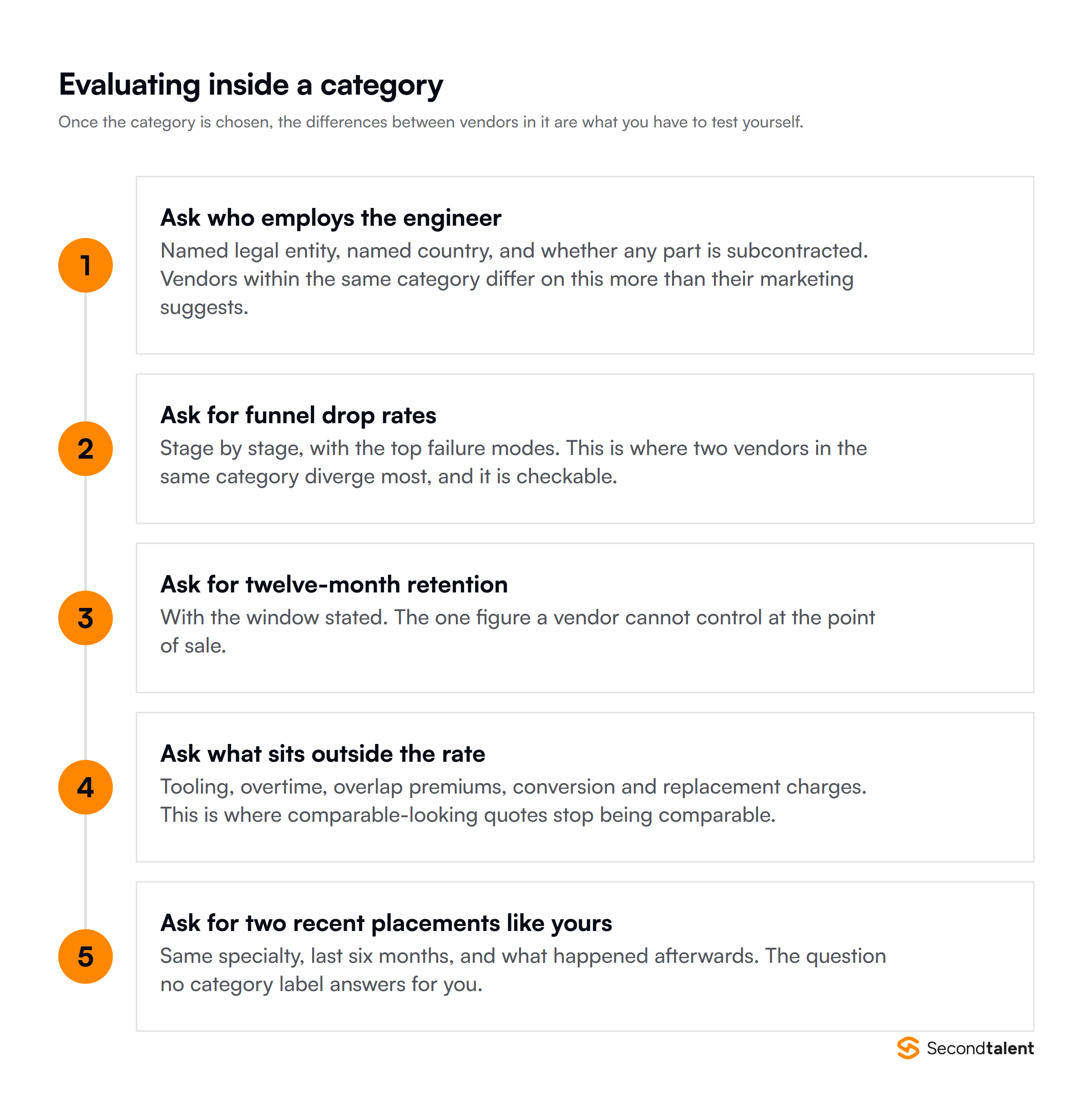
Evaluating inside a category
Category tells you how a vendor is built. It does not tell you whether a particular one is good, and vendors within a category differ more than their marketing suggests.
Five questions do the work: who employs the engineer and where, funnel drop rates stage by stage, twelve-month retention with the window stated, what sits outside the rate, and two recent placements in your specialty with what happened afterwards.
The employment question deserves particular attention because it is not a category property. Vendors that look similar can differ on whether they hold their own entities, and that decides where classification exposure sits. The IRS common-law test and the HMRC CEST tool both turn on control, so ask each vendor directly rather than inferring from their category. Our guide to worker classification in cross-border IT staffing covers why.
Our list of 15 questions to ask before you sign extends these into a full call.
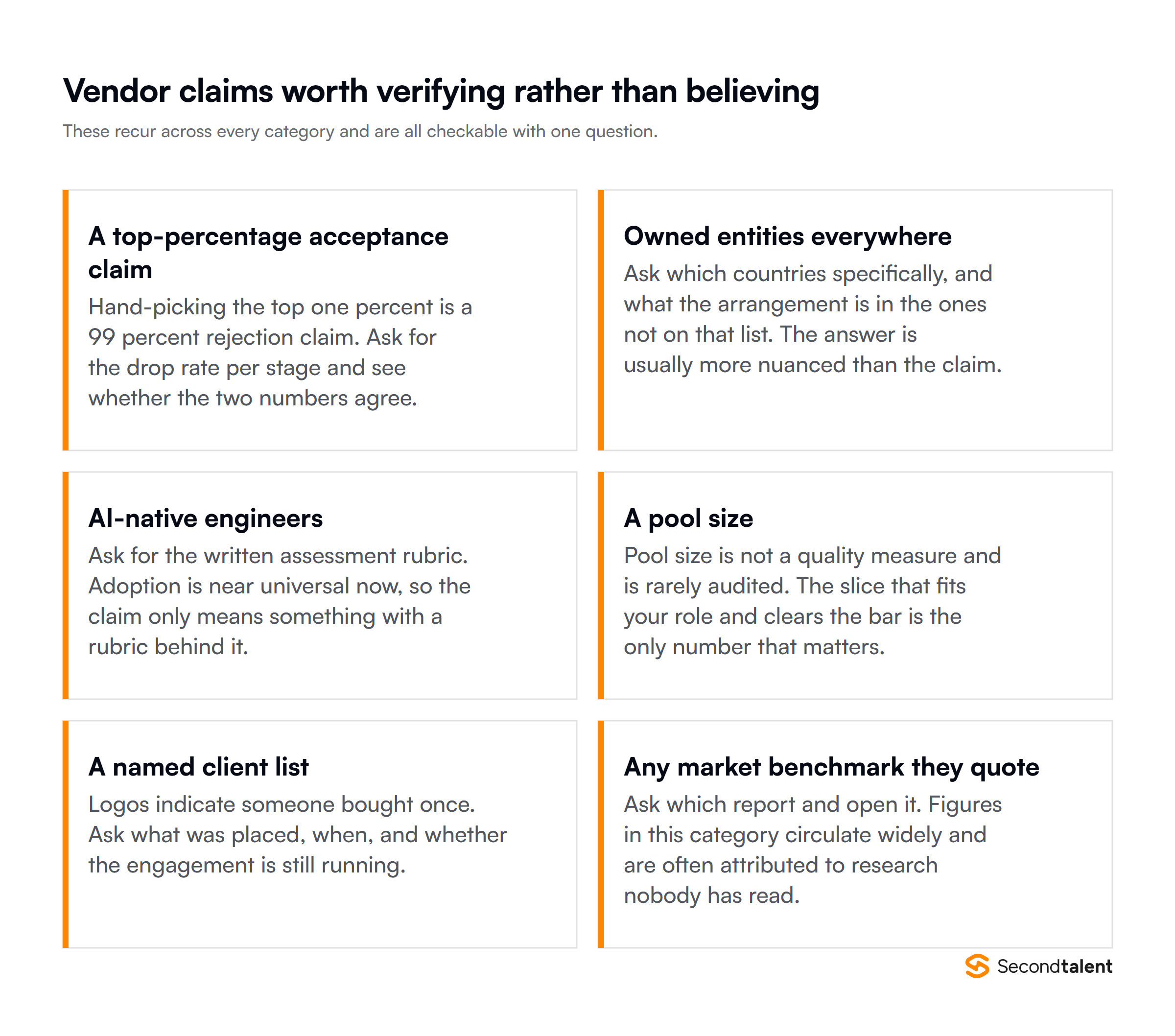
Claims worth verifying rather than believing
These recur across every category and each is checkable with one follow-up question.
A top-percentage acceptance claim. Hand-picking the top one percent is a 99 percent rejection claim. Ask for the drop rate per stage and see whether the two agree.
Owned entities everywhere. Ask which countries specifically, and what the arrangement is in the ones not on that list.
AI-native engineers. Ask for the written rubric. The 2025 Stack Overflow Developer Survey found 84 percent of developers use or plan to use AI tools, so the claim only means something with an assessment behind it.
A pool size. Not a quality measure and rarely audited. The slice that fits your role and clears the bar is the only number that matters.
A logo wall. Logos indicate someone bought once. Ask what was placed, when, and whether it is still running.
Any market benchmark. Ask which report and open it. Figures in this category circulate widely and are frequently attributed to research nobody has read.
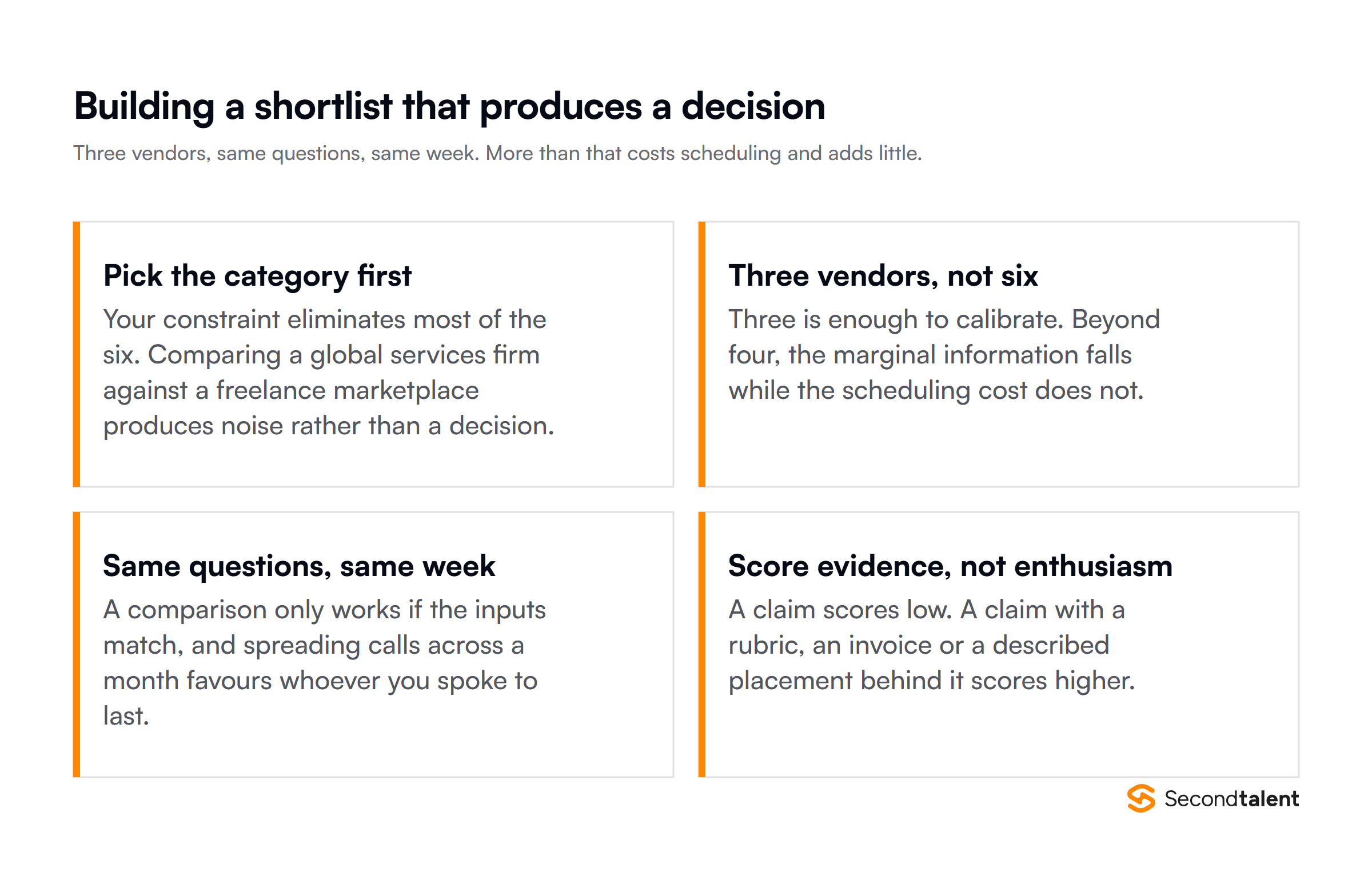
Building a shortlist
Pick the category first, take three vendors, ask the same questions in the same week, and score evidence rather than enthusiasm.
Three is enough to calibrate. Beyond four the marginal information drops while the scheduling cost does not, and comparing across categories produces noise rather than a decision.
Keep the dated sheet. It turns your next renewal into a comparison rather than a renegotiation from memory, and it shows you whether a vendor improved or you simply got used to them.
One practical note on scheduling: book all three calls before you take the first. Vendors who learn they are in a competitive process behave differently, and you want that to be true for everyone rather than only for whoever you spoke to last.
Reading vendor comparison content, including this
Almost every comparison in this category is published by a participant, which is not disqualifying and is worth accounting for.
Three tells are reliable. The author’s category wins. If a comparison concludes in favour of the model its publisher operates, the framework was probably chosen after the conclusion. Competitor weaknesses are specific and unsourced. Precise negative claims about another company’s rates or structure are rarely verifiable and rarely challenged. The scorecard matches one vendor’s feature list. If the criteria for a good answer read like a product page, they were.
Apply all three to this page. Our category is named in the disclosure, the competitor claims that used to be here are gone, and the evaluation questions are ones we can be asked as easily as anyone.
The general defence is cheap: ask three vendors from your chosen category the same questions and compare their answers rather than anyone’s write-up. A comparison you ran yourself beats every published one, including this.
Where the market context actually helps
Two pieces of market data are worth carrying into a vendor conversation, and neither is a ranking.
The market is fragmented rather than dominated by a few firms, which means brand recognition carries less signal here than in most software categories and shortlisting genuinely matters. Mordor Intelligence sizes IT staffing at $127.75 billion for 2026 with Asia Pacific growing fastest at 8.15 percent a year, against 3.61 percent for the market overall.
And demand concentrates in specific roles. The US Bureau of Labor Statistics projects data scientist employment to grow 34 percent between 2024 and 2034 and information security analysts 29 percent, against roughly 4 percent across all occupations. For those seats, ask any vendor in any category to show recent placements rather than describe capability.
How the categories are converging
The boundaries are less clean than the list implies, in three ways worth knowing.
Large agencies run bench models. Established staffing firms have operated contract divisions with standing benches for decades, so the category describes an operating model rather than a company. The same firm can appear in two rows.
Services firms now sell augmentation. Enterprise firms built for programme delivery increasingly offer individual placement, which can be excellent and is priced by an organisation whose economics were built for something else.
Everyone claims the AI category. The label has become free to use, which means it no longer carries information. What distinguishes vendors now is whether an assessment rubric exists behind the claim.
Use the categories to generate questions rather than to pre-sort vendors. A weak vendor in a well-suited category will still cost you a quarter.
Vendor selection FAQs
Why does this page not name and rank vendors?
Because we are one of them, and a ranking published by a participant tells you about the participant. We can describe how the categories are built, since that is public and checkable. We cannot fairly assess a competitor’s vetting funnel, retention or employment structure, because we do not have that information and neither does anyone writing a comparison from the outside.
What we can give you is the method to find out, applied identically to every vendor including us. That is worth more than a ranking, and it is the part a competitor cannot dispute.
Should we always get three quotes?
For anything beyond a single short engagement, yes. Not mainly for price, but because a comparison is the only way to calibrate whether an answer is good. One vendor’s answers sound reasonable in isolation.
Does vendor size predict quality?
No. It predicts procurement compatibility and bench depth. Quality tracks the funnel and the retention figure, which are properties of a specific vendor rather than of their size.
Can we mix vendors across categories?
Yes, and larger teams commonly do: one for capacity, another for a specialty, a third for local permanent hiring. Keep one register of which engagement sits with whom, on what terms, with which renewal date.
How often should we re-run this?
At each renewal for your existing vendor, and roughly annually for the category view. Rates reset, benches change, and the retention figure that persuaded you is a year old by the time you renew.
Takeaways
- Pick the category from your constraint. It usually eliminates four of the six.
- Category describes how a vendor is built, not whether a specific one is good.
- Ask who employs the engineer directly. It is not a category property.
- Verify the recurring claims: acceptance rate, owned entities, AI rubric, pool size.
- Three vendors, same questions, same week, evidence over enthusiasm.
Put the questions to us
Second Talent sits in the regional offshore platform category: licensed local entities across Asia, a standing vetted bench, 24-hour matching and 92 percent twelve-month retention.
Ask us the five questions, and ask two other vendors the same ones in the same week.