TL;DR: Staff augmentation carries eight risks worth naming: misclassification, mid-engagement churn, scope creep, knowledge loss at exit, IP assignment that does not hold, vendor concentration, overlap that never materialises, and undisclosed subcontracting. Almost every control is a contract term, which makes them cheap now and expensive to retrofit. Misclassification has the largest downside, because back taxes and penalties appear in no rate comparison and are big enough to invert one.
The mature approach is not to avoid these risks but to name them up front and put a control against each. This is the practical companion to the benefits of staff augmentation, and it is deliberately the less comfortable half.
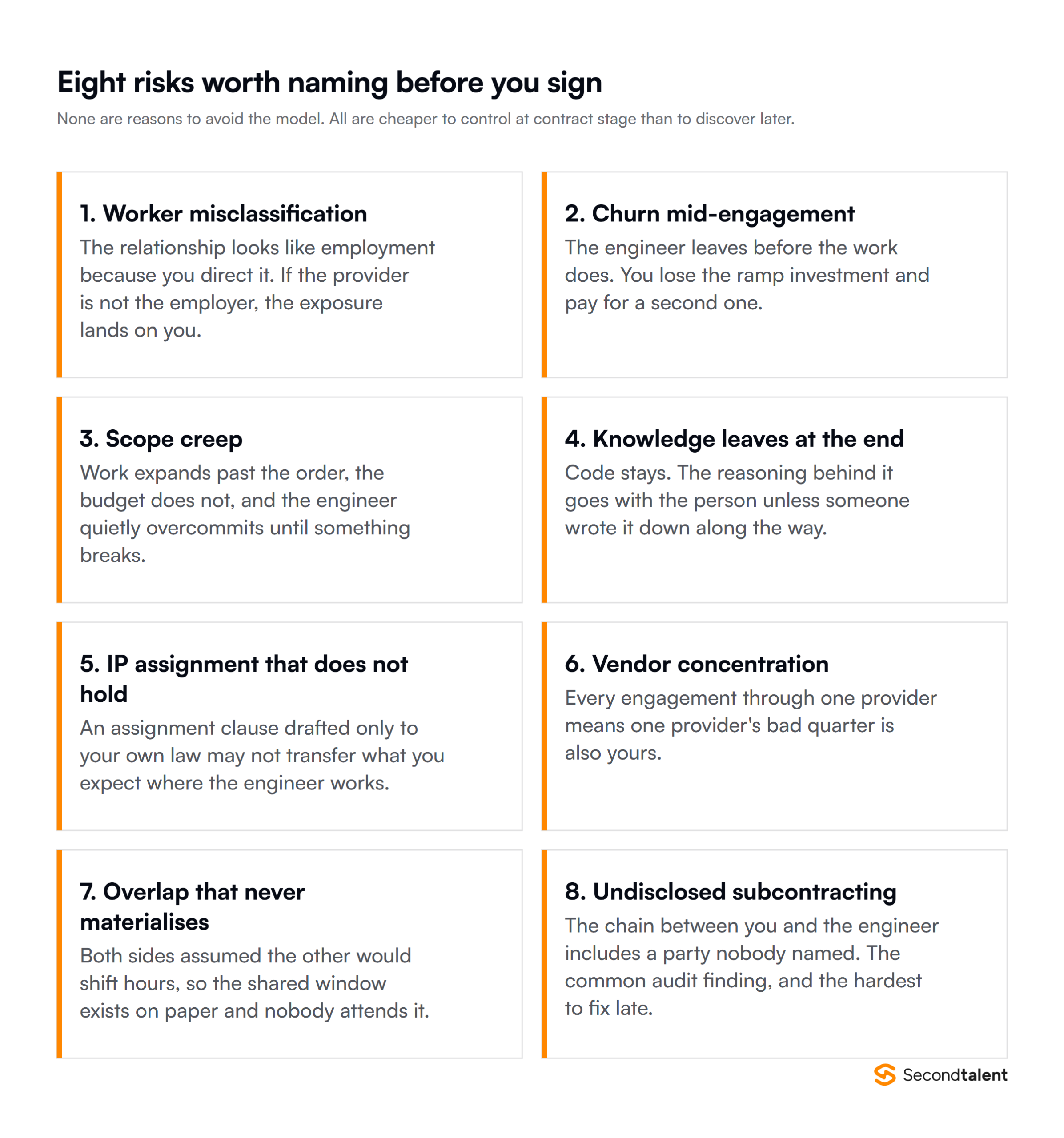
What are the main risks of staff augmentation?
Eight recur often enough to plan for, and they fall into three groups.
Compliance risks: misclassification, IP assignment that does not hold in the engineer’s jurisdiction, and undisclosed subcontracting.
Delivery risks: churn mid-engagement, scope creep, knowledge leaving at the end, and overlap that exists on paper but not in practice.
Portfolio risk: vendor concentration, which only appears once you are running enough seats for one provider’s problems to become yours.
Risk 1: worker misclassification
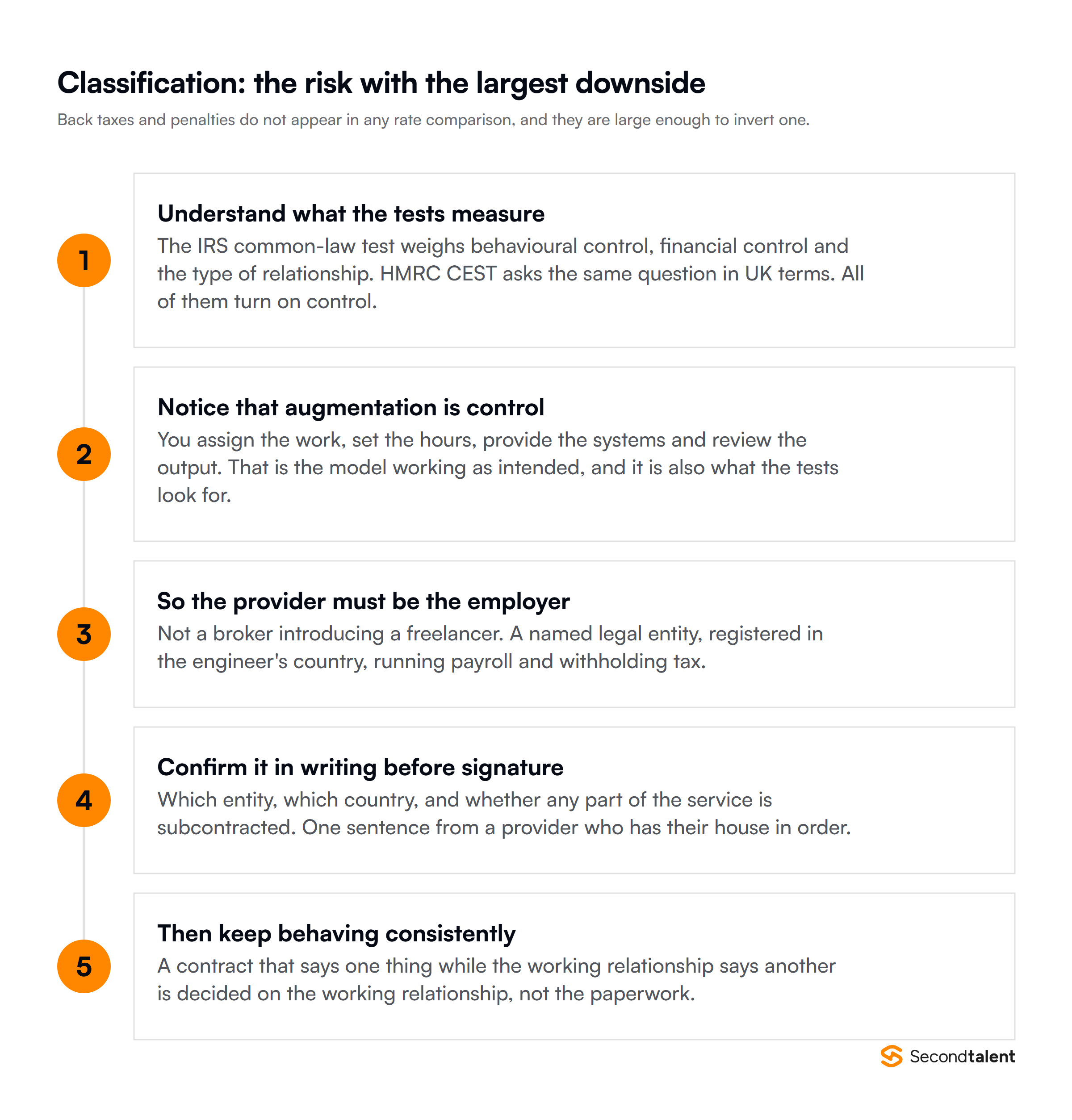
This one has the largest downside, and the mechanism is worth understanding rather than memorising.
The IRS common-law test weighs behavioural control, financial control and the type of relationship. The HMRC CEST tool asks the same question in UK terms. Both turn on control.
Now notice what staff augmentation is. You assign the work, set the hours, provide the systems and review the output. That is the model working as designed, and it is also precisely what those tests look for.
The control. The provider must be the employer through a named legal entity registered in the engineer’s country, not a broker introducing a freelancer. Confirm which entity, which country, and whether any part is subcontracted, in writing, before signature.
Then keep behaving consistently. Where a contract says one thing and the working relationship says another, the working relationship decides. Our guide to worker classification in cross-border IT staffing covers the detail.
Risks 2 to 5: the delivery and contract risks
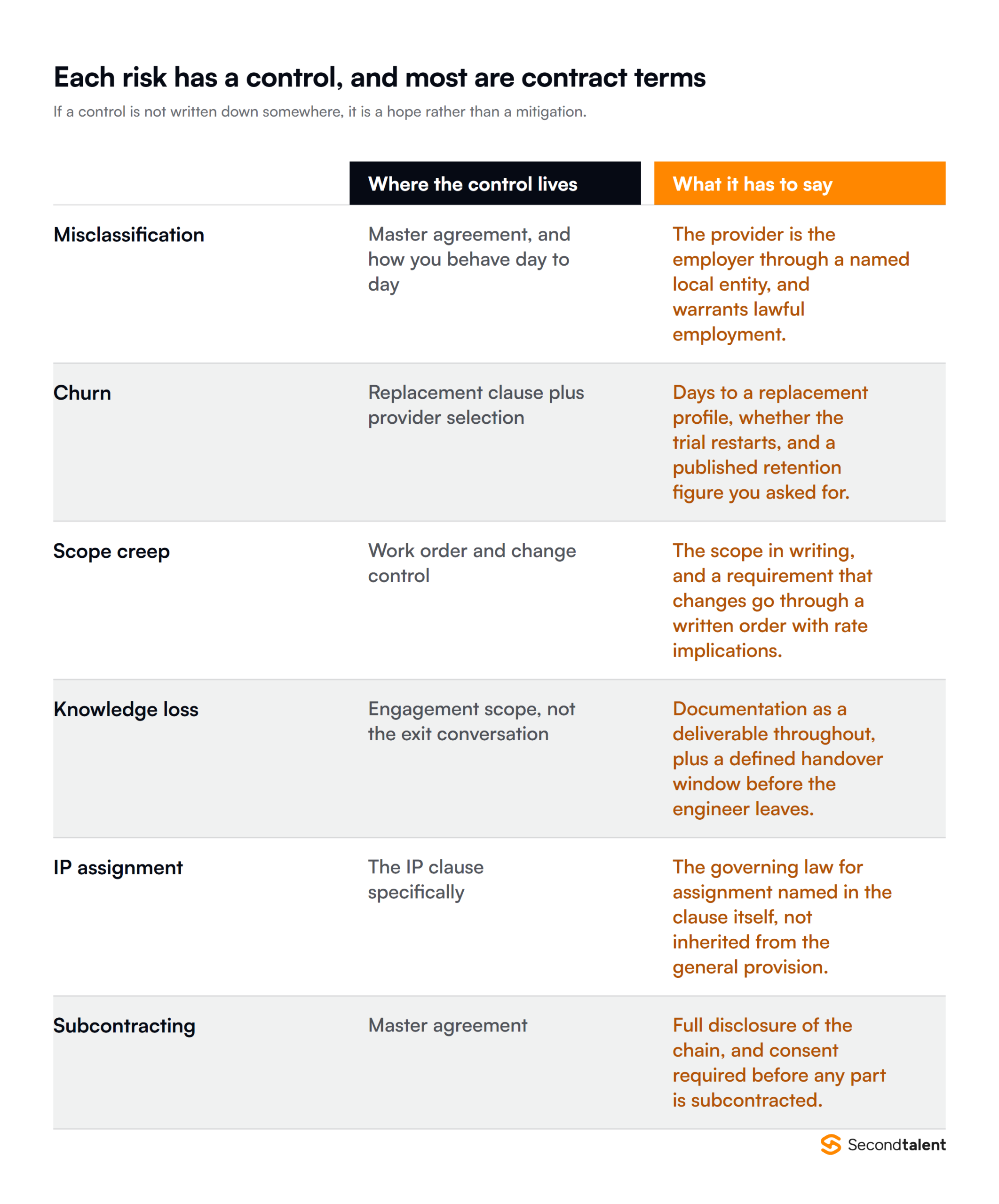
Churn mid-engagement costs you the ramp investment twice. The control is provider selection plus a replacement clause with teeth: days to a replacement profile, whether the trial restarts, and a published twelve-month retention figure you asked for rather than one you assumed.
Scope creep expands the work without expanding the budget, and it quietly changes the classification picture at the same time. The control is a written work order and a change process that attaches a rate implication to changes.
Knowledge loss happens because code stays and reasoning leaves. The control is making documentation a deliverable throughout the engagement rather than a request in the final week, plus a defined handover window in the contract.
IP assignment can fail where it matters most. First ownership of a work differs by country under the Berne Convention framework, so a clause drafted only to your own governing law may not transfer what you expect. Name the assignment law inside the IP clause. Our guide to IP assignment in IT staffing contracts covers the jurisdictional detail.
A control that is not written down is a hope. Most of these mitigations cost nothing at contract stage and cannot be added later without reopening the agreement. If you take one thing from this page, make it the habit of asking where a given control lives, and refusing “we always do that” as an answer.
Risk 6: vendor concentration
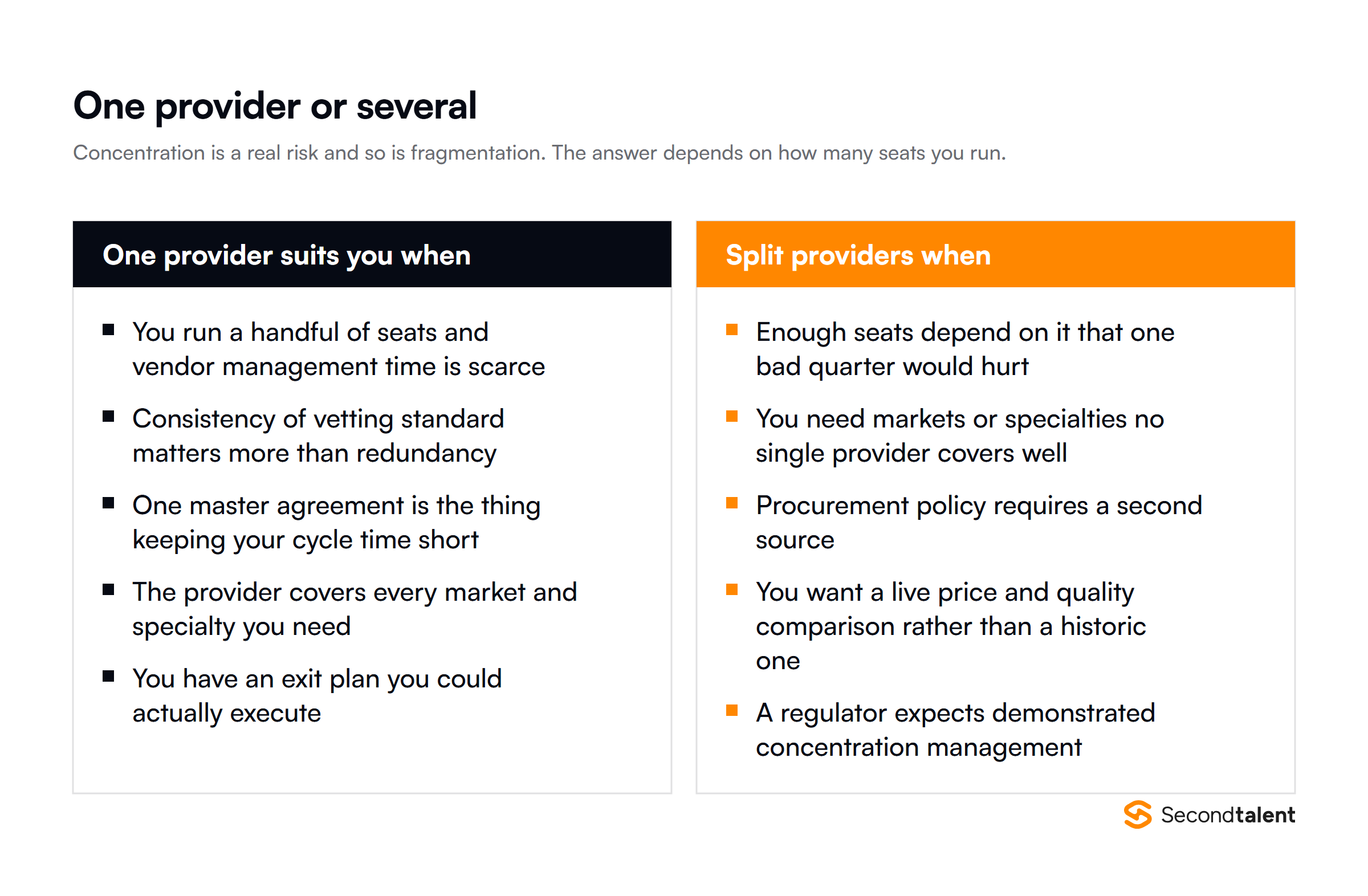
Running everything through one provider means one provider’s bad quarter becomes yours. Splitting providers costs vendor management time and consistency.
One provider suits you while seats are few, vendor management time is scarce, and a single master agreement is what keeps your cycle time short. Split once enough seats depend on it that a single failure would hurt, when you need markets a single provider does not cover, or when a regulator expects demonstrated concentration management.
Whichever way you go, have an exit plan you could actually execute. Concentration is only dangerous in combination with an exit nobody has thought through.
Risks 7 and 8: overlap and subcontracting
Overlap that never materialises happens when both sides assume the other will shift hours. The window exists in the contract and nobody attends it. The control is deciding explicitly who moves, and writing it down.
Undisclosed subcontracting is the compliance finding that surfaces during an audit rather than during a sales call. Require disclosure of the full chain between you and the engineer, and consent before any part of the service is subcontracted.
For regulated buyers this stops being good practice and becomes an obligation. Where the work touches personal data, GDPR Article 28 sets the terms for engaging a sub-processor, and the NIST Cybersecurity Framework gives you supply-chain vocabulary an auditor will follow.
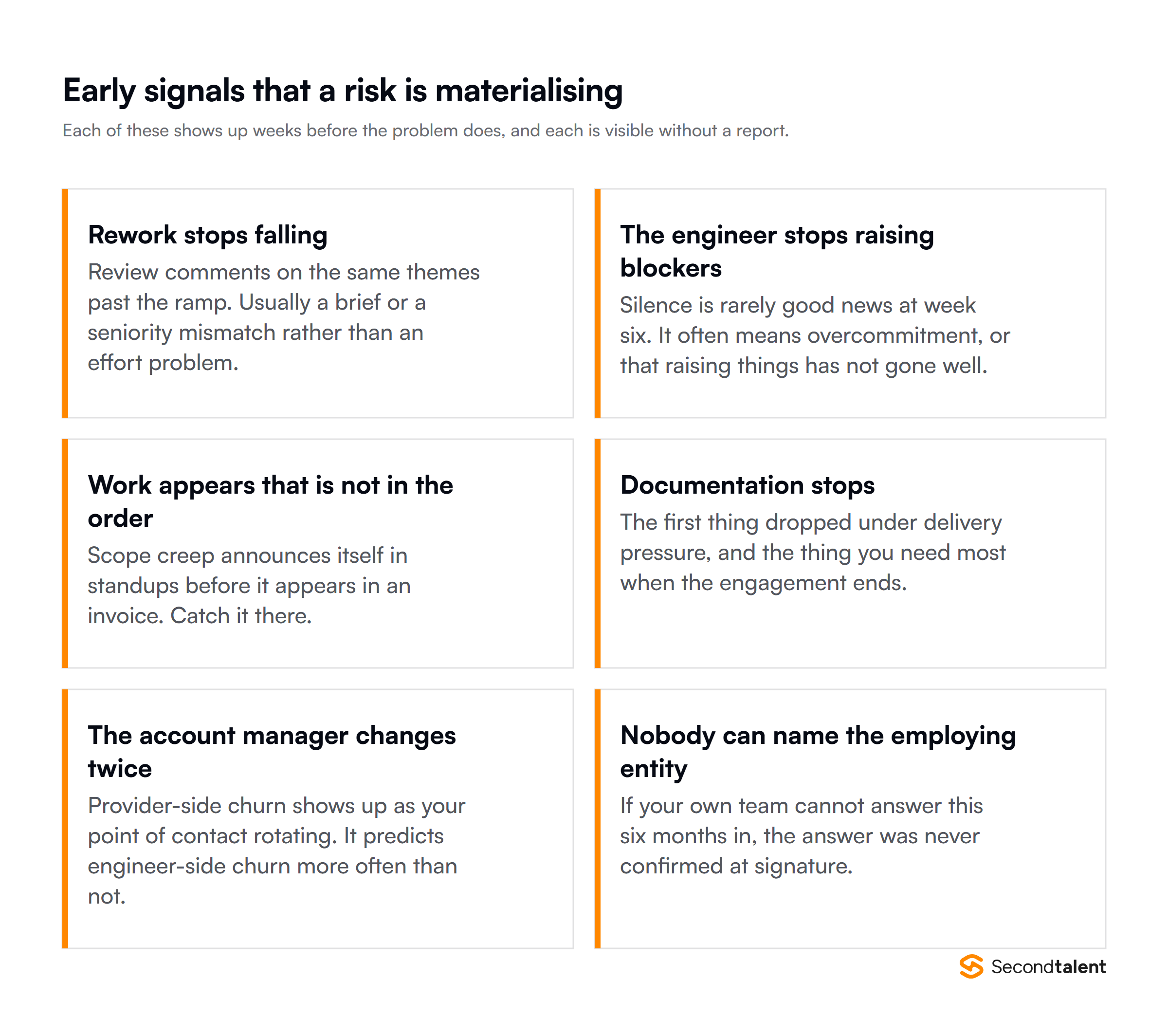
Early signals that a risk is materialising
Each of these shows up weeks before the problem does, and none require a report to spot.
Rework stops falling past the ramp, which usually means a brief or seniority mismatch rather than an effort problem. The engineer stops raising blockers, which at week six is rarely good news. Work appears that is not in the order, and scope creep announces itself in standups long before it appears in an invoice.
Documentation stops, because it is the first thing dropped under delivery pressure and the thing you need most at the end. The account manager changes twice, which predicts engineer-side churn more often than not. And nobody on your side can name the employing entity, which means it was never confirmed at signature.
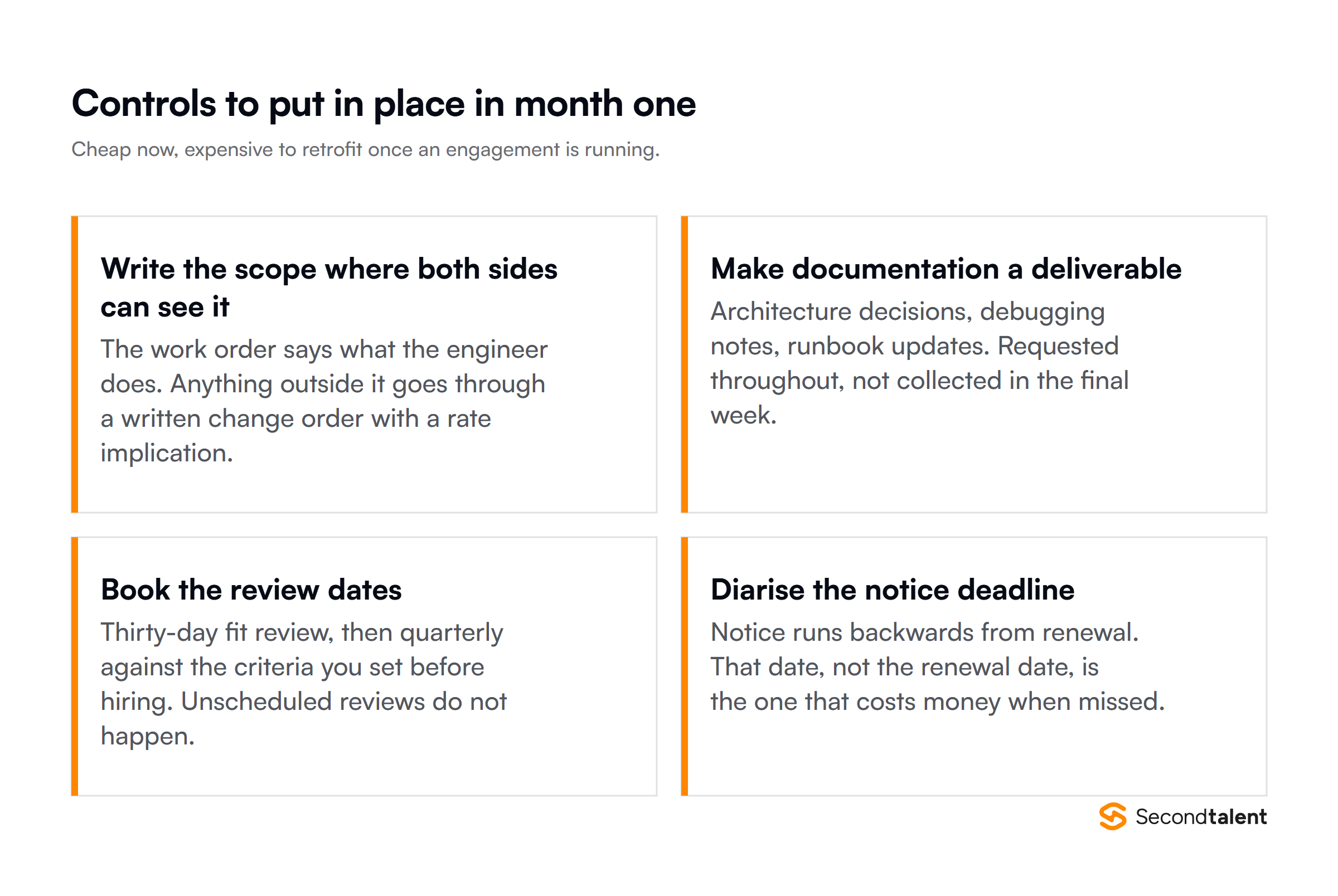
What to put in place in month one
Four controls, all cheap now and awkward to retrofit.
- Write the scope where both sides can see it, with changes going through a written order.
- Make documentation a deliverable, requested throughout rather than collected at the end.
- Book the review dates: a 30-day fit review, then quarterly against the criteria you set before hiring.
- Diarise the notice deadline, which runs backwards from renewal and is the date that costs money when missed.
Our IT staffing checklist covers the full sequence, and the agreement template covers where each control belongs in the contract.
What changes for a regulated buyer
Financial services, health and public sector buyers carry obligations that turn several of these controls from good practice into requirements.
Under DORA, where a service supports a critical or important function, audit and access rights, data locations, exit plans and subcontracting conditions belong in the written contract rather than in an understanding. The classification decision has to happen before drafting, because it determines which clauses you are obliged to include, and discovering it late means reopening an agreement you already signed.
The practical effect is that the risk list above does not change but the deadline does. Every control has to exist at signature rather than being added when someone notices. Our guide to fintech staff augmentation covers what that looks like in a payments team, and the same shape applies in any supervised sector.
Risks that get overstated
Two concerns come up in nearly every procurement conversation and deserve less weight than they get.
Quality. Augmentation does not lower the standard of engineer available to you. It changes who screens them, and your own technical screen closes that gap for the cost of one interview. What tracks quality is the provider’s vetting funnel rather than the model or the map, which is why how the funnel works is the better question.
Security. Under augmentation the engineer works inside your perimeter, on your accounts, under your access reviews. That is a tighter arrangement than most alternatives, including outsourcing, where you audit somebody else’s controls instead of applying your own. The real security question is offboarding speed, which is a contract term.
Weighting these two above misclassification is a common and expensive misallocation of attention.
Who owns each risk on your side
An unowned risk is an unmanaged one, and these tend to sit across three functions that do not naturally talk.
Engineering owns scope discipline, documentation as a deliverable, and the early signals. These are the risks visible in standups and code review, and nobody else can see them.
Legal or procurement owns the contract controls: classification warranties, IP assignment law, subcontracting disclosure, notice and handover.
Finance owns concentration and renewal. The notice deadline in particular belongs to whoever tracks contract dates, because engineering will not.
Name a person against each before the engagement starts. The failures in this article mostly happen in the gaps between those three, where everyone assumed someone else was watching.
Staff augmentation risk FAQs
Which risk should we worry about most?
Misclassification, because its downside is uncapped and invisible in a rate comparison. Everything else costs you time or a quarter. That one can cost back taxes and penalties.
Does an EOR remove the classification risk entirely?
It moves employment to a licensed local employer, which is the structural fix. It does not licence you to behave inconsistently with the contract, and it does not cover a provider who subcontracts without telling you.
How do we assess churn risk before signing?
Ask for twelve-month retention on placed engineers. A provider who has measured it answers in a sentence. One who has not will explain why the question is complicated, which is itself the answer.
What should a replacement guarantee actually say?
Three things: how many days until a replacement profile arrives, whether the trial period restarts for the new engineer, and what happens to the ramp you already paid for. Most guarantees cover only the first. The second and third are where the real cost of a replacement sits, and they are negotiable if you raise them before signature.
Is scope creep really a compliance issue?
It can become one. Work drifting outside the order tends to mean more direction and more integration into your team, which are exactly the factors a classification test weighs.
Takeaways
- Almost every control is a contract term. Ask where each one lives.
- Misclassification has the largest downside because it appears in no rate comparison.
- Name the IP assignment law inside the IP clause, not in the general provision.
- Require disclosure of the full subcontracting chain before signature.
- Watch for rework that stops falling and blockers that stop being raised.
Reduce the risk at the structural level
Second Talent employs engineers through licensed local entities across Asia, so classification, payroll and statutory obligations sit with the employer rather than with you. Matching runs within 24 hours and 92 percent of placements are still in seat a year later.
Tell us which seat you need to fill, or read how to evaluate IT staffing companies before you choose a provider.