TL;DR: Senior mobile app developers from Asia start from $23 USD/hr (billed monthly) through Second Talent, matched in 24 hours. The closest US benchmark, the BLS median for software developers, was $135,980 a year in May 2025.
React Native 0.82, released on 8 October 2025, was the first version to run entirely on the New Architecture. Setting newArchEnabled=false is now ignored, and 0.81 is the last release that allows the old one. A React Native app that has not migrated is stuck a year behind, and a mobile hire should know which side of that line your code sits on.
Key takeaways
- On our mobile app developer rate cards, Indonesia's range tops out at $2,550 a month, below Thailand's floor of $3,020.
- Apple says over 40% of unresolved App Review issues relate to guideline 2.1, App Completeness, which covers crashes and placeholder content.
- Kotlin Multiplatform has been stable since November 2023, and Compose Multiplatform for iOS since May 2025.
- CocoaPods trunk is due to stop accepting new podspecs on 2 December 2026, while React Native 0.87 still uses CocoaPods by default.
What Mobile App Developers Earn Working for International Clients in Asia
Thailand has the highest floor of the five markets, and Vietnam's top of $6,500 is two and a half times Indonesia's $2,550. The figures are what mobile app developers in each market earn working directly for foreign companies, before any employer or platform costs.
| Market |
Monthly pay working for international clients (USD) |
| Indonesia |
$1,130-$2,550+ |
| Philippines |
$1,910-$3,350+ |
| Malaysia |
$2,460-$4,910+ |
| Vietnam |
$2,500-$6,500+ |
| Thailand |
$3,020-$6,050+ |
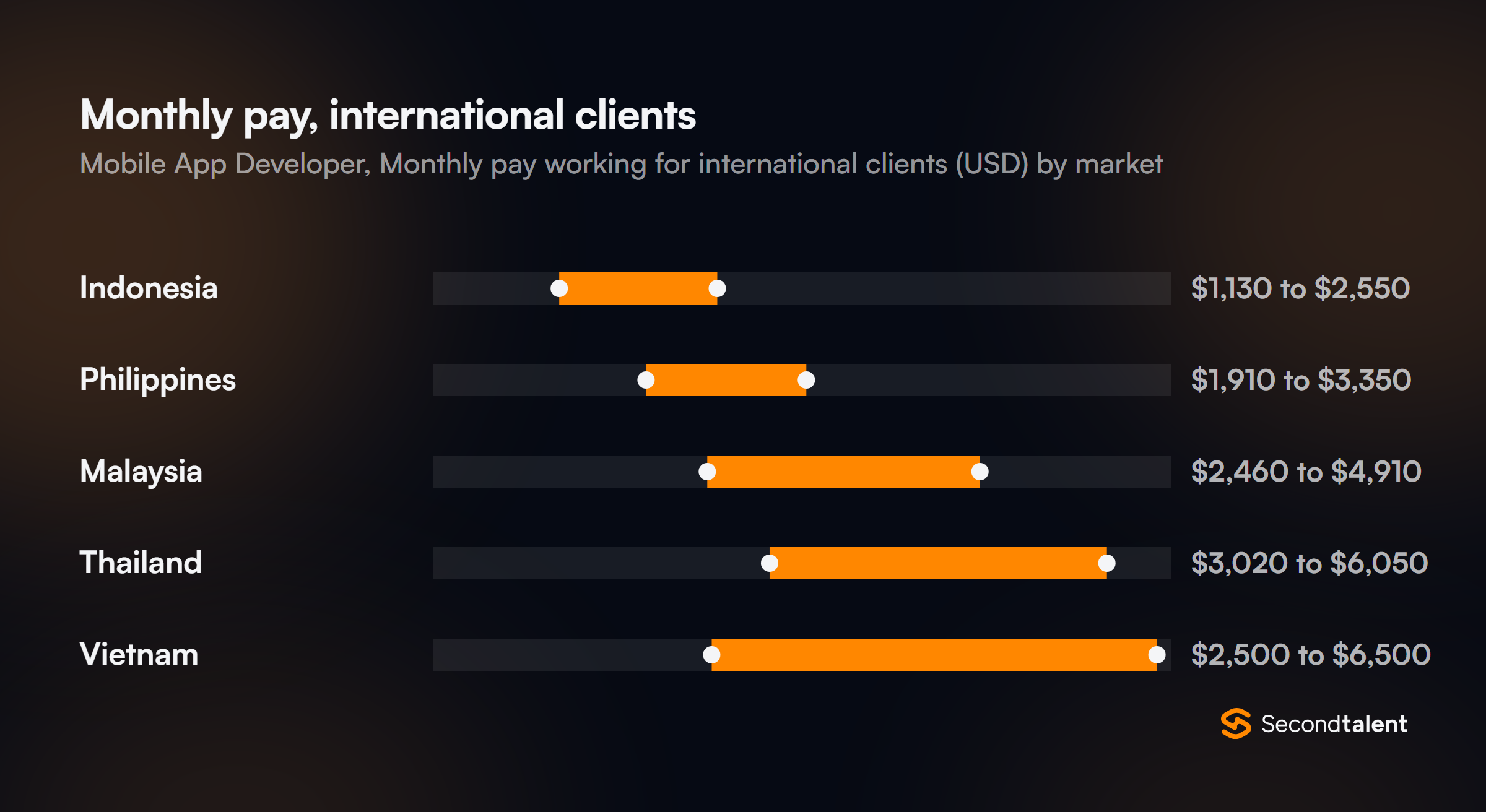
Monthly ranges from the Remote (Working for International Clients) figures on our rate cards for Indonesia, the Philippines, Malaysia, Vietnam and Thailand, converted at ExchangeRate-API mid-market rates for 14 September 2026.
The Vietnamese card publishes its range in US dollars. The other four quote local currency: rupiah (Rp17,624 to the dollar), pesos (₱62.69), ringgit (RM4.07) and baht (฿33.08). All five ranges are open at the top.
Through Second Talent, senior mobile app developers start from $23 USD/hr (billed monthly): one monthly fee that bundles salary, payroll taxes, statutory contributions and our service fee. Our pricing page shows how the subscription works.
US Pay Benchmark for Mobile App Developers
BLS has no mobile developer occupation. Mobile work maps to Software Developers (15-1252), the occupation that designs and builds applications, whether the app ships in Swift, Kotlin, Dart or JavaScript.
| BLS OEWS, May 2025, national |
Software Developers (15-1252) |
| Median annual |
$135,980 |
| 10th percentile, monthly |
$6,870 |
| 25th percentile, monthly |
$8,770 |
| Median, monthly |
$11,330 |
| 75th percentile, monthly |
$14,330 |
| 90th percentile, monthly |
$17,890 |
Monthly figures are the annual wages on the BLS OEWS profile for 15-1252 divided by 12, rounded to the nearest $10.
Salary is only part of the US cost. In the BLS Employer Costs for Employee Compensation release for June 2026, wages and salaries made up 68.5% of employer compensation costs for full-time private industry workers, and benefits the other 31.5%.
For the contract route, our mobile app developer cost-to-hire page, updated on 12 September 2026, puts a mid-level US freelance or contract mobile developer at $108 to $165 an hour.
Time Zone Overlap with ET, CT and PT
Apple's App Review page says its reviewers handle 90% of submissions in less than 24 hours on average. A build submitted as a Manila evening shift ends, 3:00 pm in New York, usually has a verdict by the next US afternoon. No city in the table changes its clocks, and US daylight time runs from 8 March to 1 November 2026, per NIST.
| Engineer's city |
UTC offset |
9:00 am ET (EDT) |
9:00 am CT (CDT) |
9:00 am PT (PDT) |
| Manila, Singapore, Kuala Lumpur, Taipei |
UTC+8 |
9:00 pm |
10:00 pm |
12:00 midnight |
| Ho Chi Minh City, Jakarta, Bangkok |
UTC+7 |
8:00 pm |
9:00 pm |
11:00 pm |
| Bengaluru |
UTC+5:30 |
6:30 pm |
7:30 pm |
9:30 pm |
After 1 November 2026, every time in the table moves one hour later.
A Manila shift from 6:00 pm to 3:00 am runs 10:00 to 19:00 UTC. Subtract four hours for EDT and it covers 6:00 am to 3:00 pm in New York. That is six hours inside a 9-to-5 day on the East Coast, five with Chicago and three with San Francisco.
Use the shared hours for design reviews, bugs your US testers reproduce and store rejections that need a reply. Builds, library upgrades and crash triage fit the hours before New York wakes up. We agree that split before the offer, which is how our placements keep 4-6 hours of daily overlap with US hours.
That Manila shift has five hours inside the Philippine night window, which costs at least 10% extra for employees between 10 pm and 6 am (Labor Code Article 86). Vietnam's Labor Code adds at least 30% for work between 22:00 and 06:00 (Articles 98 and 106).
Mobile App Developer Skills to Screen For
In August 2026, iOS ran on 60.68% of mobile devices in the US, while Android ran on 78.13% in Asia, per StatCounter. Most of your US users carry iPhones, while the market around a developer in Jakarta runs on Android, so ask early which iPhones the candidate tests on.
Native, cross-platform or Kotlin Multiplatform
JetBrains declared Kotlin Multiplatform stable on 1 November 2023, for sharing code across platforms while keeping native programming where it matters. On 6 May 2025, Compose Multiplatform 1.8.0 made shared UI on iOS stable as well.
That gives a US team four real options: Swift and Kotlin apps, Flutter, React Native, or Kotlin shared across both. Ask the candidate which one they would choose for your app and what they would give up. For single-stack briefs, our Flutter developer page covers that framework.
React Native after the New Architecture
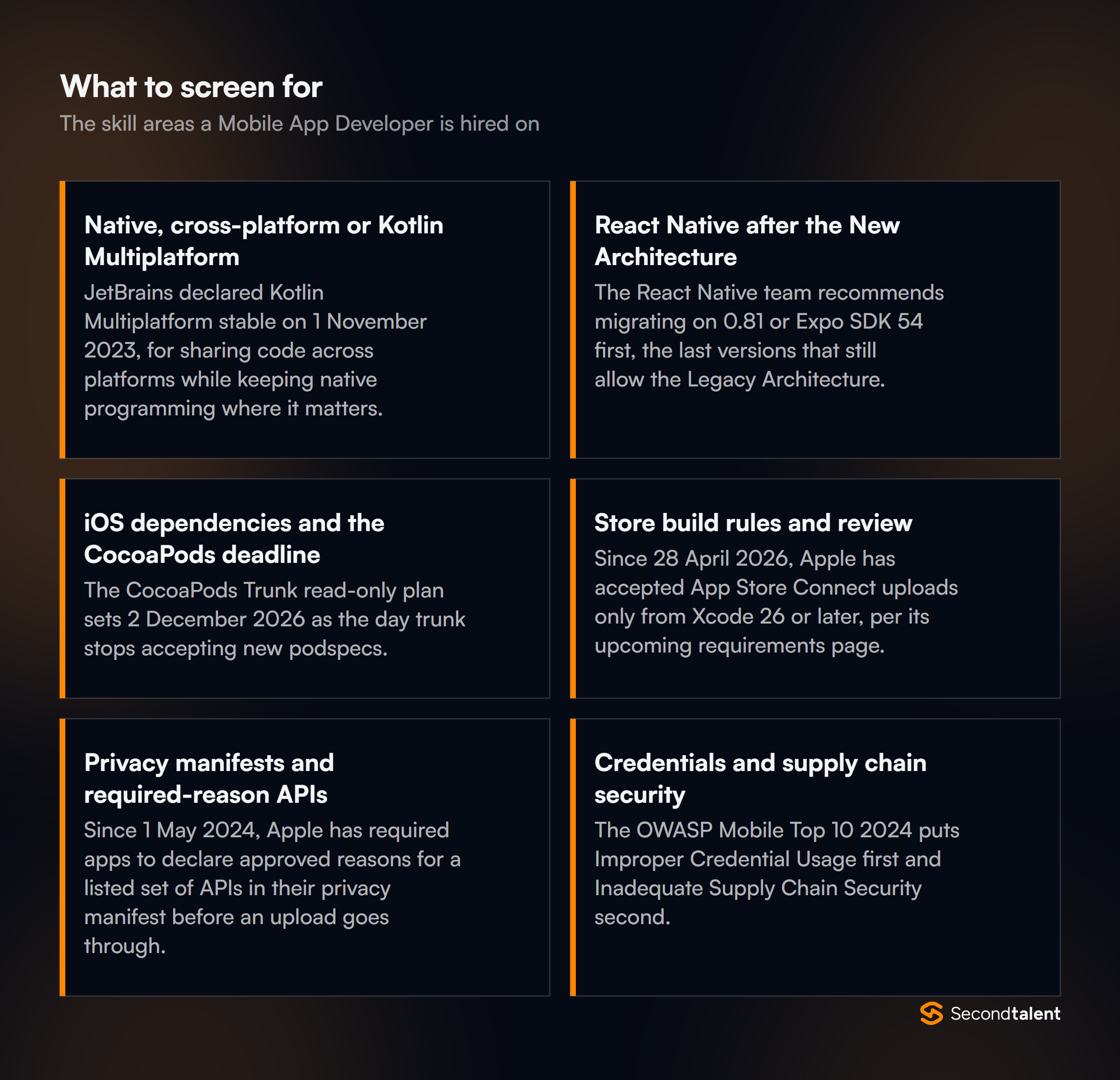
The React Native team recommends migrating on 0.81 or Expo SDK 54 first, the last versions that still allow the Legacy Architecture. Interop layers stay in the codebase for now, and libraries that support both architectures keep working on 0.82. React Native 0.87, released on 11 August 2026, raised the minimum toolchain to Node.js 22, Android Gradle Plugin 9 and Kotlin 2.0. Give the candidate a package.json from an app on 0.79 and ask which dependency they would check first.
iOS dependencies and the CocoaPods deadline
The CocoaPods Trunk read-only plan sets 2 December 2026 as the day trunk stops accepting new podspecs. Existing builds keep working, but dependencies that ship through trunk get no further updates. React Native 0.87 added Swift Package Manager as an experimental option, with CocoaPods still the default. Ask how the candidate would find every pod in your Podfile that has a Swift Package Manager release.
Store build rules and review
Since 28 April 2026, Apple has accepted App Store Connect uploads only from Xcode 26 or later, per its upcoming requirements page. Google Play has required new apps and updates to target Android 16, API level 36, since 31 August 2026 (target API policy). From 1 February 2027, Play blocks updates without support for 16 KB memory page sizes. Ask for the last rejection the candidate fixed, the guideline number and how long the resubmission took.
Privacy manifests and required-reason APIs
Since 1 May 2024, Apple has required apps to declare approved reasons for a listed set of APIs in their privacy manifest before an upload goes through. Any SDK you add from Apple's list of common third-party SDKs needs its own privacy manifest, plus a signature if you add it as a binary.
Hand the candidate an analytics SDK that reads the device's boot time and ask what the manifest needs.
Credentials and supply chain security
The OWASP Mobile Top 10 2024 puts Improper Credential Usage first and Inadequate Supply Chain Security second. In a mobile codebase that means API keys compiled into the app binary and SDKs your team has not audited. Plant a hard-coded key in the assessment repo and score whether the candidate moves it behind your backend.
What a senior mobile app developer should own
A senior title on a mobile CV should mean the developer has owned releases, not only features. Ask for one app they kept current through a major iOS and Android release cycle, and what they changed before the stores raised their minimum requirements. Three areas separate senior candidates from mid-level ones.
Architecture across platforms. A senior hire can explain where state lives, how the offline cache reconciles with the server, and which code is shared between iOS and Android and which stays native. Ask them to sketch the module boundaries of the last app they led.
Release ownership. They should run staged rollouts on Google Play and phased releases on the App Store, read crash-free rates per build, and know when to halt a rollout. Ask for the last build they stopped and the metric that triggered it.
Review and mentoring. Senior developers set the review standard for the rest of the team. Hand them a junior developer's pull request with a memory leak in an image list and a missing accessibility label, and score the comments they leave as well as what they catch.
Expect a senior candidate to show at least one app in both stores where they held the release role, with the version history to prove it.
Contractor or Employer of Record for a US Company
Software is not one of the nine categories of commissioned work that can be "work made for hire" under 17 U.S.C. § 101. A transfer must be in writing and signed under § 204(a). Name the Swift, Kotlin, Dart or JavaScript code, native modules, design assets and build scripts in the assignment.
An app also has store accounts to own. Apple's enrollment page requires a D-U-N-S Number for an organization account. Enroll your company, then add the developer as a team member, so signing certificates and the listing stay with you when the engagement ends.
IRS Publication 515 says the place where the developer performs the services determines the source of the income. A developer working from Kuala Lumpur earns foreign-source income. A foreign individual gives the payer Form W-8BEN to certify foreign status.
The developer's own country applies its own employment test. Philippine courts use the four-fold test, and in Atok Big Wedge v. Gison the Supreme Court called the power of control the most important of the four. Article 13 of Vietnam's 2019 Labor Code treats an agreement under another name as a labor contract when it covers a paid job, wages and management or supervision.
|
Independent contractor |
Employer of Record |
| Legal employer |
None; the developer invoices you |
The EOR's local entity |
| US paperwork |
Form W-8BEN from the developer |
Service agreement with the EOR |
| IP |
Written assignment covering app code, native modules and assets |
Assignment terms in the employment contract and your EOR agreement |
| Local labor law |
Classification risk if you set hours and methods |
Night premiums, public holidays and leave apply |
| Pay currency |
Agreed in the contract, often USD |
Local currency through the EOR's payroll; Vietnam's Labor Code states wages in dong (Article 95) |
A fixed-scope job, such as moving an app onto the New Architecture, suits a contractor agreement. A developer who ships your releases every sprint fits the employment tests above. Our Employer of Record service employs that developer in-country, with local detail on the Vietnam EOR page. This is a summary, not legal advice.
English Level and Working Norms
Malaysia's IT workers score 590 on the EF English Proficiency Index 2025, the highest IT score among the five markets in the cost table. The index covers 123 countries and regions, with a global average of 488.
| Country |
EF EPI 2025 score |
World rank (of 123) |
IT job-function score |
| Malaysia |
581 |
24 |
590 |
| Philippines |
569 |
28 |
581 |
| Vietnam |
500 |
64 |
500 |
| Indonesia |
471 |
80 |
523 |
| Thailand |
402 |
116 |
459 |
Scores come from EF's country pages, such as Malaysia, the Philippines and Thailand.
Mobile developers write English that strangers read: App Review replies, release notes and answers to one-star reviews. Ask finalists to reply to a sample rejection under guideline 2.1 in writing.
Plan releases around both calendars. Thanksgiving on 26 November 2026 is a working day in Asia, so a developer there can watch crash reports through the holiday traffic. Vietnam's Labor Code gives five paid days for Lunar New Year (Article 112), in late January or February. Hold major store submissions that week with a Vietnam-based developer.
Mobile App Developer Hiring Process
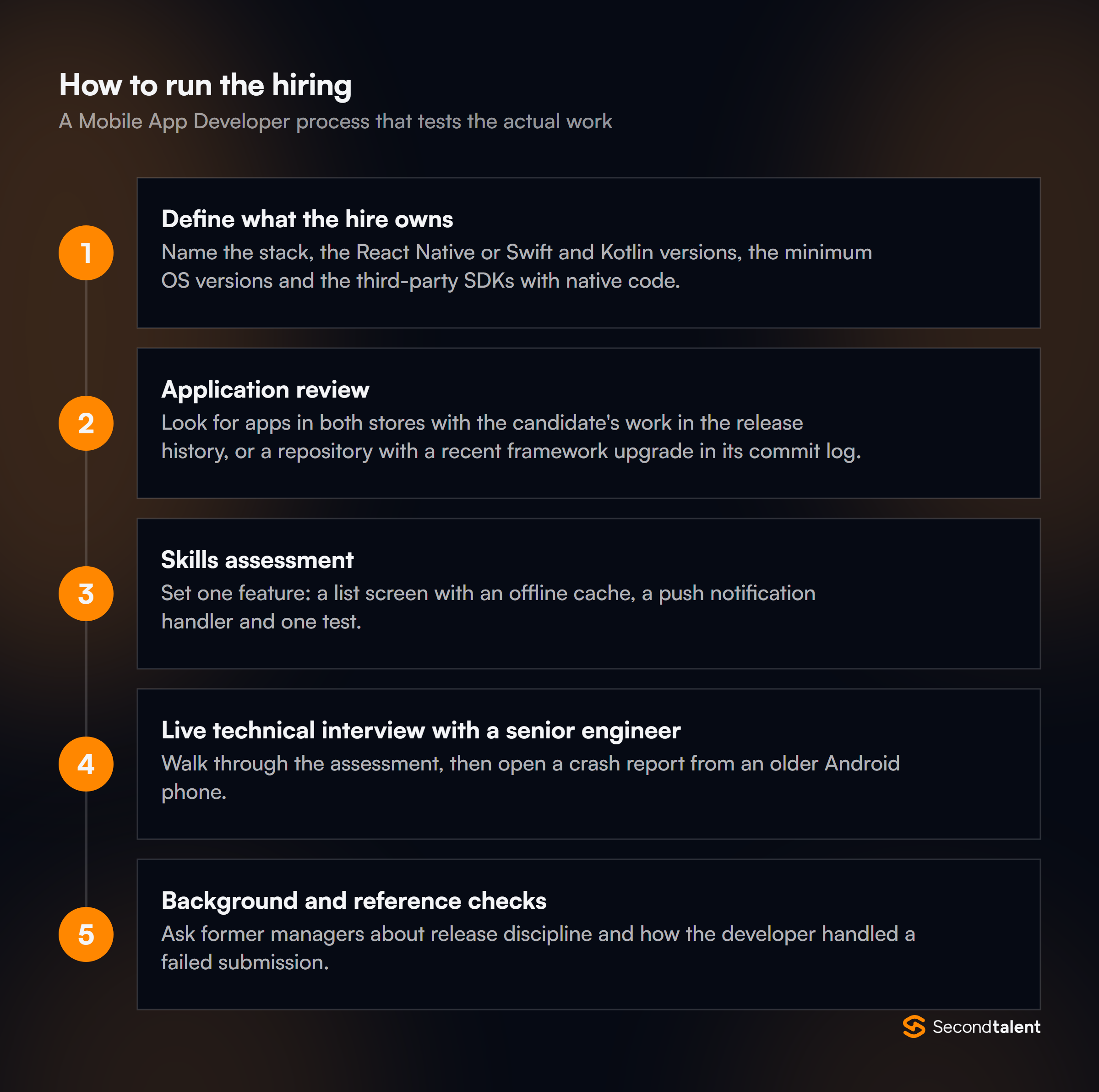
Second Talent's vetting covers stages 2 to 5 before you see a profile. The exercises below are the mobile versions to run in your own final round, and our Android and Kotlin interview guide adds question sets.
Stage 1: Define what the hire owns
Name the stack, the React Native or Swift and Kotlin versions, the minimum OS versions and the third-party SDKs with native code. Say who holds the App Store Connect and Play Console roles, and whether the hire owns releases.
Stage 2: Application review
Look for apps in both stores with the candidate's work in the release history, or a repository with a recent framework upgrade in its commit log. Ask which version the app shipped on and who answered store rejections.
Stage 3: Skills assessment
Set one feature: a list screen with an offline cache, a push notification handler and one test. Plant a hard-coded API key and an SDK missing its privacy manifest, and score whether the candidate flags both.
Stage 4: Live technical interview with a senior engineer
Walk through the assessment, then open a crash report from an older Android phone. Ask how the candidate would move your app to the next major framework version, and what they would test before submitting.
Stage 5: Background and reference checks
Ask former managers about release discipline and how the developer handled a failed submission. Then sign the IP assignment and add the hire to both store accounts with only the roles the job needs.
For single-platform work, compare our iOS developer and Android developer pages, and for design work our mobile app designer page.
Hire Mobile App Developers from Asia with Second Talent
We shortlist 6-8 candidates within 24 hours from 100,000+ pre-vetted engineers, accepting only the top 1% of applicants. Mobile app developers start from $23 USD/hr (billed monthly), with $0 upfront, no lock-in and 4-6 hours of daily overlap with US hours. We handle contracts, payroll and equipment, with compliant EOR contracts and payroll in 9 Asian markets.
Our pricing page sets out subscription, direct-hire and EOR pricing. Truckstop, the US freight technology company, hired eight engineers in Vietnam through us, two of them mobile developers, at an average of 22 days to hire, according to the Truckstop case study.