TL;DR: Forward deployed engineers from Asia earn from $2,230 a month working for international clients, on our Philippine rate card, and we shortlist 6-8 candidates within 24 hours. The BLS median for US software developers was $135,980 a year in May 2025.
Palantir calls its forward deployed software engineers "Deltas", after the NATO-alphabet names of its early Business Development teams. Its 2019 engineering blog post "Dev versus Delta" splits the work in two: a product engineer handles "one capability, many customers", a Delta "one customer, many capabilities". You are hiring the Delta.
Key takeaways
- On our forward deployed engineer rate cards, the Vietnam and Philippine floors sit $280 apart, while Singapore's starts above $10,000.
- When a16z wrote about the role in June 2025, 22 of the 311 open roles on OpenAI's careers page were forward deployed or solutions engineering jobs.
- Kubernetes 1.35 reaches end of life on 28 February 2027, so a customer cluster running it today needs an upgrade plan within six months.
- AWS lets a customer grant a vendor's engineer access through an IAM role with an external ID, without sharing the customer's security credentials.
What Forward Deployed Engineers Earn Working for International Clients in Asia
Pay for this role splits into two bands. Engineers in the Philippines, India and Vietnam start within $280 of each other, while China and Singapore start above $9,600. Our China card puts that down to competition from the domestic technology sector. Our Singapore card points to US software vendors that already staff the role there.
Each figure is what forward deployed engineers in that market earn working directly for foreign companies, before any employer or platform costs.
| Market |
Monthly pay working for international clients (USD) |
| Philippines |
$2,230-$5,500+ |
| India |
$2,410-$9,410+ |
| Vietnam |
$2,510-$5,330+ |
| China |
$9,680-$25,760+ |
| Singapore |
$10,660-$22,490+ |
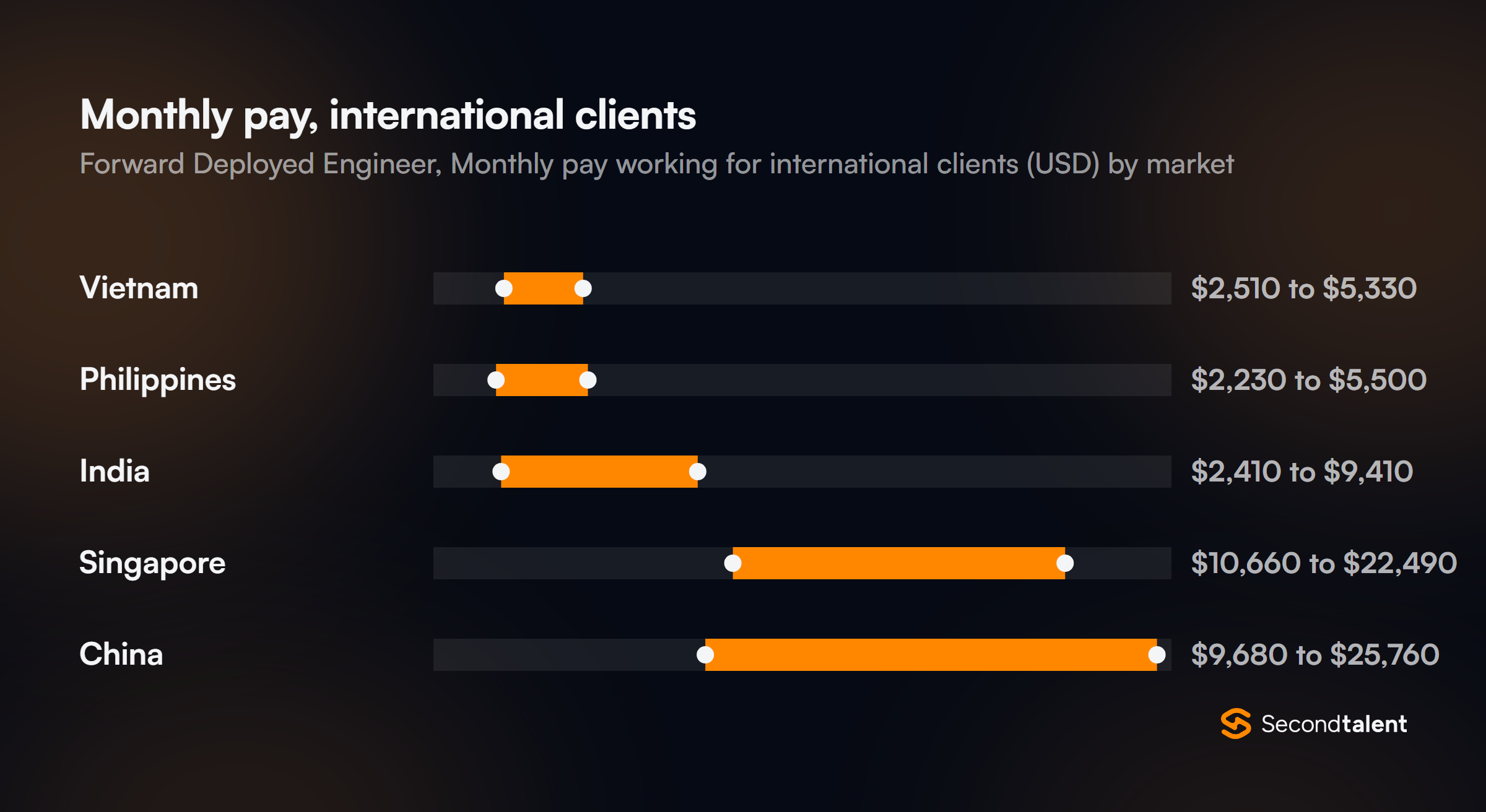
Monthly ranges from the Remote (Working for International Clients) figures on our rate cards for the Philippines, India, Vietnam, China and Singapore, converted at ExchangeRate-API mid-market rates for 14 September 2026.
All five cards quote local currency and all five ranges are open at the top. India's spread is the widest in the first band: its ceiling of $9,410 sits close to the Chinese floor, so seniority moves the figure most there.
Our pricing page explains how a Second Talent subscription bills one monthly fee that bundles salary, payroll taxes, statutory contributions and our service fee. On the US contract route, a mid-level freelance or contract engineer costs $119 to $185 an hour, per our forward deployed engineer cost-to-hire page.
US Pay Benchmark for Forward Deployed Engineers
BLS publishes no forward deployed engineer occupation. The role maps to Software Developers (SOC 15-1252), because the engineer writes and ships production code, only inside one customer's systems instead of a shared product.
| BLS OEWS, May 2025, national |
Software Developers (15-1252) |
| Median annual |
$135,980 |
| 10th percentile, monthly |
$6,870 |
| 25th percentile, monthly |
$8,770 |
| Median, monthly |
$11,330 |
| 75th percentile, monthly |
$14,330 |
| 90th percentile, monthly |
$17,890 |
Monthly figures are the annual wages on the OEWS profile for 15-1252 divided by 12, rounded to the nearest $10.
Salary is only part of the US cost. In the BLS Employer Costs for Employee Compensation release for June 2026, wages and salaries made up 68.5% of employer compensation costs for full-time private industry workers, and benefits the other 31.5%.
The AI labs set the bar for seniority. Anthropic's forward deployed engineer posting for Paris asks for 8+ years in a technical, customer-facing role and production experience with LLMs. Demand at the labs is recent. In June 2025, a16z counted 22 forward deployed or solutions engineering jobs among the 311 open roles on OpenAI's careers page.
Time Zone Overlap with ET, CT and PT
The same Anthropic posting expects its engineers to travel to customer sites 25-50% of the time. An engineer in Asia replaces most of that travel with video calls, so the overlap window is where discovery, demos and go-live calls happen. US daylight time runs from 8 March to 1 November 2026, per NIST, and none of the cities below change their clocks.
| Engineer's city |
UTC offset |
9:00 am ET (EDT) |
9:00 am CT (CDT) |
9:00 am PT (PDT) |
| Manila, Singapore, Kuala Lumpur, Taipei |
UTC+8 |
9:00 pm |
10:00 pm |
12:00 midnight |
| Ho Chi Minh City, Jakarta, Bangkok |
UTC+7 |
8:00 pm |
9:00 pm |
11:00 pm |
| Bengaluru |
UTC+5:30 |
6:30 pm |
7:30 pm |
9:30 pm |
After 1 November 2026, every time in the table moves one hour later.
One schedule works across all three markets in the first band: a shift from 10:00 to 19:00 UTC. That is 6:00 pm to 3:00 am in Manila, 5:00 pm to 2:00 am in Ho Chi Minh City and 3:30 pm to 12:30 am in Bengaluru.
In US terms it runs 6:00 am to 3:00 pm EDT, which gives six hours inside a 9-to-5 day in New York, five with Chicago and three with San Francisco. The arithmetic: 6:00 pm in Manila is 10:00 UTC, and 10:00 UTC minus four hours is 6:00 am EDT.
Book customer calls in that window and keep builds, data pipeline runs and deployment scripts for the engineer's local afternoon. West Coast customers get the shortest overlap, so schedule their go-lives for a US morning. We agree the schedule before the offer, which is how our placements get 4-6 hours of daily overlap with US hours.
Late hours cost more for employees. The Philippine Labor Code adds at least 10% for work between 10 pm and 6 am (Article 86), which covers five hours of the Manila shift. Vietnam's Labor Code adds at least 30% for 22:00 to 06:00 (Articles 98 and 106), four hours of the Ho Chi Minh City shift.
Forward Deployed Engineer Skills to Screen For
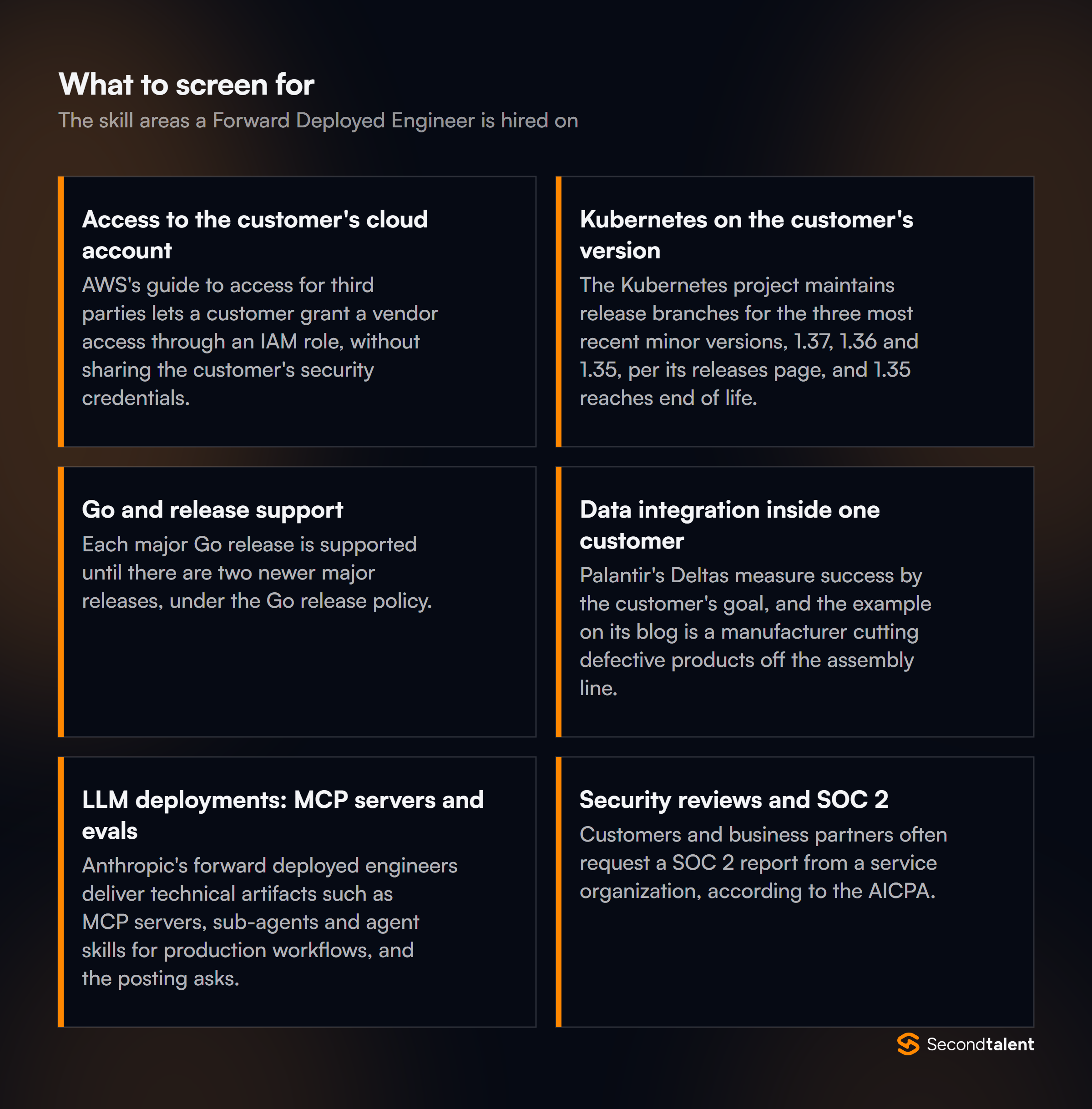
Kubernetes was used by 30.1% of professional developers in Stack Overflow's 2025 survey, and Go by 17.4%. A forward deployed engineer meets both on someone else's terms: the customer picks the cluster version, the cloud account and the security rules.
Access to the customer's cloud account
AWS's guide to access for third parties lets a customer grant a vendor access through an IAM role, without sharing the customer's security credentials. The role's trust policy names the vendor's account ID and an external ID that only the two parties know, which AWS uses to prevent the confused deputy problem.
Ask the candidate to write that trust policy for a new customer, then explain what goes wrong if the external ID is the customer's company name.
Kubernetes on the customer's version
The Kubernetes project maintains release branches for the three most recent minor versions, 1.37, 1.36 and 1.35, per its releases page, and 1.35 reaches end of life on 28 February 2027. Give the candidate a Helm chart that installs on 1.37 and ask what they would check before deploying it to a customer's 1.35 cluster with no outbound internet access.
Go and release support
Each major Go release is supported until there are two newer major releases, under the Go release policy. Go 1.27 shipped on 19 August 2026, which ended support for Go 1.25. Ask the candidate how they would ship a security fix for an agent or connector to a customer who has pinned an older toolchain.
Data integration inside one customer
Palantir's Deltas measure success by the customer's goal, and the example on its blog is a manufacturer cutting defective products off the assembly line. A goal like that starts with data the customer already holds in systems not built to connect: ERP exports, sensor feeds and spreadsheets.
Hand the candidate two messy extracts with conflicting part numbers. Ask for the join logic, the data quality checks and the question they would put to the customer's operations lead.
LLM deployments: MCP servers and evals
Anthropic's forward deployed engineers deliver technical artifacts such as MCP servers, sub-agents and agent skills for production workflows, and the posting asks for evaluation frameworks alongside prompt engineering. Stack Overflow's 2025 AI survey found 66% of developers frustrated by "AI solutions that are almost right, but not quite", and a customer sees those failures first. Ask for the eval set the candidate would write before a customer's first agent goes live.
Security reviews and SOC 2
Customers and business partners often request a SOC 2 report from a service organization, according to the AICPA. The report covers controls relevant to security, availability, processing integrity, confidentiality or privacy. Ask the candidate which controls their last deployment had to satisfy, and how they logged and removed their own access at the end of the engagement.
Contractor or Employer of Record for a US Company
Software is not one of the nine categories of commissioned work that can be "work made for hire" under 17 U.S.C. § 101, and a copyright transfer must be in writing and signed under § 204(a). A forward deployed engineer's code often passes to your customer under your own contract, so you need the written assignment from the engineer before you can pass the rights on. Name connectors, deployment scripts, prompts and eval sets in it.
IRS Publication 515 says the place where services are performed determines the source of the income, so an engineer working from Manila earns foreign-source income. That holds even when your customers are in Ohio. A foreign individual gives the payer Form W-8BEN to certify foreign status.
Local law applies its own employment test. Philippine courts use the four-fold test, and in Atok Big Wedge v. Gison the Supreme Court called the power to control the employee's conduct the most important of the four. In Vietnam, Article 13 of the 2019 Labor Code looks past the name on the agreement. If it covers a paid job, wages and one party's management and supervision, it counts as a labor contract.
An engineer who joins your customer calls on a fixed schedule and holds standing access to customer accounts fits both tests. Employees in the Philippines also receive 13th-month pay under PD 851 and Memorandum Order 28. Contributions go to SSS (15% shared, credit cap ₱35,000), PhilHealth (5%, cap at ₱100,000) and Pag-IBIG (2% each side, ₱10,000 cap).
|
Independent contractor |
Employer of Record |
| Legal employer |
None; the engineer invoices you |
The EOR's local entity |
| US paperwork |
Form W-8BEN from the engineer |
Service agreement with the EOR |
| IP |
Written assignment covering connectors, scripts, prompts and eval sets |
Assignment in the employment contract and your EOR agreement |
| Local labor law |
Classification risk if you control hours and methods |
Night premiums, 13th-month pay and leave apply |
| Pay currency |
Agreed in the contract, often USD |
Local currency through the EOR's payroll; Vietnam's Labor Code states wages in dong (Article 95) |
A single fixed-scope integration suits a contractor agreement. A standing seat on your customer rotation is the case our Employer of Record service covers, with country detail on the Philippines EOR page. Our EOR, PEO and contractor comparison sets out the trade-offs. This is a summary, not legal advice.
English Level and Working Norms
Filipino adults score 539 for speaking on the EF English Proficiency Index 2025, 64 points below their writing score of 603, and discovery calls run on speaking. The index covers 123 countries and regions, with a global average of 488.
| Country |
EF EPI 2025 score |
World rank (of 123) |
IT job-function score |
| Philippines |
569 |
28 |
581 |
| Vietnam |
500 |
64 |
500 |
| India |
484 |
74 |
487 |
| China |
464 |
86 |
491 |
Scores come from EF's country pages, such as the Philippines and China. EF EPI 2025 has no page for Singapore, so it is not in the table. China's IT workers score 27 points above the national figure, the largest gap of the four.
Test the spoken half live. Run a 20-minute mock discovery call in which you play a customer operations lead who describes the problem badly. Then ask the candidate for the written recap they would send your account executive.
Plan launches around both calendars. Thanksgiving on 26 November 2026 is a working day in Asia, so an engineer there can watch a customer go-live while your US team is off. Article 112 of Vietnam's Labor Code gives five paid days for Lunar New Year, in late January or February, so avoid first deployments that week with a Vietnam-based engineer.
Forward Deployed Engineer Hiring Process
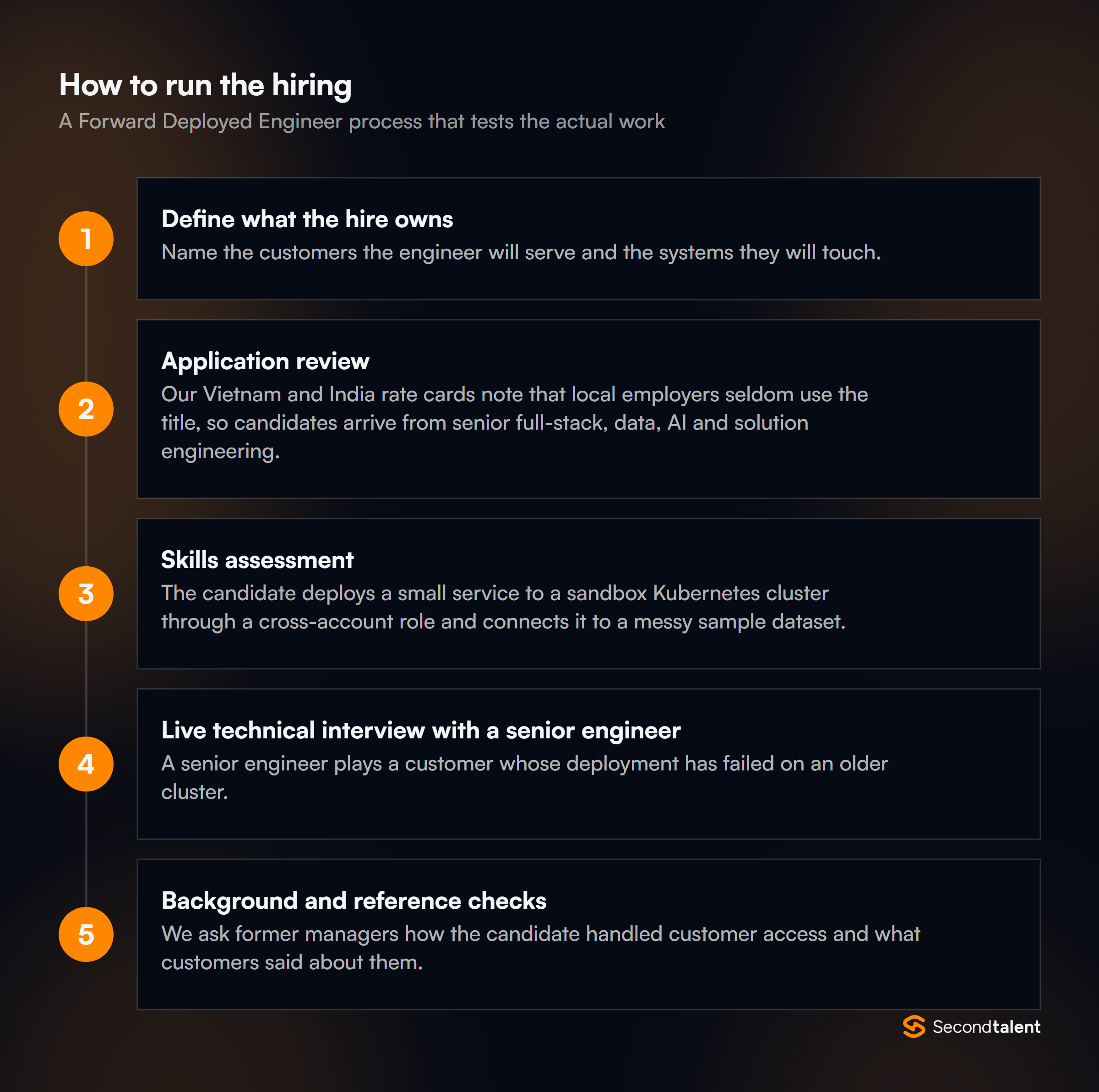
Second Talent's vetting covers stages 2 to 5 before you see a profile. Our Kubernetes interview guide has question sets for the infrastructure half of stage 4.
Stage 1: Define what the hire owns
Name the customers the engineer will serve and the systems they will touch. Add the cloud and cluster versions in play and who signs off a production deployment. List the customer time zones too, since a West Coast book of accounts needs a later shift than an East Coast one.
Stage 2: Application review
Our Vietnam and India rate cards note that local employers seldom use the title, so candidates arrive from senior full-stack, data, AI and solution engineering roles. We look for a deployment the candidate owned inside a customer's environment: a data integration, an on-premises install or an agent rollout, with a named result.
Stage 3: Skills assessment
The candidate deploys a small service to a sandbox Kubernetes cluster through a cross-account role and connects it to a messy sample dataset. Then they write the handover note for the customer's team. The note carries the same weight as the code.
Stage 4: Live technical interview with a senior engineer
A senior engineer plays a customer whose deployment has failed on an older cluster. The questions: what the candidate checks first, what they tell the customer in the first ten minutes, and when they escalate to your product team.
Stage 5: Background and reference checks
We ask former managers how the candidate handled customer access and what customers said about them. We also ask whether they ever built a one-off fix that belonged in the core product. You then choose the contractor or EOR route above.
Hire Forward Deployed Engineers from Asia with Second Talent
We shortlist 6-8 candidates within 24 hours from 100,000+ pre-vetted engineers, accepting only the top 1% of applicants. Forward deployed engineers come with $0 upfront, no lock-in and 4-6 hours of daily overlap with US hours. We handle contracts, payroll and equipment, with compliant EOR contracts and payroll in 9 Asian markets.
Our pricing page sets out the subscription, and for infrastructure-heavy deployments we also staff Kubernetes engineers, Golang developers and DevOps engineers.