TL;DR: AI-assisted staffing and traditional recruitment agencies both place engineers, and they differ on when the vetting happens and how the provider gets paid. A bench provider vets before you call and earns while the engineer stays. An agency searches when you call and earns at signature. Each incentive creates a different bias worth knowing about. Second Talent sits in the first category, so read this comparison with that in mind and apply the questions at the end to us as well.
Two categories, one problem. The useful comparison is not which is better in general, because most teams end up using both, but which suits a given seat and what each model quietly optimises for.
Disclosure. Second Talent is one of the providers in the first category. That gives us a stake in this comparison, so the article names the weaknesses of our own model alongside the other one, and the closing questions are written to be used against any provider including us. Treat the framework as useful and the conclusion as ours.
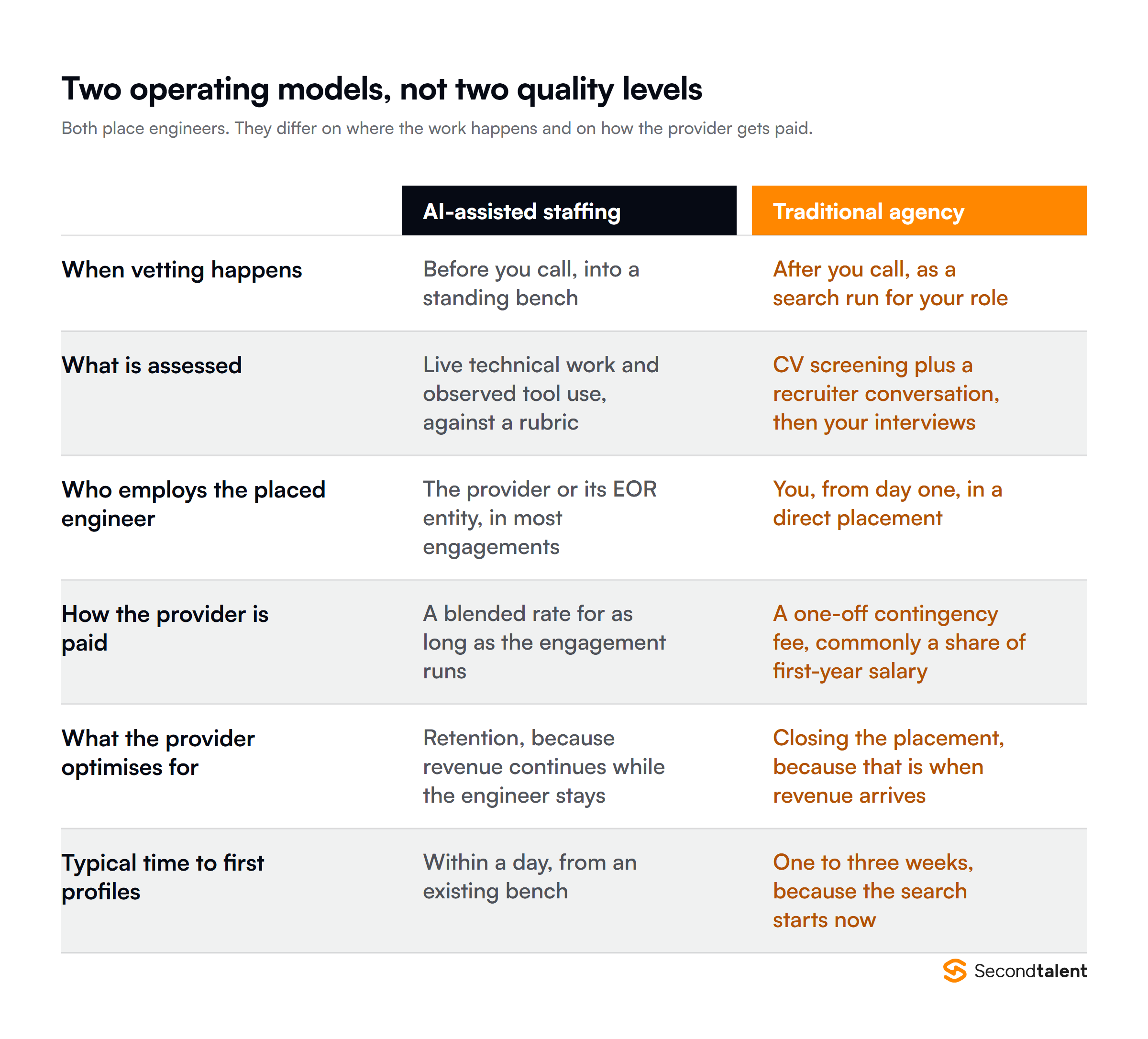
What is the actual difference?
When the vetting happens, and how the provider gets paid. Everything else follows from those two.
AI-assisted staffing vets into a standing bench before you call, assesses live technical work against a rubric, usually employs the engineer through its own entity or an EOR, and charges a blended rate for as long as the engagement runs.
A traditional agency runs a search when you call, screens CVs and interviews candidates, presents them for your payroll, and charges a one-off contingency fee, commonly a share of first-year salary.
Neither description is a quality claim. There are excellent agencies and poor bench providers, and the operating model tells you what to check rather than what to conclude.
What each model optimises for
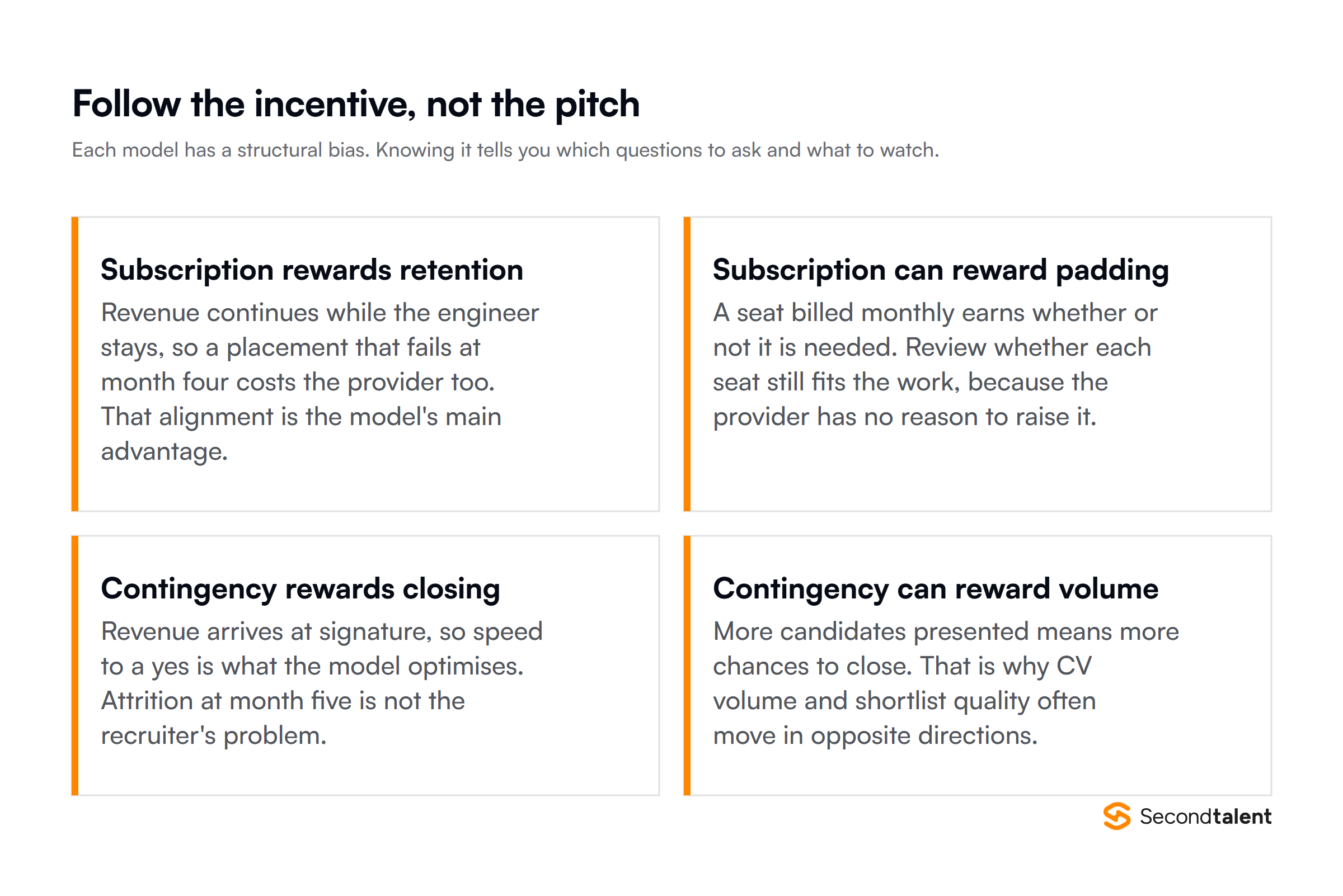
Follow the incentive rather than the pitch, because each structure has a bias and knowing it tells you what to watch.
Subscription pricing rewards retention. Revenue continues while the engineer stays, so a placement failing at month four costs the provider as well as you. That alignment is the model’s strongest feature.
Subscription pricing can also reward padding. A seat billed monthly earns whether or not the work still needs it. Nobody on the provider side has a reason to tell you a seat has become unnecessary, so review that yourself each quarter.
Contingency pricing rewards closing. Revenue arrives at signature, so speed to a yes is what the model optimises. Attrition at month five is not the recruiter’s commercial problem.
Contingency pricing can also reward volume. More candidates presented means more chances to close, which is why CV volume and shortlist quality often move in opposite directions.
Why the assessment method matters more than it used to
Because a CV has less signal in it than it did three years ago.
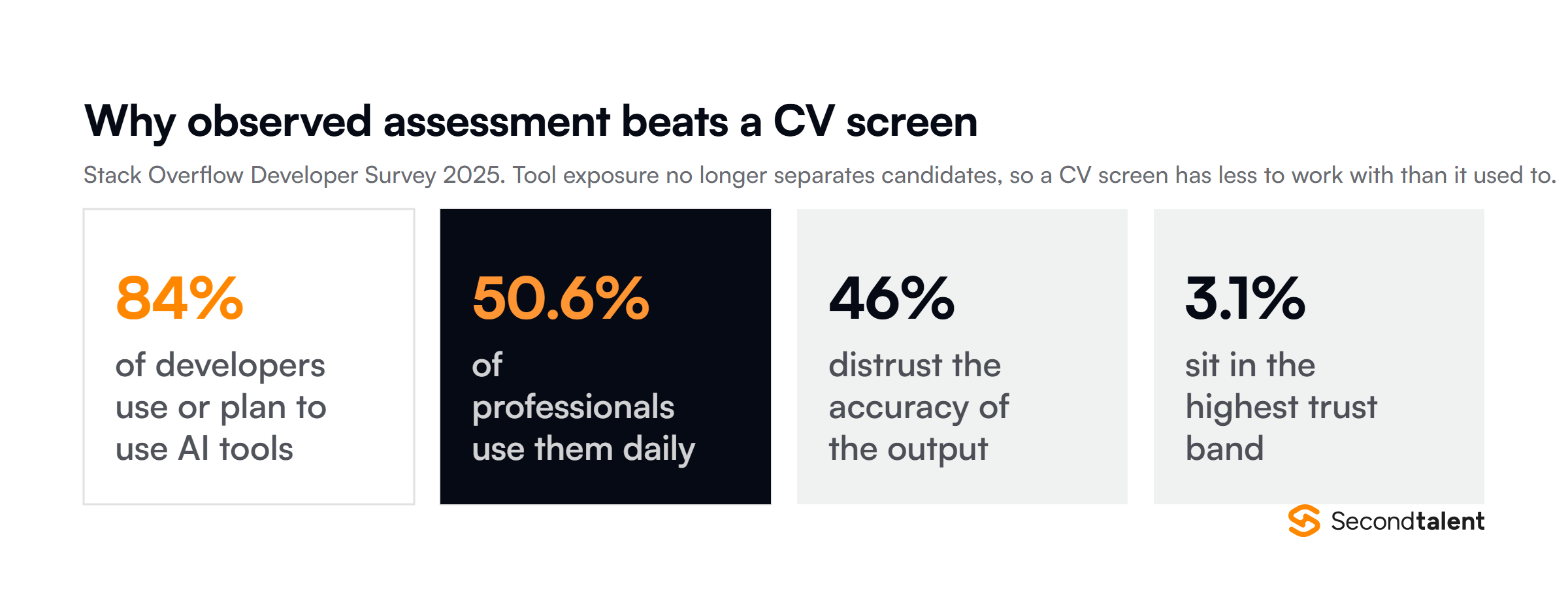
The 2025 Stack Overflow Developer Survey found 84 percent of developers use or plan to use AI tools, with 50.6 percent of professionals using them daily. A CV listing modern tooling now describes the majority rather than a subset.
What stayed scarce is judgment about the output. The same survey found 46 percent of developers distrust its accuracy against 33 percent who trust it, with the most experienced developers the most sceptical. That is a thing you can only see by watching someone work, which is the argument for observed assessment regardless of which category a provider belongs to.
An agency can do observed assessment too. Most do not, because the fee structure does not fund engineering hours before a placement closes. That is a structural difference rather than a competence one, and it is worth asking about directly. Our guide to how vetting funnels work covers what to ask for.
Where the speed difference comes from
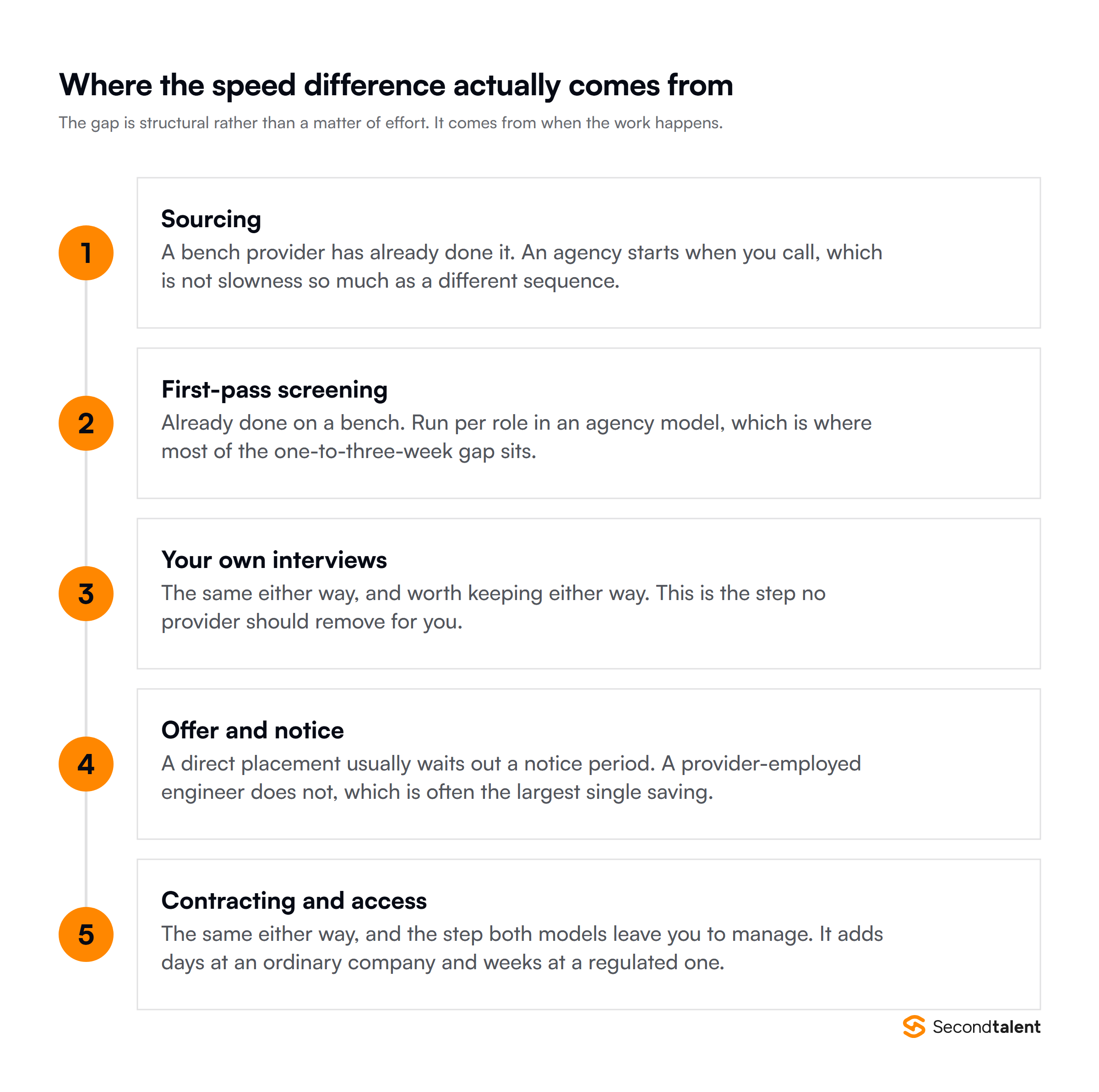
Sequence rather than effort.
Sourcing and first-pass screening are already done on a bench and start when you call in an agency model. That is where most of the gap sits. Offer and notice periods disappear for a provider-employed engineer and remain for a direct placement, which is often the single largest saving.
Two steps are identical either way. Your own technical interviews, which are worth keeping whichever model you use. And contracting and access provisioning, which both models leave you to manage and which adds days at an ordinary company and weeks at a regulated one.
Second Talent returns matched profiles within 24 hours. That number describes when our vetting happened rather than how hard anyone searched, and it is worth understanding that way.
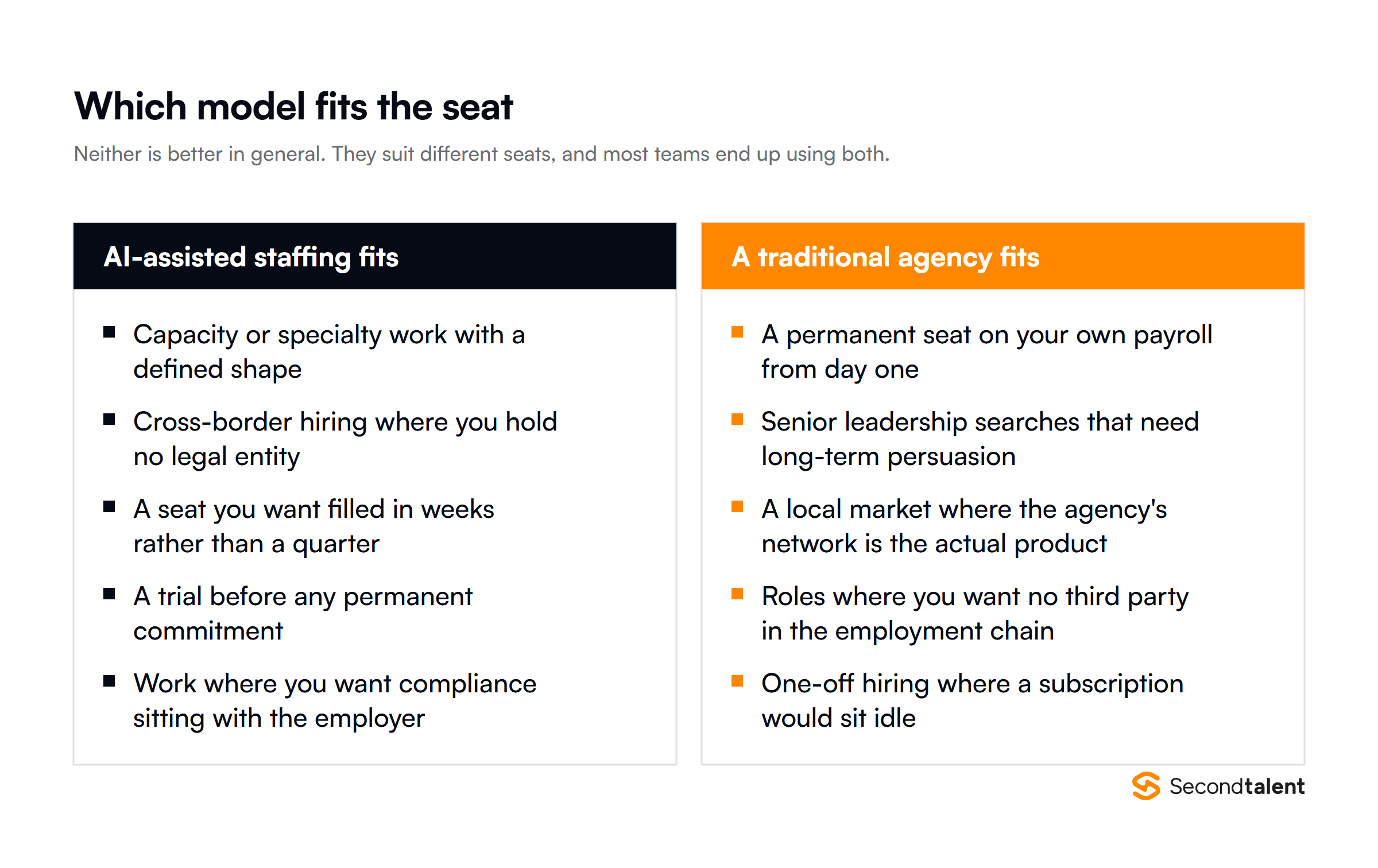
Which model fits which seat
Most teams use both, mapped to the seat rather than standardised across the company.
AI-assisted staffing fits capacity or specialty work with a defined shape, cross-border hiring where you hold no legal entity, a seat you want filled in weeks, a trial before permanent commitment, and work where you want compliance sitting with the employer.
A traditional agency fits a permanent seat on your own payroll from day one, senior leadership searches needing long-term persuasion, a local market where the agency’s network is genuinely the product, and one-off hiring where a subscription would sit idle.
The compliance point deserves detail. Engaging someone directly across a border puts classification, payroll and statutory obligations on you. The IRS common-law test and the HMRC CEST tool both turn on control, and a direct placement leaves all of it with you by design. That is correct for a permanent employee and awkward for a contractor you direct daily. Our guide to worker classification in cross-border IT staffing covers it.
What the categories share
Three things are true of both, and they matter more than the category label.
You still run your own technical screen. No provider in either category should remove that step, and one offering to is telling you about their confidence rather than their quality.
Ramp is still real. About three weeks before unsupervised work on an ordinary product, longer in a regulated domain. Neither model shortens it.
Scarcity is the same for both. The seats that are hard to fill are hard to fill in either model. The US Bureau of Labor Statistics projects data scientist employment to grow 34 percent between 2024 and 2034 and information security analysts 29 percent, against about 4 percent across all occupations. A provider in either category who promises those seats will be easy is selling something.
Someone on your side still directs the work. Both categories supply people. Neither supplies the engineering management that makes those people useful.
Where the category labels break down
The two-category framing is useful and it is also cleaner than reality, in three ways worth knowing before you use it.
Large agencies run bench models too. Established staffing firms have operated contract divisions with standing benches for decades. The label describes an operating model rather than a company, and the same firm can run both.
Some newer providers are brokers with good software. A modern interface does not establish that anyone employs the engineer, that a funnel exists, or that a retention figure has been measured. The questions below distinguish these; the category label does not.
Every provider claims to be AI-assisted now. The claim has become free to make, which means it has stopped carrying information. Ask what specifically is assisted, then ask for the assessment rubric.
Treat the categories as a way to generate questions rather than as a way to pre-sort vendors. A weak provider in the better-aligned category will still cost you a quarter.
Running both at once
Most teams past a handful of engineers use both, and the mistake is running them without a shared view.
Keep one register listing every engagement, which model it sits under, who employs the person, who directs the work, the notice period and the renewal date. Those six fields are what teams lose when two vendor relationships run in parallel under different commercial shapes.
Watch the overlap in particular. A subscription seat covering work an agency-placed employee has since absorbed is the quiet duplication that survives several quarters, because neither provider has any reason to raise it and nobody internally owns the comparison.
Our IT staffing checklist covers the ongoing cadence, and the planning template covers keeping the register.
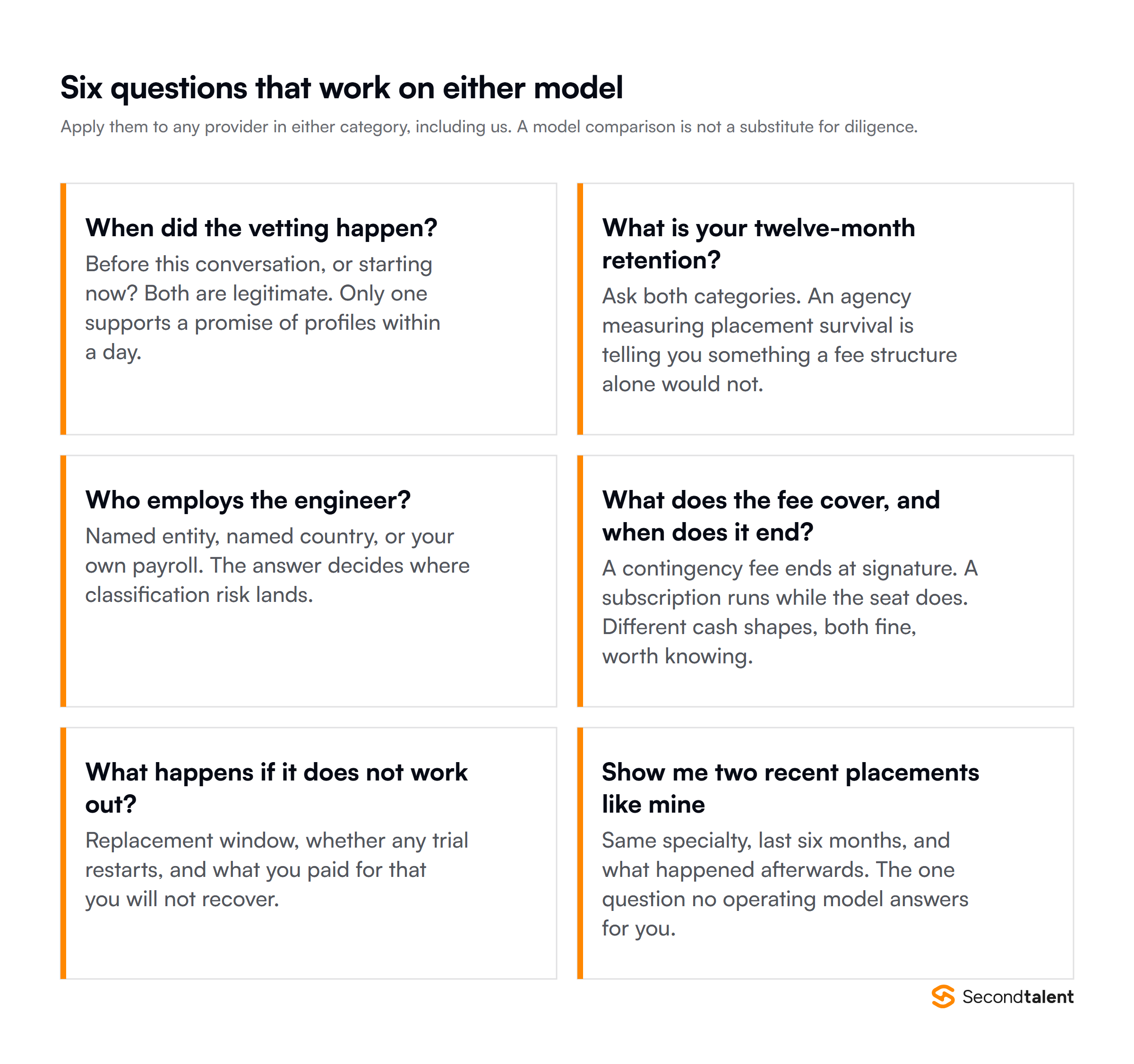
Six questions that work on either model
Use these against any provider in either category, including us.
- When did the vetting happen? Before this conversation or starting now. Both are legitimate; only one supports a same-day profile promise.
- What is your twelve-month retention? Ask agencies too. One measuring placement survival is telling you something the fee structure would not.
- Who employs the engineer? Named entity and country, or your own payroll.
- What does the fee cover, and when does it end? Different cash shapes, both workable, worth knowing which you are signing.
- What happens if it does not work out? Replacement window, whether a trial restarts, and what you will not recover.
- Show me two recent placements like mine. Same specialty, last six months, and what happened afterwards.
Our fuller checklist on evaluating IT staffing companies turns these into a scoring framework.
Category comparison FAQs
Is one category cheaper?
They price differently rather than one being cheaper. A contingency fee is a large one-off; a subscription is a smaller recurring amount that continues. Which is cheaper depends entirely on how long the person stays, which is why retention is the question that settles it.
Can an agency place offshore engineers?
Some do. Ask who employs them, because a direct placement across a border leaves the employment obligations with you unless an EOR sits in between.
Does AI-assisted mean the vetting is automated?
It should not mean that. Tooling helps with sourcing and matching. The assessment that matters is still a person watching an engineer work, and a provider describing their whole funnel as automated is describing a weakness.
Which is better for a first offshore hire?
Usually a bench provider with EOR cover, because the compliance structure is the part a first-time buyer is least equipped to build. That is a structural argument rather than a quality one.
Takeaways
- The difference is when vetting happens and how the provider is paid.
- Subscription rewards retention and can reward padding. Contingency rewards closing and can reward volume.
- A CV carries less signal than it did, which is the case for observed assessment in either category.
- Keep your own technical screen, budget the ramp, and supply the management. Neither model covers those.
- Ask both categories for twelve-month retention. It is the question that settles the cost comparison.
Put the questions to us
Second Talent vets into a standing bench, employs through licensed local entities across Asia, matches within 24 hours, and reports 92 percent of placements still in seat a year later.
Start the conversation, or read what IT staffing is for how the engagement models compare.