TL;DR: Seven objections come up in almost every IT staffing conversation. Two of them are largely true, three depend entirely on how the arrangement is structured, and two are usually a different problem wearing a disguise. This walks through each one with the mechanism that decides it, and gives you a cheap way to test it against your own situation rather than trusting anyone’s write-up.
Buyers raise the same handful of objections to IT staffing, and most of them started as accurate observations about engagements that ran badly. Dismissing them as myths is the wrong response, because several are still true under conditions that are easy to walk into.
What changed here, and why. An earlier version of this page answered every objection with a statistic: parity at six months, 92 to 108 percent of in-house velocity, 0.3 percent classification disputes, 87 percent of co-located velocity on a four-hour overlap. Those figures were attributed to research reports that do not exist. A myth-busting article whose method is inventing counter-evidence is worse than the myths, so this version argues from mechanisms you can check and says plainly where a concern is legitimate.
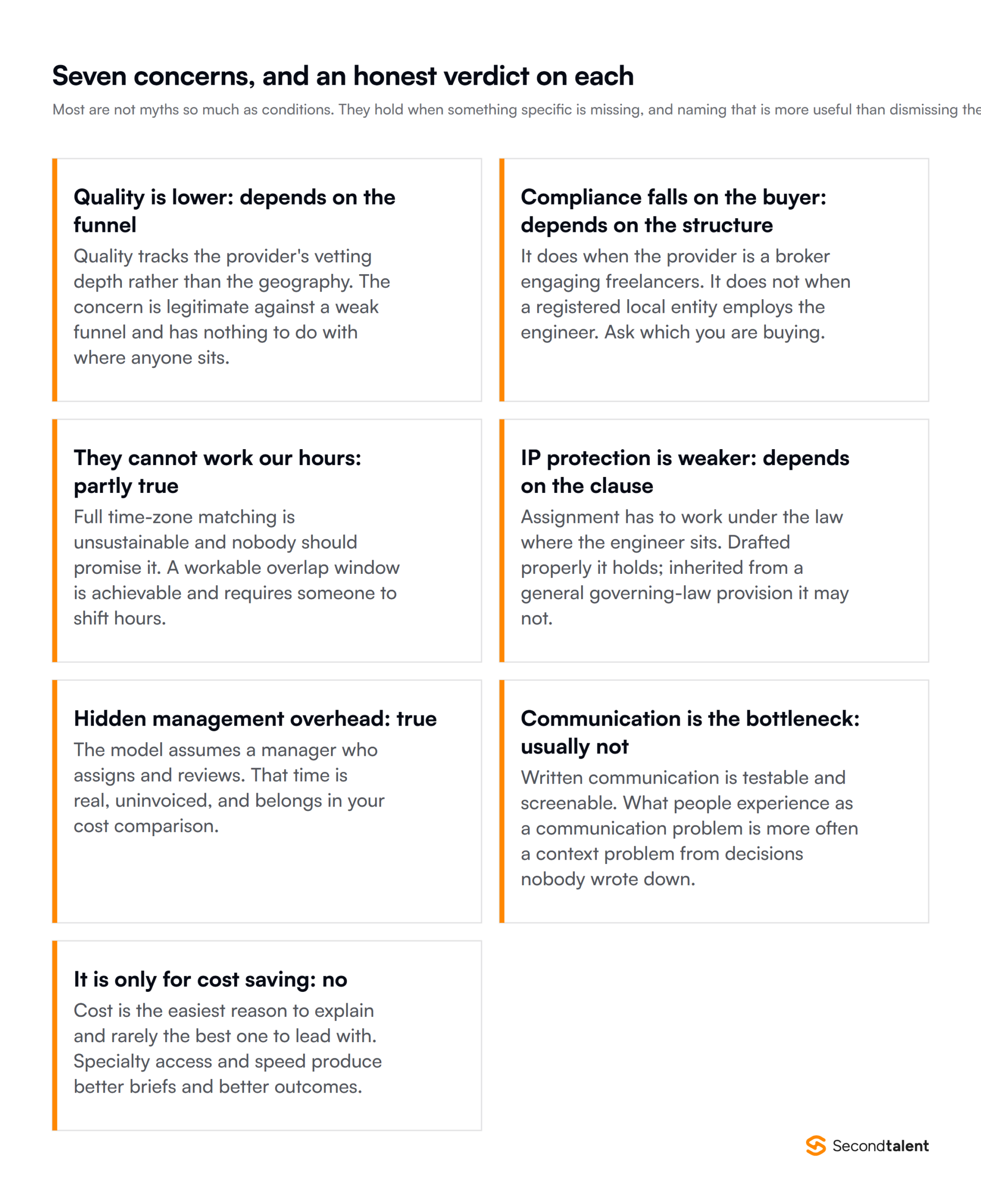
Myth 1: quality is lower than direct hiring
This one is not about geography, and treating it as a geography question is what makes it hard to resolve.
Nobody publishes a credible measure of offshore versus onshore engineering output. Any figure you see of that shape, including the ones this page used to carry, is untraceable. What can be described is what actually produces the quality gaps people experience, and there are four of them.
Measuring during the ramp. Output sits below baseline for the first weeks of any engagement, including a direct hire down the hall. Judging at week one measures onboarding and reaches a conclusion about capability.
A brief that returned generalists. A role description that lists technologies attracts people who list technologies. Naming what someone has to accomplish in month one changes who applies and who passes.
A funnel that forwards CVs. Vetting depth varies enormously between providers operating in the same city, drawing from the same universities. This is the variable people attribute to the map.
Context nobody wrote down. An engineer working from partial information looks slower than they are, and this is the most common cause by a distance.
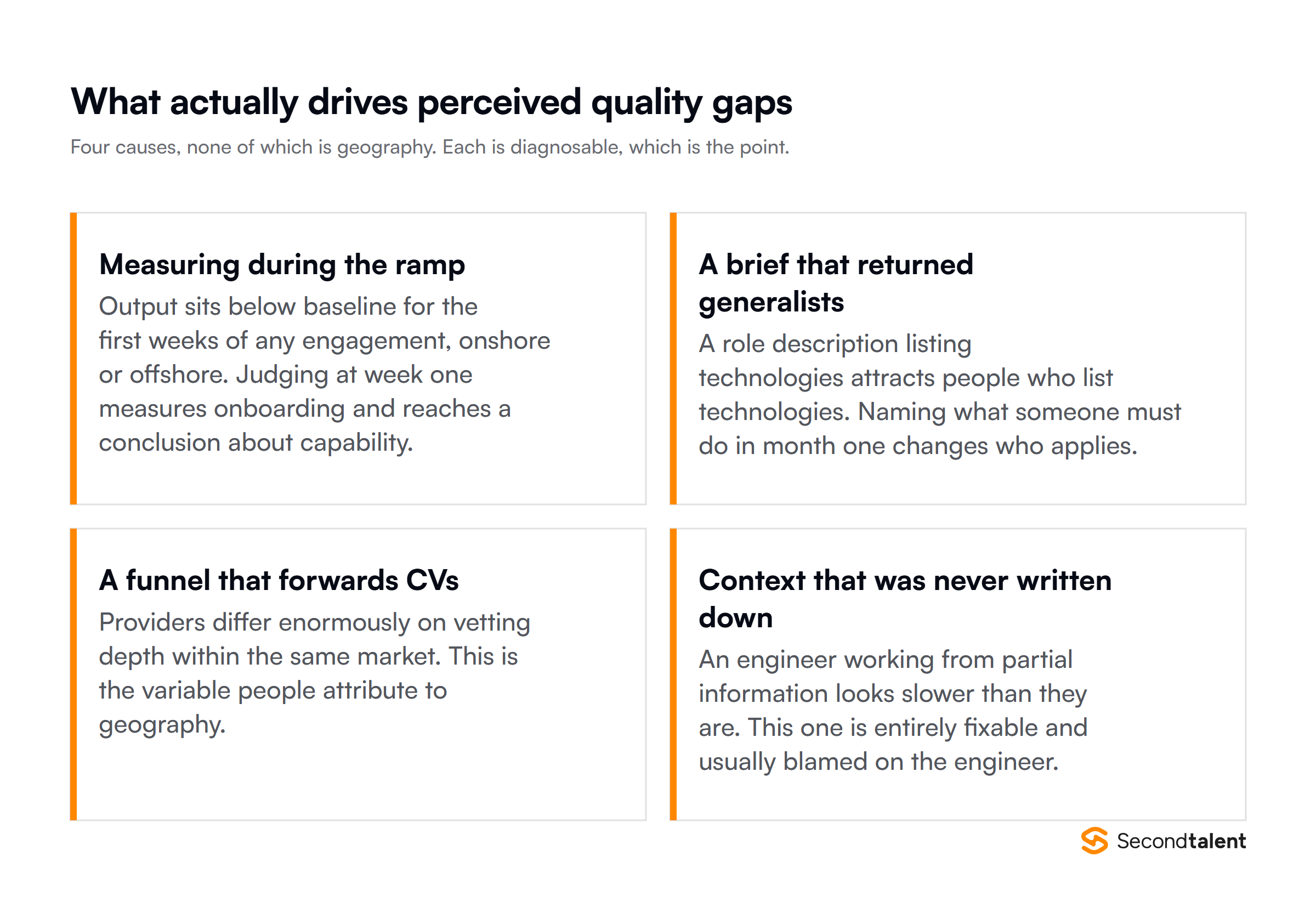
The honest version of the concern is that you are buying a funnel, not a country. Our guide to what IT staffing actually is covers what a real funnel looks like at each stage, and the questions that separate one from a CV forwarding service.
Myth 2: compliance risk falls on the buyer
Sometimes it does. Whether it does is decided by one structural fact, and buyers frequently do not know which version they bought.
If a registered legal entity in the engineer’s country employs them, pays local payroll taxes, files locally and provides statutory benefits, the employment relationship sits with that entity. If the provider is a broker connecting you to someone contracting independently, the relationship you are directing daily looks a great deal like employment, and the exposure sits closer to you than the invoice suggests.
Augmentation means you direct the work, and control is precisely what classification tests examine, which is why the structure carries weight. The IRS common-law test weighs behavioural control, financial control and the type of relationship. Behavioural control covers instructions about when, where and how the work is done, which is a description of what a staff augmentation manager does every day. The UK equivalent, the HMRC CEST tool, asks the same question in different words.
So the myth is neither true nor false in general. It is true of one structure and false of another, and one written question separates them: which legal entity employs this engineer, in which country, and is any part of the service subcontracted. A provider who cannot answer that in a sentence has answered it. Our guide to worker classification in cross-border IT staffing covers what the answer should contain.
Myth 3: offshore engineers cannot work your hours
This is the objection on the list with the most substance, and providers who wave it away are the ones to be careful with.
The literal version is correct. An engineer in Vietnam or the Philippines working permanently through their own night is describing an arrangement that ends within a year, usually by resignation. Any provider promising full time-zone matching is either not doing it or is burning through people to sustain it, and the churn will reach you eventually.
The practical question is different: how much daily overlap does your team actually need, and who moves their hours to create it. Both halves matter, and the second is the one that gets skipped. A contract that says four hours of overlap without saying which side shifts produces a window both parties assumed the other would attend.
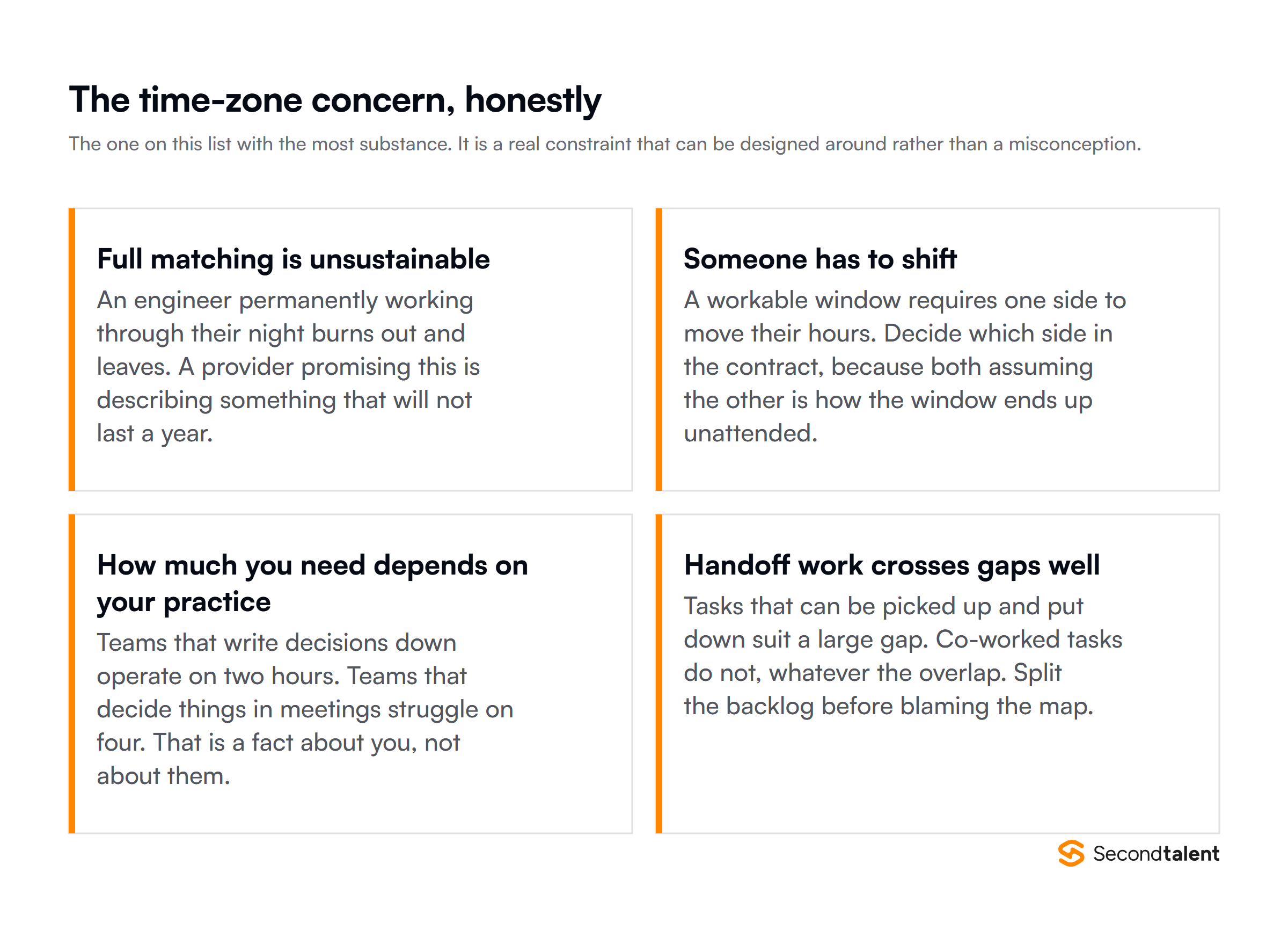
How much you need is a fact about your own working practice rather than about the engineer. Teams that write decisions down operate comfortably on two hours. Teams that make decisions in meetings and never record them struggle on four, because everything an engineer needs arrives during hours they are asleep.
The other half is what kind of work you are sending. Some tasks can be picked up and put down, and those cross a large gap without difficulty. Work that requires two people thinking at once does not, whatever the overlap window says. Splitting the backlog by that property is more useful than negotiating an extra hour.
Myth 4: IP protection is weaker
Weaker than what, and under whose law. This one turns on a clause rather than on a country.
Copyright in software is protected across almost every jurisdiction you would hire in, because the Berne Convention has more than 180 contracting parties. The subsistence of the right is rarely the issue. What varies is who owns it by default, and whether an assignment of future work is effective under the law where the engineer sits.
A single governing-law provision at the end of a master agreement, naming your home state, is the common failure. Assignment of intellectual property is one of the areas most likely to be governed by local mandatory rules regardless of what the contract chose, and a clause drafted for one jurisdiction may simply not do the work in another.
The version of the concern worth holding is therefore narrow and answerable: does the IP clause address the law where the engineer actually is, does it cover pre-existing material as well as work product, and does it survive the engineer leaving the provider. Our guide to IP assignment in IT staffing covers the drafting. Where personal data is in scope as well, GDPR Article 28 prescribes the processor terms rather than leaving them to negotiation.
Myth 5: the management overhead cancels the saving
Mostly true, and the most useful objection on the list.
Staff augmentation assumes a manager on your side who assigns work, reviews it and unblocks people. That time is real, it is uninvoiced, and it does not appear in any rate comparison. On a team of four augmented engineers it is a meaningful fraction of a senior person’s week, and pretending otherwise is how engagements get approved and then resented.
Where the objection overreaches is in assuming the overhead is specific to augmentation. A direct hire needs the same direction, plus the recruiting, onboarding, equipment and benefits administration that the augmentation model absorbs. The comparison people make in their heads is against a hire who is already productive, which is a hire that does not exist yet.
The right move is to put the number in the model rather than to argue about it. Estimate the management hours honestly, price them at your own loaded cost, and add them to the provider rate before comparing anything. If the case only works with that line set to zero, the case does not work.
The same discipline applies on the other side of the comparison. The US Bureau of Labor Statistics puts the median wage for software developers at $135,980 as of May 2025, and that is salary before employer taxes, benefits, equipment and space. A provider rate already carries all of it. Comparing an unloaded salary against a loaded rate is the single most common arithmetic error in this decision, and it usually runs against the provider by a wide margin.
Myth 6: communication is the bottleneck
Usually a different problem wearing this label.
Written English proficiency is testable, screenable and consistent enough across a provider’s bench to be a solved variable. The EF English Proficiency Index tracks national averages, which are the wrong unit anyway: you are hiring one person from a filtered pool, not a national average.
What people experience as a communication problem is more often a context problem. An engineer who does not know why a constraint exists asks questions that look basic, proposes solutions that miss the point, and takes longer than expected. That reads as a language barrier from the outside. It is a documentation gap, and it produces the same symptoms with a colleague in the next room, where it gets excused instead of diagnosed.
The distinguishing test is cheap. Ask a candidate for a written incident postmortem, a design note or a code review summary. Written output predicts async performance better than any conversation, and it separates the two problems in about fifteen minutes. Our guide to managing augmentation teams covers the written practices that make the rest work.
Myth 7: it is only about cost
Cost is the easiest reason to explain to a finance committee, which is why it dominates the conversation and why so many engagements are scoped badly.
Two other reasons produce better outcomes. The first is access to a specialty your local market genuinely lacks, where the alternative is not a cheaper hire but a nine-month vacancy. The second is speed, where the cost of the seat being empty exceeds the difference between any two rates you are comparing.
These matter beyond framing. A brief written to save money asks for the cheapest person who can do the job. A brief written to close a capability gap asks for someone who has done the specific thing before, and it produces a different shortlist. Buyers who lead with cost and then complain about seniority are usually reading back their own brief.
What we can and cannot show you
Being straight about the evidence is part of the answer here, given what this page used to claim.
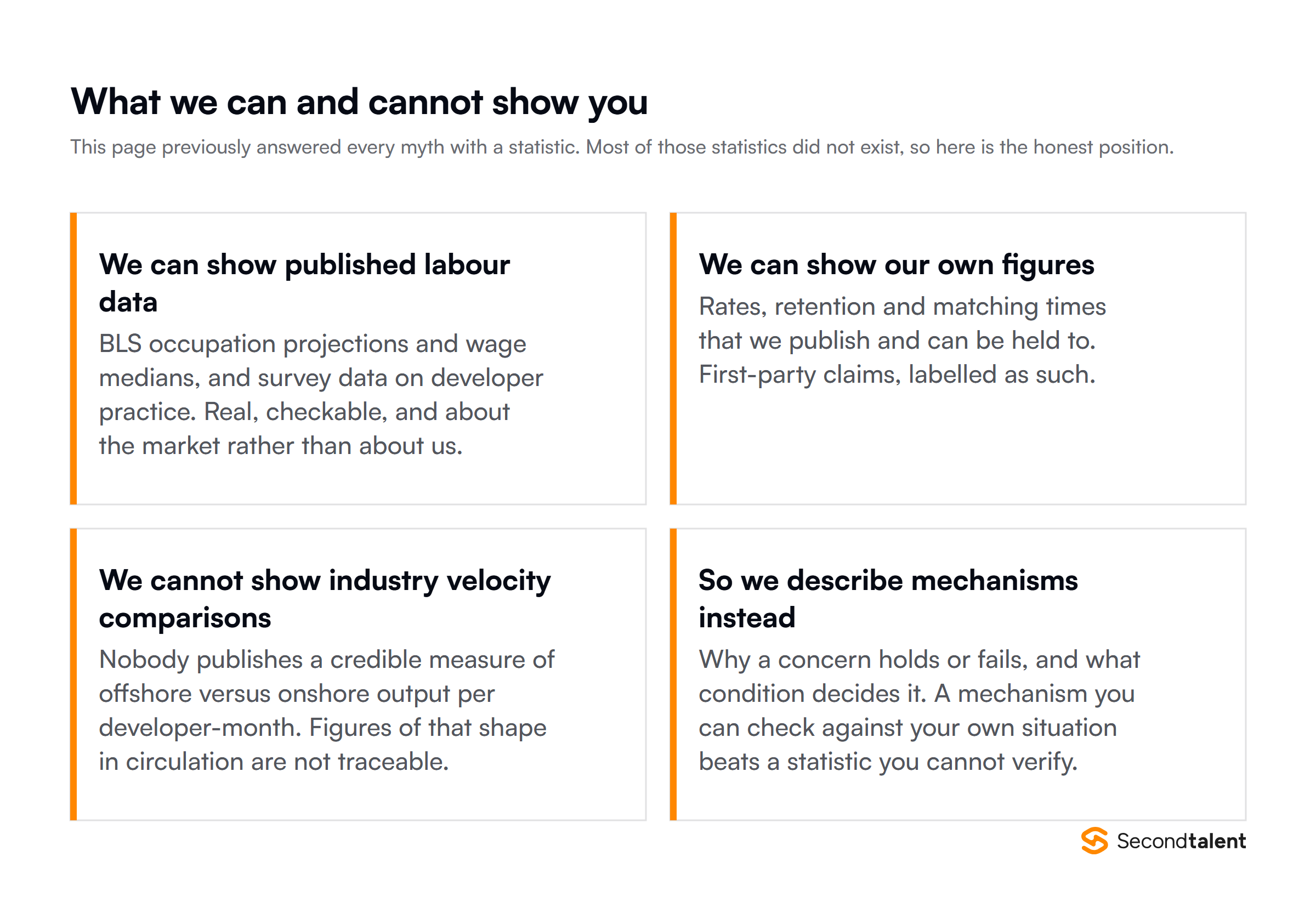
Published labour data exists and is checkable: BLS wage medians and occupational projections, and survey data on how developers work. The 2025 Stack Overflow Developer Survey found 84 percent of developers use or plan to use AI tools while 46 percent distrust the accuracy of what those tools produce, which is a real finding about the market and says nothing about anyone’s provider.
Our own figures are first-party claims, and we label them that way. What does not exist is an industry measure of offshore versus onshore output per developer-month. If a provider quotes you one, ask which report, then open it.
Testing the objections yourself
Every objection on this list has a cheap experiment attached, which beats trusting any write-up including this one.
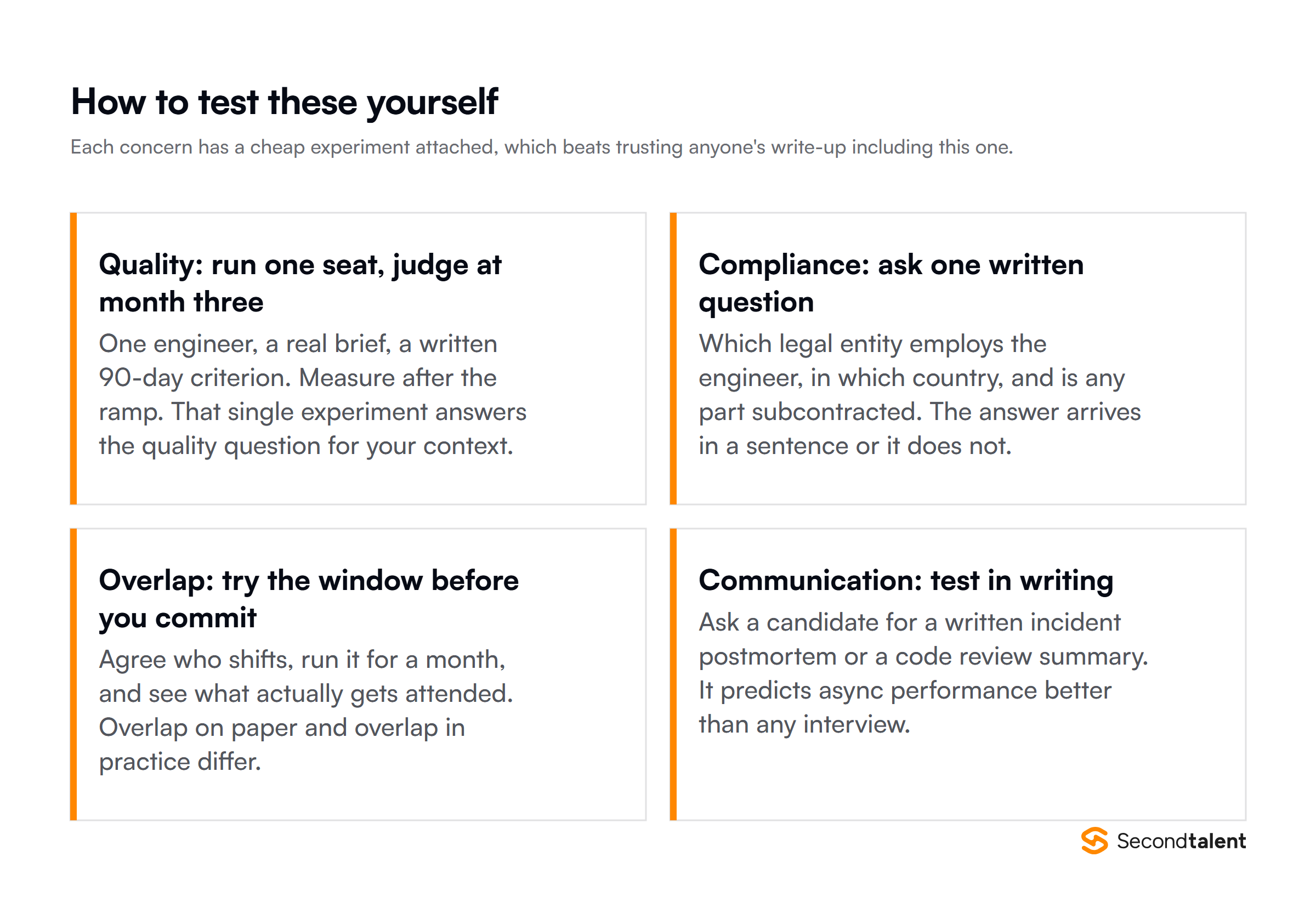
The quality question is answered by one seat, a real brief, a written 90-day criterion, and patience until month three. The compliance question is answered by one written question about employing entities. The overlap question is answered by running the window for a month and seeing what actually gets attended. The communication question is answered by a writing sample.
None of those takes longer than the argument usually does, and each produces evidence about your situation rather than about someone’s aggregate.
Common questions
Which of these should I take most seriously?
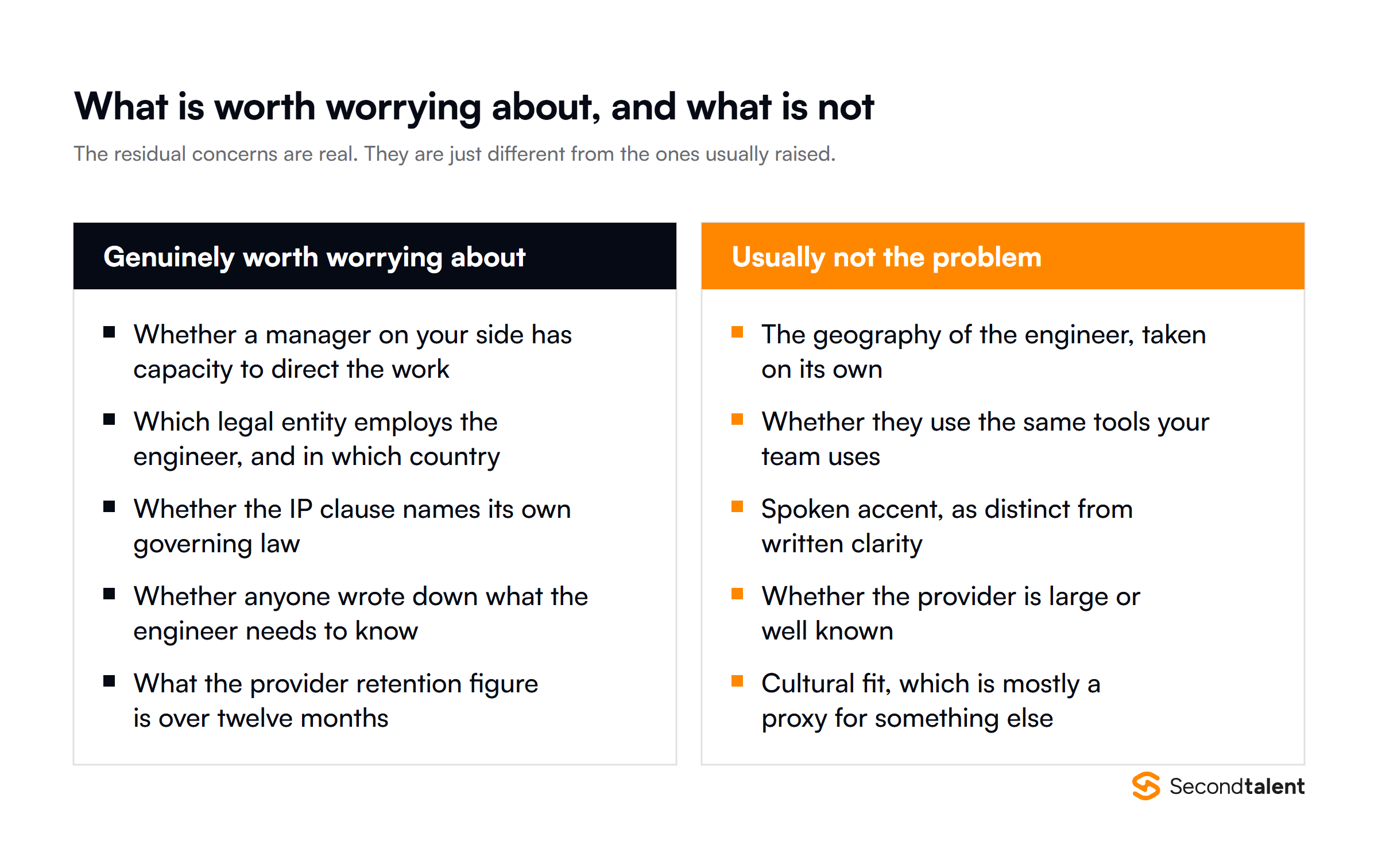
The management overhead, because it is true and it is quantifiable, and the employment structure, because it is the only item on the list with uncapped downside. The rest are conditions you can design around.
Is nearshore a way around the time-zone objection?
It shrinks the gap rather than removing the design question. A three-hour difference still requires someone to decide whose hours move for the standup. It buys you a larger natural window at a rate typically between offshore and onshore, which is a genuine trade rather than a free fix.
How do I tell a real vetting funnel from a claim?
Ask for drop rates stage by stage and the top failure mode at each. Providers who run a funnel can produce this in a day. Providers who forward CVs will offer a top-percentage acceptance figure instead, which is a rejection claim with nothing behind it. Our checklist on evaluating IT staffing companies covers the follow-ups.
Do these objections apply differently in regulated industries?
Two of them change weight considerably. Employment structure and IP both become supervisory questions rather than commercial ones, with named entities, audit rights and data locations required in the contract. The others behave the same way.
What if my last engagement genuinely went badly?
Then work out which of the four quality drivers it was, because that is recoverable information. An engagement that failed on a vague brief or an undocumented context fails identically with a different provider in a different country.
Takeaways
- Management overhead is real. Price it into the comparison rather than arguing about it.
- Compliance exposure depends on which entity employs the engineer. One written question settles it.
- Full time-zone matching is unsustainable. Agree an overlap window and name who shifts.
- Quality tracks the vetting funnel, not the map. Ask for drop rates.
- Most communication complaints are context gaps. Test with a writing sample.
Where to go next
Second Talent employs engineers through licensed local entities across Asia, publishes rates rather than quoting on request, and reports 92 percent of placements still in seat after a year. Those are our own figures and we will stand behind them in writing.
Tell us what you are hiring for, or start with the 15 questions to ask any provider if you want to test all of this against a shortlist first.