TL;DR: The standard fifteen-minute reference call is designed to produce a warm summary, and it succeeds. Five categories produce real information instead: operational fit, mid-engagement surprises, pricing reality, the exit, and renewal intent. Ask for episodes rather than verdicts, run forty minutes, and get at least one reference the provider did not choose.
References are the diligence step almost every buyer schedules and almost nobody runs well. The default call ends with a yes to a question that was never going to get a no, and the buyer marks the stage complete having learned nothing.
What changed here. An earlier version attributed its central claims to five research reports: a Forrester vendor trust outlook, an SIA staffing report, a Gartner reference diligence index, a Robert Half hiring quality report and a McKinsey talent diligence study. None of them exist, and the percentages attached to them were invented. The framework below is unchanged because it did not depend on them. The reasoning is now stated as reasoning.
Why the default call produces nothing
Three mechanisms are working against you before the call starts, and none involves anyone behaving badly.
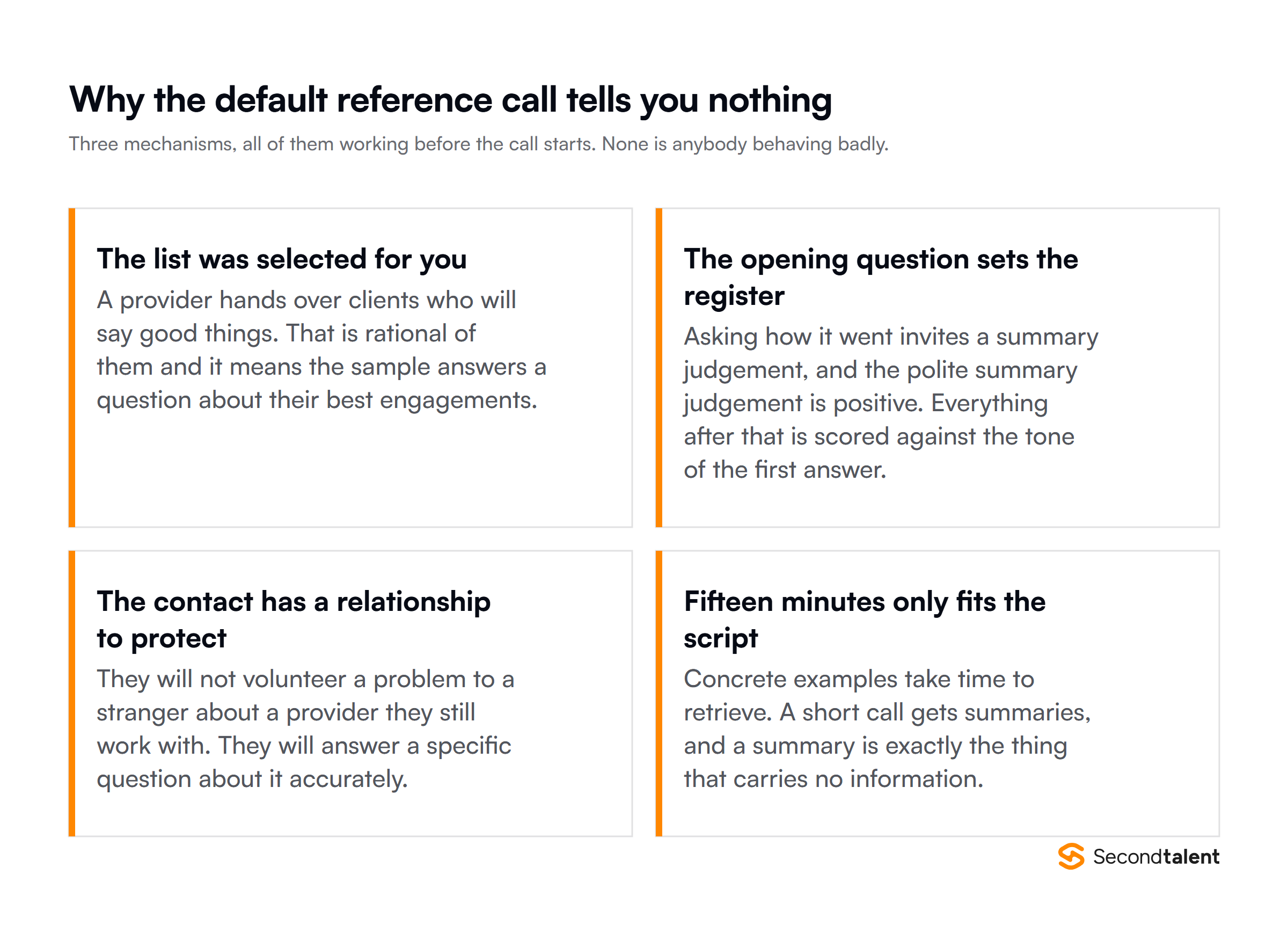
The provider chose the list. That is entirely rational of them and it means your sample answers a question about their best engagements rather than about their typical one. Any conclusion you draw generalises to a population of one.
Your opening question sets the register. Asking how it went requests a summary judgement, and the polite summary judgement is positive. Everything after it gets scored against the tone of that first answer, including your own reading of pauses and qualifications later on.
The contact has a relationship to protect. They will not volunteer a problem to a stranger about a provider they still work with. They will, almost always, answer a specific question about that problem accurately. The difference between those two behaviours is the entire opportunity.
And fifteen minutes only fits the script. Retrieving a concrete example takes time, so a short call gets summaries, and a summary is precisely the artefact that carries no information.
The five categories worth asking about
These are chosen for one property: a hand-picked reference cannot give a warm answer to them without telling you something useful along the way.

Operational fit is what had to change on their side after the engineer joined. Sprint shape, on-call rotation, review load, whether the overlap window was actually attended. Friction is invisible in a headline outcome and it is the thing that will repeat for you.
Mid-engagement surprises are where the real information sits. Almost every engagement has a scope shift, a personnel substitution, a pricing conversation or a missed date. How the provider handled it predicts far more than whether it happened, and it is the category references never raise unprompted.
Pricing reality is where the politeness gradient breaks down, because people have specific numbers in front of them. Did the quoted rate hold. What line items appeared later. How was renewal priced. Even a contact determined to be positive answers numerical questions precisely.
The exit is the strongest single indicator available. How the last thirty days ran, whether handover was structured, whether credentials were transferred cleanly, whether the engineer ramped down or checked out in week two. It tells you whether the provider treats the engagement as a contract or a relationship.
Renewal intent is harder to soften than would-you-hire-again, because a contract is either renewing or it is not. Ask whether it is renewing and on what terms, and listen for the hedge.
Rewriting the questions
Most of the improvement here comes from one change: ask for an episode rather than a verdict. A verdict invites a summary and a summary is where the information goes to die.
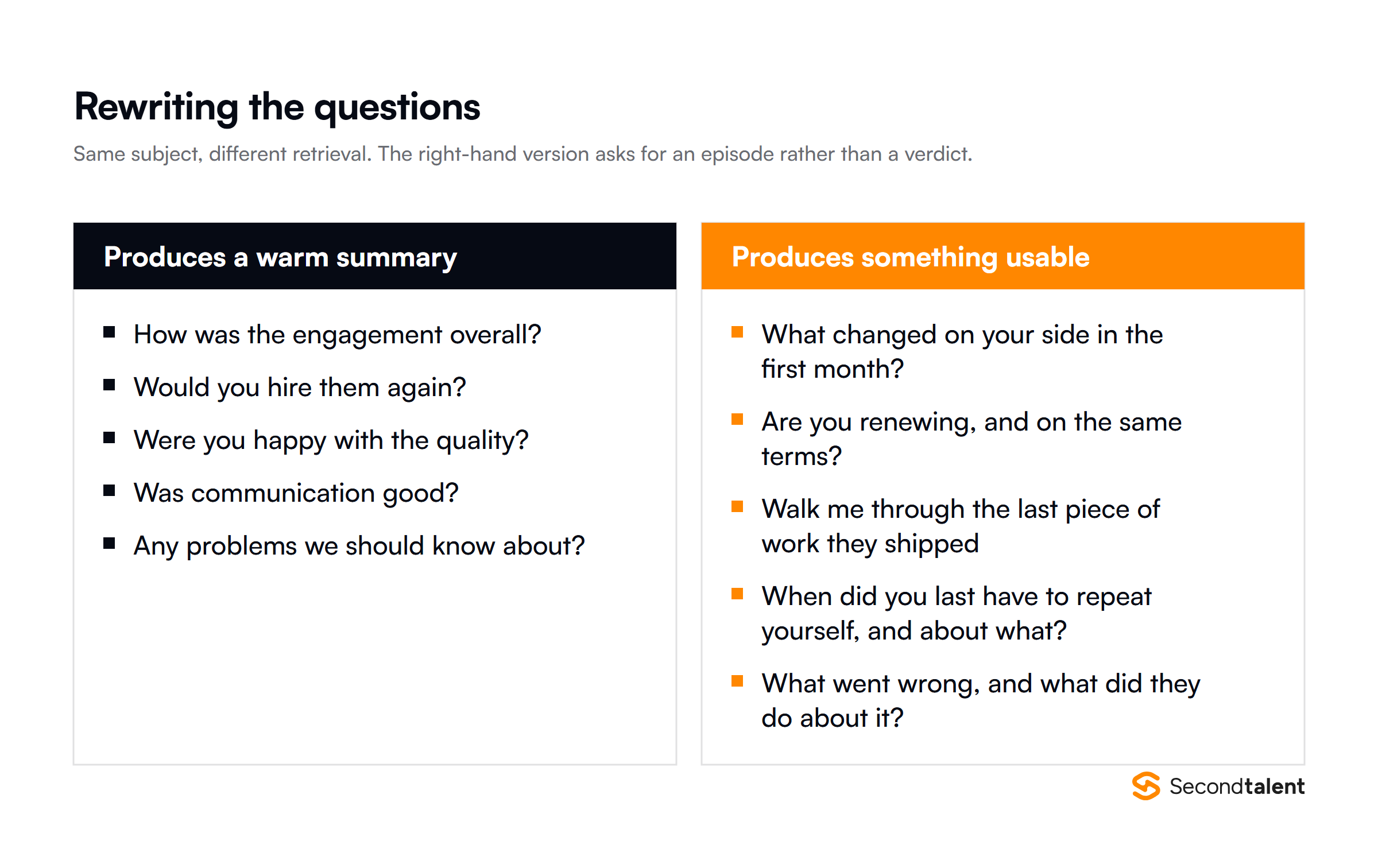
Compare two versions of the same enquiry. “Was communication good?” gets a yes. “When did you last have to repeat yourself, and about what?” gets a story, and the story contains the answer plus several things you did not know to ask about.
The same substitution works everywhere. Instead of asking about quality, ask them to walk you through the last piece of work the engineer shipped. Instead of asking whether there were problems, ask what went wrong and what the provider did about it. The second half of that question is what makes it answerable, because it gives the contact somewhere constructive to land.
Where you are buying against a specific claim, test the claim through the reference. If a provider has told you their engineers are assessed on working with AI tools, ask a reference what they observed. The 2025 Stack Overflow Developer Survey found 84 percent of developers use or plan to use these tools while 46 percent distrust their output, so tool familiarity separates nobody and judgement about output is the thing worth confirming. Our guide to AI-native skills assessment covers what that assessment should look like.
Running the call
Forty minutes, structured, with the order chosen deliberately. Ask for that long when you book it and explain why, because a contact who expects fifteen minutes will start closing at twelve.
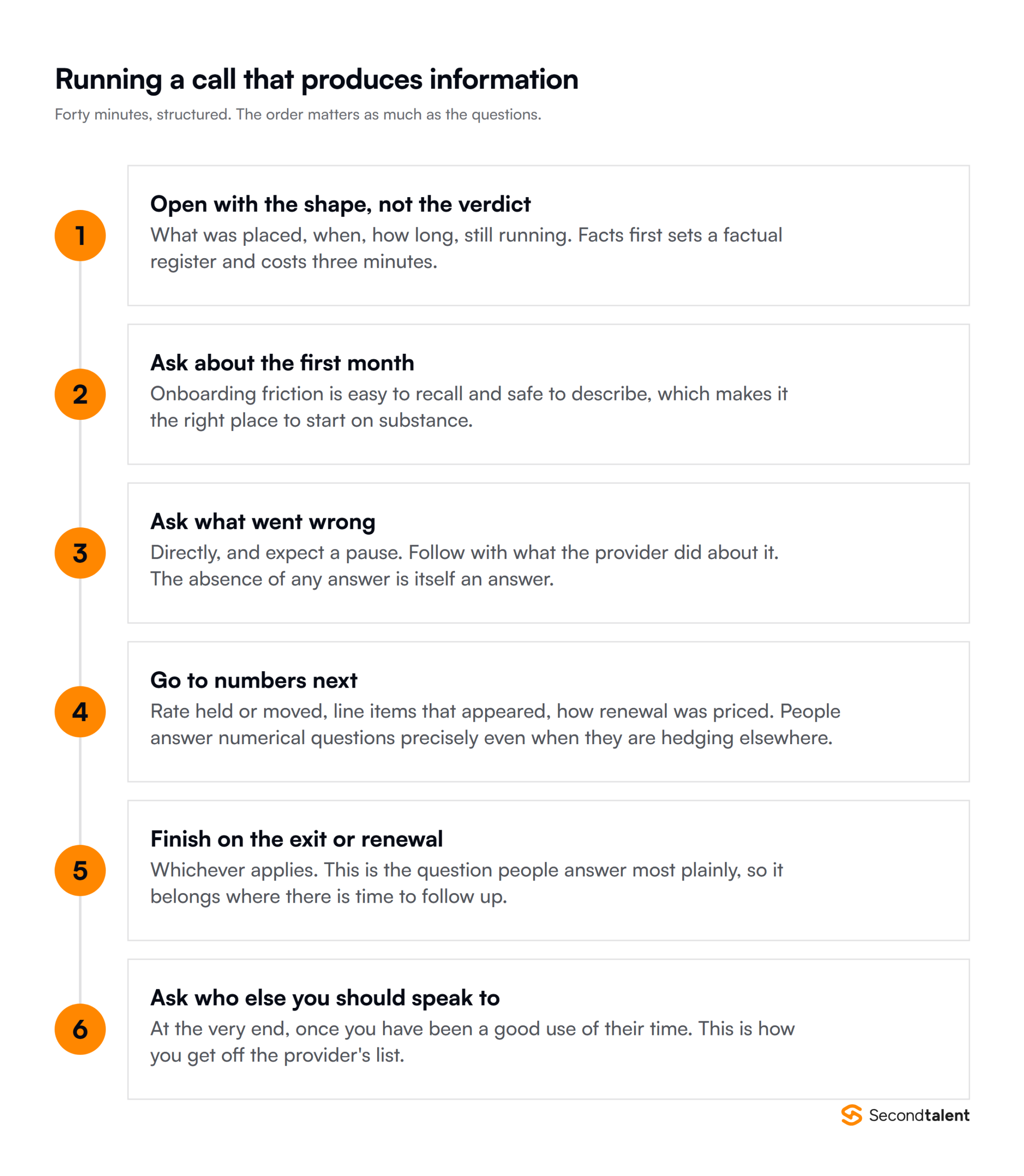
Open with the shape rather than the verdict. What was placed, when, for how long, whether it is still running. Facts first sets a factual register and costs three minutes.
Move to the first month, because onboarding friction is easy to recall and safe to describe. Then ask what went wrong, directly, and let the pause happen. Most people answer this question honestly when it is asked plainly and nobody has asked it before.
Numbers come next. Whether the rate held, what appeared on invoices that was not on the quote, how renewal was priced. Then finish on the exit or the renewal, whichever applies, where there is still time to follow up on a hedge.
The last question is who else you should speak to, asked after you have been a good use of their time. That single question is how you get off the provider’s list.
Getting a reference the provider did not choose
This is the highest-value move available in the whole exercise, and none of it requires anything underhanded.
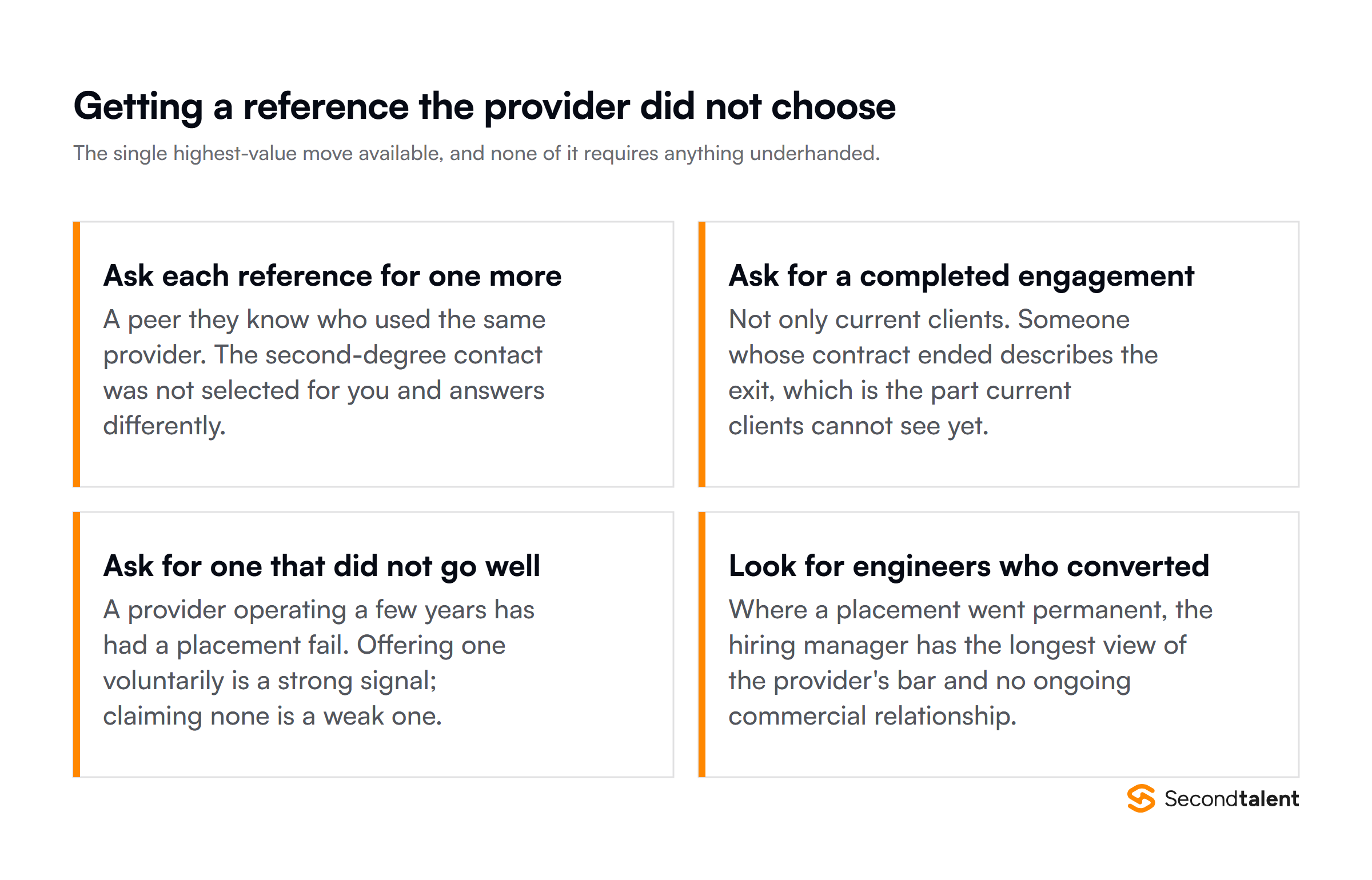
Ask each reference for a peer who used the same provider. That second-degree contact was not selected for you and answers differently, usually within the first two minutes.
Ask specifically for a completed engagement rather than only current clients. Someone whose contract ended will describe the exit, which is the part current clients have not reached yet and the part that most reliably predicts your own last month.
Ask the provider directly for a reference that did not go well. A provider operating a few years has had a placement fail. Offering one voluntarily is among the strongest signals available in a sales process, and claiming there are none means they are either new or not telling you.
Where a placement converted to a permanent hire, the hiring manager has the longest view of the provider’s bar and no continuing commercial relationship with them. Those are the most candid conversations in this process by a distance. Our checklist on evaluating IT staffing companies covers where references sit in the wider assessment.
Reading what you get back
Much of the content of a reference call is in how something is said rather than in what is said, and a few patterns recur often enough to name.
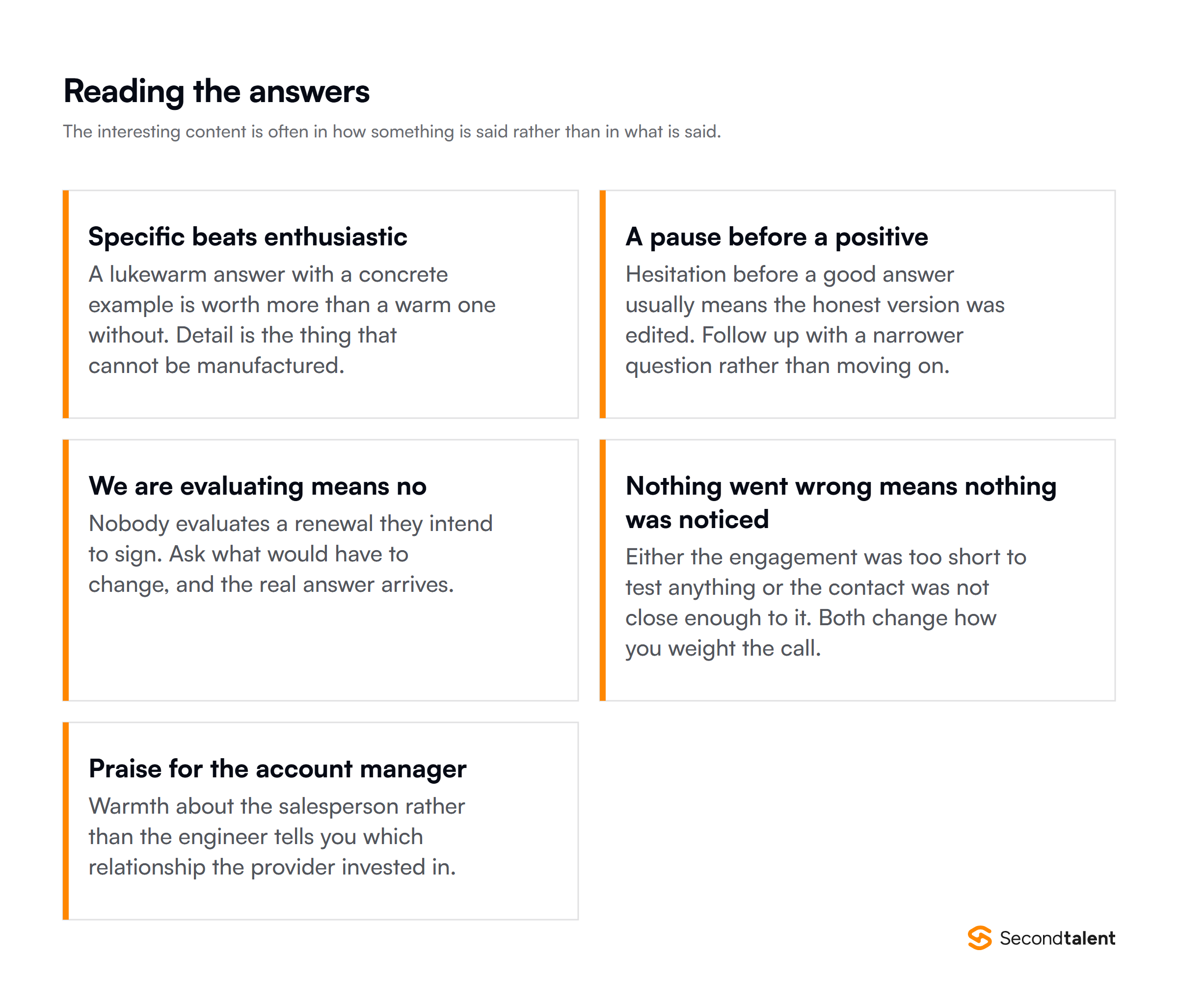
Specific beats enthusiastic. A lukewarm answer carrying a concrete example is worth more than a warm one without, because detail is the part nobody manufactures.
A pause before a positive answer usually means the honest version was edited on the way out. The move is not to note it and move on, but to ask a narrower question about the same thing.
“We are evaluating” means no. Nobody evaluates a renewal they intend to sign. Ask what would have to change, and the real answer arrives immediately.
And “nothing went wrong” means nothing was noticed. Either the engagement was too short to test anything or the contact was not close enough to it, and both change how much weight the call carries.
What references cannot tell you
Some things have to be verified directly, and treating a reference as a substitute is a common way to skip them.
Employment structure is one. A reference will not know which legal entity employed the engineer or whether any part of the service was subcontracted, and that question decides where classification exposure sits. The IRS common-law test weighs behavioural control, financial control and the type of relationship, and staff augmentation involves you directing the work daily. Ask the provider in writing instead. Our guide to worker classification in cross-border IT staffing covers what a sufficient answer contains.
Contract terms are another. What is warranted, what replacement triggers exist, what happens to data at exit. Where personal data is in scope, GDPR Article 28 prescribes the processor terms rather than leaving them to negotiation, and a reference’s recollection of how it went is no substitute for reading the clause.
Access handling is a third. A reference can describe how the exit felt, but not whether credential provisioning and revocation followed any documented practice. The NIST Cybersecurity Framework treats identity and access management as a core function, and whether a provider maps to something like it is a question for the provider and for your own security team.
Nor can a reference tell you what a placement should cost. For a baseline, the US Bureau of Labor Statistics puts the median wage for software developers at $135,980 as of May 2025, which is salary before employer taxes and benefits and therefore not directly comparable to a loaded provider rate.
Common questions
How many references are enough?
Three, of which at least one you found yourself. Two provider-selected references tell you about their best work; the third tells you whether the first two were representative.
Do email reference forms work?
Not for this. A written form gets considered, edited answers, which is the opposite of what the method above is for. Use email to schedule the call, not to replace it.
What if the provider will not supply references?
For a large enterprise buyer under confidentiality, this is sometimes genuine. Ask for an anonymised engagement description with a contact at a smaller client instead. A flat refusal at any size is information.
Should I check references before or after the shortlist?
After. References are expensive in other people’s time and the questions get sharper once you know what you are worried about. Run them on the final two rather than on six.
Does any of this change for a short engagement?
The categories compress but do not change. On a three-month seat, weight onboarding friction and pricing reality highest, since exit and renewal have less to say and onboarding is a larger share of what you are buying.
Takeaways
- Ask for episodes, not verdicts. A verdict is a summary and summaries carry no information.
- Book forty minutes. Fifteen only fits the script that produced the problem.
- Get at least one reference the provider did not select, by asking each one for a peer.
- Ask about the exit. It predicts your own last thirty days better than anything else.
- Verify employment structure and contract terms with the provider, not with a reference.
Where to go next
Second Talent will put you in touch with clients whose engagements ended as well as ones still running, and will describe a placement that did not work if you ask. We employ engineers through licensed local entities across Asia and report 92 percent of placements still in seat after a year, which are our own figures and which we will stand behind in writing.
Tell us what you are hiring for, or work through the 15 questions to ask any provider before you book the calls.