TL;DR: Arc.dev publishes its prices: freelancers at $15 to $110+ an hour, or a one-off fee of 20% of the annual salary for a full-time hire. Toptal publishes a $79 monthly subscription, quotes the talent’s rate on a call, and says it introduces candidates within 24 hours. Pick Arc for listed fees and a full-time option, and Toptal for a fast shortlist and the right to trial up to three people per role.
Both companies screen remote talent before you meet anyone, and both say only a few percent of applicants get through. Arc says 2% pass its technical interview, and Toptal accepts fewer than 3%.
They part ways on price and on what a hire is. Arc prices freelance and full-time hires on one page. Toptal sells engagements billed weekly, at rates you get on a call.
- 1Toptal’s first stage cuts hardest: only 26.4% of applicants pass its English and personality interview. Arc’s first stage lets 55% through.
- 2On a $90,000 salary, an Arc full-time hire costs a one-off $18,000 fee. Toptal publishes no equivalent figure.
- 3Toptal says 90% of clients hire the first candidate it introduces, and lets you trial up to three people per position.
- 4Arc backs full-time hires with a free replacement for three months. Toptal’s cover is a no-risk trial of up to two weeks.
Arc.dev or Toptal: which should you use?
Use Arc if you want a price before you talk to anyone, or if you want to hire someone full time and put them on your own payroll or an EOR’s. Its fees sit on one page, and the full-time fee is paid once.
Use Toptal if speed and a guided shortlist matter more than a listed price. Toptal introduces candidates within 24 hours, runs the trial for you, and can cover design, finance and project management as well as engineering.
The table sets the two side by side on each company’s own pages, read on September 14, 2026. “Not published” means the company gives no figure. For the wider field, see our Toptal alternatives and Arc.dev alternatives pages.
| Arc.dev | Toptal | |
|---|---|---|
| What it sells | Freelance and full-time remote hires | Freelance engagements across engineering, design, finance and project management, plus HireGlobal payroll and EOR |
| Published prices | $15 to $110+ an hour freelance; 20% of annual salary for a full-time hire | $79 monthly subscription once you proceed; talent rates quoted on a call |
| Screening | Three rated steps; 2% pass the technical interview | Five stages; fewer than 3% accepted |
| Speed claim | Freelance hire in 72 hours; full-time in about 14 days | Candidates within 24 hours |
| If it fails | Freelance trial of up to two weeks; free replacement for three months on full-time | No-risk trial of up to two weeks; up to three trial candidates per position |
| Network claim | 450,000 talent in 190 countries | 3,600,000+ cumulative applications by 2025 |
| Track record | 800+ hires made | 35,000+ clients and 91,000+ engagements by 2025 |
| Billing | Hourly freelance; one-off fee on hire | Weekly price; invoiced twice a month on Net 10 |
How the two screen talent
Both companies publish the share of applicants who survive each stage, so the funnels can sit on one scale. The difference is where each one cuts.
Toptal cuts at the door. Its first stage is an English and communication interview that also assesses personality, and only 26.4% of applicants pass it. An in-depth skill review leaves 7.4%.
A live screening with experts in the candidate’s field leaves 3.6%, and a test project of one to three weeks leaves 3.2%.
Toptal rates the fifth stage, continued excellence, on client work, and puts the end result at 3%. Its screening process page says the whole process takes 3 to 8 weeks.
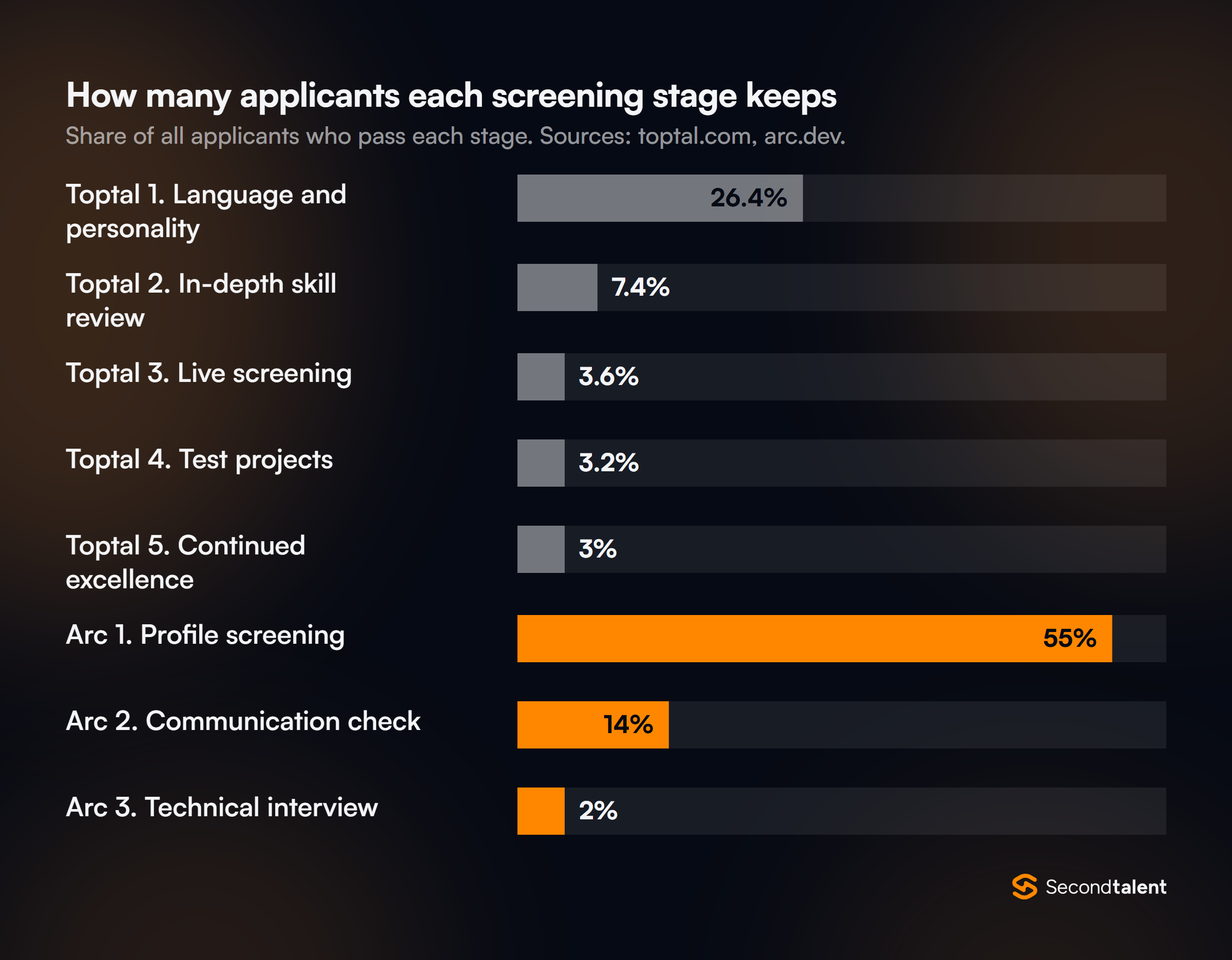
Arc cuts later. Its how Arc works page says 55% of applicants pass a review of skills, training and experience. An English and remote-readiness check, by live interview or recorded video, leaves 14%.
A one-hour expert interview or pair programming session leaves 2%. A fourth step, the final review, has no pass rate, and Arc says it keeps monitoring talent after they start.
Arc also sources beyond its applicants: open source contributors, top Stack Overflow answerers, and the best of the 350,000+ mentors on Codementor, the mentoring site Arc grew out of.
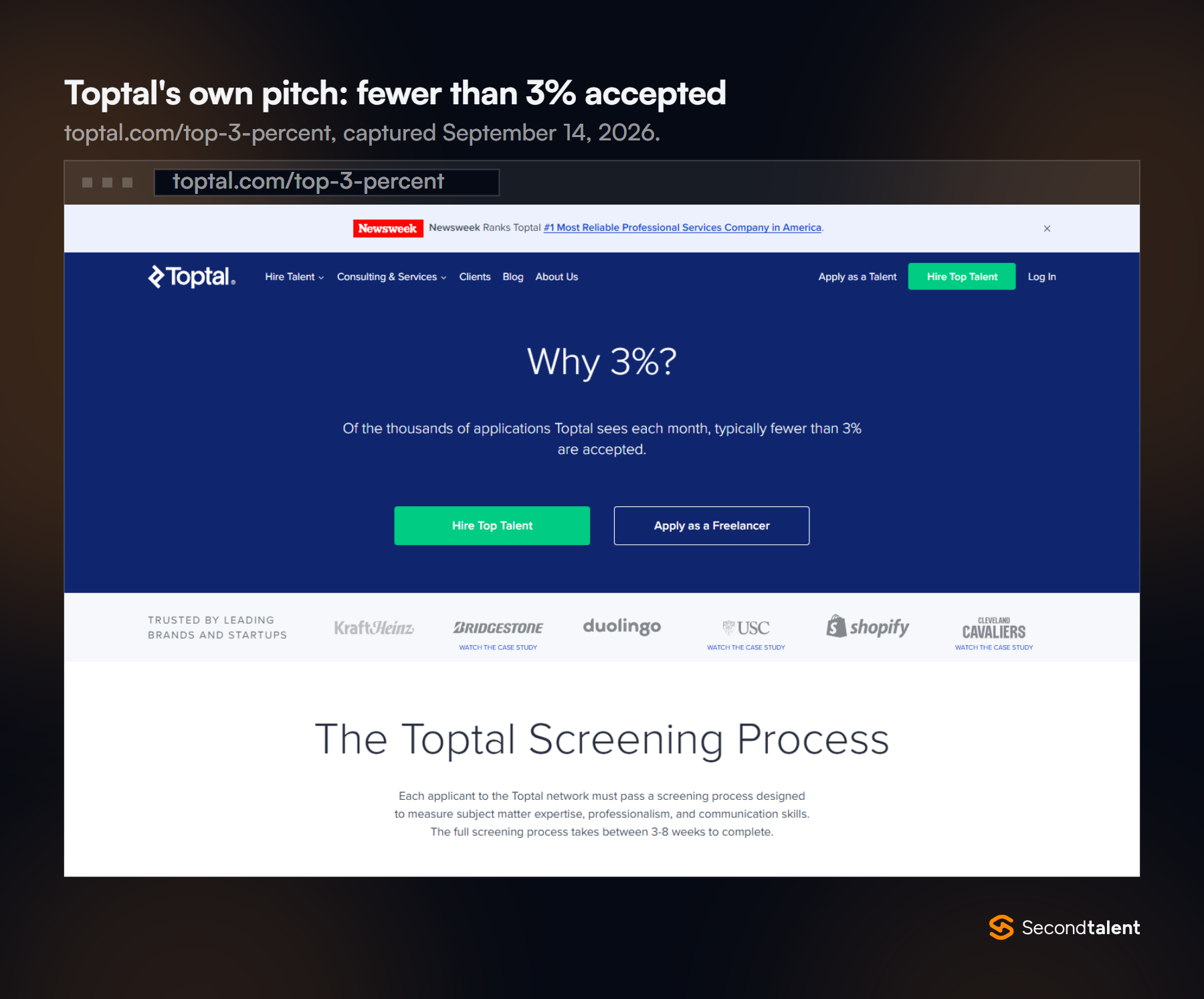
Read the two percentages with care. Toptal’s 3% is the share accepted into the network. Arc’s 2% is the share who pass the technical interview.
Neither company says how many of those people are available in a given week, which is what decides your shortlist.
What each one charges
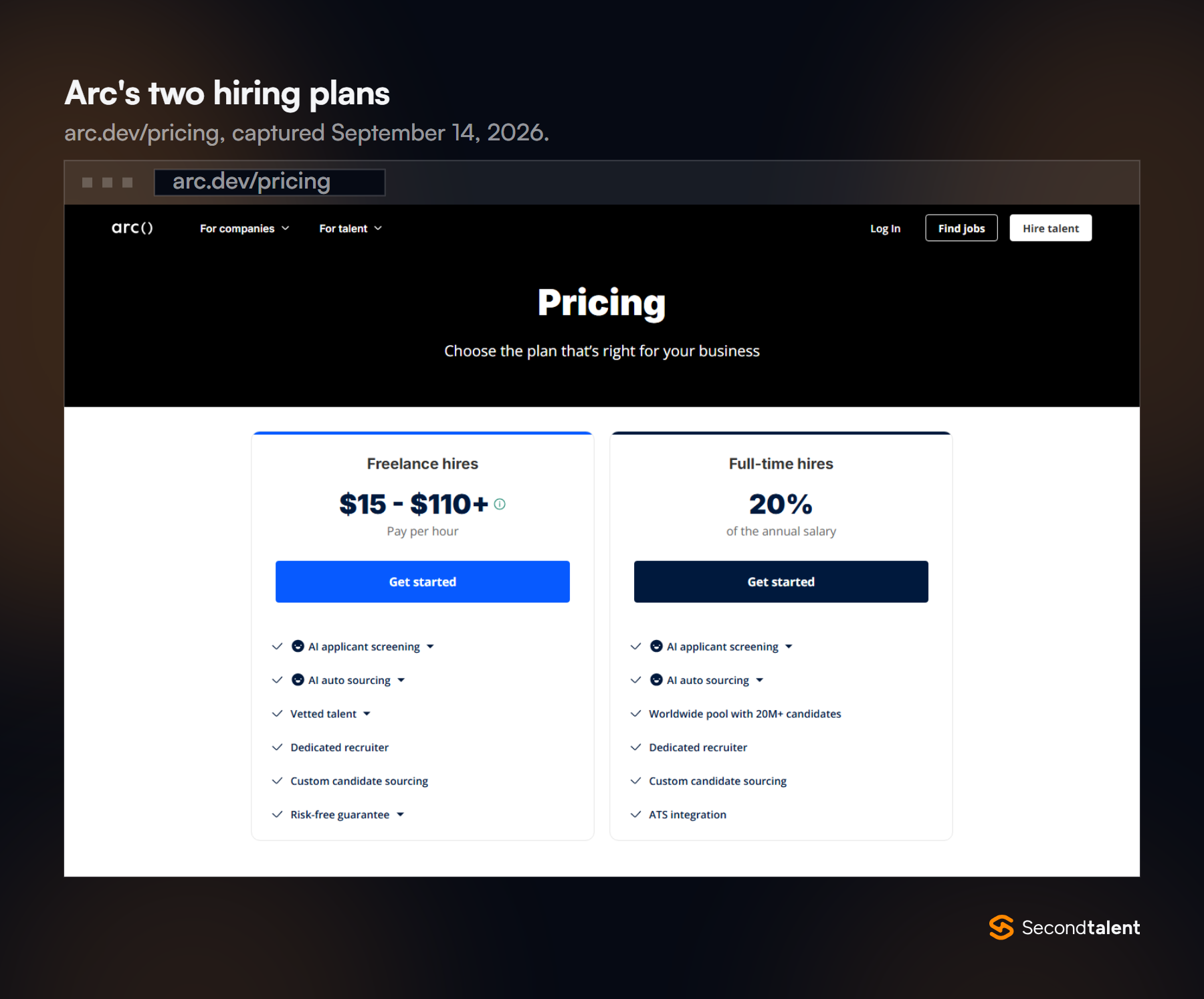
Arc prices its two plans in different units, and both sit on its pricing page. Freelancers bill by the hour, from $15 to $110+. For a full-time hire, you pay a fee of 20% of the hire’s annual salary, once, and only when you hire.
Candidates set their expected salary, and Arc matches you with people inside your range.
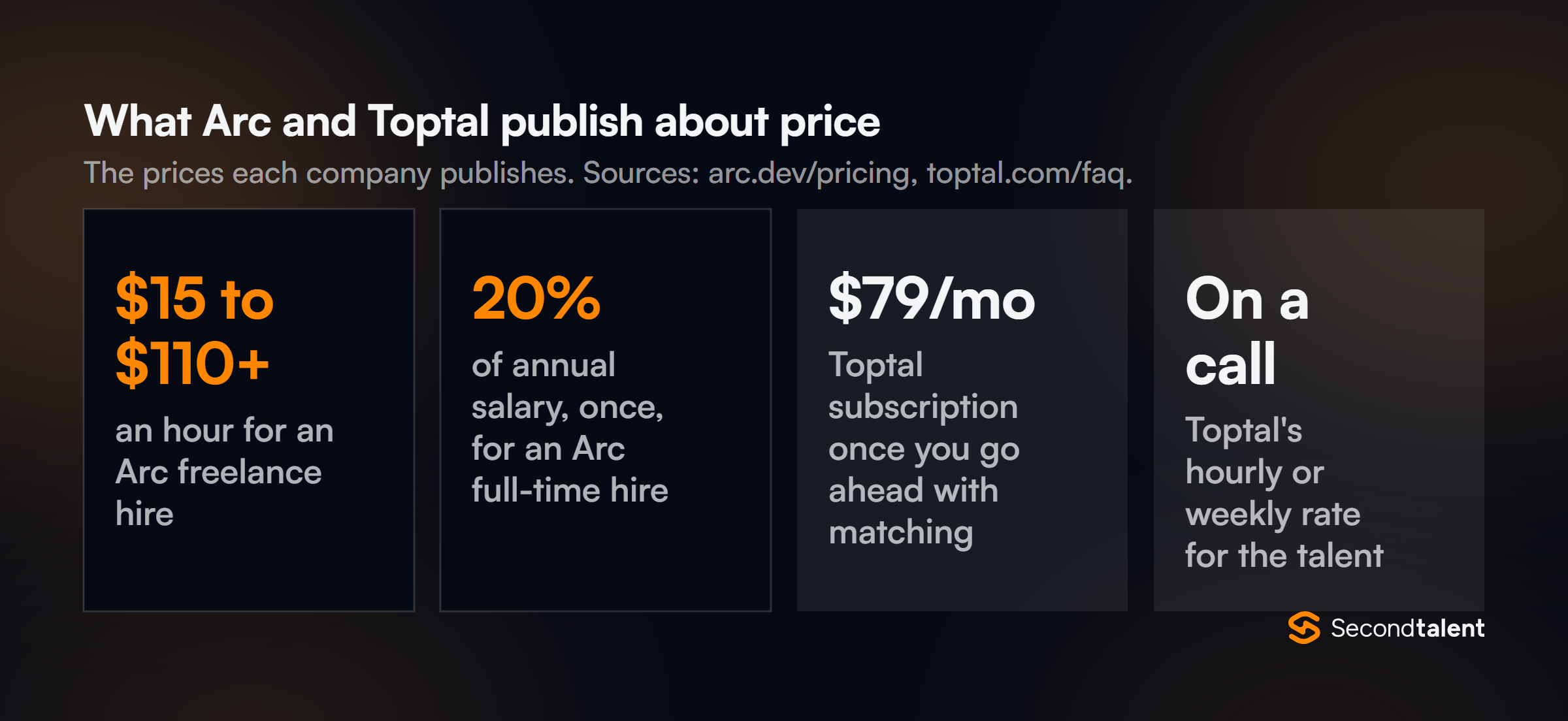
The full-time fee is easy to budget. On a $90,000 salary it comes to $18,000, paid on top of pay, with no monthly charge afterwards.
For hourly benchmarks by stack and region, our freelance developer rate index sets offshore rates against US rates.
Toptal publishes one fee. Its FAQ describes a flat $79 monthly subscription, charged if you decide to proceed with talent matching. You can cancel at any time, and ask for a refund if Toptal cannot provide talent.
The talent’s own price comes on a call. Toptal’s pricing overview says you can work with talent “hourly, part-, or full- time for a fixed price on a weekly basis”. It invoices twice a month on Net 10 terms.
So you can only compare total cost once you have a Toptal quote for the same role.
Speed to a first candidate
Toptal’s speed claim is about the shortlist. Its FAQ says it introduces candidates within 24 hours, and that 90% of clients hire the first candidate it introduces.
Arc’s claims are about the hire. Its homepage says you can hire a freelancer in 72 hours and a full-time employee in about 14 days.
Arc sets that 14 days against 58 days for a typical hiring process, a figure it credits to Workable, where interviews alone take 21 days.
The two claims measure different moments, so do not set 24 hours against 72. Both remove the slow part of hiring: posting a job, collecting CVs and running the first rounds of screening yourself.
When a hire does not work out
Toptal starts each engagement with a trial of up to two weeks. If you are not completely satisfied, you are not billed.
Toptal can then introduce another person for a second no-risk trial, and it allows trials with up to three people per position.
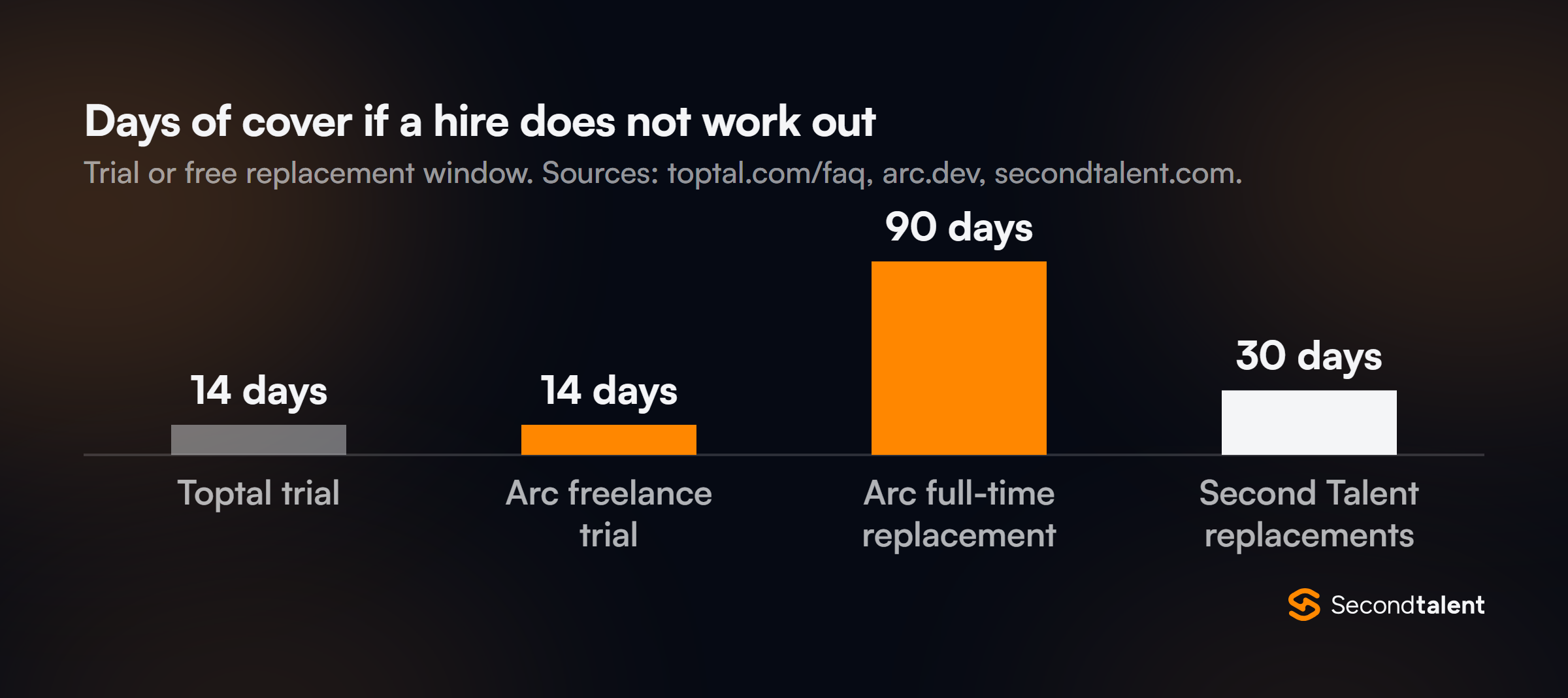
Arc’s cover depends on the plan. Freelance hires come with a risk-free trial of up to two weeks.
For full-time hires, Arc says that during the first three months it will match you with another person free of charge if the hire does not suit you.
That is the longest window in this comparison, but it replaces the person rather than refunding the fee.
Network size and track record
Toptal publishes running totals rather than a network size. Its about page counts 3,600,000+ talent applications received by 2025, up from 85,000+ in 2015.
By the same page, it has served 35,000+ clients across 91,000+ engagements, with talent in 155+ countries.
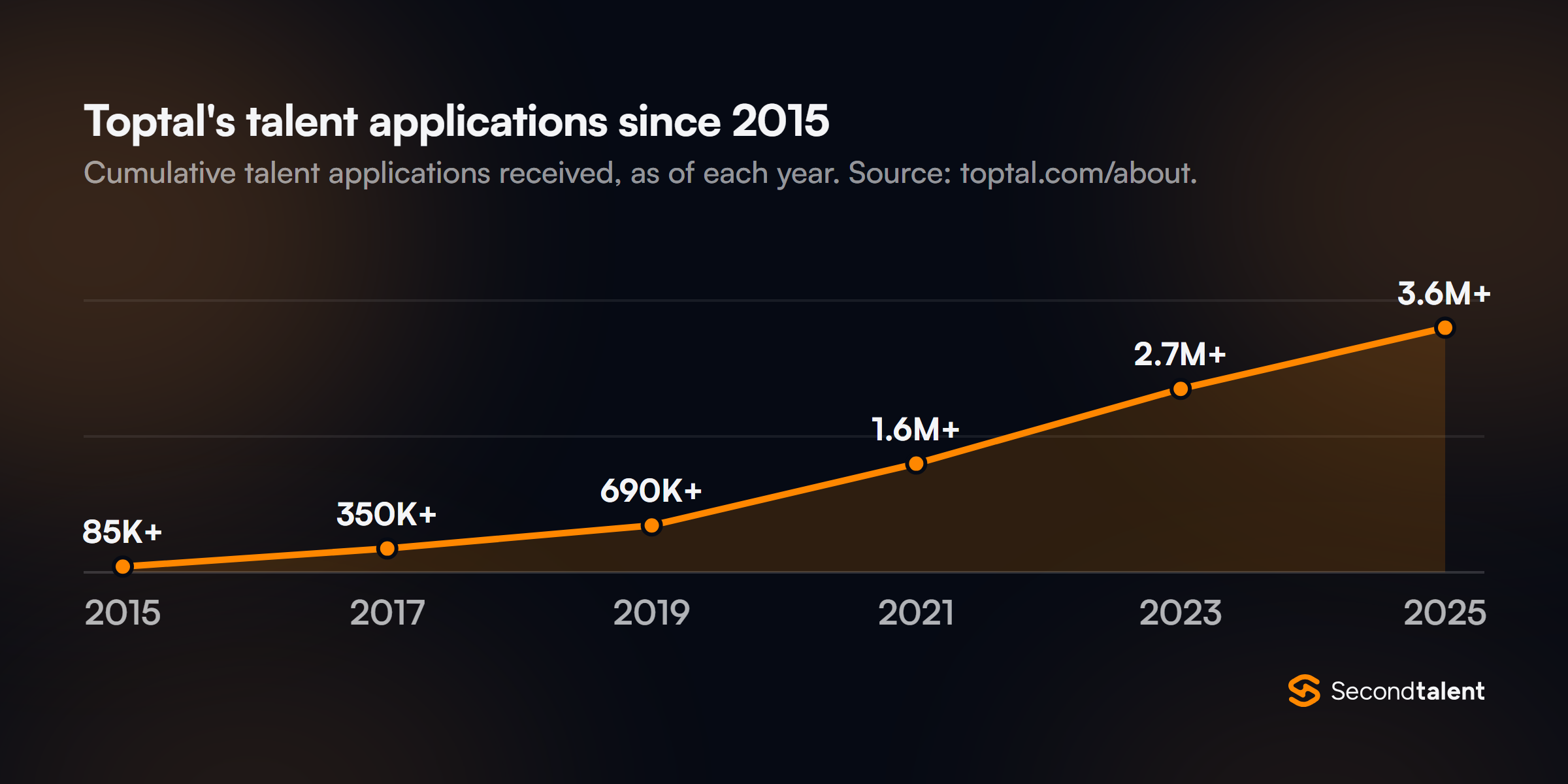
These totals only rise, because they count everything since Toptal started. They show how much the network has grown, not how many people are available to hire today, and Toptal does not publish that second figure.
Arc gives three different numbers on three pages. The homepage says “450,000 talent in 190 countries” and “800+ hires made”. Its full-time plan mentions a worldwide pool of 20M+ candidates that its HireAI tool can search.
And its developer hiring page counts the profiles listed as ready to interview.
Toptal is also growing by buying other networks.
Its about page lists four 2026 acquisitions: QO Collective for management consultants, Adeva for developers, No Single Individual for branding and creative talent, and Graphite for finance and strategy consultants.
Contractor or employee
Toptal talent work with you as contractors on an engagement. For companies that want employees in other countries, Toptal sells HireGlobal, which runs payroll and employer of record contracts.
Toptal says it has processed $5B+ in payroll and payments across 180+ countries, and its “virtual employer of record” model carries $1M of compliance indemnification per worker.
Arc handles both paths inside hiring. Freelancers are paid as contractors.
Full-time hires join your company, either on your own payroll or through an EOR, so the employment contract, benefits and local compliance sit with you or your provider. Our employer of record guides cover what that means market by market.
Full-time engineers in Asia with Second Talent
Second Talent vets engineers and employs them for you in nine Asian markets: Vietnam, the Philippines, Indonesia, Singapore, Malaysia, Thailand, Hong Kong, Taiwan and China.
The price is a flat $3,000 to $6,000 a month per engineer, all-in, covering sourcing, vetting and our managed EOR.
Our engineers pass four vetting stages: a technical assessment, an AI-native tooling check covering Claude Code, Cursor and Copilot, English at C1 or above, and a behavioural interview.
Search our talent directory yourself or send us a brief. We are engineering first, with a limited non-technical bench in design, sales development, data annotation and operations. Terms are on our pricing page.
Frequently asked questions
Is Arc.dev cheaper than Toptal?
Arc is the only one with published rates, so you can price it before a call. A fair comparison needs a Toptal quote for the same role, plus its $79 monthly subscription.
Is Arc the same company as Codementor?
They share a founder, Weiting Liu. Codementor launched in 2014 for coding mentorship, and announced Arc on July 31, 2019.
Related comparisons: Toptal vs Turing · Turing vs Arc.dev · Toptal vs Upwork · Toptal alternatives · Arc.dev alternatives