TL;DR: Organisations build a distributed engineering function through four recognisable stages: one arm’s-length engagement, several separate ones, integration into product teams, and distributed by default. Headcount is the visible signal, but the variable underneath every transition is how much of the work survives without a meeting. Most stalls get blamed on talent quality and are caused by operations, and the most common one is judging a first engagement on week-one output.
Most teams build their first engagement awkwardly and improve from there. The improvement path is predictable enough to plan against, which is what this guide is for. It is the long-horizon companion to managing IT staffing augmentation teams.
What follows is a pattern we see repeatedly rather than a surveyed finding. Treat it as a map of common terrain, not a claim about how many organisations sit at each point.

The four stages
Stage 1: one engagement, held at arm’s length. One to three engineers, often on a side project, sponsored by a single person. What is being tested is whether the model works here at all, and the answer usually turns on operations rather than talent.
Stage 2: several engagements, still separate. Four to fifteen engineers across a few teams. Managing them becomes a named responsibility. Practices vary between teams because nobody has written any down.
Stage 3: integrated into product teams. Engineers sit inside product teams with no functional distinction at team level: same board, same standup, same review process. Onboarding is templated rather than improvised.
Stage 4: distributed by default. Location stops being a design constraint. Work is written down because that is how the organisation operates, not because remote colleagues require it.
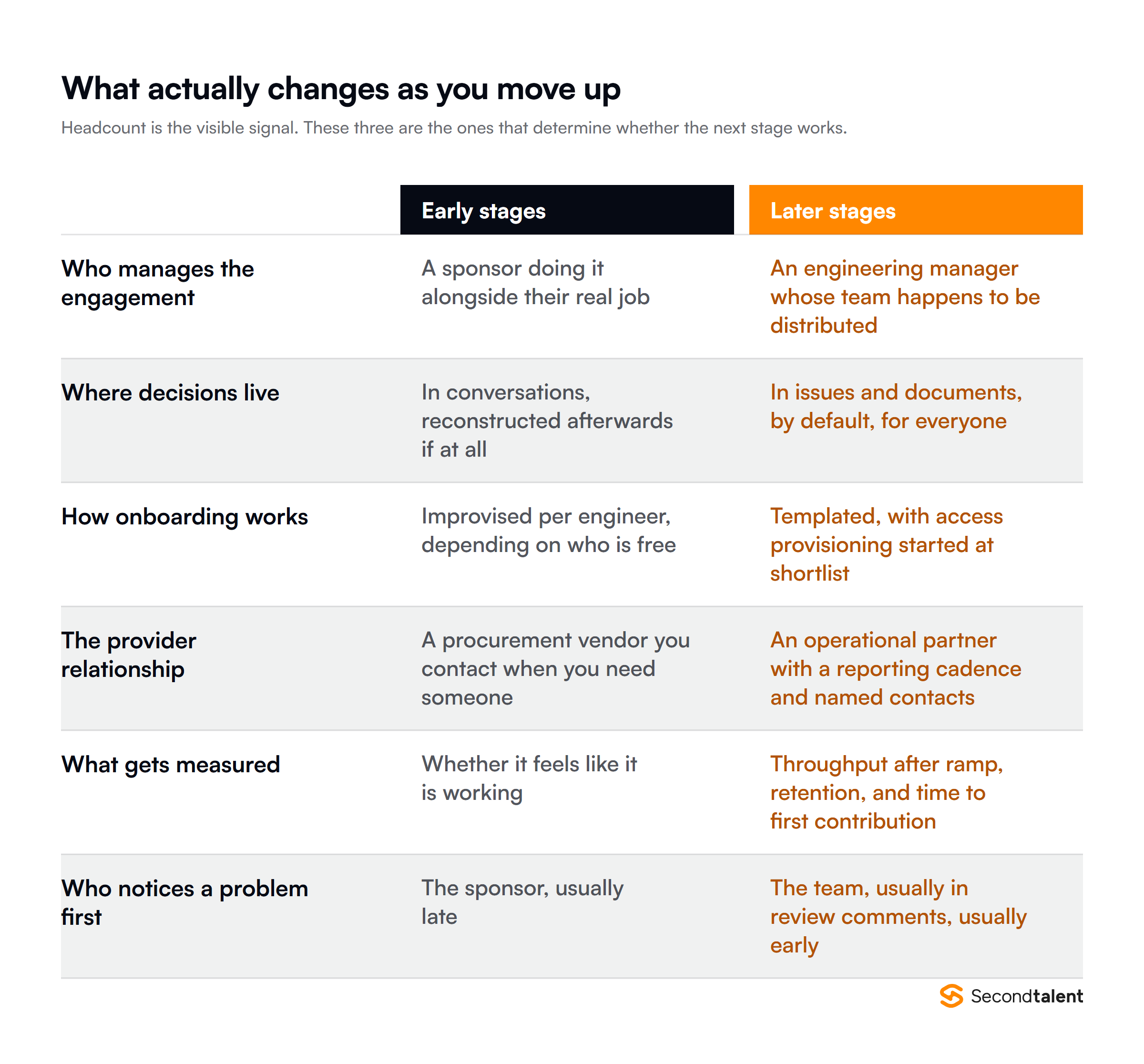
What actually changes between stages
Headcount is the visible signal and the least interesting one. Three shifts determine whether the next stage works.
Who manages it. Early on, a sponsor does it alongside their real job. Later, an engineering manager runs a team that happens to be distributed. That is a different thing from managing an engagement.
Where decisions live. In conversations, or in issues and documents by default. This is the single most predictive difference between an organisation that reaches stage three and one that does not.
What the provider is. A procurement vendor you contact when a seat opens, or an operational partner with a reporting cadence and named contacts on both sides.
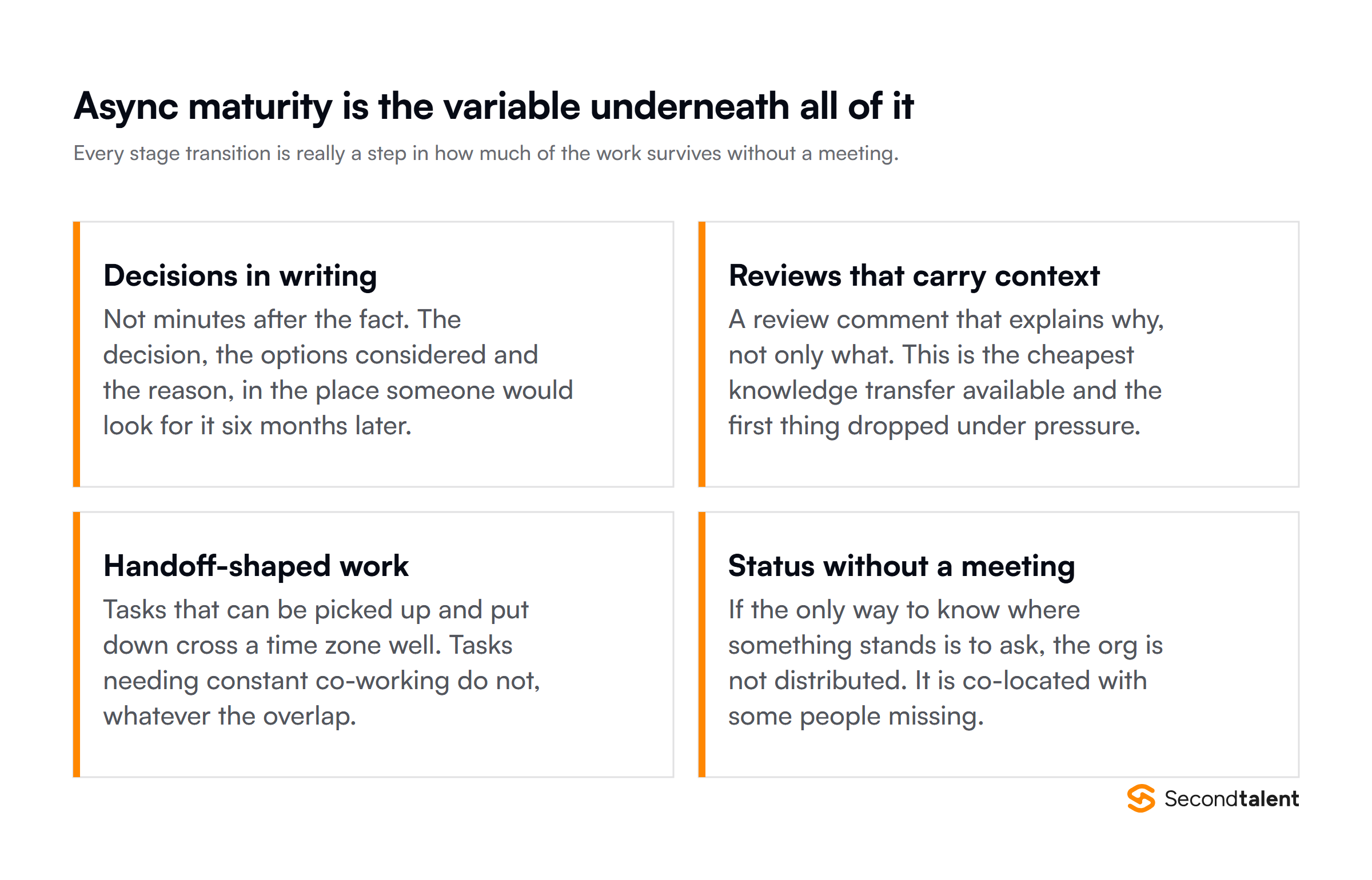
Async maturity is the variable underneath
Every stage transition is really a step in how much work survives without a meeting.
Decisions in writing means the decision, the options considered and the reason, recorded where someone would look for it in six months. Not minutes taken after the fact.
Reviews that carry context explain why rather than only what. This is the cheapest knowledge transfer available and the first thing dropped under delivery pressure.
Handoff-shaped work can be picked up and put down, which is what crosses a time zone well. Work needing constant co-working does not, whatever the overlap window says. Our guide to onshore, nearshore and offshore covers the overlap arithmetic.
Status without a meeting. If the only way to know where something stands is to ask someone, the organisation is co-located with some people missing rather than distributed.
Async practice benefits your in-house engineers too. The habits distributed work forces on you, writing decisions down and reviewing with context, make the co-located half of the team better as well. Organisations that treat these as an offshore tax miss that, and they are the ones that keep re-litigating the model rather than improving it.
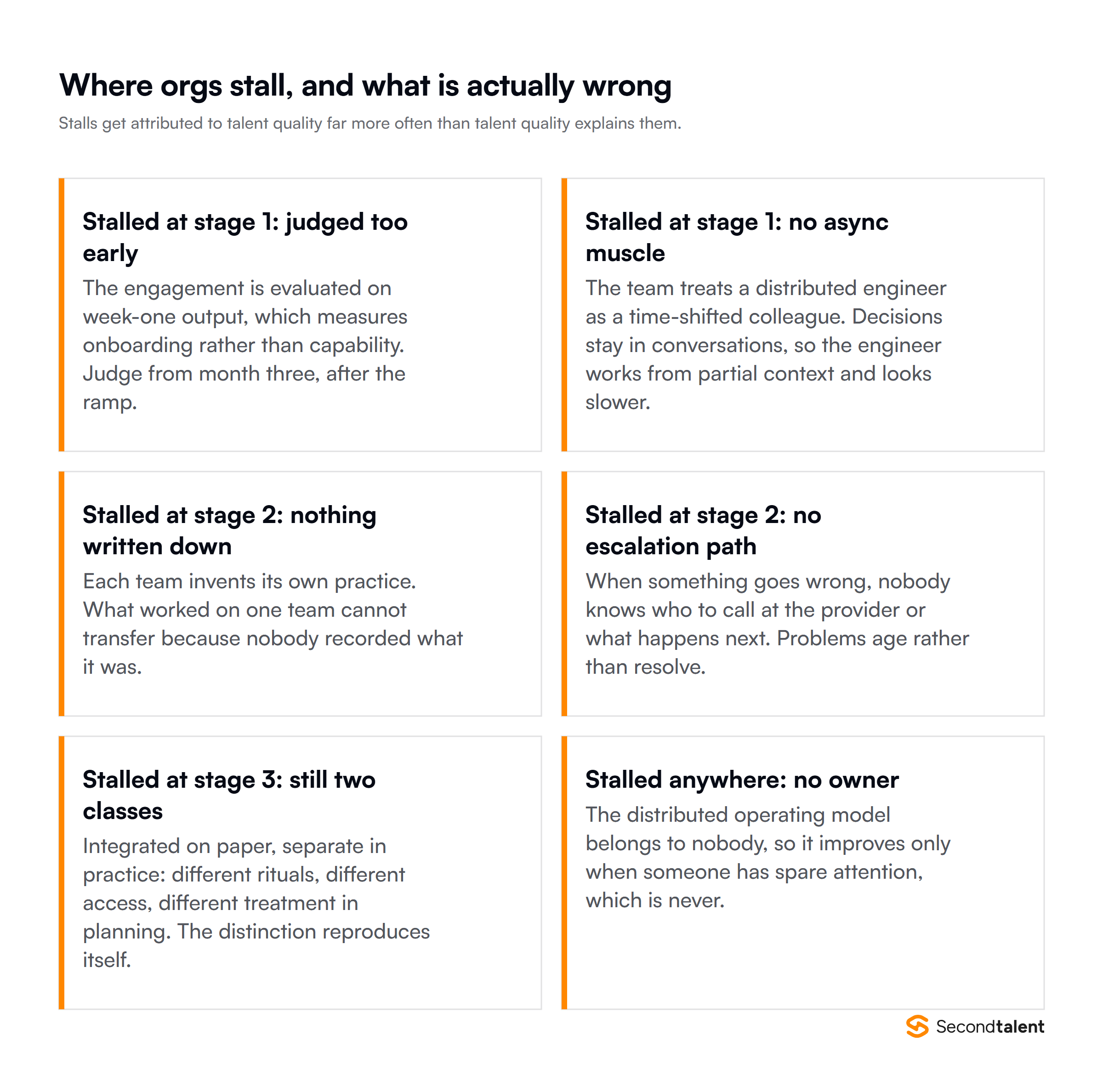
Where organisations stall
Stalls get attributed to talent quality far more often than talent quality explains them.
Judged too early. The engagement is evaluated on week-one output, which measures onboarding rather than capability. Judge from month three, once the ramp is behind you.
No async muscle. The team treats a distributed engineer as a time-shifted colleague. Decisions stay in conversations, so the engineer works from partial context and looks slower than they are.
Nothing written down. At stage two, each team invents its own practice, so what worked on one team cannot transfer because nobody recorded what it was.
No escalation path. When something goes wrong, nobody knows who to call at the provider or what happens next, so problems age rather than resolve.
Still two classes. Integrated on paper and separate in practice: different rituals, different access, different treatment in planning. The distinction reproduces itself until someone removes it deliberately.
No owner. The distributed operating model belongs to nobody, so it improves only when someone has spare attention.
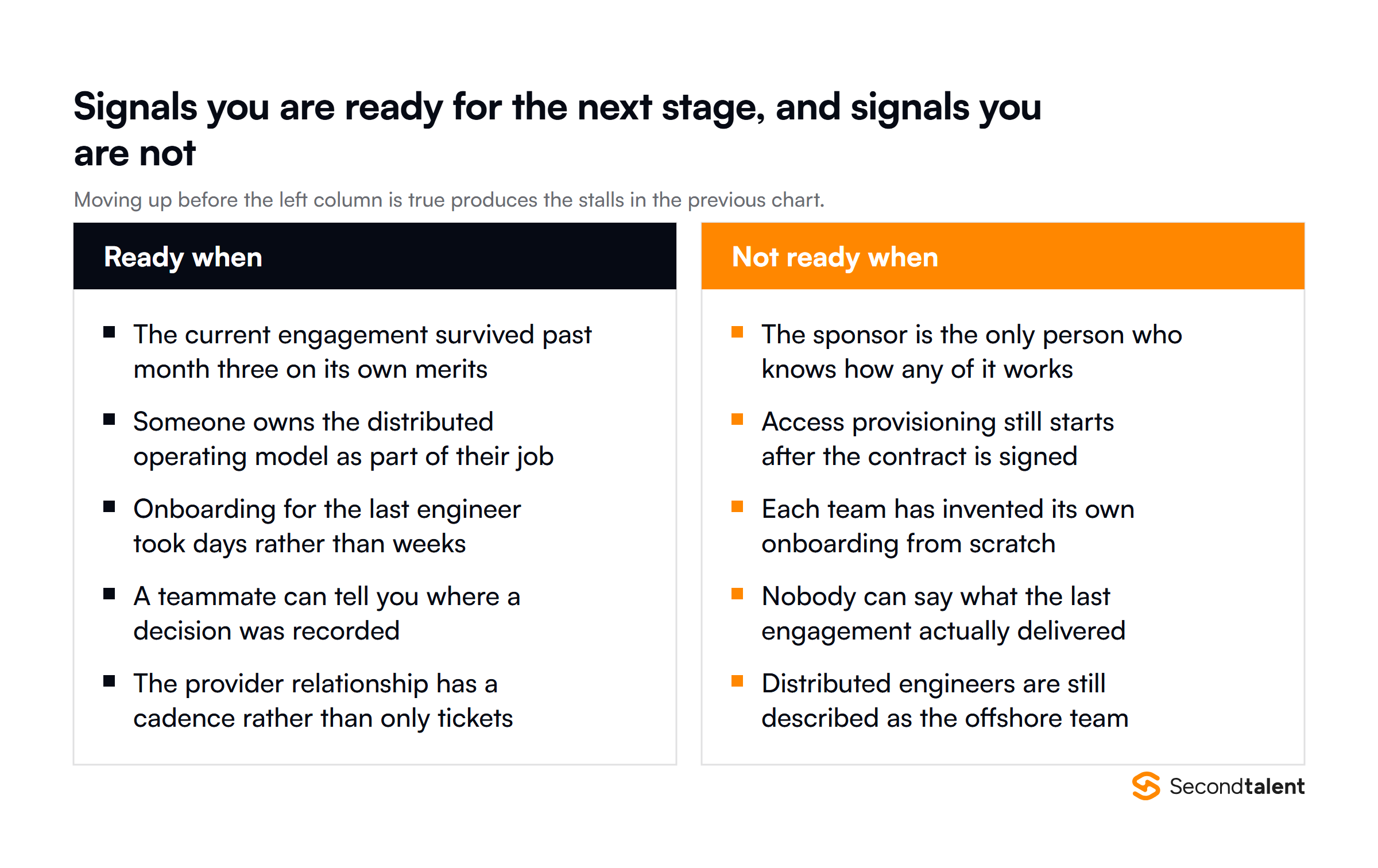
Are you ready for the next stage?
You are ready when the current engagement survived past month three on its own merits, someone owns the operating model as part of their job, the last onboarding took days rather than weeks, a teammate can tell you where a decision was recorded, and the provider relationship has a cadence rather than only tickets.
You are not ready when the sponsor is the only person who knows how any of it works, access provisioning still starts after contract signature, each team invented its own onboarding, nobody can say what the last engagement delivered, or distributed engineers are still described as the offshore team.
Moving up before the first list is true produces the stalls above, and the organisation then concludes the model does not work for them.
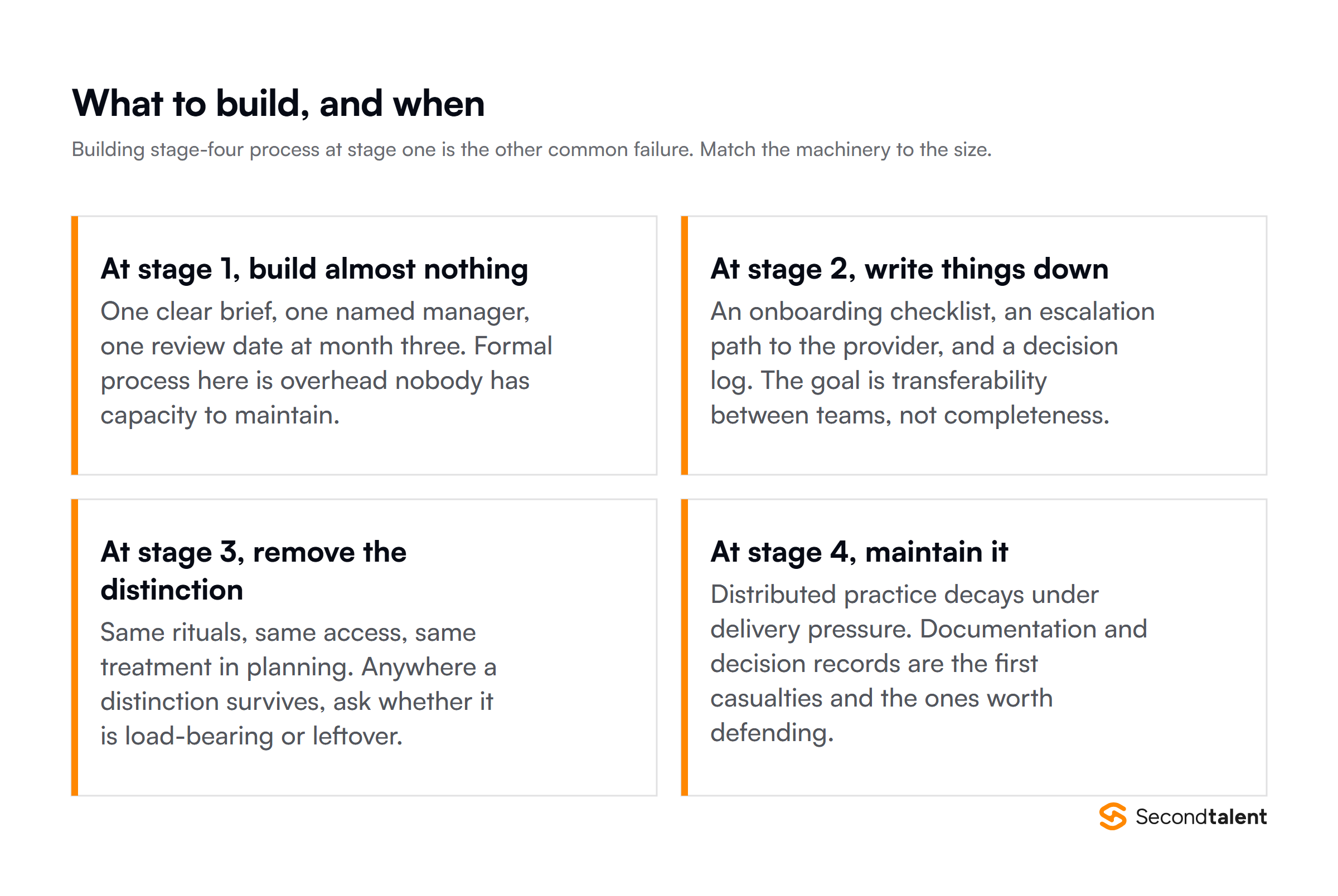
What to build, and when
Building stage-four process at stage one is the other common failure, and it is quieter because it looks like diligence.
At stage 1, build almost nothing. One clear brief, one named manager, one review date at month three. Formal process here is overhead nobody has capacity to maintain, and it makes a small experiment feel like a programme.
At stage 2, write things down. An onboarding checklist, an escalation path to the provider and a decision log. The goal is transferability between teams rather than completeness.
At stage 3, remove the distinction. Same rituals, same access, same treatment in planning. Wherever a distinction survives, ask whether it is load-bearing or leftover.
At stage 4, maintain it. Distributed practice decays under delivery pressure, and documentation is the first casualty.
Our IT staffing checklist covers the per-engagement mechanics that support all four stages.
Where the distributed model pays off most
Distribution costs coordination, so it repays most where local supply is thinnest and a search would otherwise stall.
The US Bureau of Labor Statistics projects data scientist employment to grow 34 percent between 2024 and 2034 with about 23,400 openings a year, and information security analysts 29 percent with 16,000 openings, against roughly 4 percent across all occupations.
For a common seat with deep local supply, the coordination cost may exceed the benefit at stage one. Start distributed where the alternative is not hiring at all, and expand once the practice exists.
What the tooling shift changes
Two things about distributed work got easier and one got harder, and it is worth separating them.
Easier: written communication now has assistance available to everyone, which lowers the barrier for engineers working in a second language. The EF English Proficiency Index still shows real differences between markets, and those matter less for written async work than they did.
Also easier: context capture. Summarising a thread, drafting a decision record or writing a handover is exactly the kind of task these tools do well, and those are the practices distributed teams most often skip for lack of time.
Harder: reviewing work you did not watch being produced. The 2025 Stack Overflow Developer Survey found 84 percent of developers using or planning to use these tools while 46 percent distrust the accuracy of the output. In a distributed team you see the artefact rather than the process, so review discipline has to carry more weight than it did.
Practical consequence: use the tooling to lower the cost of writing things down, and raise rather than relax your review standard as the team spreads out.
What the provider should do at each stage
The provider relationship should change as you do, and a provider who treats a stage-three buyer the way they treated you at stage one has stopped paying attention.
Early on, what you need is candidate quality and a fast first profile. Later, what you need is consistency across many seats, a named contact who knows your context, structured reviews, and honesty when a placement is not working.
Ask about the later-stage version before you need it. A provider set up only for transactional placement will struggle to become an operational partner, and finding that out at stage three is expensive. Our checklist on evaluating IT staffing companies covers what to ask.
The compliance layer nobody plans for
One thing that changes as headcount grows is that arrangements which were fine for two engineers stop being fine for twenty.
At stage one, a single engagement in one market is straightforward. By stage three you may have engineers across several countries, each with its own employment law, statutory benefits and notice requirements, and the question of who employs each of them has real weight. The IRS common-law test and the HMRC CEST tool both turn on control, and control is exactly what deeper integration increases.
The practical move is to settle the employment structure at stage two rather than stage three. An EOR arrangement that covers every market you operate in scales quietly; a patchwork of contractor relationships assembled one seat at a time becomes an audit problem at exactly the point you are least able to unpick it.
Our guide to worker classification in cross-border IT staffing covers where the structure breaks.
Distributed engineering FAQs
How long does each stage take?
It varies enough that a number would mislead. What sets the pace is not headcount growth but how fast the organisation builds async habits, and that ranges from a quarter to never.
Can we skip stages?
Rarely, and attempts usually produce stage-two problems at stage-three scale. The practices compound, and an organisation that has not written anything down cannot integrate teams it cannot describe.
Should distributed engineers be in separate teams or embedded?
Separate at stage one, because you are testing a model and want a clean read. Embedded from stage three, because the separation itself becomes the constraint.
What is the single highest-leverage change?
Recording decisions where someone can find them later. It costs almost nothing, it is the prerequisite for every later stage, and it improves the co-located half of the team at the same time.
Takeaways
- Four stages: arm’s length, several separate, integrated, distributed by default.
- Async maturity is the real variable. Headcount is only the visible one.
- Judge a first engagement from month three. Week-one output measures onboarding.
- Match the process to the stage. Stage-four machinery at stage one is its own failure.
- Give the operating model an owner, or it improves only by accident.
Build the first stage properly
Second Talent places pre-vetted senior engineers across Asia with EOR cover, matched within 24 hours, at 92 percent twelve-month retention across more than 200 companies.
Start with one seat, or read what IT staffing is for the engagement models underneath.