TL;DR: FinTech staff augmentation places vetted engineers inside your team while a provider employs and pays them. The difference from ordinary IT staffing sits in the contract, not the code. DORA in the EU, SR 23-4 in the US and FCA operational resilience rules in the UK all hold you responsible for work a third party performs. This guide covers the seats fintechs augment, the four rulebooks that constrain them, senior Asian rates from our own rate cards, and the five checks to run before signing.
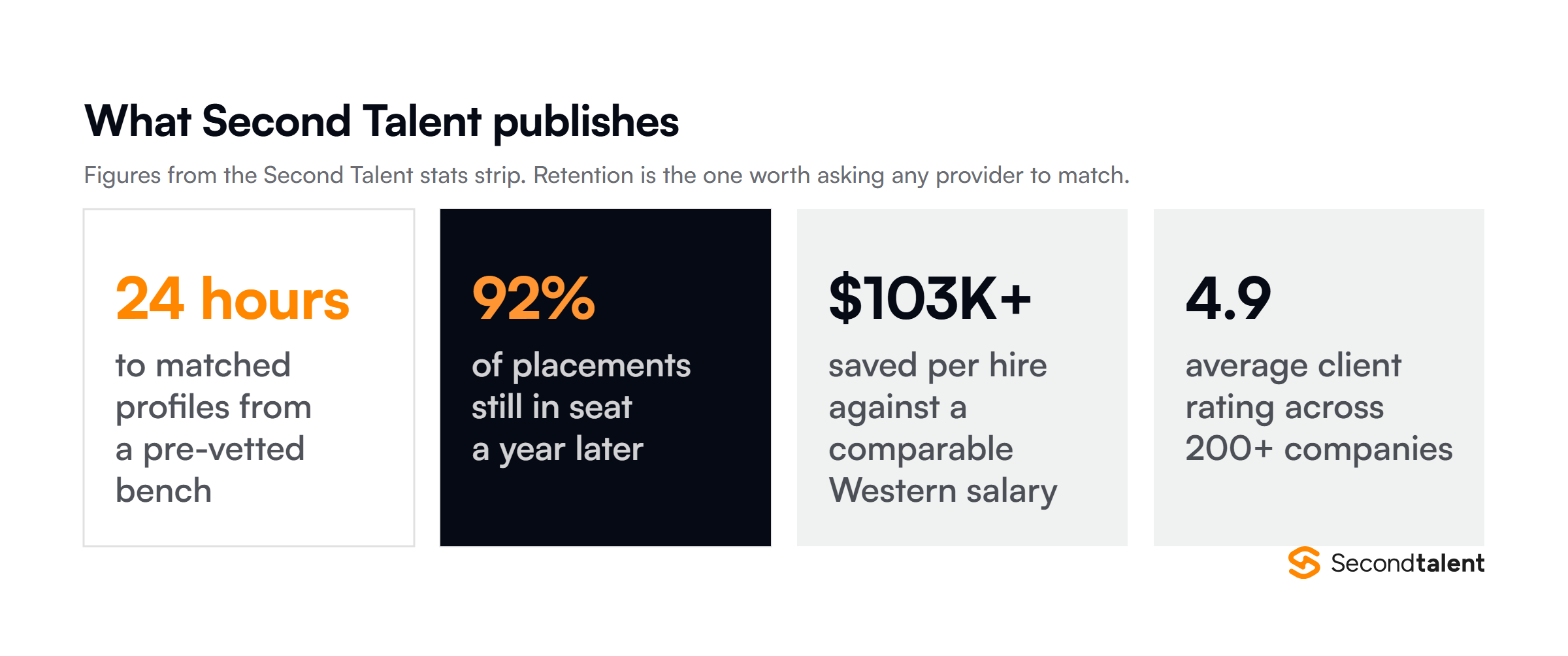
Second Talent matches engineers to regulated fintech teams in 24 hours, and 92 percent of those placements are still in seat a year later. For a payments team, finding the engineer is rarely the hard part. Proving to a supervisor that the arrangement around them holds up is what takes the time, and it is the part this guide is about.
What is FinTech staff augmentation?
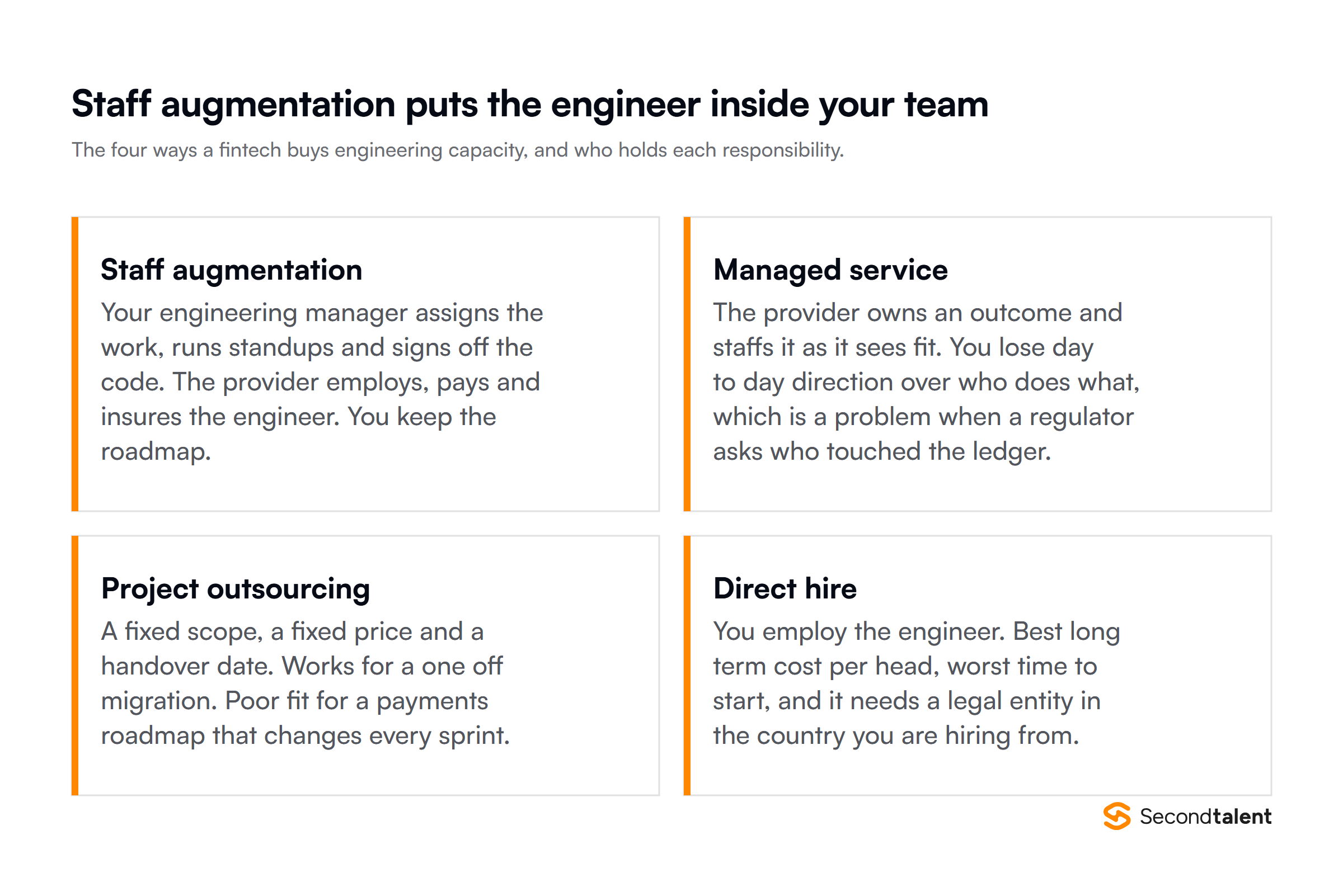
FinTech staff augmentation is an engagement model where a provider supplies engineers who work under your direction, on your roadmap, inside your tooling, while the provider remains their legal employer.
You direct the work. The provider handles employment, payroll, benefits and local tax. Ownership of the product does not move.
That last point separates it from the other models a fintech buys from the same vendors. A managed service hands the provider an outcome and the freedom to staff it however it likes. Project outsourcing fixes a scope and a handover date.
Both weaken your answer to the question a supervisor asks after an incident: who, by name, changed the code that moved the money.
Our staff augmentation versus managed services guide works through the trade-off in general terms. For a fintech, auditability decides it more often than price.
Why fintech hiring differs from ordinary tech hiring
The engineering is comparable. The obligations are not.
A retail company that adds a contractor to its checkout team answers to its own security policy. A payments firm doing the same thing answers to a supervisor, a card scheme and an external assessor, and each asks a different question about the same person.
Three constraints show up on most fintech engagements:
- Cardholder data scope. An engineer who can reach card data pulls your assessment boundary around their laptop, their network and their access rights.
- Segregation of duties. The person who writes a change to a ledger service often may not approve and deploy it. That rules out the single contractor who does everything.
- Evidence on demand. Access logs, approval trails and offboarding records have to exist before someone asks for them.
None of these make augmentation a poor fit. They decide which providers can serve you and which cannot.
Which roles do fintech teams augment?
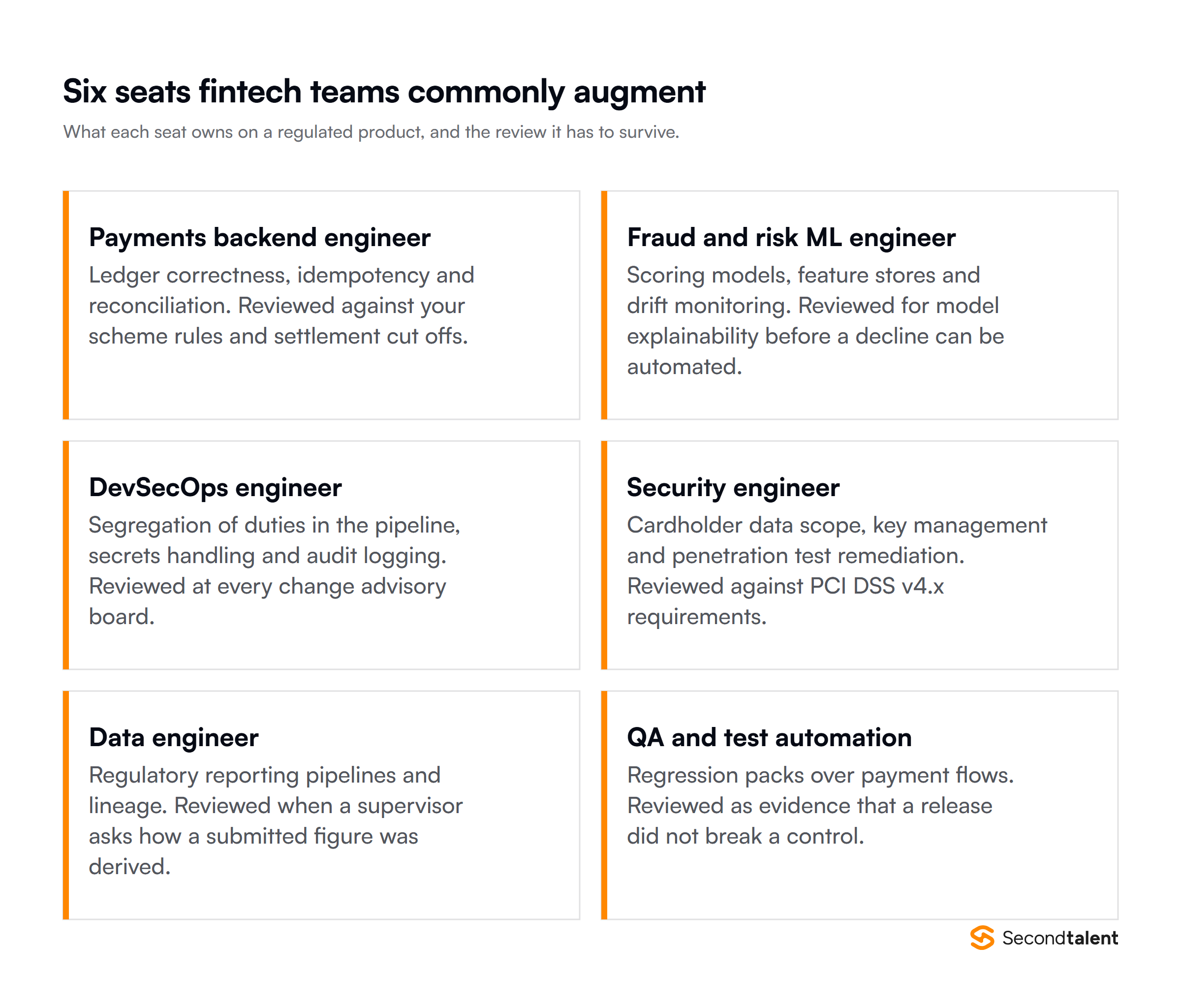
Six seats account for most fintech augmentation requests: payments backend, fraud and risk ML, DevSecOps, security, data engineering, and QA automation.
Each carries a review it has to survive, and that review shapes the vetting brief more than the job title does.
Your assessor judges a payments backend engineer on ledger correctness and idempotency, because a duplicate settlement becomes a reportable incident. Your risk team judges a fraud ML engineer on whether they can explain a model decision after the fact, because an automated decline you cannot explain becomes a complaint you cannot close.
Write the review into the brief. Providers screen against the brief you hand them. A brief reading “senior Python engineer, payments experience” returns generalists. A brief reading “must have owned reconciliation for a card issuer and can explain an idempotency key strategy” returns four people, and you can interview all four in a week.
Specialty seats sit alongside these. Firms building on chain add smart contract work, which is why our blockchain developer hiring page skews toward payments and custody rather than consumer tokens.
Which rules apply to an augmented fintech engineer?
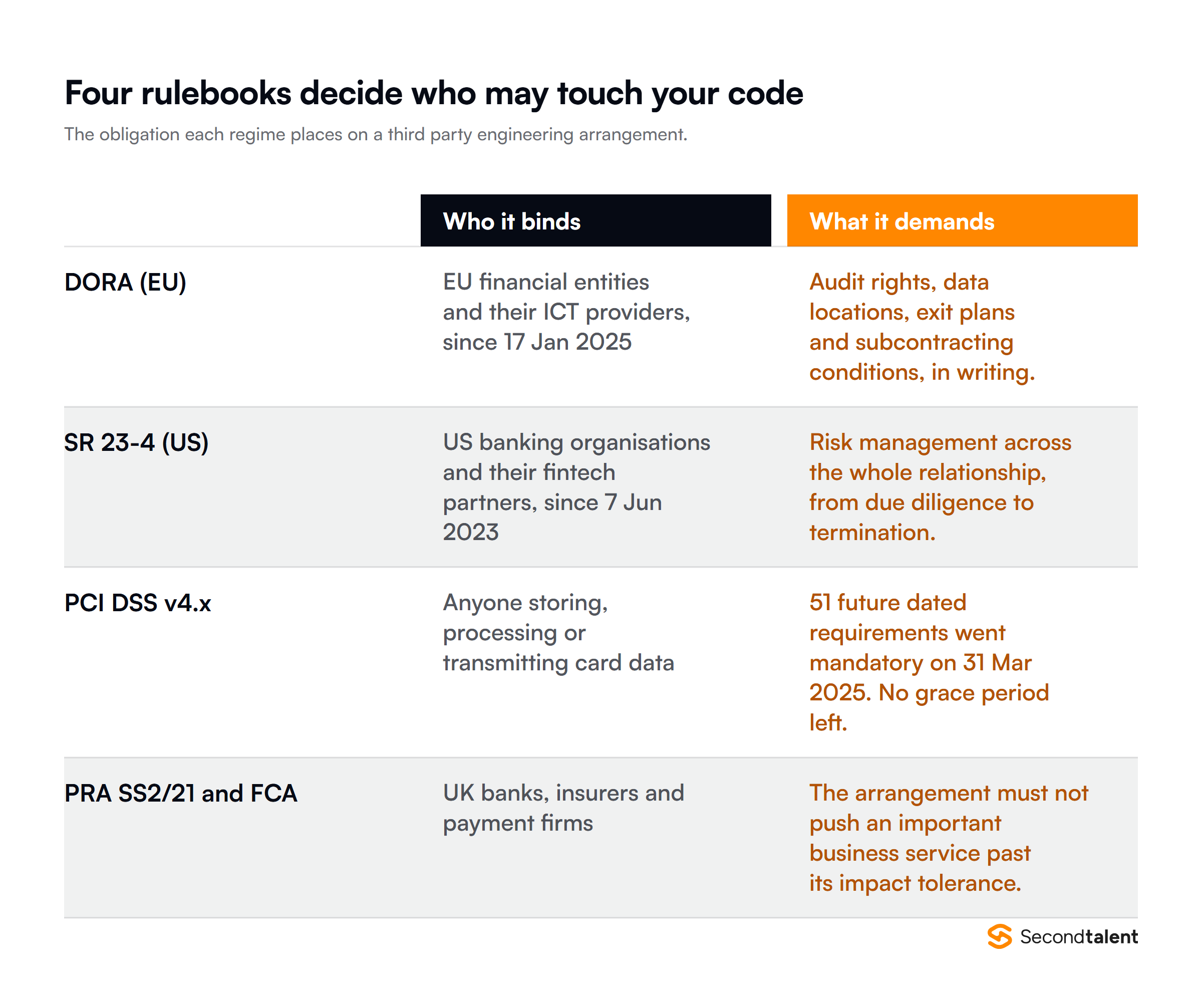
Four rulebooks shape the arrangement, and which ones bind you depends on where you hold a licence and whether you touch card data.
DORA has applied to EU financial entities and their ICT providers since 17 January 2025. Article 30 requires a written contract wherever a service supports a critical or important function, covering service description, data locations, audit and access rights, exit plans and the conditions under which the provider may subcontract. The European Securities and Markets Authority publishes the supervisory detail alongside the other European supervisory authorities.
SR 23-4, the interagency guidance issued on 7 June 2023, sets out how US banking organisations should manage third party relationships across the full life cycle. It spans planning, due diligence, contracting, ongoing monitoring and termination, and it reaches fintech partners of banks as well as ordinary vendors.
PCI DSS v4.x closed its transition on 31 March 2025, when the 51 future dated requirements became mandatory. No grace period remains, so an assessor scores your augmented engineers against the full standard from the day they receive access. The PCI Security Standards Council publishes the current version and its supporting documents.
UK firms work to PRA supervisory statement SS2/21 on outsourcing and third party risk, read together with FCA operational resilience rules. The test is whether an important business service stays inside its impact tolerance when the arrangement comes under stress.
Undisclosed subcontracting is the gap supervisors find most often. Ask the provider to name each legal entity in the chain between you and the engineer, in writing, before you sign. A provider who cannot answer in a sentence is not ready for a regulated client.
Cross-border placements add an employment question on top of the supervisory one. Our guide to worker classification in cross-border IT staffing covers where the contractor label breaks down, and the 12 clauses that shift risk in a staffing MSA covers what goes into the contract itself.
What does fintech staff augmentation cost?
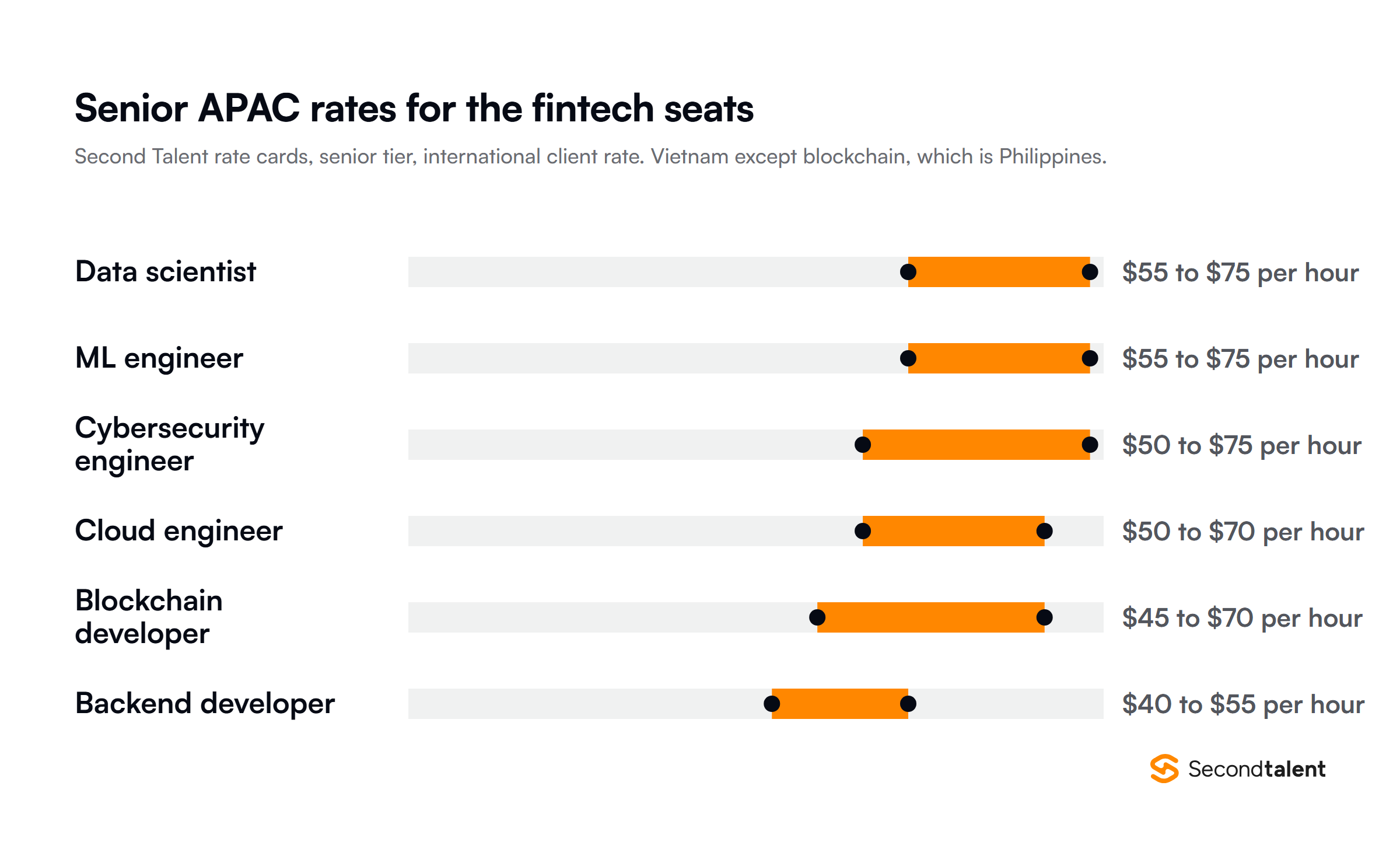
Senior engineers in these seats run between $40 and $75 per hour through Asian providers, based on international client rates published in the Second Talent developer rate cards.
Data scientists and ML engineers sit at the top of that band at $55 to $75. Cybersecurity engineers run $50 to $75, cloud engineers $50 to $70, senior blockchain developers in the Philippines $45 to $70, and senior backend developers $40 to $55.
Compare that against a London or New York equivalent before calling it cheap. The US Bureau of Labor Statistics puts the median wage for information security analysts at $129,180 in May 2025, salary only, before employer taxes and benefits. A provider rate already includes them, so compare fully loaded against fully loaded. Across placements, Second Talent clients save $103,000 or more per hire.
Three costs sit outside the hourly rate and belong in the business case:
- Compliance overhead. Contract review, due diligence and the first assessment cycle. Budget real legal hours for a DORA critical-function engagement.
- Access provisioning. Managed devices, hardware keys and privileged access reviews for each engineer.
- Ramp. Regulated domains take longer to learn. Our case study engineers spent three weeks onboarding before they shipped.
For AI-specific roles, the AI staffing pricing benchmarks break the premium down by specialty.
How do you vet a provider for regulated work?
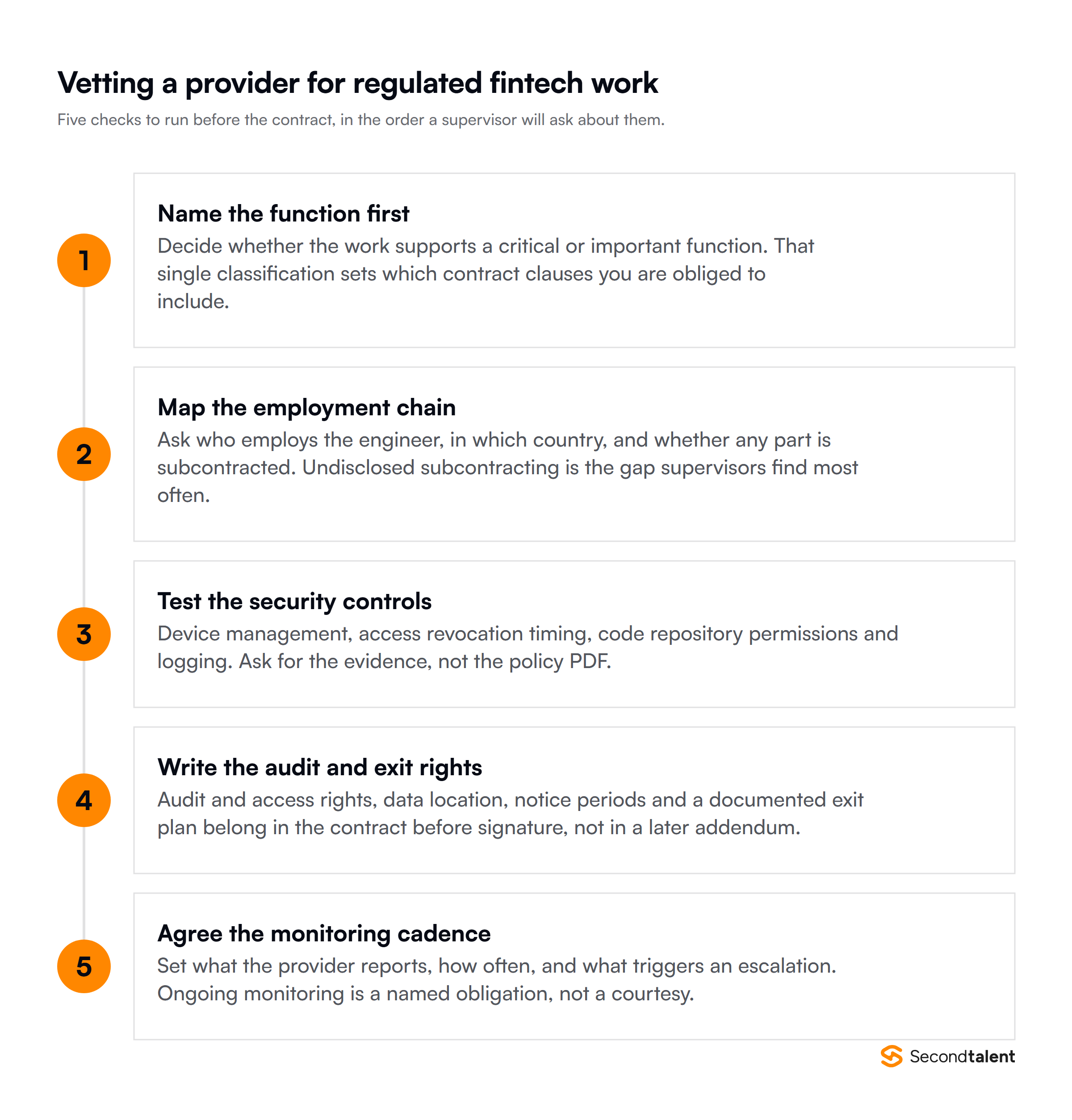
Run five checks before the contract, in the order a supervisor will ask about them.
Classify the function first. Decide whether the work supports a critical or important function. That classification determines which contractual clauses you must include, and doing it after signature means reopening the contract.
Map the employment chain. Who employs the engineer, in which country, and is any part of the service subcontracted? Get the answer in writing.
Test the controls, not the policy. Ask how fast the provider revokes access when someone leaves, who holds repository admin, and what they log. Ask for evidence from the last offboarding rather than a policy document.
Write the audit and exit rights before signature. Audit and access rights, data location, notice periods and a documented exit plan are contract terms, not later addenda.
Agree the monitoring cadence. Set what the provider reports, how often, and what triggers escalation. DORA and SR 23-4 both treat ongoing monitoring as an obligation rather than a courtesy.
Our walkthrough of how IT staffing vetting funnels work covers the provider side of those checks, and the risk and mitigation guide covers what to do when one fails.
What good looks like in year one
Set expectations against the compliance calendar rather than the sprint calendar, because that is what a fintech engagement is actually paced by.
Weeks 1 to 2. Matched profiles arrive within 24 hours, and your own technical screen runs against your codebase. Nothing here is unusual for any staffing engagement.
Weeks 3 to 5. Contracting and access. In a regulated firm this is the long pole, not the hiring: device management, privileged access review, and the classification decision that sets which contract clauses apply.
Weeks 5 to 8. Ramp. Regulated domains take longer than ordinary products because the engineer is learning your controls as well as your code. Budget it rather than assuming it away.
Month 12. Retention is the figure that tells you whether the arrangement worked. Second Talent runs at 92 percent, with 200 or more companies building on the platform and an average client rating of 4.9.
For the wider regional picture, see our roundup of the top AI fintech startups in Southeast Asia.
When staff augmentation is the wrong answer
Three situations call for a different model.
You have no engineering management capacity. Augmentation assumes someone on your side assigns and reviews the work. Without that, buy a managed service and accept the reduced visibility.
The role is a permanent core function. A head of platform or a founding risk engineer belongs on your payroll. Augmentation carries a rate premium that compounds over years.
The provider cannot answer the subcontracting question. If the chain between you and the engineer looks unclear before signature, it will look unclear during an assessment.
FinTech staff augmentation FAQs
Is staff augmentation allowed under DORA?
Yes. DORA regulates how you contract for ICT services, not whether you may buy them. Article 30 sets the clauses your contract must carry once the work supports a critical or important function: audit rights, data locations, exit plans and subcontracting conditions.
Who employs an augmented fintech engineer?
The provider or its EOR entity employs them, pays their salary and handles local tax and benefits. You direct the work day to day. That split is what keeps you out of a misclassification claim in the engineer’s home country.
How long does it take to place a fintech engineer?
Second Talent returns matched profiles within 24 hours. Onboarding into a regulated codebase then takes about three weeks on top of contracting and access provisioning, which is the part most plans underestimate.
Can an augmented engineer work inside PCI DSS scope?
Yes, provided the controls travel with the access. The engineer falls inside your assessment boundary, so their device management, access rights and logging get scored against PCI DSS v4.x the same way an employee’s would.
Takeaways
- Classify the function before you shortlist. It sets the contract.
- Ask who employs the engineer and who else sits in the chain, in writing.
- Senior Asian rates for fintech seats run $40 to $75 per hour, plus compliance and ramp cost.
- Audit rights, data location and exit plans belong in the contract before signature.
- Write the regulatory review into the role brief, or providers will send you generalists.
Hire fintech engineers who pass the review
Second Talent places vetted engineers into regulated fintech teams across Asia, with EOR cover so employment and tax stay with a licensed employer. Matches land within 24 hours, retention runs at 92 percent, and clients save $103,000 or more per hire.
Tell us which seat you need to fill, or start with the IT Staffing Knowledge Base if you are still choosing an engagement model.
Hiring contractors rather than employees changes the arithmetic. The freelance developer rate index prices 14 roles across nine regions, benchmarked against North America and sourced from published wage data.