TL;DR: A good IT staffing RFP has nine sections, and its value comes from asking questions with checkable answers rather than from a scoring rubric someone else designed. Weight the sections against your own binding constraint, score evidence above assertion, and read pricing last. Download the free PDF template, then decide the weightings yourself.
A weak RFP returns a stack of capability statements. A strong one produces facts you can compare. The difference is mostly in how the questions are written.
Disclosure, and what changed here. An earlier version gave a “what good looks like” benchmark for every section, and those benchmarks were close to Second Talent’s own specification. An RFP template whose rubric is one bidder’s feature list is not a procurement document. This version describes what makes an answer useful and leaves the weightings to you, because the right acceptance rate or engagement length varies by provider model and by what you are buying.
Download the RFP template
Download the IT Staffing RFP Template (PDF). Nine sections with fill-in question fields and a scoring sheet you weight yourself. No sign-up required.
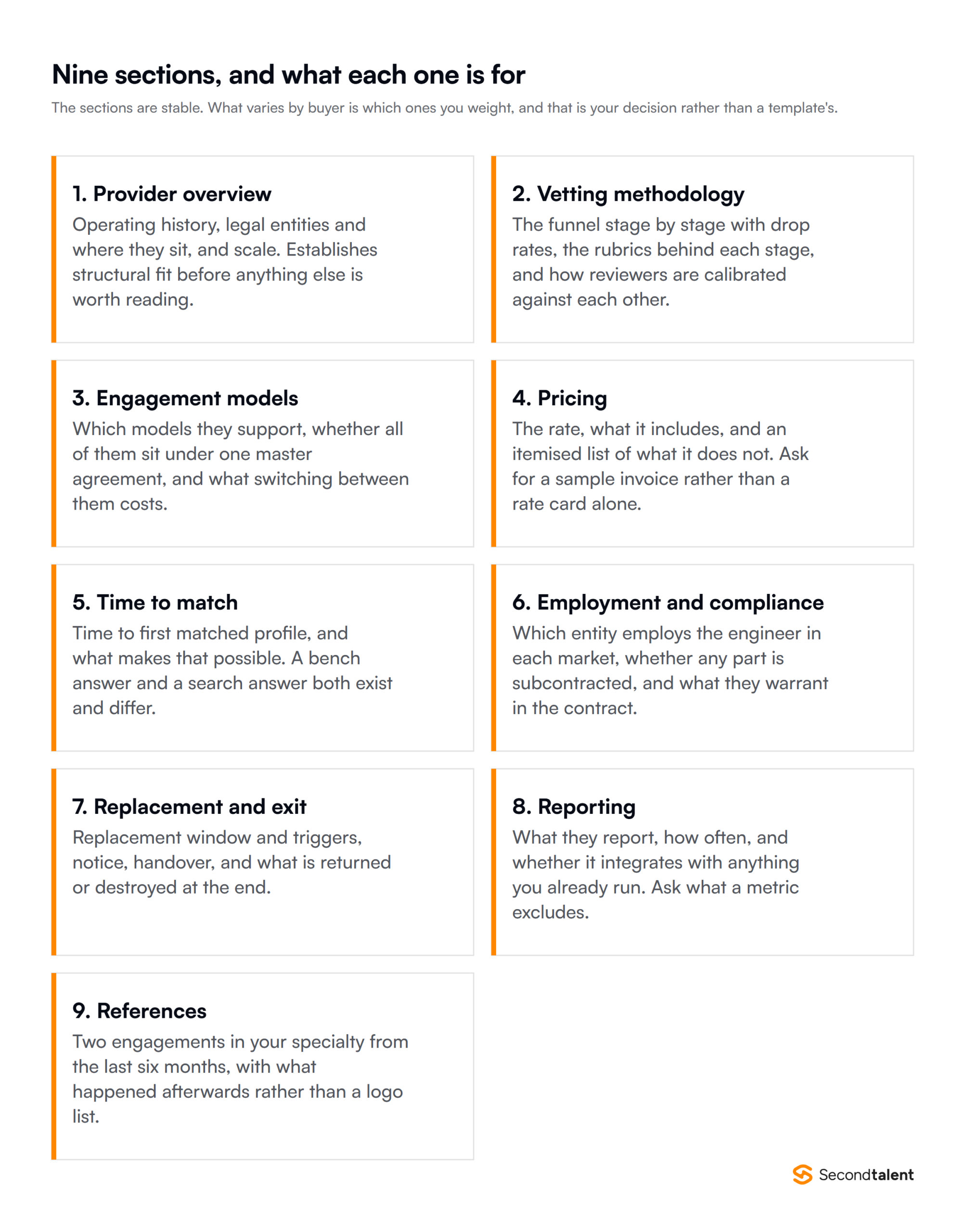
The nine sections
1. Provider overview. Operating history, which legal entities they hold and where, and scale.
2. Vetting methodology. The funnel stage by stage with drop rates, the rubric behind each stage, and how reviewers are calibrated against one another.
3. Engagement models. Which they support, whether all sit under one master agreement, and what switching costs.
4. Pricing. The rate, what it includes, and an itemised list of what it does not. Ask for a sample invoice rather than a rate card alone.
5. Time to match. Time to first matched profile, and what makes that possible.
6. Employment and compliance. Which entity employs the engineer in each market, whether any part is subcontracted, and what is warranted in the contract.
7. Replacement and exit. Replacement window and triggers, notice, handover, and what is returned or destroyed.
8. Reporting. What they report, how often, and what each metric excludes.
9. References. Two engagements in your specialty from the last six months, with what happened afterwards.
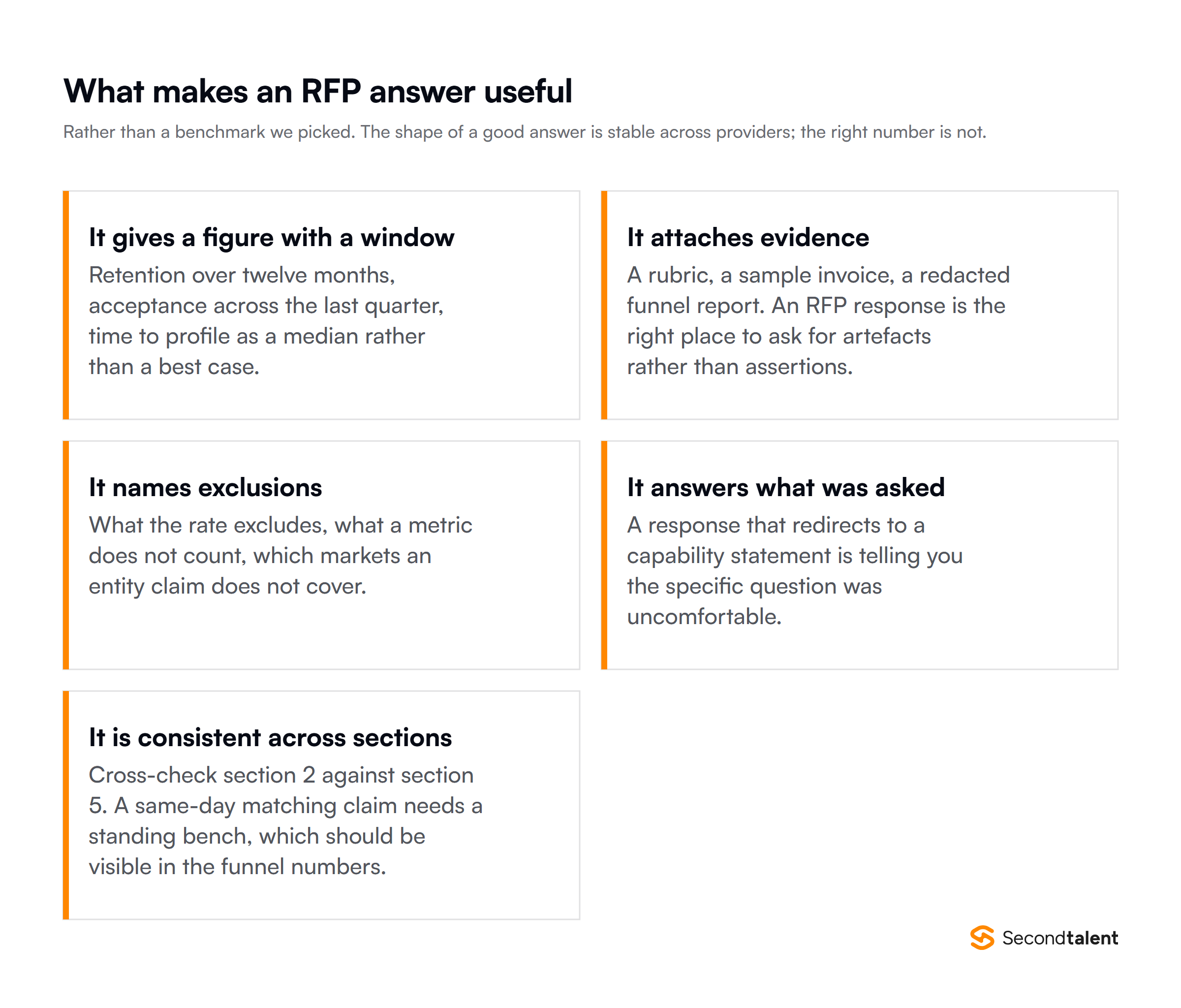
What makes an answer useful
A figure with a window. Retention over twelve months, acceptance across the last quarter, time to profile as a median rather than a best case.
Evidence attached. A rubric, a sample invoice, a redacted funnel report. An RFP is the right place to ask for artefacts, because the provider has time to produce them.
Exclusions named. What the rate excludes, what a metric does not count, which markets an entity claim does not cover.
The question actually answered. A response that redirects to a capability statement is telling you the specific question was uncomfortable.
Consistency across sections. Cross-check section 2 against section 5. A same-day matching claim requires a standing bench, and that should be visible in the funnel numbers.
Why section 6 deserves heavy weighting
Employment and compliance is the section buyers most often treat as boilerplate and the one with the only uncapped downside.
Augmentation means you direct the work, and control is exactly what classification tests examine. The IRS common-law test weighs behavioural control, financial control and the type of relationship, and the HMRC CEST tool asks the same question in UK terms.
So ask for the named legal entity per market, confirmation it is registered to employ there, whether any part of the service is subcontracted, and what the provider will warrant in the contract. A bidder who answers those four in a paragraph has thought about the arrangement. Our guide to worker classification in cross-border IT staffing covers why it carries this much weight.
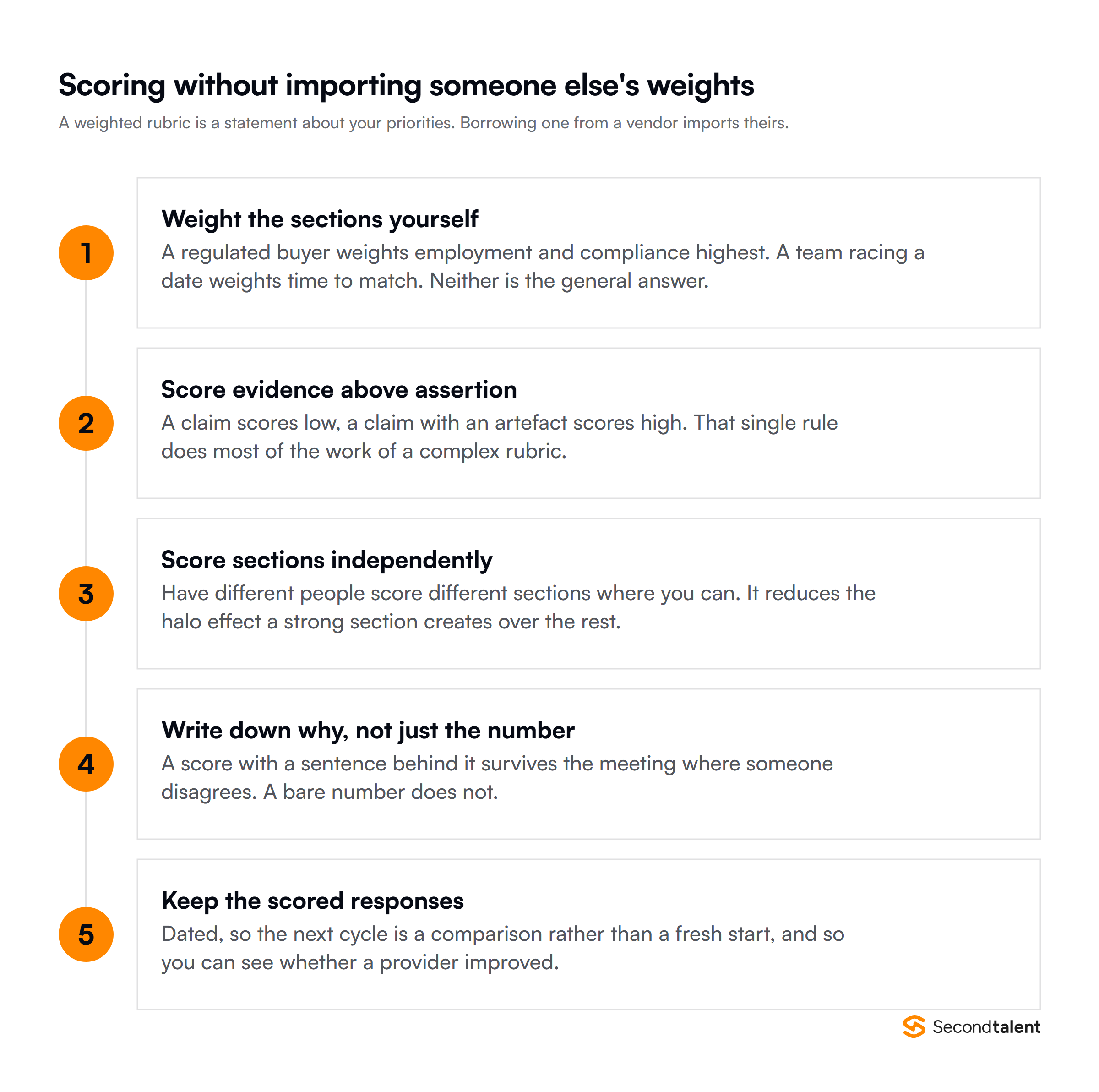
Scoring without importing someone else’s weights
A weighted rubric is a statement about your priorities, so borrowing one imports somebody else’s.
Weight the sections yourself. A regulated buyer weights employment and compliance highest. A team racing a delivery date weights time to match. Neither is the universal answer, and a template that supplies one is guessing about you.
Score evidence above assertion. A claim scores low, a claim with an artefact scores high. That single rule does most of the work of a complicated rubric.
Score sections independently where you have the people, to reduce the halo a strong section casts over the rest. Write down why, because a score with a sentence behind it survives disagreement and a bare number does not.
Keep the scored responses, dated. Our checklist on evaluating IT staffing companies covers the criteria in more depth.
Where the work sits inside a supervised boundary, section 6 should also ask for audit and access rights, named data locations, a documented exit plan and explicit subcontracting conditions. Under GDPR Article 28 the processing terms are prescribed rather than negotiable where personal data is involved, so a bidder who treats those as optional has told you something about their regulated experience.
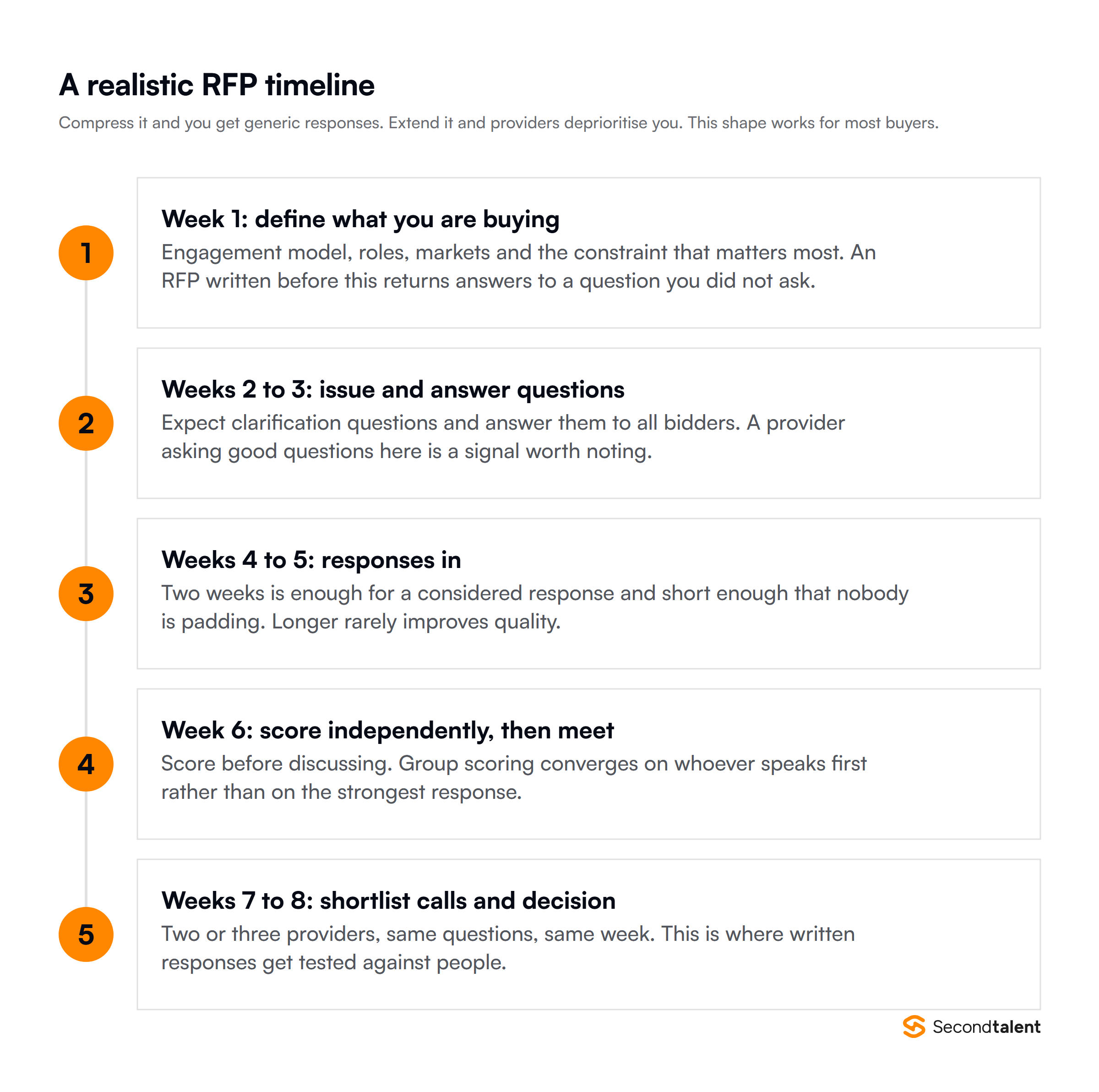
A realistic timeline
Six to eight weeks works for most buyers. Compress it and you get generic responses; extend it and providers deprioritise you.
Week one defines what you are buying, because an RFP written before that returns answers to a question you did not ask. Weeks two and three issue it and handle clarification questions, answered to all bidders. Weeks four and five are the response window. Week six is independent scoring, before anyone discusses it. Weeks seven and eight are shortlist calls and a decision.
The scoring order matters more than it sounds. Group scoring converges on whoever speaks first rather than on the strongest response, so score alone and then meet.
One thing worth doing in week one that most buyers skip: write down what a winning response would say, before you issue anything. If you cannot describe it, the questions are not specific enough yet, and you will discover that reading five responses rather than while drafting.
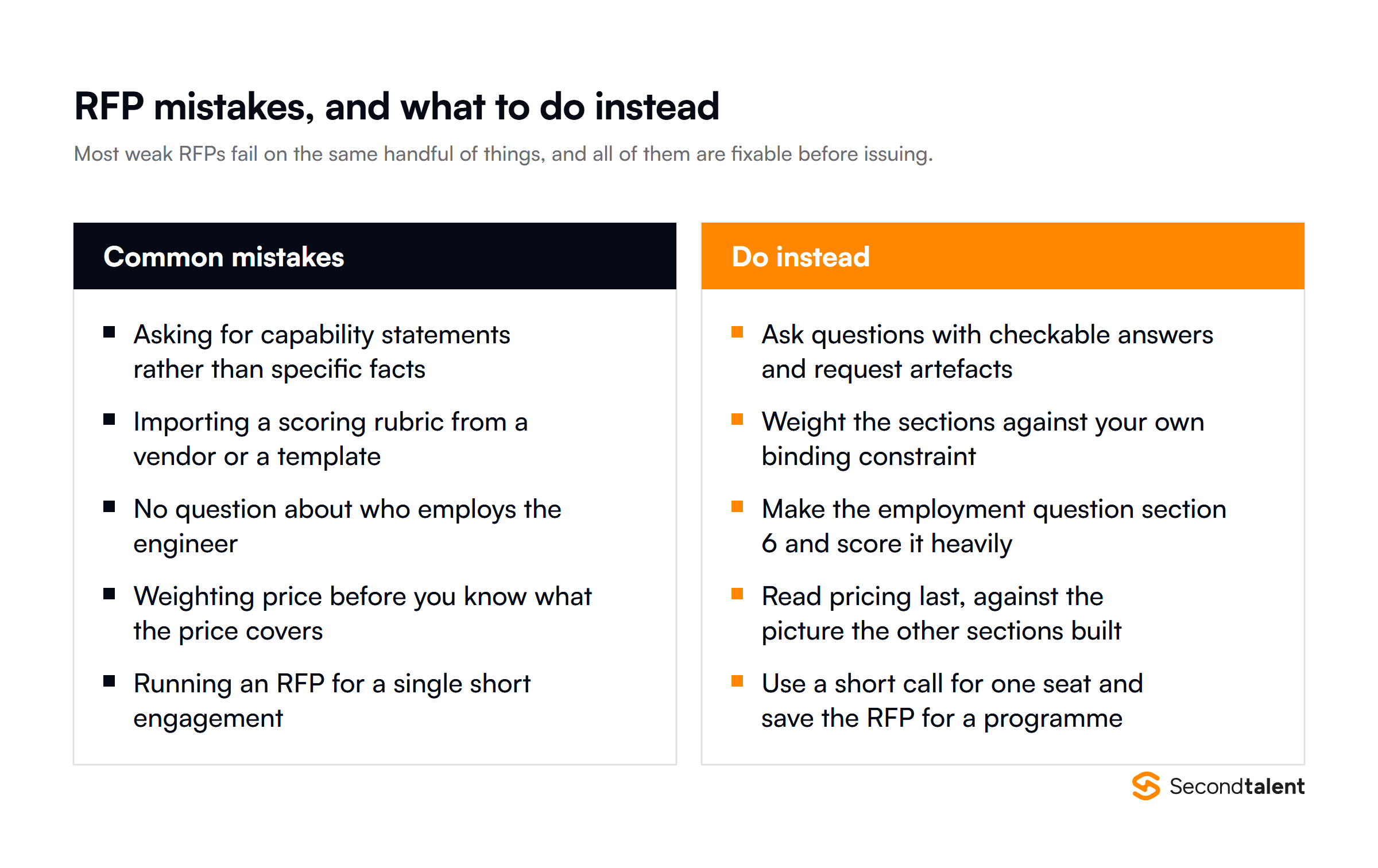
The mistakes that produce weak RFPs
Asking for capability statements rather than facts. Importing a scoring rubric from a vendor or a template. Omitting the question about who employs the engineer. Weighting price before you know what the price covers. And running a full RFP for a single short engagement.
The pricing one is worth dwelling on. Reading rates first anchors every subsequent judgement, and rates are not comparable until you know what sits outside each of them. Read section 4 last.
For a baseline going in, the US Bureau of Labor Statistics puts the median wage for software developers at $135,980 in May 2025, salary before employer taxes and benefits. A provider rate already includes those, so load the salary side before treating any gap as a saving.
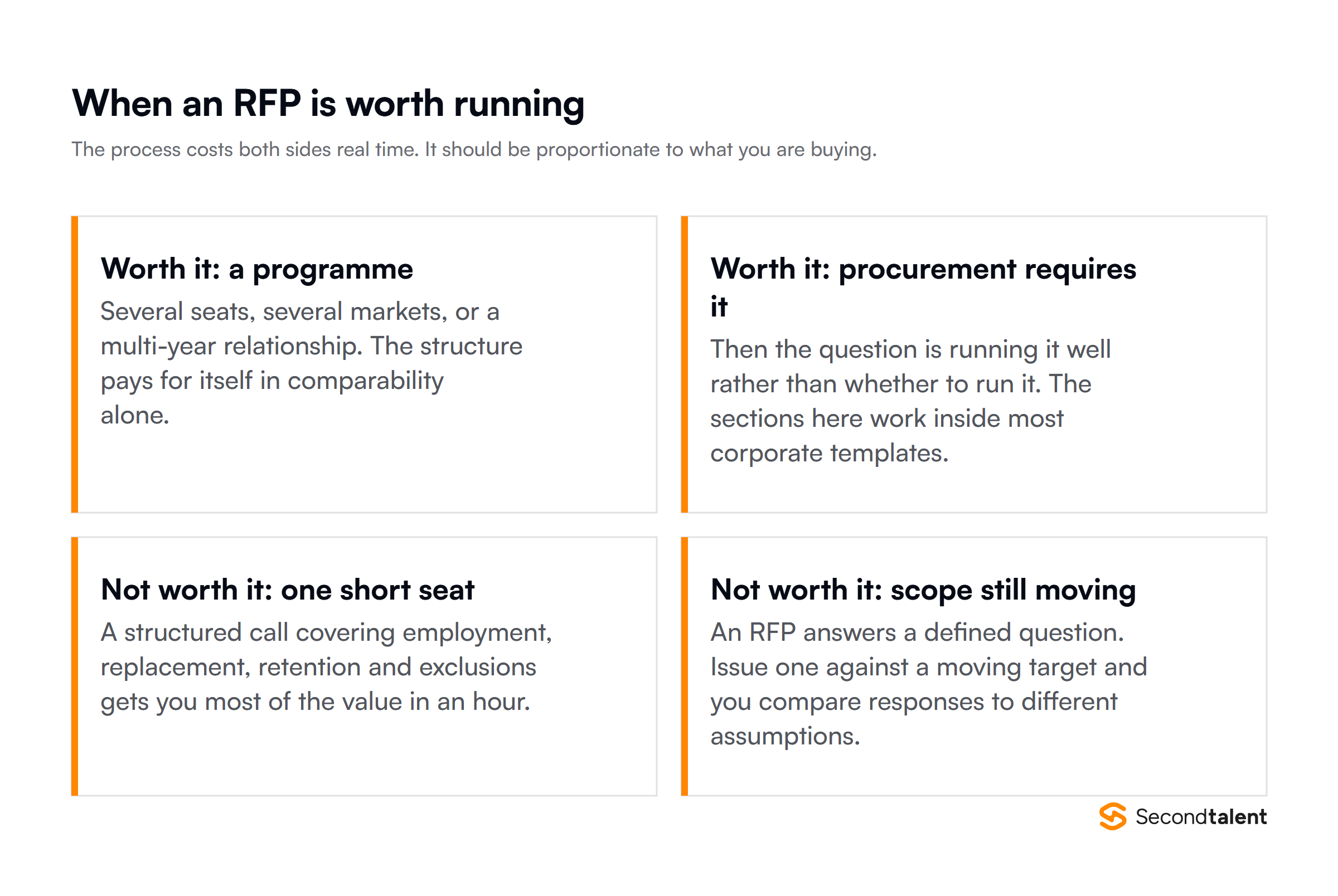
When an RFP is worth running
It costs both sides real time and should be proportionate.
Worth it for a programme spanning several seats, markets or years, where the structure pays for itself in comparability. Also worth it when procurement requires one, in which case the question is running it well.
Not worth it for a single short seat, where a structured call covering employment, replacement, retention and exclusions gets most of the value in an hour. And not worth it while scope is still moving, since an RFP answers a defined question and a moving target produces responses to different assumptions.
Our list of 15 questions to ask before you sign covers the lighter-weight version.
What to ask about AI assessment in section 2
Vetting methodology has changed enough in two years that an RFP written from an older template asks the wrong thing here.
The 2025 Stack Overflow Developer Survey found 84 percent of developers use or plan to use AI tools, with 50.6 percent of professionals using them daily. So asking whether a provider tests for tool familiarity now returns yes from everyone and separates nobody.
The same survey found 46 percent distrust the accuracy of what those tools produce against 33 percent who trust it, with experienced developers the most sceptical. Judgment about output is the scarce thing, and it is only visible by watching someone work.
The version of the question worth asking in an RFP: send us the written rubric your assessors use, and describe what a candidate does that fails it. The second half is what distinguishes a real assessment from a claim. Our guide to AI-native skills assessment covers the test design.
Section 9: making references useful
Reference sections usually produce a logo list and three happy customers the provider chose, which is close to zero information.
Ask instead for two engagements in your specialty from the last six months, with what was placed, how long it took, and what happened afterwards including anything that went wrong. A provider who has been operating a few years has had a placement fail, and one claiming otherwise is either new or not telling you.
The follow-up worth asking is what changed as a result. A specific process change in response to a specific failure is the strongest quality signal available in an RFP, and it is the one nobody can fabricate convincingly.
Ask to speak to a reference whose engagement ended, not only to current clients. Their account of the exit tells you what the last month of your own engagement will look like.
RFP FAQs
Who should write the RFP?
Whoever will manage the engagement, with procurement handling the process rather than the content. RFPs written entirely by procurement ask commercially sound questions that miss what makes a staffing engagement work, and ones written entirely by engineering skip the terms that decide what a bad outcome costs. Both functions need to see section 6.
How many providers should we invite?
Four to six, expecting three or four responses. Inviting more raises the evaluation cost without improving the shortlist, and providers can tell when a field is too wide to take seriously.
Should we share the budget?
A range, yes. Withholding it produces responses priced at guesses, and you then compare proposals built on different assumptions about what you can spend.
What if a strong provider declines to respond?
Ask why. Sometimes the RFP asked for something they cannot supply, which is useful. Sometimes it signalled a process too heavy for the size of the engagement, which is also useful.
Can we reuse the responses later?
For a year or so, with the dates attached. Rates reset and benches change, so treat an old response as a starting point for questions rather than as current fact.
Takeaways
- Ask questions with checkable answers. Capability statements are the failure mode.
- Weight the sections against your own constraint rather than importing a rubric.
- Weight section 6 heavily. Employment is the only uncapped exposure on the list.
- Read pricing last, after you know what each rate covers.
- Score independently before anyone discusses it, and write down why.
Send it to us as well
Second Talent employs engineers through licensed local entities across Asia, matches within 24 hours, and reports 92 percent of placements still in seat a year later.
Include us in the process, or start with the IT staffing plan template if you are still defining what you are buying.