TL;DR: IT staffing supplies technology workers through a third-party provider that employs them, rather than putting them on your payroll. Three engagement models cover almost all of it: staff augmentation, managed services, and project work under a statement of work. They differ on one question, which is who carries the outcome risk. Mordor Intelligence sizes the IT staffing market at $127.75 billion in 2026, growing at 3.61 percent a year to 2031, with Asia Pacific the fastest-growing region at 8.15 percent.
Most engineering leaders have bought IT staffing without using the term. Hiring a contractor through a marketplace, standing up an offshore pod, bringing in a DevOps specialist for one migration: all of it sits in the same category. This article defines the models, the vocabulary and the trade-offs that the rest of the IT Staffing Knowledge Base builds on.
What is IT staffing?
IT staffing is the practice of sourcing technology workers through a third-party provider that employs them, pays them and carries their compliance obligations, while you direct or receive the work.
The category covers software engineering, data, security, cloud infrastructure and adjacent specialties. It is separate from IT services, which contract for an outcome rather than for labour.
In practice the provider handles sourcing, vetting, employment, payroll and local tax, then bills you a blended rate covering wages, benefits, employer taxes and margin.
Over the last two decades the category widened to take in offshore and nearshore sourcing, and Employer of Record services that let you engage someone in a country where you hold no legal entity.

What are the three IT staffing engagement models?
Staff augmentation, managed services and project work under a statement of work. They differ on who directs the work day to day and who carries the outcome risk.
Staff augmentation
The provider employs the engineer. Your manager assigns the work, runs standups and reviews the code. You carry the outcome risk; the provider carries employment and compliance risk.
This is where most engagement volume sits, because it maps onto the common problem of needing more hands on a roadmap you already own.
Managed services
The provider takes a whole function, such as QA, infrastructure operations or support engineering, and directs its own people against agreed service levels. It reports against SLAs rather than billable hours, and it carries the outcome risk.
The trade is visibility. You stop choosing who does what, which matters if you later need to prove who touched a given system.
Project work under an SOW
A statement of work fixes scope, deliverables, timeline and price. The provider assembles the team, owns the deliverable and bills against milestones, carrying the outcome risk in full.
It suits a bounded piece of work with a clean edge, such as a migration or an integration. It suits a roadmap that changes each sprint far less well.
Pick the model from the risk you want to hold, not the price. If you want to keep control of sequencing and review, buy augmentation and accept that delivery is your problem. If you want to hand over the problem, buy a managed service and accept that you no longer choose the people. Buying augmentation and expecting managed-service accountability is the most common and most expensive mismatch.
Contract length, conversion rights and notice periods sit on top of these three. Our guide to contract, contract-to-hire and direct hire covers those mechanics, and the buyer’s guide to all three models works through the choice in detail.
How is IT staffing different from recruiting?
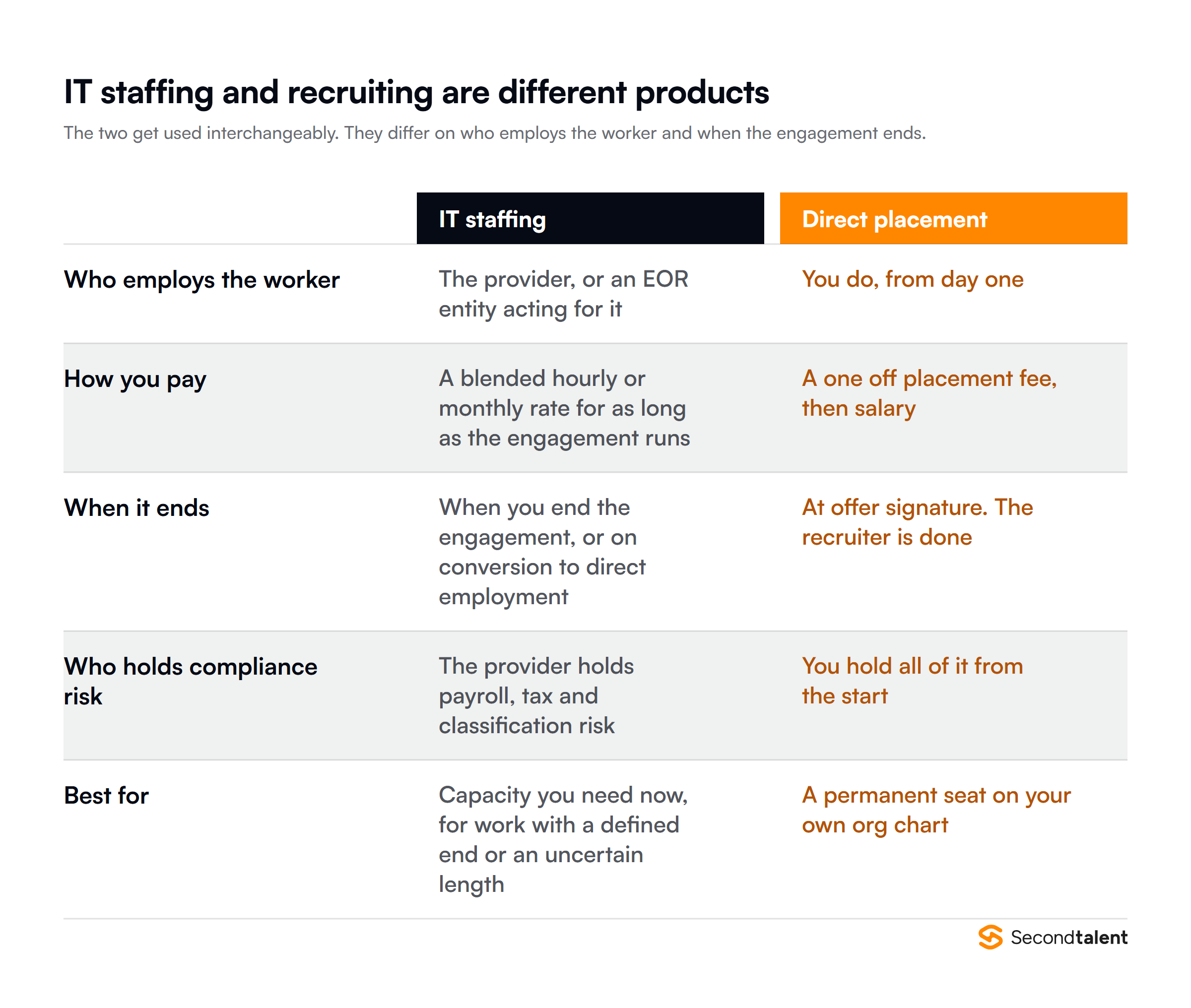
A recruiter finds someone for your payroll and collects one fee. An IT staffing provider keeps the worker on its own payroll and bills you for as long as the engagement runs.
That difference decides who holds the risk. In a direct placement, employment, payroll, tax and classification exposure land on you the moment the person starts. In a staffing engagement they stay with the provider or its EOR entity.
A third arrangement gets confused with both. Direct contracting engages a freelancer with no provider in the middle, often through a marketplace. It looks cheaper and it moves classification risk onto you. The IRS common-law test turns on behavioural control, financial control and the type of relationship, and a contractor who works your hours on your systems under your direction often fails it. Our guide to worker classification in cross-border IT staffing covers where that breaks.

How big is the IT staffing market?
Mordor Intelligence puts the IT staffing market at $123.30 billion in 2025 and $127.75 billion in 2026, forecast to reach $152.47 billion by 2031 at a 3.61 percent compound annual rate.
That is a mature market growing at a modest clip in aggregate, with the growth concentrated in specific regions and specialties rather than spread evenly.
North America produced 44.05 percent of 2025 revenue. Large enterprises accounted for 70.80 percent of spend. Asia Pacific is growing fastest at 8.15 percent a year through 2031.
Watch out for a common sizing error. Figures near $500 billion describe the entire global staffing market, across nursing, logistics, finance and the rest. The IT segment is about a quarter of that. If a vendor quotes you a half-trillion-dollar IT staffing market, they are quoting the wrong number.
Who buys IT staffing?
Large enterprises dominate the spend. Mordor Intelligence attributes 70.80 percent of 2025 IT staffing revenue to them, which reflects how the category grew: through procurement functions, master service agreements and preferred-supplier lists.
Smaller companies buy differently. They tend to come in through a single urgent role rather than a framework agreement, they care more about time to first candidate than about vendor consolidation, and they convert contractors to employees more often.
Both patterns run into the same constraint. Whoever signs, someone has to direct the work, and that person is usually an engineering manager who already has a full plate.
Which roles move through IT staffing?
The roles with the sharpest demand growth and the thinnest local supply, which in the US means data, security and software engineering.
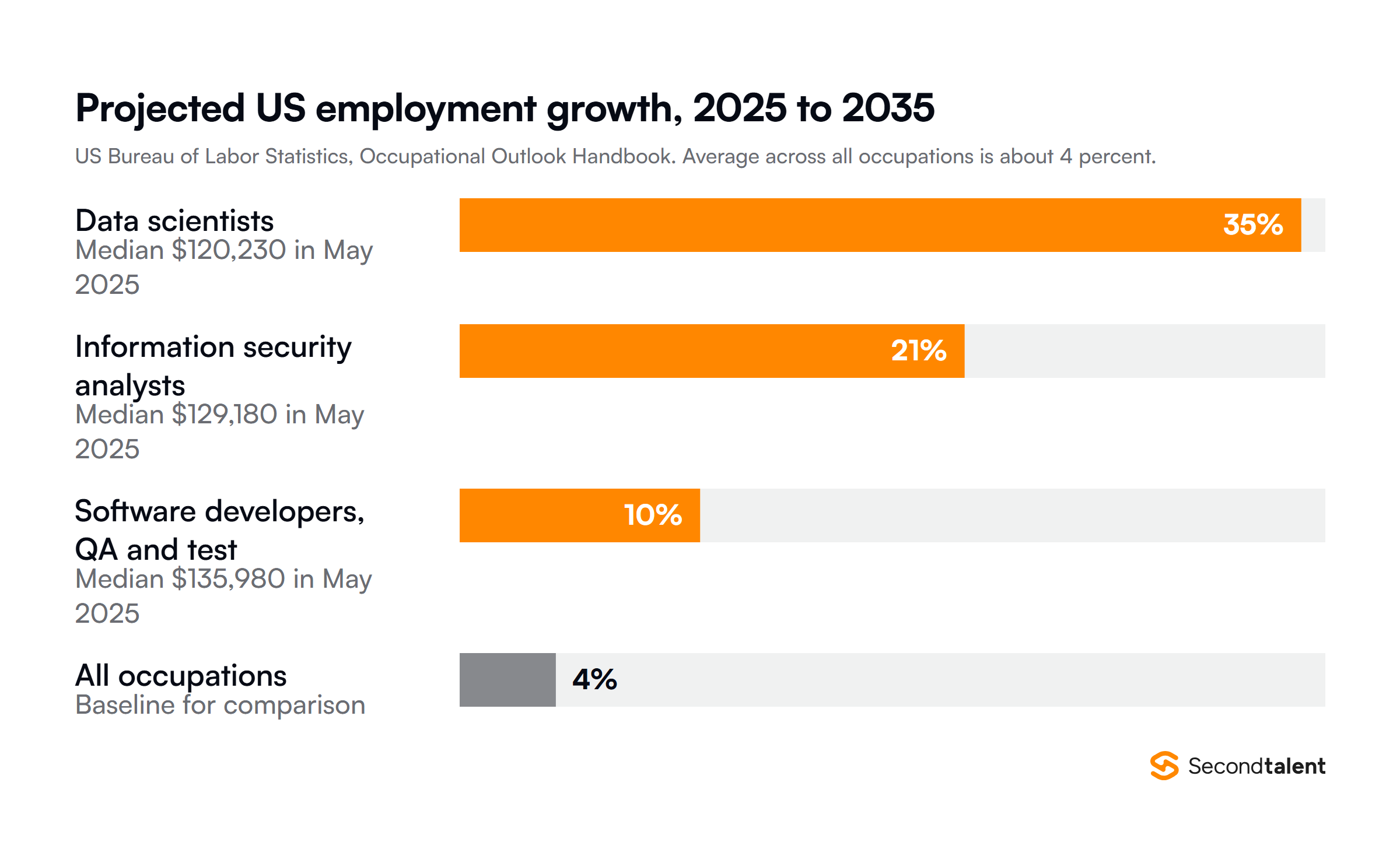
The US Bureau of Labor Statistics projects data scientist employment to grow 35 percent between 2025 and 2035, against about 4 percent across all occupations, with a median wage of $120,230 in May 2025. Information security analysts are projected to grow 21 percent at a median of $129,180. Software developers, QA analysts and testers grow 10 percent at a median of $135,980, with about 106,100 openings a year.
Those medians are the reason offshore supply keeps expanding. A US employer facing a $135,980 median for a developer, before employer taxes and benefits, has a strong reason to look at markets where the same seniority costs less.
AI fluency now sits on top of the role, not beside it. The 2025 Stack Overflow Developer Survey found 84 percent of respondents use or plan to use AI tools, up from 76 percent a year earlier, with 50.6 percent of professional developers using them daily. Trust has not followed adoption.
On accuracy, 46 percent distrust what those tools produce against 33 percent who trust them, and developers with ten or more years of experience are the most sceptical of all. Testing for that judgment, rather than for tool familiarity, is what separates a useful vetting process from a checkbox one.
What does IT staffing cost?
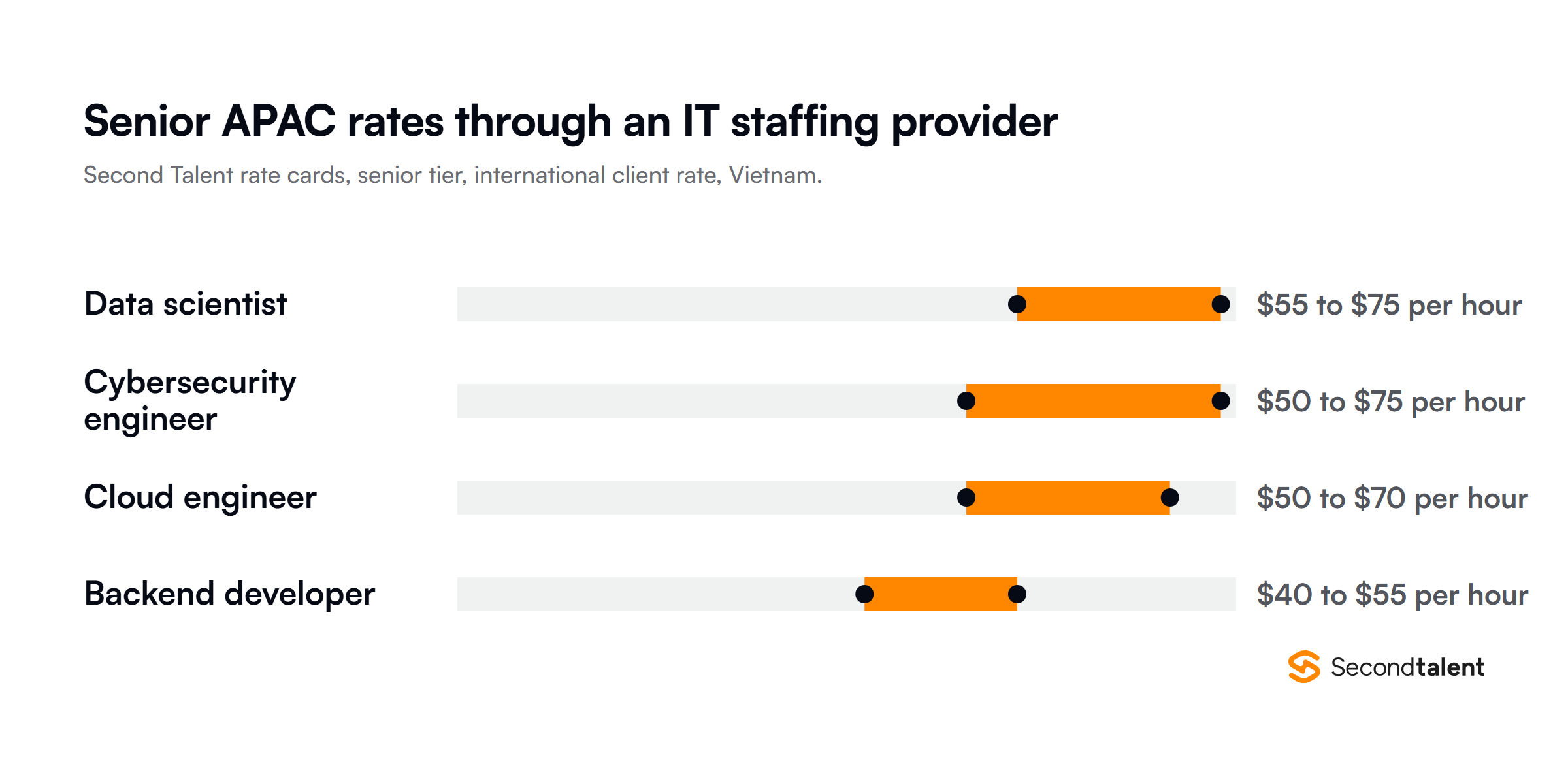
Senior engineers through an Asian provider run about $40 to $75 per hour depending on specialty, based on the international client rates published in the Second Talent developer rate cards.
Data scientists and cybersecurity engineers sit at the top of that band at $55 to $75 and $50 to $75. Cloud engineers run $50 to $70 and senior backend developers $40 to $55.
Two costs sit outside the rate and belong in any comparison. Vetting and onboarding time is real, and a regulated or unusual domain adds weeks. Management time is also real, because augmentation only works if someone on your side directs the work.
Second Talent clients save $103,000 or more per hire against a comparable Western salary, match within 24 hours, and see 92 percent of placements still in seat a year later.
When does IT staffing fit, and when does it not?
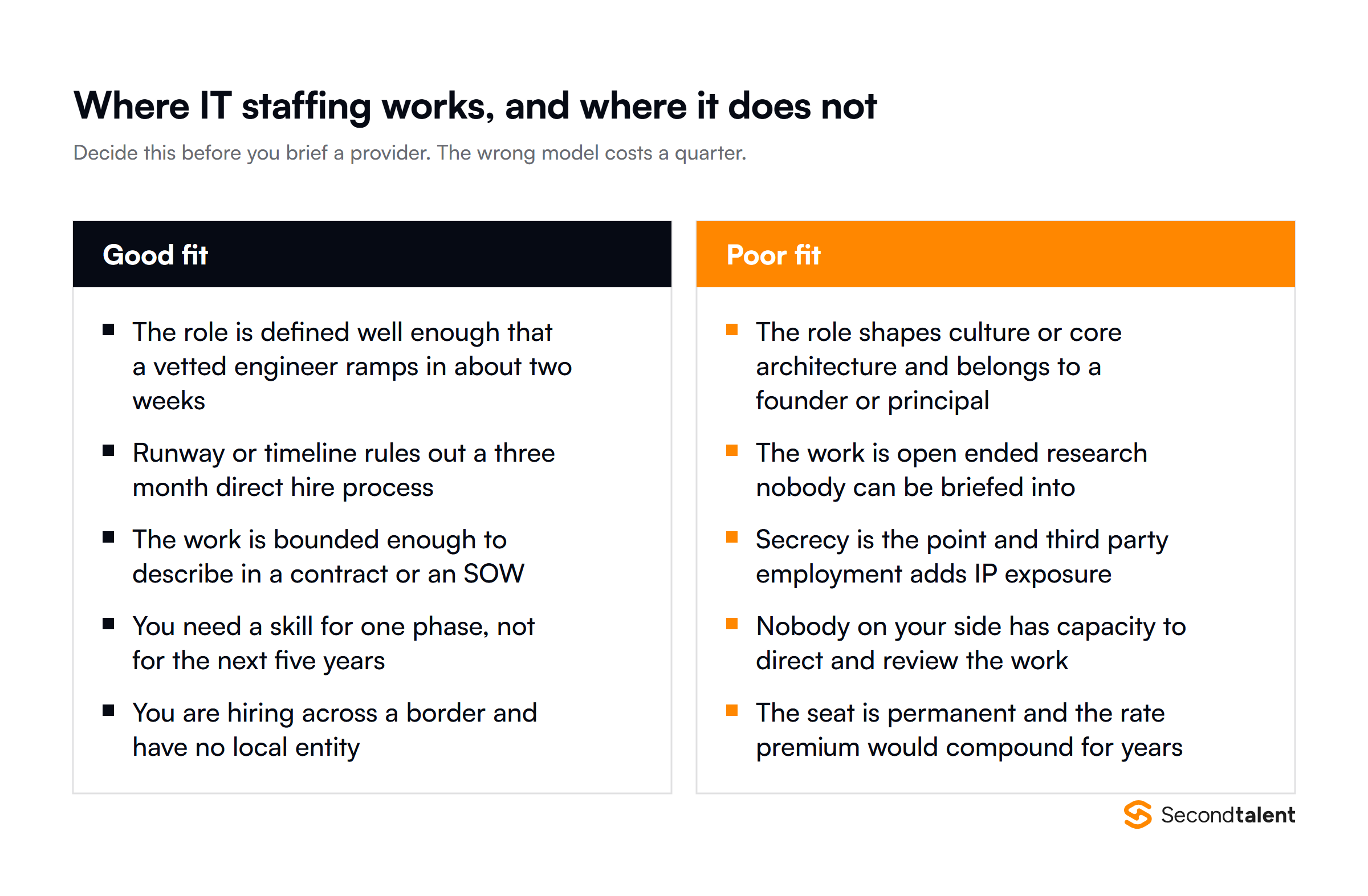
It fits when you can define the role tightly enough that a vetted engineer ramps in about two weeks, when your timeline rules out a three-month hiring process, and when you can draw a boundary around the work in a contract.
It does not fit when the role shapes culture or core architecture, when the work is open-ended research you cannot brief anyone into, or when no one on your side has capacity to direct and review what gets built.
The full decision framework sits in when to use IT staffing versus in-house hiring. Once you have chosen the model, how to evaluate IT staffing companies covers picking the provider.
IT staffing FAQs
Is staff augmentation the same as outsourcing?
No. In staff augmentation you keep control of the work and the provider supplies the person. In outsourcing you hand over the work itself and the provider decides how to staff it. The distinction matters when someone asks who made a given decision.
Who employs a worker in an IT staffing engagement?
The provider, or an Employer of Record entity acting on its behalf in the worker’s country. They run payroll, withhold tax and provide statutory benefits. You direct the work without becoming the employer.
How long does an IT staffing engagement usually run?
Augmentation engagements typically run six to twelve months with rolling extensions. Managed services run longer because the provider needs time to absorb a function. Project work under an SOW ends at the deliverable.
Can a contractor convert to a direct employee?
Yes, under a contract-to-hire arrangement agreed up front. The provider takes a conversion fee. Agree the fee and the trigger before the engagement starts, because negotiating it once you want to keep someone puts you in a weak position.
Takeaways
- IT staffing means a provider employs the worker. That single fact drives every other difference.
- Three models: augmentation (you hold outcome risk), managed service and SOW (the provider does).
- The IT staffing market is about $128 billion in 2026, not the half-trillion figure quoted for all staffing.
- US demand growth is concentrated in data (35 percent) and security (21 percent) through 2035.
- Senior Asian rates run $40 to $75 per hour. Budget vetting, onboarding and management time on top.
Hire pre-vetted senior engineers
Second Talent is a senior-only IT staffing provider with vetted engineers across Vietnam, the Philippines, Indonesia and the wider region. We support all three engagement models and include EOR cover for cross-border hires and contractor conversions.
Tell us which seat you need to fill, or read more about our IT staffing services and how the engagement models work in practice.
Hiring contractors rather than employees changes the arithmetic. The freelance developer rate index prices 14 roles across nine regions, benchmarked against North America and sourced from published wage data.