When OpenAI checked the benchmark it had built to measure coding models, it found that most of the tasks were broken. Of 1,699 samples that 93 experienced Python developers screened for SWE-bench Verified, 68.3 percent were thrown out, mostly because the tests rejected valid fixes or the issue was too vague to solve. Only human engineers caught it.
A coding AI trainer does that work for a living: writing the solutions, tests and tasks that coding models learn from, and grading the code those models produce. Most are working engineers, and the best-paid work now goes to those who can design a task as well as grade one.
What is a Coding AI Trainer?
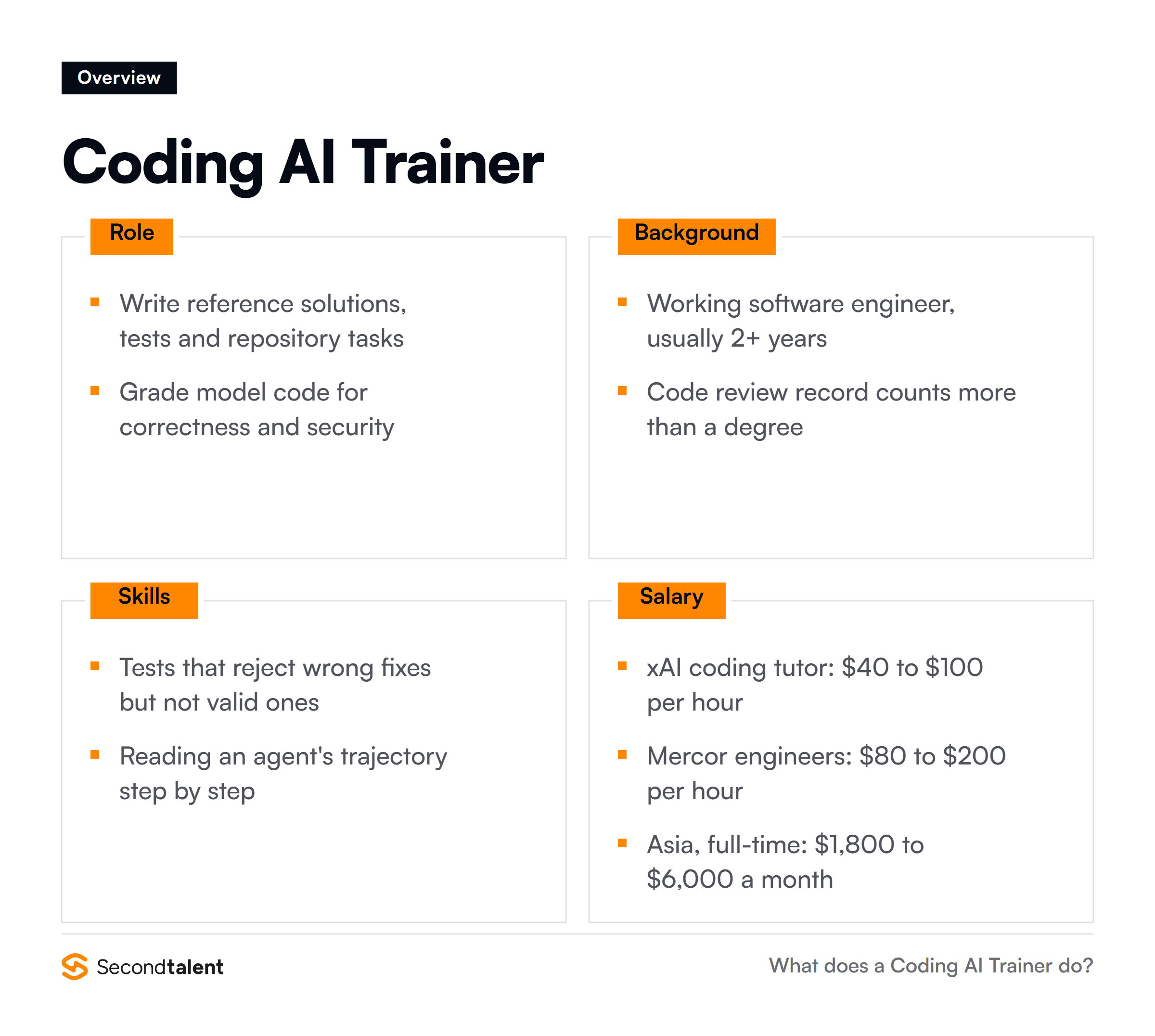
A coding AI trainer is a software engineer who produces and judges training data for models that write code. The output is not a product feature. It is the examples, grades and environments that decide whether a model learns to write code a senior engineer would merge, or code that merely passes the obvious test.
The work falls into two halves. The first is writing: reference solutions with explanations for supervised fine-tuning, unit tests and hidden test cases, and realistic repository tasks such as a bug fix spread across several files.
The second is judging: reviewing model output for correctness, security, efficiency and style, ranking two solutions against each other, and checking every step an agent took rather than only its final diff.
Why it needs engineers is simple. A generalist reviewer can tell whether an answer reads well. Only someone who writes production code can tell whether it handles the empty input, leaks a file handle, or passes the test because the test is weak.
OpenAI made the point when it released HumanEval in 2021: its 164 problems had to be hand-written, because the models had already trained on a large fraction of GitHub.
Most coding trainers work on contract through data platforms or directly for model labs. A growing number work full-time and dedicated to one lab or product team, which suits long projects where calibration and consistency matter more than raw hours.
Coding AI Trainer Job Market and Pay
Demand has shifted from simple code grading toward whole environments that an agent can work in. TechCrunch reported in September 2025 that labs were betting on RL environments, with data vendors such as Mercor and Surge investing in them, and cited The Information’s report that Anthropic leaders had discussed spending more than $1 billion on environments over the following year.
Epoch AI’s January 2026 survey of the market, based on 18 interviews, found labs typically pay $200 to $2,000 per task. Figures near $20,000 come up for especially complex software engineering tasks, but rarely. Interviewees named robustness against reward hacking as a key quality test, which is exactly the skill a strong coding trainer brings.
Contract rates published by the platforms (checked September 2026):
- DataAnnotation, Software Engineer: up to $75 to $150+ per hour, depending on task difficulty
- Mercor, software engineers: $80 to $200 per hour
- Alignerr, Software Engineer Task Author: $70 to $120 per hour
- Handshake AI, Software Engineer: up to $65 per hour, with 4+ years of professional experience required
- xAI, AI Tutor, Software Engineering: $40 to $100 per hour for US-based candidates
Salaried roles on the same career path:
- xAI, Human Data Engineer: $144,000 to $270,000 base
- OpenAI, Software Engineer, Research, Human Data: $295,000 to $385,000 plus equity
- Anthropic, Research Engineer, Code RL: $500,000 to $850,000, the research end of the path rather than a trainer rate
Two cautions apply. Platform rates are ceilings that depend on assessments, location and project need, and contract hours are not guaranteed. Aggregate salary sites are thin for this title and tend to blend in human coding instructors, so treat them with suspicion.
Outside the US, full-time dedicated coding AI trainers hired through Second Talent typically cost $1,800 to $6,000 a month across Asia, from engineers with two or more years of experience up to senior engineers who design task families and test suites.
Essential Coding AI Trainer Skills and Qualifications
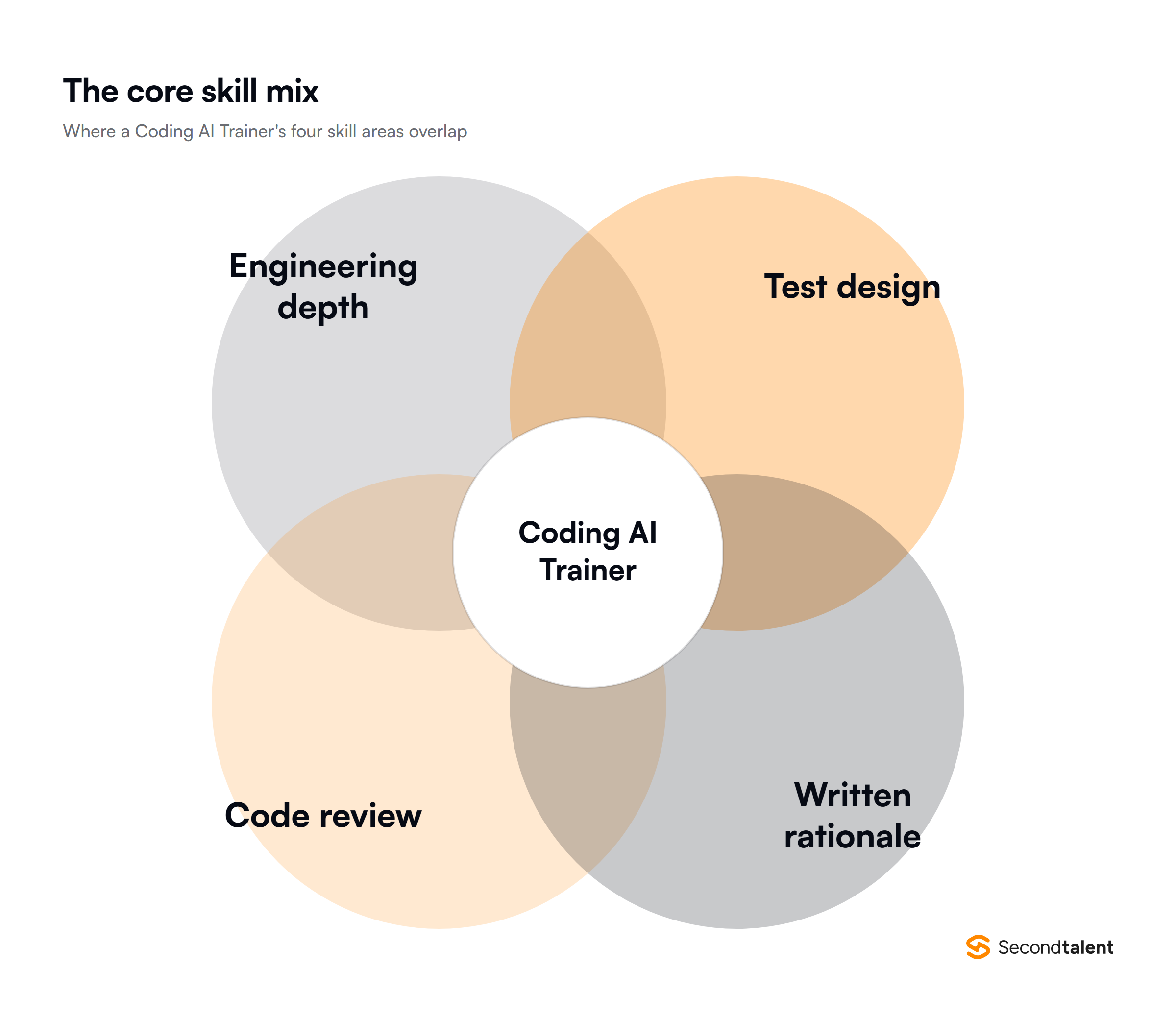
Engineering Depth:
- Professional experience in at least one language used heavily in training work, most often Python, with JavaScript or TypeScript, Java, Go, C++ and Rust close behind
- Enough breadth to judge a solution outside your favorite stack, because tasks rarely stay in one language
- A working knowledge of security basics: injection, unsafe deserialization, secrets in code and unbounded resource use
Review and Testing:
- Finding the subtle bug, not just the syntax error: off-by-one edges, race conditions, and code that is correct only for the happy path
- Writing tests that reject wrong solutions without rejecting valid ones, the exact failure OpenAI found in 61.1 percent of the SWE-bench samples it screened
- Reading an agent’s full trajectory and naming the step where it went wrong
Writing and Judgment:
- Clear, specific rationales, since a grade with no reason cannot be audited or trained on
- Following a rubric consistently on the five-hundredth task, and flagging the cases it does not cover
- Thinking like an adversary: spotting when a model fakes a passing test or games the grader
Background: Most coding trainers are working software engineers with two or more years of professional experience, and some platforms ask for four. A computer science degree is common but rarely required. A strong code review record matters more than credentials, because many capable programmers are not strong reviewers.
Coding AI Trainer Career Paths and Progression
Common Routes In:
- From software engineering: the most direct path, often starting part-time on contract alongside a full-time role
- From QA and test automation: strong on test design and edge cases, needing to show depth in writing solutions as well as breaking them
- From competitive programming: strong on algorithmic problems, needing to show judgment on messy repository work
- From general AI evaluation work: already fluent in rubrics and rationales, needing a verifiable engineering record to reach coding projects
Progression Within the Role:
- Reviewer: grading and ranking model solutions against an existing rubric
- Task author: writing reference solutions, tests and complete repository tasks
- Senior trainer: designing task families, calibrating difficulty and reviewing other trainers
- Lead: owning quality for a language or a task family across a project
Where It Leads: The natural next steps are human data engineering, evaluation engineering and RL environment design, all salaried roles on lab and vendor teams. Some trainers move into fine-tuning or research engineering. Others return to product engineering with a rare understanding of how coding assistants fail.
Coding AI Trainer vs Adjacent Roles
The title overlaps with several others, and the differences decide who you should hire or which job you should apply for.
Coding AI Trainer vs AI Evaluator & Trainer: The evaluator role is the generalist version: rating and ranking model output across many kinds of task. A coding trainer does the same judging only for code, and adds writing work a generalist cannot do, such as test suites and repository tasks.
Coding AI Trainer vs RLHF Specialist: An RLHF specialist produces preference data on open-ended prompts, where two good answers can differ. Coding work is more verifiable. A solution either passes a well-designed test or it does not, so much of a coding trainer’s value lies in making the tests good enough to trust.
Coding AI Trainer vs AI Training Data Annotator: Annotation labels data at volume against a clear right answer. Coding training asks for engineering judgment on every item and rarely runs at annotation volumes.
Coding AI Trainer vs evaluation or human data engineer: Engineers on a lab’s human data team build the platforms, harnesses and pipelines that trainers work inside. Trainers create the data; the engineers build the machinery and prove the data worked. Many trainers move into those roles later.
How Coding Training Work Is Built and Checked
The tooling looks like ordinary engineering, because the tasks are ordinary engineering. What changes is how hard every artifact is checked.
Reproducible environments. Tasks run in containers so every model and every reviewer sees the same system. SWE-bench uses Docker for this, and Terminal-Bench 2.0 ships each task as a containerized environment with a human-written solution and tests.
Sandboxed execution. Model-written code is untrusted by definition, so it runs isolated from the host. The HumanEval team used the gVisor container runtime for this, and newer RL frameworks bundle sandboxes directly into their environments.
Layered human review. Benchmarks built by human engineers now use several reviewers per task. SWE-Lancer’s end-to-end tests were triple-verified by experienced engineers, and Terminal-Bench 2.0 spent roughly three reviewer-hours on each task, keeping 89 of the 229 its 93 contributors submitted.
Versioned tasks. Task authors work through Git, write task descriptions a model can act on without seeing the answer, and record which tests must fail before the fix and pass after it.
Even careful review decays. In February 2026 OpenAI stopped reporting SWE-bench Verified, after at least six experienced engineers reviewed each of 138 audited problems and found material flaws in 59.4 percent. It now recommends Scale AI’s SWE-Bench Pro, 1,865 problems from 41 repositories in which human experts wrote the problem statements.
How to Become a Coding AI Trainer
The fastest route is to prove review skill rather than coding skill, since the second is assumed.
- Pick one or two languages where you can review at a senior level, and be honest about where your judgment stops
- Practice grading: take model-written solutions to real problems and write a one-paragraph verdict on each, naming the specific fault
- Write tests that separate a correct solution from three plausible wrong ones, and check that they do not reject a valid alternative
- Build two or three small repository tasks with a description, a failing test, and a reference fix, as a portfolio
- Apply to platforms that assess by task, then use that record to reach dedicated or full-time roles
Expect a skills assessment rather than a résumé screen. Platforms and employers test live: a coding interview, a review exercise on flawed model code, and a test-writing task. Second Talent’s vetting for dedicated coding trainers follows the same pattern, and the review exercise is the one most candidates fail.
Future of the Coding AI Trainer Role
Developers already use these models heavily and trust them little. In the Stack Overflow 2025 Developer Survey, 84 percent of respondents used or planned to use AI tools and 51 percent of professional developers used them daily.
Yet more developers distrusted the accuracy of AI output (46 percent) than trusted it (33 percent). The top frustration, cited by 66 percent, was solutions that are almost right, but not quite.
That gap is the job. As long as models produce code that is nearly correct, someone has to define what correct means, in tests a model cannot game, on tasks realistic enough to matter.
Expect the work to keep moving up the difficulty curve. Short function-level problems are largely solved as a training target, so demand is concentrating on multi-file repository work, long agent trajectories, and environments that resist reward hacking. That favors senior engineers over generalists, and it rewards trainers who can design a task as well as grade one.
Expect the talent map to widen too. Strong reviewers are not concentrated in one country, and labs that need thousands of senior engineering hours are already hiring across time zones.
Frequently Asked Questions
What does a coding AI trainer do?
A coding AI trainer is a software engineer who writes and grades training data for code-generating models. The work includes reference solutions for fine-tuning, unit and hidden tests, realistic repository tasks for agentic coding, reviews of model output for correctness and security, and rankings of competing solutions with written rationales.
How much do coding AI trainers earn?
Contract rates published in September 2026 include $40 to $100 per hour for xAI’s US AI Tutor, Software Engineering role and $80 to $200 per hour for software engineers on Mercor. Salaried human data engineering roles at model labs run from $144,000 to $385,000 base. Full-time dedicated coding trainers in Asia typically cost $1,800 to $6,000 a month.
Do you need AI or machine learning experience to become a coding AI trainer?
No. The core requirement is professional software engineering experience, usually two or more years, plus strong code review skills. Understanding how models are trained helps you write better tasks, but platforms and employers assess you mainly on whether you can find faults in code and write tests that catch them.
Is coding AI training real engineering work?
Yes, and increasingly so. Task authors set up realistic codebases, solve each task themselves, and write tests that must fail before the fix and pass after it. Epoch AI found labs typically pay $200 to $2,000 per training task, with rare complex software engineering tasks priced near $20,000.
What is the difference between a coding AI trainer and an AI evaluator?
An AI evaluator rates model output across many task types against a rubric. A coding AI trainer specializes in code and also writes material a generalist cannot, such as test suites, reference solutions and repository tasks. Most coding projects require a verified engineering background, while general evaluation work does not.
How quickly can Second Talent place a coding AI trainer?
We send a shortlist of pre-vetted coding AI trainers within 24 hours of receiving your brief, covering languages, task types and expected volume. Every candidate passes a live coding interview, a review exercise on flawed model solutions and a test-writing task, and most clients have a trainer working within a week.
Related Roles
Explore related roles you can hire on Second Talent: RLHF Specialist, Domain Expert AI Trainer, Multilingual AI Trainer, AI Evaluator & Trainer, Fine-Tuning Engineer, Test Automation Engineer, AI Agent Developer.