TL;DR: AI is changing IT staffing across vetting, role definitions, the seniority bar, supply concentration and pricing. This guide separates what is measured from what follows from it. Measured: 84 percent of developers now use or plan to use AI tools, while 46 percent distrust the accuracy of the output. Inferred: vetting shifts to observed behaviour, hourly billing loses ground, and judgment about tool output becomes part of what senior means. The last section says plainly what cannot be predicted.
Most writing about the future of this industry quotes a forecast and moves on. This one splits the two halves: the evidence that exists today, and the reading that follows from it. Where something is inference, it says so. It is the forward-looking companion to the state of the IT staffing market.
What is already measured
Two findings anchor everything below, and both come from a survey you can open.
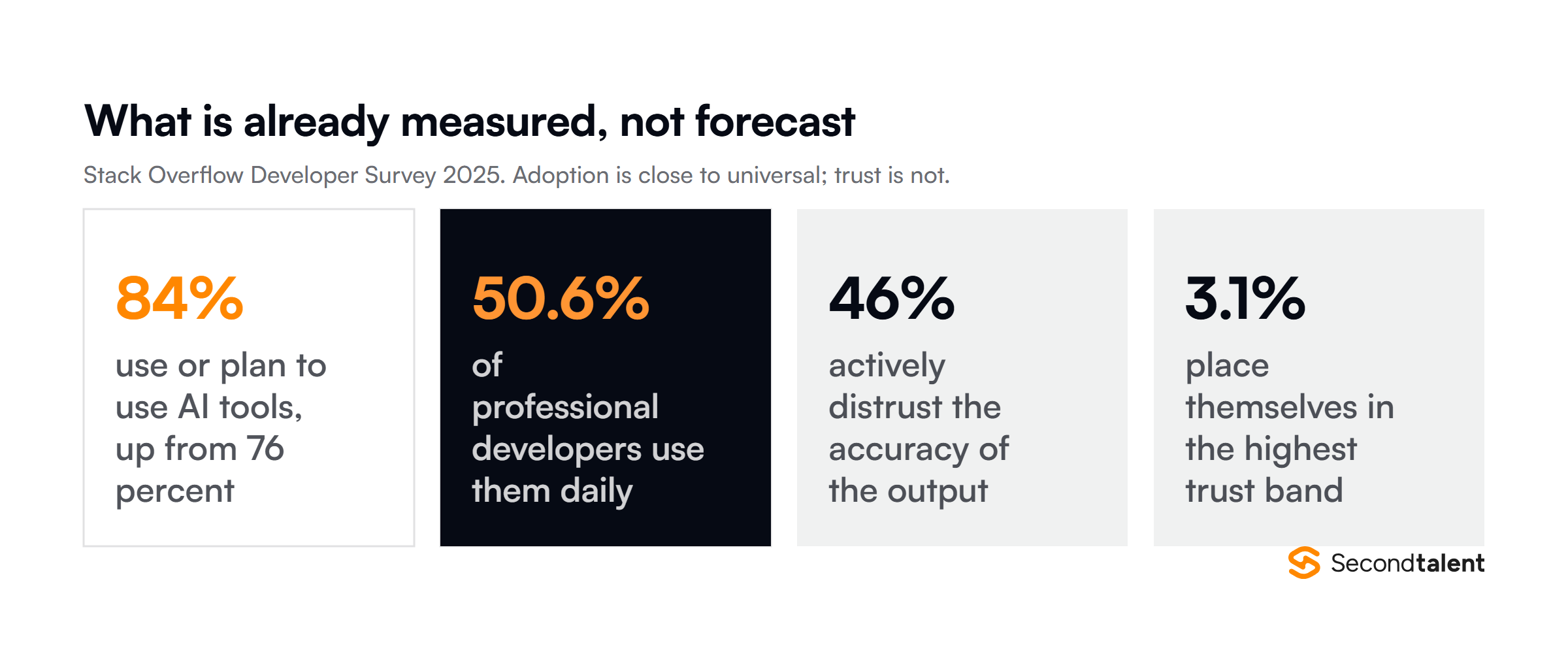
The 2025 Stack Overflow Developer Survey found 84 percent of respondents use or plan to use AI tools in development, up from 76 percent a year earlier, with 50.6 percent of professional developers using them daily.
Trust has not followed. On accuracy, 46 percent of developers distrust what the tools produce against 33 percent who trust them, and 3.1 percent put themselves in the highest trust band. Developers with ten or more years of experience are the most sceptical of the lot.
Adoption is settled. Judgment about the output is the open question, and that gap is what reshapes hiring.
Worth noting what the survey does not say. It does not measure whether the tools make anyone faster, or by how much. It measures use and confidence, which are the two things a survey can actually establish. Everything downstream of that in this article is reasoning from those two facts, not a second dataset.

Shift 1: vetting moves to observed behaviour
Observed. Adoption is close to universal, so a tool named on a CV separates almost nobody. A candidate listing Cursor or Claude Code is telling you they are in the majority.
What follows. Screening on keywords loses whatever signal it had, and live observed assessment becomes the only reliable filter. Watching someone iterate a prompt after a wrong first answer, write an eval, or refuse generated code that looks plausible tells you something a CV cannot.
What to do. Ask any provider claiming AI-native engineers for the written assessment rubric. Without published criteria the claim cannot be checked. Our guide to how vetting funnels work covers the stage design, and AI-native skills assessment covers the test itself.
Shift 2: AI-native roles become ordinary
Observed. Agent engineering and LLM engineering are being hired as named roles rather than as tasks folded into someone else’s job.
What follows. The specialty premium these roles carry today compresses as supply catches up, while the role categories themselves stay. That is the usual pattern when a specialty becomes a default, and mobile engineering went through it a decade ago.
What to do. Put the line item in next year’s plan rather than treating it as an exception. Roles that feel like a stretch to budget for now tend to be ordinary by the time you need three of them.
Shift 3: the seniority bar moves
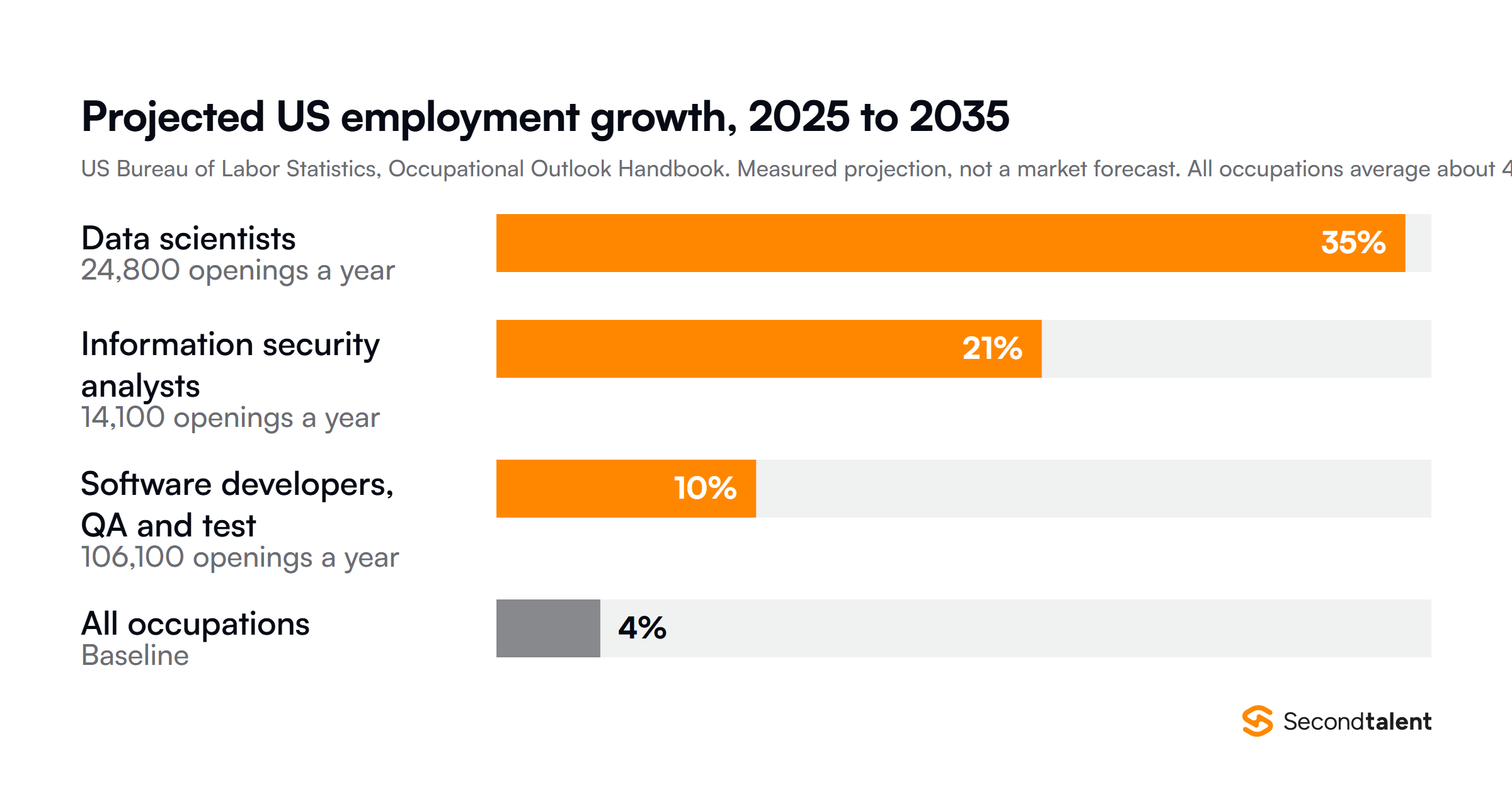
Observed. Half of professional developers use these tools daily, and demand is concentrated in specialties where supply was already thin. The US Bureau of Labor Statistics projects data scientist employment to grow 35 percent between 2025 and 2035 and information security analysts 21 percent, against about 4 percent across all occupations.
What follows. Output expectations reset upward, and what counts as senior shifts. The distinguishing skill stops being the ability to produce code and becomes the judgment to reject the wrong code, which is exactly where the trust data points.
What to do. Brief for the judgment. A role description asking for tool familiarity in 2026 returns everybody; one asking for the ability to explain why a generated approach was wrong returns a shortlist.
Be careful with productivity percentages. Figures of the form “AI-assisted engineers ship 30 to 40 percent more” circulate widely and are hard to trace to a study you can read. Treat any specific number in that shape as unverified until you have opened the source, including numbers a vendor attributes to a research firm. Measure it on your own team instead, after the ramp.
Shift 4: supply concentrates where practice is deep
Observed. Markets differ in specialty depth and in language proficiency, and both are measurable. The EF English Proficiency Index ranks 123 countries from the results of 2.2 million adults, with the Philippines at rank 28 and Vietnam at rank 64 against a global average score of 488.
What follows. Markets that build AI practice early hold an advantage, because practice compounds faster than headcount does. A market can grow its graduate pipeline in a few years and cannot buy a decade of habits.
What to do. Choose the market for the specialty and the overlap you need. Our comparison of onshore, nearshore and offshore works through the trade.
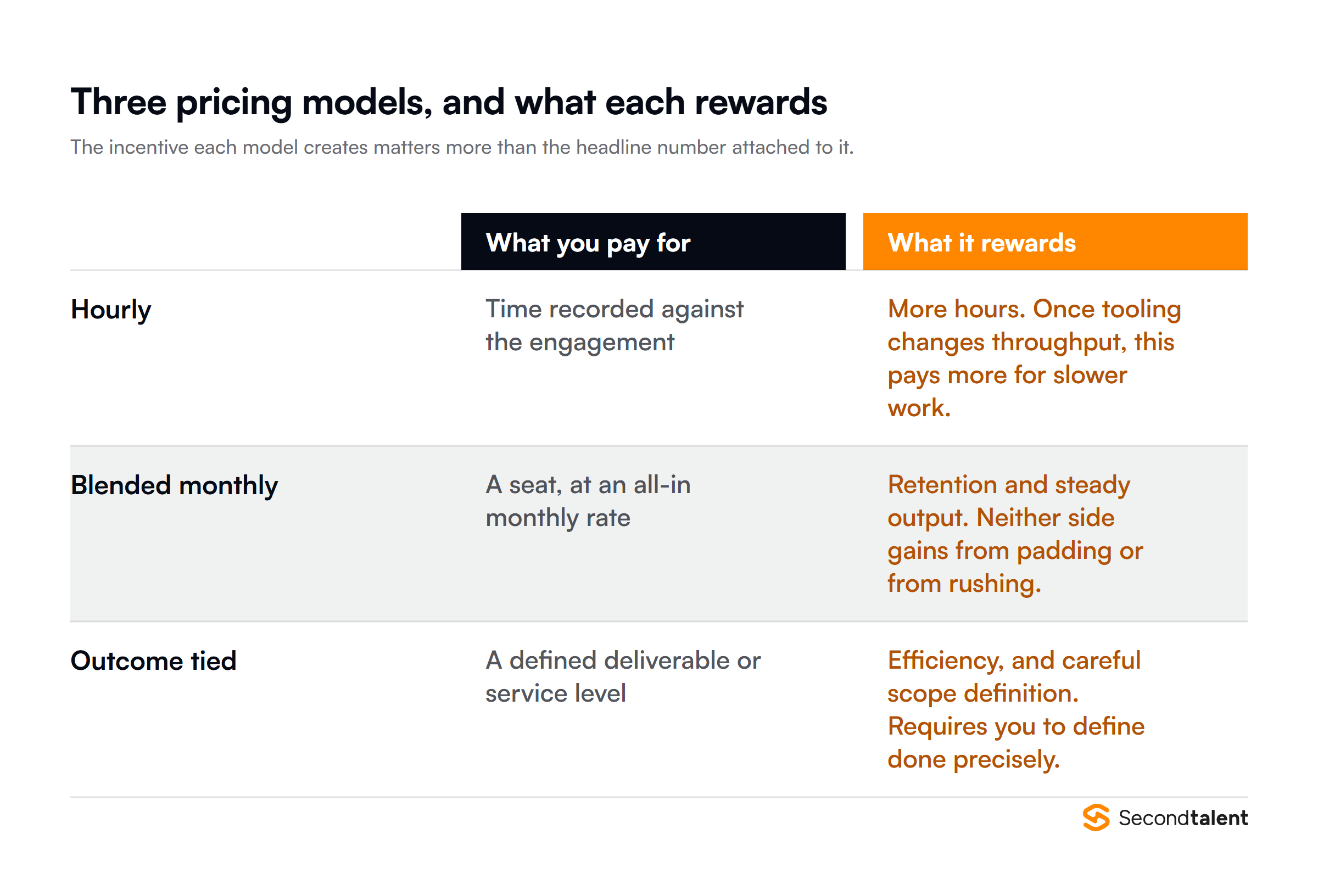
One caution on outcome-tied pricing. It rewards efficiency, and it also requires you to define done with a precision most teams underestimate. A vague acceptance criterion under an outcome contract becomes a dispute rather than a conversation, so it suits bounded deliverables far better than an evolving roadmap.
Shift 5: pricing decouples from hours
Observed. Hourly billing pays more for slower work. That was a tolerable inefficiency when throughput was stable across engineers, and it is a structural conflict once tooling changes throughput.
What follows. Blended monthly rates and outcome-tied pricing keep taking share, because both remove the incentive to bill slowly. Neither is new; what changed is how much the incentive now costs the buyer.
What to do. Push for a blended monthly rate. It removes the conflict, and it makes your own budgeting simpler, which is the smaller but more immediate benefit. Our guide to measuring IT staffing ROI covers how to compare the models.
What does not change
Forecast articles overweight what is moving. Four things about this industry have not shifted, and planning around them is safer than planning around any projection.
Someone still has to direct the work. Staff augmentation assumes a manager who assigns and reviews. No amount of tooling removes that, and engagements still fail on it more often than on candidate quality.
Employment law still decides the structure. The IRS common-law test and the HMRC CEST tool turn on control, which is exactly what an augmentation engagement involves. That is why the provider has to be the employer, and it is unaffected by anything happening in tooling.
Ramp time is still real. An engineer joining a codebase needs weeks to be useful whatever they use to write code, and regulated domains take longer. Plans that assume tooling removes the ramp keep being wrong.
Retention still tells you the truth. It is the one figure a provider cannot control at the point of sale, and it will still be the right question in 2028.
If the five shifts above turn out differently from the reading here, these four stay true regardless. That is the part worth building a process around.
What to change now
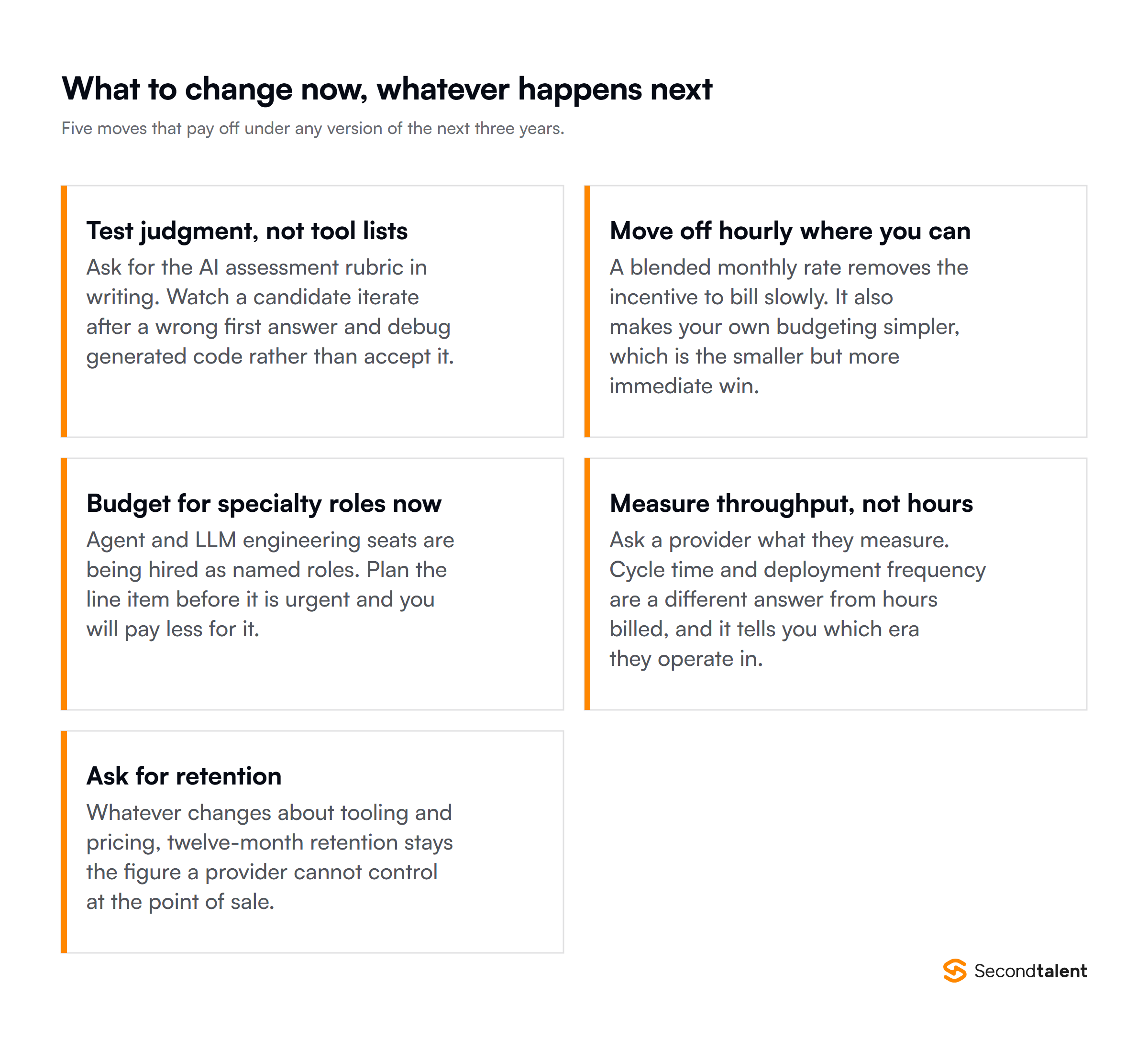
Five moves pay off under any version of the next three years, which is the test worth applying to a forward-looking article.
- Test judgment, not tool lists. Ask for the assessment rubric in writing.
- Move off hourly where you can. A blended rate removes the incentive to bill slowly.
- Budget for specialty roles now. They are cheaper to plan for than to react to.
- Measure throughput, not hours. Ask a provider what they track; the answer dates them.
- Ask for retention. It stays the figure a provider cannot control at the point of sale.
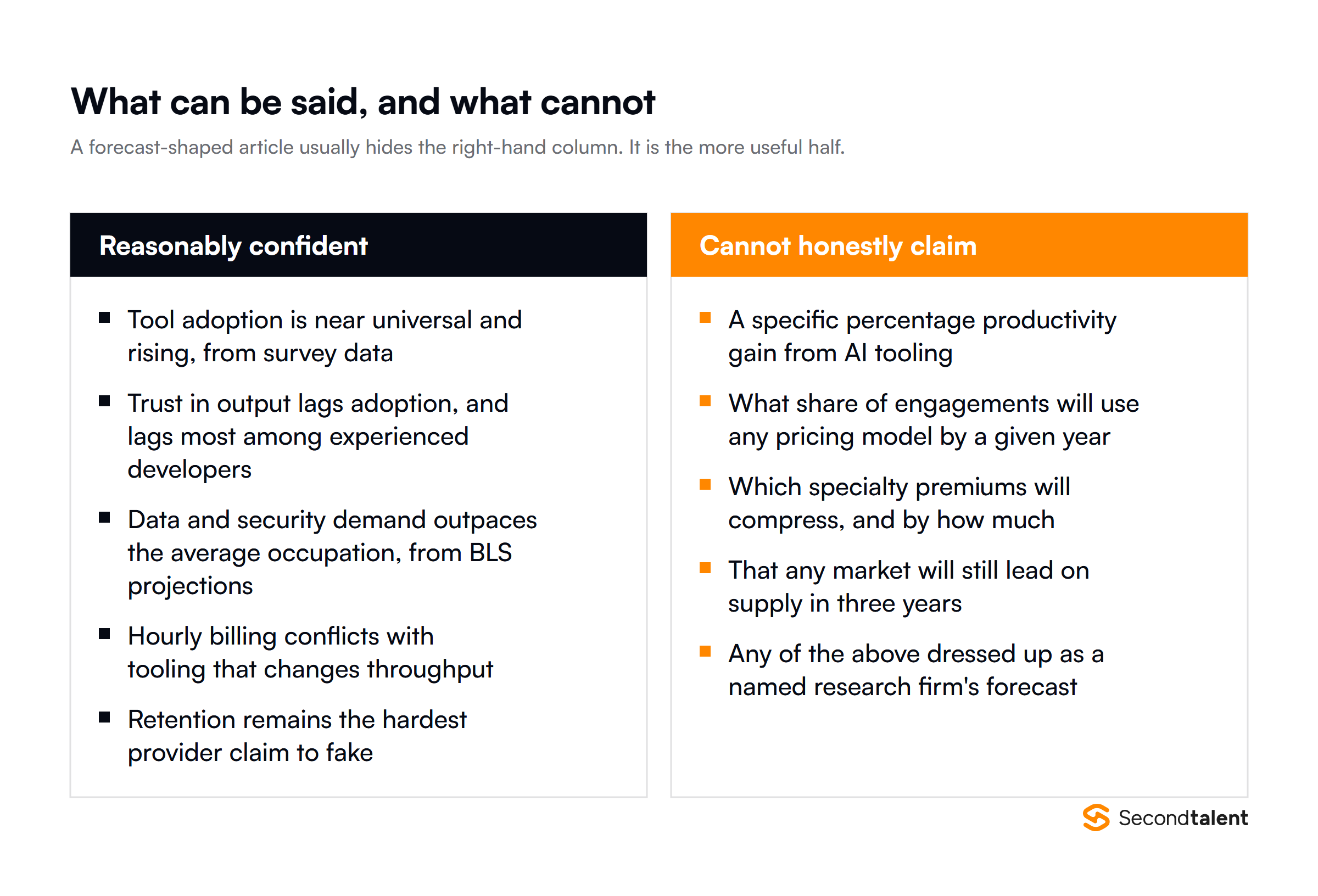
What cannot honestly be predicted
An article shaped like a forecast usually omits this section, and it is the more useful half.
We cannot give you a specific percentage productivity gain from AI tooling, or say what share of engagements will use a given pricing model by a given year, or name which specialty premiums will compress and by how much, or promise that any market leading on supply today will still lead in three years.
What makes those claims tempting is that they are easy to write and hard to check. A named research firm attached to one does not make it verifiable; it makes it harder to question. If a vendor quotes you a precise figure about 2028, ask which report it came from and open it.
The honest version of a forecast is a set of directions with the evidence attached, plus a list of the things nobody knows. That is what this page is.
Future of IT staffing FAQs
How should we read vendor claims about 2028?
Ask which report a figure came from and open it. A named research firm attached to a precise number does not make the number checkable; it makes it harder to question, which is the reason it gets attached. If the source turns out to be a page that does not carry the figure, treat the whole pitch accordingly.
Will AI reduce demand for engineers?
Nothing measurable points that way yet. BLS still projects growth well above the average occupation across data, security and software roles through 2035. What is visible is a change in the mix rather than in the total.
Should we still hire junior engineers?
That is a real open question and anyone answering it with confidence is guessing. What can be said is that the tasks juniors traditionally learned on are the ones most affected, so the training path needs rethinking whatever the headcount decision.
Is AI fluency worth a rate premium?
Fluency alone, decreasingly, since adoption is near universal. Judgment about output, yes, because that is what the trust data says is scarce.
How should we evaluate a provider’s AI claims?
Ask for the rubric, ask what they measure, and ask for retention. Three questions, and a provider without good answers to them will fill the silence with a forecast.
Takeaways
- Adoption is settled at 84 percent. Trust in the output is not, at 46 percent distrusting.
- That gap is the hiring signal: screen for judgment, not for tool familiarity.
- Hourly billing pays more for slower work. Move to a blended monthly rate.
- Treat any precise productivity percentage as unverified until you open the source.
- Retention at twelve months survives every version of the next three years.
Hire for the judgment, not the tool list
Second Talent vets engineers on observed behaviour rather than on what their CV claims, matches within 24 hours, and keeps 92 percent of placements in seat a year later.
Tell us which seat you need to fill, or start with what IT staffing is for the engagement models behind it.