TL;DR: An IT staffing agreement sets what you are buying, what you own, what stays confidential and what happens when something goes wrong. This page gives you a free PDF template with fourteen clauses and a reusable statement of work, plus the part a template cannot give you: which clauses to negotiate, in which order, and what to strike from a provider’s standard draft. Negotiate replacement terms before rate.
Most buyers do one of two things. They sign the provider’s template without touching the clauses that matter, or they spend six weeks with legal building one from scratch. The template below is the middle path, and the rest of this page is the negotiation guide that should come with it.
This is a template, not legal advice. Have counsel review before signing.
Download the IT staffing agreement template
Download the IT Staffing Agreement Template (PDF). Fourteen clauses plus a statement of work appendix with fill-in fields. No sign-up, no email gate.
Which clauses actually matter?
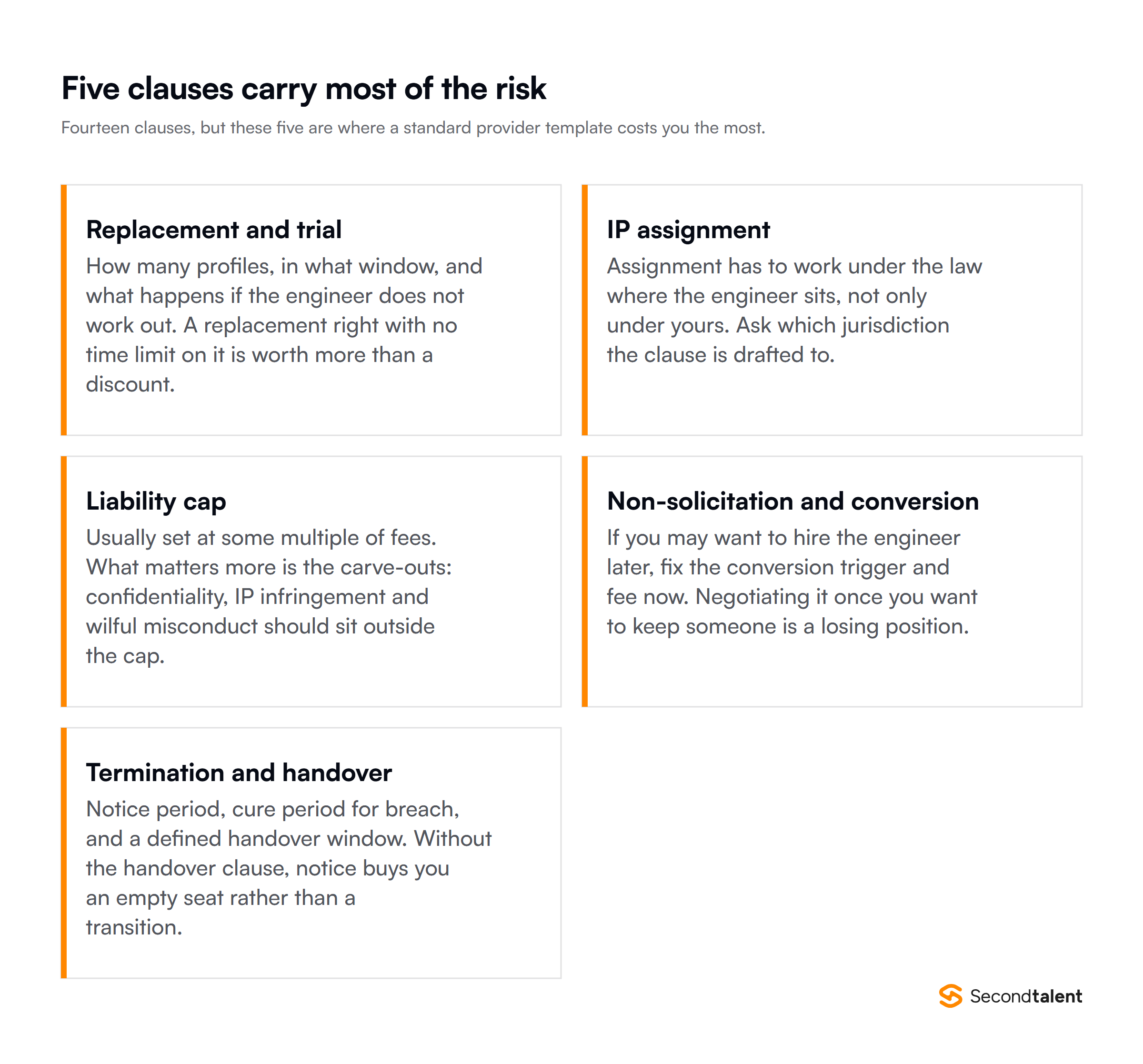
Five of the fourteen carry most of the commercial risk, and a standard provider template is usually weakest on all five.
Replacement and trial. How many profiles you get, in what window, and what happens if the engineer does not work out. A replacement right without a tight time limit is worth more than a rate discount, and a provider with a real bench gives it up cheaply.
IP assignment. Covered below, because it is the clause most often drafted to the wrong jurisdiction.
Liability cap. Argue the carve-outs rather than the number. A cap that also limits confidentiality breach and IP infringement leaves you exposed on the two risks worth caring about.
Non-solicitation and conversion. If you might want to hire the engineer permanently, fix the trigger and the fee now. Once you have decided you want to keep someone, you have no leverage left.
Termination and handover. Notice, a cure period for breach, and a defined handover window. Without the handover obligation, notice buys you an empty seat instead of a transition.
Who should carry each obligation?
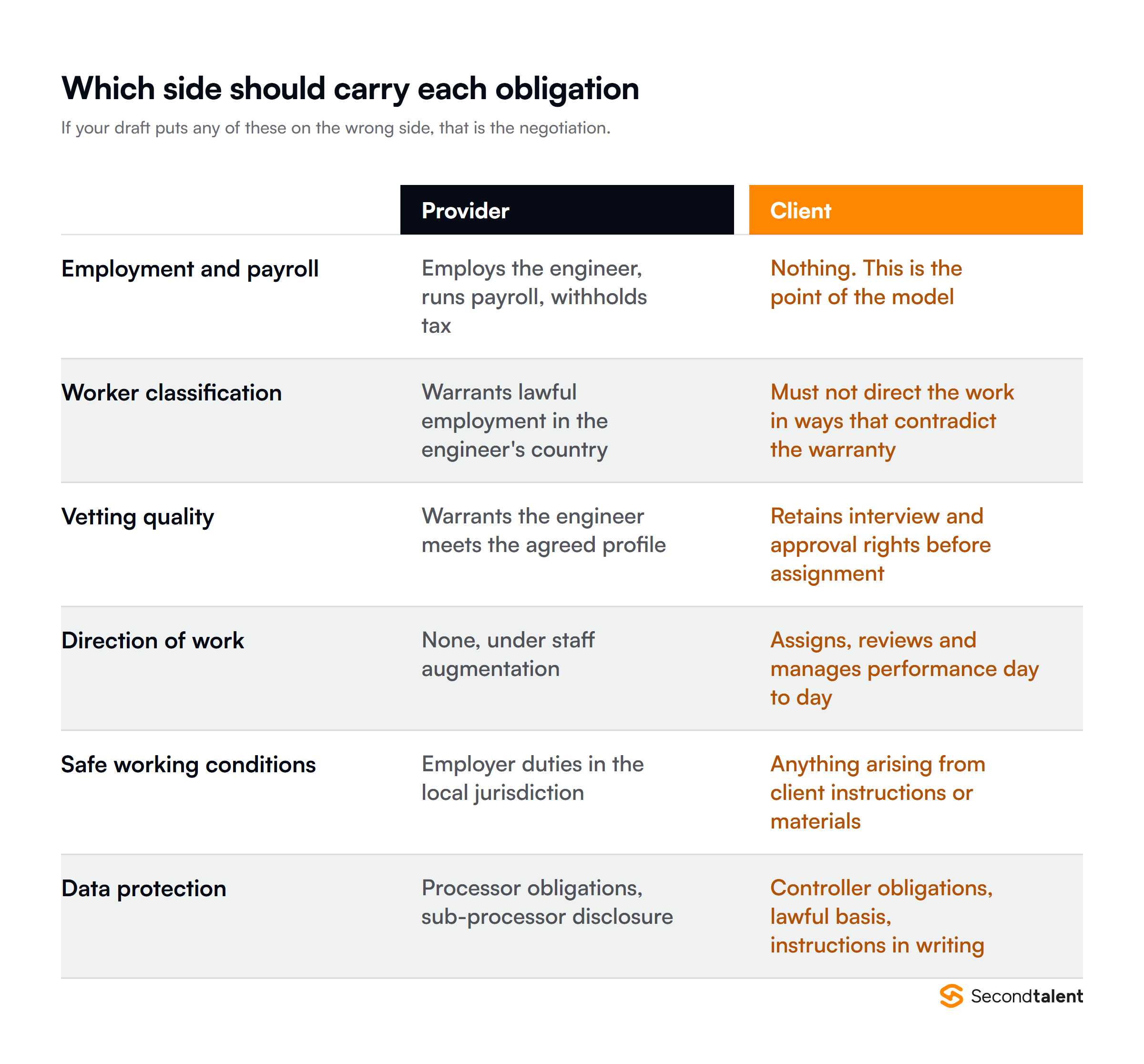
The provider employs the engineer and carries everything that follows from employment. You direct the work and carry everything that follows from direction.
That split is what makes the model work, and it is also what a badly drafted agreement quietly undoes. Two clauses deserve particular attention.
Classification. The provider should warrant lawful employment in the engineer’s country. You should avoid directing the work in ways that contradict that warranty. The IRS common-law test weighs behavioural and financial control, and the HMRC CEST tool asks the same question in UK terms. Our guide to worker classification in cross-border IT staffing covers where the structure breaks.
Data protection. Where the engagement touches personal data, the provider is a processor and you are the controller. GDPR Article 28 sets what the contract has to contain, including the conditions under which the provider may engage a sub-processor.
Getting the IP clause right
All work product should belong to you, with a full assignment and no surviving licence for the provider. That part is uncontroversial and most templates already say it.
The problem is which law the assignment is drafted to. First ownership of a work differs by country under the Berne Convention framework, so a clause written only under your own governing law may not transfer what you expect where the engineer sits and creates the work.
Ask for the assignment law to be named explicitly in the IP clause rather than inherited from the general governing-law provision. Our guide to IP assignment in IT staffing contracts covers the jurisdictional detail.
Ask who else is in the chain. Before signature, get the provider to name every legal entity between you and the engineer, in writing. If the agreement is silent on subcontracting, assume there is some. For a regulated buyer this is the single most common audit finding, and silence in the contract is not a defence.
Negotiate in this order
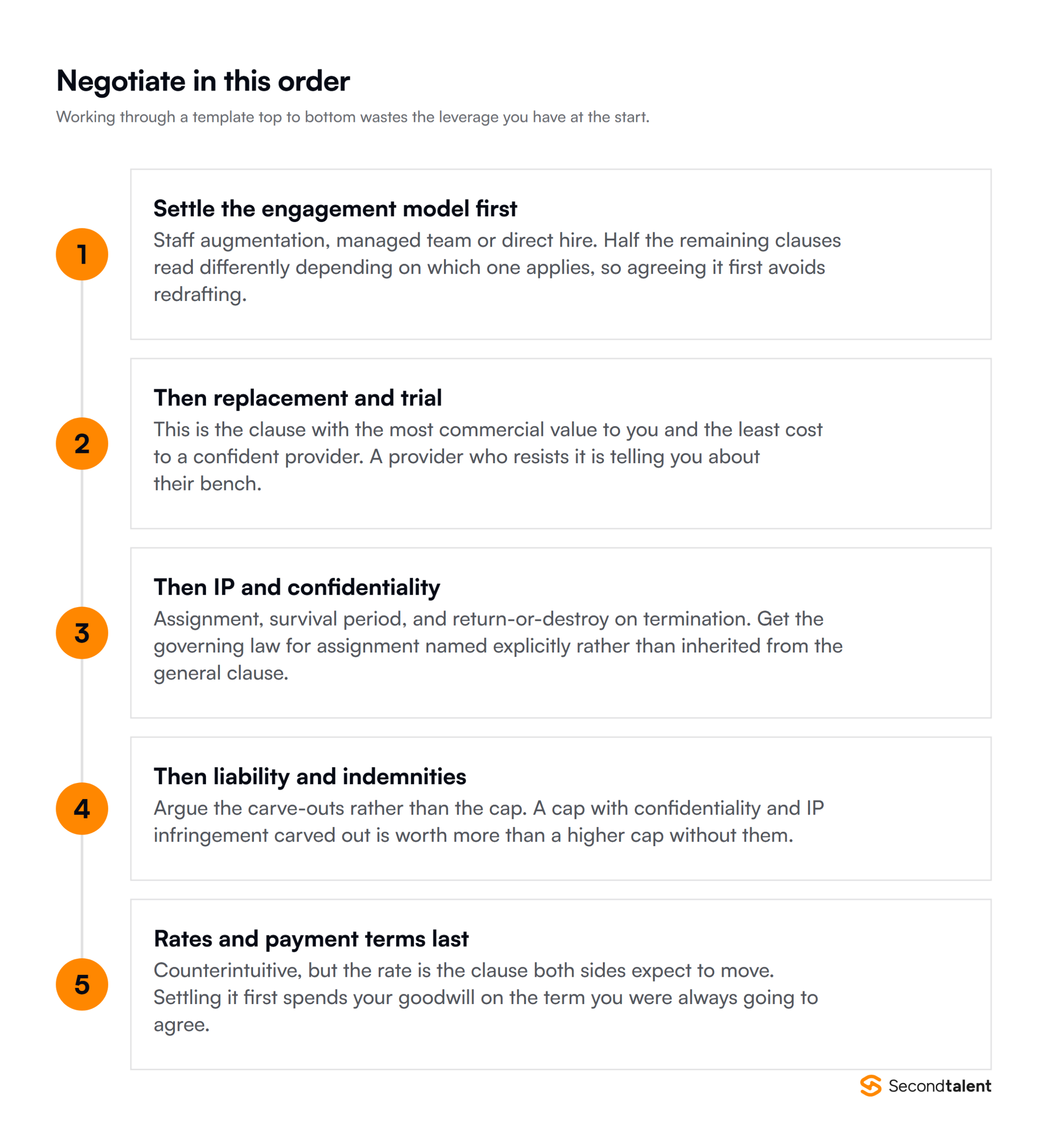
Working through a template from clause one to clause fourteen spends your leverage on the terms both sides were always going to agree.
Settle the engagement model first, because half the remaining clauses read differently under staff augmentation than under a managed team. Then replacement and trial, which has the highest value to you and the lowest cost to a confident provider. Then IP and confidentiality. Then liability and indemnities, arguing carve-outs rather than the cap.
Leave rates and payment terms until last. It sounds backwards, but the rate is the clause both parties expect to move, so opening with it burns goodwill on an outcome you would have reached anyway.
What to strike from a provider’s standard draft
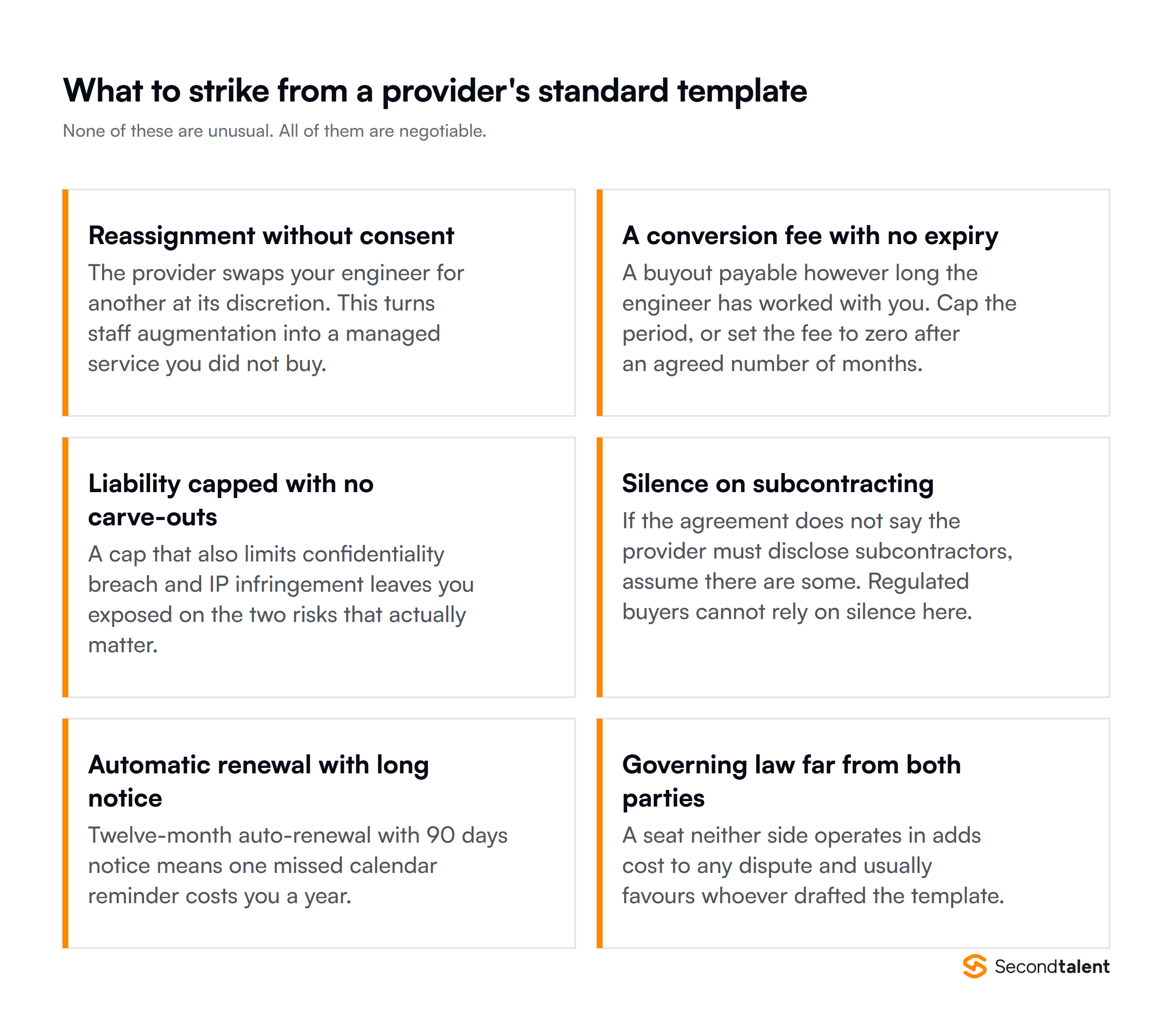
Six terms show up often in provider templates and all of them are negotiable.
- Reassignment without consent. The provider swaps your engineer at its discretion, which converts augmentation into a managed service you did not buy.
- A conversion fee with no expiry. Cap the period, or set the fee to zero after an agreed number of months.
- A liability cap with no carve-outs. Confidentiality and IP infringement belong outside it.
- Silence on subcontracting. Require disclosure of the full chain.
- Automatic renewal with long notice. A twelve-month renewal on 90 days notice means one missed reminder costs a year.
- A governing law neither party operates in. It adds cost to any dispute and tends to favour whoever drafted the template.
Our breakdown of the 12 MSA clauses that materially shift risk goes deeper on the drafting itself.
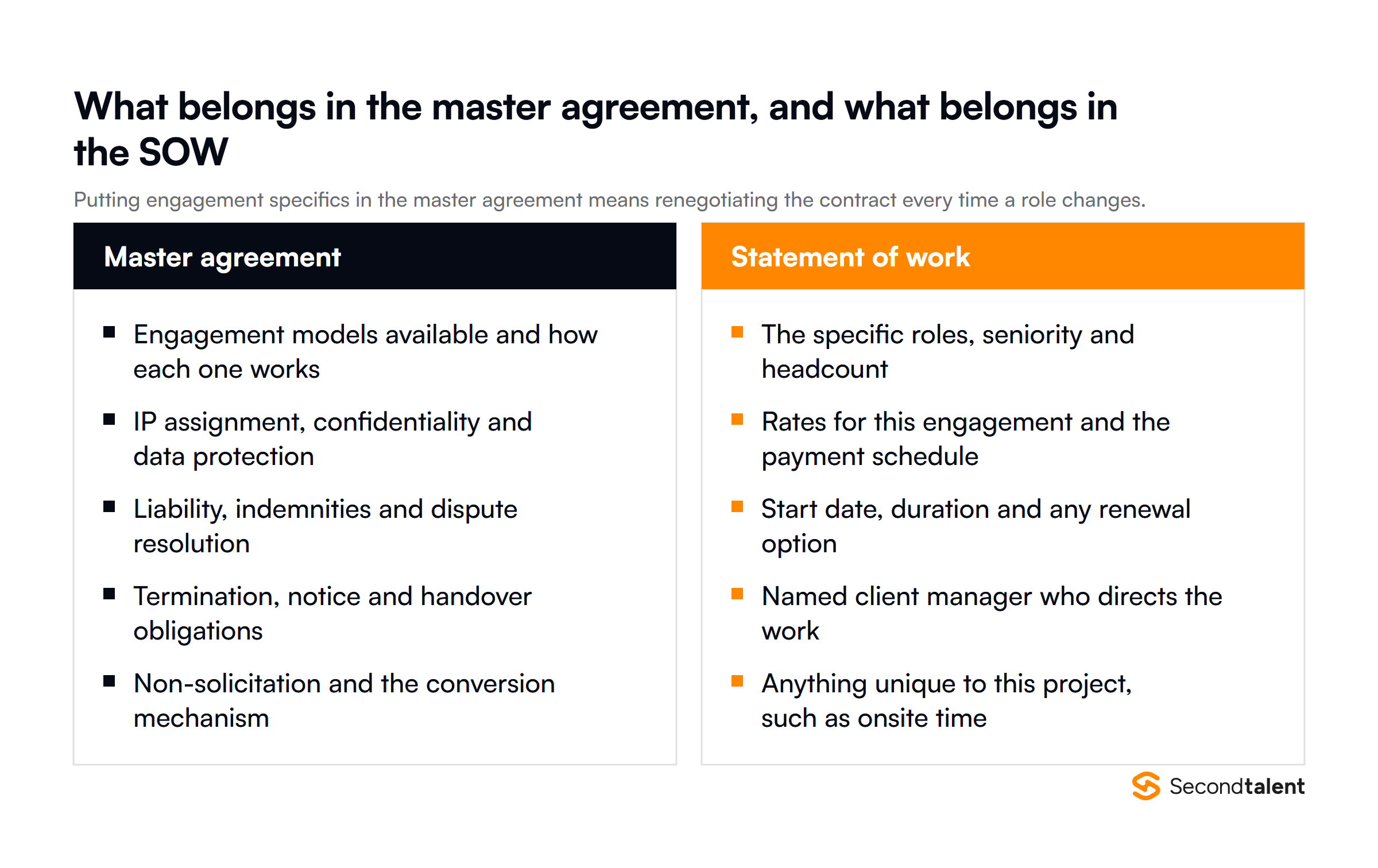
Master agreement or statement of work?
The master agreement holds what stays true across every engagement. The statement of work holds what changes per role.
Get this split wrong in the direction of the master agreement and you renegotiate the contract every time a rate or a headcount changes. Get it wrong the other way and each SOW quietly restates terms that should have been settled once.
One test settles most placements: if the answer changes when you hire a second engineer next quarter, it belongs in the statement of work. If it would read the same for any engineer under any engagement, it belongs in the master agreement.
Rates belong in the SOW. Liability, IP, confidentiality and termination belong in the master agreement. The named manager who directs the work belongs in the SOW, because that person is engagement-specific and the clause matters for classification.
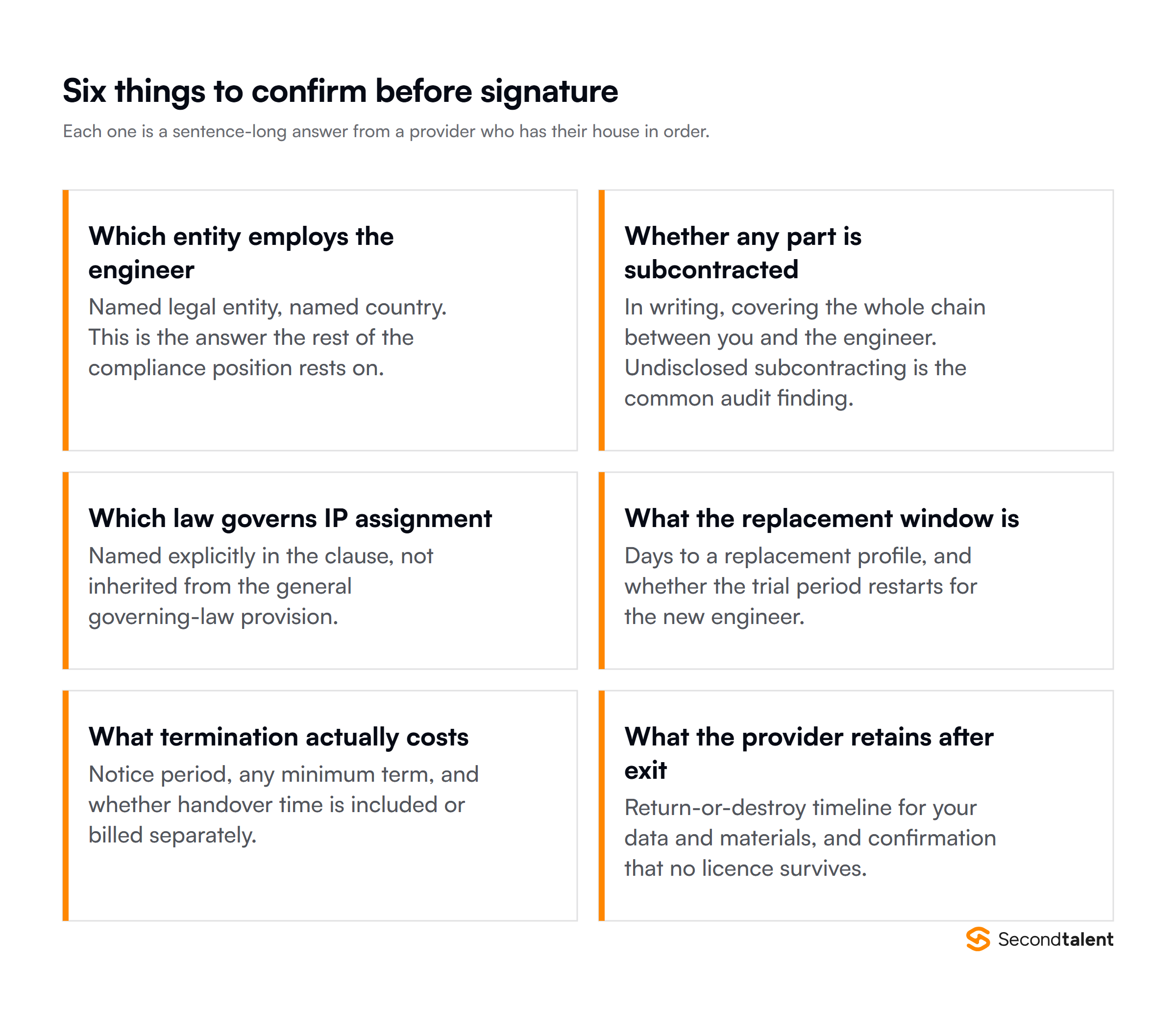
Six things to confirm before signature
Each of these should get a one-sentence answer from a provider with their house in order.
- Which legal entity employs the engineer, and in which country.
- Whether any part of the service is subcontracted, across the whole chain.
- Which law governs IP assignment, named in the clause itself.
- How long a replacement takes, and whether the trial restarts for the replacement.
- What termination costs, including whether handover time is billed.
- What the provider retains after exit, and the return-or-destroy timeline.
A provider who needs to check with someone on the first two is not ready for a regulated client. Our 15 questions to ask before you sign extends this into full diligence.
Security obligations belong in the agreement too
Most staffing templates cover confidentiality and stop there, which leaves the operational security terms to an email exchange nobody can find later.
Four obligations are worth writing down. How fast the provider revokes access when an engineer leaves the engagement. Who holds administrative rights on your repositories. What device management the engineer’s machine is under. And what gets logged, retained and made available to you if you need to reconstruct who did what.
Borrow a published structure rather than drafting from nothing. The NIST Cybersecurity Framework added a Govern function covering supply chain and third-party risk, which gives you vocabulary a provider will recognise and an auditor can follow. Where the provider runs any part of the service on its own infrastructure, ask for assurance evidence such as an AICPA SOC report rather than a policy document.
Under staff augmentation most of this is simpler than it sounds, because the engineer works inside your perimeter on your accounts. The clause exists to make that explicit and to cover the cases where it is not.
What changes for a regulated buyer
Financial services, health and public sector buyers carry obligations their provider contract has to reflect, and a general template will not carry them.
Expect to add audit and access rights, defined data locations, a documented exit plan, and explicit conditions on subcontracting. Under DORA those are contractual requirements rather than preferences where the service supports a critical or important function, and our guide to fintech staff augmentation covers what that looks like in practice.
Decide the criticality classification before you draft, not after. It determines which clauses you are obliged to include, and discovering it late means reopening a contract you have already signed.
IT staffing agreement FAQs
How long should this take to agree?
Days rather than weeks, if you work in the order above and the provider has seen a regulated buyer before. The delays come from two places: an engagement model that was never settled, so clauses keep getting redrafted, and a subcontracting question the provider cannot answer without checking. Both are avoidable by raising them on the first call rather than at redline stage.
Do I need a separate agreement for each engagement?
No. Sign one master agreement, then attach a statement of work per engagement. That is the whole point of the structure, and it is what lets a new role start in days rather than weeks.
Should the agreement name individual engineers?
The master agreement should not. The statement of work can, and should also record that reassignment requires your consent.
What liability cap is reasonable?
The number matters less than the exclusions. A cap tied to fees over a defined period is normal; what you want is confidentiality breach, IP infringement and wilful misconduct sitting outside it.
Can we convert an engineer to a direct hire?
Yes, if the agreement says so. Fix the trigger and the fee before the engagement starts, and check whether the fee expires after a period of service.
Takeaways
- Negotiate the engagement model first and the rate last.
- Replacement terms are worth more than a discount, and cost a good provider little.
- Name the law governing IP assignment inside the IP clause.
- Argue liability carve-outs, not the cap.
- Get the full subcontracting chain in writing before signature.
Put the agreement to work
Second Talent places pre-vetted senior engineers across Asia with EOR cover, so employment, payroll and statutory obligations sit with a licensed local employer. Matching runs within 24 hours and 92 percent of placements are still in seat a year later.
Start a hire, check pricing, or work through the IT staffing plan template before you contract.