TL;DR: ChatGPT developers from Asia start at $3,000 a month through Second Talent, matched in 24 hours. The closest US benchmark, the BLS median for software developers, was $135,980 a year in May 2025.
OpenAI removed the Assistants API on 26 August 2026, and its deprecations page names the Responses API and Conversations API as the replacement. The Evals dashboard and Agent Builder follow on 30 November 2026. A ChatGPT developer you hire this quarter will spend part of the first months moving code off retired endpoints, so migration history belongs in the interview.
Key takeaways
- On our AI engineer rate cards, pay for work with international clients starts at $2,390 a month in the Philippines and $4,540 in Indonesia.
- In Stack Overflow's 2025 survey, 81.4% of developers had used OpenAI's GPT models for development work, and 42.8% had used Claude Sonnet.
- A 6:00 pm to 3:00 am shift in Manila covers six hours of a 9-to-5 Eastern day while US daylight time runs.
- Code from an independent contractor is not "work made for hire" under US copyright law, so the contract needs a signed IP assignment.
What ChatGPT Developers Earn Working for International Clients in Asia
Our rate cards carry no separate ChatGPT developer title, so the table uses our AI engineer rate cards, the closest match for engineers who ship LLM features. The figure is what developers in that market earn working for foreign companies as their direct clients, before any employer or platform costs.
| Market |
Monthly pay working for international clients (USD) |
| Philippines |
$2,390-$4,790+ |
| India |
$2,610-$10,150+ |
| Malaysia |
$3,690-$7,370+ |
| Vietnam |
$3,870-$7,730+ |
| Indonesia |
$4,540-$10,210+ |
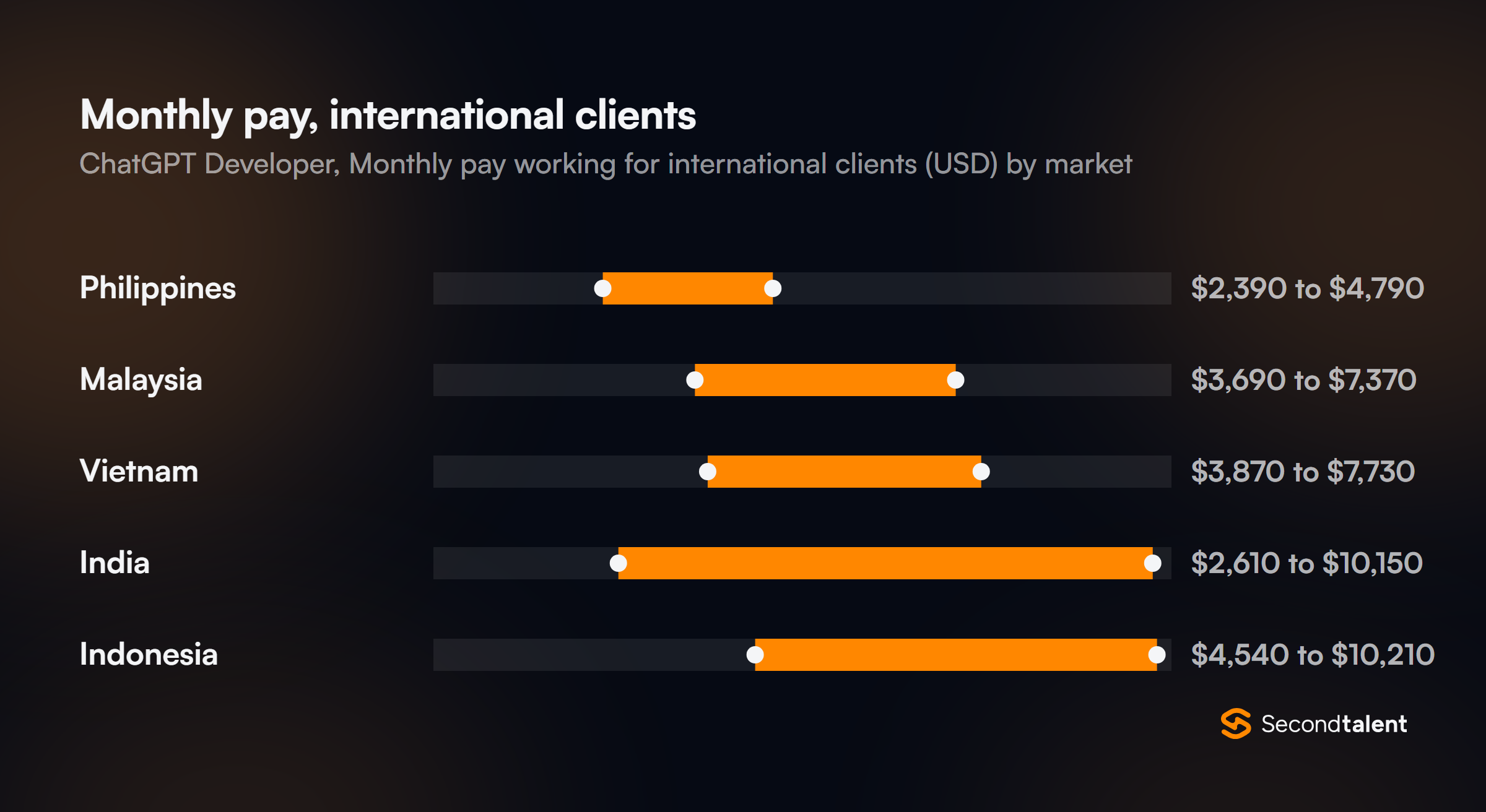
Monthly ranges from the Remote (Working for International Clients) figures on our rate cards for the Philippines, India, Malaysia, Vietnam and Indonesia, converted at ExchangeRate-API mid-market rates for 14 September 2026.
India has the widest spread: its top figure is almost four times its starting figure, while the Philippine range about doubles from bottom to top. All five ranges are open at the top, marked with a plus sign.
Through Second Talent, ChatGPT developers start at $3,000 a month: one monthly fee that bundles salary, payroll taxes, statutory contributions and our service fee. The final monthly figure depends on market and seniority, and our pricing page shows how the subscription works. For contract rates on the same skill set, our cost to hire a freelance ChatGPT developer page lists hourly ranges.
US Pay Benchmark for ChatGPT Developers
BLS publishes no ChatGPT or LLM developer occupation. The role maps to Software Developers (15-1252), because the work is building and shipping application features that call a model API rather than researching new models.
| BLS OEWS, May 2025, national |
Software Developers (15-1252) |
| 10th percentile, monthly |
$6,870 |
| 25th percentile, monthly |
$8,770 |
| Median, monthly |
$11,330 |
| 75th percentile, monthly |
$14,330 |
| 90th percentile, monthly |
$17,890 |
Monthly figures are the annual wages on the BLS OEWS profile for 15-1252 divided by 12 and rounded to the nearest $10. The annual median is $135,980.
If the engineer you hire will also own evaluation and model spend, compare against the 75th and 90th percentile rows as well as the median.
Salary is only part of the US cost. In the BLS Employer Costs for Employee Compensation release for June 2026, wages and salaries made up 68.5% of employer compensation costs for full-time private industry workers, and benefits the other 31.5%.
Time Zone Overlap with ET, CT and PT
None of the Asian cities below change their clocks, and US daylight time runs from 8 March to 1 November 2026, per NIST. 9:00 am EDT is 13:00 UTC, which is 9:00 pm in Manila.
| Engineer's city |
UTC offset |
9:00 am ET (EDT) |
9:00 am CT (CDT) |
9:00 am PT (PDT) |
| Manila, Singapore, Kuala Lumpur, Taipei |
UTC+8 |
9:00 pm |
10:00 pm |
12:00 midnight |
| Ho Chi Minh City, Jakarta, Bangkok |
UTC+7 |
8:00 pm |
9:00 pm |
11:00 pm |
| Bengaluru |
UTC+5:30 |
6:30 pm |
7:30 pm |
9:30 pm |
After 1 November 2026, every time in the table moves one hour later.
LLM features break in ways that need a person awake: a provider outage, a spike in refusals, a prompt change that sends a cost chart vertical. Pick a shift that puts the engineer online for your release window and the first hours of US traffic after it.
- Manila, 6:00 pm to 3:00 am (10:00 to 19:00 UTC) covers 6:00 am to 3:00 pm in New York, six hours of a 9-to-5 Eastern day, five with Chicago and three with San Francisco.
- Ho Chi Minh City, 3:00 pm to midnight (08:00 to 17:00 UTC) covers 4:00 am to 1:00 pm Eastern, four hours with New York.
- Bengaluru, 2:00 pm to 11:00 pm (08:30 to 17:30 UTC) covers 4:30 am to 1:30 pm Eastern, four and a half hours.
For employees, late hours carry a premium. The Philippine Labor Code sets a night shift differential of at least 10% for work between 10 pm and 6 am (Article 86), which covers five hours of the Manila shift. Vietnam's Labor Code adds at least 30% for work between 22:00 and 06:00 (Articles 98 and 106), two hours of the Ho Chi Minh City shift.
ChatGPT Developer Skills to Screen For
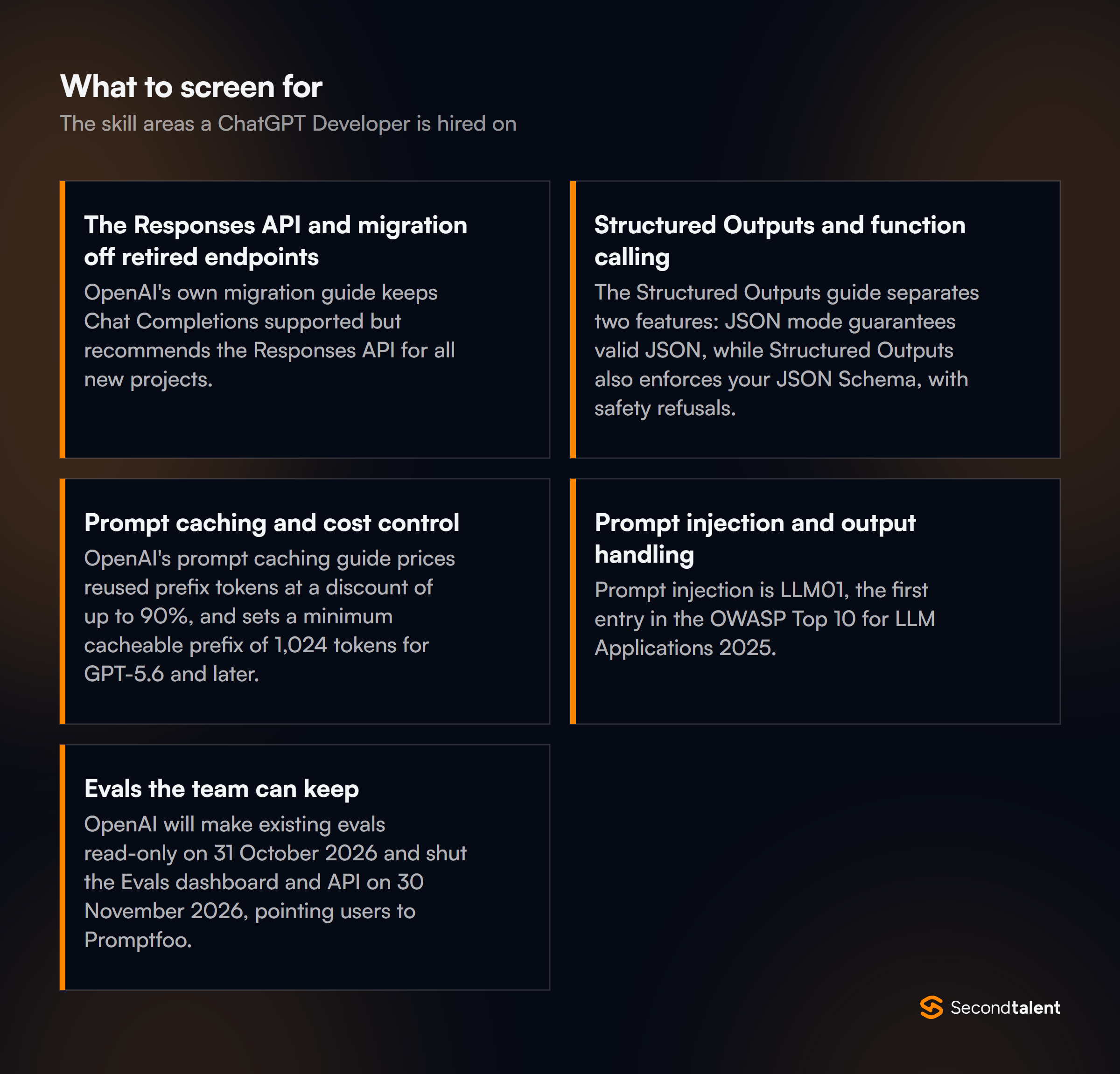
OpenAI GPT models top Stack Overflow's 2025 LLM usage list, at 81.9% among professional developers, so a CV that lists them tells you little. Test the five areas below against work the candidate has shipped.
The Responses API and migration off retired endpoints
OpenAI's own migration guide keeps Chat Completions supported but recommends the Responses API for all new projects. Its reported gains include 40% to 80% better cache utilization than Chat Completions in internal tests. Ask the candidate to explain how they moved an Assistants integration, what happened to stored threads, and how they tested the switch.
Structured Outputs and function calling
The Structured Outputs guide separates two features: JSON mode guarantees valid JSON, while Structured Outputs also enforces your JSON Schema, with safety refusals returned as a field your code can detect. A strong candidate reaches for a strict schema whenever the output feeds another system, and handles the refusal branch in code.
Prompt caching and cost control
OpenAI's prompt caching guide prices reused prefix tokens at a discount of up to 90%, and sets a minimum cacheable prefix of 1,024 tokens for GPT-5.6 and later. Ask how the candidate ordered a prompt so the stable part comes first, and which usage fields they tracked to prove the cache hit rate.
Prompt injection and output handling
Prompt injection is LLM01, the first entry in the OWASP Top 10 for LLM Applications 2025. Indirect injection arrives through websites or files the model reads, the exact path a retrieval feature opens to any document in its index. Give the candidate a document with hidden instructions and ask what their pipeline does with it. The OWASP guidance calls for deterministic code that checks output formats, and a good answer includes it.
Evals the team can keep
OpenAI will make existing evals read-only on 31 October 2026 and shut the Evals dashboard and API on 30 November 2026, pointing users to Promptfoo. Ask where the candidate's regression suite lives, whether it runs in CI, and what it caught last. An eval set tied to one vendor dashboard is a migration waiting to happen.
Contractor or Employer of Record for a US Company
Software is not one of the nine categories of commissioned work that can be "work made for hire" under 17 U.S.C. § 101. Prompts, eval sets and integration code a contractor writes for you stay theirs until transferred, and a transfer must be in writing and signed under § 204(a).
IRS Publication 515 says the place where someone performs the services determines the source of the income, wherever the parties signed the contract and wherever the payer sits. A foreign individual gives the payer Form W-8BEN to certify foreign status.
The engineer's country applies its own test. Philippine courts use the four-fold test, and in Atok Big Wedge v. Gison the Supreme Court called the power to control the employee's conduct the most important factor. Under Article 13 of Vietnam's 2019 Labor Code, an agreement under another name that covers a paid job, wages and management or supervision counts as a labor contract.
|
Independent contractor |
Employer of Record |
| Legal employer |
None; the developer invoices you |
The EOR's local entity |
| US paperwork |
Form W-8BEN from the developer |
Service agreement with the EOR |
| IP |
Written assignment signed by the developer |
Assignment terms in the employment contract and EOR agreement |
| Local labor law |
Classification risk if the work looks like employment |
Night premiums, public holidays and leave apply |
| Pay currency |
Agreed in the contract |
In Vietnam, wages in the labor contract are stated in dong (Article 95) |
A scoped build, such as one retrieval feature with a fixed deadline, suits a contractor agreement. A developer who joins your standups and owns the LLM roadmap fits the employment tests above, and our Employer of Record service handles that case. This is a summary, not legal advice.
English Level and Working Norms
LLM work runs on written English twice over: the prompts themselves, and the design notes and eval reports your US team reads. Malaysia and the Philippines rank 24th and 28th of 123 countries and regions on the EF English Proficiency Index 2025.
| Country |
EF EPI 2025 score |
World rank (of 123) |
IT job-function score |
| Malaysia |
581 |
24 |
590 |
| Philippines |
569 |
28 |
581 |
| Vietnam |
500 |
64 |
500 |
| India |
484 |
74 |
487 |
| Indonesia |
471 |
80 |
523 |
Scores come from EF's country pages, for example the Philippines and Indonesia. The global average is 488. Indonesia's IT workers score 52 points above the national figure, so a market score alone can misjudge an engineering hire.
Test English with the documents the job produces. Ask for a system prompt with inline comments and a one-page eval summary during the process.
Plan launches around both calendars. Thanksgiving on 26 November 2026 is a working day in Asia, which gives you coverage while your US team is off. Vietnam's Labor Code grants five paid days for Lunar New Year (Article 112), so keep model migrations out of that week with a Vietnam-based engineer.
ChatGPT Developer Hiring Process
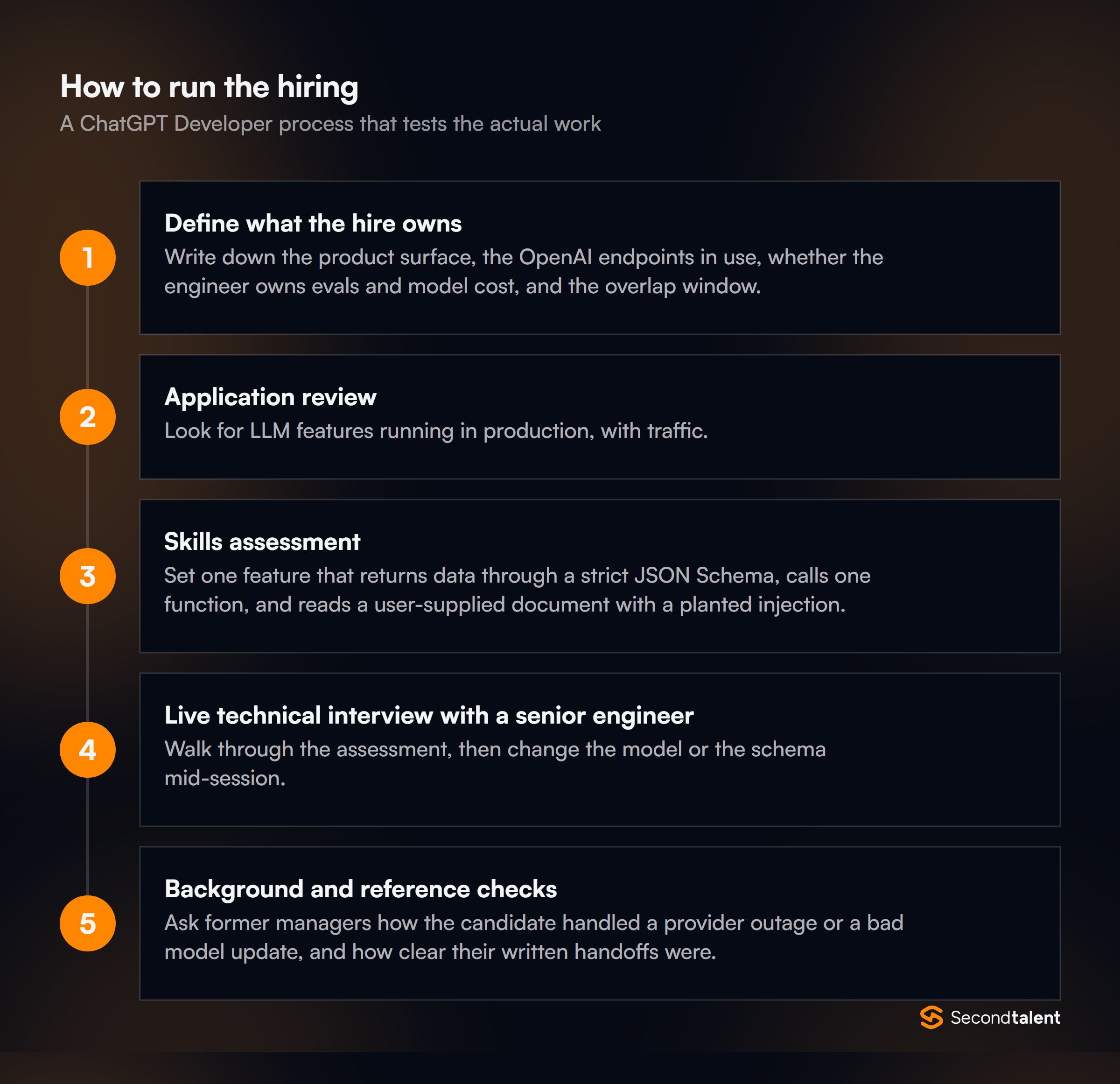
Second Talent's vetting covers stages 2 to 5 before you see a profile. The notes below are the ChatGPT-specific checks to run in your final round.
Stage 1: Define what the hire owns
Write down the product surface, the OpenAI endpoints in use, whether the engineer owns evals and model cost, and the overlap window. A developer adding one summarization feature and a developer running an agent platform need different tests.
Stage 2: Application review
Look for LLM features running in production, with traffic. Ask which endpoints the candidate used, what the monthly API bill was, and whether any of their code sat on an endpoint OpenAI has since retired.
Stage 3: Skills assessment
Set one feature that returns data through a strict JSON Schema, calls one function, and reads a user-supplied document with a planted injection. Score the eval file the candidate hands in alongside the code.
Stage 4: Live technical interview with a senior engineer
Walk through the assessment, then change the model or the schema mid-session. The candidate should show which tests fail and what they would change before shipping.
Stage 5: Background and reference checks
Ask former managers how the candidate handled a provider outage or a bad model update, and how clear their written handoffs were. Then sign a contract with the IP assignment, as a contractor agreement or through an EOR.
Hire ChatGPT Developers from Asia with Second Talent
We shortlist 6-8 candidates within 24 hours from 100,000+ pre-vetted engineers, accepting only the top 1% of applicants. ChatGPT developers cost from $3,000 a month, with $0 upfront, no lock-in and 4-6 hours of daily overlap with US hours. We handle contracts, payroll and equipment, with compliant EOR contracts and payroll in 9 Asian markets.
Our pricing page sets out the monthly subscription, and for agent-heavy roles we also staff AI agent developers and LLM engineers.