TL;DR: Senior Java developers from Asia cost from $2,700 a month through Second Talent, matched in 24 hours. The closest US benchmark, the BLS median for software developers, was $135,980 a year in May 2025.
Oracle's Premier Support for Java SE 17 ends this month, September 2026, per its support roadmap. Oracle plans to offer JDK 21 updates released after that month under the Java SE OTN license. A Java developer you hire now starts with a runtime decision.
Key takeaways
- Open-source support for Spring Boot 3.5 ended on 30 June 2026, and Spring Boot 4.1.1 runs on Java 17 up to Java 26.
- JDK 27, a non-LTS release, has a general availability date of 15 September 2026; Oracle plans the next LTS, Java 29, for September 2027.
- Java was used by 29.6% of professional developers in Stack Overflow's 2025 survey, and Spring Boot by 15.6%.
- Since Java 24, a virtual thread that blocks inside
synchronized code releases its platform thread, so the JDK version changes how a service scales.
What Java Developers Earn Working for International Clients in Asia
India and Taiwan share the lowest floor in the table, $2,200 a month, but India's range stays open above $8,470 while Taiwan's stops at $6,500. The figure is what Java developers in that market earn working directly for foreign companies, before any employer or platform costs.
| Market |
Monthly pay working for international clients (USD) |
| India |
$2,200-$8,470+ |
| Taiwan |
$2,200-$6,500 |
| Philippines |
$2,500-$7,500 |
| Thailand |
$2,870-$6,200+ |
| Malaysia |
$2,950-$6,270+ |
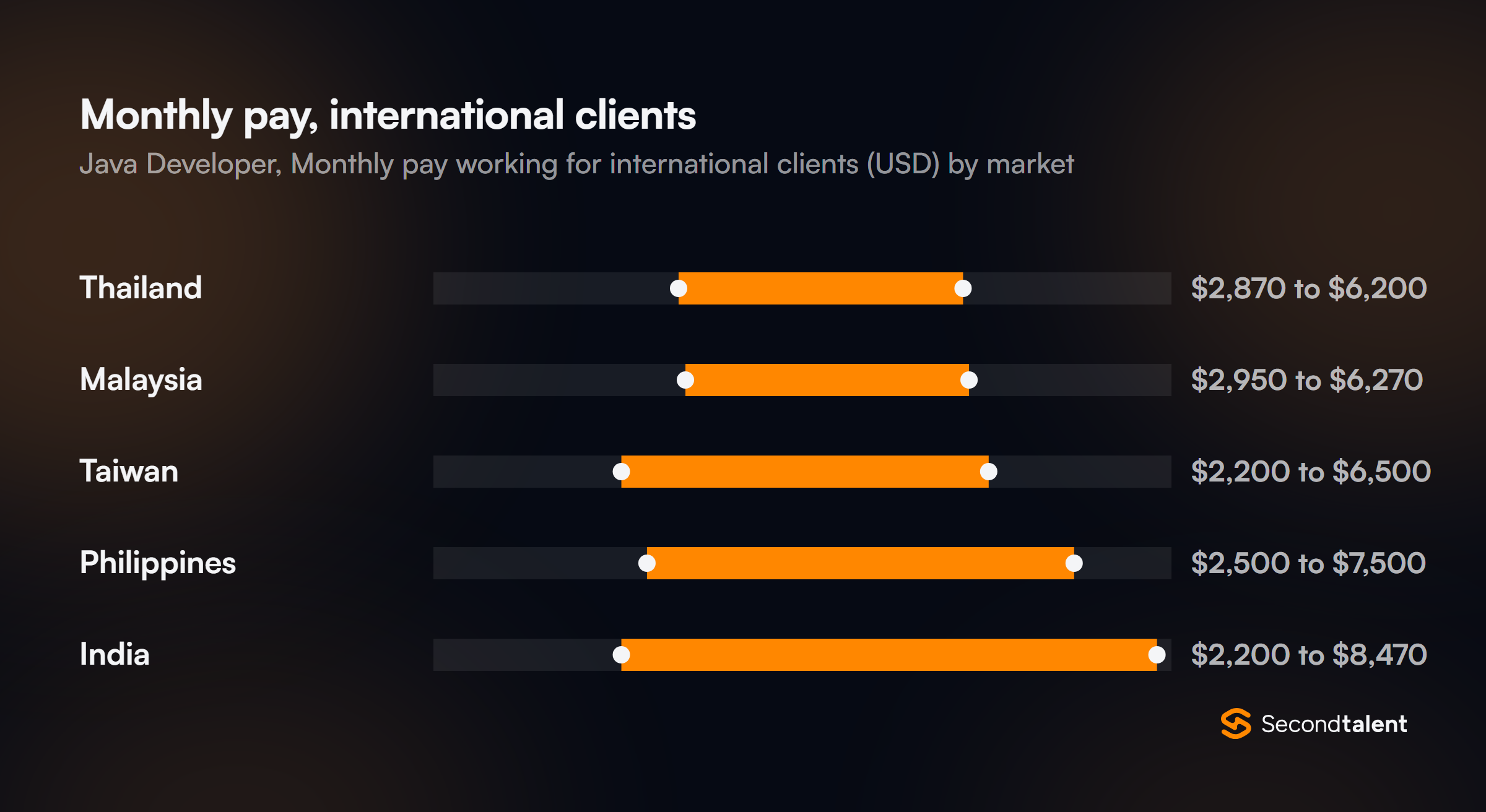
Monthly ranges from the Remote (Working for International Clients) figures on our rate cards for India, Taiwan, the Philippines, Thailand and Malaysia, converted at ExchangeRate-API mid-market rates for 14 September 2026.
The Taiwanese and Philippine cards state this figure in US dollars with a fixed top. The Indian, Thai and Malaysian cards quote rupees, baht and ringgit with an open top.
Through Second Talent, senior Java developers cost from $2,700 a month: one monthly fee that bundles salary, payroll taxes, statutory contributions and our service fee. The pricing page explains the subscription. For one market, see our Philippines Java page or India Java page.
US Pay Benchmark for Java Developers
The fixed top of the Philippine Java card, $7,500 a month, falls between the 10th and 25th percentiles of US software developer pay. BLS has no Java occupation, so the role maps to Software Developers (15-1252), the occupation that designs and builds applications and the systems behind them.
| BLS OEWS, May 2025, national |
Software Developers (15-1252) |
| Median annual |
$135,980 |
| 10th percentile, monthly |
$6,870 |
| 25th percentile, monthly |
$8,770 |
| Median, monthly |
$11,330 |
| 75th percentile, monthly |
$14,330 |
| 90th percentile, monthly |
$17,890 |
Monthly figures are the annual wages on the OEWS profile for 15-1252 divided by 12, rounded to the nearest $10.
Salary is only part of the US cost. In the BLS Employer Costs for Employee Compensation release for June 2026, wages and salaries made up 68.5% of employer compensation costs for full-time private industry workers, and benefits the other 31.5%.
Contract rates sit on a different scale. Our Java developer cost-to-hire page puts a mid-level US freelance or contract Java developer at $85 to $135 an hour, before payroll, insurance and leave.
Time Zone Overlap with ET, CT and PT
Oracle releases Critical Patch Updates on the third Tuesday of January, April, July and October, and its security alerts page lists the next one for 20 October 2026. A developer in Asia can patch and redeploy a JVM fleet during the US night that follows. No city below observes daylight saving time, and US daylight time runs from 8 March to 1 November 2026, per NIST.
| Engineer's city |
UTC offset |
9:00 am ET (EDT) |
9:00 am CT (CDT) |
9:00 am PT (PDT) |
| Manila, Singapore, Kuala Lumpur, Taipei |
UTC+8 |
9:00 pm |
10:00 pm |
12:00 midnight |
| Ho Chi Minh City, Jakarta, Bangkok |
UTC+7 |
8:00 pm |
9:00 pm |
11:00 pm |
| Bengaluru |
UTC+5:30 |
6:30 pm |
7:30 pm |
9:30 pm |
After 1 November 2026, every time in the table moves one hour later.
A worked example: a Bengaluru shift from 1:30 pm to 10:30 pm runs 08:00 to 17:00 UTC. In September that is 4:00 am to 1:00 pm in New York, 3:00 am to 12:00 noon in Chicago and 1:00 am to 10:00 am in San Francisco, so four, three and one hours of a 9-to-5 day.
Put code review, API contract changes and incident handoffs in those hours. Leave the early part of the shift for load tests and dependency upgrades that need no US sign-off.
For employees in the Philippines, the Labor Code adds at least 10% for work between 10 pm and 6 am (Article 86), so a Manila shift that reaches 1:00 am carries three premium hours.
Java Developer Skills to Screen For
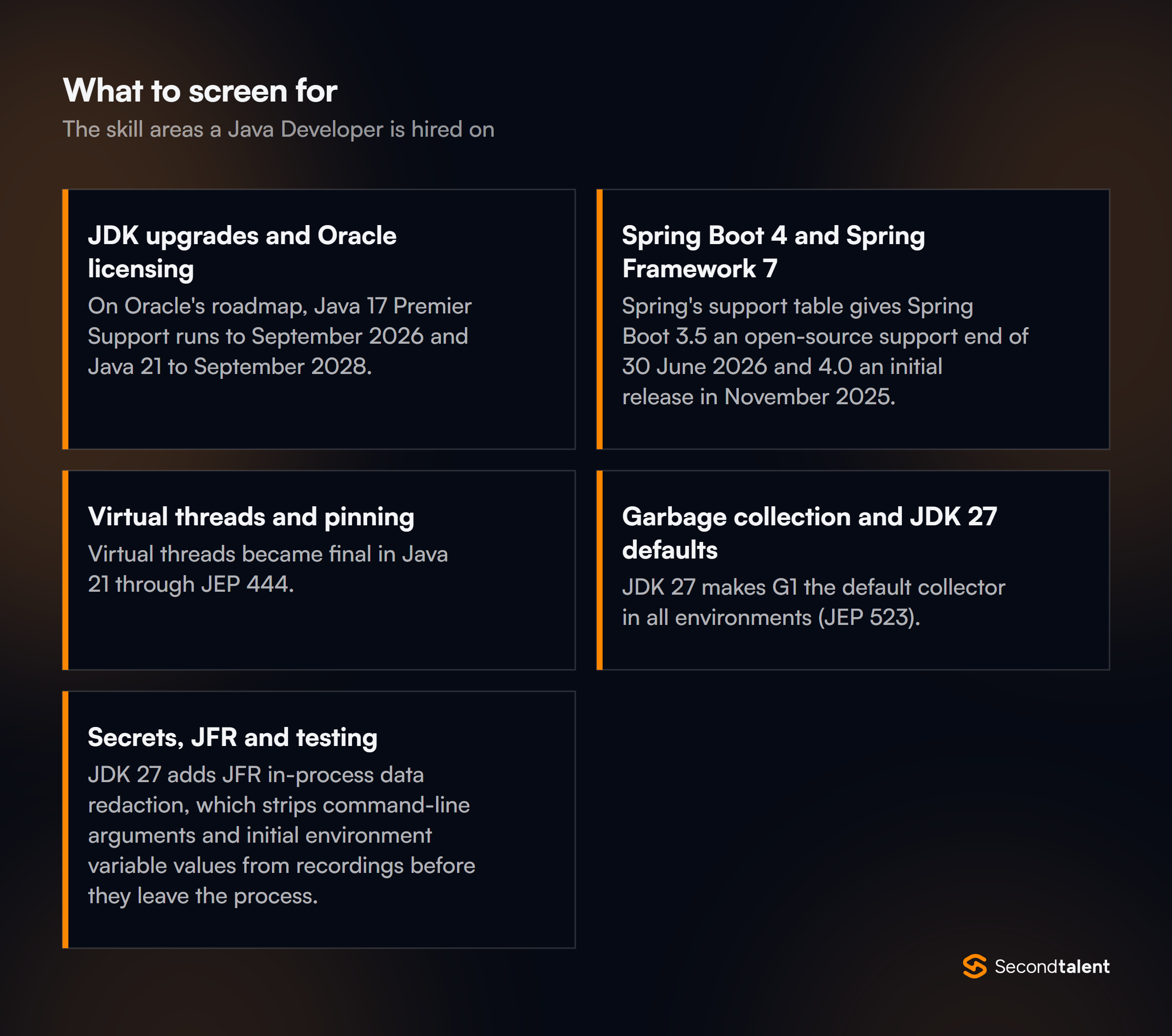
Oracle names Java SE 8, 11, 17, 21 and 25 as LTS releases and intends a new one every two years. The skills that separate candidates now sit in the gap between the JDK they know and the one you will run next.
JDK upgrades and Oracle licensing
On Oracle's roadmap, Java 17 Premier Support runs to September 2026 and Java 21 to September 2028. Oracle JDK 17 updates released from 15 October 2024 already sit under the OTN license, and Oracle points users who want permissive terms to Oracle JDK 25 or later.
Ask which JDK distribution the candidate's last team ran in production, and how they tested a move between LTS versions.
Spring Boot 4 and Spring Framework 7
Spring's support table gives Spring Boot 3.5 an open-source support end of 30 June 2026 and 4.0 an initial release in November 2025. The Spring Boot 4.1.1 system requirements list Spring Framework 7.0.9 or above, Tomcat 11.0 or Jetty 12.1 and Servlet 6.1. Give the candidate a Spring Boot 3.3 service and ask for an upgrade plan with the order of the steps.
Virtual threads and pinning
Virtual threads became final in Java 21 through JEP 444. Until Java 24, a virtual thread blocked inside a synchronized block kept its carrier thread; JEP 491 changed that, so the virtual thread now releases its platform thread. Show the candidate a thread dump from a Java 21 service under load and ask what they would change before and after an upgrade to Java 25.
Garbage collection and JDK 27 defaults
JDK 27 makes G1 the default collector in all environments (JEP 523). Since JDK 9 the JVM had picked the Serial collector in constrained environments with a single CPU or less than 1792 MB of physical memory. The same release turns on compact object headers by default, cutting headers from 96 to 64 bits on 64-bit platforms. Ask the candidate to read a GC log from a pod with a 1 GB memory limit.
Secrets, JFR and testing
JDK 27 adds JFR in-process data redaction, which strips command-line arguments and initial environment variable values from recordings before they leave the process. For payments code, ask how the candidate keeps card data and keys out of logs and heap dumps. Test suites move too: the current JUnit user guide documents JUnit 6.1.3, which requires Java 17 at runtime.
Contractor or Employer of Record for a US Company
Software is not one of the nine categories of commissioned work that can be "work made for hire" under 17 U.S.C. § 101, and a copyright transfer must be in writing and signed under § 204(a). Name the services, database migration scripts, build files and test suites in the assignment.
IRS Publication 515 says the place where services are performed determines the source of the income, so a developer working from Taipei or Bengaluru earns foreign-source income. A foreign individual gives the payer Form W-8BEN to certify foreign status.
Local law applies its own test. Philippine courts use the four-fold test, and in Atok Big Wedge v. Gison the Supreme Court called the power to control the employee's conduct the most important of the four.
A developer who joins your stand-ups, works your hours and holds production database credentials meets that control test. Employees in the Philippines also receive 13th-month pay under PD 851 and Memorandum Order 28, with contributions to SSS (15% shared, credit cap ₱35,000), PhilHealth (5%, cap at ₱100,000) and Pag-IBIG (2% each side, ₱10,000 cap).
|
Independent contractor |
Employer of Record |
| Legal employer |
None; the developer invoices you |
The EOR's local entity |
| US paperwork |
Form W-8BEN from the developer |
Service agreement with the EOR |
| IP |
Written assignment covering services, scripts and tests |
Assignment terms in the employment contract and your EOR agreement |
| Local labor law |
Classification risk if you control hours and methods |
Night premiums, 13th-month pay and leave apply |
| Pay currency |
Agreed in the contract, often USD |
Set in the employment contract and paid through the EOR's local payroll |
A fixed migration, such as moving one service from Spring Boot 3 to 4, fits a contractor agreement. A developer who carries your payments service month after month fits employment, and our Employer of Record service covers that, with country detail on the Philippines EOR page. Our EOR, PEO and contractor comparison sets out the trade-offs. This is a summary, not legal advice.
English Level and Working Norms
Malaysian IT workers score 590 on the EF English Proficiency Index 2025, the highest IT score in the table, while Thai IT workers score 459. The index covers 123 countries and regions, with a global average of 488.
| Country |
EF EPI 2025 score |
World rank (of 123) |
IT job-function score |
| Malaysia |
581 |
24 |
590 |
| Philippines |
569 |
28 |
581 |
| India |
484 |
74 |
487 |
| Thailand |
402 |
116 |
459 |
Scores come from EF's country pages, such as Malaysia, India and Thailand. EF EPI 2025 has no page for Taiwan, so the table leaves Taiwan out.
Java teams in banking and insurance run on written design documents, API contracts and change requests. Ask finalists to write a one-page proposal for splitting a module out of a monolith, including the rollback step.
Plan releases around both calendars. Thanksgiving, 26 November 2026, is a working day in Asia, so a developer there can hold a change freeze or watch a batch run while your US team is off. Agree the local public holidays in writing before the start date.
Java Developer Hiring Process
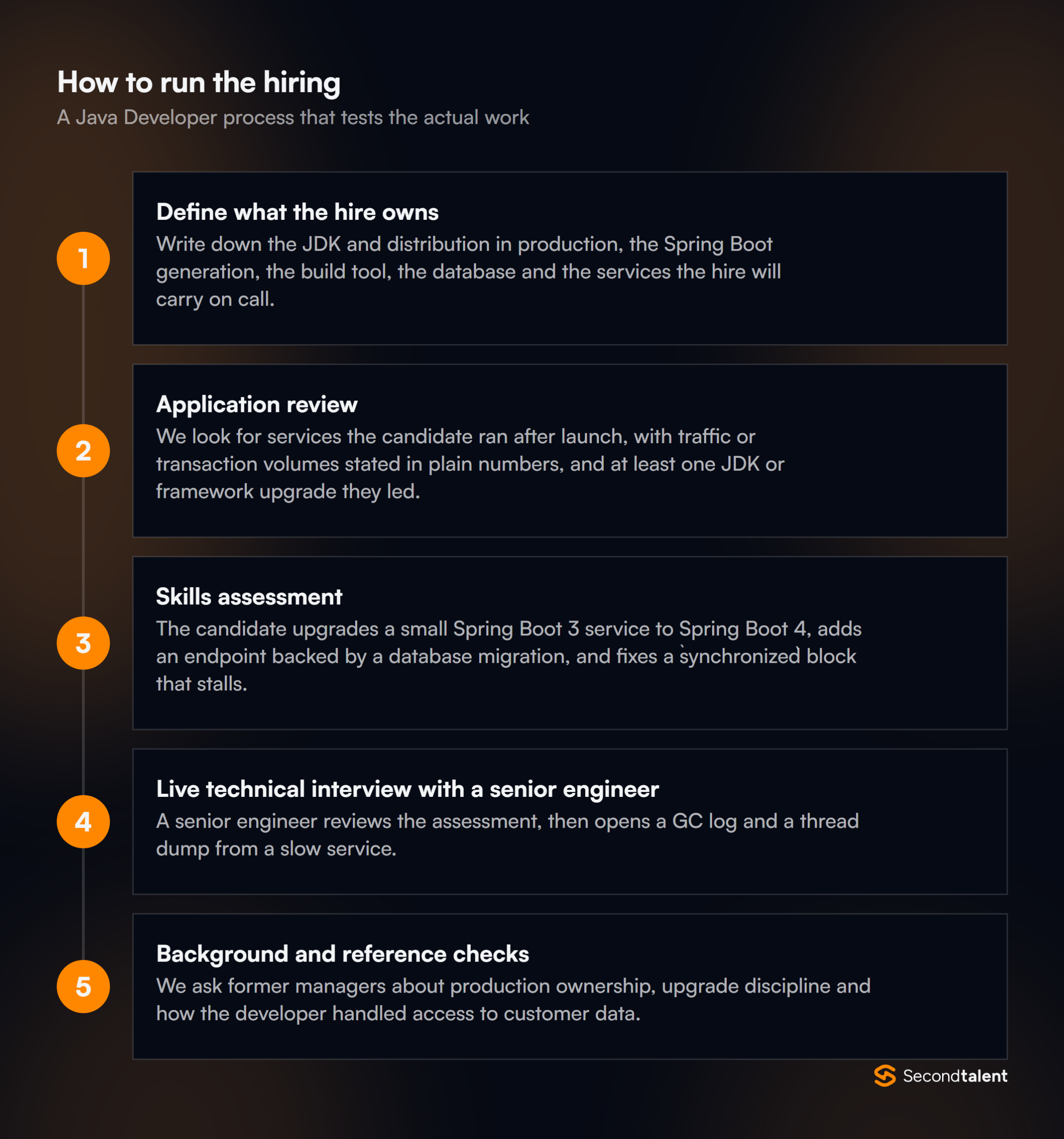
Second Talent's vetting covers stages 2 to 5 before you see a profile. Our Spring Boot interview questions and Java coding challenges add material for your final round.
Stage 1: Define what the hire owns
Write down the JDK and distribution in production, the Spring Boot generation, the build tool, the database and the services the hire will carry on call. A Java 8 monolith and a Java 25 microservice estate need different developers.
Stage 2: Application review
We look for services the candidate ran after launch, with traffic or transaction volumes stated in plain numbers, and at least one JDK or framework upgrade they led.
Stage 3: Skills assessment
The candidate upgrades a small Spring Boot 3 service to Spring Boot 4, adds an endpoint backed by a database migration, and fixes a synchronized block that stalls under virtual threads. We score the pull request description with the code.
Stage 4: Live technical interview with a senior engineer
A senior engineer reviews the assessment, then opens a GC log and a thread dump from a slow service. The questions cover transaction boundaries, connection pool sizing and how the candidate would roll back a failed release.
Stage 5: Background and reference checks
We ask former managers about production ownership, upgrade discipline and how the developer handled access to customer data. You then sign the IP assignment, as a contractor or through an EOR.
Hire Java Developers from Asia with Second Talent
We shortlist 6-8 candidates within 24 hours from 100,000+ pre-vetted engineers, accepting only the top 1% of applicants. Java developers cost from $2,700 a month, with $0 upfront, no lock-in and 4-6 hours of daily overlap with US hours. We handle contracts, payroll and equipment, with compliant EOR contracts and payroll in 9 Asian markets.
Our pricing page covers subscription, direct-hire and EOR pricing, and for broader server-side roles we also staff back-end developers.