TL;DR: LangChain developers from Asia earn $2,390 to $10,210+ a month working for international clients on our AI engineer rate cards, and we shortlist 6-8 candidates within 24 hours. The closest US benchmark, the BLS median for software developers, was $135,980 a year in May 2025.
LangChain's version 1 moved legacy chains, retrievers, indexes and the hub module out of langchain and into langchain-classic, as the v1 migration guide lists. Code a candidate wrote in 2023 or 2024 may no longer import from the main package. Ask which side of that line their production app runs on.
Key takeaways
- A critical langchain-core flaw, CVE-2025-68664, scored 9.3 out of 10 and could turn a prompt-injected response field into a revived LangChain object during deserialization.
- Among Stack Overflow respondents who build AI agents, 32.9% had used LangChain in the past year, second only to Ollama.
- LangChain's model call limit middleware defaults to no limit, so a runaway agent keeps billing until someone sets one.
- A 5:00 pm to 2:00 am shift in Kuala Lumpur covers five hours of a 9-to-5 New York day while US daylight time lasts.
What LangChain Developers Earn Working for International Clients in Asia
Our rate cards carry no LangChain title, so the table uses our AI engineer rate cards, the closest match for engineers who build retrieval and agent features on top of model APIs.
The Philippine ceiling of $4,790+ sits $250 above the Indonesian floor. The figure is what developers in each market earn working directly for foreign companies, before any employer or platform costs.
| Market |
Monthly pay working for international clients (USD) |
| Philippines |
$2,390-$4,790+ |
| India |
$2,610-$10,150+ |
| Malaysia |
$3,690-$7,370+ |
| Vietnam |
$3,870-$7,730+ |
| Indonesia |
$4,540-$10,210+ |
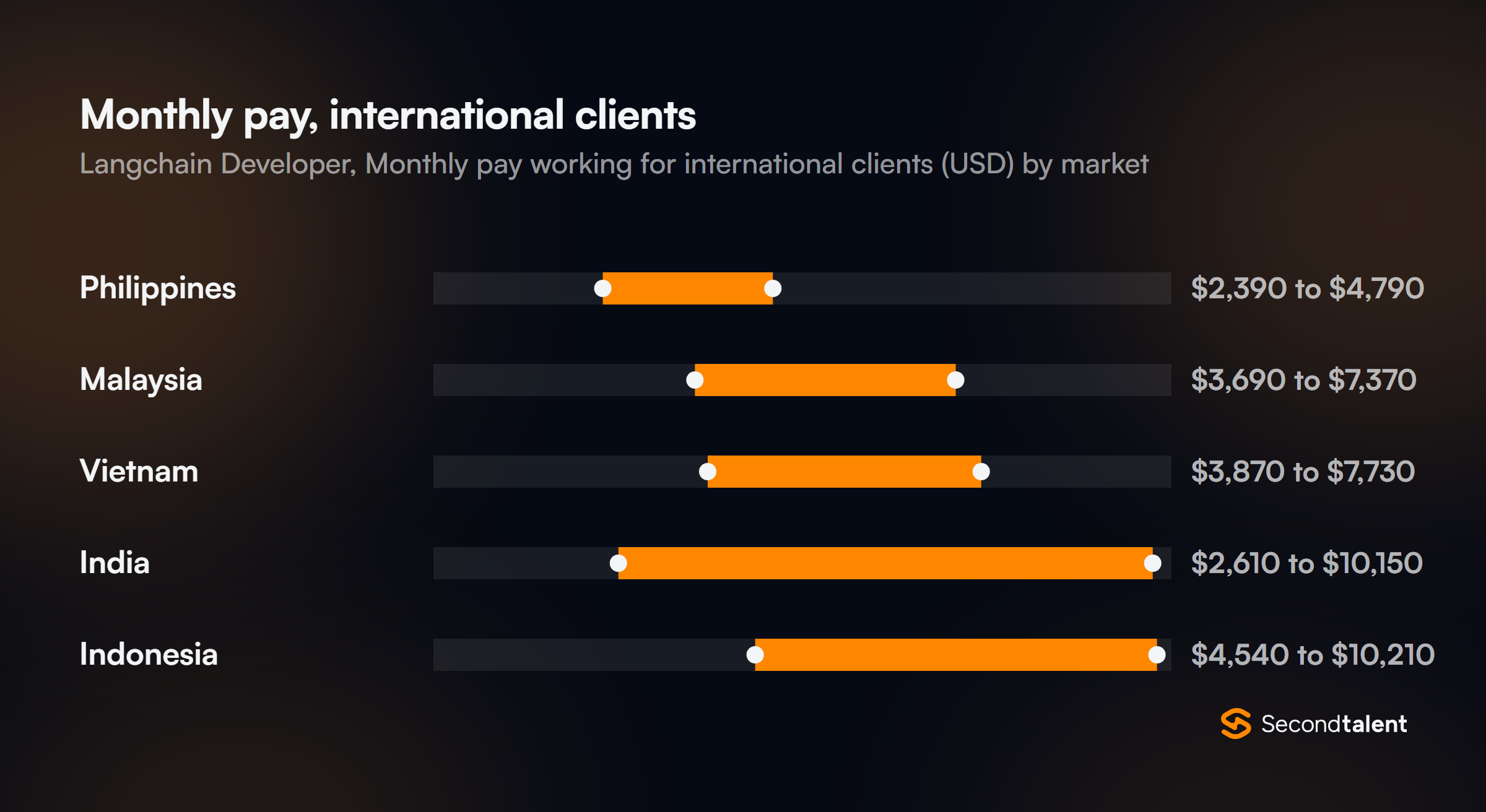
Monthly ranges from the Remote (Working for International Clients) figures on our rate cards for the Philippines, India, Malaysia, Vietnam and Indonesia, converted at ExchangeRate-API mid-market rates for 14 September 2026.
India and Indonesia both top out above $10,000 a month, and all five ranges are open at the top. Budget for the retrieval stack as well: embedding a document corpus, hosting a vector store and tracing each run are running costs that sit outside the salary.
For contract work, our LangChain developer cost-to-hire page puts a mid-level US freelance or contract LangChain developer at $119 to $185 an hour. Our pricing page explains how a Second Talent subscription bills a full-time hire.
US Pay Benchmark for LangChain Developers
BLS publishes no framework-level occupation. The role maps to Software Developers (SOC 15-1252), because a LangChain developer designs, writes and maintains application code in which model calls, retrievers and tools are components.
| BLS OEWS, May 2025, national |
Software Developers (15-1252) |
| Median annual |
$135,980 |
| 10th percentile, monthly |
$6,870 |
| 25th percentile, monthly |
$8,770 |
| Median, monthly |
$11,330 |
| 75th percentile, monthly |
$14,330 |
| 90th percentile, monthly |
$17,890 |
Monthly figures are the annual wages on the OEWS profile for 15-1252 divided by 12, rounded to the nearest $10.
Salary is only part of the US cost. In the BLS Employer Costs for Employee Compensation release for June 2026, wages and salaries made up 68.5% of employer compensation costs for full-time private industry workers, and benefits the other 31.5%.
Time Zone Overlap with ET, CT and PT
Re-embedding a large corpus can take hours, and a LangChain team in Asia can run it while your US office sleeps. US daylight time runs from 8 March to 1 November 2026, per NIST, and none of the cities below change their clocks.
| Engineer's city |
UTC offset |
9:00 am ET (EDT) |
9:00 am CT (CDT) |
9:00 am PT (PDT) |
| Manila, Singapore, Kuala Lumpur, Taipei |
UTC+8 |
9:00 pm |
10:00 pm |
12:00 midnight |
| Ho Chi Minh City, Jakarta, Bangkok |
UTC+7 |
8:00 pm |
9:00 pm |
11:00 pm |
| Bengaluru |
UTC+5:30 |
6:30 pm |
7:30 pm |
9:30 pm |
After 1 November 2026, every time in the table moves one hour later.
A Kuala Lumpur shift from 5:00 pm to 2:00 am runs 09:00 to 18:00 UTC. Subtract four hours for EDT and it covers 5:00 am to 2:00 pm in New York: five hours of a 9-to-5 day there, four with Chicago and two with San Francisco.
Put the shared hours on retrieval reviews: the queries your users complained about, the chunks that came back and the answer the model wrote from them. Index rebuilds and evaluation runs go in the hours after your team logs off.
We agree the schedule before the offer, which is how our placements get 4-6 hours of daily overlap with US hours.
Late shifts cost more for employees in two markets: at least 10% extra for work between 10 pm and 6 am in the Philippines (Labor Code Article 86), and at least 30% for work between 22:00 and 06:00 in Vietnam (Labor Code Articles 98 and 106).
LangChain Developer Skills to Screen For
Redis led the memory and data tools that agent builders reported in Stack Overflow's 2025 AI survey, at 42.9%. Dedicated vector stores trailed it: ChromaDB at 19.7%, pgvector at 17.9% and Pinecone at 11.2%. Test the five areas below against the store you run.
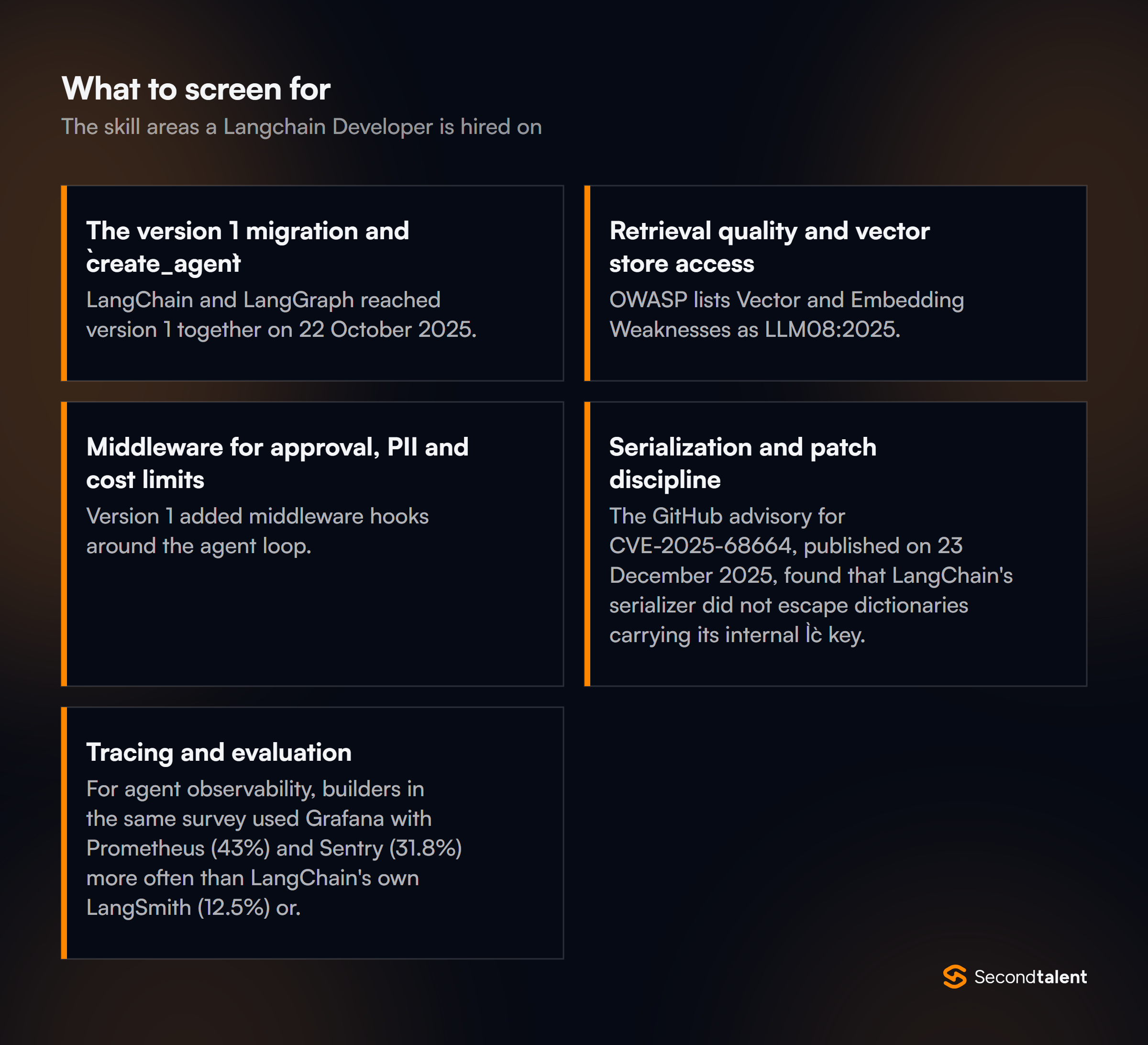
The version 1 migration and create_agent
LangChain and LangGraph reached version 1 together on 22 October 2025. The release announcement made create_agent the standard way to build an agent and deprecated the older create_react_agent helper. The new release requires Python 3.10 or later. Hand the candidate a file that imports LLMChain and a legacy retriever, and ask for the migrated version with the changed imports explained.
Retrieval quality and vector store access
OWASP lists Vector and Embedding Weaknesses as LLM08:2025. It warns that when several classes of users share one vector database, context can leak between them, and it recommends permission-aware stores with strict partitioning. Ask how the candidate filters retrieval by tenant or role, and how they measured whether a chunking change improved answers or only moved the failures.
Middleware for approval, PII and cost limits
Version 1 added middleware hooks around the agent loop. The built-in middleware covers human approval of tool calls, PII detection and summarization near context limits. Its model call limit exists to stop runaway agents, and both thread_limit and run_limit default to no limit. Ask which limits the candidate set on their last agent and what the app did when it hit one.
Serialization and patch discipline
The GitHub advisory for CVE-2025-68664, published on 23 December 2025, found that LangChain's serializer did not escape dictionaries carrying its internal lc key. The advisory names model response fields, which prompt injection can control, as the most common attack path, and older defaults let a crafted payload read environment variable secrets.
The fix shipped in langchain-core 1.2.5 and 0.3.81 and turned secret loading off by default. Ask how the candidate hears about advisories for their dependencies, and how many days their last patch took to reach production.
Tracing and evaluation
For agent observability, builders in the same survey used Grafana with Prometheus (43%) and Sentry (31.8%) more often than LangChain's own LangSmith (12.5%) or Langfuse (8.9%). Ask the candidate to open the trace of a bad answer, point to the retrieval step that went wrong, and name the evaluation that would catch it next time.
For multi-step, stateful agents, our LangGraph developers track tests the lower-level runtime.
Contractor or Employer of Record for a US Company
Software is not one of the nine categories of commissioned work that can be "work made for hire" under 17 U.S.C. § 101, and a copyright transfer must be in writing and signed under § 204(a). Name the chains, prompts, retrieval pipelines, evaluation datasets and ingestion code in the assignment.
IRS Publication 515 says the place where someone performs the services determines the source of the income, so a developer working from Kuala Lumpur or Manila earns foreign-source income. A foreign individual gives the payer Form W-8BEN to certify foreign status.
Local law then applies its own test. Philippine courts use the four-fold test, and in Atok Big Wedge v. Gison the Supreme Court called the power to control the employee's conduct the most important of the four. Article 13 of Vietnam's 2019 Labor Code treats an agreement under another name as a labor contract when it covers a paid job, wages and one party's management or supervision.
|
Independent contractor |
Employer of Record |
| Legal employer |
None; the developer invoices you |
The EOR's local entity |
| US paperwork |
Form W-8BEN from the developer |
Service agreement with the EOR |
| IP |
Written assignment covering code, prompts, pipelines and eval sets |
Assignment in the employment contract and your EOR agreement |
| Local labor law |
Classification risk if you control hours and methods |
Night premiums, public holidays and leave apply |
| Pay currency |
Agreed in the contract, often USD |
Vietnam's Labor Code states wages in dong (Article 95) |
A fixed-scope build, such as one retrieval prototype with an end date, suits a contractor agreement. A developer who maintains your production RAG service on your hours, with access to customer documents, fits the employment tests above.
Our Employer of Record service employs that developer in-country, with market detail on the Malaysia EOR page. This is a summary, not legal advice.
English Level and Working Norms
Your reviewers judge retrieval work in English: the eval question, the retrieved passage and the answer they mark wrong. Malaysia scores 590 in the IT job function on the EF English Proficiency Index 2025, the highest in the table, which ranks 123 countries and regions against a global average of 488.
| Country |
EF EPI 2025 score |
World rank (of 123) |
IT job-function score |
| Malaysia |
581 |
24 |
590 |
| Philippines |
569 |
28 |
581 |
| Vietnam |
500 |
64 |
500 |
| India |
484 |
74 |
487 |
| Indonesia |
471 |
80 |
523 |
Scores come from EF's country pages, such as Malaysia and Indonesia. Indonesia's IT score of 523 runs well above its national 471, so test the individual rather than the country average. Give finalists ten eval questions with model answers and ask for a written note on which answers they would fail and why.
Holidays affect release timing. Thanksgiving on 26 November 2026 is a working day in Asia, so an engineer there can run a re-index while your US team is off. Vietnam's Labor Code gives five paid days for Lunar New Year (Article 112), so freeze retrieval changes that week if your developer works there.
LangChain Developer Hiring Process
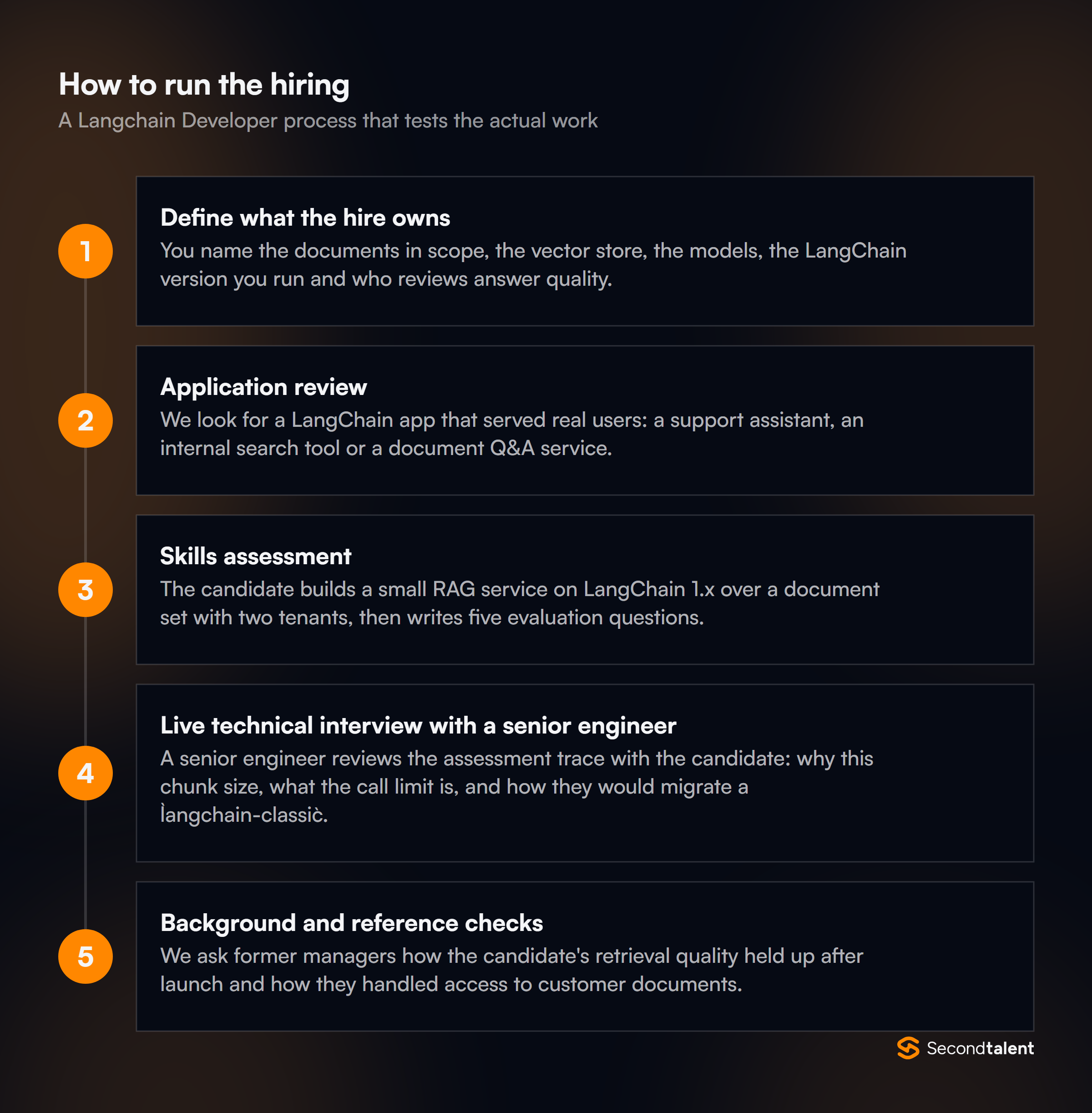
Second Talent's vetting covers stages 2 to 5 before you see a profile.
Stage 1: Define what the hire owns
You name the documents in scope, the vector store, the models, the LangChain version you run and who reviews answer quality. Say whether the hire builds agents with tools or retrieval only.
Stage 2: Application review
We look for a LangChain app that served real users: a support assistant, an internal search tool or a document Q&A service. We ask for its corpus size and how the candidate measured answer quality. A tutorial notebook does not pass.
Stage 3: Skills assessment
The candidate builds a small RAG service on LangChain 1.x over a document set with two tenants, then writes five evaluation questions. We plant a document with an injected instruction and check whether one tenant can retrieve the other's files.
Stage 4: Live technical interview with a senior engineer
A senior engineer reviews the assessment trace with the candidate: why this chunk size, what the call limit is, and how they would migrate a langchain-classic import. The last question: how would they have found out that CVE-2025-68664 affected their service?
Stage 5: Background and reference checks
We ask former managers how the candidate's retrieval quality held up after launch and how they handled access to customer documents. You then choose the contractor or EOR route above.
Hire LangChain Developers from Asia with Second Talent
We shortlist 6-8 candidates within 24 hours from 100,000+ pre-vetted engineers, accepting only the top 1% of applicants. LangChain developers come with $0 upfront, no lock-in and 4-6 hours of daily overlap with US hours. We handle contracts, payroll and equipment, with compliant EOR contracts and payroll in 9 Asian markets.
Our pricing page covers the subscription, and for agents that act on external systems we also staff AI agent developers.