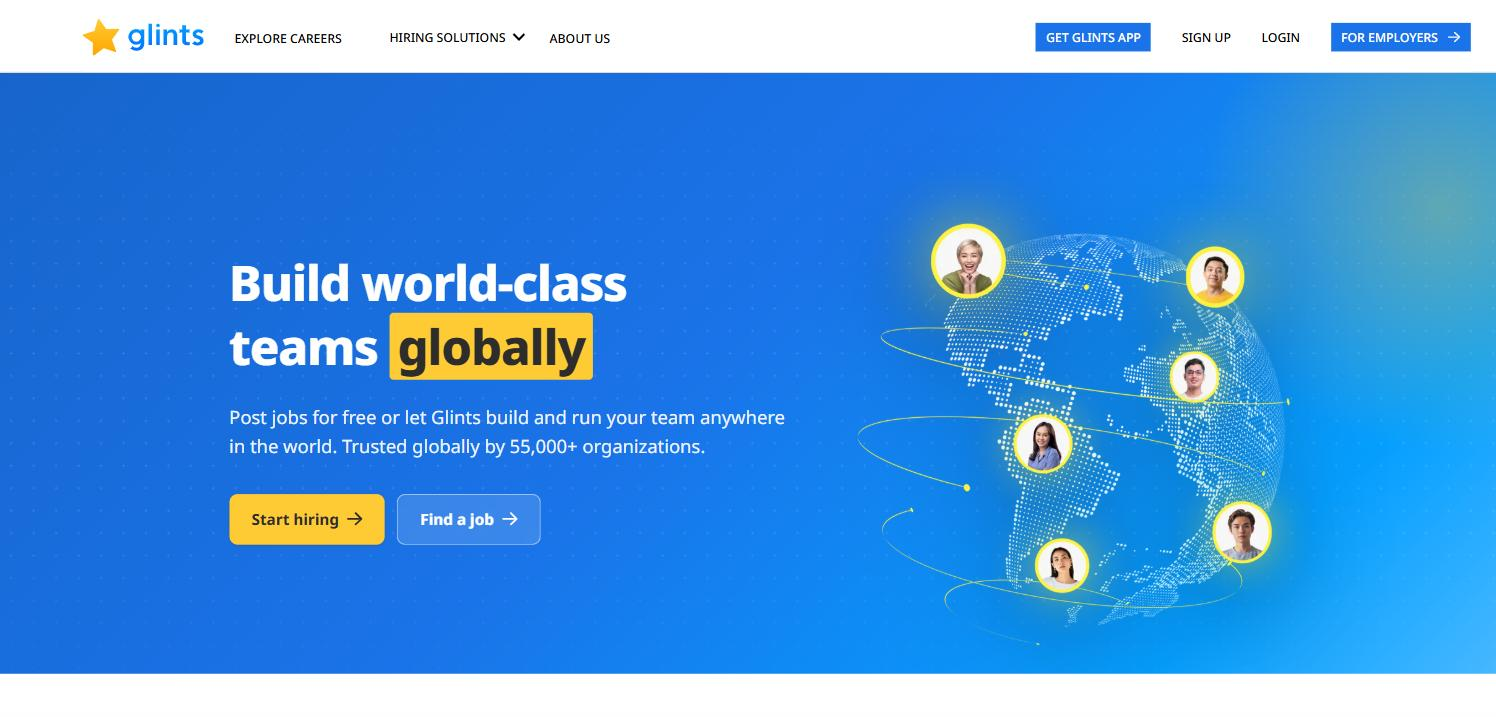
Glints is the most established tech-and-graduate hiring platform in Southeast Asia: Singapore-based since 2013, operating in Indonesia, Vietnam, the Philippines, Malaysia, Singapore, Thailand and Taiwan, with a talent database it puts past 10 million and more than 55,000 organisations using it by its own count. Its TalentHub arm bundles recruitment, Employer of Record and local HR support, with EOR-only quoted around $299 per employee per month, roughly half what global providers charge for the same markets. The friction is the one every large pool carries: reach is not screening. Employers report doing the filtering themselves, and the pool skews to graduate and mid-level rather than senior engineering. This guide covers the 7 best Glints alternatives for hiring in Asia in 2026.
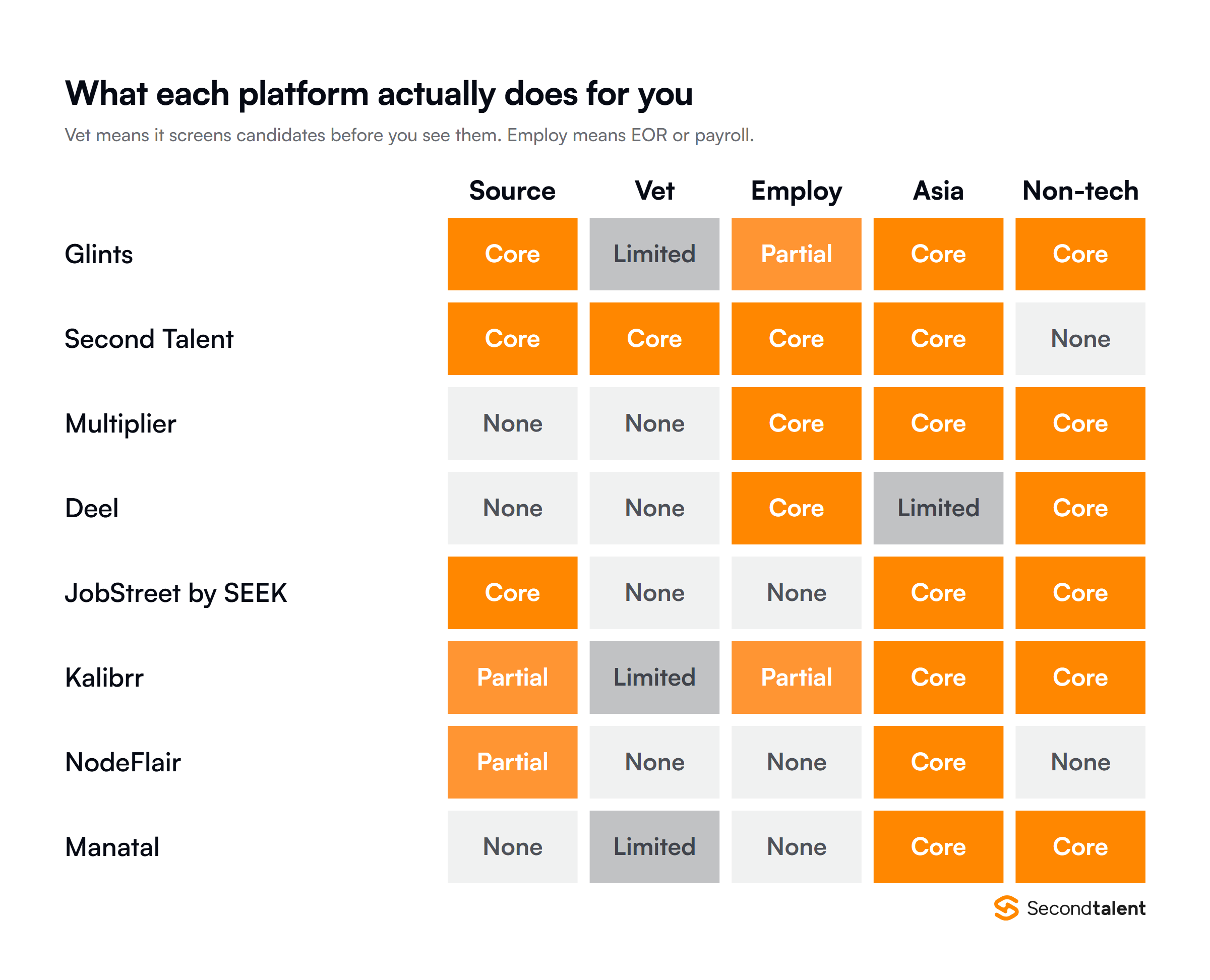
| Platform | Best For | Pricing Model | Key Difference from Glints |
|---|---|---|---|
| Second Talent | Dedicated senior engineers from Asia, with EOR included. | $3,000–$6,000/mo flat per engineer. $0 upfront. | Vetting and employment done for you, on a bench you can also search yourself. |
| Multiplier | Employing people you have already found, across Asia. | From ~$400/employee/mo; ~$549 Singapore. | Deeper owned-entity coverage and volume discounts, but no talent pool. |
| Deel | Multi-continent hiring under one HR platform. | EOR from ~$599/employee/mo. | 150+ countries and a full HRIS, against seven Southeast Asian markets. |
| JobStreet by SEEK | High-volume, non-technical hiring across SEA. | Per-posting and package pricing. | Larger reach and stronger brand recall outside tech, with no EOR. |
| Kalibrr | Depth in the Philippines and Indonesia. | Posting packages plus ATS tiers. | Two markets covered properly rather than seven covered broadly. |
| NodeFlair | Senior tech hiring and salary benchmarking. | Employer packages, quoted. | An engineering audience and verified pay data, with no non-tech roles. |
| Manatal | Owning your pipeline with in-house recruiters. | Per-user monthly subscription. | Recruitment software rather than a marketplace, so you source the candidates. |
1. Second Talent

Glints gives you a very large pool and leaves the assessment to you. That is fine for volume roles and expensive for engineering ones, because every unscreened CV costs a hiring manager an hour. Second Talent inverts it: four stages of human vetting happen before you see anyone, you get a shortlist in 24 hours, and the engineer joins full-time at a flat monthly rate with employment, payroll, tax and offboarding handled through a managed Employer of Record. Senior engineers run $3,000 to $6,000 a month all-in, with $0 upfront and a 30-day replacement guarantee with unlimited replacements. The trade is narrower scope: this is AI-native engineering talent first, with a limited non-technical bench in design, sales development and operations, not the full commercial spread Glints covers. You can search that bench yourself in the platform or hand the brief to a recruiter.
✅ Pros vs. Glints
- Vetting Done Before You See Anyone: Four human stages including a work sample, against a searchable database you screen yourself.
- Flat Monthly Rate: $3,000 to $6,000 per engineer per month, with no separate recruitment fee.
- EOR Included: Employment, payroll and compliance across nine markets, bundled rather than a separate $299 line.
- 24-Hour Shortlist: Six to eight profiles, all of which have already passed a work sample.
- AI-Native by Default: Engineers who build with Claude Code, Cursor and Copilot every day, with AI-tool fluency assessed during vetting rather than assumed from a CV.
- Self-Serve or Managed: Search and shortlist the vetted bench yourself in the Second Talent platform, or brief a recruiter and get a matched shortlist in 24 hours.
❌ Cons vs. Glints
- Engineering-First: Limited non-technical coverage, in design, sales development and operations, not the full commercial spread that makes up much of the Glints pool.
- Curated, Not Open: You search a vetted bench in our platform, where Glints opens a much larger unscreened database.
- Full-Time Model: Built for dedicated hires, not short freelance engagements.
Best For
- Teams hiring engineers where a bad hire costs more than the fee saved.
- Companies with no entity in Asia that want employment handled end to end.
- Founders who would rather interview four good candidates than sift forty.
Key Features
- Pre-vetted engineers across Vietnam, the Philippines, Indonesia and India.
- Owned-entity EOR across nine Asian markets.
- Work-sample screening before shortlist, with a 30-day replacement guarantee.
- Published rate benchmarks in the developer rate card.
- 92% talent retention across placements, with 200+ companies hiring through the platform.
Pricing Structure
$3,000 to $6,000 per engineer per month, flat. $0 upfront, pay only when you hire.
2. Multiplier
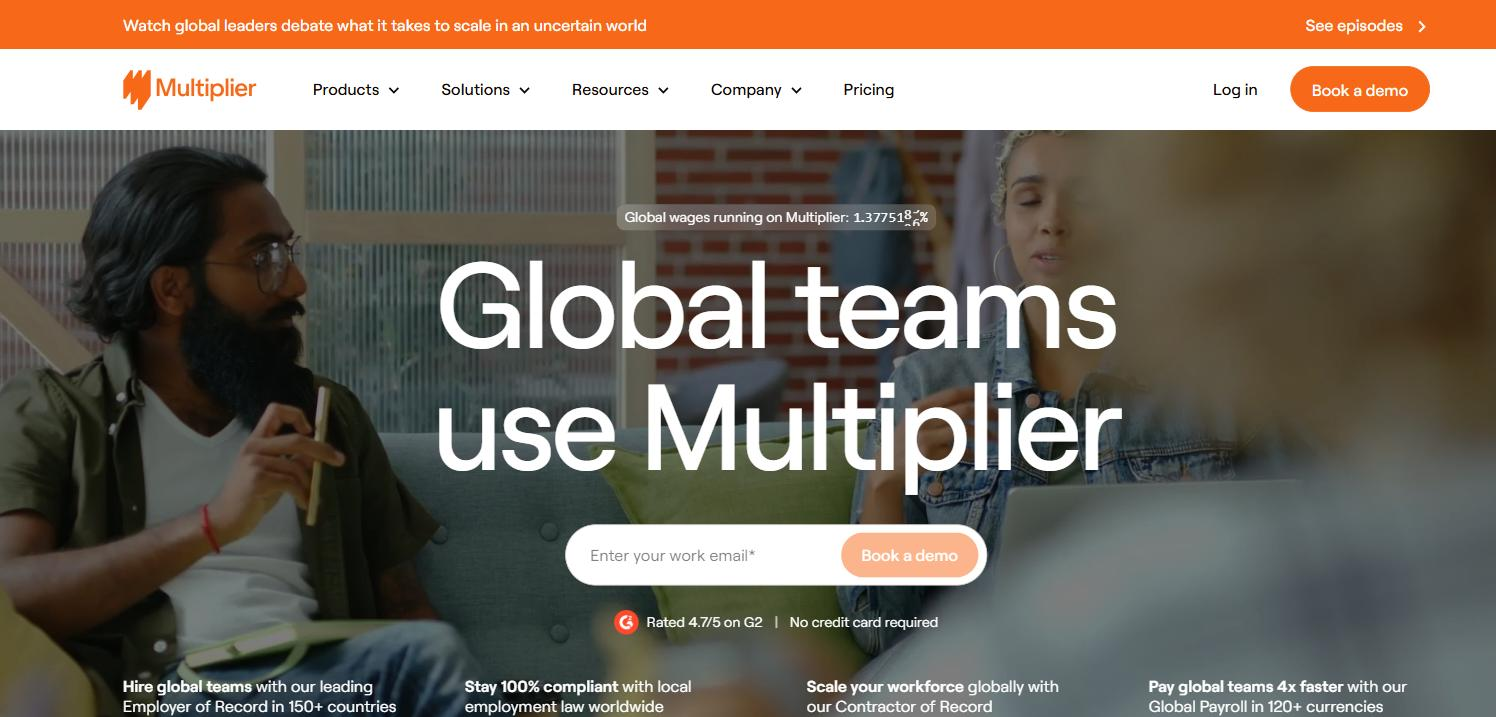
If what you actually want from Glints is TalentHub rather than the job board, Multiplier is the closest like-for-like. It is Singapore-headquartered with owned entities across India, the Philippines and Australia, so support runs in your timezone rather than a US one. EOR pricing starts around $400 per employee per month and drops to roughly $250 to $300 at 50+ employees, with Singapore at the higher end near $549. What it does not give you is candidates: Multiplier employs the person you found, it does not find them.
✅ Pros vs. Glints
- Deeper Asia Entity Coverage: Owned entities across India, Singapore, the Philippines and Australia.
- Volume Pricing: Rates fall to roughly $250 to $300 per employee at 50+ headcount.
- Same-Timezone Support: Singapore HQ rather than a US or European support desk.
- Broader Than Southeast Asia: Global coverage if you later hire outside the region.
❌ Cons vs. Glints
- No Talent Pool: Sourcing stays entirely your problem, where Glints at least gives you candidates.
- Higher Entry Price: From about $400 per employee per month against the $299 Glints quotes for EOR-only.
- Employment, Not Recruitment: Two vendors instead of one if you need both.
Best For
- Teams that already know who they want to hire and need someone to employ them.
- Companies scaling past 50 employees where volume discounts start to matter.
- Anyone expanding beyond Southeast Asia into India or Australia.
Key Features
- EOR and global payroll across 150+ countries.
- Owned entities in the core Asian markets rather than partner arrangements.
- Contractor management and multi-currency payroll in one platform.
- Benefits administration localised per market.
Pricing Structure
From roughly $400 per employee per month. About $549 in Singapore. Volume rates near $250 to $300 at 50+ employees.
3. Deel
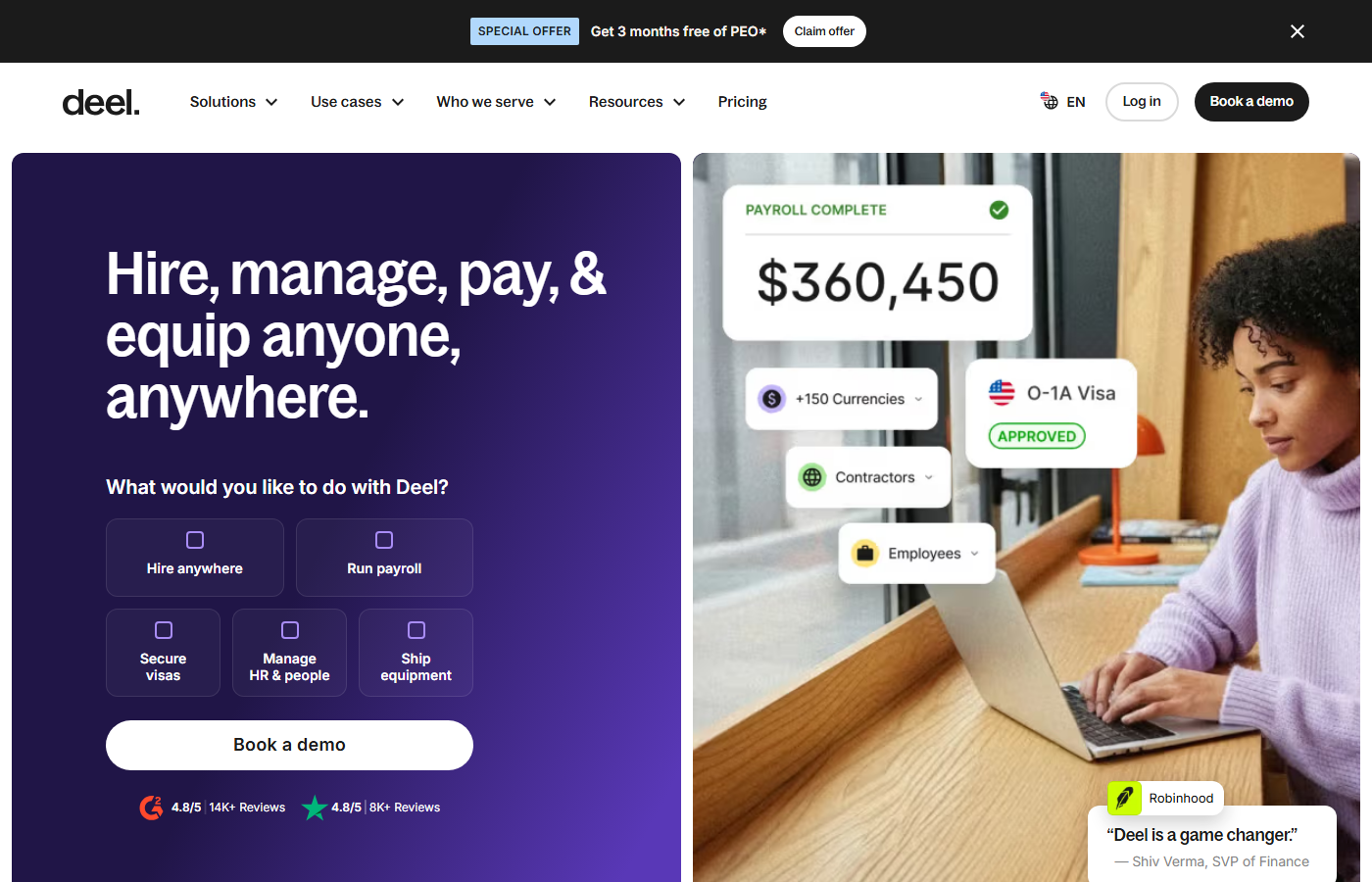
Deel is the option procurement has usually already heard of, which matters more than it should. Coverage runs past 150 countries, the platform bundles an HRIS, contractor management, equipment and visa support, and the integration list is long. Against Glints it is broader and more expensive, and it is emphatically not a recruitment product. For a team hiring across Asia and Europe simultaneously it consolidates a lot of vendors; for a team hiring three people in Jakarta it is more platform than the problem needs. We cover the wider field in our Deel alternatives comparison.
✅ Pros vs. Glints
- Widest Country Coverage: 150+ countries against seven Southeast Asian markets.
- Full HR Stack: HRIS, contractor management, equipment and visas in one system.
- Procurement-Friendly: A recognised brand shortens security and vendor review.
- Strong Integrations: Connects to most existing finance and HR tooling.
❌ Cons vs. Glints
- No Sourcing At All: Deel employs people; finding them is entirely on you.
- More Expensive: Typically around $199 per employee per month above Multiplier on comparable Asian roles.
- Feature Weight: A lot of platform for a team hiring a handful of people in one country.
Best For
- Companies hiring across several continents, not just Southeast Asia.
- Teams that want HRIS, payroll and EOR from one vendor.
- Organisations where vendor recognition speeds up internal approval.
Key Features
- EOR, payroll and contractor management in 150+ countries.
- Built-in HRIS with onboarding and time-off tracking.
- Immigration and visa support for relocations.
- Equipment procurement and retrieval.
Pricing Structure
EOR from around $599 per employee per month, varying by country. Contractor management is billed separately.
4. JobStreet by SEEK
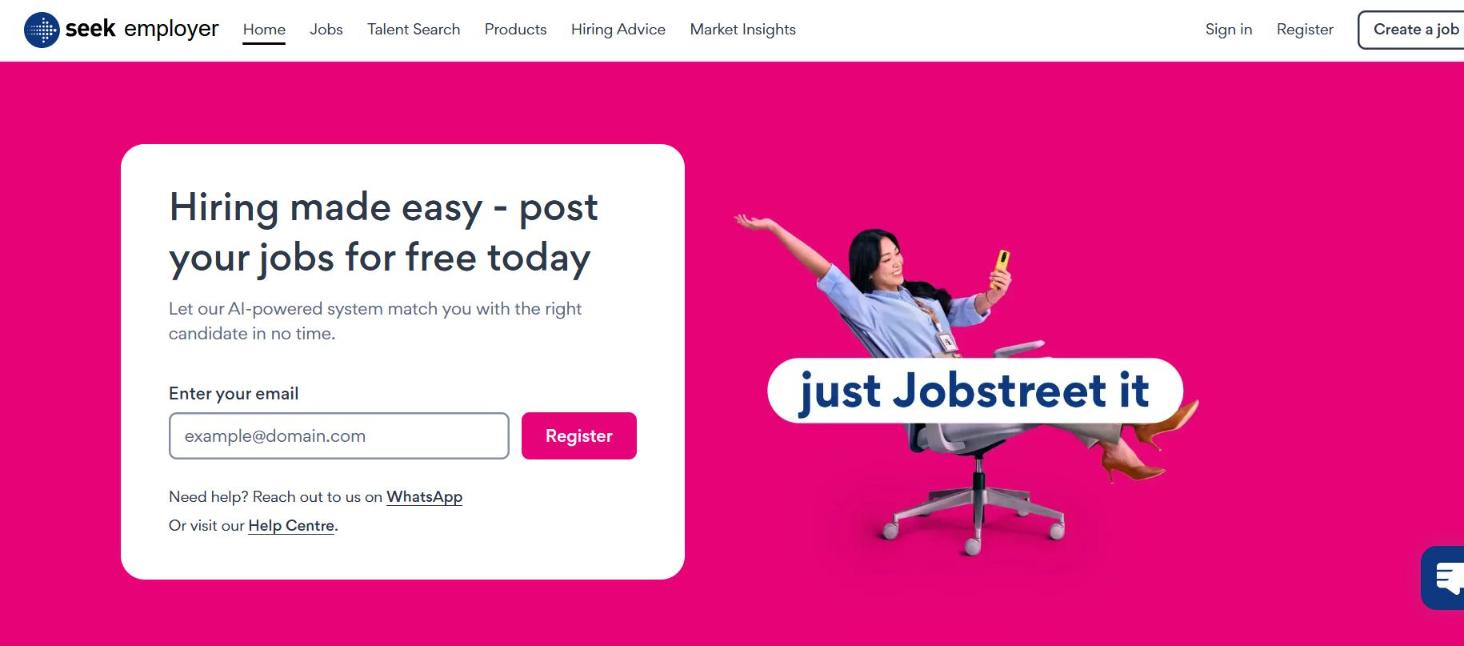
JobStreet is the incumbent Glints was built to disrupt, and in raw reach across Malaysia, Singapore, Indonesia and the Philippines it is still the larger board. Now part of SEEK, it carries the deepest employer brand recognition among candidates outside tech, which is exactly where Glints is thinnest. The trade-off is the one every job board carries: you are buying reach, not screening. Expect volume, expect to do the filtering, and expect a candidate mix skewed towards non-technical and mid-market roles.
✅ Pros vs. Glints
- Larger Candidate Reach: The most recognised job board brand across Malaysia, Singapore and the Philippines.
- Stronger Outside Tech: Better depth in finance, operations, sales and administrative roles.
- SEEK Backing: Regional scale and a mature employer product behind it.
- Pay Per Posting: No platform subscription to justify if you hire twice a year.
❌ Cons vs. Glints
- No EOR: You need your own entity or a separate provider to employ anyone.
- Reach Without Screening: High application volume, all of it unfiltered.
- Weaker for Senior Tech: Not where senior engineers in the region look first.
Best For
- High-volume hiring for non-technical roles across Southeast Asia.
- Companies that already have a local entity and an internal recruiter.
- Employers whose brand recognition does the filtering for them.
Key Features
- Job postings across Malaysia, Singapore, Indonesia and the Philippines.
- Employer branding and company profile pages.
- Candidate database search on higher tiers.
- SEEK-wide talent insight and salary data.
Pricing Structure
Per-posting and package pricing, varying by market. Quoted on request.
5. Kalibrr
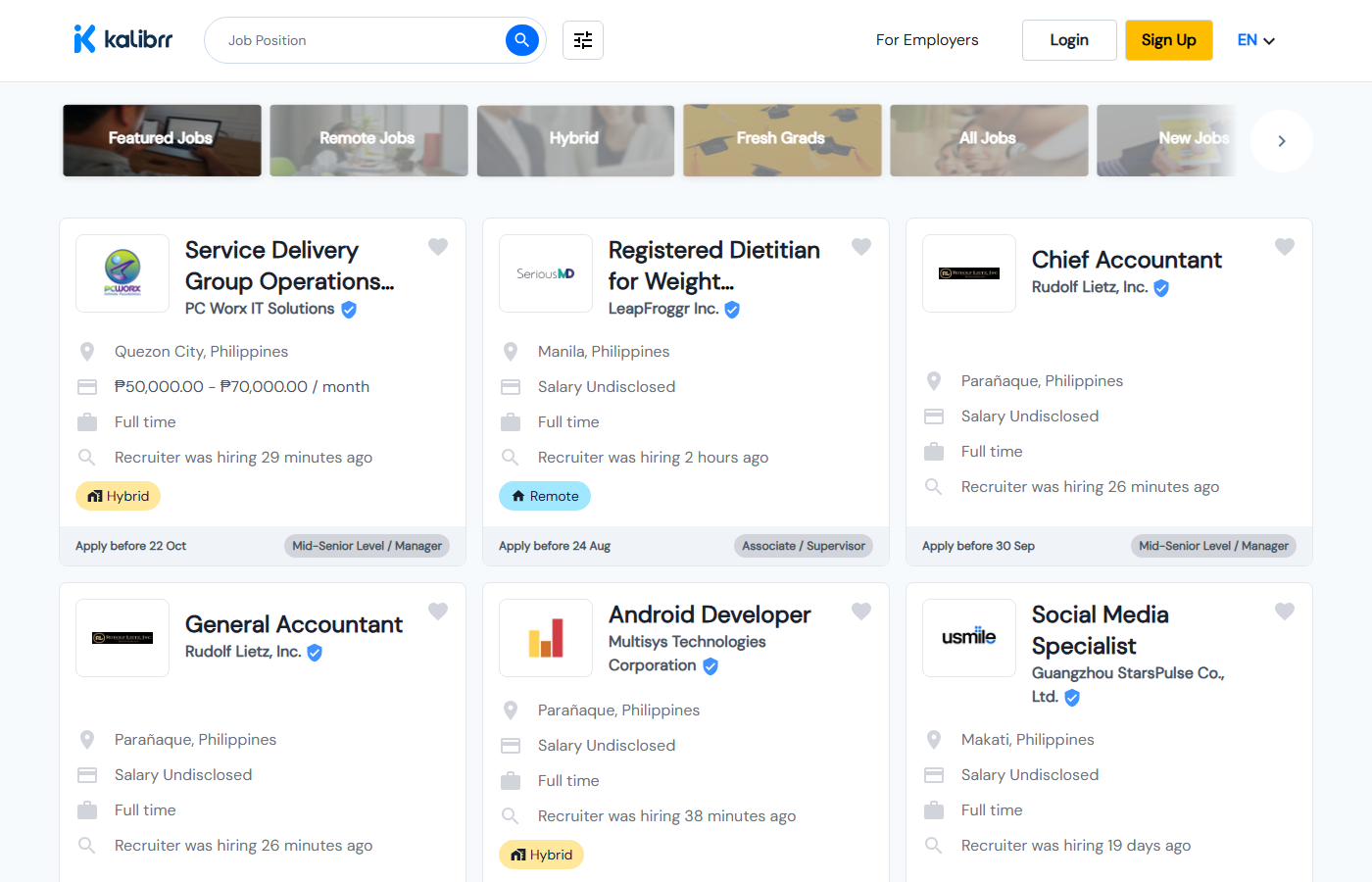
Where Glints spreads across seven markets, Kalibrr goes deep in two. It is Filipino-founded, strongest in the Philippines and Indonesia, and counts San Miguel, Ayala, Aboitiz and PLDT among its clients, which tells you it plays at enterprise scale locally. Around 10,000 companies use it, against a candidate base past six million. It also ships an ATS, employer branding and EOR, so the shape is similar to Glints TalentHub with a narrower footprint and, in the Philippines specifically, a denser pool.
✅ Pros vs. Glints
- Deeper in the Philippines: Local density that a seven-market platform cannot match.
- Enterprise Client Base: San Miguel, Ayala, Aboitiz and PLDT hire through it.
- ATS Included: Applicant tracking built in rather than bolted on.
- AI Job Matching: Matching engine on top of the jobs portal.
❌ Cons vs. Glints
- Two Markets, Not Seven: Little use if you are hiring in Vietnam or Taiwan.
- Still Volume-Led: Screening remains your job.
- Thinner Senior Tech Pool: Strongest in mid-market and graduate hiring.
Best For
- Companies hiring in the Philippines at volume.
- Employers who want an ATS and a candidate pool from one vendor.
- Teams building support, operations or finance functions in Manila or Cebu.
Key Features
- Jobs portal covering the Philippines and Indonesia.
- Applicant tracking system and employer branding pages.
- AI-driven job matching engine.
- Employer of Record services for companies without an entity.
Pricing Structure
Job posting packages plus ATS subscription tiers. EOR quoted separately.
6. NodeFlair
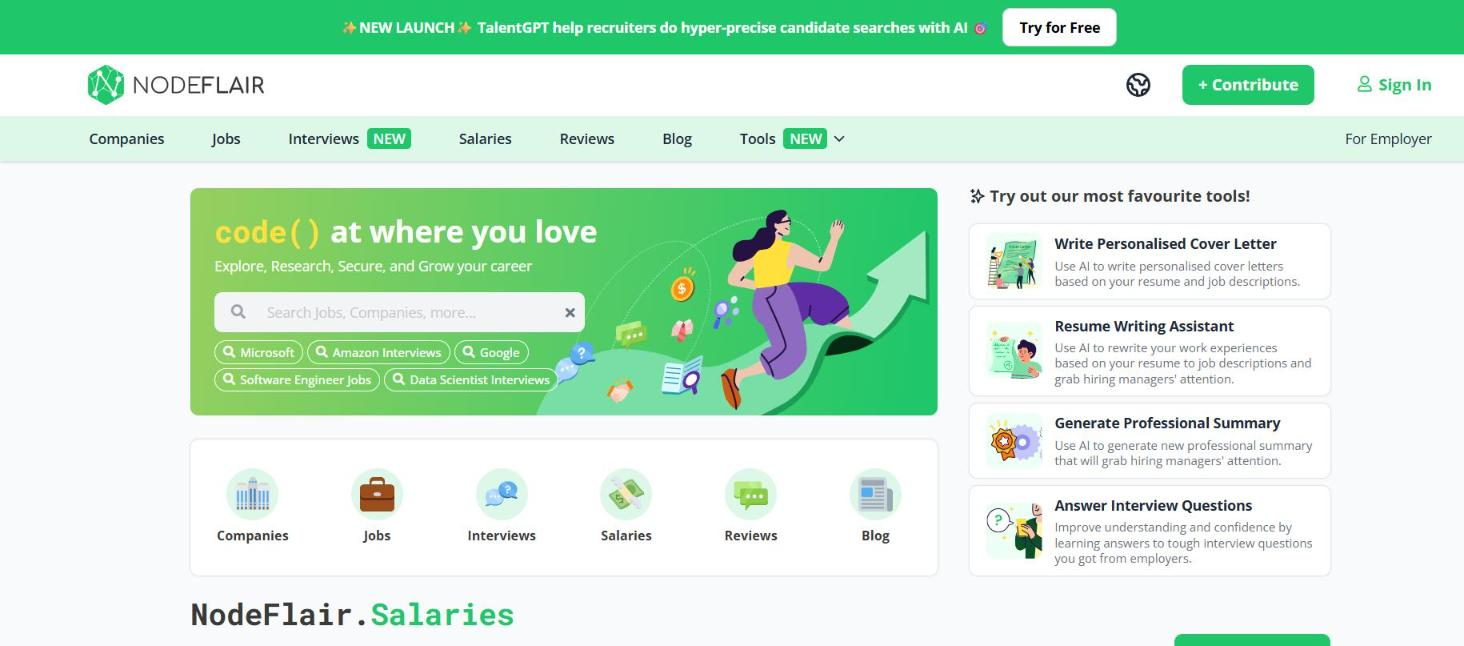
NodeFlair is the narrowest platform here and the most useful if your problem is senior tech specifically. It built its audience on salary transparency, publishing verified compensation data drawn from payslips, and now runs over 500,000 monthly visitors across eight Asian countries. That reputation is why engineers who ignore general job boards use it. The flip side is scope: no EOR, no non-technical roles, and a pool measured in the hundreds of thousands rather than the millions Glints claims.
✅ Pros vs. Glints
- Genuinely Tech-Focused: An engineering audience rather than a general one.
- Verified Salary Data: Compensation benchmarks sourced from payslips, which speeds up offer calibration.
- Regional Reach: Over 500,000 monthly visitors across eight Asian markets.
- Credibility With Engineers: Candidates who would not open a JobStreet alert do open this.
❌ Cons vs. Glints
- No EOR or Payroll: Purely a sourcing channel.
- Smaller Pool: Hundreds of thousands rather than millions.
- Tech Only: No use for the rest of your org chart.
Best For
- Hiring senior engineers in Singapore and the wider region.
- Teams calibrating offers against verified market compensation.
- Employers whose problem is credibility with engineers, not reach.
Key Features
- Tech job listings across eight Asian markets.
- Verified salary data by role, level and company.
- Company culture and benefits transparency pages.
- Employer profiles aimed at an engineering audience.
Pricing Structure
Job posting and employer packages, quoted on request.
7. Manatal
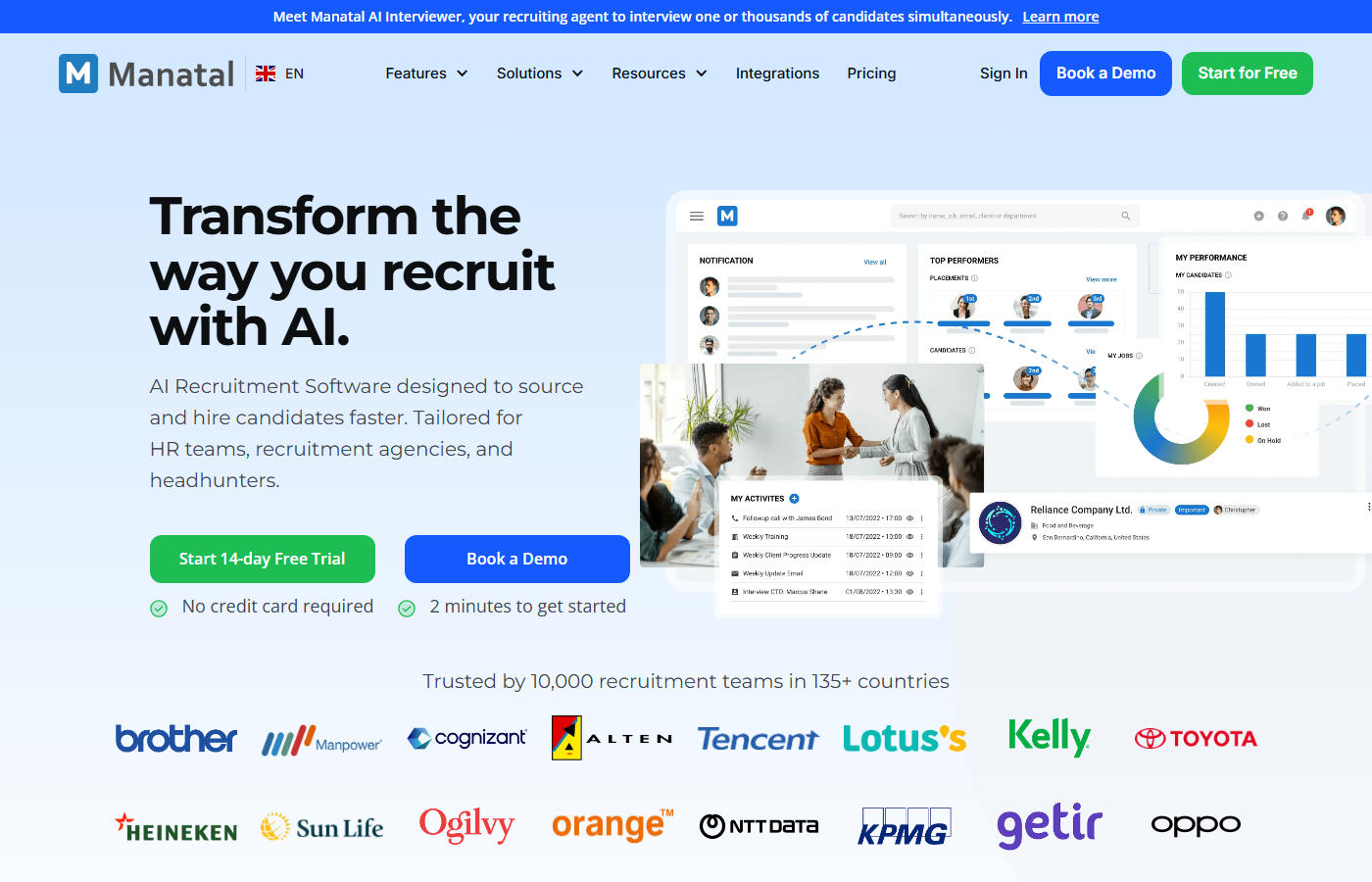
Manatal answers a different question from the rest of this list. It is Bangkok-built recruitment software, so if the reason you are leaving Glints is that you want to own your pipeline rather than rent access to someone else’s pool, this is the category. It gives you an ATS, AI candidate recommendations, social and job-board enrichment, and a career page, at a per-user subscription rather than a per-hire fee. That is materially cheaper at volume and materially more work, because the candidates are the ones you source.
✅ Pros vs. Glints
- You Own the Pipeline: Candidate data stays yours rather than living in a marketplace.
- Per-User Pricing: Subscription rather than per-hire fees, which is cheaper at volume.
- Built in Southeast Asia: Bangkok-headquartered, with the regional context that implies.
- AI Recommendations: Scoring and enrichment on top of your own database.
❌ Cons vs. Glints
- No Candidates Included: Software, not a talent pool. Sourcing is entirely on you.
- Needs a Recruiter: Only pays off if someone owns the process full-time.
- No Employment Layer: No EOR, no payroll.
Best For
- Companies with an in-house recruiter who want to stop paying per hire.
- Teams hiring continuously rather than occasionally.
- Agencies and RPO providers managing multiple client pipelines.
Key Features
- Applicant tracking with a customisable pipeline.
- AI candidate scoring and recommendations.
- Social media and job-board candidate enrichment.
- Branded career pages and reporting.
Pricing Structure
Per-user monthly subscription, tiered by feature set. Free trial available.
How to Choose a Glints Alternative in 2026
The seven platforms above answer three different questions, and picking well starts with knowing which one you are actually asking.
Match the Tool to the Bottleneck
- If your bottleneck is finding people: JobStreet for reach outside tech, Kalibrr for depth in the Philippines, NodeFlair for senior engineers. All three leave screening to you.
- If your bottleneck is employing people: Multiplier for Asia-first entity coverage, Deel if you are hiring across several continents. Neither sources candidates.
- If your bottleneck is hiring-manager time: Second Talent, where vetting happens before the shortlist and employment is included.
- If you want to stop paying per hire: Manatal, provided you have a recruiter to run it.
Do the Full-Time Arithmetic
Job-board pricing looks cheap because it is priced per posting rather than per hire. A $300 job ad that produces 400 unscreened applications and two weeks of a hiring manager’s time is not cheaper than a managed shortlist; it just moves the cost somewhere that does not appear on an invoice. Before you compare prices, work out what an engineering hour costs you and how many of them each option consumes.
The second number that matters is time to productivity. A senior engineer in Vietnam or the Philippines costs 50% to 70% less than an equivalent US hire, but only if the role is filled. Six weeks of an empty seat erases a year of the saving. Current bands are in the developer rate card and the Asia Tech Salary Index.
If you want the shortlist without the sifting, tell us the role and we will come back within 24 hours with engineers who have already passed a work sample. If you have the people and need the employment layer, our EOR service covers nine Asian markets including Vietnam and the Philippines.