TL;DR: Contract, contract-to-hire and direct hire cover most engineering hiring. The same senior engineer can arrive through any of them, so the choice is not about talent quality. It is about how long the need lasts, how costly a wrong hire would be, and what conversion path you want. Agree the conversion trigger and fee before the engagement starts, because negotiating them once you want to keep someone means negotiating from behind.
These three sit underneath the engagement model decision covered in staff augmentation versus managed services versus project work. That choice sets who directs the work. This one sets how long you are committing and what happens at the end.
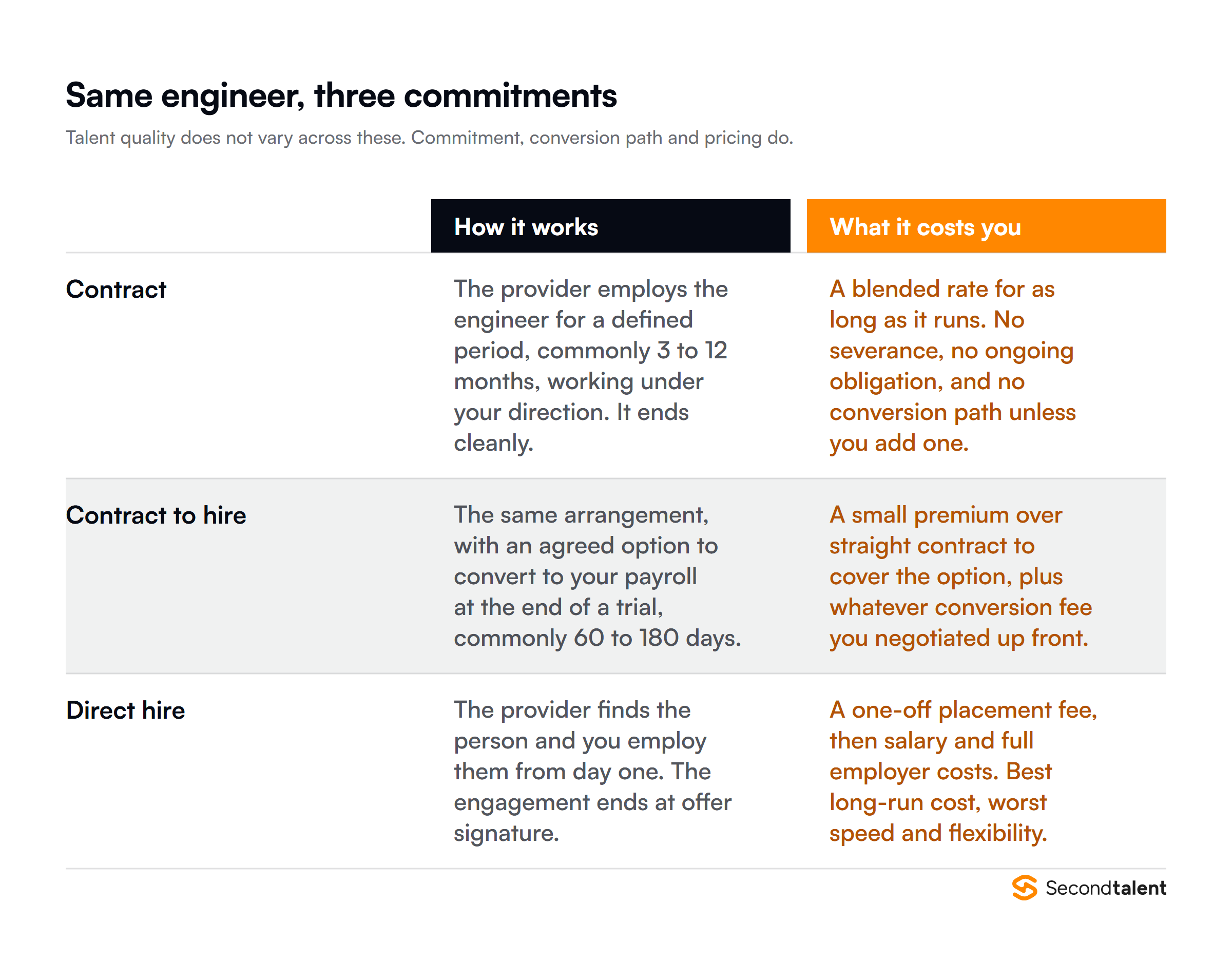
What are the three IT staffing models?
Contract staffing, contract-to-hire and direct hire. They differ on commitment, conversion path and pricing structure.
Contract means the provider employs the engineer for a defined period, commonly three to twelve months, working under your direction. It ends cleanly with no severance and no ongoing obligation.
Contract-to-hire is the same arrangement with an agreed option to convert onto your payroll after a trial, commonly 60 to 180 days.
Direct hire means the provider finds the person and you employ them from day one. The provider’s engagement ends at offer signature and they are paid a one-off fee.
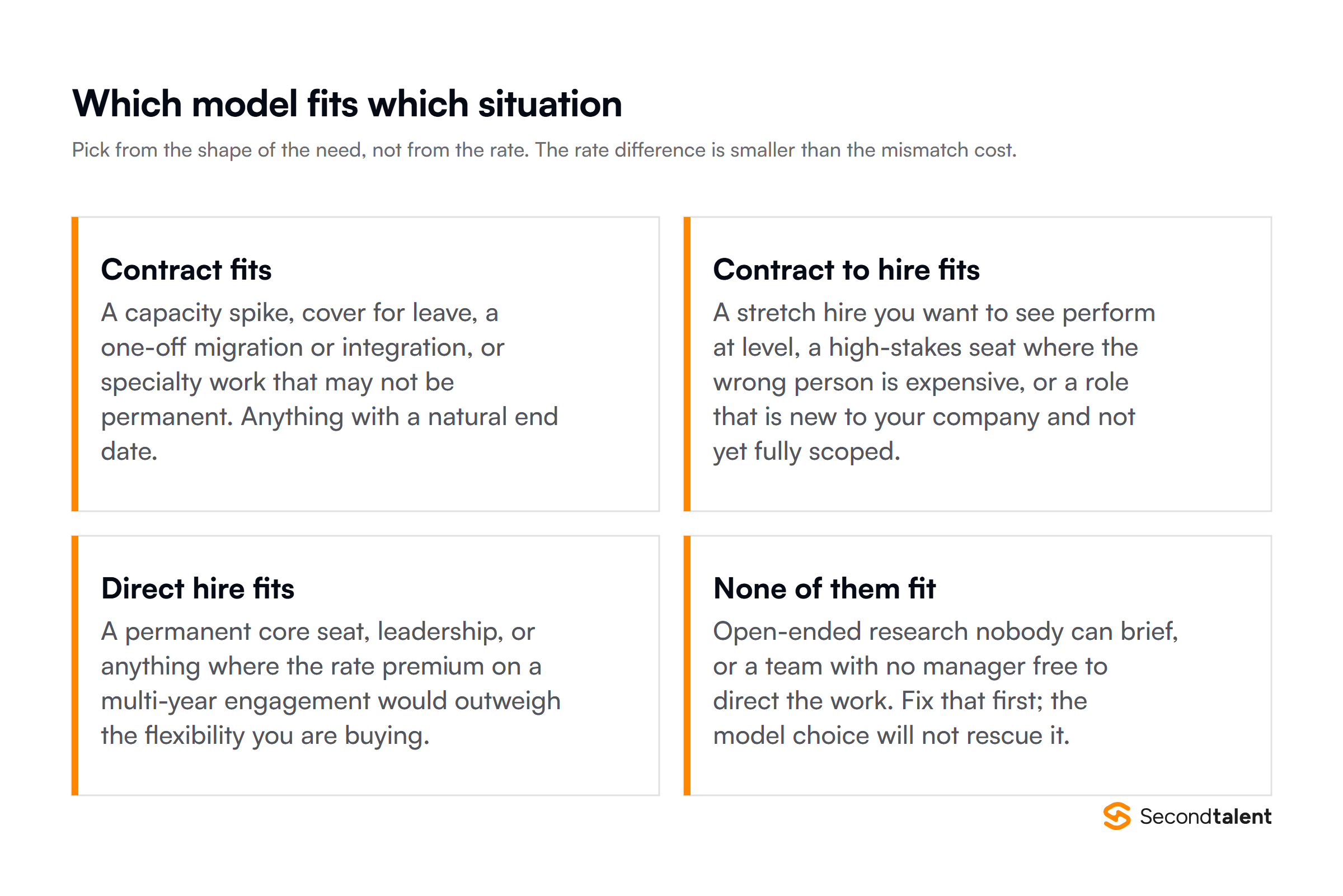
When does each one fit?
Pick from the shape of the need. The rate difference between models is smaller than the cost of getting the shape wrong.
Contract fits anything with a natural end date: a capacity spike, cover for parental leave, a one-off migration, or specialty work that may not be permanent.
Contract-to-hire fits a stretch hire you want to see perform at level, a high-stakes seat where a wrong hire is expensive, or a role new enough to your company that the scope is still moving.
Direct hire fits a permanent core seat or leadership, where a rate premium across several years would outweigh the flexibility you would be buying.
If none of them fit, that usually means the work is open-ended research nobody can brief, or there is no manager free to direct it. Neither problem is solved by picking a model.
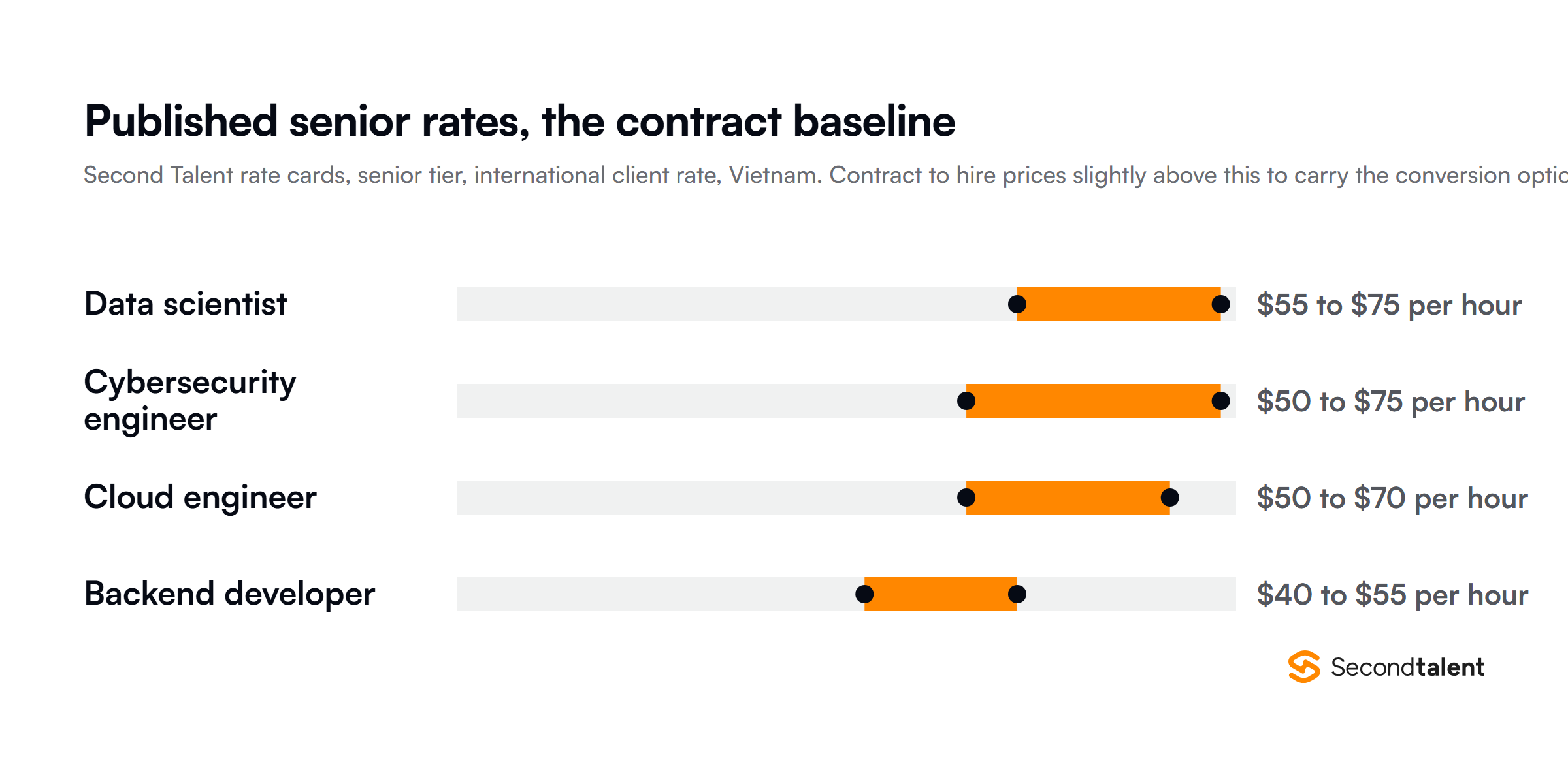
What do the models cost?
Contract sets the baseline. Contract-to-hire prices slightly above it to carry the conversion option. Direct hire trades an upfront fee for the lowest long-run cost per head.
Second Talent publishes senior international client rates in the developer rate cards. In Vietnam, senior backend developers run $40 to $55 per hour, cloud engineers $50 to $70, cybersecurity engineers $50 to $75 and data scientists $55 to $75.
Compare against a local alternative on fully loaded terms rather than rate against salary. The US Bureau of Labor Statistics puts the median wage for software developers at $135,980 in May 2025, which is employee salary before employer taxes and benefits. A provider rate already includes those, so loading the BLS figure before comparing is the step that makes the comparison mean anything.
Watch for a rate compared against a salary. Provider rates and BLS wage medians measure different things, and putting them side by side without loading the salary side inflates the gap considerably. If a vendor shows you a comparison that looks too good, check which of the two numbers has employer costs in it.
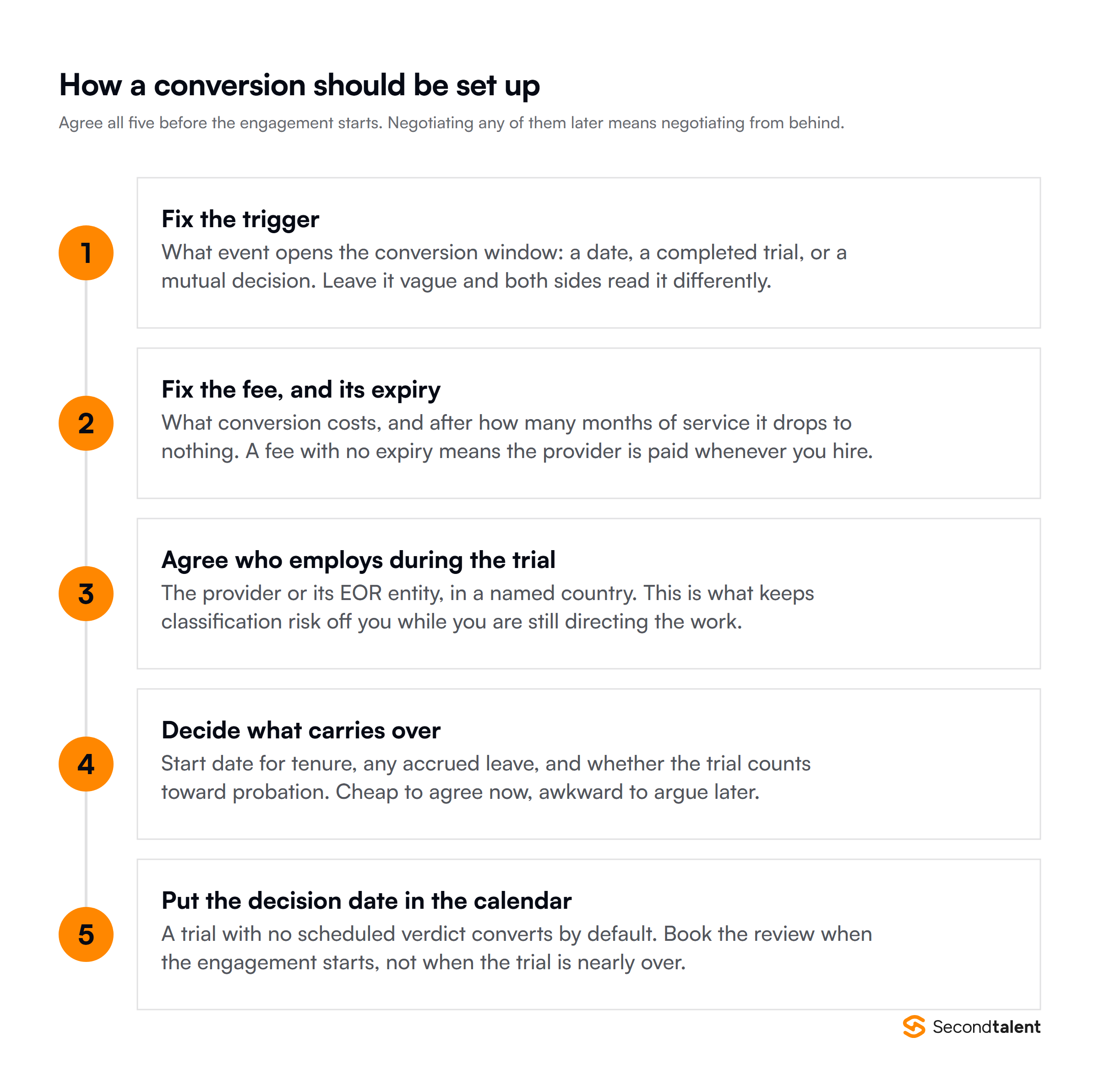
How should a conversion be set up?
Agree five things before the engagement starts. All five are cheap to settle up front and awkward to settle later.
The trigger. What event opens the conversion window: a date, a completed trial, or a mutual decision. Leave it vague and each side reads it differently at exactly the wrong moment.
The fee, and its expiry. What conversion costs, and after how many months of service it falls to zero. A fee with no expiry means the provider is paid whenever you hire the person, however long they have worked with you.
Who employs during the trial. The provider or its EOR entity, in a named country. This is what keeps classification risk away from you while you direct the work.
What carries over. Tenure start date, accrued leave, and whether the trial counts toward probation.
The decision date. Put it in the calendar when the engagement starts. A trial with no scheduled verdict converts by default, which is fine when the fit is good and expensive when it is not.
Where each model goes wrong
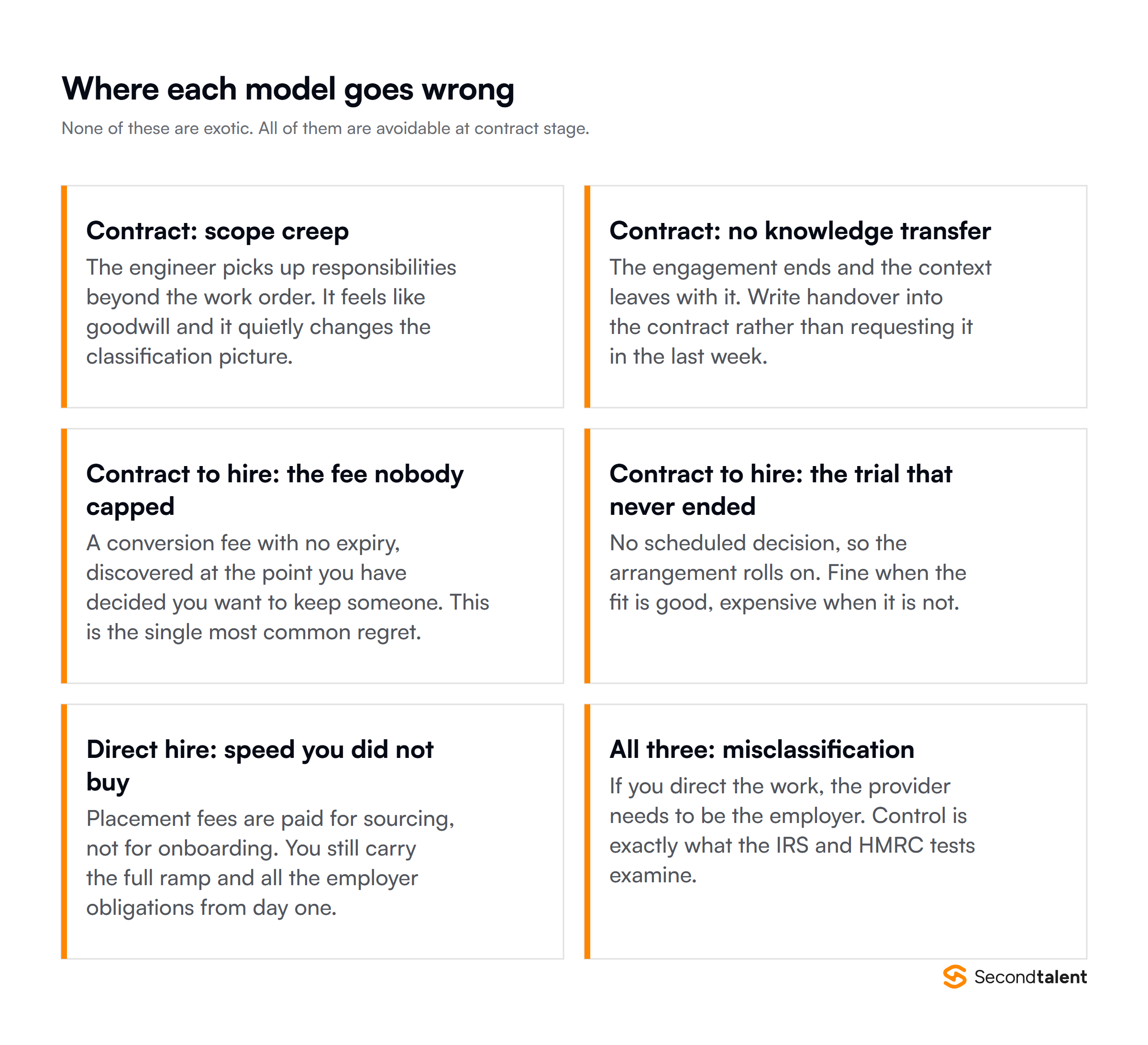
Six failure patterns cover most of it, and all are avoidable at contract stage.
On contract: scope creep past the work order, which feels like goodwill and quietly changes the classification picture, and no knowledge transfer at the end. Write handover into the contract rather than asking for it in the final week.
On contract-to-hire: an uncapped conversion fee discovered at the point you have decided to keep someone, and a trial that never formally ends.
On direct hire: assuming the placement fee bought speed. It bought sourcing. You still carry the full ramp and every employer obligation from day one.
Across all three: misclassification. If you direct the work, the provider needs to be the employer. The IRS common-law test weighs behavioural control, financial control and the type of relationship, and the HMRC CEST tool asks the same question in UK terms. Our guide to worker classification in cross-border IT staffing covers where it breaks.
Which model for which role
Role scarcity should shift the choice, because the harder a seat is to fill, the more a conversion option is worth.
The US Bureau of Labor Statistics projects data scientist employment to grow 35 percent between 2025 and 2035 with about 24,800 openings a year, and information security analysts 21 percent with 14,100 openings a year, against roughly 4 percent across all occupations.
For those seats, contract-to-hire earns its premium twice over. You get the person working now rather than in a quarter, and you get an agreed route to keep them if it works, in a market where finding a second candidate is genuinely hard.
For a role with deep local supply, the calculation flips. The option costs something and buys certainty you could get more cheaply by interviewing more people.
What to test before converting
A conversion decision is a different question from a hiring decision, and the useful evidence is different too.
Judge unsupervised work rather than potential, since you have months of real output rather than an interview. Look at whether rework fell over time, whether the engineer raised blockers early rather than late, and whether their written updates work for someone in another time zone.
What not to weight: how much you like working with them. That is real information and it is also the thing most likely to override a weak performance signal. Write the criteria down before the trial starts, for the same reason you write them before an interview.
Running all three under one agreement
You do not need three contracts. A single master agreement can carry all three models, with the specific engagement defined in a statement of work.
That is the arrangement worth setting up early, because it turns a new role into a two-day paperwork exercise rather than a six-week legal cycle. Our IT staffing agreement template covers the clause structure, and the 12 MSA clauses that shift risk covers what to negotiate inside it.
Keep one register of which engagements sit under which model, with the directing manager, notice period and renewal date. Teams running several models at once lose track of exactly those three fields.
How to choose
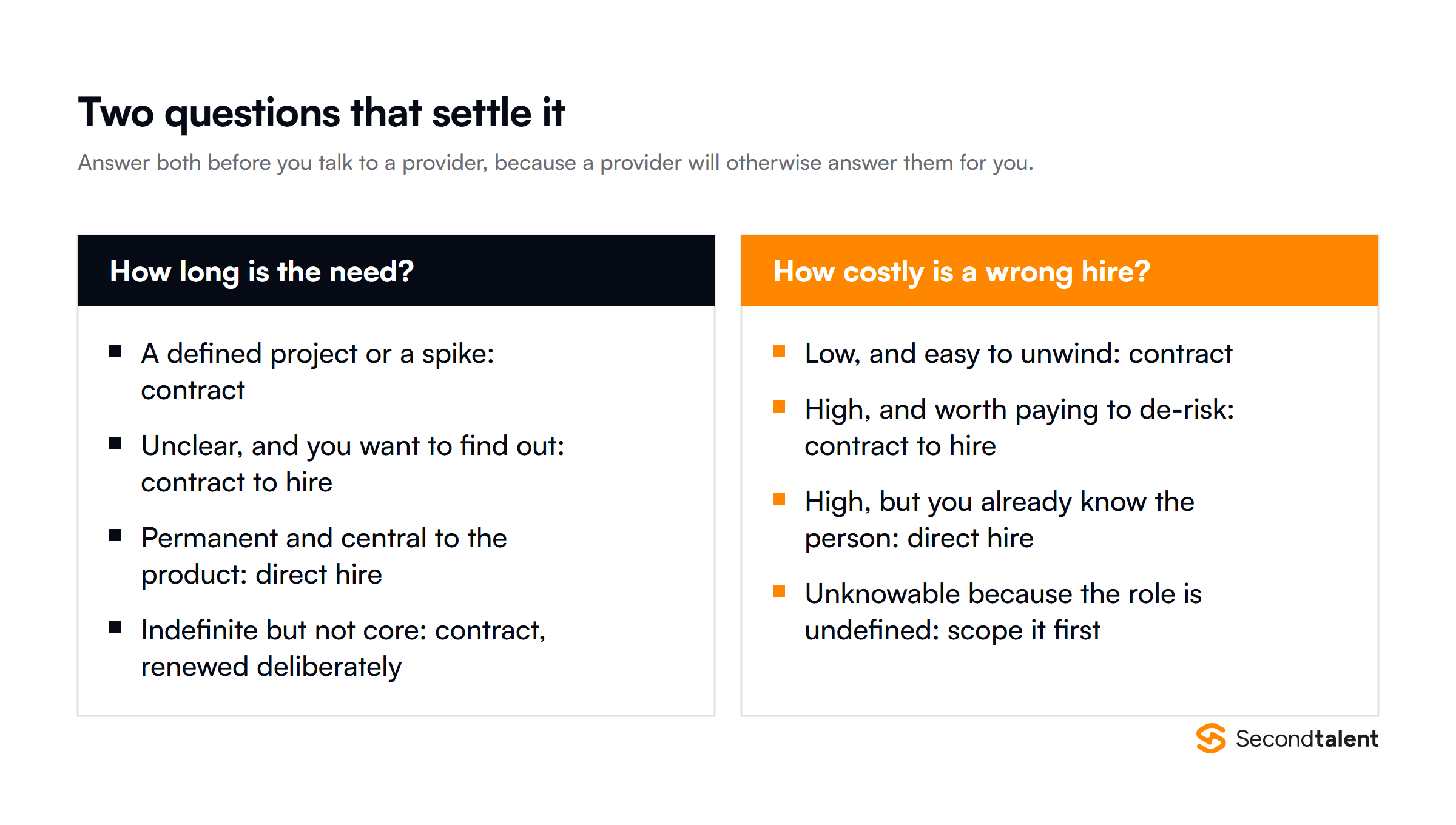
Two questions settle most cases.
How long is the need? A defined project or a spike points to contract. Something you want to find out about points to contract-to-hire. Permanent and central to the product points to direct hire.
How costly is a wrong hire? Low and easy to unwind points to contract. High and worth paying to de-risk points to contract-to-hire. High but with a person you already know points to direct hire.
Where the two answers disagree, follow the second. Duration mistakes cost money; wrong-hire mistakes cost a quarter.
Switching models mid-engagement
Moving between models during an engagement is common and worth planning for rather than improvising.
Contract to contract-to-hire. The awkward one, because you are asking for a conversion option after the provider has learned you value the person. Expect to pay more than you would have at the start, which is the argument for agreeing the option up front even when you think you will not use it.
Contract-to-hire to direct hire. The intended path. Trigger the agreed conversion, pay the agreed fee, and move the person onto your payroll with the tenure treatment you settled at the start.
Direct hire back to contract. Rare, and usually a sign the role was scoped wrong rather than that the person was. Fix the scope before re-contracting, or you will repeat the outcome with a different model attached.
Whichever direction you move, treat it as a new arrangement rather than an amendment. Who employs the person and who directs the work are what changes, and both carry consequences a small contract variation will not cover.
IT staffing model FAQs
Can a contract engagement convert without a contract-to-hire agreement?
Usually yes, and usually on worse terms. Without a pre-agreed trigger and fee you are negotiating at the moment you have shown you want the person, which is the weakest position available.
Is contract-to-hire worth the premium?
For a high-stakes or stretch seat, generally yes. For a role you have hired five times before, the premium buys certainty you already have.
Does direct hire mean lower quality candidates?
No. The same vetting applies. What changes is that all employer obligations and the full ramp cost sit with you from day one.
Can we run different models for different roles at once?
Yes, and most teams past a handful of engineers do. Keep one register listing the model, the directing manager, the notice period and the renewal date for each seat. Those four fields are what teams lose track of when several models run in parallel, and losing them is how you end up paying twice for the same capacity.
How long should a trial period be?
Long enough to see unsupervised work, which means past the ramp. Thirty days tests fit; three months tests performance. Pick according to what you are actually uncertain about.
Takeaways
- Same talent, three commitments. Choose on duration and on wrong-hire cost.
- Agree the conversion trigger, fee and expiry before the engagement starts.
- Book the trial decision date up front, or the trial converts by default.
- Never compare a loaded provider rate against an unloaded salary median.
- Run all three under one master agreement, with the model set per statement of work.
Set up the agreement once
Second Talent supports all three models under a single master agreement, with EOR cover across Asia, 24-hour matching and 92 percent of placements still in seat a year later.
Tell us which seat you need to fill, or read what IT staffing is for how the engagement models sit above these three.