TL;DR: The best Chinese AI agents in 2026 are Moonshot's Kimi, Alibaba's QwenWork and MiniMax Agent for general work, with Tencent's WorkBuddy and Z.ai's AutoClaw close behind. Accio Work and Lovart lead for e-commerce and design. Most have a free option, and paid plans start at $9 a month.
The best-known AI agent to come out of China is no longer Chinese. Manus agreed a sale to Meta for about US$2 billion in December 2025, Beijing ordered the deal unwound in April 2026, and Manus now runs independently from Singapore. The ten agents below come from companies based in China or owned by a Chinese tech group.
The 10 Chinese AI Agents, Compared
| Agent | Company | Best for | Paid from |
|---|---|---|---|
| 1. Kimi | Moonshot AI | Research, slides, parallel tasks | $19/mo |
| 2. QwenWork | Alibaba | Documents, websites, computer use | $20/mo |
| 3. MiniMax Agent | MiniMax | Websites, documents, video | $22/mo |
| 4. WorkBuddy | Tencent | Team tasks from Slack or Telegram | $10/mo |
| 5. AutoClaw | Z.ai | Office and browser automation | $18/mo (GLM Coding Plan) |
| 6. Accio Work | Alibaba International | E-commerce sourcing and stores | $19.90/mo |
| 7. Lovart | Evoken | Brand and marketing design | $19/mo |
| 8. Skywork | Kunlun Tech | Business websites and slides | Shown after login |
| 9. Coze | ByteDance | Building your own agents | $9/mo |
| 10. Flowith | Flowith | Image and video with an agent | $19.90/mo |
- 1Kimi’s Agent Swarm splits one task across up to 300 sub-agents and more than 4,000 tool calls.
- 2Three of the ten opened to international users in 2026: Accio Work in March, WorkBuddy in May and QwenWork on August 26.
- 3Z.ai’s AutoGLM agent now redirects to AutoClaw for users outside China.
- 4Coze’s international site blocked access from India in our test, but its builder is open source under Apache 2.0.
1. Kimi (Moonshot AI)
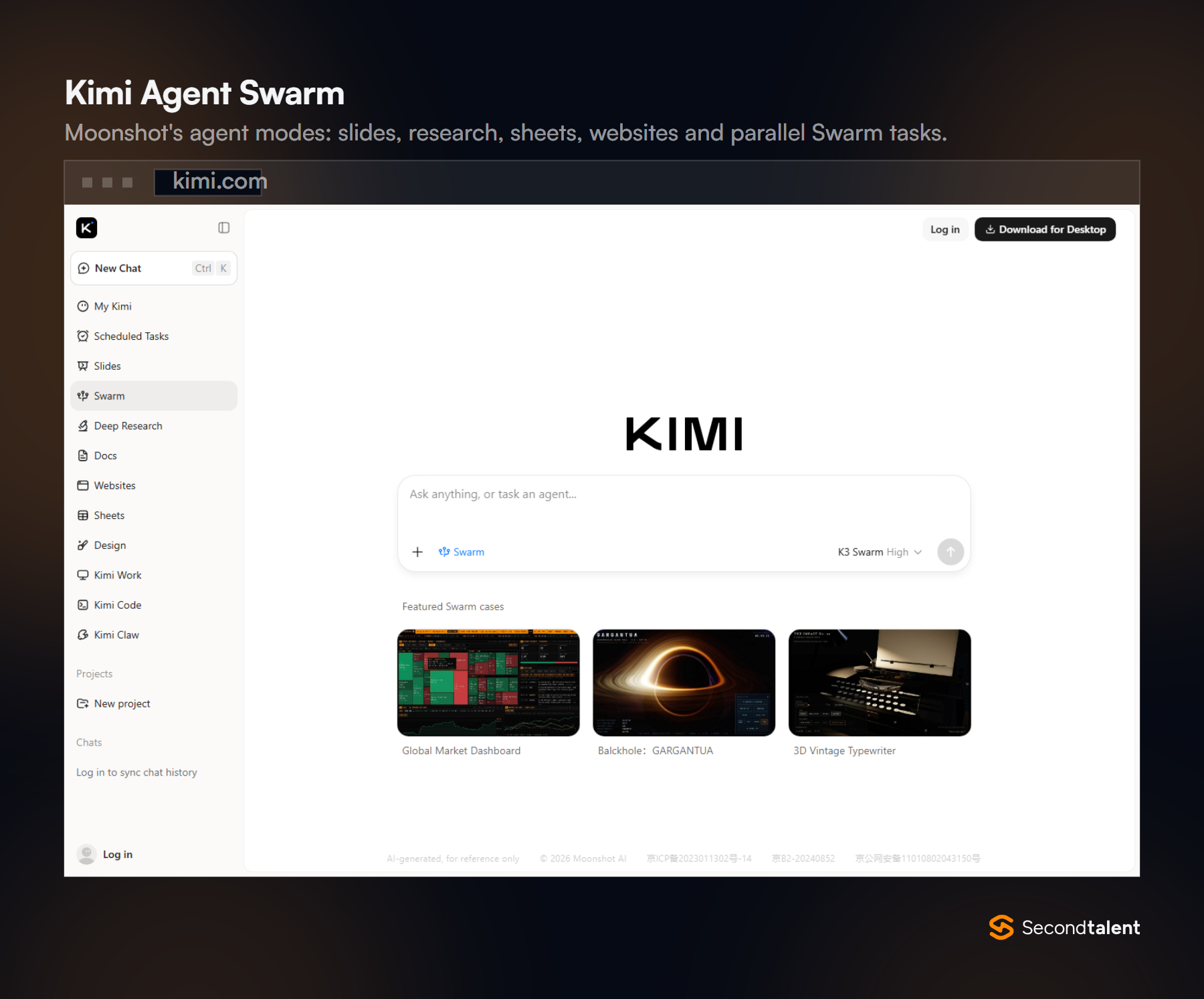
Kimi suits research and reporting jobs that break into many pieces. Moonshot’s web app, now branded Kimi.ai, puts its agents in one sidebar: Slides, Deep Research, Docs, Websites, Sheets, Design, Scheduled Tasks and Swarm.
Swarm is the headline feature. Moonshot’s help centre says it runs up to 300 sub-agents and more than 4,000 tool calls on a single task, finishing 4.5 times faster than working in sequence. It launched with Kimi K2.5 on January 27, 2026 and now runs on Kimi K3, a 2.8 trillion parameter open model. A Swarm task costs several times the credits of a normal agent task.
Kimi Work takes the agent onto your computer. The desktop app for macOS and Windows mounts local folders, drives your browser through an extension, runs Python in the background and repeats tasks on a schedule. Our guide to every Kimi model covers the models underneath.
- Best for: research reports, decks and dashboards built from many sources at once.
- Where it struggles: Swarm burns credits fast, and the free plan runs one agent task at a time.
- Price: free Adagio plan; Plus $19, Pro $39, Max $99 and Ultra $199 a month, or about 20% less billed yearly.
2. QwenWork (Alibaba)
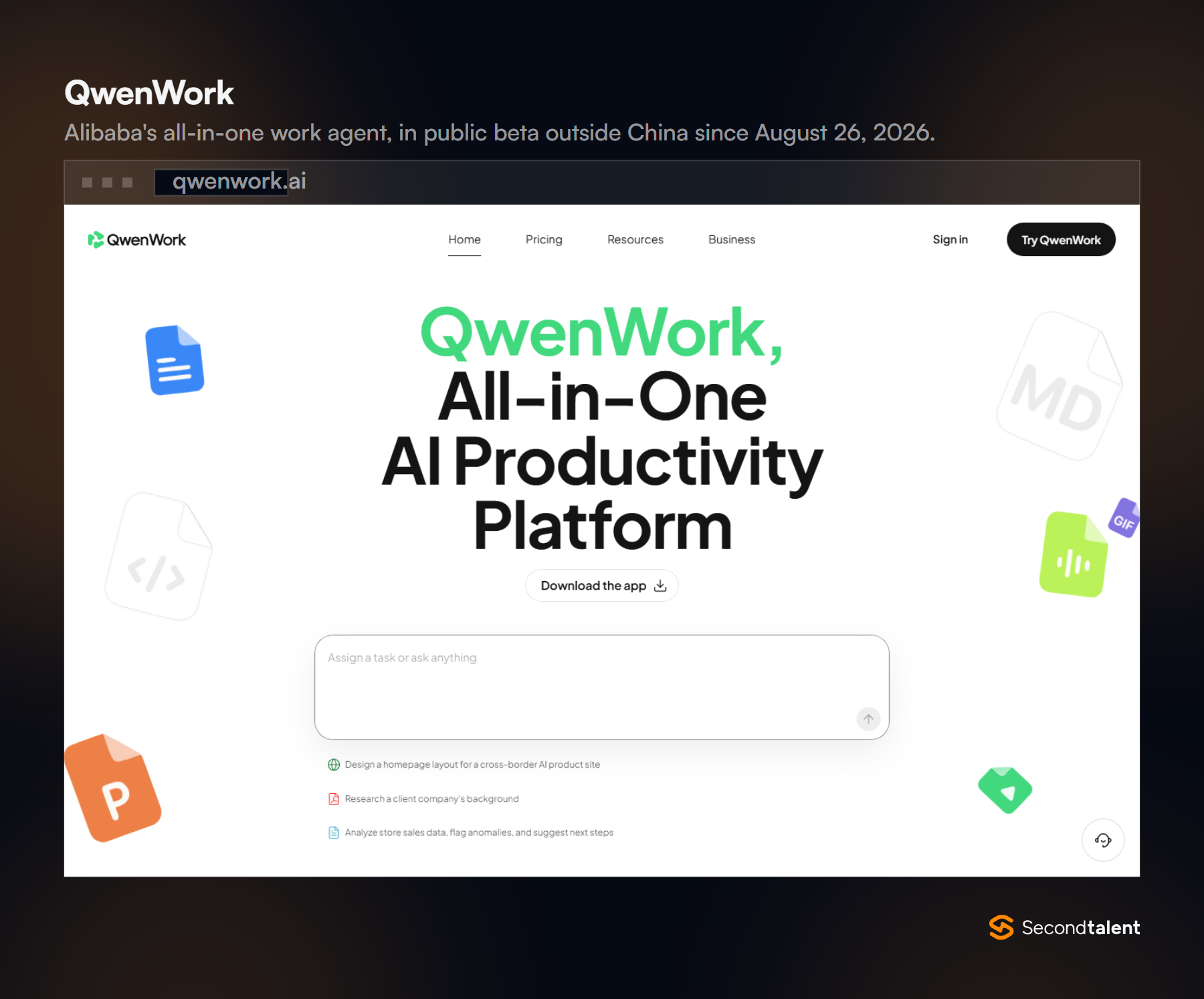
QwenWork is Alibaba’s one-stop work agent for documents, websites and computer tasks. Its free plan runs 10 tasks in parallel, where Kimi’s free plan runs one.
Alibaba launched it in China on August 3, 2026, and opened an international edition as a public beta on August 26, aimed at Asia, the Middle East and Latin America. You sign up with Google or email. It writes documents and presentations, builds web pages with hosting, a database and a custom domain, makes images, and carries out multi-step work in a browser or on your computer.
Alibaba built it from three products: QoderWork for apps, MuleRun for workflows and Wukong for website and local computer operation. The desktop app adds a memory feature called Awareness. The models are Qwen3.8, covered in our Qwen model guide.
- Best for: teams that want documents, websites and computer tasks in one tool.
- Where it struggles: it is still a beta outside China, and its free credits are marked limited time.
- Price: free with 500 sign-up and 200 daily credits; Plus $20 and Pro $40 a month; enterprise seats $30.
3. MiniMax Agent (MiniMax)
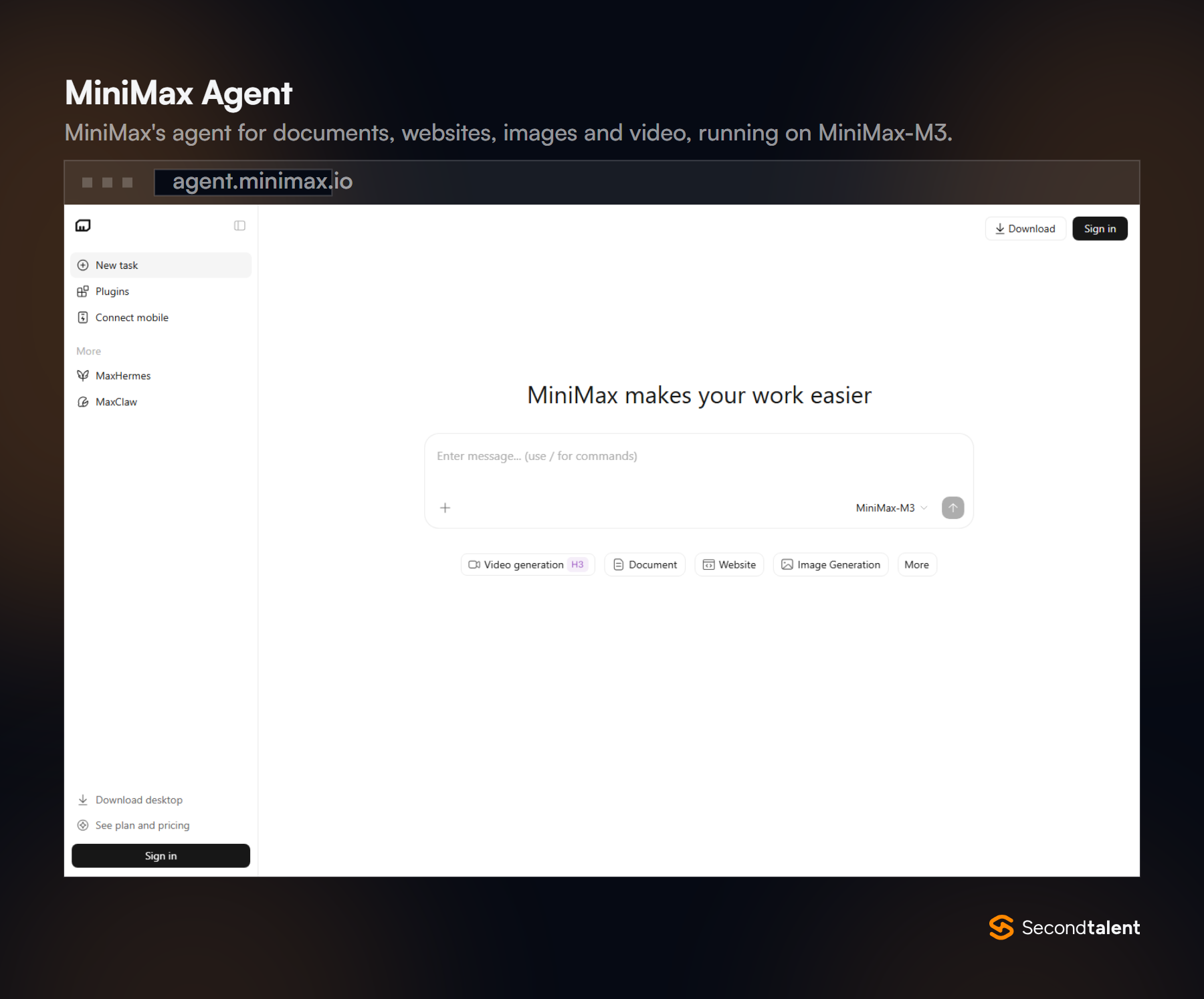
MiniMax Agent is the best pick if one subscription should cover both an agent and an API. A single Token Plan pays for the web agent, the MiniMax Code desktop app and API calls to MiniMax-M3.
The agent handles research, websites, slide decks, documents, and image and video generation. It adds scheduled tasks, expert modes for office, finance and coding work, and MaxClaw, a hosted version of the open-source OpenClaw agent. The desktop app took the name MiniMax Code on May 29, 2026, according to MiniMax’s changelog.
MiniMax reports 70.06% on OSWorld-Verified, a computer-use test, for MiniMax-M3 in its launch post. A KDnuggets review quoted MiniMax’s own finding that loosely coordinated agent teams can use 2.1 to 3.4 times the tokens for no gain in accuracy, which is worth knowing before you run several agents at once.
- Best for: builders who want the agent and the API on one bill.
- Where it struggles: the plan is sold in tokens, so it takes a test month to learn what a task costs.
- Price: free daily check-in points; Plus $22, Max $55 and Ultra $132 a month.
4. WorkBuddy (Tencent)
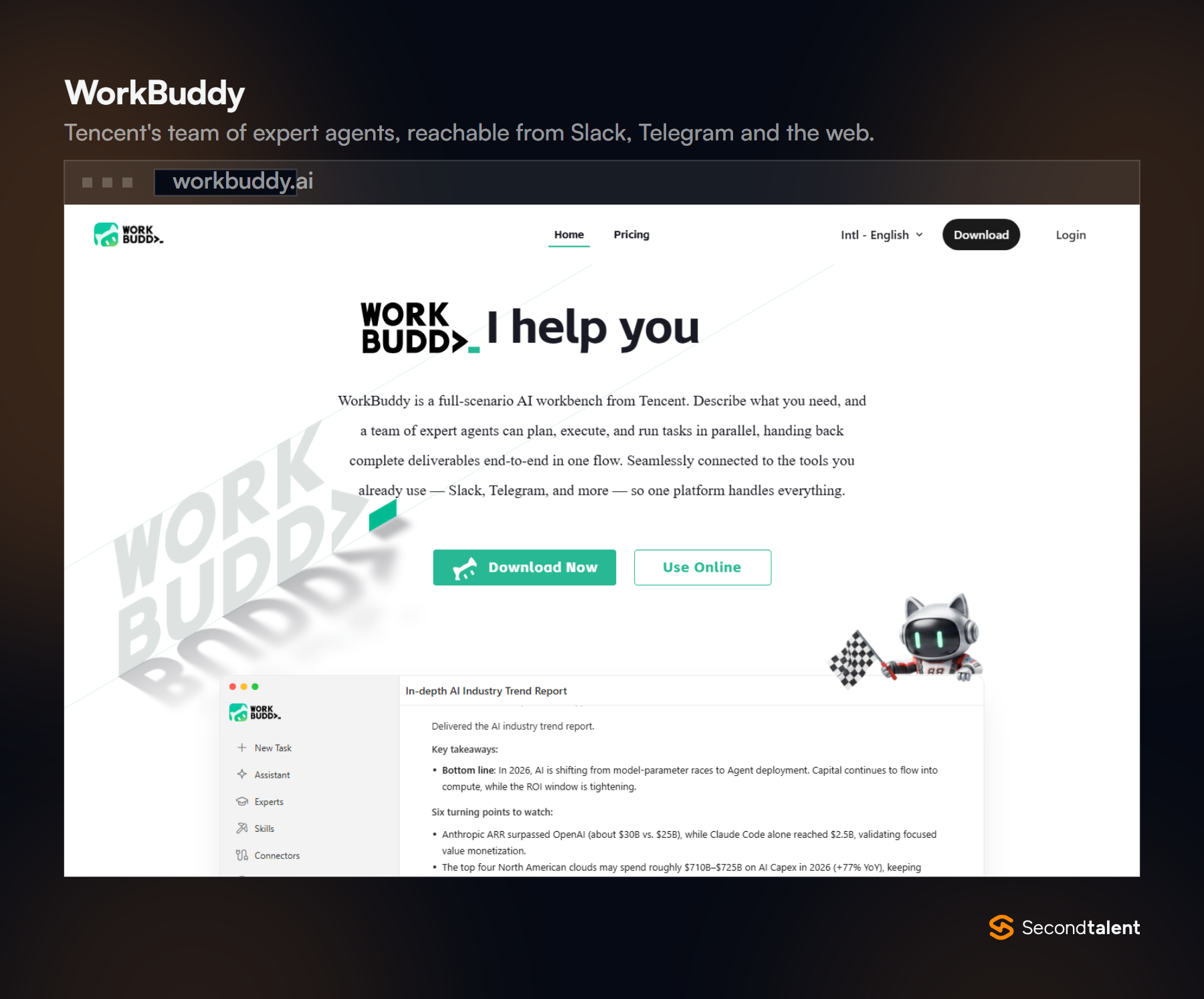
WorkBuddy is the agent to try if your team lives in chat apps. Tencent describes it as a team of expert agents that plan, execute and run tasks in parallel, and you can hand it work from Slack, Telegram and other messengers.
The product is built around four parts: Experts, Skills, Connectors and Automations. TechNode reported the international launch on May 29, 2026, listing Slack, Telegram, Discord and WeChat as channels and GitHub, Jira, Google Drive, Gmail and Notion as connectors. Teams can also plug in their own model through an API key. The China edition claims more than 100 domain experts.
Automations are where the plans differ most. The free plan runs 3 automated tasks, and Pro runs 15. New users get 250 welcome credits, and a 7-day Pro trial with 500 credits needs a payment card.
- Best for: small teams that want recurring reports and task hand-offs inside Slack or Telegram.
- Where it struggles: 100 free credits a month runs out fast, and there is no tier above Pro.
- Price: free; Pro $10 a month or $96 a year, with 1,000 base and 1,000 bonus credits.
5. AutoClaw (Z.ai)
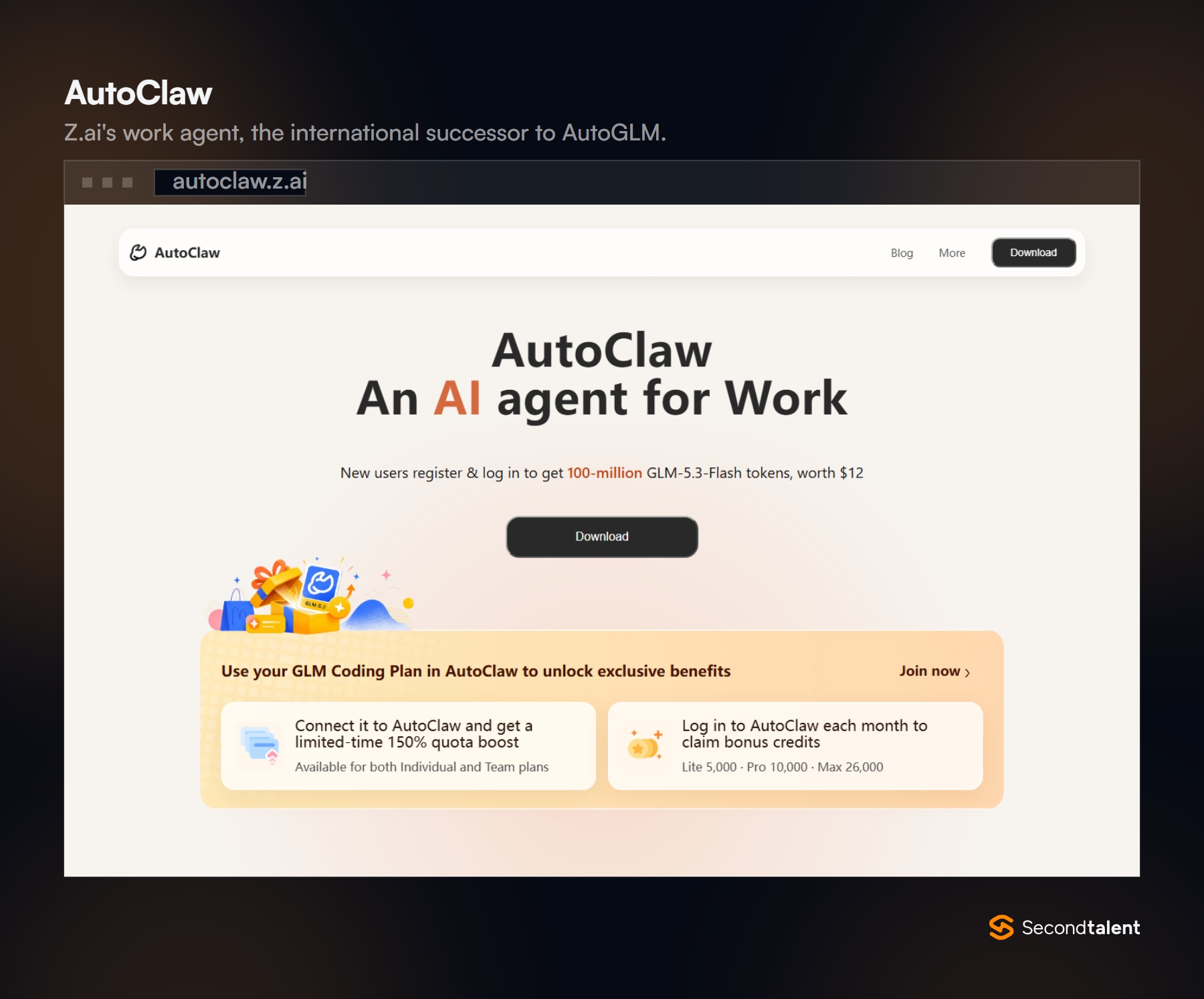
AutoClaw is the agent for office and browser automation. New users get 100 million GLM-5.3-Flash tokens to start, which Z.ai values at $12.
It replaced AutoGLM for users outside China: autoglm.z.ai now redirects to AutoClaw. The agent edits Word, Excel and PowerPoint files, runs content and investment research, builds web products, and automates browsers for forms, scraping and scheduled browser tasks. You can steer it from Slack, Telegram, WhatsApp, Lark or Discord. It runs on Windows, macOS, iOS and Android, and switches between GLM and DeepSeek models.
AutoClaw has no plan of its own. Subscribers to the GLM Coding Plan claim monthly bonus credits (5,000 on Lite, 10,000 on Pro, 26,000 on Max), plus a limited-time 150% quota boost. The models behind it are in our guide to every GLM model.
- Best for: repetitive office and browser work controlled from a chat app.
- Where it struggles: it has no plan of its own, so paid credits come through a coding subscription.
- Price: free start; bonus credits through the GLM Coding Plan at $18, $80 or $168 a month.
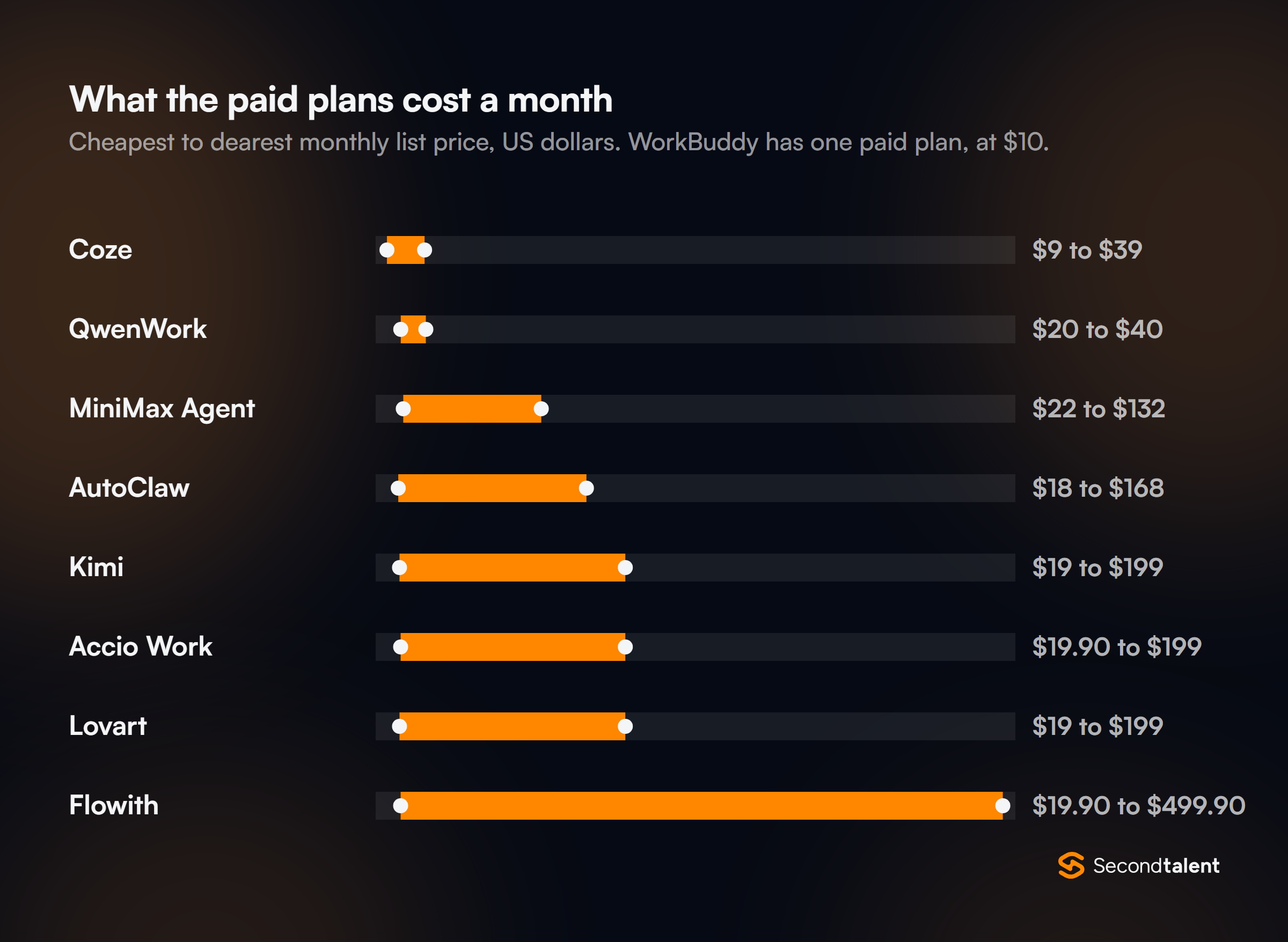
Most entry plans cluster between $18 and $22 a month. The top tiers spread much wider, from $39 for Coze Premium Plus to $499.90 for Flowith’s Infinite plan.
6. Accio Work (Alibaba International)
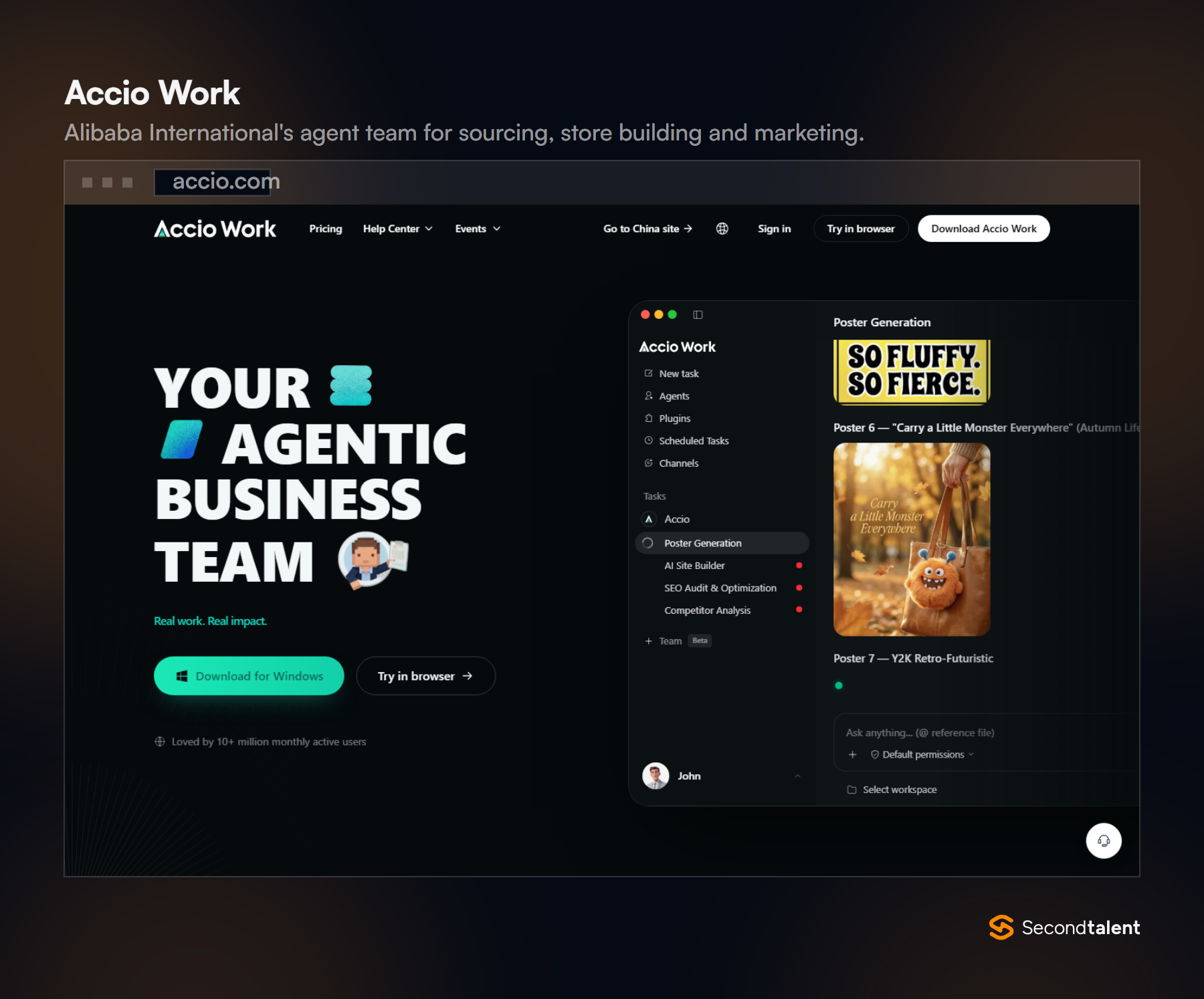
Accio Work is the agent for people who sell products online. Alibaba International pitches it as an “agentic business team” that runs market research, finds products and suppliers, builds stores and writes the marketing.
It launched on March 23, 2026, according to Alibaba’s press release. Supplier search draws on Alibaba’s 1688 wholesale marketplace, and official integrations cover Shopify, Amazon Seller Toolkit, eBay, HubSpot, Notion and Klaviyo. TechNode reported Alibaba’s claim that it goes from market analysis to a store listing within 30 minutes.
The homepage claims more than 10 million monthly active users, a figure Accio has not broken down. A new AI workspace for global e-commerce starts its beta, by waitlist, on September 15, 2026. Accio Work runs in a browser, on mobile and as a Windows app.
- Best for: e-commerce sellers sourcing from China and listing on Shopify or Amazon.
- Where it struggles: outside e-commerce it offers little that Kimi or QwenWork do not.
- Price: free 7-day allowance, then daily credits; Pro $19.90, Elite $99 and Ultra $199 a month, 15% off yearly.
7. Lovart (Evoken)
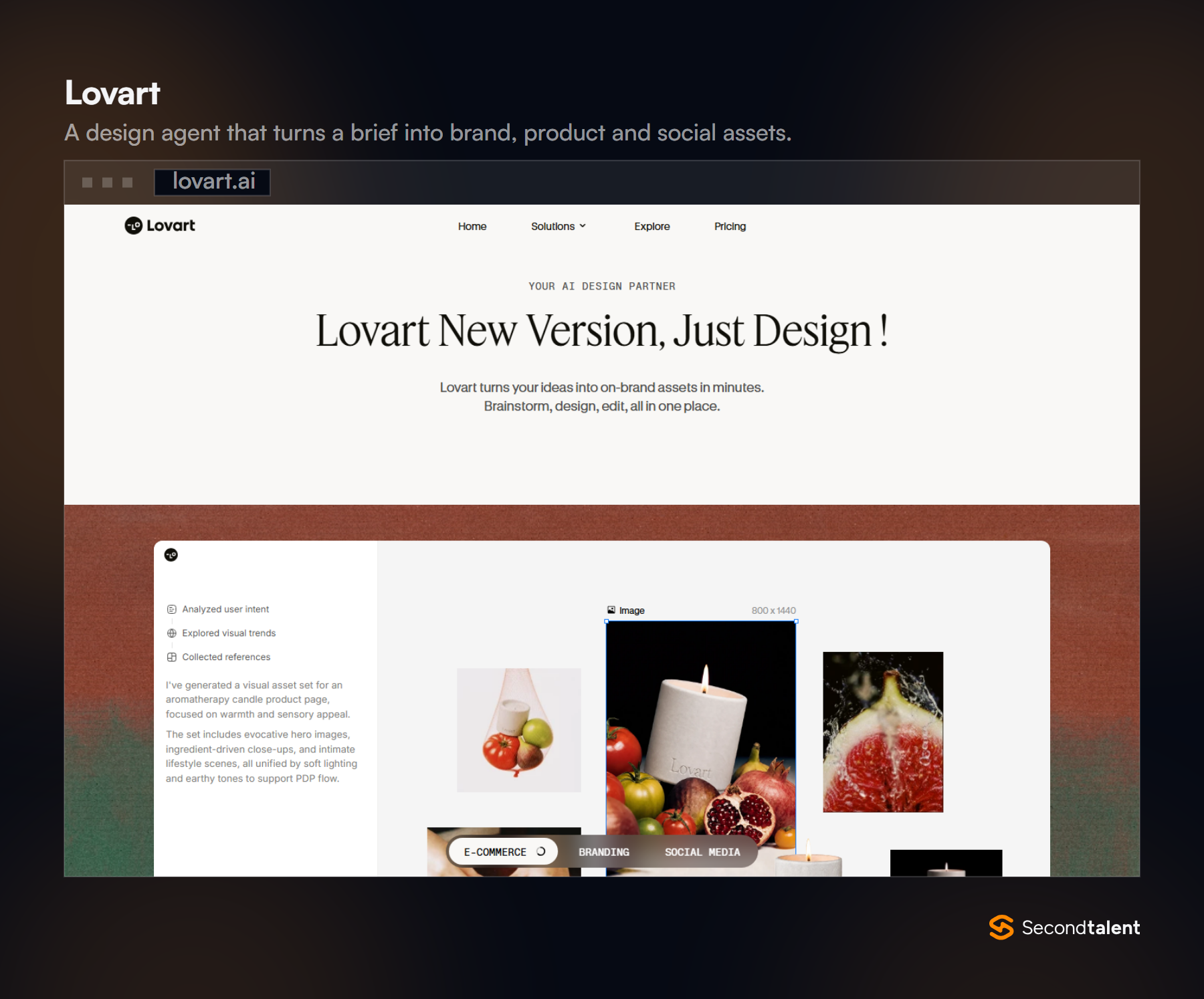
Lovart is a design agent: give it a brief and it produces brand systems, e-commerce product shots, posters, merchandise and logos. It went public on July 28, 2025, clearing a waitlist of 800,000 people.
Its editing tools are built for revisions: Touch Edit, text on separate layers, brand kits and custom skills. Lovart does not rely on one model. Its site lists GPT Image 2, Seedance 2.0, Nano Banana Pro, Kling 3.0, Seedream 5, Veo 3.1, Midjourney and Flux 2 Pro.
Its maker, Beijing-based Evoken, raised a US$300 million Series B+ at a valuation above US$2 billion, Yicai Global reported in June 2026. In August, The Standard, citing Bloomberg, reported that Evoken was exploring a Hong Kong IPO at a possible US$3 billion valuation. Some company databases list a US address for Lovart.
- Best for: marketing teams that need many on-brand images a week.
- Where it struggles: the promotional prices on Pro and Ultimate rise sharply at renewal.
- Price: Starter $19 a month ($16 yearly); Ultimate lists at $199, on promotion for $109.
8. Skywork (Kunlun Tech)
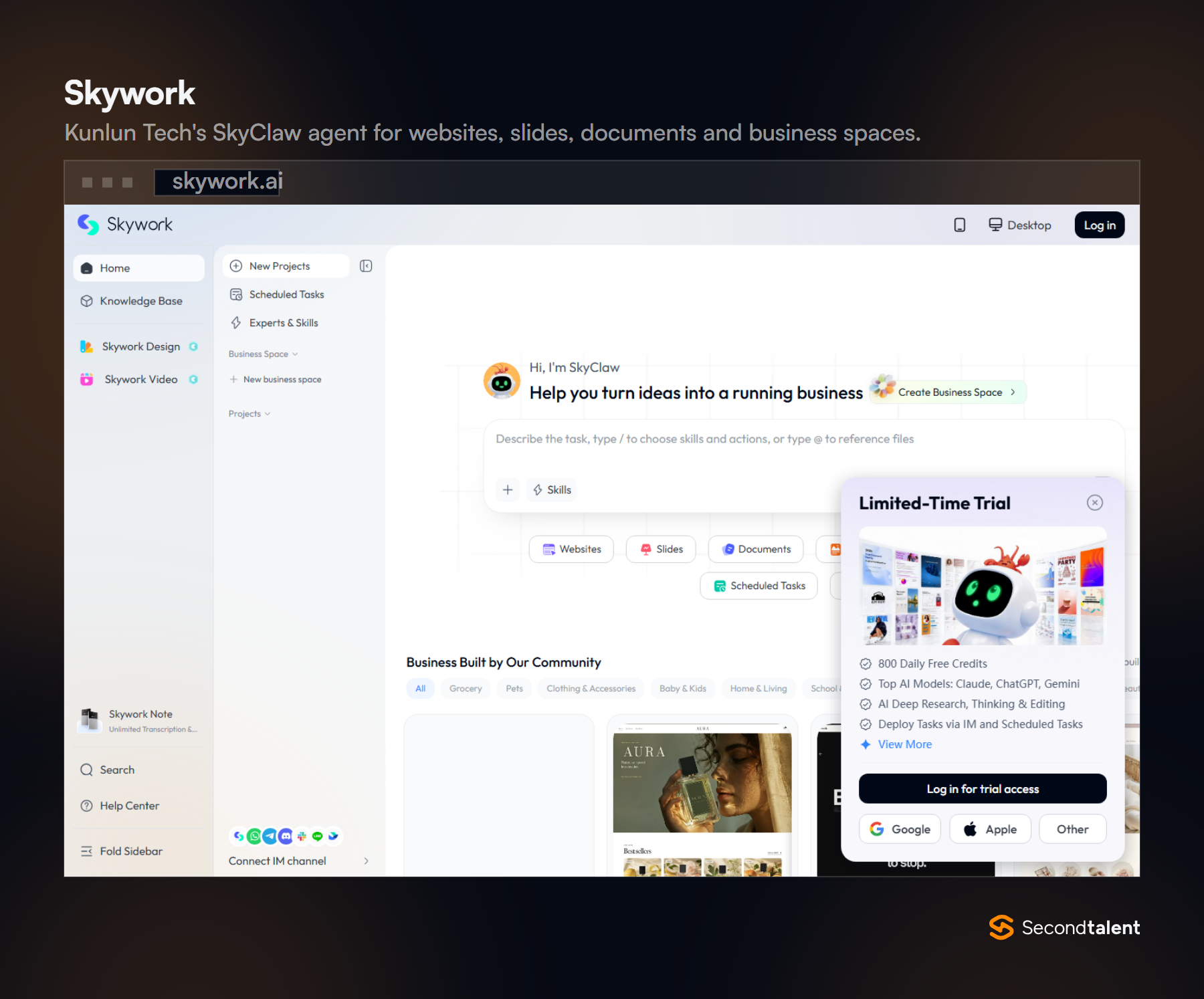
Skywork puts American chat models inside a Chinese-owned agent. Its homepage offers a limited-time trial with 800 free credits a day on Claude, ChatGPT and Gemini.
Skywork is the AI brand of Kunlun Tech, the Beijing internet group that launched the Skywork model line in 2023. The international site states it is powered by Skywork AI Pte. Ltd., a Singapore company.
The main agent, SkyClaw, promises to “turn ideas into a running business”. It builds business spaces, websites, slides, documents, posters, spreadsheets and videos, and it runs scheduled tasks. Like WorkBuddy and AutoClaw, it can take instructions through messaging apps, and it has a desktop app.
- Best for: founders who want a site, a deck and documents for a new business from one prompt.
- Where it struggles: you cannot see a price until you log in.
- Price: 800 free daily credits during the trial; paid plans are shown after login on skywork.ai.
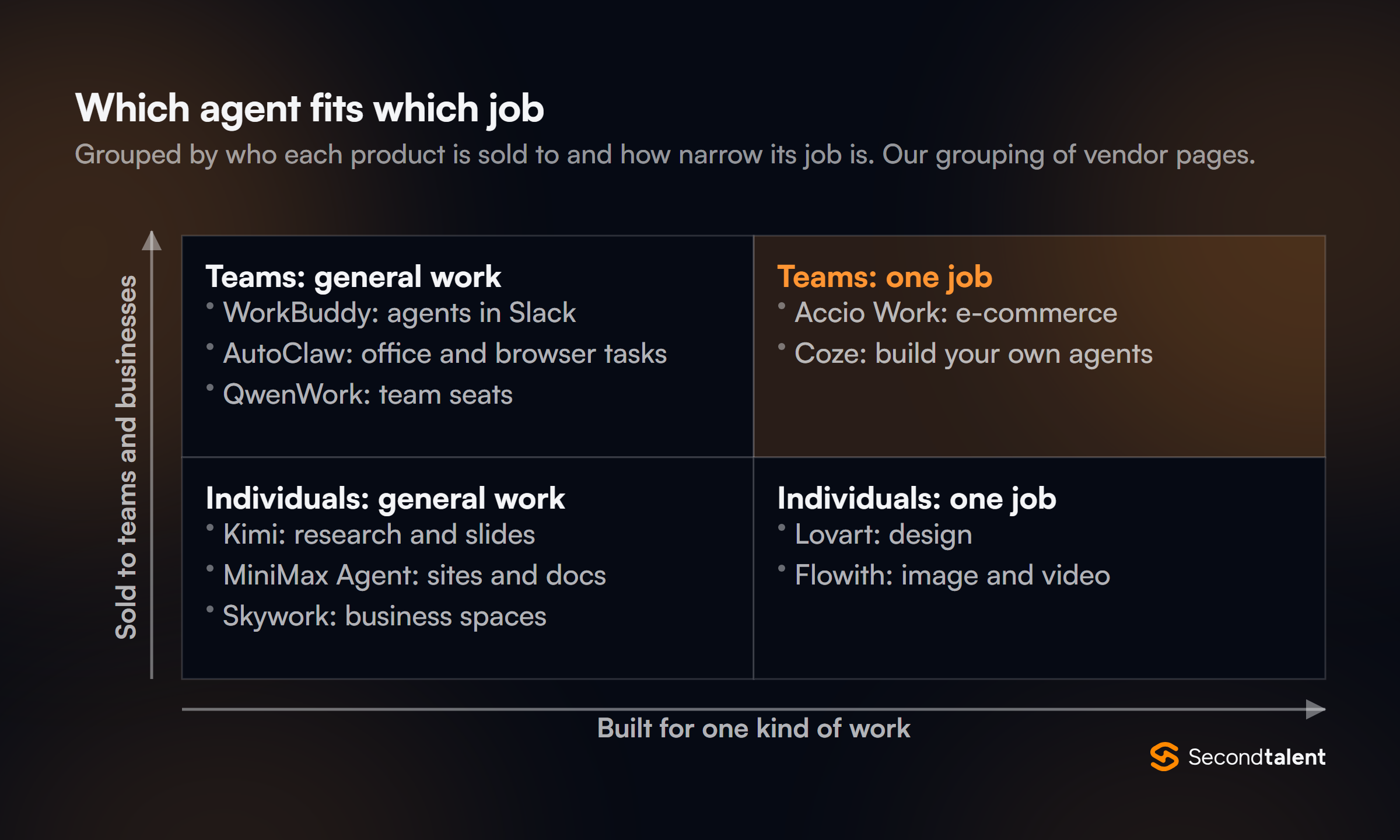
The general agents overlap heavily. The specialists each own a job the others do not cover: design for Lovart, image and video for Flowith, e-commerce for Accio Work and agent building for Coze.
9. Coze (ByteDance)
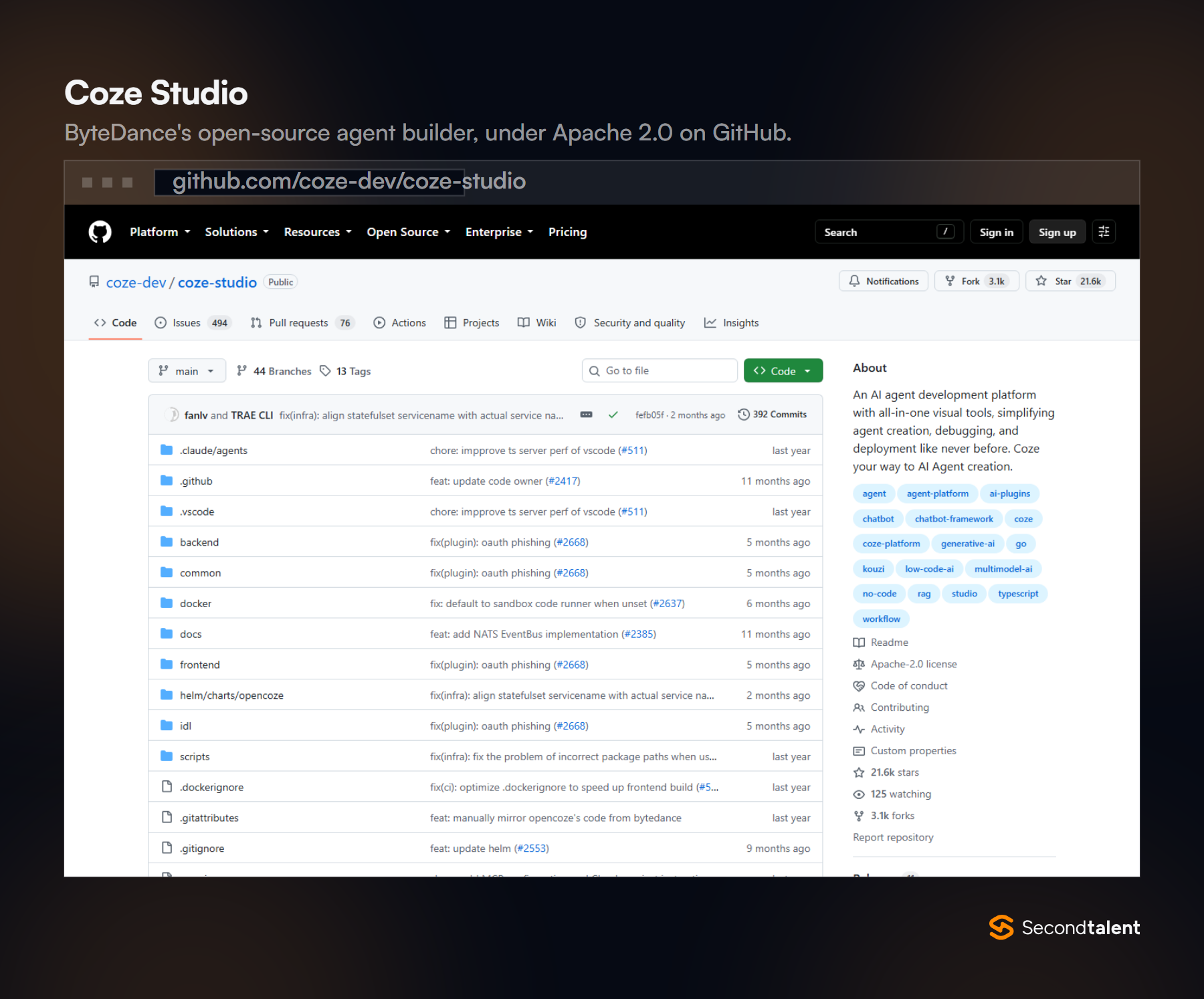
Coze is different from the rest of the list: it is a builder for making your own agents, not an agent that does the work. ByteDance offers it as a hosted service and as open-source code.
The open-source version, Coze Studio, went up on GitHub in June 2025 under Apache 2.0 and has 21.6K stars. It gives developers visual tools to create, debug and deploy agents on their own servers. For teams that cannot send data to a Chinese service, that route is the useful one.
The hosted international site is weaker. Coze.com returned “our services are not available in your country or region” when we loaded it from India. Its subscription docs still list GPT-4o and Claude 3-era models.
- Best for: developers building a custom agent they can self-host.
- Where it struggles: the international hosted service is region-locked and behind on models.
- Price: free Coze Studio; hosted plans run from free (10 credits a day) through Premium Lite $9, Premium $19 and Premium Plus $39 a month.
10. Flowith
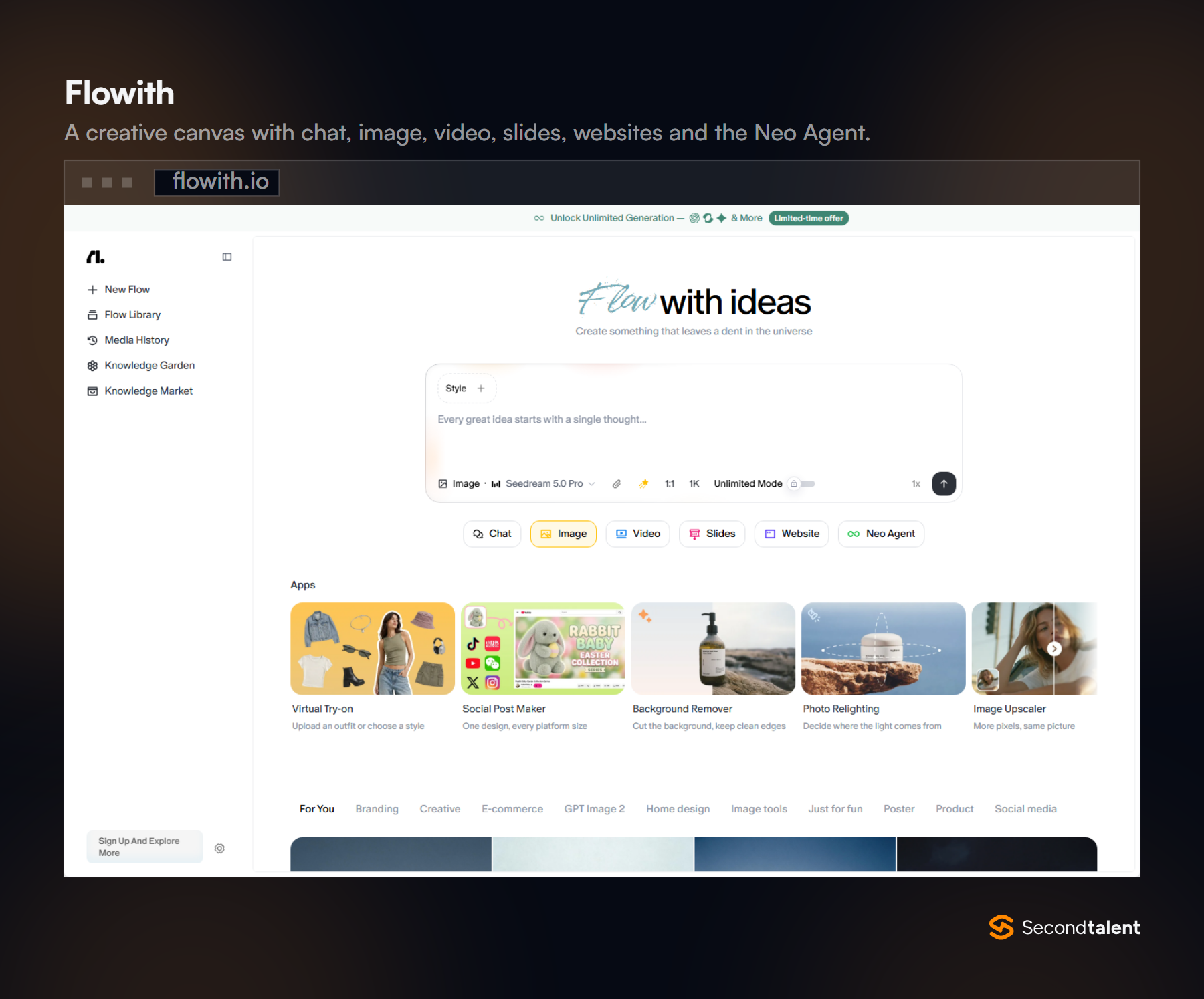
Flowith started as an agent workspace and has turned into a creative canvas. Its homepage now leads with image and video generation, with chat, slides, websites and its Neo Agent as tabs beside them.
The sidebar holds a Flow Library, Media History and a Knowledge Garden for saved material. Apps on the homepage include virtual try-on, a social post maker, background removal, photo relighting and an image upscaler. Its image models include Seedream 5.0 Pro, GPT Image 2.5 and Nano Banana Pro.
Flowith has the widest price range of the ten. The pricing page runs from a free Starter plan with 300 credits to Infinite at $499.90 a month with 500,000 credits. Company databases list it in Shanghai, though some press has called it a Silicon Valley startup.
- Best for: creators who mix image, video and written work on one board.
- Where it struggles: the agent is no longer the product’s focus.
- Price: free; Pro $19.90, Ultimate $49.90 and Infinite $499.90 a month, with 10% to 20% off yearly.
Build Your Own Agents With the Right Engineers
Off-the-shelf agents cover common office work. Connecting one to your own systems, or building a custom agent on Coze Studio or open Chinese models, takes engineers. Second Talent matches companies with vetted engineers from Asia: hire AI agent developers or AI engineers in China. Tell us the role and get a shortlist within 24 hours.
Frequently Asked Questions
Is Manus a Chinese AI agent?
Not any more. Manus was founded in China and now operates independently from Singapore, as our Singapore AI companies list explains.
What about Chinese coding agents?
Coding tools such as Kimi Code, Qoder and Baidu Comate are covered separately in our Chinese AI coding assistants ranking.
Is it safe to give a Chinese AI agent company data?
Treat it like any cloud service: read where data is stored before uploading anything sensitive. For confidential work, a self-hosted builder such as Coze Studio keeps data on your own servers.


![Singapore AI Companies Leading Southeast Asia. Top 10 Singapore AI Companies Leading Southeast Asia [2026], by Second Talent.](https://www.secondtalent.com/wp-content/uploads/2026/09/singapore-ai-companies-featured-v2-768x403.jpg)
![AI Recruiting Tools. Top 7 AI Recruiting Tools in 2026 [Tried & Tested], by Second Talent.](https://www.secondtalent.com/wp-content/uploads/2026/09/top-ai-recruiting-tools-featured-v2-768x403.jpg)