TL;DR: Founding engineers from Asia start at $4,000 a month through Second Talent, matched in 24 hours. The closest US benchmark, the BLS median for software developers, was $135,980 a year in May 2025.
A startup's first engineer received a median equity grant of 1.54% over the two years Carta reviewed in December 2025, and the median fell to 0.61% two hires later. Engineers two and three inherit the first engineer's choices: the stack, the database schema, the deploy pipeline and the list of accounts that hold production keys.
Key takeaways
- Taiwan's full-stack rate card covers senior developers only, starting at $4,750 a month for work with international clients, and Singapore's range starts at $9,470.
- Incentive stock options require the holder to be an employee of the company granting them or its parent or subsidiary, which a contractor abroad is not.
- In GitGuardian's 2026 report, Claude Code-assisted commits leaked secrets at a 3.2% rate, against 1.5% across all public GitHub commits.
- Code a contractor writes stays theirs until a signed written transfer, so the assignment belongs in the contract before the first commit.
What Founding Engineers Earn Working for International Clients in Asia
Our rate cards carry no founding engineer title, so the table uses our full-stack developer rate cards: a first engineer ships the screen, the API and the database behind it. The figures are what developers in each market earn working directly for foreign companies, before any employer or platform costs.
| Market |
Monthly pay working for international clients (USD) |
| Indonesia |
$850-$2,270+ |
| Philippines |
$1,600-$3,350+ |
| Malaysia |
$2,090-$5,040+ |
| Vietnam |
$3,000-$7,000+ |
| Taiwan |
$4,750-$6,650+ |
| Singapore |
$9,470-$17,360+ |
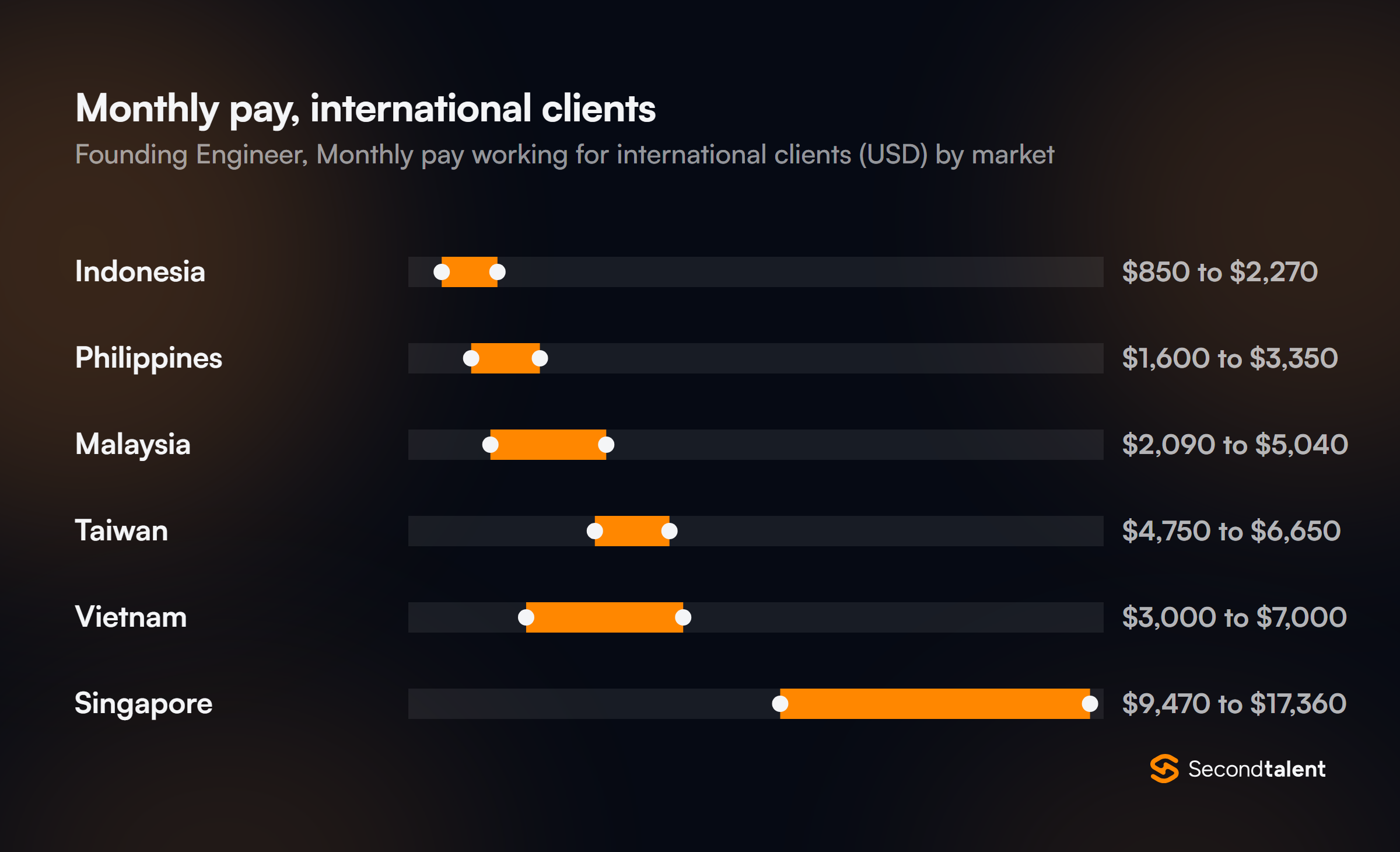
Monthly ranges from the Remote (Working for International Clients) figures on our rate cards for Indonesia, the Philippines, Malaysia, Vietnam, Taiwan and Singapore, converted at ExchangeRate-API mid-market rates for 14 September 2026.
Vietnam's card quotes US dollars. The other five quote local currency: Rp15 million to Rp40 million in Indonesia, ₱100,000 to ₱210,000 in the Philippines, NT$150,000 to NT$210,000 in Taiwan. All six ranges are open at the top, and Taiwan's is the narrowest, because that card prices senior developers alone. For a founding hire, read the top half of each range.
Through Second Talent, founding engineers start at $4,000 a month: one monthly fee that bundles salary, payroll taxes, statutory contributions and our service fee. The pricing page shows how the subscription works, and our full-stack developer page fits a second or third engineer joining an existing codebase.
US Pay Benchmark for Founding Engineers
Singapore's floor of $9,470 a month sits above the US 25th percentile for software developers, while Taiwan's senior floor sits below the US 10th percentile. BLS publishes no founding engineer occupation. The role maps to Software Developers (SOC 15-1252), because a founding engineer designs, writes and runs the company's application software.
| BLS OEWS, May 2025, national |
Software Developers (15-1252) |
| Median annual |
$135,980 |
| 10th percentile, monthly |
$6,870 |
| 25th percentile, monthly |
$8,770 |
| Median, monthly |
$11,330 |
| 75th percentile, monthly |
$14,330 |
| 90th percentile, monthly |
$17,890 |
Monthly figures are the annual wages on the OEWS profile for 15-1252 divided by 12, rounded to the nearest $10.
Salary is only part of the US cost. In the BLS Employer Costs for Employee Compensation release for June 2026, wages and salaries made up 68.5% of employer compensation costs for full-time private industry workers, and benefits the other 31.5%.
A US founding engineer offer also carries equity on top of cash. Our full-stack cost-to-hire page prices the freelance route for founders who want a build before a hire.
Time Zone Overlap with ET, CT and PT
A founding engineer reports to a founder, so the schedule needs daily live time with that founder rather than with a whole team. US daylight time runs from 8 March to 1 November 2026, per NIST, and none of the Asian cities below change their clocks.
| Engineer's city |
UTC offset |
9:00 am ET (EDT) |
9:00 am CT (CDT) |
9:00 am PT (PDT) |
| Manila, Singapore, Kuala Lumpur, Taipei |
UTC+8 |
9:00 pm |
10:00 pm |
12:00 midnight |
| Ho Chi Minh City, Jakarta, Bangkok |
UTC+7 |
8:00 pm |
9:00 pm |
11:00 pm |
| Bengaluru |
UTC+5:30 |
6:30 pm |
7:30 pm |
9:30 pm |
After 1 November 2026, every time in the table moves one hour later.
The first cell: 9:00 am EDT is 13:00 UTC, and 13:00 plus eight hours is 21:00 in Taipei. Two shifts, computed for September:
- Taipei or Kuala Lumpur, 6:00 pm to 3:00 am (10:00 to 19:00 UTC) covers 6:00 am to 3:00 pm in New York: six hours of a 9-to-5 Eastern day, five with Chicago and three with San Francisco.
- Ho Chi Minh City, 3:00 pm to midnight (08:00 to 17:00 UTC) covers 4:00 am to 1:00 pm Eastern: four hours with New York, three with Chicago and one with San Francisco.
Use the start of the overlap for the founder sync and any production deploy, so both of you are awake when the first errors arrive. Leave spec questions in writing before the US evening. We agree that schedule before the offer, which is how our placements get 4-6 hours of daily overlap with US hours.
Late hours cost more for employees. Worked from Manila, the same 6:00 pm to 3:00 am shift puts five hours between 10 pm and 6 am, each carrying a night shift differential of at least 10% under Article 86 of the Philippine Labor Code. Vietnam adds at least 30% for work between 22:00 and 06:00 (Labor Code Articles 98 and 106), the last two hours of the Ho Chi Minh City shift.
Founding Engineer Skills to Screen For
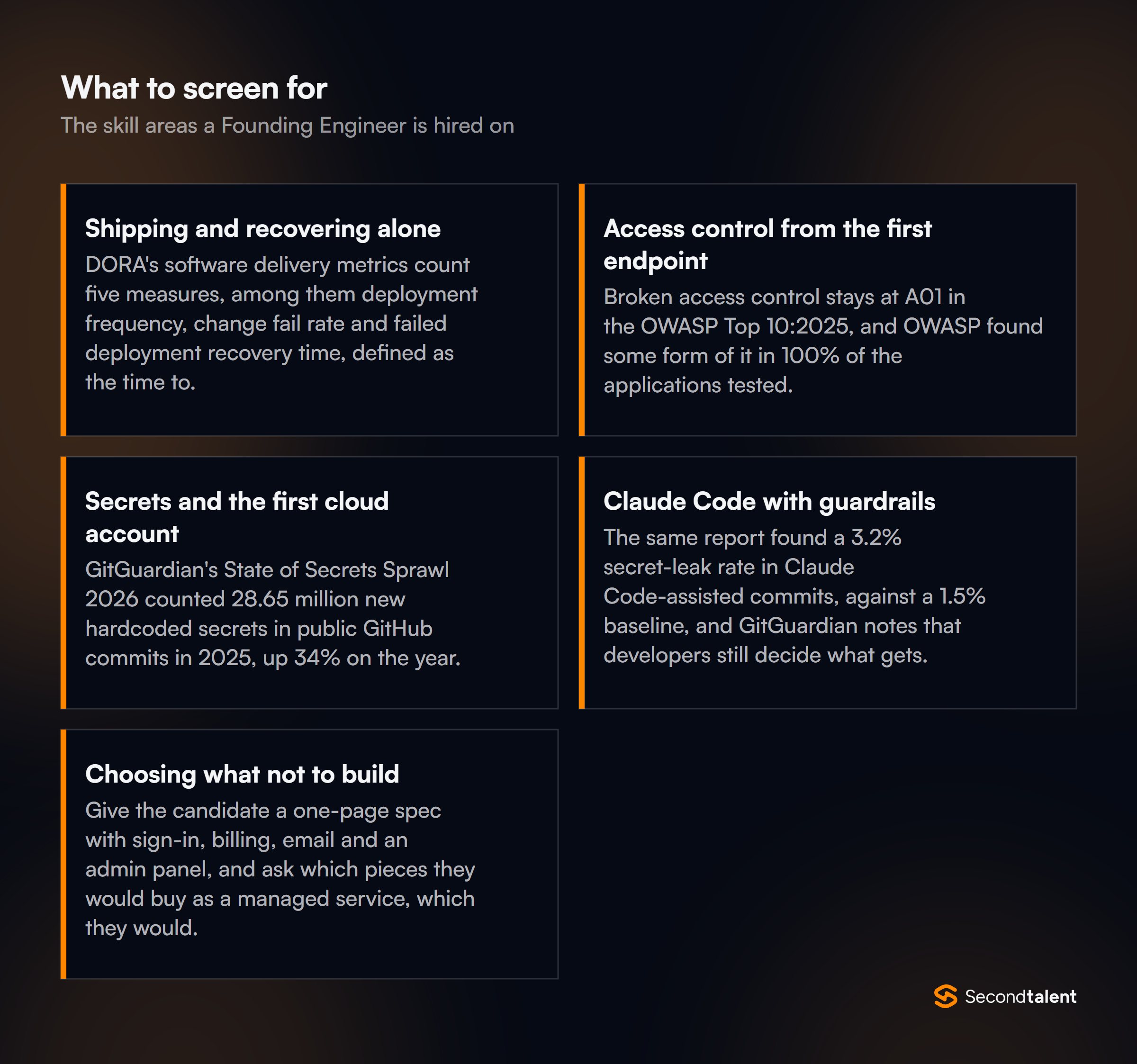
A first engineer has no code reviewer except the founder. In Stack Overflow's 2025 survey, only 3.1% of developers said they highly trust AI output, and 66% named "AI solutions that are almost right, but not quite" as a frustration. Test the habits that replace a senior reviewer.
Shipping and recovering alone
DORA's software delivery metrics count five measures, among them deployment frequency, change fail rate and failed deployment recovery time, defined as the time to recover from a deployment that needs immediate intervention. Ask the candidate for those three numbers on their last product, and who got paged when a deploy failed.
Access control from the first endpoint
Broken access control stays at A01 in the OWASP Top 10:2025, and OWASP found some form of it in 100% of the applications tested. Server-side request forgery now sits inside the same category. Give the candidate an endpoint that checks for a signed-in user but not whether that user owns the record, and see how fast they spot it.
Secrets and the first cloud account
GitGuardian's State of Secrets Sprawl 2026 counted 28.65 million new hardcoded secrets in public GitHub commits in 2025, up 34% on the year. Of the credentials it confirmed valid in 2022, more than 64% still worked in January 2026. Ask where the candidate would keep the database password on day one, and how they would rotate it when engineer two joins.
Claude Code with guardrails
The same report found a 3.2% secret-leak rate in Claude Code-assisted commits, against a 1.5% baseline, and GitGuardian notes that developers still decide what gets pushed. Claude Code checks its permission rules in a fixed order: deny, then ask, then allow. Its memory documentation says CLAUDE.md files are context, not enforced configuration, and points to a PreToolUse hook to block an action outright. Ask which commands the candidate denies and which hook they run.
Budget the tool as well: Anthropic's cost documentation puts average enterprise spend around $13 per developer per active day. Our Claude Code developer page covers engineers hired for that skill alone.
Choosing what not to build
Give the candidate a one-page spec with sign-in, billing, email and an admin panel, and ask which pieces they would buy as a managed service, which they would build, and what each choice costs to reverse at 20 customers. A candidate who wants to write an auth system in week one fails this exercise.
Contractor or Employer of Record for a US Company
Software is not one of the nine categories of commissioned work that can be "work made for hire" under 17 U.S.C. § 101, and § 204(a) requires a copyright transfer to be in writing and signed. Sign the assignment before the first commit, and name the repository, the infrastructure code and the prompts in it.
IRS Publication 515 says the place where services are performed determines the source of the income, so an engineer working from Taipei or Manila earns foreign-source income. A foreign individual gives the payer Form W-8BEN to certify foreign status.
Equity needs its own check. Under 26 U.S.C. § 422, an incentive stock option keeps its tax treatment only if the holder was an employee of the granting corporation, or its parent or subsidiary, from grant until three months before exercise. A contractor does not meet that, and neither does an engineer employed by an EOR's local entity.
Options granted outside an ISO plan are nonstatutory stock options, in the IRS summary of the two types. On vesting, Carta's Peter Walker writes that the 4-year schedule with a 1-year cliff is still the norm "almost always".
Local law applies its own employment test. Philippine courts use the four-fold test, and in Atok Big Wedge v. Gison the Supreme Court called the power of control the most important of the four. Article 13 of Vietnam's 2019 Labor Code treats an agreement under another name as a labor contract when it covers a paid job, wages and one party's management and supervision.
A founding engineer who works your hours on your roadmap fits both tests. That is the case an Employer of Record covers, and our EOR, PEO and contractor comparison sets out the trade-offs. This is a summary, not legal advice.
|
Independent contractor |
Employer of Record |
| Legal employer |
None; the engineer invoices you |
The EOR's local entity |
| US paperwork |
Form W-8BEN from the engineer |
Service agreement with the EOR |
| IP |
Written assignment covering the codebase, infrastructure code and prompts |
Assignment in the employment contract and your EOR agreement |
| Local labor law |
Classification risk if you control hours and methods |
Night premiums, public holidays and leave apply |
| Pay currency |
Agreed in the contract, often USD |
Local currency; Vietnam's Labor Code states wages in dong (Article 95) |
English Level and Working Norms
Malaysia's IT workers score 590 on the EF English Proficiency Index 2025, the highest IT job-function score among the markets below. A founding engineer writes the documents engineer two learns from: the README, the setup notes and the record of why the team picked its database. The index ranks 123 countries and regions, against a global average of 488.
| Country |
EF EPI 2025 score |
World rank (of 123) |
IT job-function score |
| Malaysia |
581 |
24 |
590 |
| Philippines |
569 |
28 |
581 |
| Vietnam |
500 |
64 |
500 |
| Indonesia |
471 |
80 |
523 |
EF's country pages for Malaysia and Vietnam show the scores in full. EF EPI 2025 has no page for Taiwan or Singapore, so test written English for those two markets in the assessment.
Ask each finalist for a one-page decision record on a choice from their last project. It shows how the engineer will explain a stack decision to an investor's technical adviser or a later hire.
Plan launches around both calendars. Thanksgiving on 26 November 2026 is a working day in Asia, so the engineer can watch a launch while your US side is off. Vietnam's Labor Code gives five paid days for Lunar New Year (Article 112), in late January or February, so keep a Vietnam-based founding engineer's releases out of that week.
Founding Engineer Hiring Process
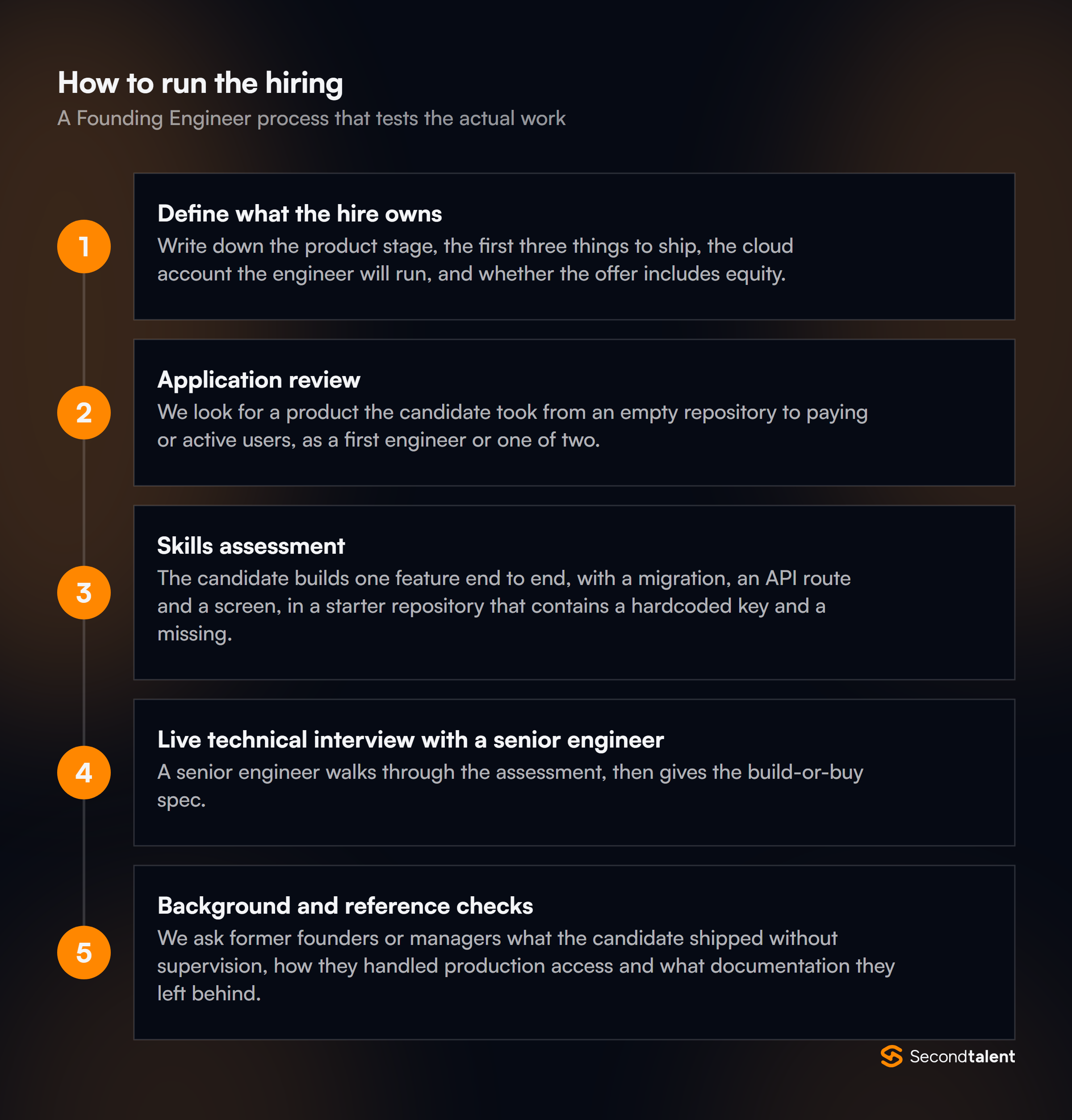
Second Talent's vetting covers stages 2 to 5 before you see a profile. Our full-stack interview guide has question sets for your own final round.
Stage 1: Define what the hire owns
Write down the product stage, the first three things to ship, the cloud account the engineer will run, and whether the offer includes equity. Name the founder who reviews code and the daily overlap that founder needs.
Stage 2: Application review
We look for a product the candidate took from an empty repository to paying or active users, as a first engineer or one of two. A long tenure on a large team's single service does not count on its own.
Stage 3: Skills assessment
The candidate builds one feature end to end, with a migration, an API route and a screen, in a starter repository that contains a hardcoded key and a missing ownership check. We score the fixes and the pull request description along with the code.
Stage 4: Live technical interview with a senior engineer
A senior engineer walks through the assessment, then gives the build-or-buy spec. The questions cover what the candidate would hand to a managed service, how they would roll back a failed deploy while the founder sleeps, and which Claude Code permissions they set.
Stage 5: Background and reference checks
We ask former founders or managers what the candidate shipped without supervision, how they handled production access and what documentation they left behind. You then sign the IP assignment, as a contractor agreement or through an EOR.
Our product engineer page covers the role for teams that need an engineer closer to customers.
Hire Founding Engineers from Asia with Second Talent
We shortlist 6-8 candidates within 24 hours from 100,000+ pre-vetted engineers, accepting only the top 1% of applicants. Founding engineers cost from $4,000 a month, with $0 upfront, no lock-in and 4-6 hours of daily overlap with US hours. We handle contracts, payroll and equipment, with compliant EOR contracts and payroll in 9 Asian markets.
Our pricing page sets out subscription, direct-hire and EOR pricing. The WELL3 case study shows a blockchain-powered wellness platform hiring a lead engineer in Hong Kong through us as the first step toward its offshore engineering team, which saved about 2 months of recruitment time and HR expense.