TL;DR: China's software and IT sector paid an average 248,752 yuan in 2025, about $3,100 a month (NBS), against a $11,330 median for a US software developer (BLS, May 2025). Second Talent quotes each China hire per role, employs them through our entity in China and sends a shortlist in 24 hours.
Since 8 April 2025, giving an engineer who lives in China access to bulk US sensitive personal data has been a restricted transaction under the Justice Department's Data Security Program, allowed only under CISA's security requirements. Decide what the hire can reach before you hire.
Key takeaways
- Chinese employers in Shanghai pay 25.7% to 27.4% of salary on top in social insurance, before the housing fund.
- Since 1 September 2025, Chinese courts treat an employee's agreement to waive social insurance as void, which ends the cheap informal contractor route.
- Anthropic and OpenAI do not offer their APIs in mainland China, so the AI coding tools your US team uses may be off the table.
- The 2027 Spring Festival break runs from 5 to 13 February, with two Sunday make-up workdays around it.
How much does a developer in China cost compared with the US?
The official benchmark is low and the market for strong engineers is not. The National Bureau of Statistics puts the 2025 average annual wage in information transmission, software and IT services at 248,752 yuan for non-private employers, the highest of any sector, and 128,166 yuan for private ones. That average covers the whole sector, from help desks to platform engineers.
Our software engineer salaries for China sets monthly salary in yuan. Dollar figures use ExchangeRate-API's mid-market rate of 6.6933 yuan to the dollar on 22 November 2026, rounded to the nearest $10.
| Level (Second Talent Tech Salaries) |
Monthly salary, yuan |
Monthly salary, USD |
| Junior, 0 to 2 years |
¥15,000 to ¥25,000 |
$2,240 to $3,740 |
| Mid-level, 3 to 5 years |
¥25,000 to ¥40,000 |
$3,740 to $5,980 |
| Senior, 5 to 8 years |
¥40,000 to ¥65,000 |
$5,980 to $9,710 |
| Lead, 8+ years |
¥65,000 to ¥100,000+ |
$9,710 to $14,940+ |
| Remote, working for foreign companies |
¥40,000 to ¥115,000+ |
$5,980 to $17,180+ |
Beijing pays most on the card, at ¥30,000 to ¥80,000 a month, ahead of Shanghai, Shenzhen and Hangzhou.
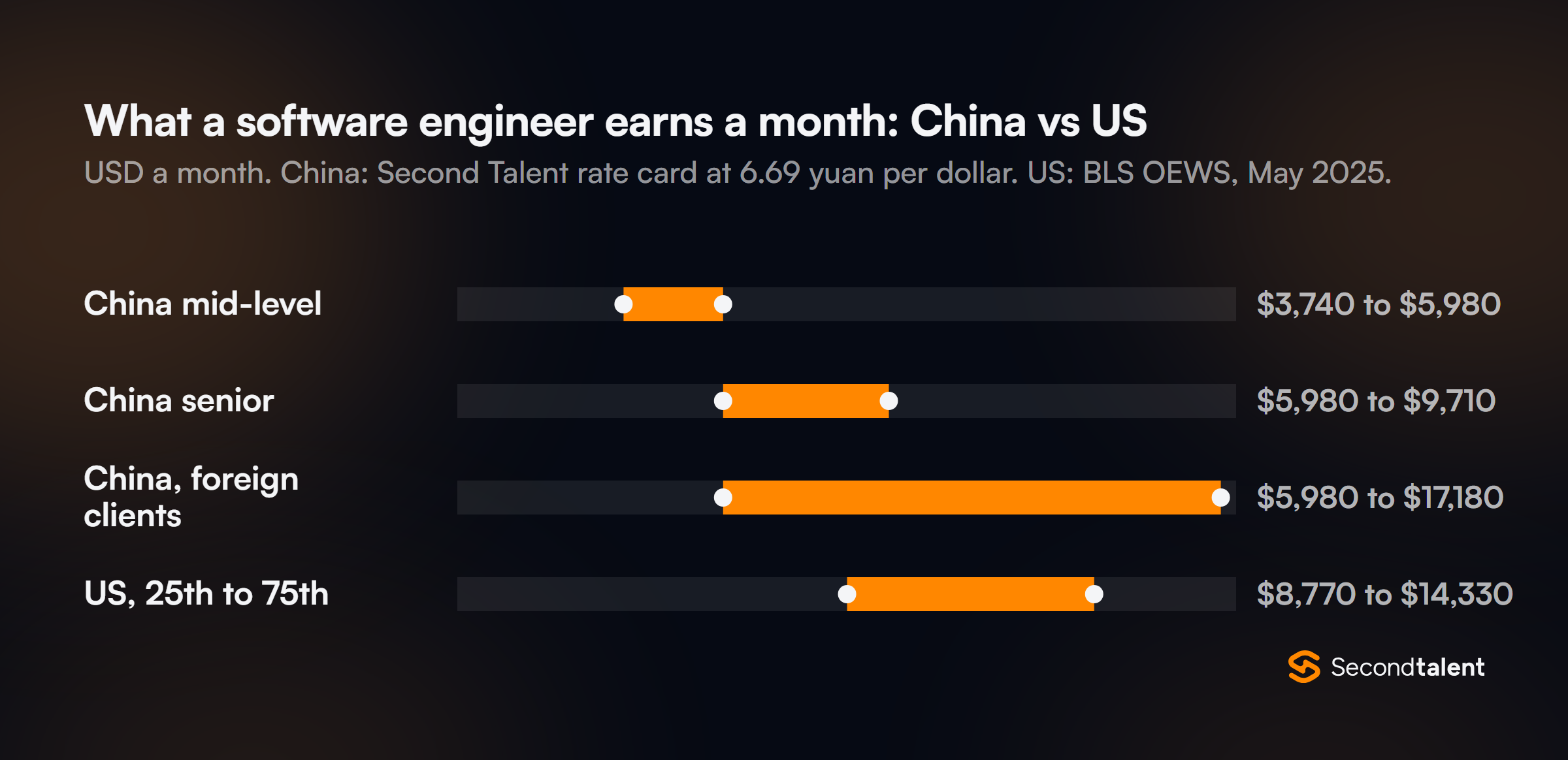
On the US side, the BLS OEWS profile for Software Developers (15-1252) puts the May 2025 median at $135,980 a year, with the middle half at $8,770 to $14,330 a month.
The OEWS metro tables show medians of $186,640 in San Francisco, $166,830 in New York and $134,120 in Austin.
Benefits take $14.07 of every $46.89 an hour that private employers spend, per the BLS Employer Costs for Employee Compensation release for June 2026, so a median US developer costs roughly $16,190 a month (our estimate).
A senior engineer on our China card earns 53% to 86% of the US median salary (our arithmetic), and a strong candidate who already works for foreign clients can price above it.
Second Talent's pricing starts from $25 USD/hr (billed monthly), 160 hours for $3,999/mo, but we quote a China engineer per role and seniority, above that floor for senior hires.
For contract work, our China cost guide puts mid-level freelance developers at $35 to $82 an hour.
What US rules apply when you hire a developer in China?
Four sets of US rules reach a China hire. None bans it; each changes what you may share and with whom.
- Export controls. Under 15 CFR 734.13, sending technology or source code out of the US is an export. Most commercial app code ships to China without a license, and published open source falls outside the rules under § 734.7. Code or technical data in controlled areas, such as advanced semiconductors, high-performance computing or some encryption, can need a license from BIS. Classify your repository before you grant access, not after.
- Screening lists. Run the candidate's current employer, and any vendor in the chain, through the Consolidated Screening List, which combines the BIS Entity List, OFAC's SDN list and other federal lists. A developer moonlighting for a listed company is a problem for you.
- Data access. The Data Security Program, at 28 CFR Part 202, names China as a country of concern and counts any individual primarily resident there as a covered person. Employment and vendor agreements that give such a person access to bulk data become restricted transactions. The bulk thresholds are low: personal health or financial data on more than 10,000 US persons, precise geolocation on more than 1,000 devices, or covered personal identifiers on more than 100,000, counted over 12 months.
- Outbound investment. Hiring through an employer of record is not an investment. Opening your own subsidiary is. Treasury's outbound rules, in force since 2 January 2025, cover AI, semiconductors and quantum, and 31 CFR 850.210 counts developing operations in China that create a covered foreign person as a covered transaction.
The practical answer for most product teams is to keep production data with US personal information out of reach: synthetic or masked data in development, no production database credentials, and access logs you can show an auditor. This is a summary, not legal advice; have counsel review a hire that touches controlled technology or regulated data.
How do the Great Firewall and China's data rules affect a remote team?
The State Department's 2023 human rights report on China lists Google, YouTube, WhatsApp, Signal and Wikipedia among blocked sites, and says major international companies may use approved VPNs while many smaller businesses may not. Plan the toolchain before day one:
- Collaboration. Google Workspace accounts will not work without a VPN. Pick chat, docs and video tools that load from China, and test them from there during the trial week.
- AI coding tools. Anthropic's supported regions and OpenAI's API country list both exclude mainland China. Anthropic also bars entities more than 50% owned by companies headquartered there. Check your vendors' terms before you hand a China-based engineer a seat.
- Package and image pulls. Container and package downloads from servers abroad can be slow or time out, so budget for a registry mirror your company controls and for CI that runs in your own cloud region.
China's own rules govern data leaving China, including HR files on your engineer. The 2024 cross-border data provisions exempt transfers needed for cross-border human resources management under lawful labor rules, which can cover the payroll and performance data an employer of record shares with you.
Who owns the code a developer in China writes?
China's Regulations on the Protection of Computer Software, Article 13, give the employer copyright in software an employee writes as an assigned job duty, as a foreseeable result of the job, or mainly with the employer's resources.
The employer is whoever signs the labor contract: your subsidiary, or an employer of record that then assigns the IP to you by contract.
On the US side, software is not one of the nine categories of commissioned work that can be "work made for hire" under 17 U.S.C. § 101, so a contractor's code reaches you only through a signed writing under § 204(a).
China also controls some technology leaving the country. In August 2020 its catalogue of technologies restricted from export added personalized recommendation technology based on data analysis, and the Ministry of Commerce opened a consultation on a further revision on 16 October 2026. Ordinary product code is not on the list; a recommender or speech model built in China might be.
Should you use an employer of record, open a WFOE or hire a contractor in China?
A US company without a Chinese entity cannot sign a local labor contract or pay social insurance. Whoever employs the developer takes on the Labor Contract Law:
- Written contract within one month. Article 82 makes the employer pay double wages for each month without one.
- Probation. Article 19 caps it at six months, and only on contracts of three years or longer.
- Non-competes. Articles 23 and 24 limit them to two years, with monthly compensation paid during the restriction.
- Severance. Article 47 sets one month's wage per year of service.
- Overtime. The Labor Law caps it at 36 hours a month and pays 150% on workdays, 200% on rest days and 300% on statutory holidays.
- Social insurance. PwC's China tax summary lists employer rates in Shanghai of 16% for pension, 9% for medical, 0.5% for unemployment and 0.2% to 1.9% for work injury, valid at 30 June 2026.
Paying a full-time developer as a contractor to skip those costs no longer holds up. Under the Supreme People's Court's Interpretation II on labor disputes, effective 1 September 2025, a waiver of social insurance is void and the employee can resign and claim severance.
A WFOE, a wholly foreign-owned company, gives you your own employer. Under the revised Company Law in force since 1 July 2024, shareholders must pay in subscribed capital within five years, and an AI or chip-design subsidiary can fall under Treasury's outbound rules.
|
Direct contractor |
Your own WFOE |
Employer of record |
Second Talent |
| Who employs the developer |
Nobody; they invoice you |
Your subsidiary |
The EOR's local entity |
Our entity in China |
| Who finds the developer |
You |
You |
You |
We do: 6 to 8 pre-vetted profiles in 24 hours |
| Social insurance and housing fund |
Not paid; void-waiver risk |
You run payroll |
The EOR |
Included in the monthly fee |
| Who owns the code |
The developer, until a signed assignment |
You |
You, through the contracts |
You; IP assignment and NDAs in the contract |
| US outbound investment review |
No |
Possible for AI, chips, quantum |
No |
No |
| If the hire fails |
You restart the search |
You restart the search |
You restart the search |
One free replacement within 90 days |
Our employer of record in China covers a developer you have already found, and our China payroll, benefits and tax guide has the city detail. This is a summary, not legal advice.
Should you outsource software development to China or hire your own developers?
An outsourcing firm in China delivers a project with its own team, process and code ownership terms, and you see the output. A dedicated developer joins your repository, your standups and your pull request reviews, and you see every commit.
Outsourcing suits a defined build with a fixed end.
For code you will maintain for years, or code that touches data covered by the rules above, a developer on your team gives you the access control and the audit trail. Our comparison of platforms to hire engineers from China covers the other routes.
How many hours do developers in China overlap with ET, CT and PT?
China keeps UTC+8 all year. Under US standard time, which runs until 14 March 2027 per NIST, Beijing and Shanghai are 13 hours ahead of ET, 14 ahead of CT and 16 ahead of PT; each gap shrinks by an hour in US summer.
A 9:00 pm to 6:00 am China shift covers 8:00 am to 5:00 pm ET in winter. A 5:00 pm to 2:00 am shift gives four hours with New York, three with Chicago and one with San Francisco.
We agree the schedule with each engineer before the offer, and our placements get 4 to 6 hours of daily overlap with US business hours.
Plan releases around the State Council's 2027 holiday schedule: Spring Festival runs from 5 to 13 February, Labor Day from 1 to 5 May and National Day from 1 to 7 October, with weekend make-up days on 31 January, 14 February, 8 May, 26 September and 9 October.
How fast can you hire developers in China with Second Talent?
The first shortlist arrives within 24 hours of a complete brief: 6 to 8 pre-vetted profiles from a pool of 100,000+ pre-vetted developers. We have placed 8,000+ engineers for 200+ companies.
- Brief. You list the stack, the seniority, the hours to cover, and the data and repositories the hire will touch, so export and data questions surface early.
- Vetting. We review the candidate's work, run a skills assessment and a live interview with a senior engineer, and check references and current employment.
- Your interviews. You meet the shortlist in a US morning slot that falls in the China evening.
- Offer and notice. We issue a Chinese labor contract with IP assignment, and the developer serves their notice period.
- Start. We run payroll, social insurance, the housing fund and holidays, and bill one monthly invoice in USD.
There are no upfront fees. Pricing and the replacement guarantee are on our pricing page. Tell us what you need and the shortlist follows. For narrower briefs, see our pages for AI engineers and LLM engineers in China.