TL;DR: Ownership of work product travels from the engineer to you through three separate assignments, and the one you negotiate is the last of them. US work-made-for-hire covers software only through the employment route, since software is not among the nine commissioned categories. Moral rights often cannot be assigned at all and need a waiver instead. Check that the assignment is effective where the engineer sits, that it covers work not yet created, and that you know which entity employs them.
Buyers spend weeks on rate cards and minutes on the IP clause. That clause decides who owns the code, the infrastructure definitions, the documentation, and increasingly the prompts and evaluation sets produced during the engagement.
What changed here. The legal analysis on this page was sound and the sourcing was not. It attributed claims to a WIPO study on IP in software outsourcing, an SIA contract benchmarks report and a US Chamber IP index, including a figure that 38 percent of cross-border staffing contracts have IP gaps that would not survive litigation. Those sources do not exist as cited. Everything below now rests on primary material, and the 38 percent figure has been removed rather than replaced, because no real equivalent exists and the argument never needed one.
How ownership actually reaches you
In almost every jurisdiction the engineer who writes the code is the original author and holds the original copyright. Ownership reaches you through a chain of written assignments, and the chain has three links.
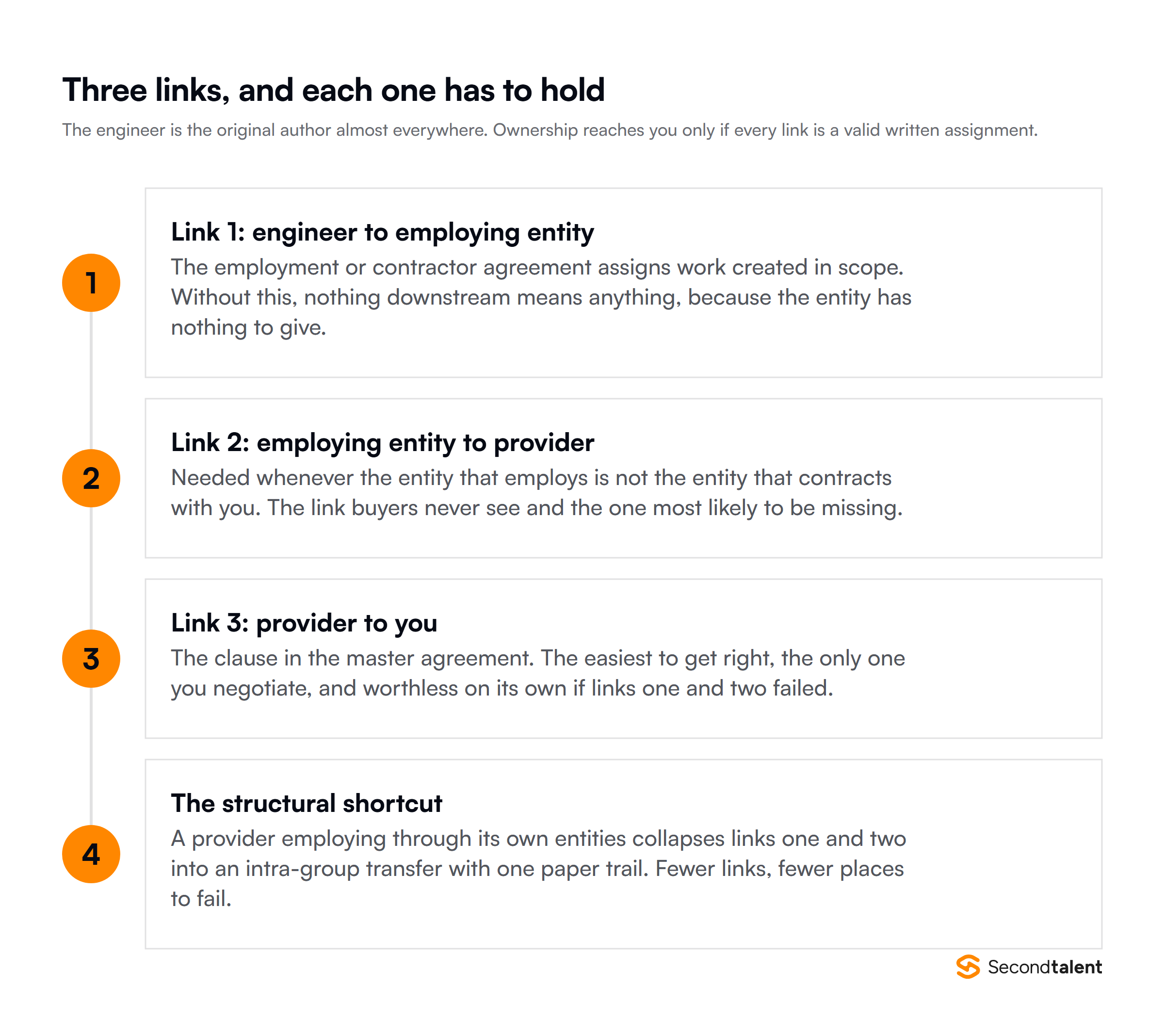
Link one runs from the engineer to whichever entity employs or engages them, through their employment contract. Without a valid link one, nothing downstream means anything, because the entity has nothing to pass on. Most disputes that get as far as a lawyer trace back to here.
Link two runs from that employing entity to the provider you contracted with, and only exists as a separate link when those are different companies. It is the link buyers never see. Where a provider engages engineers through third-party employment partners, this link depends on that partner’s own paperwork and on their continued cooperation.
Link three is the clause in your master agreement. It is the easiest of the three to get right, the only one anybody negotiates, and it cannot transfer anything the provider did not validly acquire through the first two.
A provider that employs engineers through entities it owns collapses links one and two into an intra-group transfer with a single paper trail. That is a structural reduction in risk rather than a contractual one, and it is worth asking about directly. Our guide to worker classification in cross-border IT staffing covers the same structural question from the tax and employment side.
Work made for hire, and its limits
Work made for hire is a US doctrine, and it reaches software through only one of its two routes.
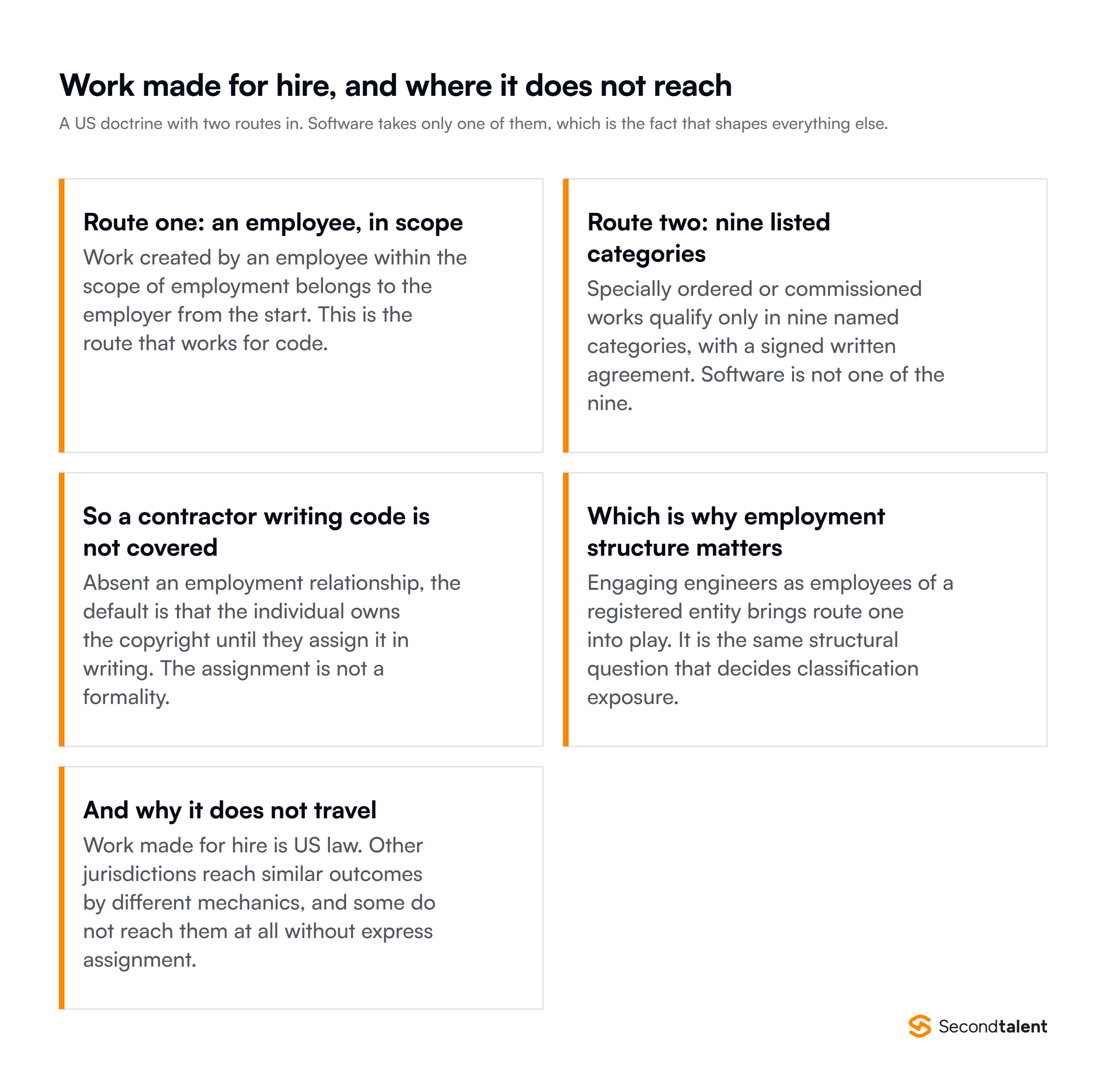
The US Copyright Office circular on works made for hire sets out both. A work qualifies either when it is created by an employee within the scope of employment, or when it is specially ordered or commissioned, falls into one of nine listed categories, and the parties sign a written agreement saying so.
The nine categories are a contribution to a collective work, part of a motion picture or audiovisual work, a translation, a supplementary work, a compilation, an instructional text, a test, answer material for a test, and an atlas. Software is not among them, and the same conclusion follows from the definition in section 101 of the Copyright Act.
So for code, the employment route is the one that works. An independent contractor writing software owns the copyright by default until they assign it in writing, and a contract that labels the arrangement work made for hire does not change that on its own.
This is where IP and employment structure turn out to be the same question. Engaging engineers as employees of a registered entity brings the employment route into play, and the IRS common-law test that decides whether someone is an employee weighs the same behavioural and financial control you are exercising in a staff augmentation engagement anyway.
None of this travels. Work made for hire is US law, and other jurisdictions reach comparable results by different mechanics or do not reach them at all without an express assignment.
Moral rights
Economic rights can be sold. Moral rights, in much of the world, cannot be, and a clause that purports to assign them is simply ineffective where that is true.
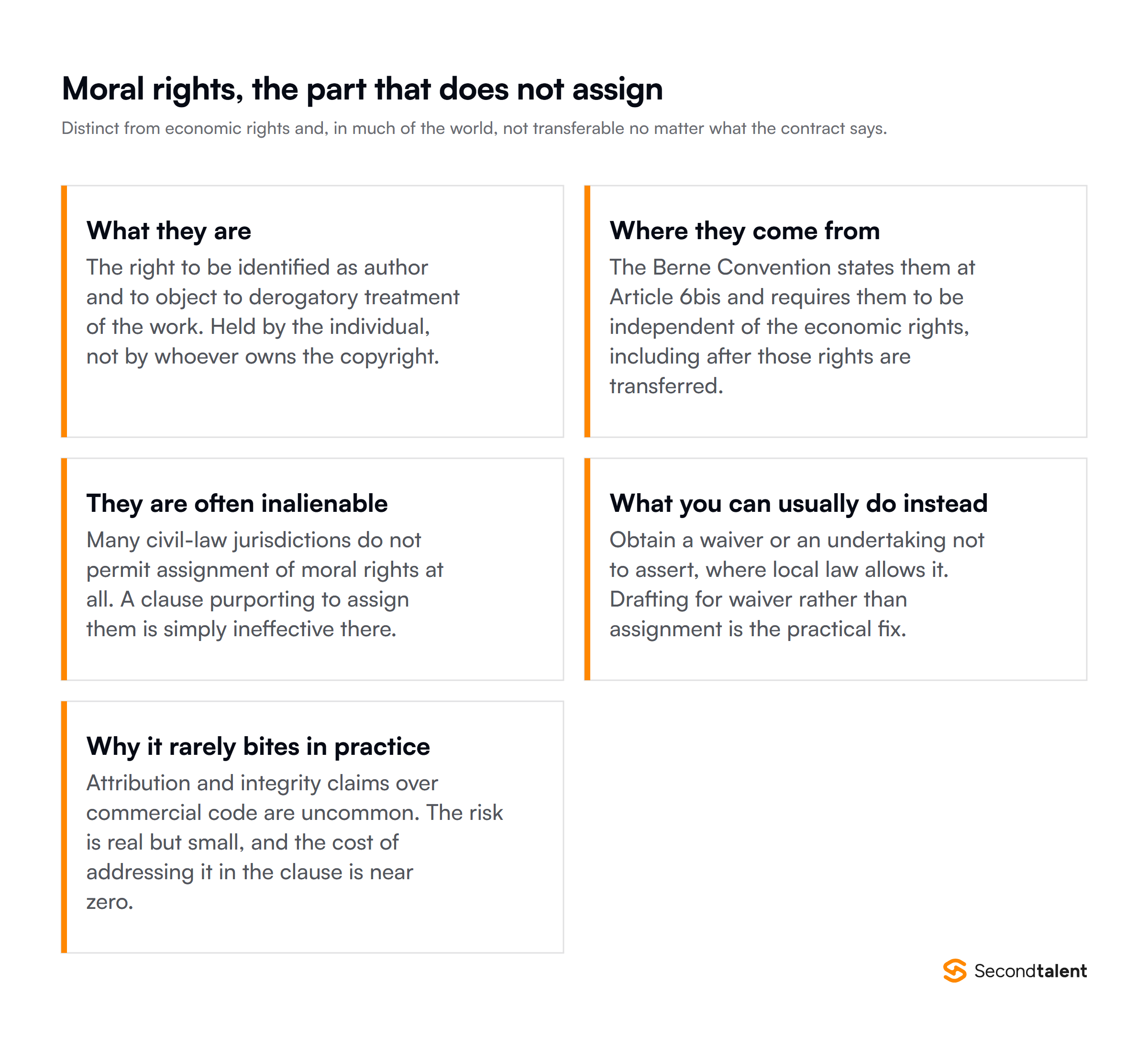
These are the author’s rights to be identified as the author and to object to derogatory treatment of the work. The Berne Convention, which has more than 180 contracting parties, states them at Article 6bis and requires them to be independent of the economic rights and to remain with the author even after those rights are transferred.
Common-law jurisdictions generally permit a waiver. Many civil-law jurisdictions do not permit assignment of moral rights at all, which is why the practical drafting move is a waiver where local law allows one and an undertaking not to assert where it does not.
In commercial software this rarely bites. Attribution and integrity claims over ordinary business code are uncommon, and the reason to handle it is that doing so costs a sentence.
Background and foreground IP
The distinction most staffing agreements handle badly, usually by not making it at all and assigning everything.
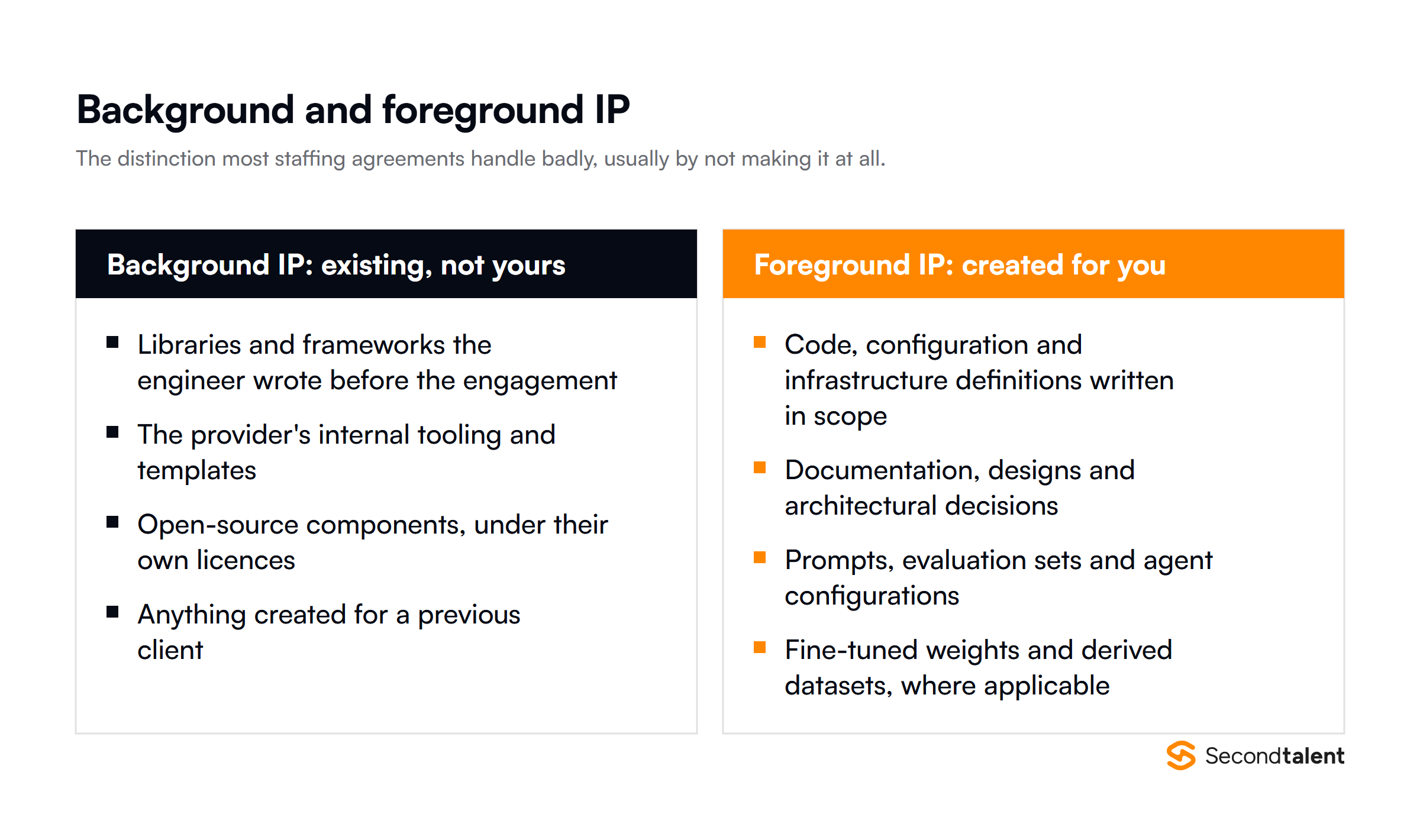
Background IP existed before the engagement or belongs to somebody else: the engineer’s own prior libraries, the provider’s internal tooling, open-source components under their own licences, work created for another client. A clause assigning all of it to you is asking the provider to give away things it does not own, which means the clause fails rather than that you gain anything.
Foreground IP is what gets created for you in scope, and it is what the assignment should actually cover. In 2026 that list is longer than it used to be: alongside code and documentation it now routinely includes prompts, evaluation sets, agent configurations and any fine-tuned weights or derived datasets. Agreements drafted three years ago frequently do not mention any of them, and a court reading a list of examples will notice what is absent.
The workable shape is foreground assigned, background licensed. A perpetual, irrevocable, royalty-free licence to whatever background material is embedded in the delivered work gives you what you actually need, which is the ability to use, modify and transfer what you paid for.
The gaps that survive a read-through
Each of these appears in agreements that look complete.
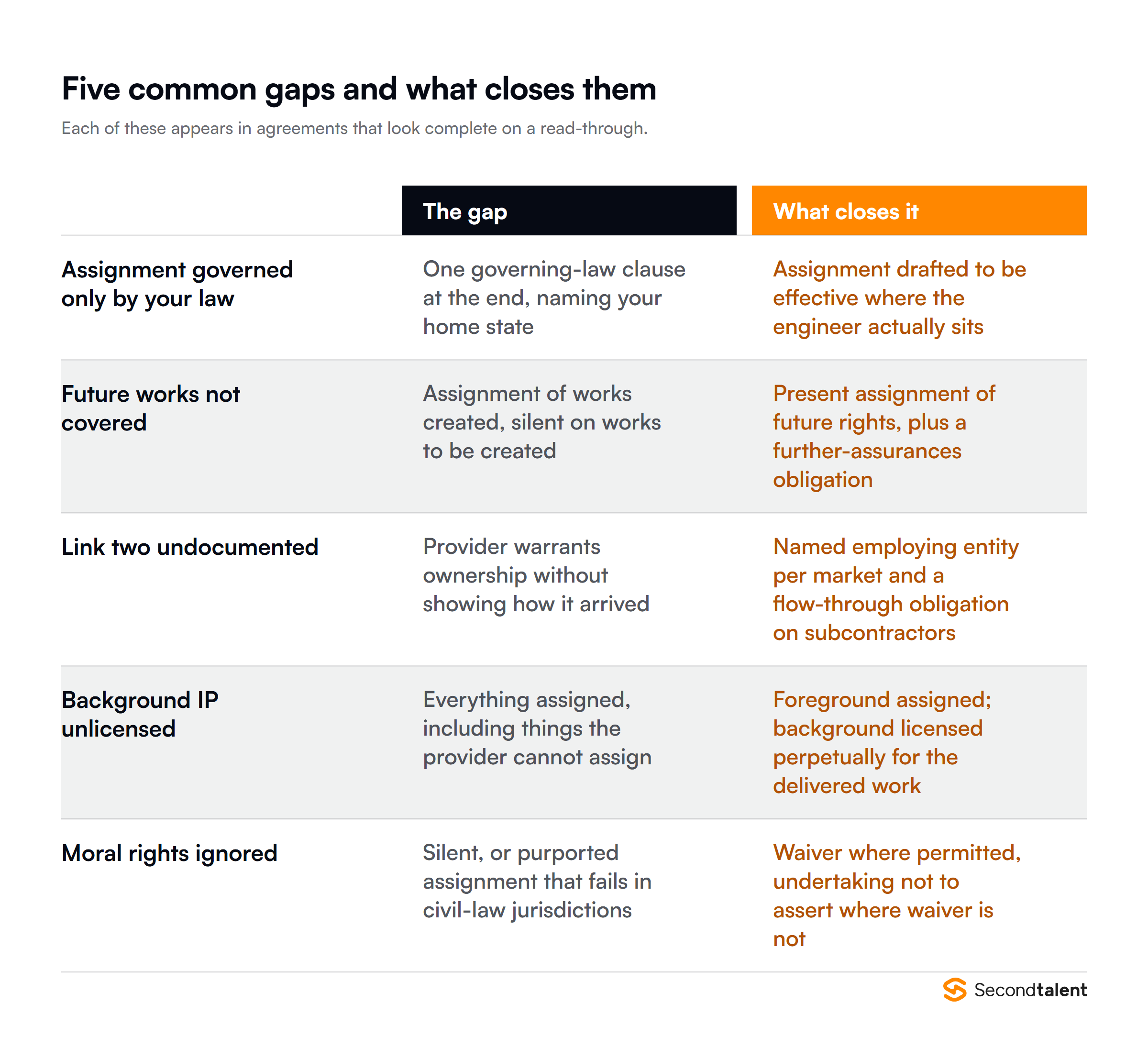
The most common is an assignment governed only by your own law. Assignment of intellectual property is an area where local mandatory rules frequently apply regardless of what the parties chose, so a clause drafted for Delaware may not operate on an engineer in a jurisdiction whose law governs how their rights transfer. The fix is to draft the assignment to be effective where the engineer actually sits.
The second is silence about work not yet created. An assignment of works created transfers what exists at signature. What you want is a present assignment of future rights together with a further-assurances obligation, so that signatures can still be obtained afterwards if a formality is needed.
The third is an undocumented link two. A provider warranting that it owns everything is useful; a provider naming the employing entity per market and accepting a flow-through obligation on any subcontractor is considerably more useful. Our breakdown of the 12 clauses that matter in an IT staffing MSA covers how this sits alongside the rest of the agreement.
What to verify before signing
Five checks, all answerable in writing, and all of which a provider who has thought about this will answer within a day.
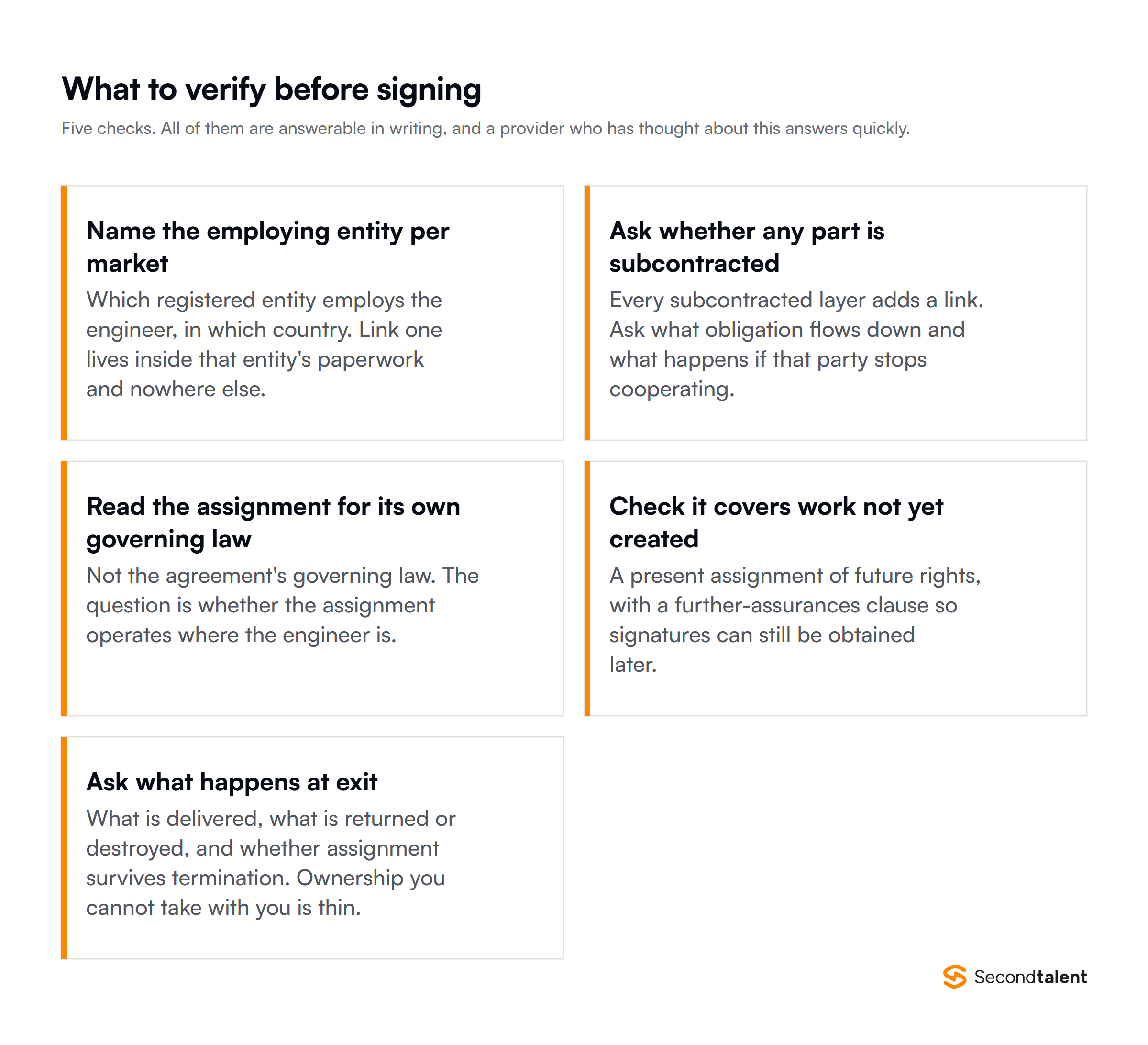
Name the employing entity in each market, and ask whether any part of the service is subcontracted. Read the assignment clause specifically for whether it addresses its own governing law rather than inheriting the agreement’s. Confirm it covers work not yet created. And ask what happens at exit, because ownership you cannot practically take with you is thin ownership.
Where personal data is in scope alongside the work product, the processing terms are prescribed rather than negotiable under GDPR Article 28, and a provider treating those as optional has told you something about their regulated experience. Our checklist on evaluating IT staffing companies covers where these questions sit in the wider diligence, and the 15 questions to ask any provider covers the shorter version of the conversation.
Common questions
Is a signed NDA enough to protect IP?
No. Confidentiality and ownership are different things. An NDA restricts disclosure of information; it does not transfer copyright in anything, and an engineer can hold copyright in code they are contractually forbidden to discuss.
Does open-source use in the deliverable create a problem?
Only if nobody tracked it. Components arrive under their own licences and those licences continue to apply whatever your assignment clause says. Ask for a dependency inventory at delivery rather than an assurance that everything is owned.
Who owns work an engineer does outside working hours?
It depends on scope and on local law, and this is one of the areas where jurisdictions differ most. The clause should define scope by reference to the engagement rather than to hours, and unrelated personal projects should sit outside it explicitly.
What about AI-generated code in the deliverable?
Material generated without meaningful human authorship may not attract copyright at all in some jurisdictions, which makes it unowned rather than owned by someone else. In practice this rarely matters for ordinary application code with substantial human involvement, but it is worth the assignment clause covering the whole deliverable rather than the copyright in it alone.
Should we insist on assignment or accept an exclusive licence?
Assignment where you can get it. An exclusive perpetual licence is workable and sometimes the only thing available where local law limits transfers, but it complicates onward sale of the business or the asset, which is exactly when this clause gets read carefully.
Takeaways
- Ownership travels in three links. The one you negotiate is the last and least of them.
- Software is not among the nine commissioned work-for-hire categories. Employment is the route that works.
- Moral rights often cannot be assigned. Draft for waiver where local law allows it.
- Assign foreground IP, license background IP. Assigning everything assigns nothing.
- Check the assignment works where the engineer sits, and that it covers work not yet created.
This is general information about how these arrangements are structured, not legal advice. IP assignment turns on the law of the jurisdiction where the engineer sits, and the clause should be reviewed by a qualified adviser in each market you hire in.
Where to go next
Second Talent employs engineers through licensed entities we own in each market, which collapses the first two links into a single documented transfer, and we will name the entity per market in writing before you sign anything.
Tell us what you are hiring for, or read the IT staffing agreement template for the surrounding contract structure.