TL;DR: Staff augmentation supplies people who work under your direction. Outsourcing supplies a result, with the vendor owning the process. That single split drives every other difference: who carries the outcome, whose tools and repositories get used, where the knowledge ends up, how you negotiate IP, and whether you start in weeks or months. Most mature teams run both, matched to the type of work rather than standardised across the company.
The two terms get used as synonyms in procurement conversations, and the sloppiness costs money in both directions. Buy outsourcing when you needed augmentation and you lose control of a roadmap that was still moving. Buy augmentation when you needed outsourcing and you carry delivery risk nobody budgeted for. This guide sets out the structural differences.
What is the difference between staff augmentation and outsourcing?
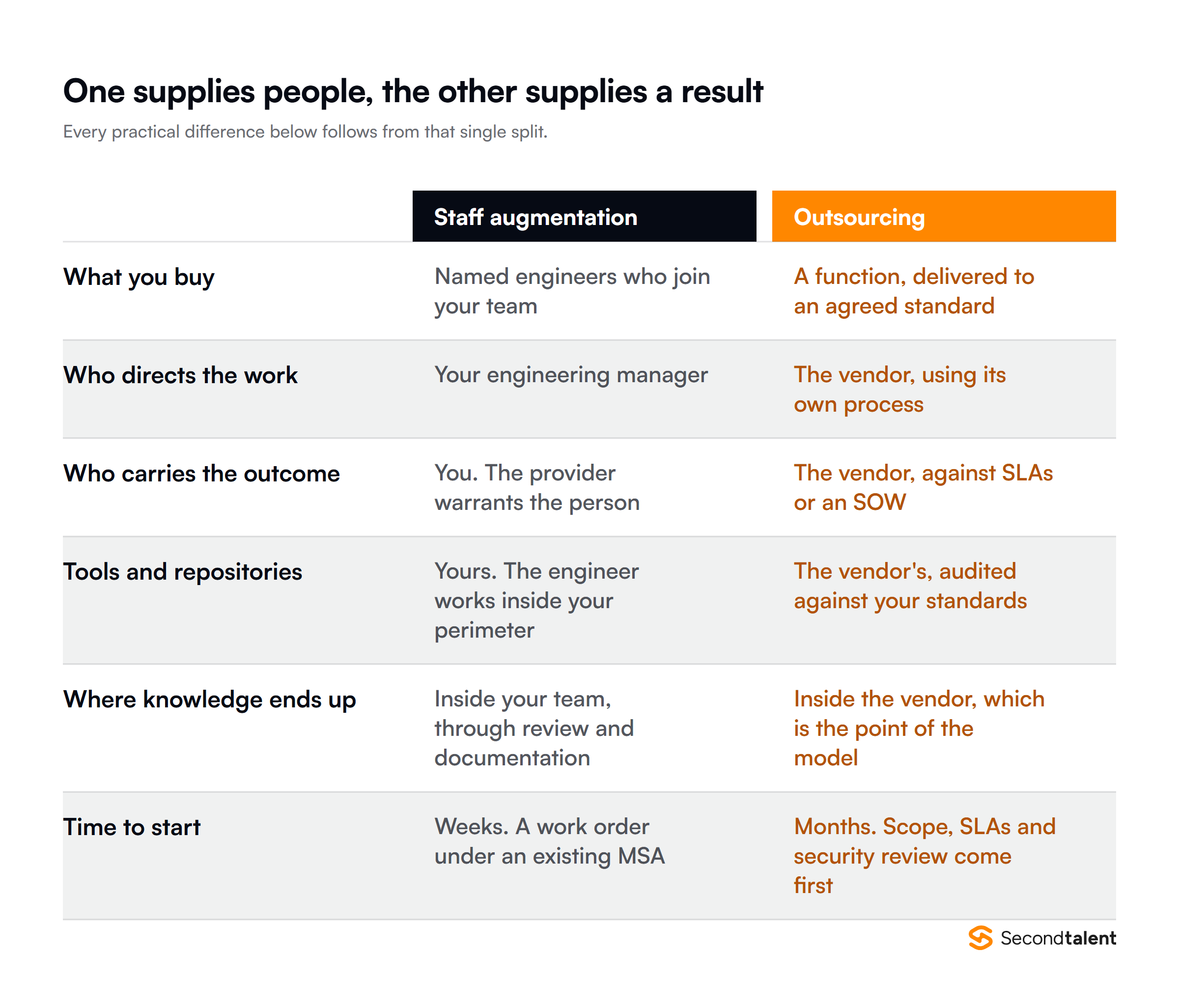
Staff augmentation places named engineers into your team. The provider, or its EOR entity, employs them; they work under your manager, on your tools, inside your process.
Outsourcing hands a defined function to a vendor. The vendor employs the people, sets the process, manages the work and answers for the result under service levels or a statement of work.
You supply direction in the first model and requirements in the second. That is the whole distinction. Everything below follows from it.
When does staff augmentation win?
When you still want to steer the work, and you have someone free to do the steering.
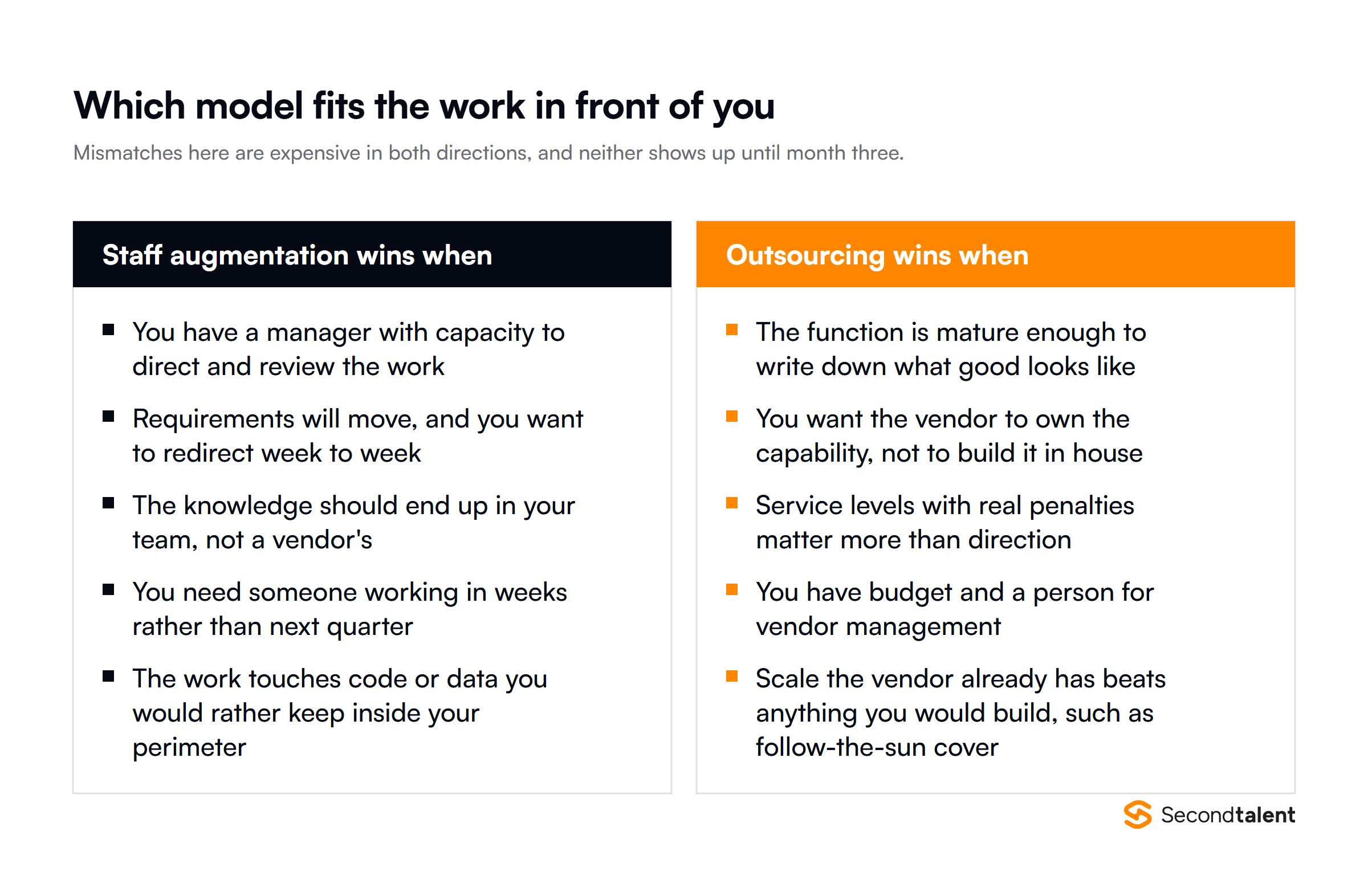
Five conditions point this way. You have a manager or tech lead with capacity to assign and review. Requirements will move, and you want to redirect week to week. The knowledge should end up in your team rather than a vendor’s. You need someone working in weeks. And the work touches code or data you would rather keep inside your own perimeter.
Teams underrate the last one. An augmented engineer commits to your repositories under your account, behind your single sign-on, covered by your access reviews. Nothing leaves your controls, which shortens the security conversation considerably.
When does outsourcing win?
When the function is mature enough to write down, and you would rather not own the capability at all.
Round-the-clock production support, infrastructure operations and payroll processing are the standard examples. They have a definition of good that survives contact with a contract, and they benefit from scale a single in-house team cannot reach.
Outsourcing also wins where service levels with real penalties matter more than direction. If you need a supplier who owes you an uptime number rather than a person who reports to your manager, augmentation cannot give you that. The comparison with managed services covers where that line sits in more detail.
Outsourcing needs a vendor manager, and the budget for one. Somebody has to run the service review, interrogate the reporting rather than accept it, handle change requests and own the renewal. Teams that sign an outsourcing contract without naming that person end up with a vendor who reports on whatever is convenient to measure.
How do IP and access differ?
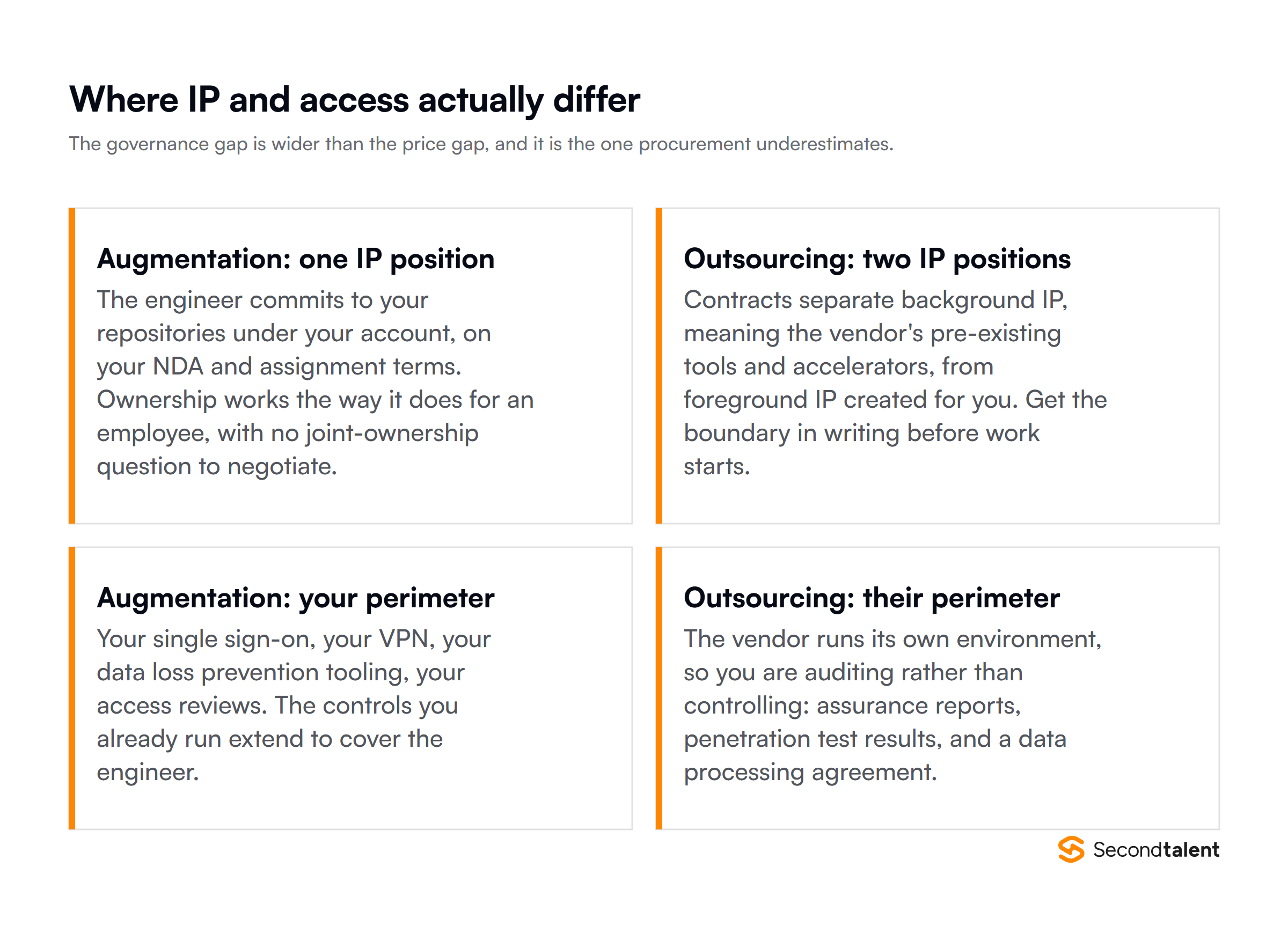
Augmentation gives you one intellectual property position. Outsourcing gives you two, and the boundary between them is negotiable.
With an augmented engineer, ownership works the way it does for an employee. They commit under your account, sign your assignment terms, and there is no joint-ownership question to resolve.
Outsourcing contracts separate background IP, meaning the vendor’s pre-existing tools, frameworks and accelerators, from foreground IP, meaning what they build for you. Both definitions need to be in writing before work starts, because a vendor whose accelerator is woven through your deliverable has a claim you did not intend to grant.
Assignment is also jurisdictional. First ownership of a work differs by country under the Berne Convention framework, so an assignment clause drafted only under your own law may not do what you expect where the engineer sits. Our guide to IP assignment in IT staffing contracts covers the jurisdictional detail.
Access control splits the same way. An augmented engineer sits inside your perimeter. A vendor runs its own, which means you are auditing rather than controlling: assurance reports such as the AICPA SOC suite, penetration test results, and a data processing agreement covering any personal data.
Why does outsourcing take longer to start?
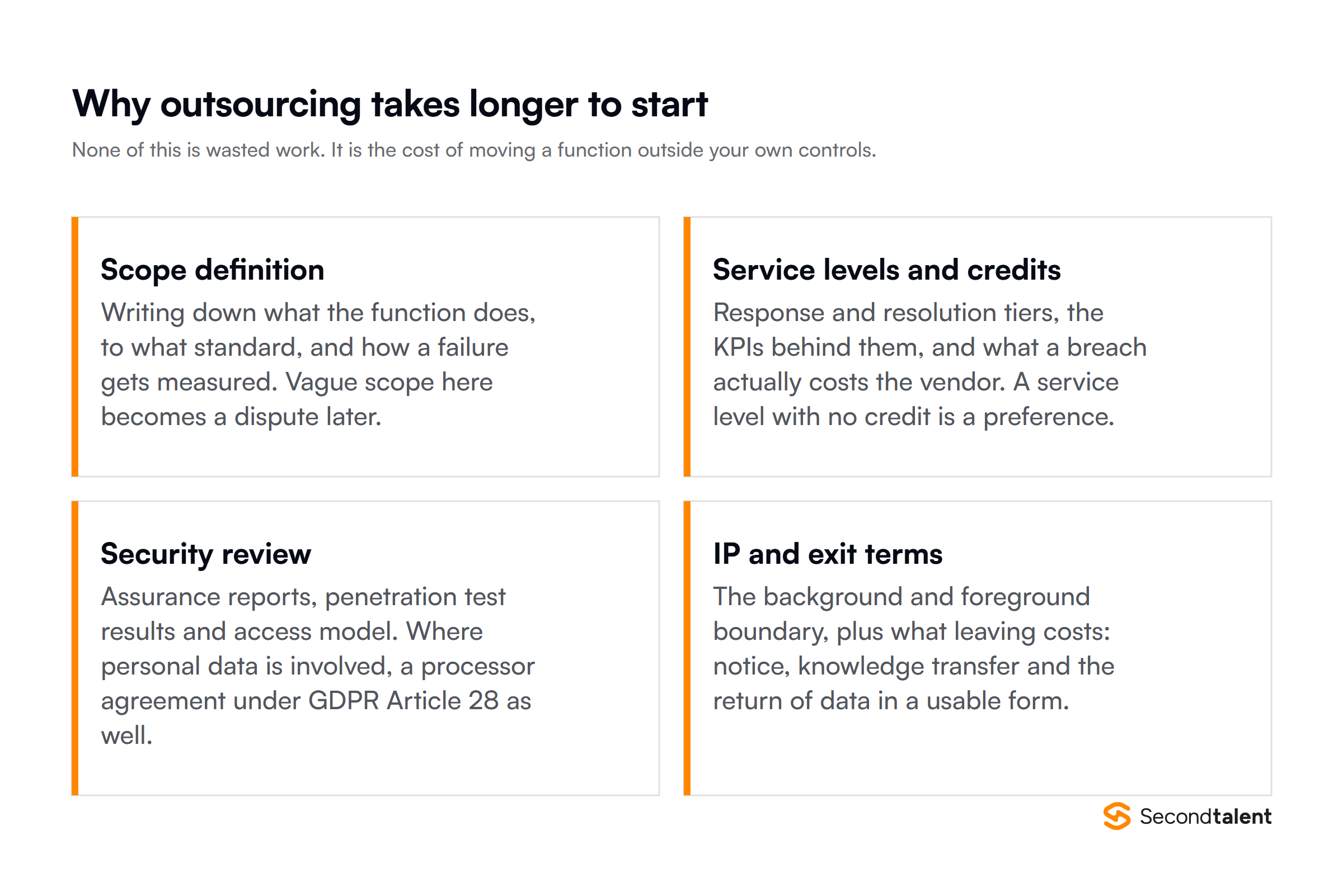
Because moving a function outside your own controls requires four things that augmentation does not.
Scope definition. Writing down what the function does, to what standard, and how failure gets measured. Vagueness here becomes a dispute later.
Service levels and credits. Response tiers, the KPIs behind them, and what a breach costs the vendor. A service level with no credit attached is a preference, not a commitment.
Security review. Assurance reports, penetration testing and the access model. Where the work touches personal data, the vendor becomes a processor and GDPR Article 28 sets what the contract must contain, including the terms for engaging any sub-processor.
IP and exit terms. The background and foreground boundary, plus what leaving costs in notice, knowledge transfer and the return of your data in a usable form.
None of this counts as wasted effort. It is the price of the model, and it should sit in your timeline from the start rather than surprising you in week six.
What do the two models cost?
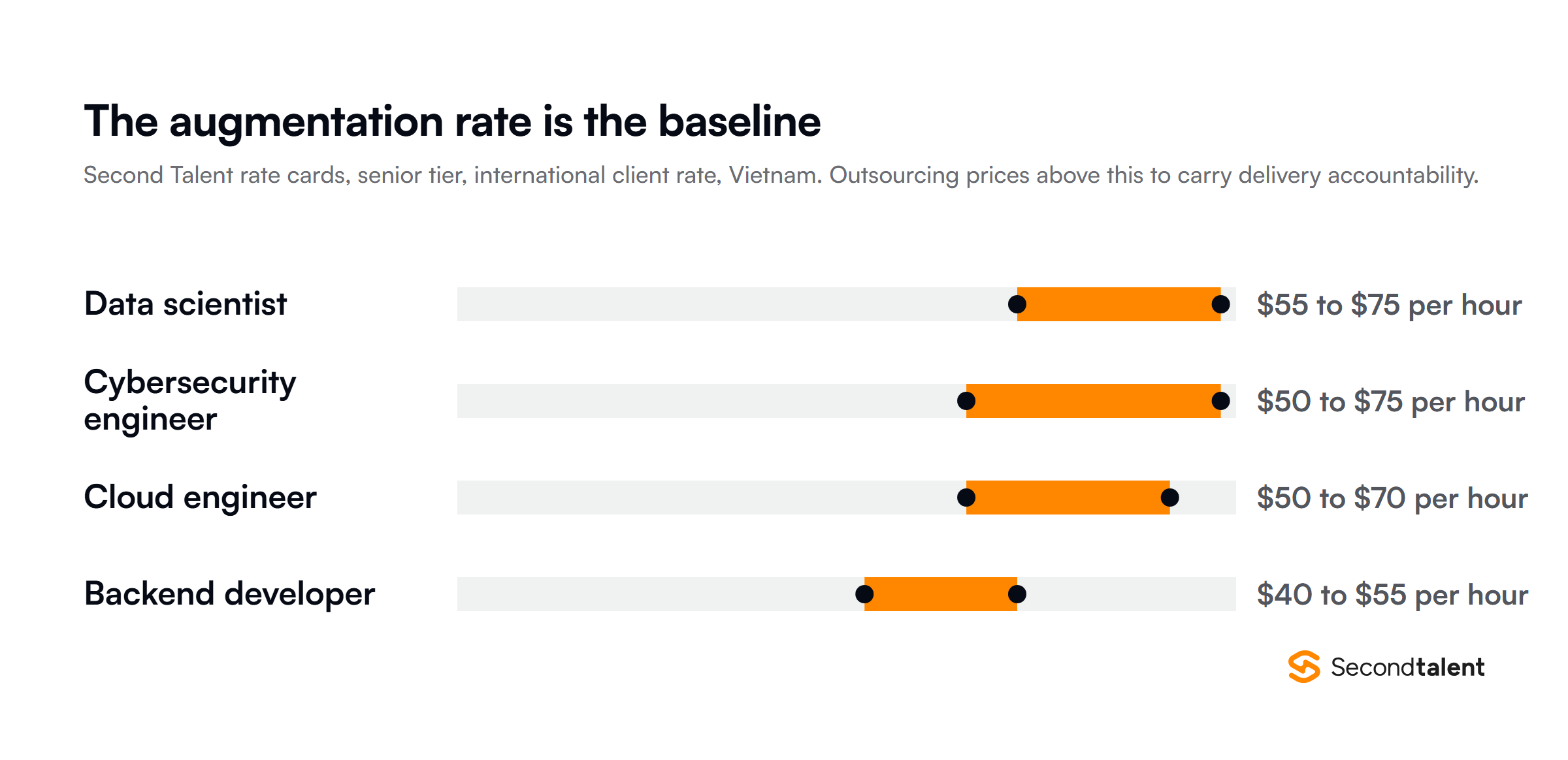
Augmentation sets the baseline because you are buying labour with no delivery wrapper around it. Outsourcing prices above that to carry management, service levels and accountability for the result.
Second Talent publishes senior international client rates in the developer rate cards. In Vietnam, senior backend developers run $40 to $55 per hour, cloud engineers $50 to $70, cybersecurity engineers $50 to $75 and data scientists $55 to $75.
Compare on fully loaded terms. The US Bureau of Labor Statistics puts the median wage for software developers at $135,980 in May 2025, which is salary before employer taxes and benefits, while a provider rate already includes them. Across placements, Second Talent clients save $103,000 or more per hire.
Two costs sit outside the rate in either model. Management time is real: augmentation consumes an engineering manager, outsourcing consumes a vendor manager, and neither is free. Transition cost is real too, and it is larger leaving an outsourcing arrangement than an augmentation one, because the knowledge has to come back.
Cost alone rarely decides this one. If the two models both fit the work, the cheaper option is augmentation. If only one fits, price is the wrong tiebreaker.
The misclassification trap that only augmentation carries
Augmentation buys you control, and control is exactly what worker-classification tests look at.
The IRS common-law test weighs behavioural control, financial control and the type of relationship. An engineer working your hours, on your systems, under your direction scores as an employee on most of those factors. In the UK the HMRC CEST tool reaches the same question from a different direction.
That is why the provider has to be the employer of record rather than a broker introducing a freelancer. Outsourcing sidesteps this by design, since the vendor directs its own people, which is one genuine advantage of the model.
Check it rather than assume it. Ask which legal entity employs the engineer, in which country, and whether the provider subcontracts any part of the service. Our guide to worker classification in cross-border IT staffing covers where the label breaks down.
Most teams end up running both
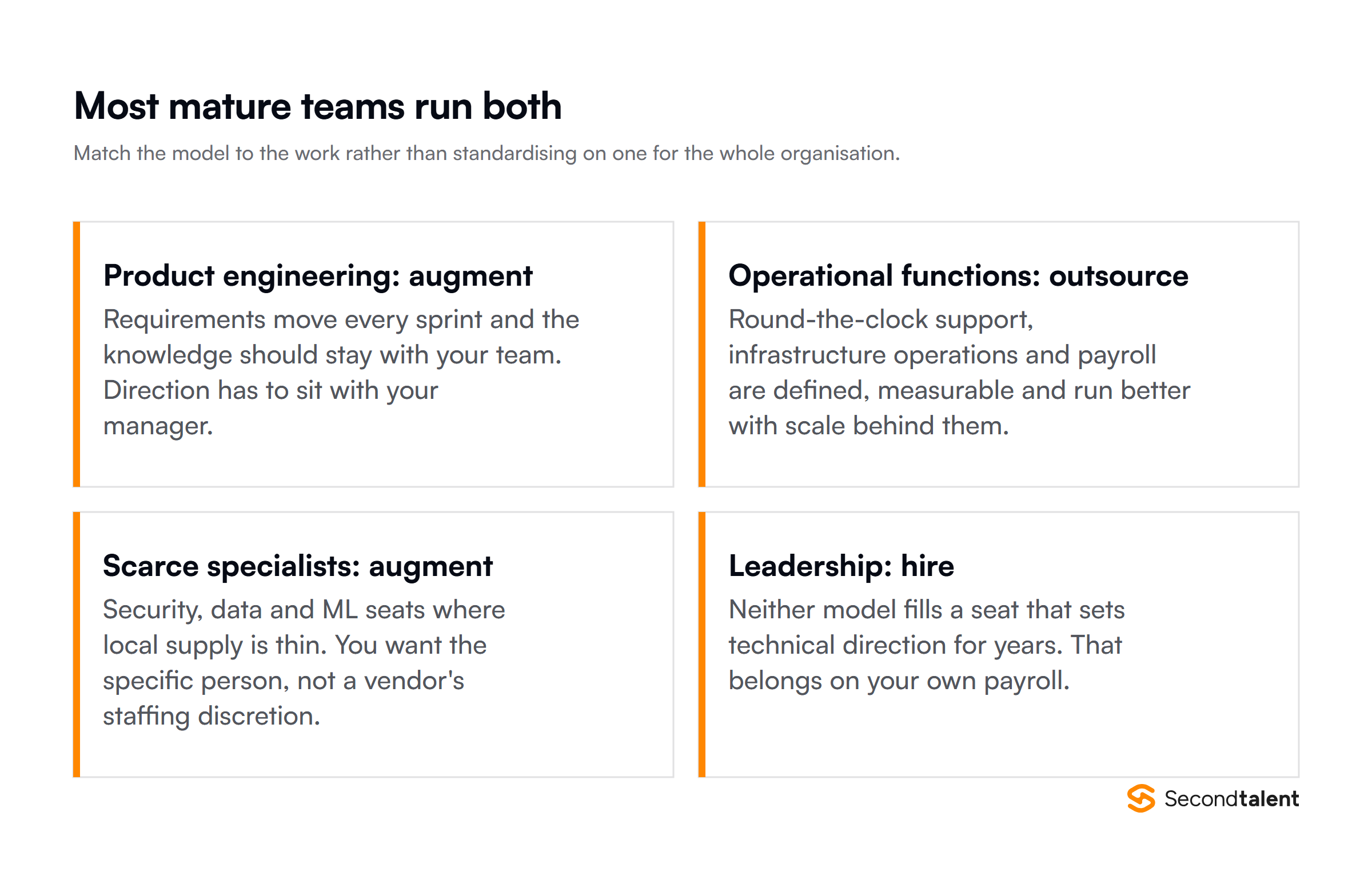
The mature pattern is not a choice between the models but a mapping from work type to model.
Product engineering suits augmentation, because requirements move each sprint and the knowledge should stay with your team. Operational functions suit outsourcing, because you can define them, measure them, and run them better at scale. Scarce specialists suit augmentation again, since you want a particular person rather than a vendor’s staffing discretion.
Leadership fits neither. A seat that sets technical direction for years belongs on your own payroll, whatever the rate comparison says.
If you run both, keep one register of engagements recording the model, the directing manager, the notice period and the renewal date. Without it, an outsourced function quietly absorbs work an augmentation contract already covers and you pay twice for the same capacity.
How to tell which one you are being sold
Vendors describe both models in similar language, so read the contract rather than the pitch deck. Three questions settle it.
Who names the people? If you interview and approve named engineers, that is augmentation. If the vendor assigns whoever fits and reserves the right to rotate them, that is outsourcing, whatever the sales conversation called it.
What does the contract promise? A warranty that a qualified person will be available is augmentation. A commitment to a response time, a throughput number or a delivered scope is outsourcing.
Whose systems does the work happen on? Your repositories and your single sign-on point to augmentation. The vendor environment, with reports flowing back to you, points to outsourcing.
Where the answers split across the three, you are probably looking at a managed service, which sits between the two. Ask the vendor to say which they are selling and to point at the clause that proves it.
Staff augmentation and outsourcing FAQs
Is offshore development the same as outsourcing?
No. Offshore describes where the work happens. Outsourcing describes who owns it. You can augment your team with offshore engineers and keep full direction, which is the arrangement most people mean when they say offshore development.
Can one vendor supply both models?
Often, and that is a reason to be precise in the contract. The same company and the same engineers can sit under very different obligations depending on which agreement you signed.
Which model protects IP better?
Augmentation, in most cases, because there is one owner and one perimeter. Outsourcing can be made safe, but it takes drafting and an audit rather than a standard assignment clause.
Can we switch from outsourcing to augmentation?
Yes, and plan for the handover rather than the contract. The knowledge sits with the vendor by design, so budget time to bring it back before the notice period runs out.
Takeaways
- Augmentation supplies people under your direction. Outsourcing supplies a result under the vendor’s.
- Knowledge ends up wherever the work was directed. That is a choice, not a side effect.
- Outsourcing brings a second IP position. Define background and foreground before work starts.
- Budget months, not weeks, for an outsourcing start. Security review is most of the gap.
- Run both, mapped to work type, and keep one register so you do not buy the same capacity twice.
Work out which one you need
Second Talent supplies augmentation with EOR cover across Asia: matched profiles within 24 hours, 92 percent retention, and engineers who work inside your perimeter on your tools.
Tell us what you are trying to ship, or read what IT staffing is for the full set of engagement models.
Hiring contractors rather than employees changes the arithmetic. The freelance developer rate index prices 14 roles across nine regions, benchmarked against North America and sourced from published wage data.