TL;DR: An agentic AI developer in the US benchmarks to the BLS software developer median of $135,980 a year, and US freelance agent developers charge $119 to $185 an hour. Through Second Talent, a vetted remote AI agent developer starts at $25 USD an hour (160 hours for $3,999 a month), with a shortlist in 24 hours.
Daily use of AI agents at work rose from 14% in Stack Overflow's 2025 survey to 37% in an April 2026 pulse survey, yet 63% still rarely or never let an agent run on autopilot. Your hire builds the tools, permissions and approval steps in between.
Key takeaways
- More than 70 agent platforms, including ChatGPT, Cursor, GitHub Copilot and VS Code, had adopted the Agent Skills format by October 2026.
- OWASP traces excessive agency in LLM apps to three root causes: too much functionality, too many permissions and too much autonomy.
- The Model Context Protocol had more than 10,000 active public servers when Anthropic donated it to the Linux Foundation in December 2025.
- Accuracy and security remain the two top concerns developers report about agents at work.
How much does it cost to hire an AI agent developer in the US?
BLS has no agent developer occupation. The role maps to Software Developers (SOC 15-1252), because an agent developer writes and runs production software whose control flow passes through model calls and tools. Research-heavy roles map closer to Computer and Information Research Scientists (15-1221), whose national median is $140,300.
| Software Developers (15-1252), May 2025 |
Annual |
Monthly |
| 10th percentile |
$82,460 |
$6,870 |
| 25th percentile |
$105,210 |
$8,770 |
| Median |
$135,980 |
$11,330 |
| 75th percentile |
$171,980 |
$14,330 |
| 90th percentile |
$214,670 |
$17,890 |
Figures come from the BLS OEWS profile for 15-1252; monthly values are annual wages divided by 12, rounded to the nearest $10.
Large tech metros pay well above the national band. San Francisco's middle half runs from $13,630 to $18,310 a month, and San Jose's median reaches $213,110 a year.
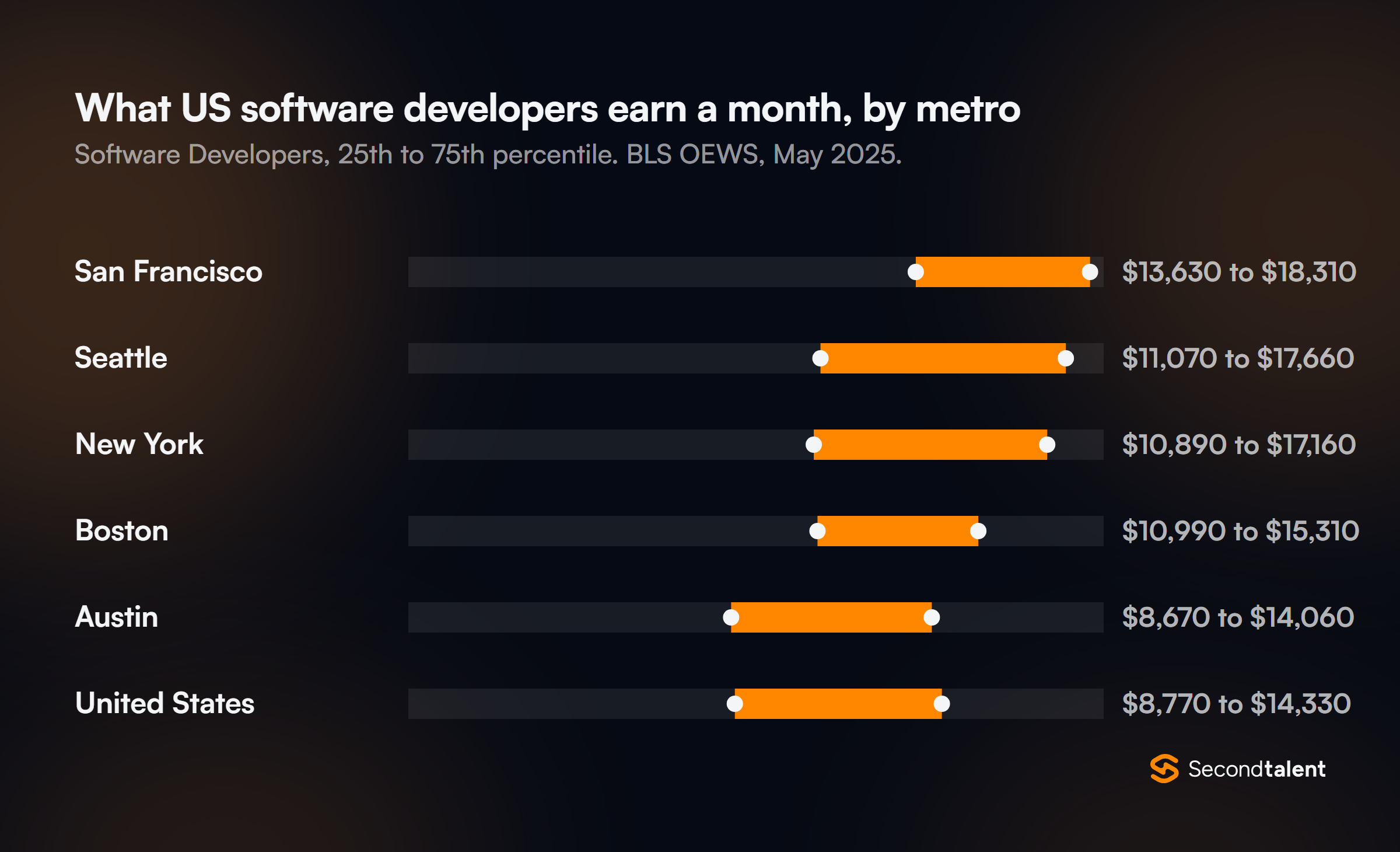
Metro figures come from the OEWS metropolitan area tables for San Francisco-Oakland-Fremont, Seattle-Tacoma-Bellevue, New York-Newark-Jersey City, Boston-Cambridge-Newton and Austin-Round Rock-San Marcos.
Benefits add to the salary. The BLS Employer Costs for Employee Compensation release for June 2026 puts private industry compensation at $46.89 an hour, with $14.07 of it (30.0%) in benefits. At that average, a median-paid hire costs the employer roughly $194,000 a year (our estimate from the two BLS figures). Our AI agent developer cost-to-hire page breaks the freelance rate down by seniority.
Which AI agent skills should you screen for in 2026?
Claude Code (66%) and GitHub Copilot (59%) were the agents of choice among AI tool users in the 2026 Stack Overflow survey, so most candidates have used an agent. Building one that runs against your systems is a different skill, and it is the one to screen for.
Workflow or agent: the first design call
Anthropic's Building effective agents separates workflows, where models and tools follow predefined code paths, from agents, where the model directs its own process and tool use. Its advice is to find the simplest solution and add complexity only when needed. Ask the candidate for a project where they replaced an agent with a fixed workflow, and why.
Tool design and MCP servers
Anthropic donated the Model Context Protocol to the Agentic AI Foundation, a fund under the Linux Foundation co-founded with Block and OpenAI, on 9 December 2025, and counted 97 million monthly SDK downloads across Python and TypeScript.
The current MCP specification carries the date 25 November 2025. Have the candidate write a tool definition for one of your internal APIs and review its input schema with them.
Agent Skills
A skill is "a folder containing a SKILL.md file that teaches an agent a specific task or domain", in the words of Anthropic's 22 October 2026 post donating the format to the same foundation. An agent skill developer does this work: packaging a team's procedures so any compatible agent can follow them. Ask the candidate to write a skill for one of your recurring tasks and show where the instructions end and a script takes over.
Permissions and human approval
The OWASP Top 10 for LLM Applications 2025 lists Excessive Agency as LLM06. Its mitigations include minimum permissions for each extension, avoiding open-ended tools such as shell access, and human approval before high-impact actions. Show the candidate an agent that can read and write a repository and ask which scopes they would remove.
Loop limits, cost and evals
Anthropic warns that autonomous agents bring higher costs and compounding errors, and recommends extensive testing in sandboxed environments. Ask what cap stopped the candidate's last runaway loop: a step limit, a token budget or a timeout. Then ask them to walk through a trace of one failed run and name the eval that would have caught it.
Frameworks and multi-agent systems
Screen against the framework you run. Anthropic describes orchestrator-workers, where a central model splits a task and combines the results, and evaluator-optimizer, where one call drafts and another critiques. Both add cost and failure points over a single agent, and 69% of pulse respondents ran a single agent. We run separate tracks for LangChain developers and LangGraph developers when a brief names one.
How do you test an AI agent developer before you hire?
Give the candidate a four-hour take-home: build an agent with two tools against a sandboxed copy of a ticketing API, one that reads tickets and one that updates their status.
Add a document in the ticket data that contains an injected instruction, and ask for a step limit, one eval and a written note on what the agent may do without approval.
A strong submission:
- Gives each tool a narrow input schema and a description the model can follow without guessing.
- Requires approval for the status update, or explains in writing why it does not.
- Ignores the injected instruction, and the eval proves it on a fresh run.
- Stops at the step limit with a readable error instead of a silent retry.
- Ships a trace the reviewer can read step by step.
In the live round, review that trace together for 45 minutes. Ask where they would switch from agent to workflow and which permission they would cut first. Our AI agent developer interview questions and LLM engineer questions add question sets with rubrics.
Should you hire a W-2 employee, a 1099 contractor, an agency or Second Talent?
Software is not one of the nine categories of commissioned work that can be "work made for hire" under 17 U.S.C. § 101, and a copyright transfer must be in writing and signed under § 204(a). Name tool definitions, prompts, skills, eval sets and agent code in the assignment.
|
Full-time W-2 hire |
1099 contractor |
AI development agency |
Second Talent |
| Who employs the developer |
You |
Nobody; they invoice you |
The agency |
Our entity in the engineer's country |
| Cost basis |
Salary plus about 30% in benefits (BLS) |
Hourly rate, $119 to $185 for agent work |
Project fee or bill rate including the agency's margin |
From $25 USD/hr, 160 hours for $3,999/mo |
| Who owns the code and prompts |
You, as work made for hire |
The contractor, until a signed assignment |
Set by the statement of work |
You; IP assignment and NDAs in the contract |
| Fits best |
A core team you will grow |
A fixed, short build |
A fixed build with a handover date |
Agents that keep changing with your workflows |
| If the hire fails |
You restart the search |
You restart the search |
Agency terms |
One free replacement within 90 days |
A full-time developer on your hours, holding credentials to production systems, looks like an employee under the IRS common-law control tests. A contractor based outside the US gives you Form W-8BEN instead of a W-9. Through Second Talent, we employ the engineer and run payroll and equipment while you direct the work; our employer of record service covers the same setup for someone you found yourself. This is a summary, not legal advice.
How many working hours overlap with ET, CT and PT?
An agent that waits for human approval stalls while its approver is offline. The overlap window decides how fast high-impact actions clear.
We agree a schedule with each engineer before the offer, and our placements overlap 4 to 6 hours a day with US business hours. A block from 11:00 am to 3:00 pm ET covers 10:00 am to 2:00 pm CT and 8:00 am to noon PT.
Put approvals, failed-run reviews and permission changes inside that block. Long agent runs, eval sweeps and batch jobs can run outside it.
How fast can you hire an AI agent developer with Second Talent?
The first shortlist arrives within 24 hours of a complete brief. The industrial AI company in our Maneva case study filled its AI engineering role in 27 days.
- Brief. You list the workflows to automate, the systems the agent may touch, the actions that need approval and the framework in use.
- Application review. We look for an agent that ran against real systems, such as a support triage bot or an internal coding agent with tool definitions and eval runs.
- Skills assessment. The candidate builds a two-tool agent against a sandbox with a step limit and an eval, and we score how it handles an injected instruction.
- Live interview and references. A senior engineer reviews the trace, then we ask former managers how the candidate handled access to live systems.
- Your final round. You interview the shortlist and the engineer starts once their notice period ends.
Our pricing page sets out the monthly terms and guarantees. Share the brief to start the shortlist, or see our AI developers and LLM developers for model-focused roles.