TL;DR: Python developers from Asia start from $2,999 a month through Second Talent, matched in 24 hours. The closest US benchmark, the BLS median for software developers, was $135,980 a year in May 2025.
In March 2026, attackers published versions of the litellm and telnyx packages to PyPI carrying credential-harvesting malware that ran on install. PyPI's incident report counts more than 119,000 downloads of the bad litellm releases in the 2 hours 32 minutes before quarantine, and estimates that 40-50% of LiteLLM installs fetched the latest version unpinned. The Python developer you hire decides whether your builds would have been among them.
Key takeaways
- Indonesia has the lowest floor on our Python developer rate cards, $1,200 a month, and India the highest open top, $8,050+.
- Python 3.10 reaches end of life in October 2026, and Django 6.0 runs only on Python 3.12 and later.
- FastAPI gained 5 points in Stack Overflow's 2025 survey, and 38% of respondents to the 2024 Python Developers Survey used it.
- Code, notebooks and pipelines a contractor writes for you stay the contractor's until a signed written assignment transfers them.
What Python Developers Earn Working for International Clients in Asia
Malaysia's card tops out at $5,500, the lowest ceiling in the table, while the Philippine range starts $700 above Vietnam's. The figures are what Python developers in each market earn working directly for foreign companies, before any employer or platform costs.
| Market |
Monthly pay working for international clients (USD) |
| Indonesia |
$1,200-$6,500 |
| Vietnam |
$1,800-$7,500 |
| Malaysia |
$2,000-$5,500 |
| India |
$2,090-$8,050+ |
| Philippines |
$2,500-$6,000 |
| Thailand |
$2,870-$7,710+ |
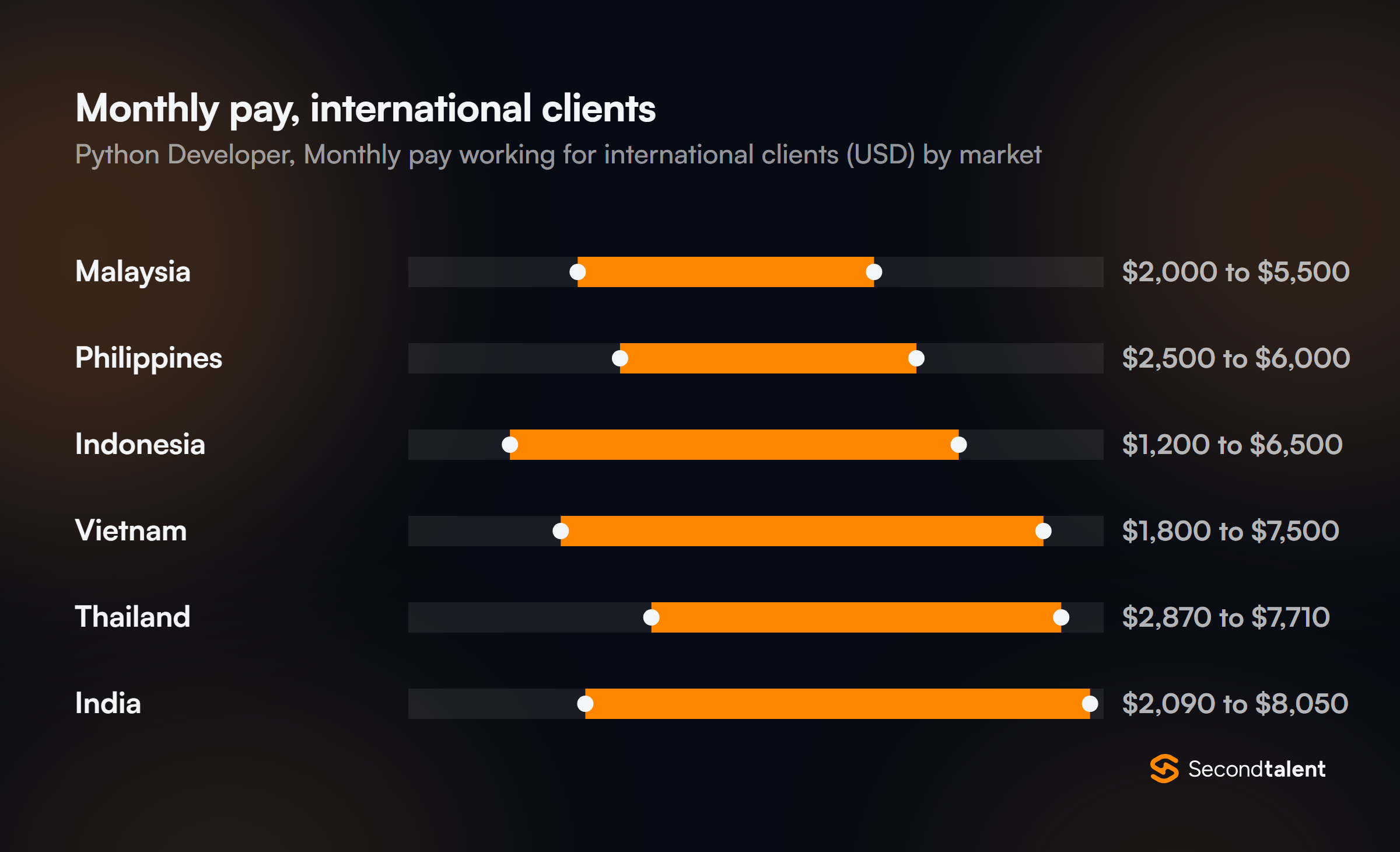
Monthly ranges from the Remote (Working for International Clients) figures on our rate cards for Indonesia, Vietnam, Malaysia, India, the Philippines and Thailand, converted at ExchangeRate-API mid-market rates for 14 September 2026.
Four of the six cards quote US dollars with a fixed top. The Indian card is set in rupees (₹95.61 to the dollar) and the Thai card in baht (฿33.08), both open at the top, so a senior offer there can pass the printed figure.
Through Second Talent, Python developers start from $2,999 a month: one monthly fee that bundles salary, payroll taxes, statutory contributions and our service fee. Our pricing page explains the subscription. For a hire in one market, our Philippines Python developer page covers that country alone.
US Pay Benchmark for Python Developers
BLS publishes no Python occupation. The role maps to Software Developers (15-1252), because a Python developer on a product team writes and maintains application software, from APIs to data pipelines. A hire whose Python work is statistical modelling sits closer to Data Scientists (15-2051), where the May 2025 median was $120,230.
| BLS OEWS, May 2025, national |
Software Developers (15-1252) |
| Median annual |
$135,980 |
| 10th percentile, monthly |
$6,870 |
| 25th percentile, monthly |
$8,770 |
| Median, monthly |
$11,330 |
| 75th percentile, monthly |
$14,330 |
| 90th percentile, monthly |
$17,890 |
Monthly figures are the annual wages on the OEWS profile for 15-1252 divided by 12, rounded to the nearest $10.
Salary is only part of the US cost. In the BLS Employer Costs for Employee Compensation release for June 2026, wages and salaries made up 68.5% of employer compensation costs for full-time private industry workers, and benefits the other 31.5%.
For the contract route, our Python developer cost-to-hire page, updated on 12 September 2026, puts a mid-level US freelance or contract Python developer at $85 to $135 an hour, before payroll, insurance and leave.
Time Zone Overlap with ET, CT and PT
Python work splits by clock. Nightly ETL jobs, test suites and dependency updates can run while one side sleeps, and code review needs both sides awake. US daylight time runs from 8 March to 1 November 2026, per NIST, and no city below changes its clocks.
| Engineer's city |
UTC offset |
9:00 am ET (EDT) |
9:00 am CT (CDT) |
9:00 am PT (PDT) |
| Manila, Singapore, Kuala Lumpur, Taipei |
UTC+8 |
9:00 pm |
10:00 pm |
12:00 midnight |
| Ho Chi Minh City, Jakarta, Bangkok |
UTC+7 |
8:00 pm |
9:00 pm |
11:00 pm |
| Bengaluru |
UTC+5:30 |
6:30 pm |
7:30 pm |
9:30 pm |
After 1 November 2026, every time in the table moves one hour later.
A Kuala Lumpur shift from 5:00 pm to 2:00 am runs 09:00 to 18:00 UTC. Subtract four hours for EDT and it covers 5:00 am to 2:00 pm in New York: five hours of a 9-to-5 day on the East Coast, four with Chicago and two with San Francisco.
Put pull request review, schema changes and deploy approvals in those shared hours. The developer merges before signing off, the nightly pipeline runs on the new code, and your US team reads the job logs in the morning. We agree that split before the offer, which is how our placements get 4-6 hours of daily overlap with US hours.
Late hours cost more for employees in two markets: at least 10% extra between 10 pm and 6 am in the Philippines (Labor Code Article 86), and at least 30% between 22:00 and 06:00 in Vietnam (Labor Code Articles 98 and 106).
Python Developer Skills to Screen For
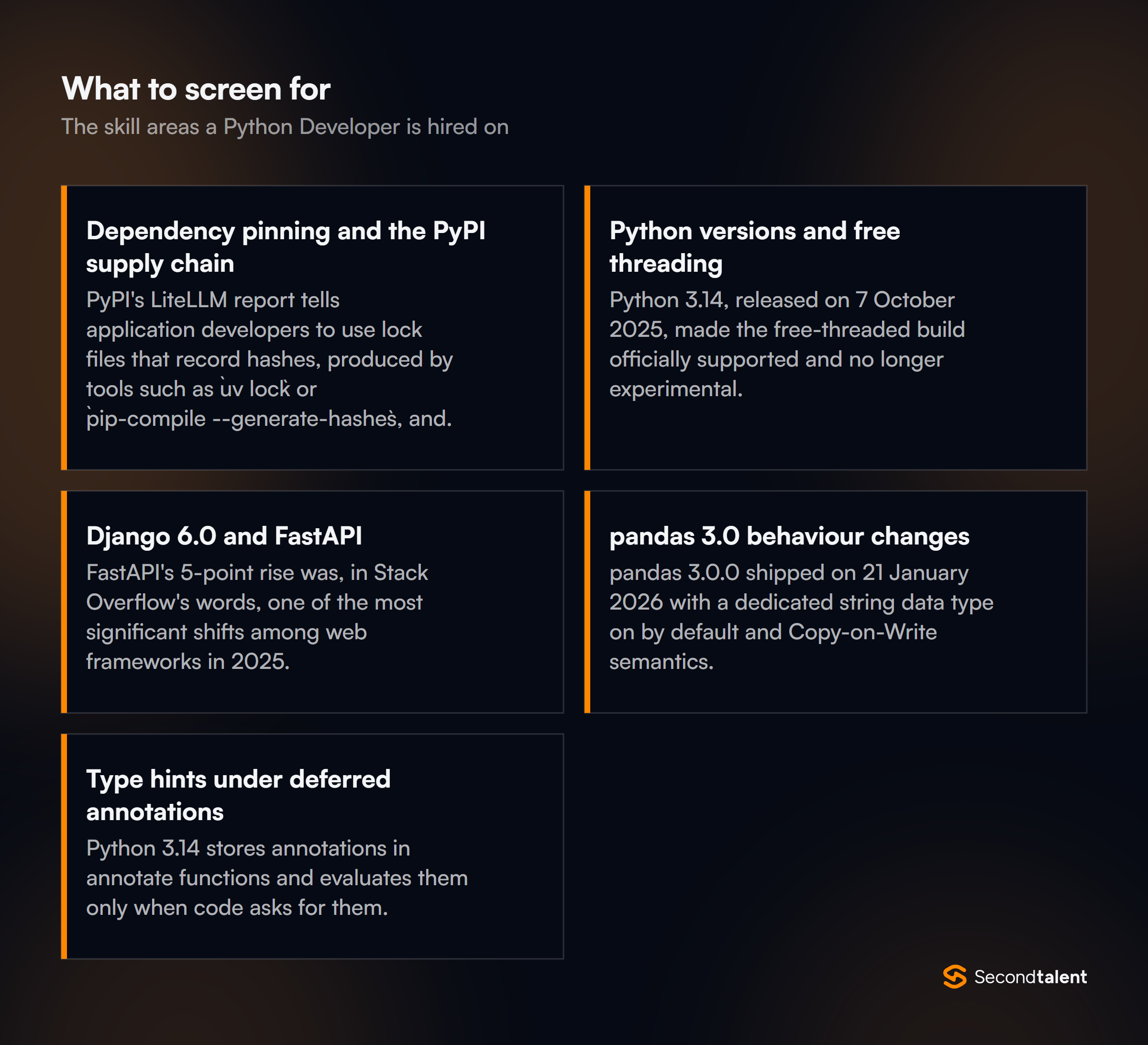
Python was used by 57.9% of respondents to Stack Overflow's 2025 survey, up 7 percentage points on 2024. That breadth is the screening problem: the same CV line covers a Django shop, a pandas notebook and an ML inference service. Test the five areas below against the Python you run.
Dependency pinning and the PyPI supply chain
PyPI's LiteLLM report tells application developers to use lock files that record hashes, produced by tools such as uv lock or pip-compile --generate-hashes, and warns that pip freeze output is not a lock file. It also describes dependency cooldowns: uv's exclude-newer = "P3D" setting skips any release less than three days old.
PEP 751 made pylock.toml the standard lock format on 31 March 2025. Hand the candidate a requirements.txt with unpinned versions and a CI job that installs fresh on each run, and score what they change first.
Python versions and free threading
Python 3.14, released on 7 October 2025, made the free-threaded build officially supported and no longer experimental. The What's New notes put its cost on single-threaded code at roughly 5-10%. On the Python version status page, 3.10 reaches end of life in October 2026, and the release schedule puts 3.15 on 1 October 2026.
Ask which version the candidate's last service ran, what blocked the upgrade, and which workload they would try without the GIL.
Django 6.0 and FastAPI
FastAPI's 5-point rise was, in Stack Overflow's words, one of the most significant shifts among web frameworks in 2025. Among professional developers it reached 15.1%, against 13.2% for Flask and 11.7% for Django. The PSF and JetBrains Python Developers Survey 2024, with more than 30,000 respondents, put FastAPI at 38%, Django at 35% and Flask at 34%.
Django 6.0, released on 3 December 2025, added built-in Content Security Policy support and a Tasks framework for background work, while external worker processes still run the tasks. Ask a Django candidate which Celery jobs they would move to Tasks, and what would run them.
pandas 3.0 behaviour changes
pandas 3.0.0 shipped on 21 January 2026 with a dedicated string data type on by default and Copy-on-Write semantics. Under Copy-on-Write every indexing step behaves as a copy, so chained assignment stops working and SettingWithCopyWarning is gone, per the 3.0.0 release notes. The notes advise upgrading to pandas 2.3 and clearing its warnings first.
Give a data-leaning candidate a script that sets values through df[mask]["col"] = value and ask what it does on pandas 3.0.
Type hints under deferred annotations
Python 3.14 stores annotations in annotate functions and evaluates them only when code asks for them. Forward references no longer need quoting, and a new annotationlib module reads them in value, forward-reference or string form. Validation and serialisation libraries that read __annotations__ at runtime feel the change first. Ask how the candidate validates request models at the API boundary, and which type checker runs in CI.
Senior and experienced Python engineers
Years of Python on a CV say little, because the language is easy to start and hard to run at scale. A senior Python engineer should show three habits beyond clean code. First, packaging discipline: one tool for environments and lock files, reproducible builds and a clear rule for when to upgrade. Second, concurrency judgment: knowing when asyncio fits an I/O-bound API, when a process pool or task queue fits CPU-bound work, and what a blocking call does to an event loop. Third, observability: structured logs, traces and metrics that let someone else debug the service at 3 am.
For an architect-level hire, ask for the boundaries of a system they designed: where Python ran, where it handed work to a database, a queue or a compiled extension, and what they would split out first as traffic grew. Then show profiler output from a slow endpoint and ask what they would measure before changing code. Experienced engineers start with measurement; less experienced ones start with a rewrite.
Contractor or Employer of Record for a US Company
Software is not one of the nine categories of commissioned work that can be "work made for hire" under 17 U.S.C. § 101, and a copyright transfer must be in writing and signed under § 204(a). Name application code, notebooks, pipeline definitions and internal packages in the assignment.
IRS Publication 515 says the place where services are performed determines the source of the income, so a developer working from Kuala Lumpur or Jakarta earns foreign-source income. A foreign individual gives the payer Form W-8BEN to certify foreign status.
The developer's own country applies its own test. Philippine courts use the four-fold test, and in Atok Big Wedge v. Gison the Supreme Court called the power of control the most important of the four. Article 13 of Vietnam's 2019 Labor Code treats an agreement under another name as a labor contract when it covers a paid job, wages and one party's management and supervision.
|
Independent contractor |
Employer of Record |
| Legal employer |
None; the developer invoices you |
The EOR's local entity |
| US paperwork |
Form W-8BEN from the developer |
Service agreement with the EOR |
| IP |
Written assignment covering code, notebooks, pipelines and packages |
Assignment terms in the employment contract and your EOR agreement |
| Local labor law |
Classification risk if you set hours and methods |
Night premiums, public holidays and leave apply |
| Pay currency |
Agreed in the contract, often USD |
Local currency; Vietnam's Labor Code states wages in dong (Article 95) |
A one-off scraper or a migration script with a fixed end date suits a contractor agreement. A developer on your sprint board with credentials to production databases fits the employment tests above, and our Employer of Record service employs that developer in-country. Our EOR, PEO and contractor comparison sets out the trade-offs. This is a summary, not legal advice.
English Level and Working Norms
Indonesia's IT workers score 523 on the EF English Proficiency Index 2025, 52 points above the country's overall score and higher than Vietnam's IT figure. The index ranks 123 countries and regions, with a global average of 488.
| Country |
EF EPI 2025 score |
World rank (of 123) |
IT job-function score |
| Malaysia |
581 |
24 |
590 |
| Philippines |
569 |
28 |
581 |
| Vietnam |
500 |
64 |
500 |
| India |
484 |
74 |
487 |
| Indonesia |
471 |
80 |
523 |
| Thailand |
402 |
116 |
459 |
Scores come from EF's country pages, such as Indonesia, Malaysia and Thailand.
Python teams write a lot of English that is not code: docstrings, README files, migration notes and the pull request description a reviewer reads eight hours later. Ask finalists to write the upgrade note for moving one service from Python 3.10 to 3.13.
Plan around both calendars. Thanksgiving on 26 November 2026 is a working day in Asia, so a developer there can watch the holiday traffic on your API while your US team is off.
Vietnam's Labor Code gives five paid days for Lunar New Year (Article 112), in late January or February, so keep a framework upgrade out of that week with a Vietnam-based developer.
Python Developer Hiring Process
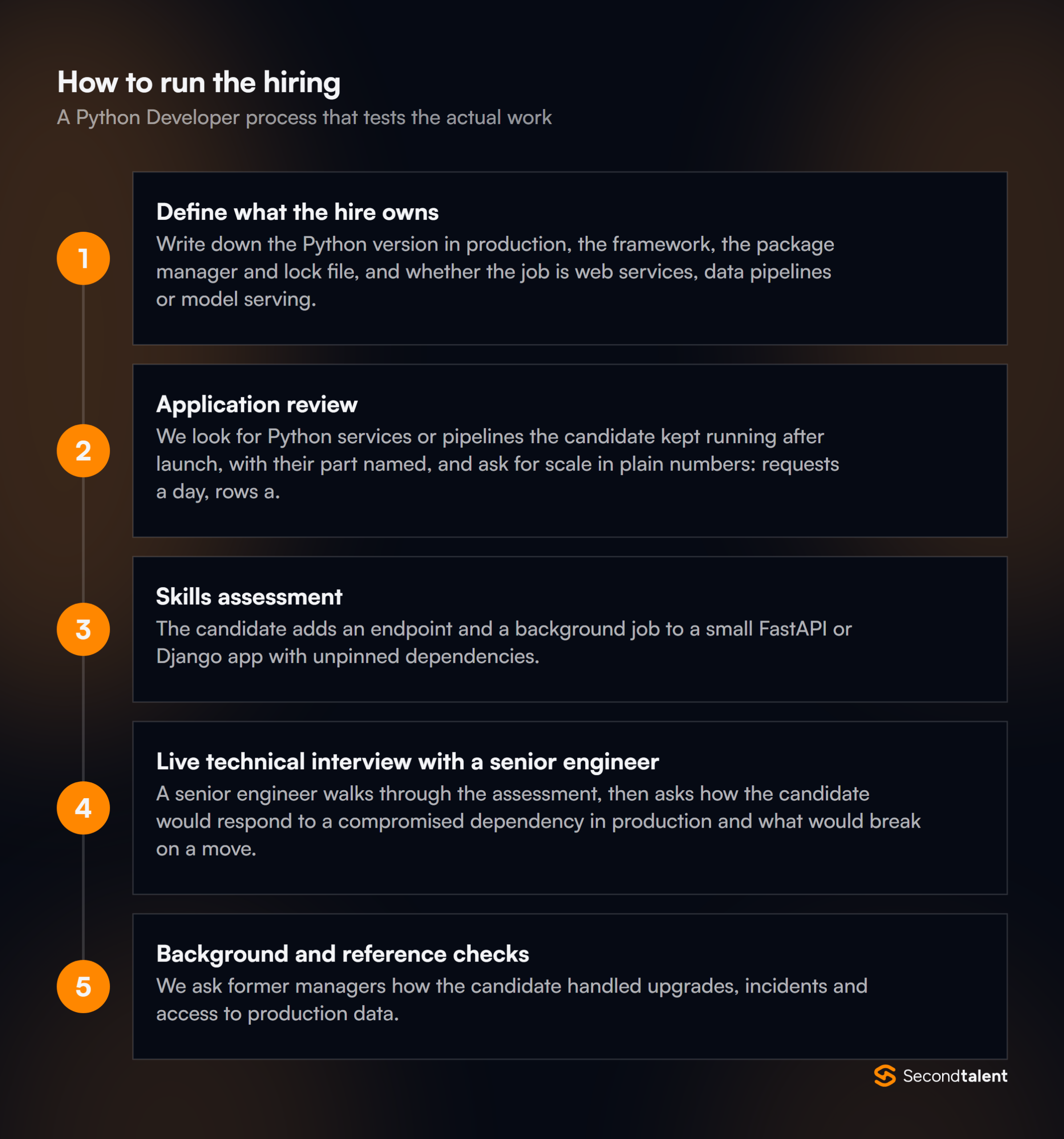
Second Talent's vetting covers stages 2 to 5 before you see a profile. Our Python backend interview guide adds question sets for your own final round.
Stage 1: Define what the hire owns
Write down the Python version in production, the framework, the package manager and lock file, and whether the job is web services, data pipelines or model serving. For pipeline-heavy work, compare our data engineer track.
Stage 2: Application review
We look for Python services or pipelines the candidate kept running after launch, with their part named, and ask for scale in plain numbers: requests a day, rows a night or jobs in the queue. A folder of tutorial notebooks does not pass.
Stage 3: Skills assessment
The candidate adds an endpoint and a background job to a small FastAPI or Django app with unpinned dependencies. We score the tests, the lock file, the type hints and whether the pull request explains the trade-offs.
Stage 4: Live technical interview with a senior engineer
A senior engineer walks through the assessment, then asks how the candidate would respond to a compromised dependency in production and what would break on a move to pandas 3.0 or Python 3.14.
Stage 5: Background and reference checks
We ask former managers how the candidate handled upgrades, incidents and access to production data. You then choose the contractor or EOR route above.
Hire Python Developers from Asia with Second Talent
We shortlist 6-8 candidates within 24 hours from 100,000+ pre-vetted engineers, accepting only the top 1% of applicants. Python developers start from $2,999 a month, with $0 upfront, no lock-in and 4-6 hours of daily overlap with US hours. We handle contracts, payroll and equipment, with compliant EOR contracts and payroll in 9 Asian markets.
Our pricing page sets out subscription, direct-hire and EOR pricing, and for model work we also staff machine learning engineers.