TL;DR: The question is never in-house or staffing in general. It is which one for this seat, and five factors settle most of them: how fast you need it, what it truly costs, whether you can actually hire it locally, how long the commitment runs, and whether you can trial it first. Six rules cover the easy cases. Spend your thinking on the roles that are genuinely close, and watch for the four situations where the obvious answer is wrong.
Most leaders pose this as a choice between two strategies. Mature engineering organisations use both, which turns it into a per-role decision you can make quickly. This is the operational companion to build versus buy, which covers the same decision through a cost model.
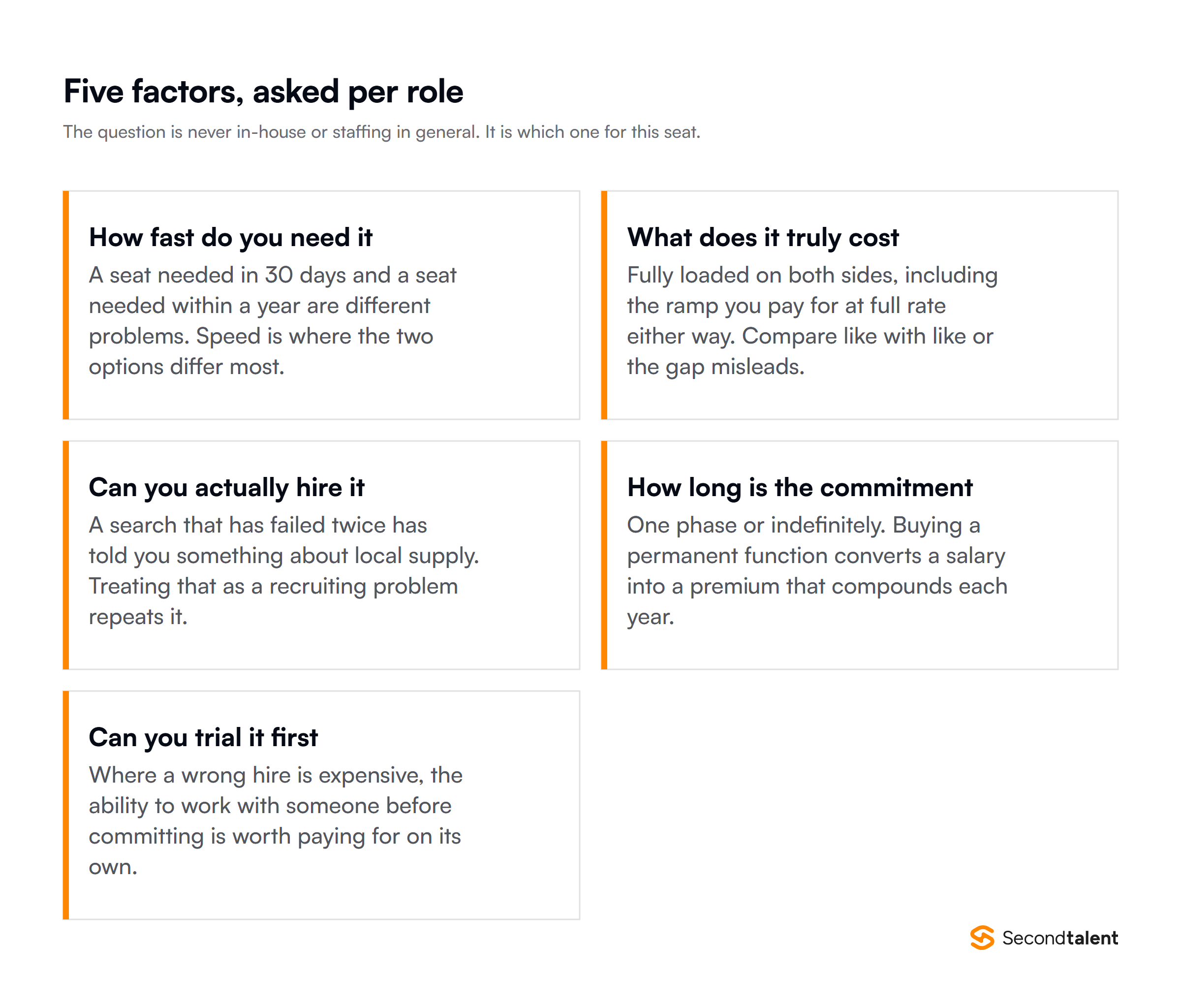
The five factors
How fast do you need it. A seat needed in 30 days and a seat needed within a year are different problems with different answers.
What it truly costs. Fully loaded on both sides, including the ramp you pay for at full rate either way.
Whether you can actually hire it. A search that has failed twice has told you something about local supply, and treating that as a recruiting problem tends to repeat it.
How long the commitment runs. One phase or indefinitely. Buying a permanent function converts a salary into a premium that compounds each year it continues.
Whether you can trial it. Where a wrong hire is expensive, working with someone before committing is worth paying for on its own.
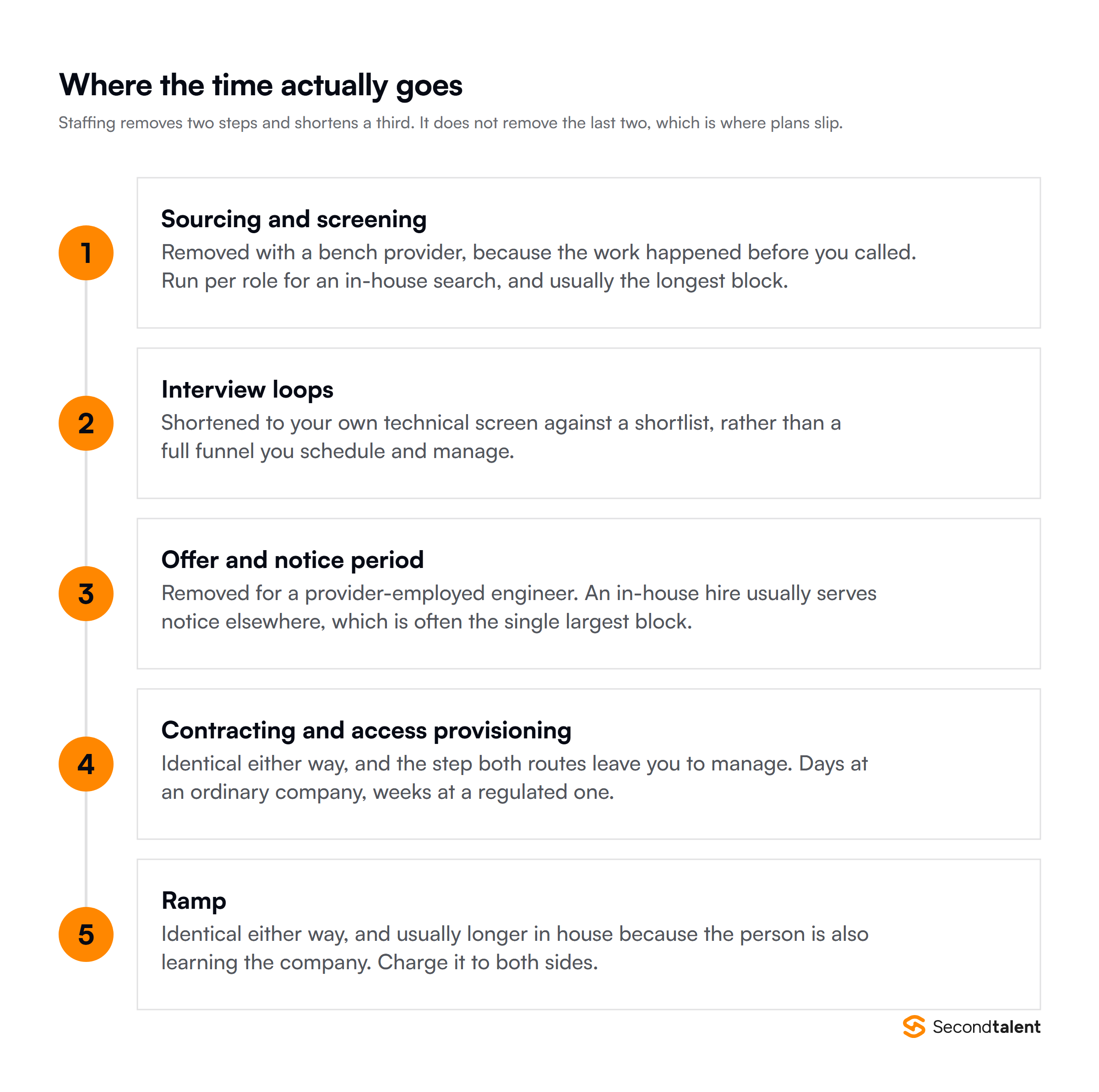
Where the time actually goes
Speed is the largest difference between the options, and being precise about which parts compress prevents the plan slipping later.
Sourcing and screening disappear with a bench provider, because that work happened before you called. Interview loops shorten to your own technical screen against a shortlist. Offer and notice periods disappear for a provider-employed engineer, and a notice period served elsewhere is often the single longest block in an in-house hire.
Two steps are identical either way. Contracting and access provisioning take days at an ordinary company and weeks at a regulated one, and sit outside the recruiting process entirely. Ramp takes about three weeks before unsupervised work, and it is usually longer in house because the person is learning the company as well as the codebase.
Second Talent returns matched profiles within 24 hours. Plan the two steps that follow rather than assuming they compress with the rest.
Comparing cost honestly
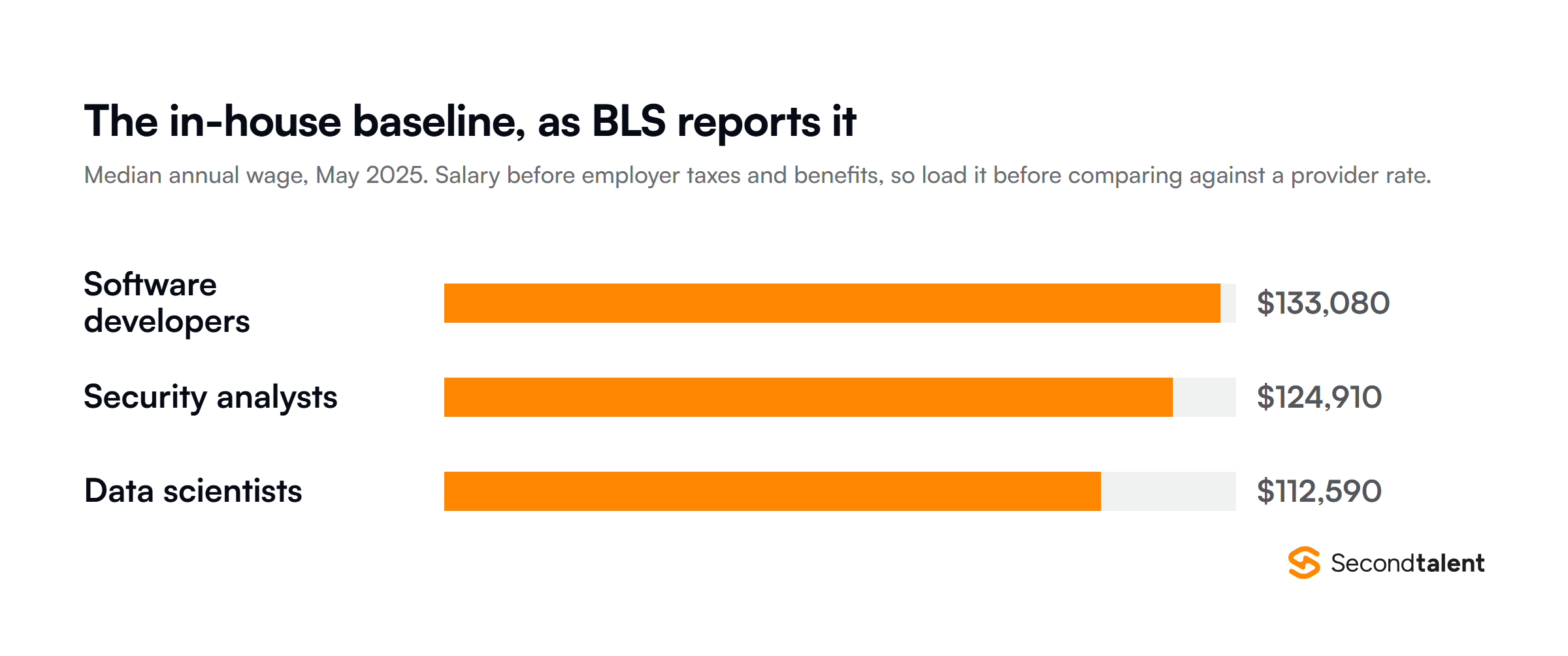
The US Bureau of Labor Statistics puts the May 2024 median annual wage at $135,980 for software developers, $129,180 for information security analysts and $120,230 for data scientists.
Those are salary before employer taxes, benefits, equipment and tooling. A provider rate already includes all of it, so apply a loading multiplier to the salary side and write down which multiplier you used.
Second Talent publishes senior international client rates in the developer rate cards, and clients save $103,000 or more per hire against a comparable Western salary.
Charge recruiting cost and ramp to both sides. Teams routinely charge ramp against the bought engineer and forget the in-house hire has a longer one, which quietly rigs the comparison.
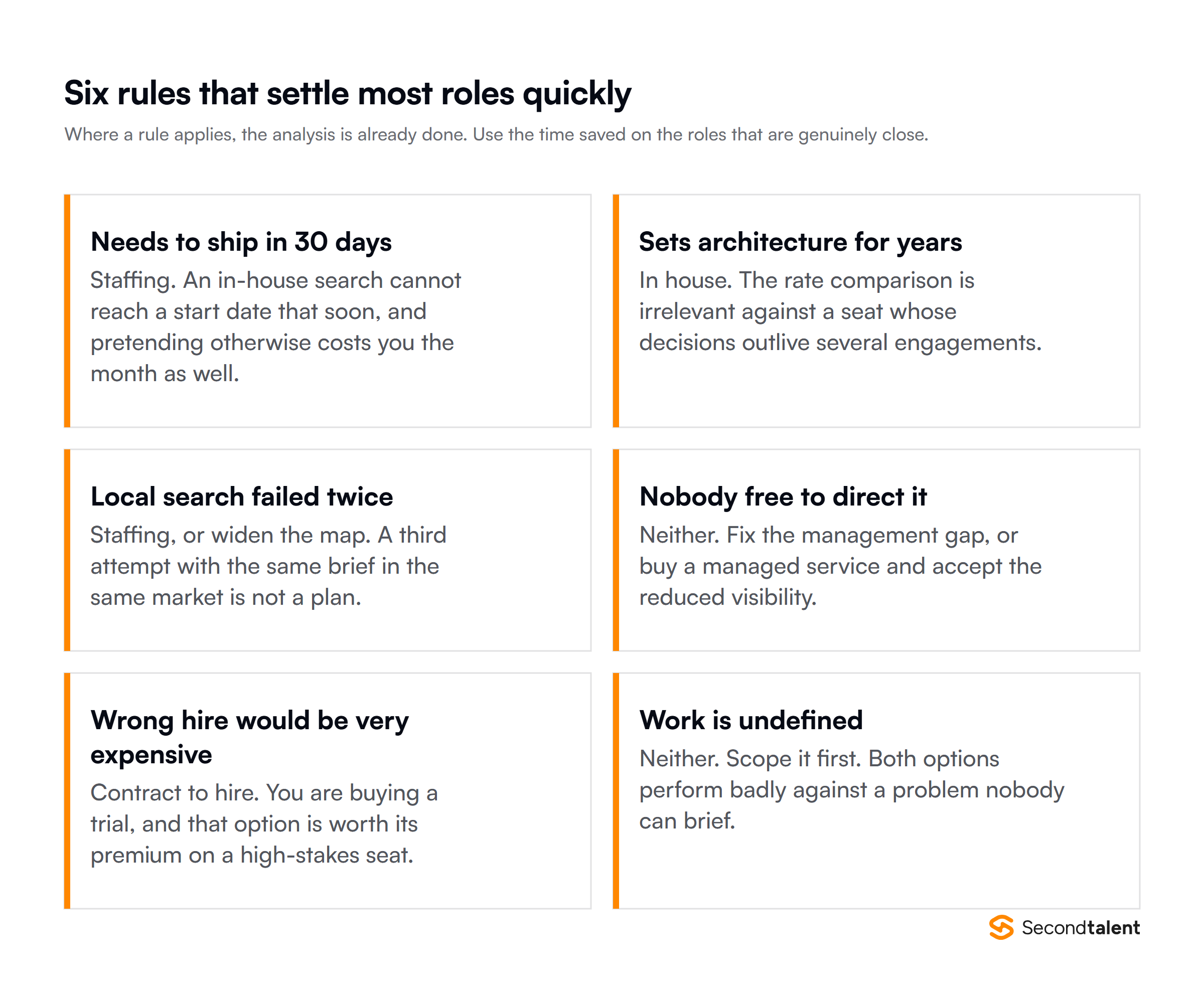
Six rules that settle most roles
Where a rule applies, the analysis is already done. Save the thinking for roles that are genuinely close.
- Needs to ship in 30 days: staffing. An in-house search cannot reach that start date.
- Sets architecture for years: in house. The rate comparison is beside the point.
- Local search failed twice: staffing, or widen the map. A third attempt with the same brief is not a plan.
- Nobody free to direct it: neither. Fix the management gap first.
- A wrong hire would be expensive: contract to hire. You are buying a trial.
- The work is undefined: neither. Scope it first.
The last two rules are the ones teams skip. Our guide to contract, contract-to-hire and direct hire covers setting the trial up so it produces a decision.
Skill availability is the factor people assess from memory. BLS projects data scientist employment to grow 35 percent between 2025 and 2035 and security analysts 21 percent, against roughly 4 percent across all occupations. For those seats a failed local search is the expected outcome rather than a recruiting failure worth fixing, and treating it as the latter costs you another quarter.
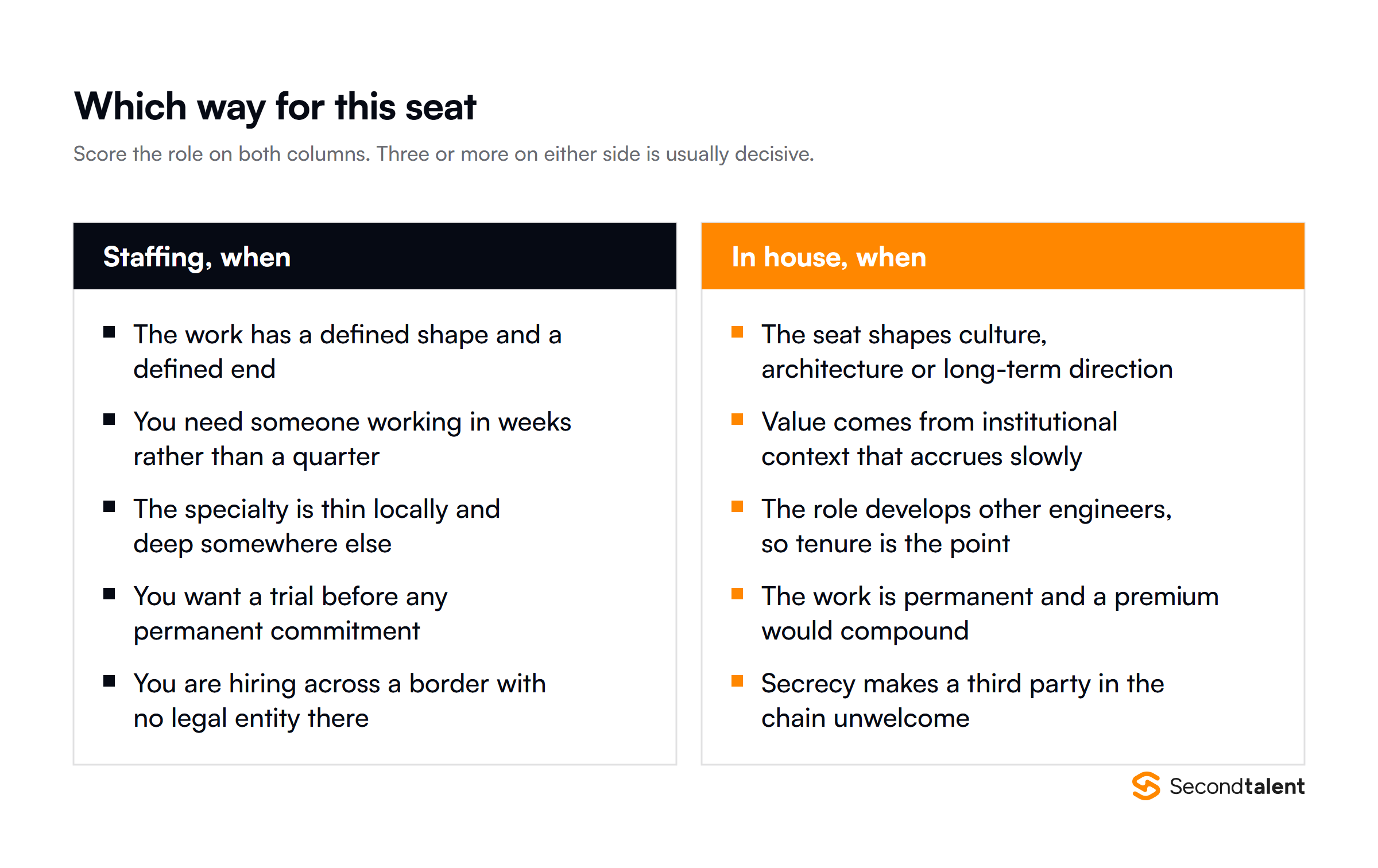
Which way for this seat
Staffing suits work with a defined shape and end, a seat you need filled in weeks, a specialty thin locally and deep elsewhere, a trial before commitment, and cross-border hiring without a legal entity.
In-house suits a seat that shapes culture or architecture, value that comes from institutional context, a role that develops other engineers, permanent work where a premium would compound, and anything where secrecy makes a third party unwelcome.
Three or more on either side is usually decisive. Where it splits evenly, default to the reversible option, which is staffing, and revisit at the first renewal.
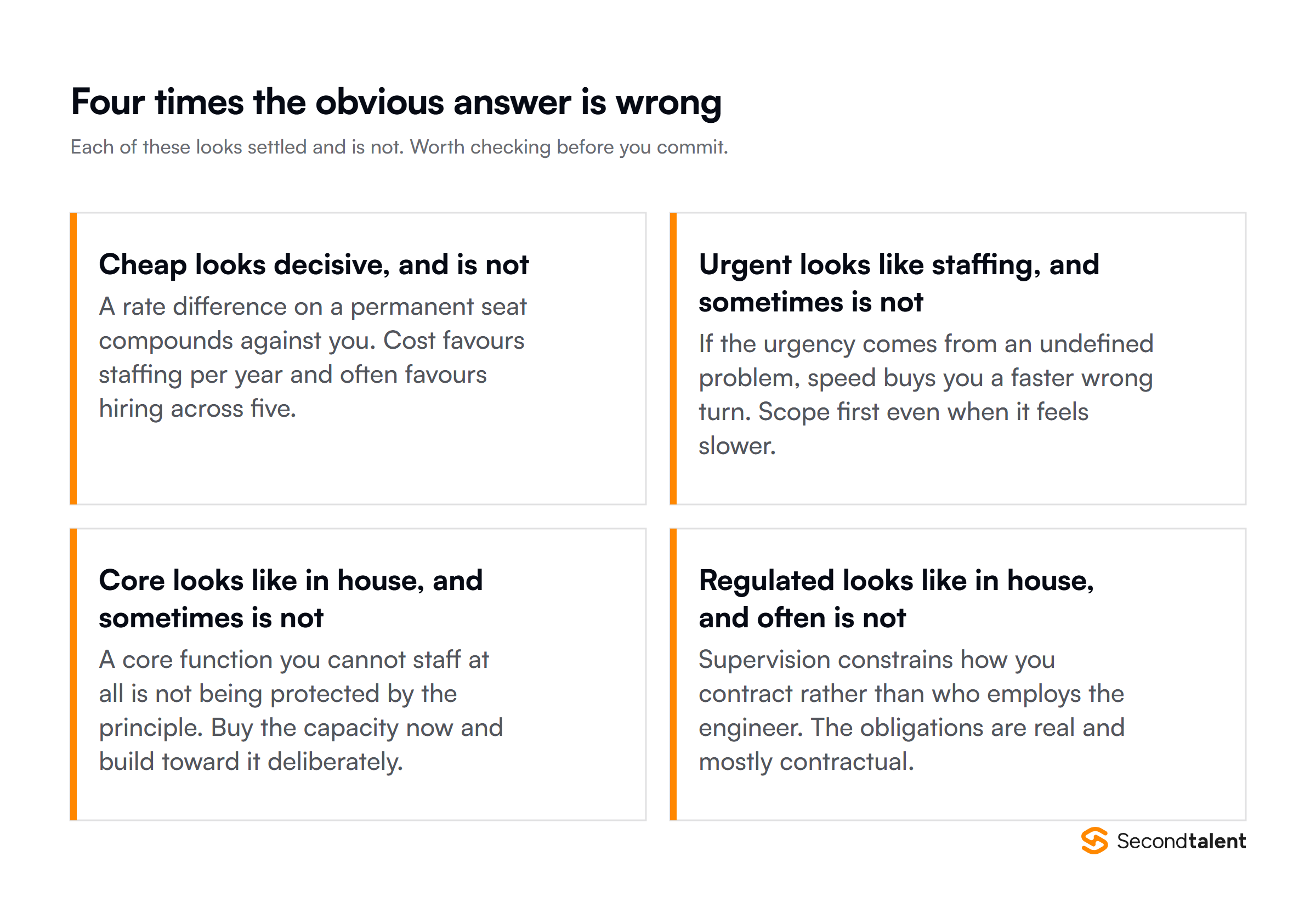
Four times the obvious answer is wrong
Cheap looks decisive, and is not. A rate difference on a permanent seat compounds against you. Cost favours staffing per year of engagement and often favours hiring across five.
Urgent looks like staffing, and sometimes is not. If the urgency comes from an undefined problem, speed buys a faster wrong turn.
Core looks like in house, and sometimes is not. A core function you cannot staff at all is not being protected by the principle. Buy the capacity now and build toward it deliberately.
Regulated looks like in house, and often is not. Supervision constrains how you contract rather than who employs the engineer, and the obligations are mostly contractual. Our guide to fintech staff augmentation covers what that looks like in a supervised sector.
The compliance factor
One consideration cuts across all five factors and is easy to leave until too late.
Hiring someone directly in a country where you hold no entity puts classification, payroll and statutory benefits on you. The IRS common-law test and the HMRC CEST tool both turn on control, and a contractor working your hours on your systems under your direction often fails them.
A provider employing through a licensed local entity moves that exposure, which is why cross-border and staffing tend to arrive together. Our guide to worker classification in cross-border IT staffing covers where it breaks.
What the decision does to the team you keep
Every one of these choices lands on people who were already there, and that effect rarely appears in the framework.
Staffing can protect a stretched team or unsettle it. Adding capacity to a team drowning in backlog is felt as relief. Adding it while a promotion case is pending, or while the team has been told headcount is frozen, is felt as something else. The difference is usually whether anyone explained the reasoning.
In-house hiring signals commitment and costs time. A permanent hire tells the team the work matters, and it takes a quarter of their interview hours to make happen. Both are real, and a team asked to run a long search while shipping will notice which one you optimised for.
The mixed team question is answered by behaviour. If augmented engineers attend the same rituals, use the same tooling and are treated the same way in planning, the distinction stops mattering within a month. Where it survives, it does so because someone kept it alive.
Say which route you took and why. Teams handle either decision well and handle an unexplained one badly.
Getting the brief right either way
The brief matters more than the route, and a weak one produces poor candidates through both channels.
Record what the person must be able to do in the first month, not a list of technologies. A brief reading “senior backend engineer, payments experience” returns generalists in either model. One reading “must have owned reconciliation for a card issuer and can explain an idempotency key strategy” returns a short list you can interview in a week.
Then write the 90-day success criteria before you see anyone. Criteria invented while looking at a CV bend to fit the person in front of you, which is how a hiring bar quietly moves. Our IT staffing plan template covers both, and the checklist covers the sequence around them.
Reviewing the decision later
This is a decision with a shelf life, and most teams make it once.
Three things should trigger a revisit. A staffed seat renewed for the third time on the same work, which means it became permanent while nobody was watching. A local search that succeeds where two failed, meaning the supply picture changed. And a role that has grown into architecture ownership, which has moved factors.
Put the review on the same quarterly cadence as the budget. It takes twenty minutes when your engagement register is current.
Decision framework FAQs
Can we use both for the same team?
Yes, and most teams past a handful of engineers do. Keep one register listing each seat, which route it came through, who directs it, the notice period and the renewal date.
Does staffing mean lower quality?
No. It means a different vetting problem. Quality tracks the provider’s funnel rather than the route, which is why how the vetting funnel works is the better question to ask.
What if we want to hire the person later?
Agree the conversion trigger and fee before the engagement starts. Negotiating once you have decided you want to keep someone is the weakest position available.
Does using staffing make in-house hiring harder later?
Not by itself. What can make it harder is the story you tell internally. A team told that staffing exists because headcount was refused will read every later hiring decision through that. A team told the seat is phase-shaped and the work has an end date reads it as a scoping decision, which is what it was.
How do we decide when the factors disagree?
Weight strategic importance and commitment length above cost. Cost differences are recoverable; a founder-grade seat filled on a three-month contract is not.
Takeaways
- Ask the question per seat rather than per company.
- Six rules settle most roles. Spend the thinking on the close ones.
- Charge ramp and recruiting cost to both sides, or the comparison is rigged.
- A failed local search for a scarce specialty is expected, not a recruiting failure.
- Where it splits evenly, take the reversible option and revisit at renewal.
Decide the close ones with real numbers
Second Talent publishes rates by role and market and places pre-vetted senior engineers across Asia with EOR cover, matched within 24 hours at 92 percent twelve-month retention.
Tell us which seat you are deciding on, or read why companies use IT staffing for the five patterns behind the decision.