TL;DR: Two engineers can do the same work under the same manager and sit in completely different employment relationships. That difference is what you are actually choosing between: who employs and pays them, who owns the performance conversation, how the arrangement ends, and where their career path sits. Commitment is symmetric, so the flexibility that lets you end an engagement on notice also lets the engineer leave for a better one.
Two companion pages cover the decision from other angles: when to use IT staffing versus in-house hiring gives the decision framework and build versus buy gives the cost model. This one covers the employment relationship itself, which is where the practical consequences live.
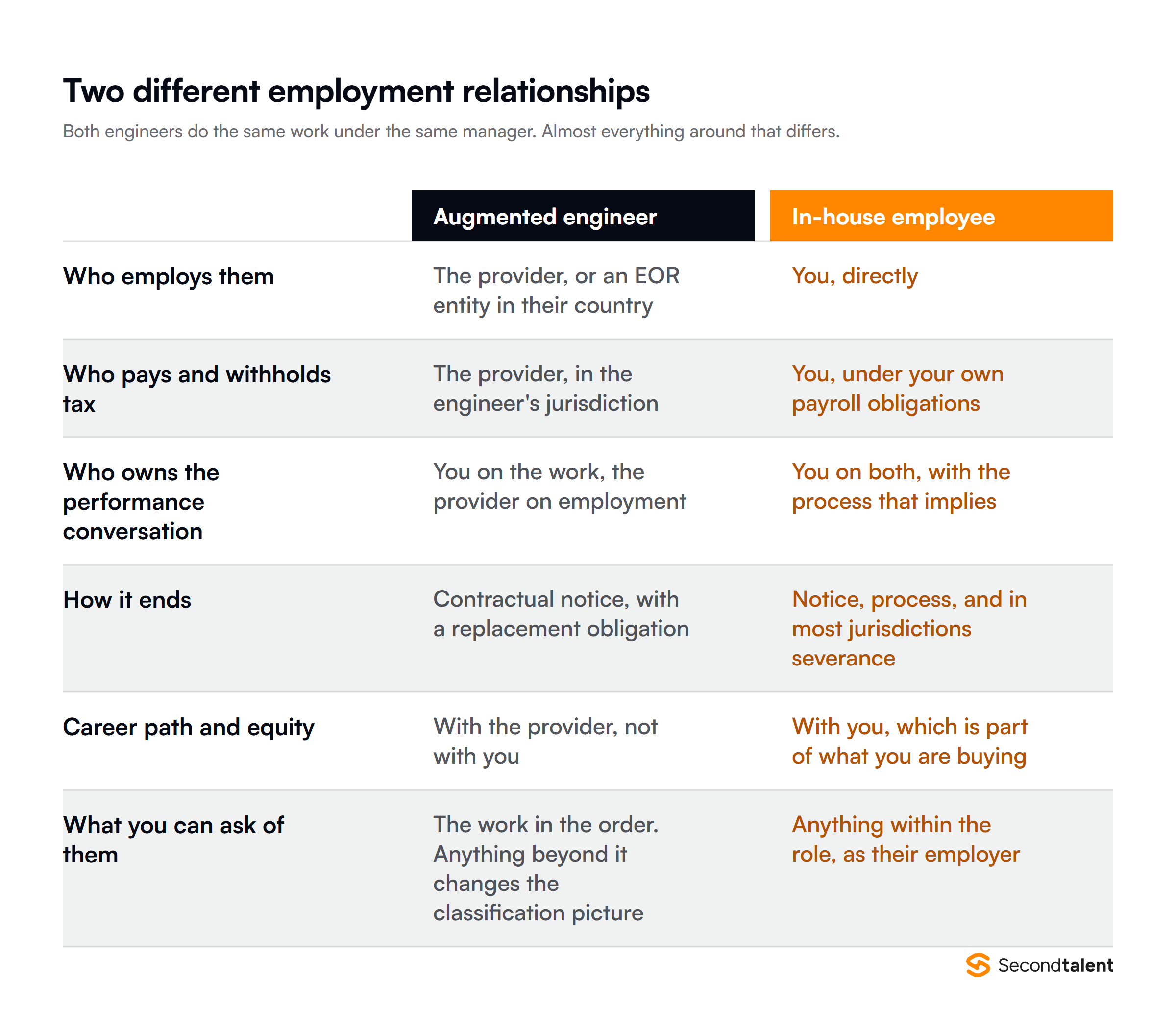
The structural difference
Staff augmentation places an engineer from a provider into your team. They are on the provider’s payroll or an EOR’s, report to your manager, use your tools and ship like anyone else. In-house hiring puts the engineer on your payroll with benefits, equity and a career path.
Both can deliver excellent work. What differs is everything around the work: who withholds tax, who runs the performance process, what happens at the end, and what you can legitimately ask of the person.
That last one matters more than it sounds. With an augmented engineer, work outside the order changes the classification picture. With an employee, anything within the role is fair. It is a real constraint on the model rather than a formality.
What differs for each party
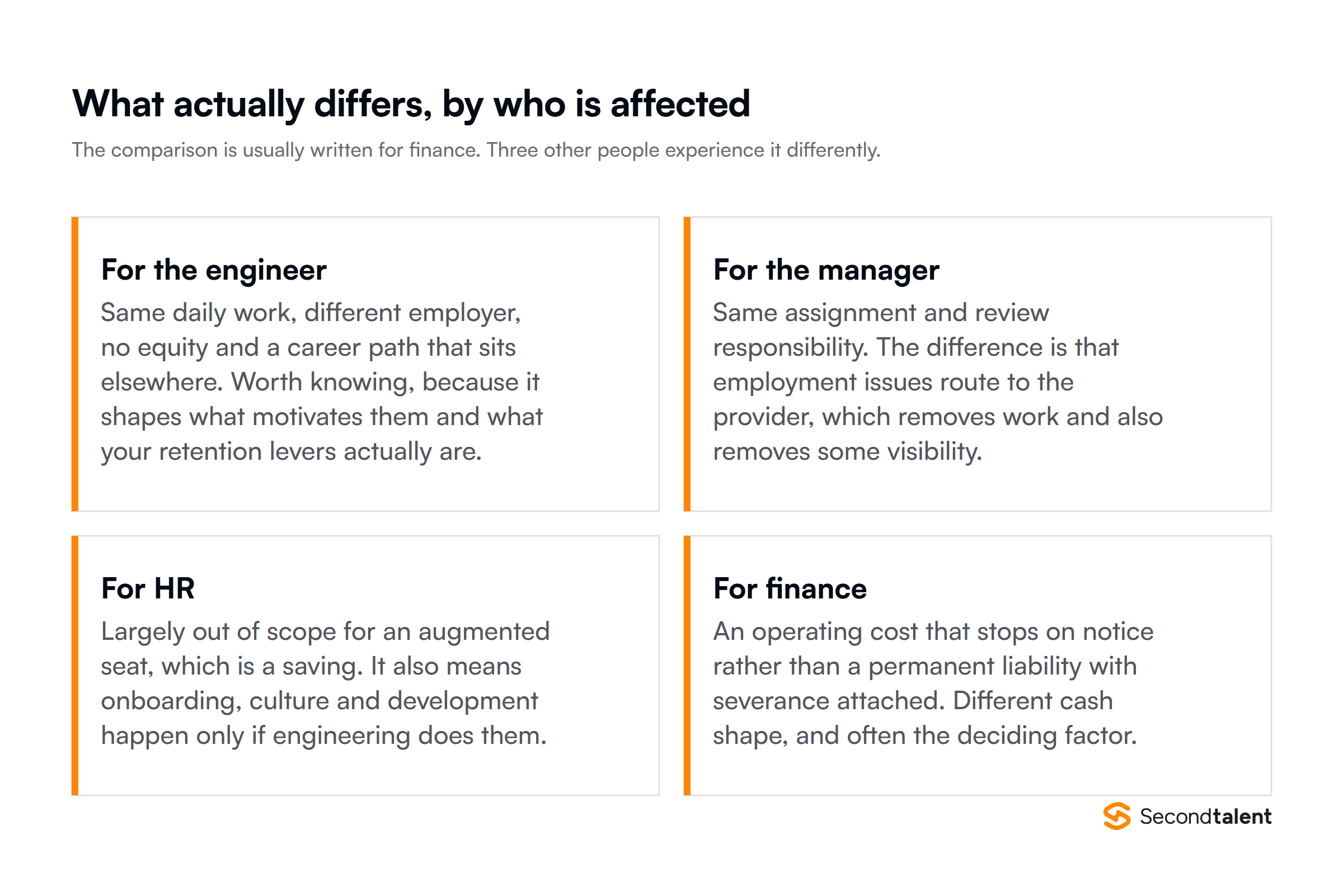
This comparison usually gets written for finance. Three other people experience it differently and are worth thinking about.
For the engineer. Same daily work, different employer, no equity, and a career path that sits with the provider. Worth knowing because it changes what motivates them and which retention levers you actually hold.
For the manager. Same assignment and review responsibility. Employment issues route to the provider, which removes work and also removes some visibility into problems.
For HR. Largely out of scope, which is a genuine saving. It also means onboarding, culture and development happen only if engineering does them, and they often do not.
For finance. An operating cost that stops on notice, rather than a permanent liability with severance attached. Different cash shape, and frequently the deciding factor.
Comparing cost fairly
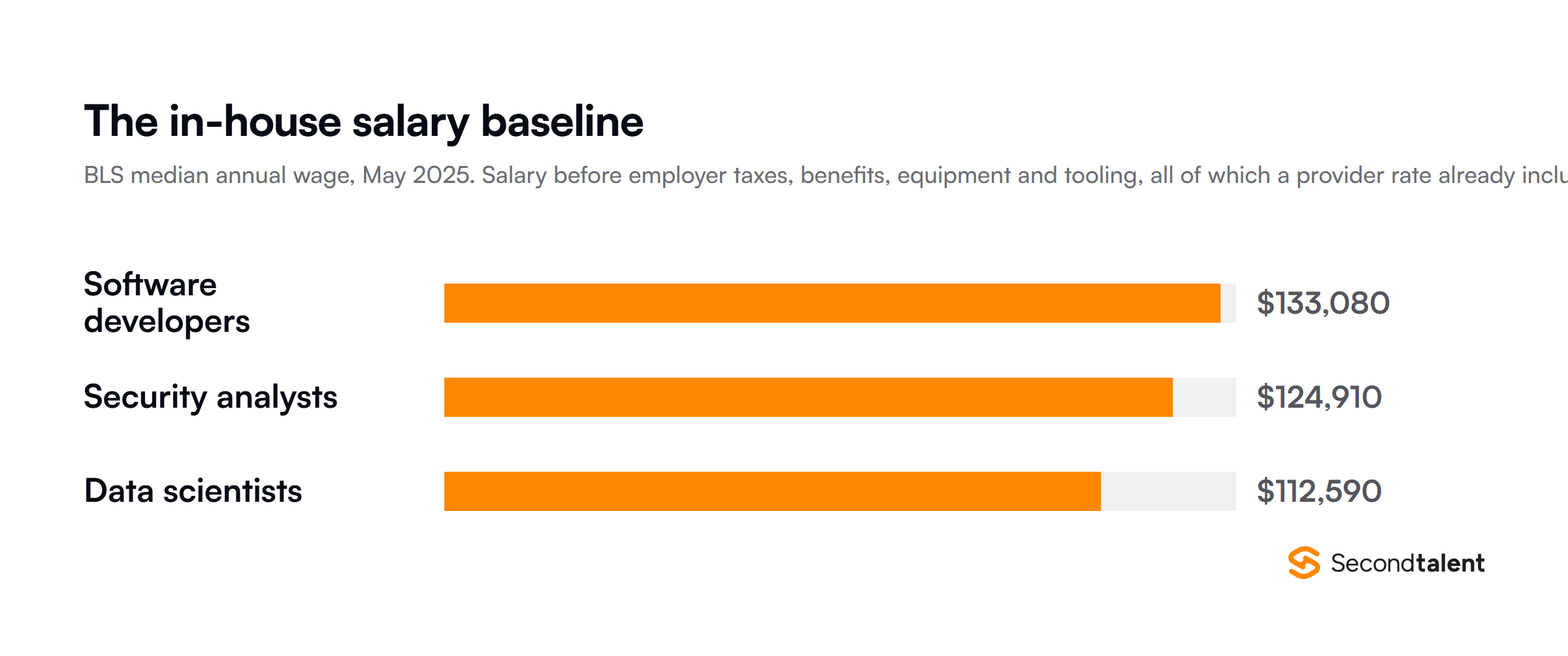
The US Bureau of Labor Statistics puts the May 2024 median annual wage at $135,980 for software developers, $129,180 for information security analysts and $120,230 for data scientists.
Those are salary before employer taxes, benefits, equipment and tooling. A provider rate already includes all of it, so load the salary side before comparing. Second Talent publishes senior rates in the developer rate cards, and clients save $103,000 or more per hire against a comparable Western salary.
Two costs get left out of most comparisons and belong in both columns: the ramp, which you pay at full rate either way and which is usually longer for an employee learning the company as well as the codebase, and management time, which the model assumes and nobody invoices for.
Commitment runs both ways
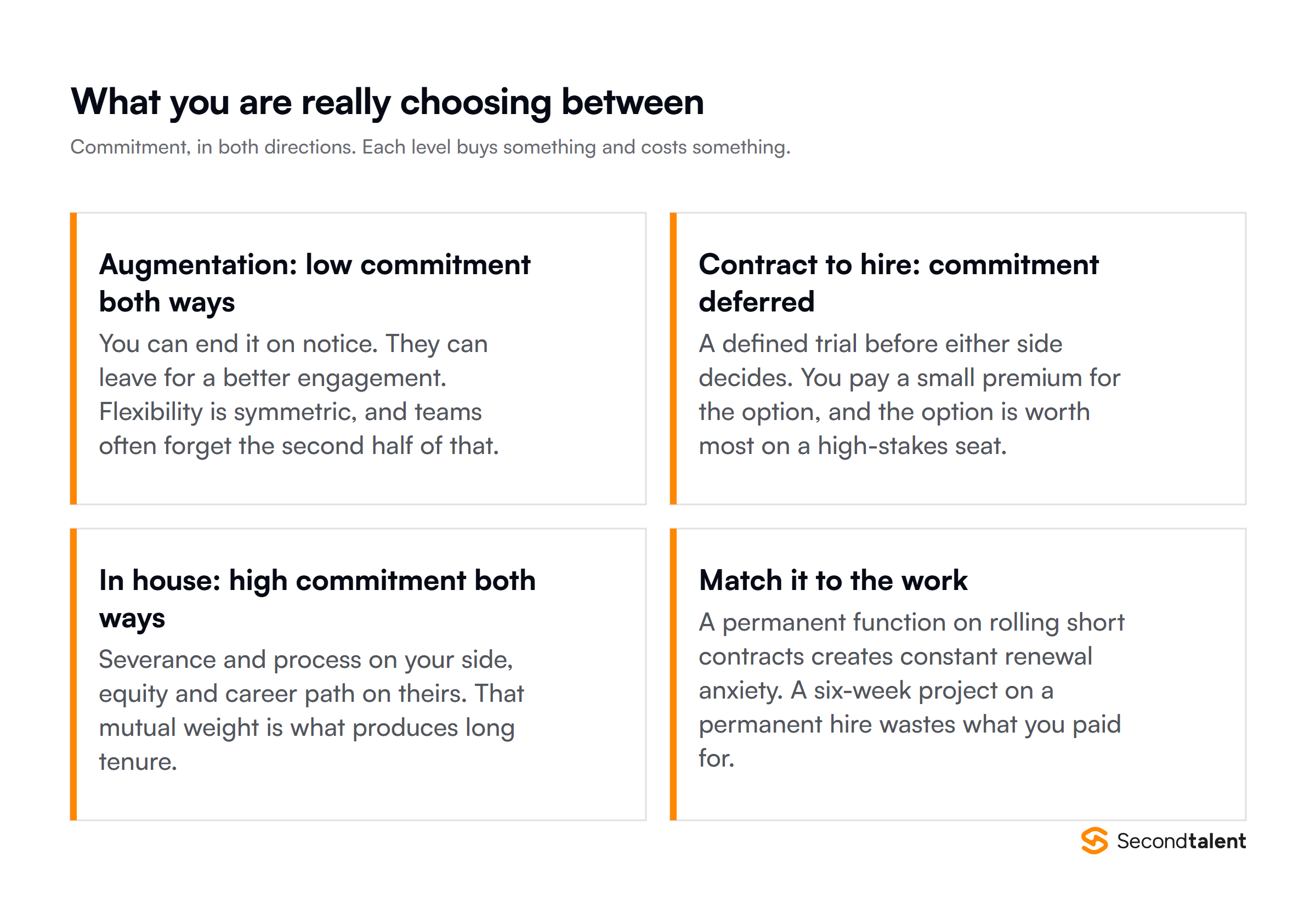
Most write-ups treat flexibility as something the buyer gains. It is symmetric, and the second half gets forgotten.
Augmentation is low commitment in both directions. You can end it on notice. They can move to a better engagement, and nothing about the arrangement gives them a reason not to.
In-house is high commitment in both directions. Severance and process on your side, equity and a career path on theirs. That mutual weight is precisely what produces long tenure, and it is what you are paying for.
Contract to hire defers the commitment. A defined trial before either side decides, with a small premium for the option.
Retention on an augmented seat is the provider’s job and your problem. You have fewer levers than with an employee: no equity, no promotion, no career path to offer. What you do control is whether the work is interesting and whether the person is treated as part of the team. Ask any provider for their twelve-month retention figure, and then do your half.
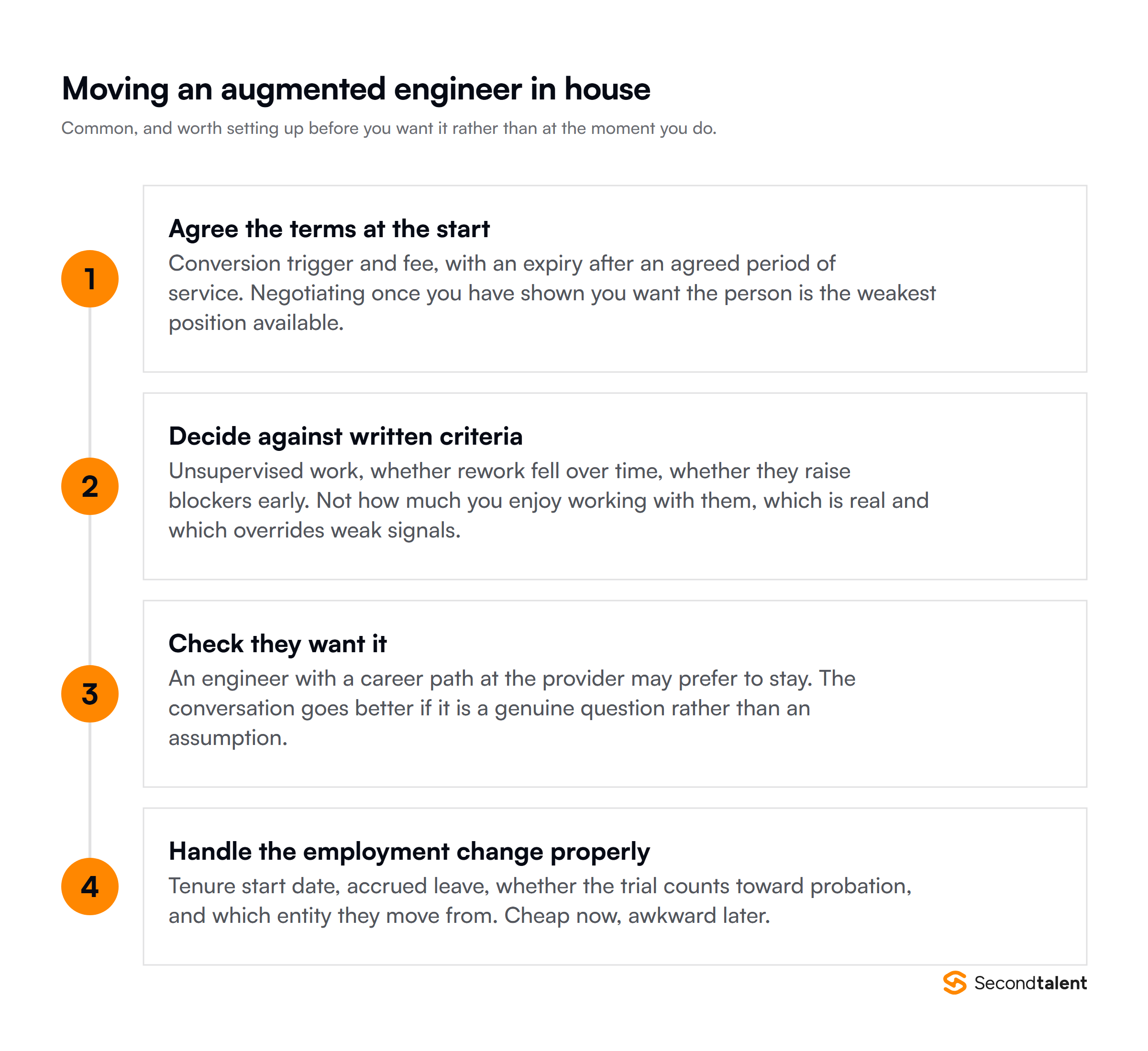
Moving an augmented engineer in house
Common enough to plan for, and much easier when the terms were set at the start.
Agree the terms up front. Conversion trigger and fee, with an expiry after an agreed period of service. Negotiating once you have shown you want the person puts you on the wrong side of the table.
Decide against written criteria. Unsupervised work, whether rework fell over time, whether they raise blockers early. Not how much you enjoy working with them, which is real information and the thing most likely to override a weak performance signal.
Check they want it. An engineer with a career path at the provider may prefer to stay, and the conversation goes better as a genuine question than an assumption.
Handle the employment change properly. Tenure start date, accrued leave, whether the trial counts toward probation, and which entity they are moving from. Our guide to contract, contract-to-hire and direct hire covers the mechanics.
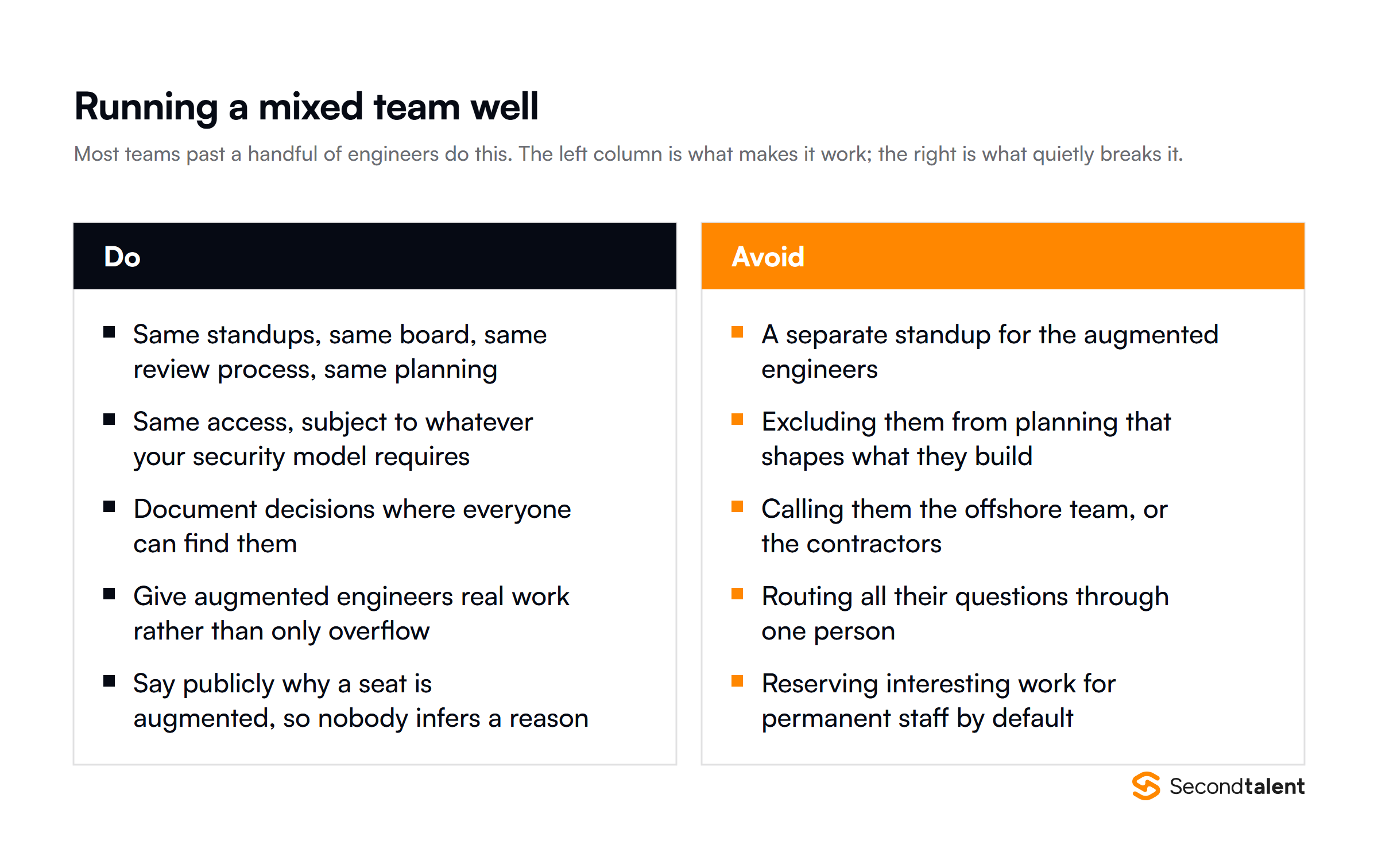
Running a mixed team well
Most teams past a handful of engineers run both, and the difference between a mixed team that works and one that does not is behavioural rather than contractual.
Do: same standups, board, review process and planning. Same access, subject to your security model. Document decisions where everyone can find them. Give augmented engineers real work rather than only overflow. And say publicly why a seat is augmented, because a team that is not told will infer a reason.
Avoid: a separate standup for augmented engineers, excluding them from planning that shapes what they build, calling them the offshore team or the contractors, routing all their questions through one person, and reserving interesting work for permanent staff by default.
None of that is about fairness for its own sake. A distinction maintained in daily practice produces exactly the weaker output people then use to justify the distinction.
What each model does to institutional knowledge
The knowledge question decides more long-run outcomes than the cost question and gets a fraction of the attention.
An employee accumulates context that never gets written down: why a system was built that way, which customer drove a decision, what was tried and abandoned. That accumulation is a large part of what tenure buys, and it is invisible until the person leaves.
An augmented engineer accumulates the same context and takes it with them at a date you already know. That is not a flaw in the model. It is a known parameter, and it means documentation stops being good hygiene and becomes a deliverable.
Practically: ask for architecture decisions, debugging notes and runbook updates throughout the engagement rather than in the final week. Teams that do this find it improves the in-house half too, because the habit does not distinguish between who wrote the note.
Where speed actually comes from
The speed advantage is real and it is worth being precise about which parts of a timeline it removes, because plans slip on the parts it does not.
Removed: sourcing and first-pass screening, which a bench provider did before you called. And the notice period, since a provider-employed engineer is not serving one elsewhere. That second one is often the largest single block in an in-house hire.
Shortened: interview loops, down to your own technical screen against a shortlist rather than a funnel you run yourself.
Unchanged: contracting and access provisioning, which take days at an ordinary company and weeks at a regulated one. And the ramp, which is about three weeks before unsupervised work either way.
Second Talent returns matched profiles within 24 hours. Plan the unchanged steps rather than assuming they compress with the rest.
One consequence worth drawing out: because the unchanged steps are identical, the speed advantage shrinks as a proportion of the total the more regulated your environment is. A team that needs six weeks of access provisioning gains less from same-day profiles than a team that needs two days, and that is worth knowing before you promise a date.
The compliance boundary
One constraint applies to augmentation and not to employment, and it is worth stating plainly rather than discovering.
Classification tests turn on control. The IRS guidance weighs behavioural control, financial control and the type of relationship, and the HMRC CEST tool asks the same in UK terms. Because augmentation is control by design, the protection comes from the provider being the employer through a registered local entity rather than from contract wording.
Practical consequence: keep the work inside the order. Scope creep is a delivery annoyance with an employee and a compliance question with an augmented engineer. Our guide to worker classification in cross-border IT staffing covers it.
Augmentation and in-house FAQs
Which roles should never be augmented?
Seats where the value comes from permanence rather than from output. A head of platform, a founding engineer, an architect whose decisions outlive several engagements, and anyone whose main job is developing other engineers. Tenure is the product in those roles, and a model built around a defined end cannot supply it at any rate.
Do augmented engineers integrate as well as employees?
They do when treated the same way, and they do not when treated differently. The variable is your practice rather than the contract, which is why the mixed-team section above matters more than the cost comparison.
Can we offer equity to an augmented engineer?
Generally no, and attempting it raises the classification question directly, since equity is one of the type-of-relationship indicators. If equity is the right instrument for the seat, the seat wants to be an employee.
How do we handle performance issues?
Raise them with the engineer as you would with anyone, and route employment consequences to the provider. That split is the model working. Keep your feedback specific and written, because the provider is acting on your account of it.
Is it harder to retain augmented engineers?
You have fewer levers. Interesting work and being treated as part of the team are the two you keep, and they carry more weight here than they do with employees who also have equity vesting.
Takeaways
- Same work, different employment relationship. That is the real choice.
- Commitment is symmetric. Low commitment lets them leave as easily as it lets you end it.
- Load the salary side before any cost comparison, and charge ramp to both columns.
- Agree conversion terms before you want to convert anyone.
- Keep the work inside the order. Scope creep is a compliance question here, not just a delivery one.
Fill the seat either way
Second Talent places pre-vetted senior engineers across Asia with EOR cover, matched within 24 hours at 92 percent twelve-month retention, and supports conversion to your payroll on terms agreed up front.
Tell us which seat you need to fill, or read the benefits of staff augmentation for what the model buys you.