TL;DR: A senior Android developer from Asia starts from $2,999 a month through Second Talent, matched in 24 hours. The median US software developer earns $135,980 a year, on BLS data for May 2025.
Since 31 August 2026, Google Play has rejected new apps and updates that do not target Android 16 (API level 36), where apps can no longer opt out of edge-to-edge display. On 30 September, app installs in Indonesia, Singapore, Thailand and Brazil start requiring a verified developer. An Android hire made this quarter starts with both changes.
Key takeaways
- Android developers in Malaysia who work for foreign companies start at more than double the pay floor in the Philippines and Indonesia.
- Android held 78.13% of mobile operating system share in Asia in August 2026, against 39.29% in the US, so these developers build for the dominant platform at home.
- An independent contractor owns the code they write until a signed written assignment transfers it, and the app itself belongs in your own Play Console account.
- Google Play's visibility threshold for user-perceived crash rate is 1.09% across devices, a number worth writing into the job description.
What Android Developers Earn Working for International Clients in Asia
An Android developer in Malaysia working for a foreign company starts at $2,950 a month, while the same work pays from $1,200 in the Philippines and Indonesia. The top of the range spreads wider still: India's card opens at $7,530 and keeps going.
| Market |
Monthly pay working for international clients (USD) |
| Philippines |
$1,200-$3,500 |
| Indonesia |
$1,200-$4,500 |
| India |
$1,880-$7,530+ |
| Vietnam |
$2,000-$5,500 |
| Malaysia |
$2,950-$7,000+ |
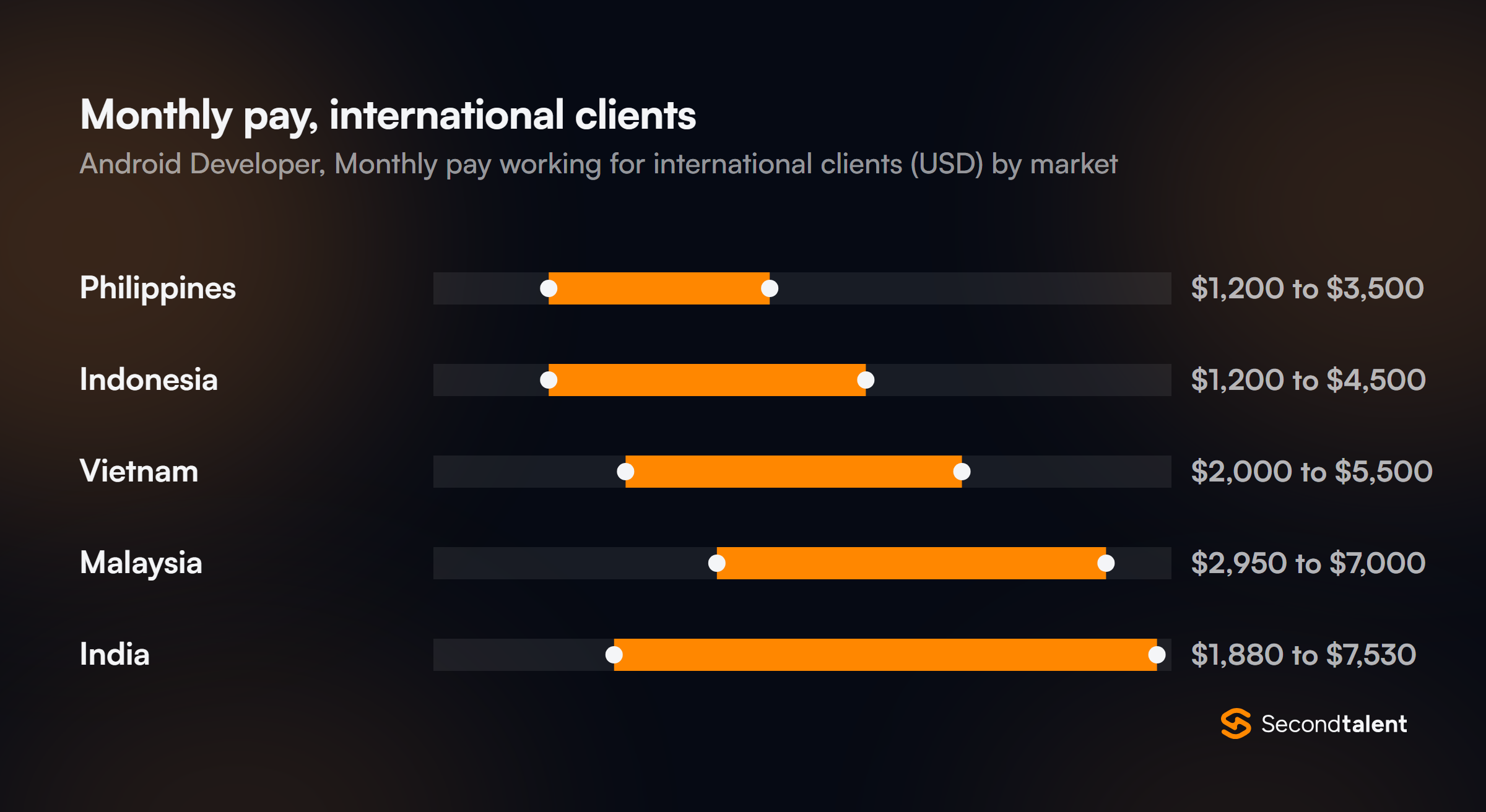
Monthly ranges from the Remote (Working for International Clients) figures on our rate cards for Philippines, Indonesia, India, Vietnam and Malaysia, converted at ExchangeRate-API mid-market rates for 14 September 2026. The Philippine, Indonesian and Vietnamese cards publish the figure in US dollars; the Indian card uses rupees (₹95.61 to the dollar) and the Malaysian card ringgit (RM4.07).
Each range is what Android developers in that market earn working directly for foreign companies, before any employer or platform costs. A "+" marks a range with no published ceiling.
Second Talent charges from $2,999 a month for a senior Android developer. That is one monthly fee that bundles salary, payroll taxes, statutory contributions and our service fee. For US freelance and agency rates on the same role, see our Android developer cost-to-hire page.
US Pay Benchmark for Android Developers
A US software developer at the 25th percentile earns $8,770 a month, which is more than the top of the Philippine and Indonesian ranges above. The federal occupation system has no separate mobile developer category, so Android work maps to Software Developers (15-1252), the occupation that designs and builds applications.
| BLS OEWS, May 2025, national |
Software Developers (15-1252) |
| 10th percentile, monthly |
$6,870 |
| 25th percentile, monthly |
$8,770 |
| Median, monthly |
$11,330 |
| 75th percentile, monthly |
$14,330 |
| 90th percentile, monthly |
$17,890 |
Monthly figures are the annual wages on the BLS occupation profile for 15-1252 divided by 12, rounded to the nearest $10.
Salary is only part of the US cost. In the BLS Employer Costs for Employee Compensation release for June 2026, wages and salaries made up 68.5% of employer compensation costs for full-time private industry workers, and benefits the other 31.5%.
Time Zone Overlap with ET, CT and PT
A Play Store rollout started at 9:00 am in New York begins at 9:00 pm in Manila. None of the Asian markets in this guide observe daylight saving time, and US clocks stay on daylight time from 8 March to 1 November 2026 (NIST).
| Engineer's city |
UTC offset |
9:00 am ET (EDT) |
9:00 am CT (CDT) |
9:00 am PT (PDT) |
| Manila, Singapore, Kuala Lumpur, Taipei |
UTC+8 |
9:00 pm |
10:00 pm |
12:00 midnight |
| Ho Chi Minh City, Jakarta, Bangkok |
UTC+7 |
8:00 pm |
9:00 pm |
11:00 pm |
| Bengaluru |
UTC+5:30 |
6:30 pm |
7:30 pm |
9:30 pm |
After 1 November 2026, every time in the table moves one hour later.
The first cell works out as 9:00 am EDT = 13:00 UTC, plus eight hours = 21:00 in Manila. Three shifts that create overlap, computed for September:
- Manila, 5:00 pm to 2:00 am (09:00 to 18:00 UTC) covers 5:00 am to 2:00 pm in New York: five hours inside a 9-to-5 ET day, four with Chicago and two with San Francisco.
- Ho Chi Minh City, 3:00 pm to midnight (08:00 to 17:00 UTC) covers 4:00 am to 1:00 pm ET, four hours with New York.
- Bengaluru, 2:00 pm to 11:00 pm (08:30 to 17:30 UTC) covers 4:30 am to 1:30 pm ET, four and a half hours.
Put staged rollouts at the start of the overlap, so the developer who shipped the build is still online when crash reports arrive from US users. Late hours cost more for employees: the Philippine Labor Code adds at least 10% for work between 10 pm and 6 am (Article 86), four hours of the Manila shift, and Vietnam's Labor Code adds at least 30% for 22:00 to 06:00 (Articles 98 and 106).
Android Developer Skills to Screen For
Android held 78.13% of mobile operating system share in Asia in August 2026 and 39.29% in the US, on StatCounter figures, so Android is the main platform in the markets these developers come from. Screen for the platform rules that changed in the last year: a developer who stopped reading release notes in 2024 will ship builds Google Play refuses.
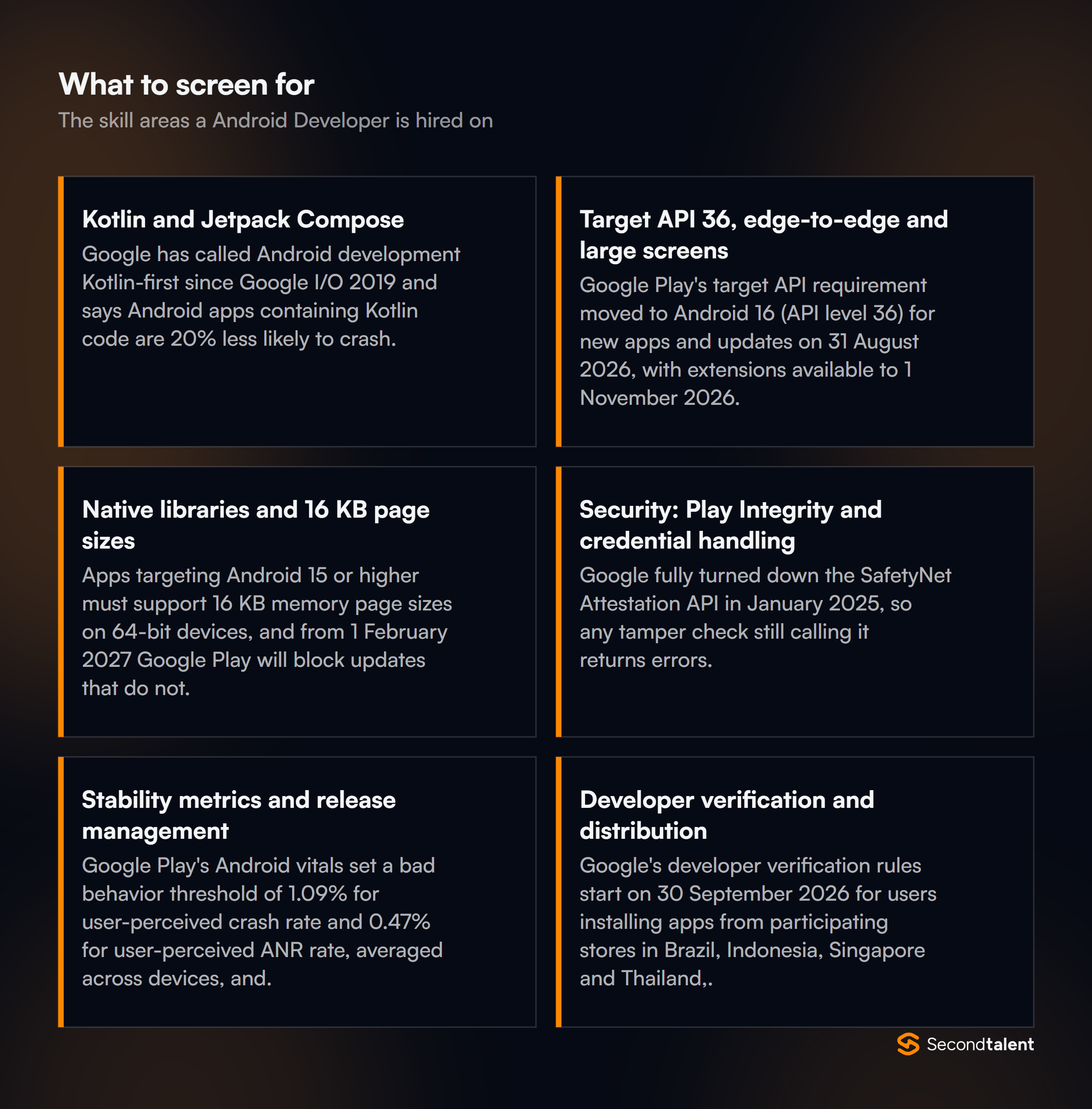
Kotlin and Jetpack Compose
Google has called Android development Kotlin-first since Google I/O 2019 and says Android apps containing Kotlin code are 20% less likely to crash. Across all fields, Kotlin was used by 11.5% of professional developers in Stack Overflow's 2025 survey. Ask the candidate to build one screen in Compose with state hoisted into a ViewModel, then rotate the emulator and check what survives. If your app still has Java modules, add a Java file to the exercise, since Kotlin and Java call each other in the same project.
Target API 36, edge-to-edge and large screens
Google Play's target API requirement moved to Android 16 (API level 36) for new apps and updates on 31 August 2026, with extensions available to 1 November 2026. The Android 16 behavior changes remove the edge-to-edge opt-out and ignore orientation, resizability and aspect-ratio restrictions on displays at least 600dp wide. Give the candidate a portrait-locked screen and ask how it will look on a tablet after the upgrade.
Native libraries and 16 KB page sizes
Apps targeting Android 15 or higher must support 16 KB memory page sizes on 64-bit devices, and from 1 February 2027 Google Play will block updates that do not. The work falls on apps with native code, including code pulled in through third-party SDKs. Ask the candidate to open your APK in APK Analyzer, find the .so files and explain how to check their alignment.
Security: Play Integrity and credential handling
Google fully turned down the SafetyNet Attestation API in January 2025, so any tamper check still calling it returns errors. Improper credential usage sits at M1 in the OWASP Mobile Top 10 2024. Plant an API key in BuildConfig in the take-home and see whether the candidate moves it server-side.
Stability metrics and release management
Google Play's Android vitals set a bad behavior threshold of 1.09% for user-perceived crash rate and 0.47% for user-perceived ANR rate, averaged across devices, and 8% for either on a single phone model. Apps above them risk reduced visibility in the store. Ask for the last ANR the candidate fixed, how they found it and which call blocked the main thread.
Developer verification and distribution
Google's developer verification rules start on 30 September 2026 for users installing apps from participating stores in Brazil, Indonesia, Singapore and Thailand, on certified devices running Android 7 or later, and expand worldwide in 2027. Google Play registers 99% of apps without any action from the developer.
A candidate who has shipped outside Play, through Galaxy Store or an OEM store, should know which account type covers those builds.
Senior Android developers: what to test beyond Compose
A senior Android developer should be able to defend the architecture of an app they have maintained across more than one Android release, not only build a screen. Google's architecture guidance for Android recommends a UI layer and a data layer, with an optional domain layer between them, and data that flows in one direction. Ask the candidate to draw the layers of their last app and point to the class that is the single source of truth for one piece of data.
Then test the work that lands on senior engineers:
- Modularization. Ask how they split a large app into feature modules, and what that did to build times and code ownership.
- Coroutines and Flow. Show them a ViewModel that collects a Flow without lifecycle awareness and ask what happens when the app goes to the background.
- Release calls. Ask when they would halt a staged rollout on Google Play, and which Android vitals figure they watch in the first hours.
- Review. Hand them a junior pull request that leaks an Activity context and score their comments.
A senior candidate should show at least one Play listing where they owned releases through a target API upgrade.
Room, Hilt and the Jetpack libraries
Most production Android apps sit on the same Jetpack building blocks, so depth there shows quickly. Screen the three that hold an app together:
- Room. Room is the Jetpack persistence library over SQLite, with compile-time checks on SQL queries. Ask the candidate to add a column to an existing entity and write the migration, then explain what happens on a device that skipped a version. A missing migration crashes the app on launch, or wipes user data if destructive fallback is turned on.
- Hilt. Hilt is Jetpack's dependency injection library, built on Dagger. Ask how they would scope a repository to the whole app versus one screen, and how they swap it for a fake in an instrumented test.
- WorkManager. For deferrable background work that must survive a restart, Google recommends WorkManager. Ask how they would run a sync only on an unmetered network and retry it with backoff.
If your app uses the NDK, add a short C++ task alongside the 16 KB page-size check above.
Contractor or Employer of Record for a US Company
Software is not one of the nine categories of commissioned work that can be "work made for hire" under 17 U.S.C. § 101. An Android app a contractor writes for you stays theirs until they transfer it, and § 204(a) requires that transfer to be in writing and signed.
Ownership of the store listing matters as much as the code. Create the app under your organization's own Play Console account, which needs a D-U-N-S number, and add the developer as a user. A developer who publishes from a personal account holds the listing, the reviews and the signing setup.
Tax follows the location of the work. IRS Publication 515 says the place where the developer performs the services determines the source of the income, so a developer working from Jakarta earns foreign-source income. A foreign individual gives the payer Form W-8BEN to certify foreign status.
The developer's own country applies its own employment test. The Philippine Supreme Court, in Atok Big Wedge v. Gison, uses a four-fold test: selection and engagement, payment of wages, the power of dismissal and the power to control the employee's conduct, and calls control "the most important".
A full-time developer who follows your sprint board and release calendar meets the control test. Employees in the Philippines also receive a 13th-month pay under PD 851 and Memorandum Order 28, and contributions go to SSS (15% shared, credit cap ₱35,000), PhilHealth (5%, cap at ₱100,000) and Pag-IBIG (2% each side, ₱10,000 cap).
|
Independent contractor |
Employer of Record (EOR) |
| Legal employer |
None; the developer invoices you |
The EOR's local entity |
| US paperwork |
Form W-8BEN from the developer |
Service agreement with the EOR |
| IP |
Written assignment signed by the developer |
Assignment terms in the employment contract and your EOR agreement |
| Local labor law |
Classification risk if the work looks like employment |
Night premiums, 13th-month pay and leave apply |
| Pay currency |
Agreed in the contract |
Set in the employment contract and paid through the EOR's local payroll |
A scoped build, such as a Compose migration with a fixed end date, fits a contractor agreement. A developer who owns your app's releases month after month fits employment, and our EOR service runs that side, with country detail on the Philippines EOR page. This is a summary, not legal advice.
English Level and Working Norms
Indonesia's IT workers score 523 on the EF English Proficiency Index 2025, 52 points above the national 471. In the other markets on the rate table, the IT score sits level with the national score or up to 12 points above it.
| Country |
EF EPI 2025 score |
World rank (of 123) |
IT job-function score |
| Malaysia |
581 |
24 |
590 |
| Philippines |
569 |
28 |
581 |
| Vietnam |
500 |
64 |
500 |
| India |
484 |
74 |
487 |
| Indonesia |
471 |
80 |
523 |
Scores come from EF's country pages, such as the Philippines, Vietnam and Indonesia. The global average is 488.
Android work produces a lot of written English that customers read: Play Store release notes, policy declarations and replies to reviews. Ask for a sample release note during the assessment, and have the candidate reply to a one-star review about a crash.
Plan holidays on both calendars. Vietnam's Labor Code gives five paid days for Lunar New Year, which lands in late January or February, so avoid a major release that week with a Vietnam-based developer. Thanksgiving, 26 November 2026, is a normal working day across Asia, which suits a release freeze while your US team is out.
Android Developer Hiring Process
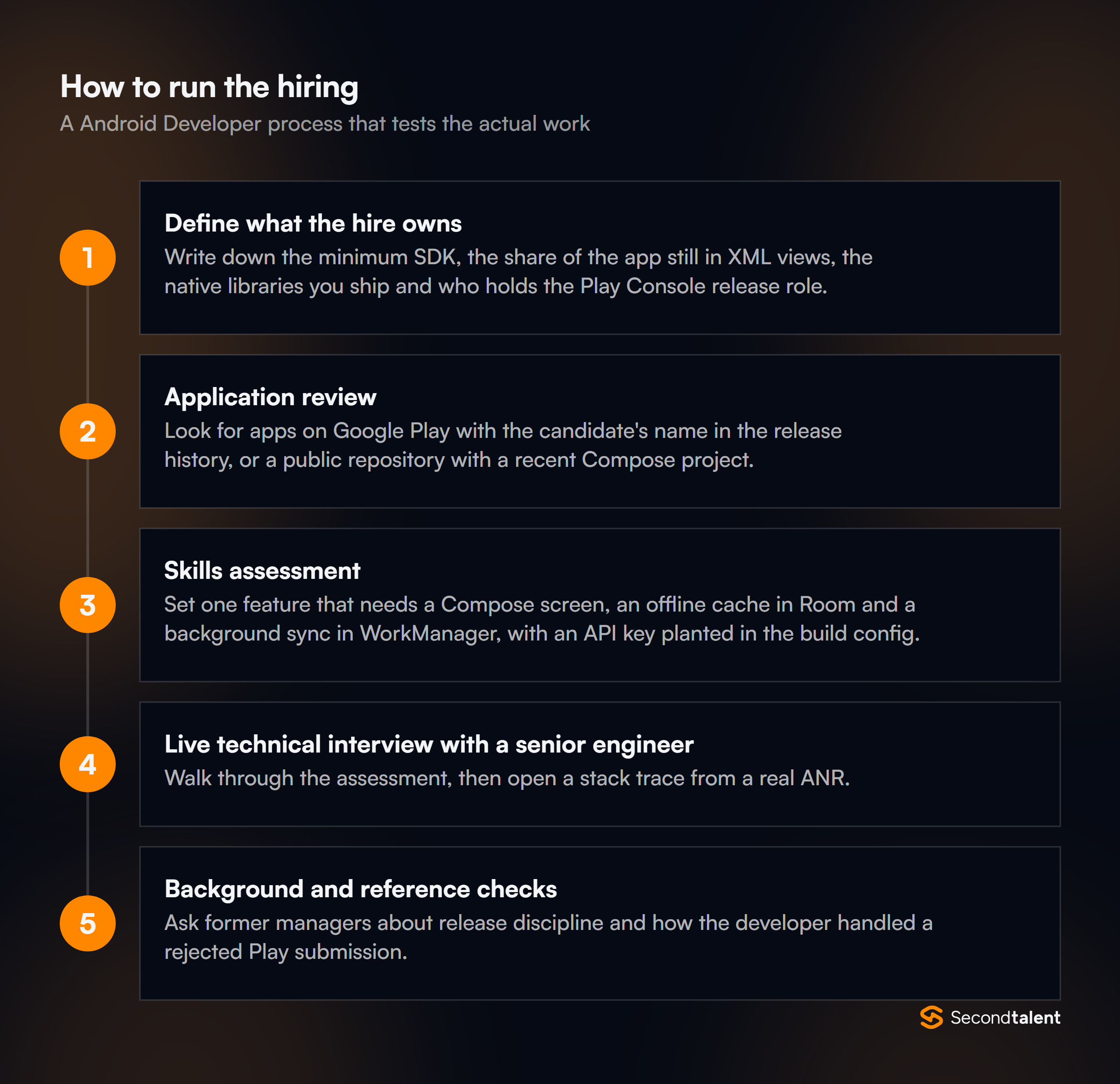
Second Talent's vetting covers stages 2 to 5 before you see a profile. The exercises below are the Android versions to run in your own final round, and our Android and Kotlin interview guide has question sets for stage 4.
Stage 1: Define what the hire owns
Write down the minimum SDK, the share of the app still in XML views, the native libraries you ship and who holds the Play Console release role. A Compose greenfield app and a ten-year-old Java codebase need different developers.
Stage 2: Application review
Look for apps on Google Play with the candidate's name in the release history, or a public repository with a recent Compose project. Ask which crash rate the app ran at and who owned the on-call rotation after launch.
Stage 3: Skills assessment
Set one feature that needs a Compose screen, an offline cache in Room and a background sync in WorkManager, with an API key planted in the build config. Score the pull request description as well as the code.
Stage 4: Live technical interview with a senior engineer
Walk through the assessment, then open a stack trace from a real ANR. Ask how the candidate would take an app from API 35 to API 36 and what they would test on a tablet first.
Stage 5: Background and reference checks
Ask former managers about release discipline and how the developer handled a rejected Play submission. Then sign the contract with the IP assignment and add the hire to your Play Console with the permissions the role needs.
For cross-platform roles, compare our Flutter developer page and iOS developer page.
Hire Android Developers from Asia with Second Talent
We shortlist 6-8 candidates within 24 hours from 100,000+ pre-vetted engineers, accepting only the top 1% of applicants. Android developers start from $2,999 a month, with $0 upfront, no lock-in and 4-6 hours of daily overlap with US hours. We handle contracts, payroll and equipment, with compliant EOR contracts and payroll in 9 Asian markets.
Our pricing page covers subscription, direct-hire and EOR pricing. Truckstop, the US freight technology company, hired eight engineers in Vietnam through us, two of them mobile developers, at an average of 22 days to hire, as the Truckstop case study sets out.