TL;DR: Most IT staffing engagements fail on process rather than on talent. Budget approval never lands, access is not ready on day one, the trial period ends without a decision, or the contract missed IP assignment. This page gives you a free checklist and worksheet PDF covering seven stages, and walks through each one with the step teams routinely skip.
The engineer is rarely the problem. The problem is that something upstream got missed, and nobody noticed until week six. A checklist is unglamorous and it is the cheapest insurance in this category.
Download the IT staffing checklist
Download the IT Staffing Checklist and Worksheet (PDF). Sixty or more checkbox items across seven stages, six fillable worksheets, and a quick-reference timeline. No sign-up, no email gate.
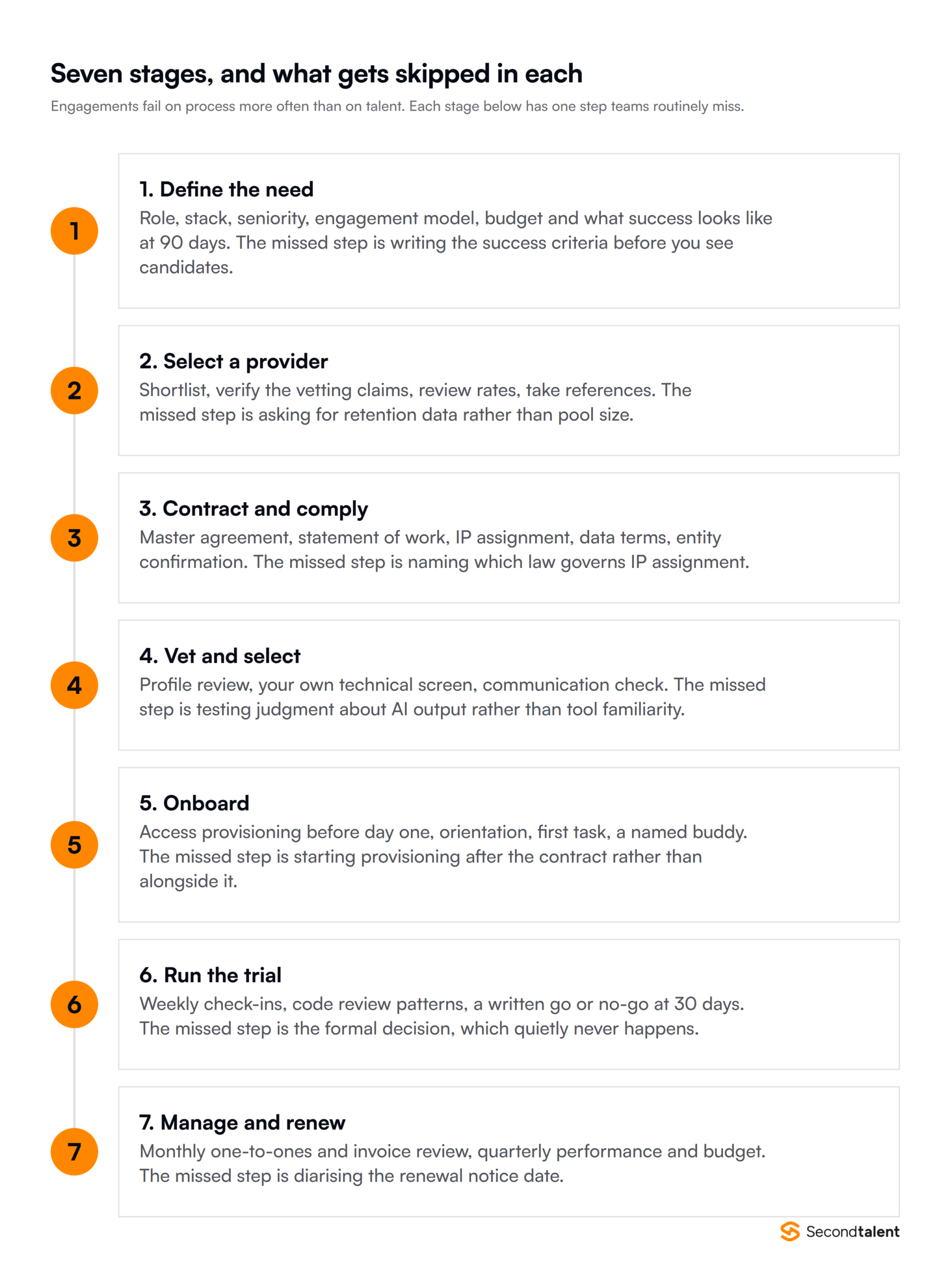
Stage 1: define the need
Record the role, stack, seniority, engagement model, budget and what success looks like at 90 days.
The step teams skip is the last one. Writing the success criteria before you see candidates keeps the bar honest, because a criterion invented while looking at a CV bends to fit that person.
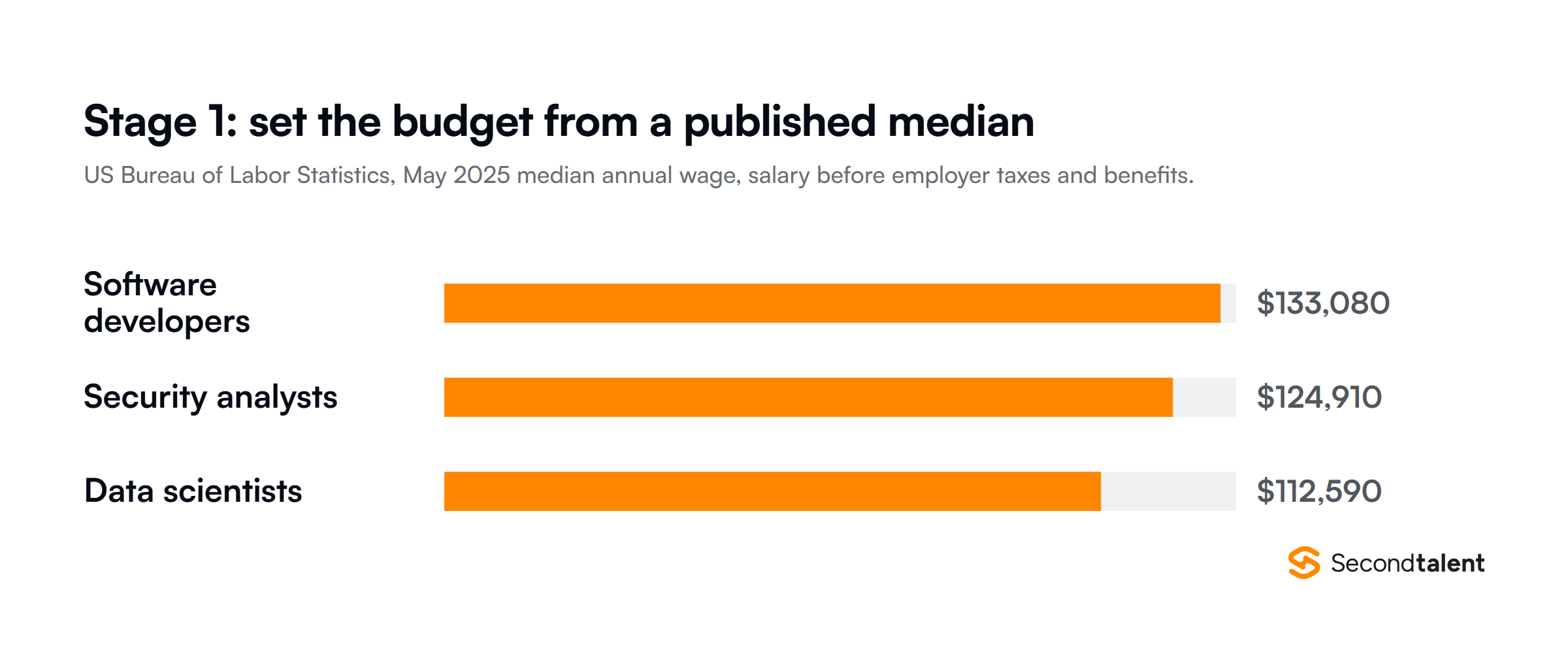
Set the budget from a published median rather than from the last offer you made. The US Bureau of Labor Statistics puts the median wage for software developers at $135,980 in May 2025, security analysts at $129,180 and data scientists at $120,230. Those are salary before employer taxes and benefits, so load them before comparing against a provider rate.
Our IT staffing plan template covers the budgeting and headcount work that should happen before you start this checklist.
Stage 2: select a provider
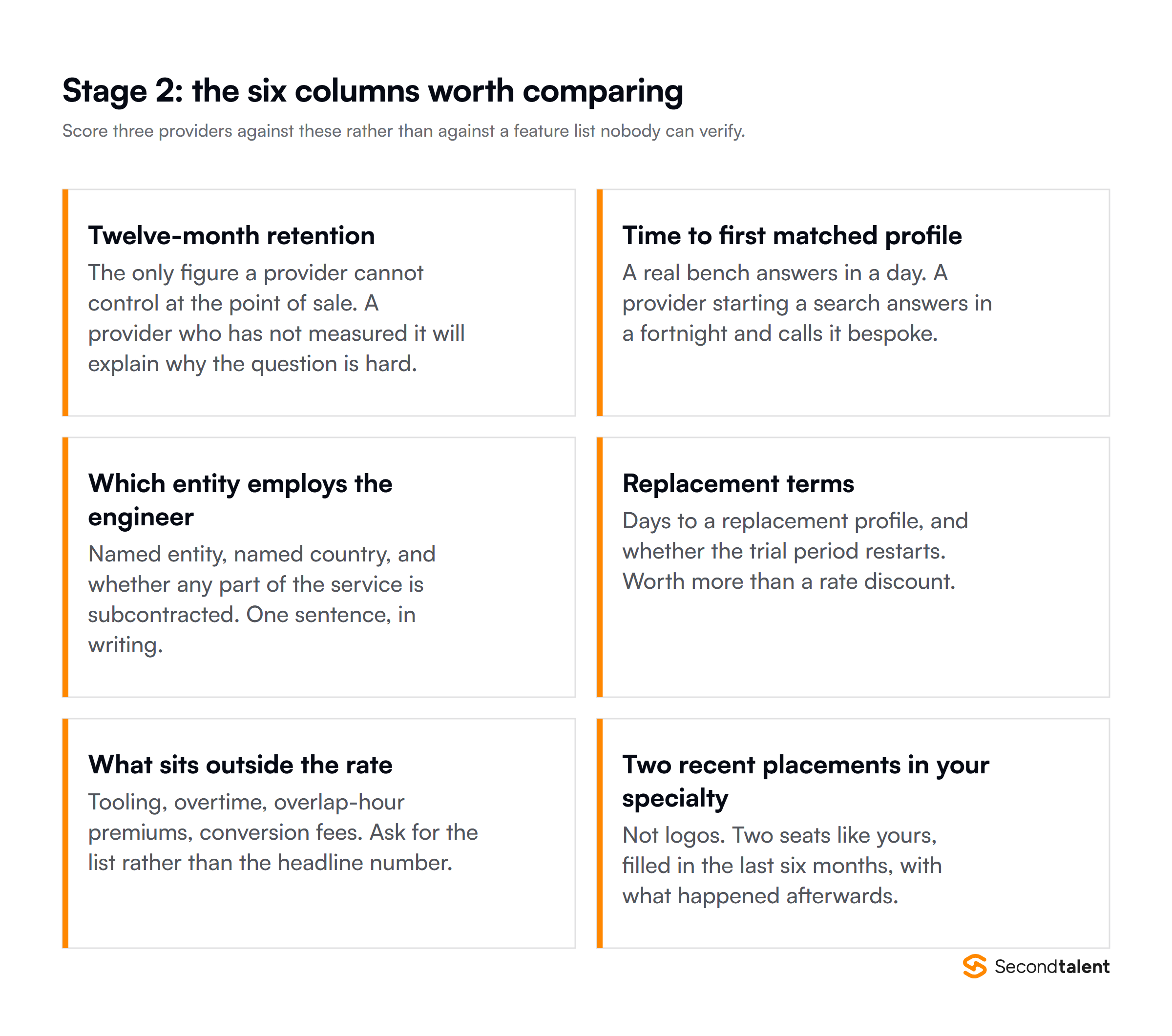
Score three providers on the same six columns rather than on a feature list nobody can verify.
Twelve-month retention does the most work of the six. It is the only figure a provider cannot control at the point of sale, and a provider who has not measured it will explain why the question is complicated rather than answer it.
The other five: time to first matched profile, which legal entity employs the engineer, replacement terms, what sits outside the quoted rate, and two recent placements in your specialty. Our checklist on how to evaluate IT staffing companies turns this into a full scoring framework.
Stage 3: contract and compliance
Master agreement, statement of work, IP assignment, confidentiality, data terms and confirmation of the employing entity.
Two things get missed here. The first is naming which law governs IP assignment inside the IP clause rather than inheriting it from the general governing-law provision. The second is classification: the IRS common-law test turns on control, which is exactly what an augmentation engagement involves, so the provider needs to be the employer rather than a broker.
Where the engagement touches personal data, GDPR Article 28 sets what the processing terms must contain, including the conditions for engaging a sub-processor. Our IT staffing agreement template covers the clause-by-clause detail.
Stage 4: vet and select
Review the profiles, run your own technical screen, and check written communication.
Keep your own screen whatever the provider’s vetting claims. It is the one step worth an engineering manager’s time, and it tests fit against your codebase rather than against a general bar.
Test judgment about AI output rather than tool familiarity. The 2025 Stack Overflow Developer Survey found 84 percent of developers use or plan to use AI tools, so listing Cursor on a CV separates nobody. The same survey found 46 percent distrust the accuracy of what those tools produce, and experienced developers are the most sceptical. Watch a candidate iterate a prompt after a wrong first answer, and debug generated code rather than accept it.
Score candidates on the same sheet, on the same day. Interviewing three people across two weeks and comparing from memory favours whoever you saw last. Fill the scorecard immediately after each conversation, before you discuss the candidate with anyone else.
Stage 5: onboard
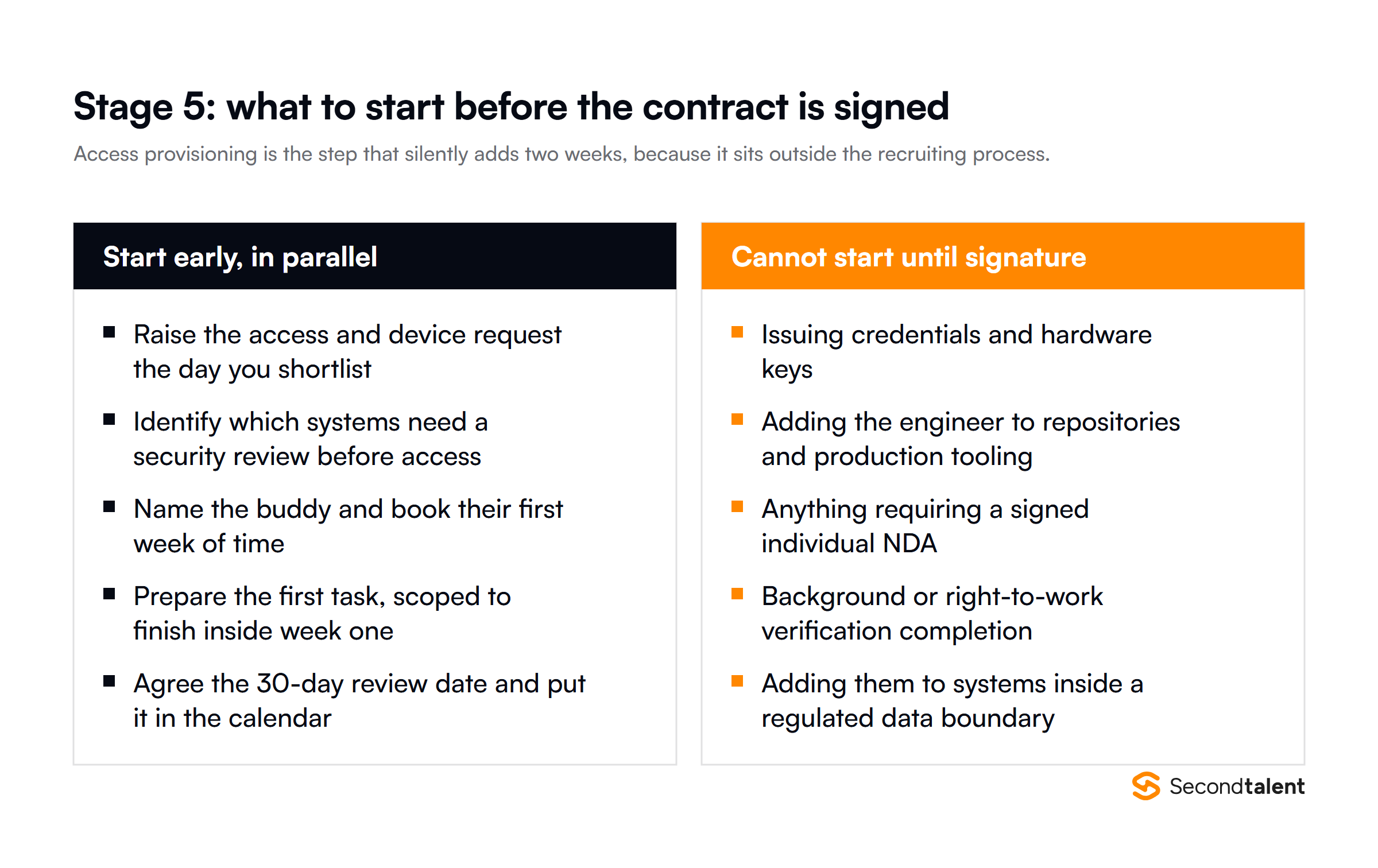
Access provisioning is the step that silently adds two weeks, because it sits outside the recruiting process and nobody owns it.
Start it in parallel rather than in sequence. The day you shortlist, raise the access and device request, identify which systems need a security review, name the buddy and book their first week. Prepare a first task scoped to finish inside week one.
Some things genuinely cannot start until signature: issuing credentials, adding the engineer to repositories, and anything inside a regulated data boundary. Knowing which is which is the difference between a two-week gap and a two-day one.
Where the provider runs any part of the service on its own infrastructure, borrow published vocabulary for the security requirements. The NIST Cybersecurity Framework covers supply chain and third-party risk in terms both a provider and an auditor will recognise.
Stage 6: run the trial
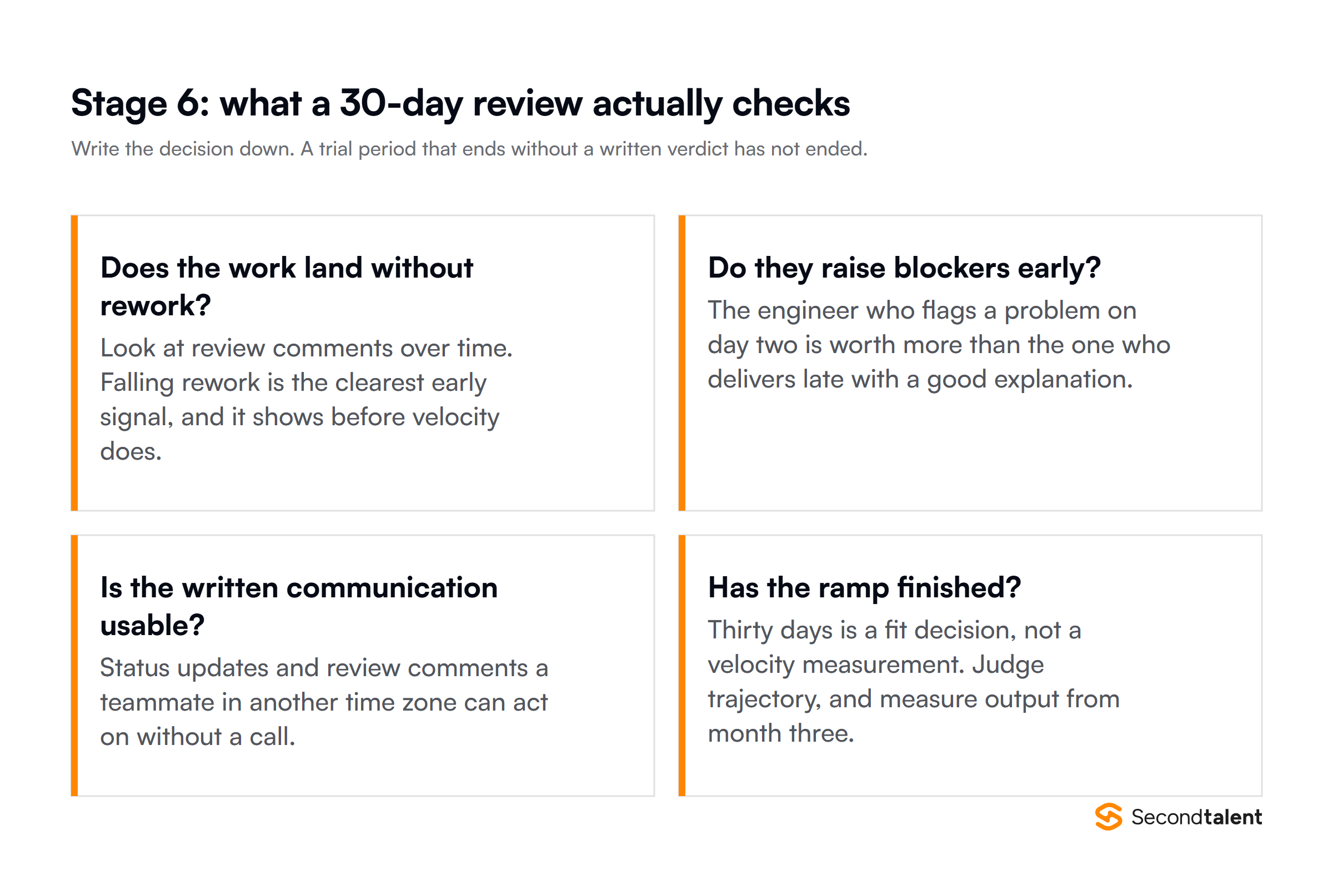
Weekly check-ins, attention to code review patterns, and a written go or no-go decision at 30 days.
The written decision is the step that quietly never happens. A trial period that ends without a verdict has not ended; it has become a permanent engagement by default, which is fine when the fit is good and expensive when it is not.
Judge four things at 30 days: whether work lands without repeated rework, whether the engineer raises blockers early, whether written updates are usable by someone in another time zone, and whether the ramp has finished. Thirty days is a fit decision. Velocity gets measured from month three, once the ramp is behind you.
Stage 7: manage and renew
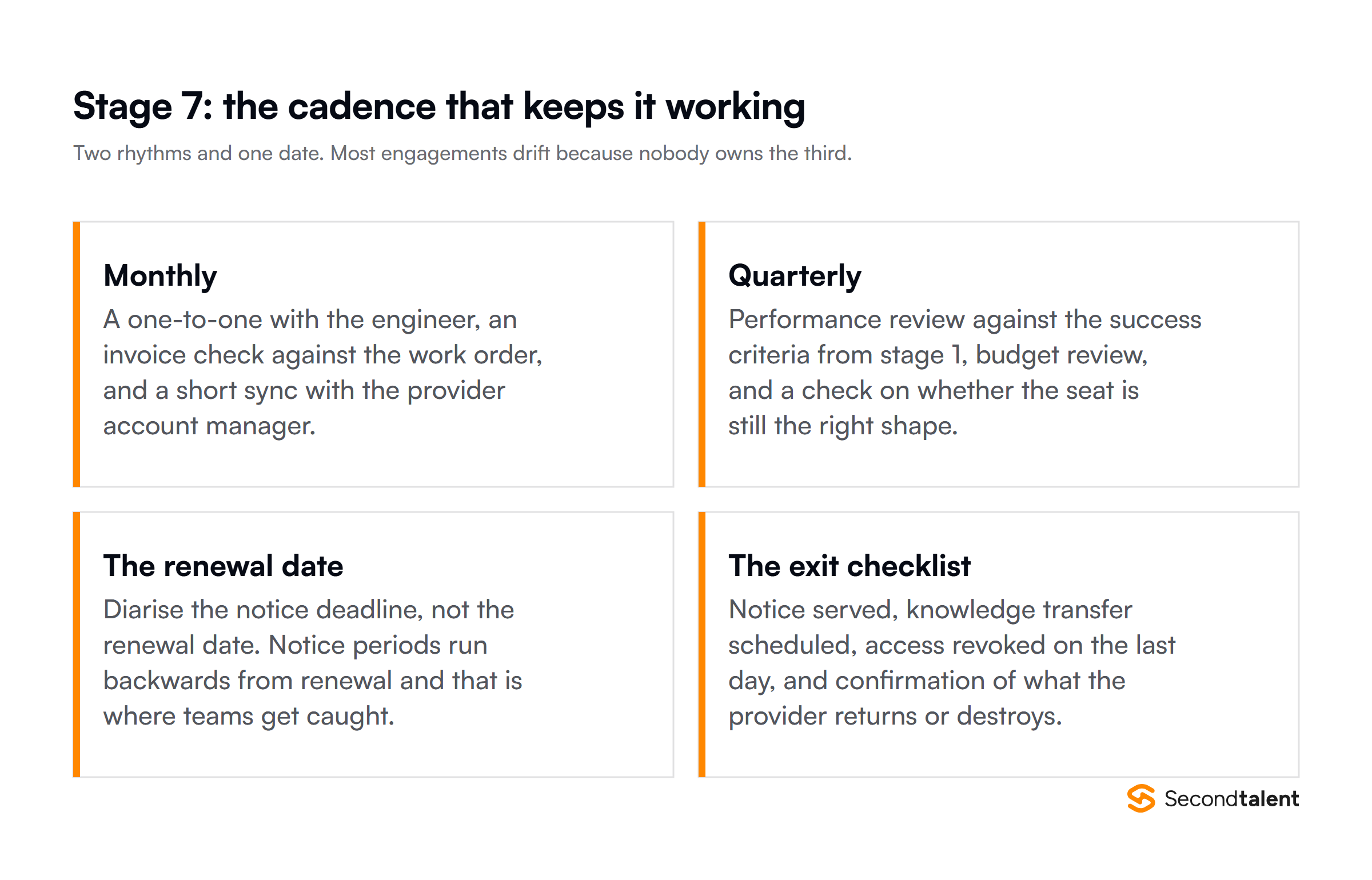
Two rhythms and one date.
Monthly: a one-to-one with the engineer, an invoice check against the work order, and a short sync with the provider’s account manager.
Quarterly: a performance review against the success criteria you wrote at stage 1, a budget review, and a check on whether the seat is still the right shape.
The date: diarise the notice deadline, not the renewal date. Notice periods run backwards from renewal, and that is where teams get caught into another term they did not intend.
Keep an exit checklist ready even when you expect to renew: notice served, knowledge transfer scheduled, access revoked on the last day, and written confirmation of what the provider returns or destroys.
The six worksheets, and what each one is for
A checkbox records that something happened. A worksheet records what you decided, which is the part you need three months later when someone asks why.
Role definition. Ten fields covering title, stack, seniority, engagement model, budget and success criteria. This is the document you hand a provider, so vagueness here returns generalists.
Provider comparison. Three vendors against ten criteria, filled in during the calls rather than afterwards. Comparing from memory a week later favours whoever presented last.
Contract summary. Nine terms pulled out of the agreement onto one page: rates, notice, replacement window, conversion fee, governing law, IP assignment law, liability carve-outs, data terms and the employing entity. Most disputes start with someone not knowing one of these.
Candidate scorecard. Three candidates across eight dimensions, completed immediately after each interview.
Onboarding tracker. Nine items with an owner and a due date. The owner column matters more than the dates, because unowned access requests are the ones that slip.
30-day review. Seven dimensions and a written verdict. Keep the completed sheet, because it is what a renewal conversation should reference.
Where engagements actually go wrong
Four failure patterns account for most of it, and each traces back to a specific skipped step rather than to the engineer.
The seat sits empty for two weeks after the contract. Access provisioning started at signature instead of at shortlist. Fix it at stage 5 by raising the request the day you have a shortlist.
Nobody can say whether the trial went well. No success criteria were written at stage 1, so the 30-day review has nothing to compare against and defaults to a general impression.
The invoice does not match the work order. The contract summary worksheet was never filled in, so nobody has the rate and the terms to hand when the first invoice arrives.
An unwanted renewal. The notice deadline was never diarised. This is the cheapest failure to prevent and one of the more expensive to unwind.
None of these are exotic. They are what happens when a process lives in one person’s head and that person is busy delivering.
Who should use this checklist
- Engineering managers hiring their first offshore or augmented engineer.
- Procurement teams running a vendor selection for IT staffing services.
- CTOs and VPs of engineering who want one repeatable process across engagements.
- HR and people operations supporting technical hiring with compliance structure.
- Founders scaling a technical team through a provider for the first time.
Adapting the checklist to your situation
Seven stages is the full version. A team hiring one contractor for three months does not need all of it, and a regulated buyer standing up a five-person pod needs more.
Scale it down by dropping provider comparison if you already have a master agreement in place, and by shortening the trial review to a single written paragraph. Keep stage 3 and stage 5 intact whatever the size, because contracting and access are where the expensive mistakes live.
Scale it up for regulated work by adding a criticality classification before stage 3, since that decision determines which contract clauses you are obliged to include. Add an access review to stage 5, and add evidence retention to stage 7 so you can reconstruct who did what when an auditor asks.
Run it once as written before you adapt it. The stages you are tempted to skip on a first engagement are usually the ones that produce the failure you then attribute to the engineer.
IT staffing checklist FAQs
How long does the full process take?
Matched profiles arrive within 24 hours from a provider with a real bench. Contracting and access provisioning are the variable part, and they run longer in a regulated firm than the hiring does.
Can stages run in parallel?
Yes, and they should. Provider selection and role definition overlap, and access provisioning should start at shortlist rather than at signature. Only the trial period has to wait for everything before it.
What if we skip the trial review?
You keep whoever you hired. That is a decision, so make it deliberately rather than by omission.
Do we need this for a single contractor?
The contracting and onboarding stages, yes. Provider comparison matters less for one seat, though the retention question is worth asking even then.
Takeaways
- Write the 90-day success criteria before you see a single candidate.
- Compare providers on twelve-month retention, not on pool size.
- Start access provisioning at shortlist. It is the step that adds two silent weeks.
- Put the 30-day verdict in writing, or the trial has not ended.
- Diarise the notice deadline, not the renewal date.
Run the checklist with a provider who fits it
Second Talent matches pre-vetted senior engineers across Asia within 24 hours, with EOR cover so employment and tax sit with a licensed local employer, and 92 percent of placements still in seat a year later.
Start a hire, check pricing, or use the RFP template if you are running a formal selection.