TL;DR: This page does not publish a market-wide pricing benchmark, because we do not hold market survey data. What it does publish is our own rates, the anatomy of a blended rate, and a method for pressure-testing any quote you receive. The most useful question you can ask a provider is what share of the rate reaches the engineer, because that number predicts whether the placement lasts.
Buying AI and data engineering capacity is a different exercise from buying generic IT staffing. Supply is global, the specialty premium moves, and quotes vary enough that a benchmark table would be out of date before you used it. A method survives longer than a number, so this page gives you the method.
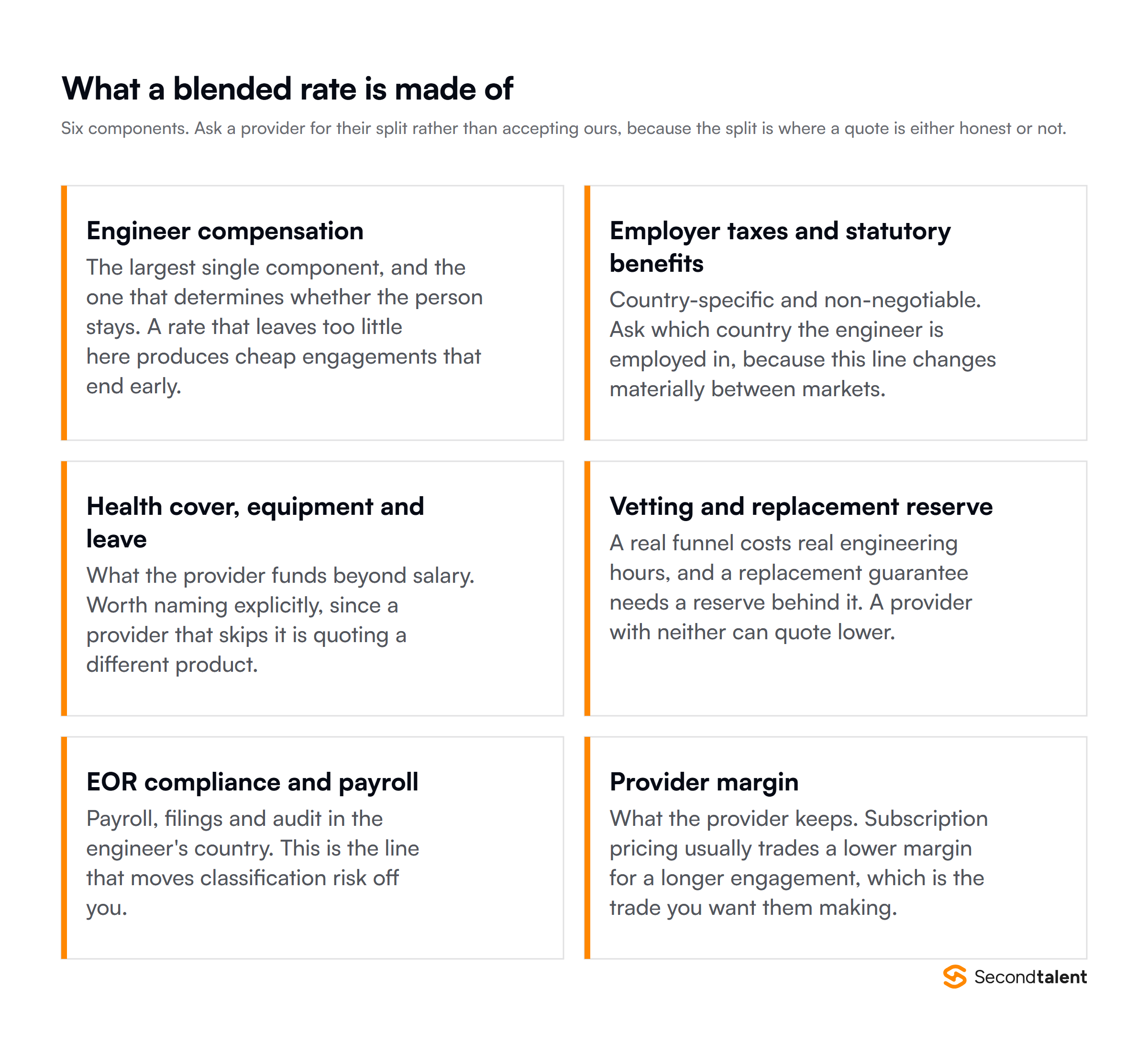
What is inside a blended rate?
A blended rate is the all-inclusive fee you pay per engineer per hour or per month. It bundles six things you would otherwise carry directly.
Engineer compensation is the largest component and the one that decides whether the person stays. Employer taxes and statutory benefits are set by law in the engineer’s country. Health cover, equipment and leave are what the provider funds beyond salary.
Then vetting and the replacement reserve, because a real funnel costs engineering hours and a replacement guarantee needs money behind it. EOR compliance and payroll, which is the line that moves classification risk off you. And provider margin.
Knowing the anatomy is what lets you answer the real procurement question, which is not “what is the market rate” but “is this particular quote sound”.
What Second Talent publishes
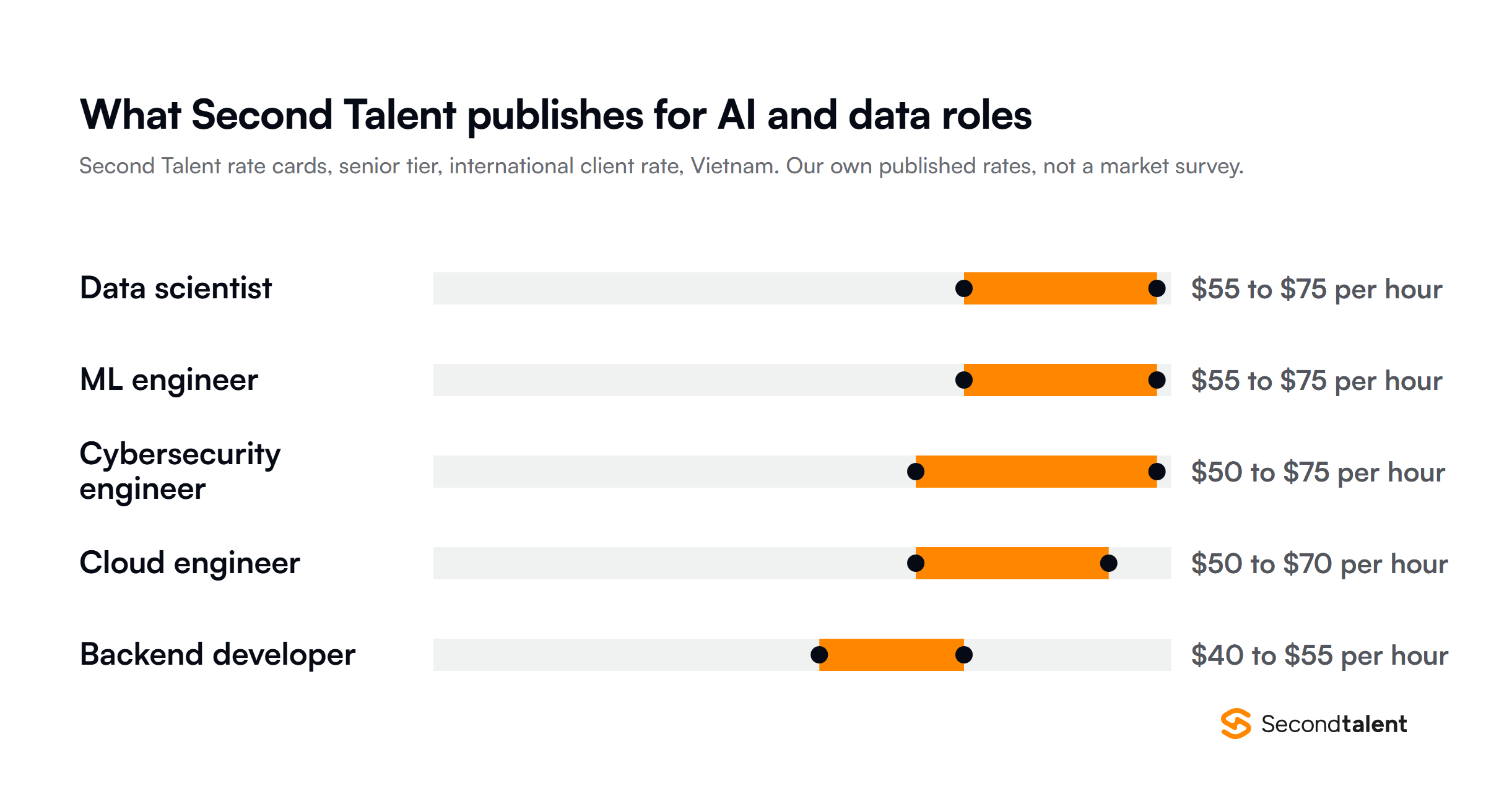
These are our rates rather than a market benchmark, and they are published so you can check them.
In Vietnam, at the senior tier, the international client rate runs $55 to $75 per hour for data scientists and ML engineers, $50 to $75 for cybersecurity engineers, $50 to $70 for cloud engineers and $40 to $55 for backend developers. Senior blockchain developers in the Philippines run $45 to $70. Full detail by role and market sits in the developer rate cards.
Across placements, clients save $103,000 or more per hire against a comparable Western salary, with payroll savings of 50 to 70 percent.
Setting the baseline you compare against
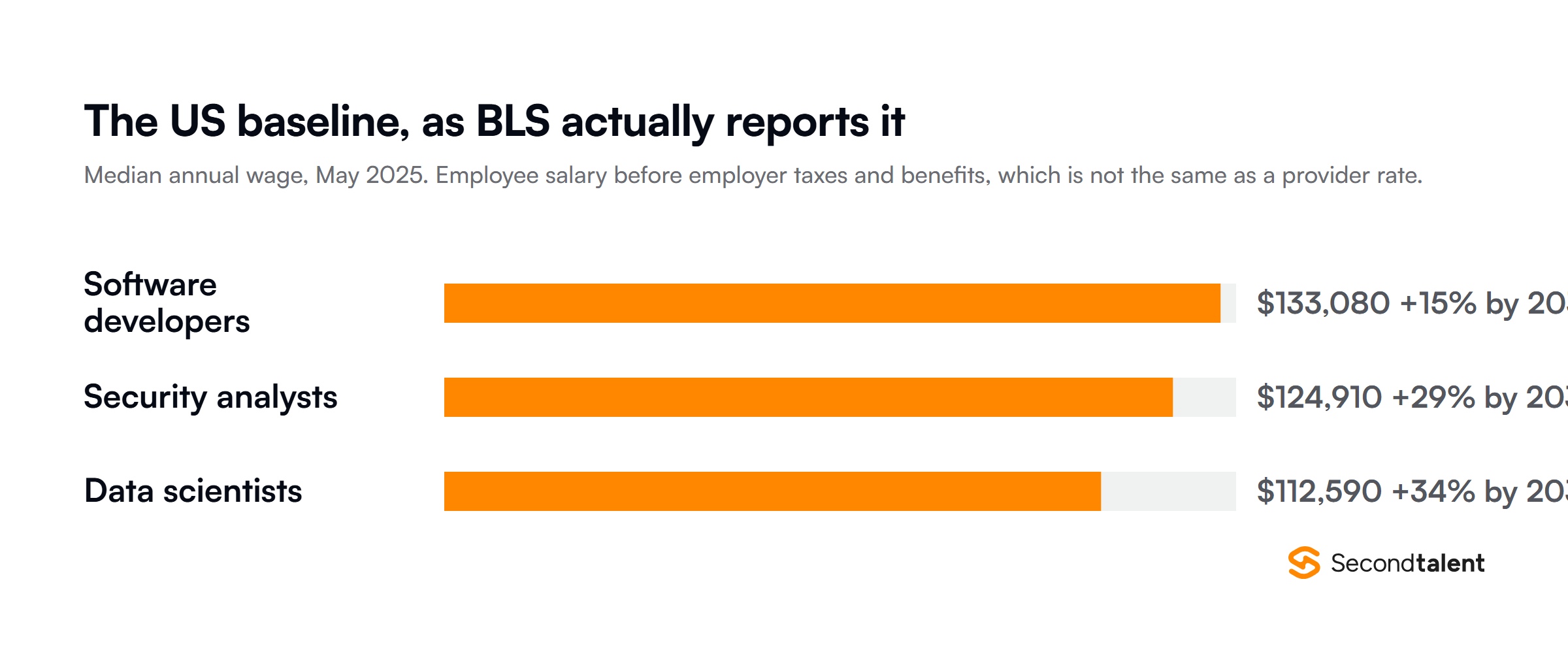
Most bad pricing comparisons come from putting two different kinds of number side by side.
The US Bureau of Labor Statistics publishes median annual wages for employees. As of May 2024 that is $135,980 for software developers, $129,180 for information security analysts and $120,230 for data scientists.
Those are salary before employer taxes, benefits, equipment and tooling. A provider rate already contains all of that. Load the salary side before you calculate any saving, or the gap will look considerably larger than it is.
The projected growth on the same pages is worth carrying into the budget conversation: data scientists 35 percent between 2025 and 2035, security analysts 21 percent, software developers 10 percent, against roughly 4 percent across all occupations. Scarcity is what a specialty premium is priced against.
Check any benchmark you are shown, including ours. Regional rate tables circulate widely in this category and are often attributed to research firms that did not publish them. Ask which report a band came from and open it. If the source turns out to be a page that does not carry the figure, that tells you something about the rest of the pitch.
How to pressure-test a quote
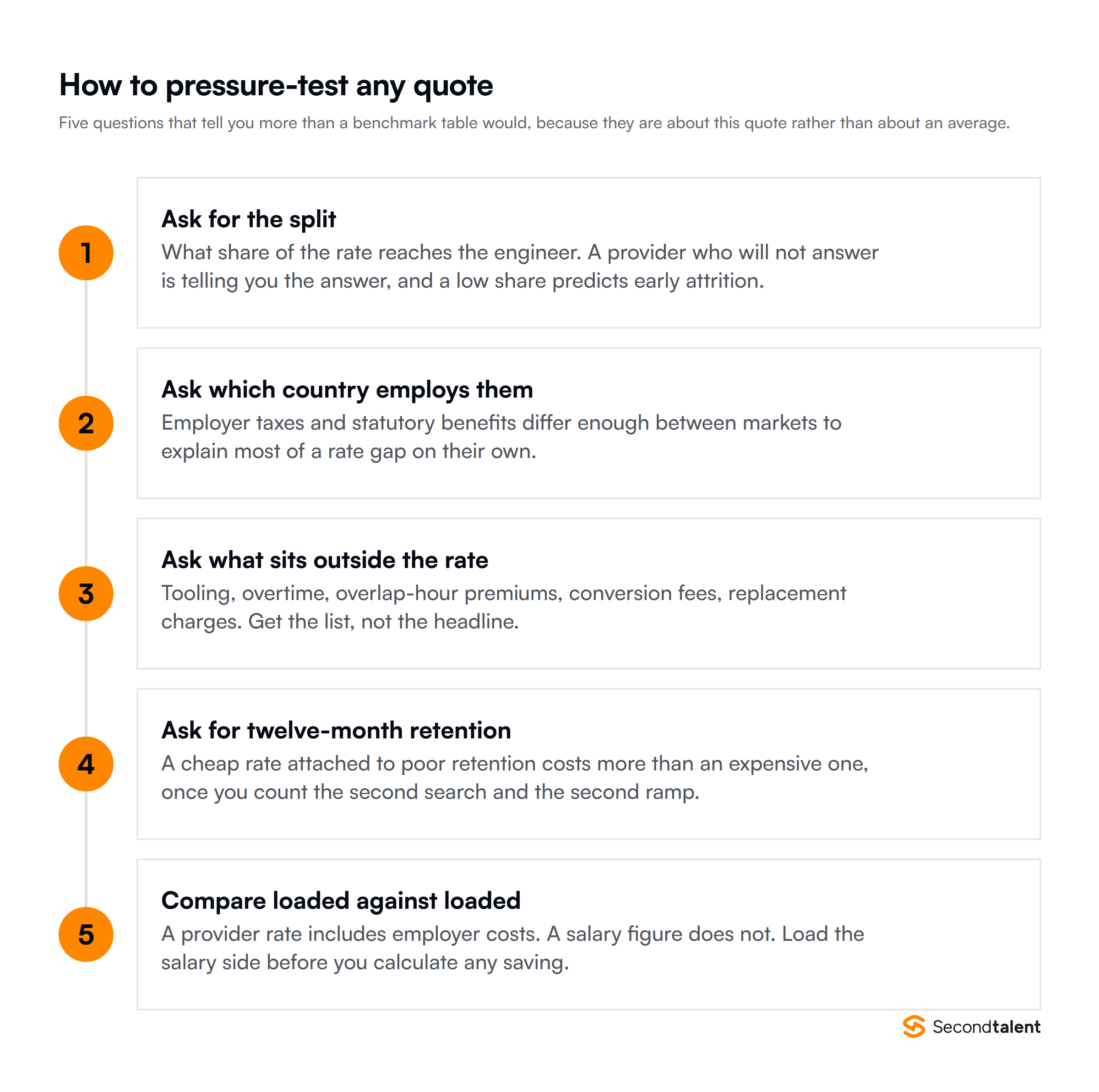
Five questions do more work than a benchmark table, because they are about the quote in front of you.
What share of the rate reaches the engineer? This is the most informative question in the whole exercise. A provider who will not answer has answered, and a low share predicts attrition regardless of how good the rate looks.
Which country employs them? Employer taxes and statutory benefits differ enough between markets to explain most of a rate gap on their own, before anyone’s margin is involved.
What sits outside the rate? Tooling, overtime, overlap-hour premiums, conversion fees, replacement charges. Ask for the list rather than the headline number.
What is your twelve-month retention? A cheap rate attached to poor retention costs more once you count the second search and the second ramp.
Is this loaded? Confirm the rate includes employer costs, then compare it against a loaded figure on your side.
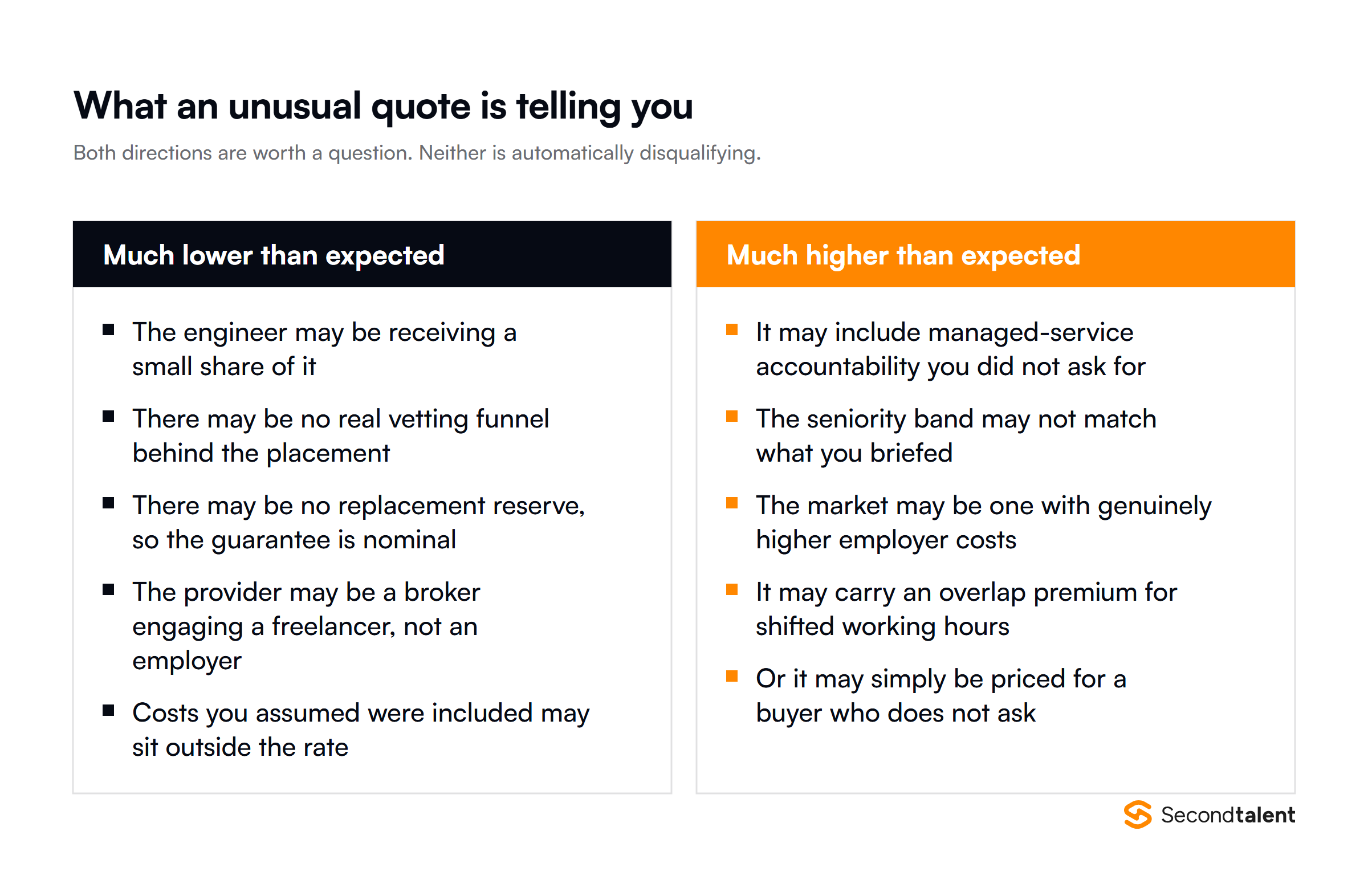
What an unusual quote is telling you
Both directions deserve a question, and neither is automatically disqualifying.
A quote well below what you expected might mean the engineer receives a small share of it, that there is no real vetting funnel, that the replacement guarantee has no reserve behind it, or that the provider is a broker engaging a freelancer rather than an employer. That last one moves classification risk back to you, which the IRS common-law test and the HMRC CEST tool both examine.
A quote well above might include managed-service accountability you did not ask for, a seniority band above your brief, a market with genuinely higher employer costs, or an overlap premium for shifted hours. Or it may be priced for a buyer who does not ask.
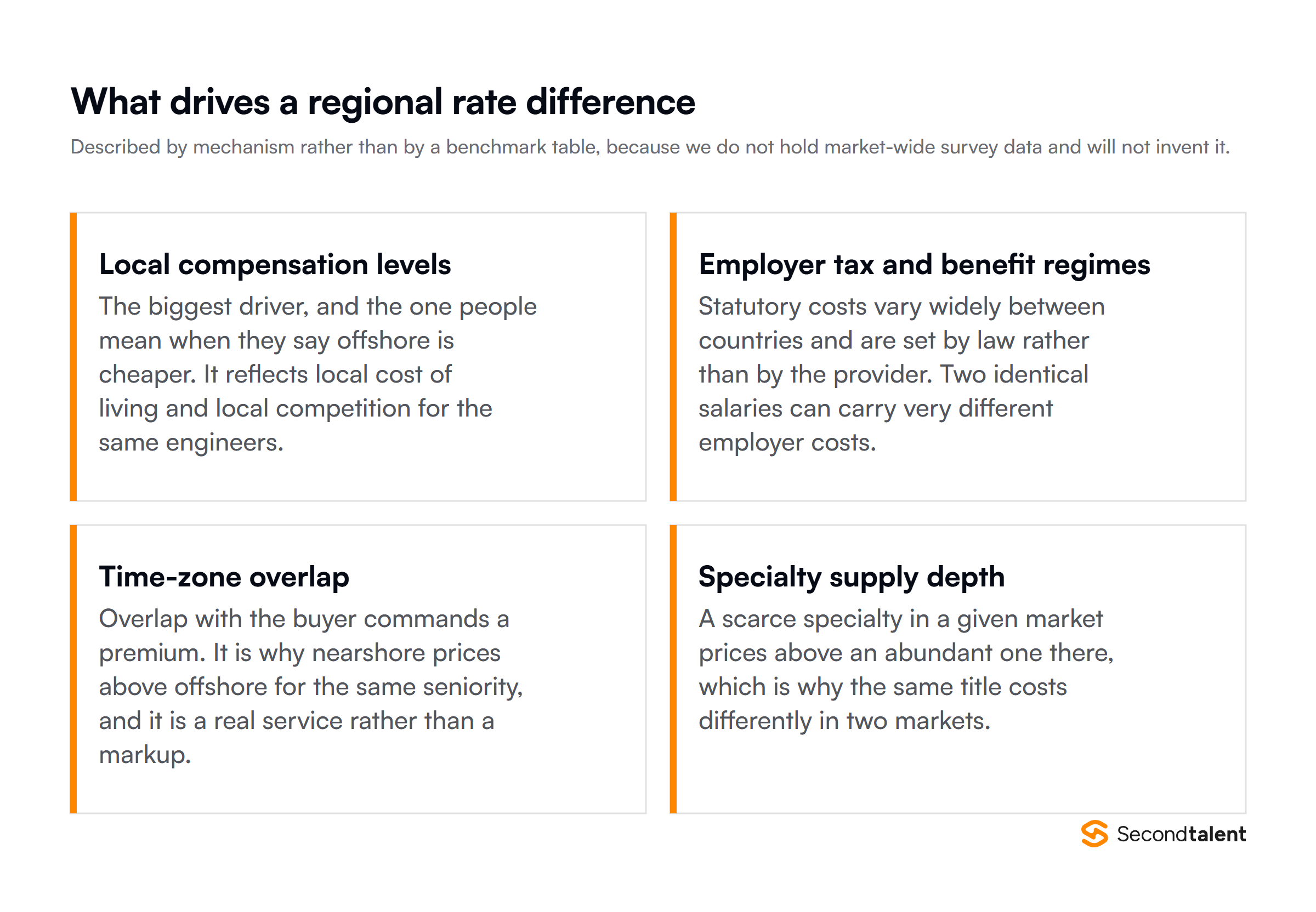
What actually drives regional differences
Four mechanisms, described rather than tabulated.
Local compensation levels are the largest driver and what people mean when they say offshore costs less. Employer tax and benefit regimes are set by law and vary widely, so two identical salaries can carry very different employer costs.
Time-zone overlap commands a premium, which is why nearshore prices above offshore for the same seniority. That is a real service rather than a markup, and our comparison of onshore, nearshore and offshore works through the trade.
Specialty supply depth explains why the same job title prices differently in two markets. A scarce specialty in one place is abundant in another.
Building the budget from the quote
A rate is not a budget. Three lines sit outside it and belong in the number you take to finance.
The ramp. You pay a full rate for partial output while the engineer learns the codebase and the domain. Budget about three weeks on an ordinary product and longer where the domain carries regulatory weight. Leaving it out is the most common reason a first-quarter forecast misses.
Access and tooling. Managed devices, licences, hardware keys and any privileged access review. Small per seat, awkward across ten.
Your own management time. Augmentation assumes a manager who assigns and reviews. That time is real even though nobody invoices you for it, and pricing it makes the comparison against an in-house hire honest.
Our IT staffing plan template covers the budget structure, and the guide to measuring ROI covers holding the number up afterwards.
How the specialty premium behaves
AI and data roles price above general engineering in our own rate cards, and the useful question is whether that gap holds.
Specialty premiums compress as supply catches up. That has happened before with mobile and with cloud, and there is no reason to expect this one to behave differently in the long run. What nobody can tell you is the timing, which is why a budget built on the premium disappearing by a specific year is a guess.
Adoption of AI tooling is already near universal. The 2025 Stack Overflow Developer Survey put it at 84 percent of developers using or planning to use these tools, with 46 percent distrusting the accuracy of the output. The scarce thing is judgment about that output rather than exposure to the tools, and that is what a premium should be paying for.
Practical consequence: pay a premium for demonstrated judgment, verified in an assessment you have seen the rubric for. Do not pay one for a tool list on a CV, because that no longer distinguishes anyone.
Why we are not publishing regional bands
An earlier version of this page carried them, attributed to research firms that did not publish them. We removed them rather than replacing them, for two reasons.
The first is that we do not have market survey data. Our rate cards tell you what we charge, and that is a different claim from what the market charges. Presenting one as the other is how buyers end up with a benchmark that is really one vendor’s price list.
The second is that a band is less useful than it looks. A single number covering senior AI engineers across a whole region hides the seniority definition, the employer country, what is included, and the retention behind it. Those four things move a quote more than geography does.
If you need a market view, ask three providers the five questions above and compare the answers. That is a benchmark you built and can trust.
Keep the answers. A short comparison sheet from three real quotes, dated, is worth more at your next renewal than any published table, because it reflects your own seniority definitions and your own markets.
AI staffing pricing FAQs
How often should we re-test our rates?
At every renewal, and once in between if the engagement runs longer than a year. Rates reset when a master agreement renews, and a rate agreed two years ago against a market that has moved is the quiet cost most buyers never look at. Re-running the five questions takes an hour and is the cheapest procurement work available.
Do AI and ML roles cost more than other engineering roles?
At the senior tier in our own rate cards, data scientists and ML engineers sit at the top of the band, above backend developers. Whether that premium persists depends on supply catching up with demand, which nobody can forecast reliably.
Is a monthly rate better than an hourly one?
Usually, because hourly billing pays more for slower work. A blended monthly rate removes that conflict and makes budgeting simpler.
What is a reasonable provider margin?
Ask rather than assume. What matters is whether enough of the rate reaches the engineer to keep them, which is a question about the split rather than about the margin percentage in isolation.
Should a cheap quote be rejected?
No, but it should be explained. Ask the five questions. If the answers are sound, a lower rate may reflect a genuinely lower cost base rather than a corner cut.
Takeaways
- Ask what share of the rate reaches the engineer. It predicts retention.
- Never compare a loaded provider rate against an unloaded salary median.
- Get the list of what sits outside the rate before you compare quotes.
- Treat any regional benchmark band as unverified until you open its source.
- Three providers answering the same five questions beats any published table.
See the rates we publish
Second Talent publishes rates by role and market, with EOR cover across Asia, 24-hour matching and 92 percent of placements still in seat a year later.
Open the rate cards, tell us which seat you need to fill, or read how to evaluate IT staffing companies before you compare quotes.
Hiring contractors rather than employees changes the arithmetic. The freelance developer rate index prices 14 roles across nine regions, benchmarked against North America and sourced from published wage data.