TL;DR: BLS has no data engineer occupation; database architects, the closest match, earn a median $139,500 a year, or $11,630 a month before benefits (BLS, May 2025). Through Second Talent, a vetted remote data engineer starts at $25 USD an hour (160 hours for $3,999 a month), with a shortlist in 24 hours.
Fivetran and dbt Labs completed their all-stock merger on 1 June 2026 and open-sourced the dbt Fusion engine runtime the same day, as dbt Core v2.0 alpha. If your stack runs both tools, the data engineer you hire inherits that engine migration.
Key takeaways
- Apache Airflow 2 reached end of life on 22 April 2026, and DAGs still running on it get no security patches.
- Snowflake does not enforce primary key, unique or foreign key constraints on standard tables, so duplicate checks are the engineer's job.
- The median database architect in New York earns $131,540 a year, below the national median, while San Jose pays $197,960.
- Pipeline code, dbt models and DAGs a 1099 contractor writes stay theirs until they sign a written assignment.
How much does it cost to hire a data engineer in the US?
BLS publishes no data engineer series, so two occupations bracket the job. Database Architects (SOC 15-1243) design and build data warehouses and large databases, which fits a hire who owns the warehouse. Data Scientists (SOC 15-2051) cover the modeling side, where raw data becomes tables analysts can use. Monthly figures are annual wages from the May 2025 OEWS profiles for 15-1243 and 15-2051 divided by 12 and rounded to the nearest $10.
| BLS OEWS, May 2025, national |
Database Architects (15-1243) |
Data Scientists (15-2051) |
| Employment |
67,140 |
262,440 |
| 10th percentile, monthly |
$7,190 |
$5,600 |
| 25th percentile, monthly |
$9,110 |
$7,140 |
| Median, monthly |
$11,630 |
$10,020 |
| 75th percentile, monthly |
$14,110 |
$13,240 |
| 90th percentile, monthly |
$17,000 |
$16,590 |
The architects column pays more at all five percentiles, with about a quarter of the employment. Use it for a hire who owns schema design and warehouse spend; use the data scientists column for a hire whose main output is dbt models for analysts.
Location moves the figure more than the title does. New York employs 5,460 database architects, more than San Francisco and San Jose combined, yet its middle half starts lower than the national one.
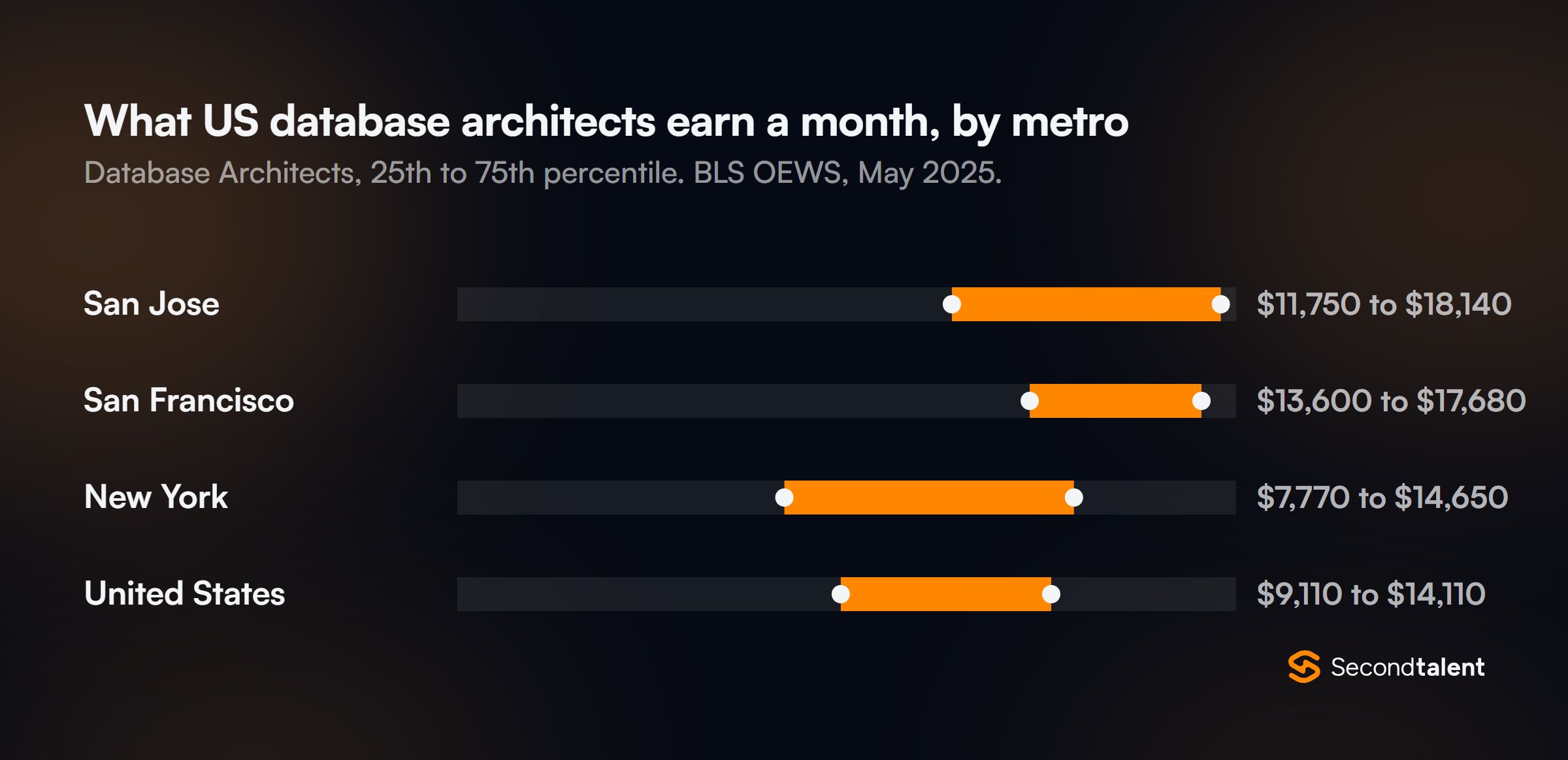
Metro figures come from the OEWS metropolitan area tables for San Jose-Sunnyvale-Santa Clara, San Francisco-Oakland-Fremont and New York-Newark-Jersey City. On the data scientist side, Seattle-Tacoma-Bellevue pays a median $164,740 a year and New York $135,980.
Salary is about 70% of what a US employer pays. In the BLS Employer Costs for Employee Compensation release for June 2026, private industry paid $46.89 an hour in total compensation, of which $14.07 (30.0%) went to benefits. If benefits on a median architect's salary follow that average, the employer's cost comes to about $199,300 a year, or $16,610 a month (our estimate from the two BLS figures).
For contract work, our data engineer cost-to-hire page puts US freelance data engineers at $92 to $145 an hour, before your own overhead.
Which data engineering skills should you screen for in 2026?
PostgreSQL was used by 57.9% of respondents to Stack Overflow's 2026 survey. Good SQL is common; production time on your warehouse, orchestrator and table format is not, so test on the platform you run.
SQL modeling and dbt contracts
A dbt model contract, once enforced, makes dbt run a preflight check that the query returns the column names and data types defined in YAML. Warehouses enforce only some constraints: Snowflake's constraints overview marks primary key, unique and foreign key as not enforced on standard tables. Load a table with a duplicate key and ask the candidate which test catches it, and whether their models would compile under the Fusion engine.
Orchestration on Airflow 3
Apache Airflow 3.0 shipped on 22 April 2025, and the project's supported versions table now lists 3.4.0 as current and the 2.x line as end of life. The upgrade guide lists what breaks: task code can no longer open sessions on the metadata database, SubDAGs are gone, and SLAs gave way to Deadline Alerts. Ask for the last DAG the candidate migrated and what they rewrote.
Big data on Spark 4
Spark 4.0, released on 23 May 2025, turned ANSI SQL mode on by default, dropped JDK 8 and 11 and moved to Scala 2.13. Under ANSI mode an invalid cast raises an error where Spark 3 returned NULL, so a job that once loaded bad rows in silence now fails. The Spark news page shows 4.3.0 on 30 October 2026 while the 3.5 line still received a patch in July. Ask a candidate on 3.5 what they would test before the upgrade.
Streaming on Kafka without ZooKeeper
Apache Kafka 4.0, released on 18 March 2025, was the first major release to run without ZooKeeper, in KRaft mode, and its brokers require Java 17. The new consumer rebalance protocol is on by default at the server, but consumers opt in with group.protocol=consumer. A streaming data engineer who ran a 3.x cluster should be able to describe the migration path and the rebalances it removed.
Lakehouse table formats
Version 2 of the Apache Iceberg spec added row-level deletes through delete files, without rewriting data files. Version 3 adds binary deletion vectors, row lineage and a variant type. Ask how the candidate compacted small files and delete files on a busy table, and which engines in your stack can read v3.
Warehouse cost ownership
Snowflake doubles credit usage with each step up in warehouse size, and bills per second with a 60-second minimum each time a warehouse starts. A job that resumes a suspended warehouse every five minutes pays that minimum twelve times an hour. Give the candidate a month of query history and ask which schedule, size or auto-suspend setting they would change first.
How do you test a data engineer before you hire?
A senior data engineer explains why the revenue dashboard is 12% low on Monday morning before anyone in finance asks. Build the assessment around that kind of failure rather than a SQL puzzle.
Use a take-home of three to four hours.
Give the candidate a raw event table with late-arriving rows, duplicate events and one malformed timestamp. They build an incremental dbt model with a contract and tests, schedule it in Airflow 3, and write a short note on the choices.
A strong answer includes:
- A unique key and a deduplication rule stated in the model, with a test that fails on the planted duplicates.
- A lookback window for late rows, with the reason for its length and what it costs in warehouse time.
- A decision on the malformed timestamp: quarantine table, hard failure or default, defended in one sentence.
- Freshness checks and an alert the on-call engineer can act on without opening the DAG code.
- A README a US analyst could use to query the table without a call.
Follow with a 45-minute live session on the submission, then one scenario.
For a data migration or data integration hire, make it a cutover: move one source from a nightly batch to change data capture with no gap in the history, and explain how they would reconcile row counts on both sides before switching readers. Our data engineer interview questions and dbt interview questions add sets for that round.
Should you hire a W-2 employee, a 1099 contractor, an agency or Second Talent?
Ownership of the pipeline code decides more than the hourly rate. Software is not one of the nine categories of commissioned work that can be "work made for hire" under 17 U.S.C. § 101, so a contractor's code transfers to you only through a written, signed assignment under § 204(a). Name the dbt project, DAGs, ingestion connectors and infrastructure code in it, and keep warehouse and cloud accounts owned by a company login.
|
Full-time W-2 hire |
1099 contractor |
Staffing agency |
Second Talent |
| Who employs the engineer |
You |
Nobody; they invoice you |
The agency |
Our entity in the engineer's country |
| Cost basis |
Salary plus about 30% in benefits (BLS) |
Hourly rate, $92 to $145 for data engineers |
Hourly bill rate including the agency's margin |
From $25 USD/hr, 160 hours for $3,999/mo |
| Who owns the code |
You, as work made for hire |
The contractor, until a signed assignment |
Set by the agency contract |
You; IP assignment and NDAs in the contract |
| Upfront cost |
Recruiting time or fees |
None |
Varies by agency |
None |
| If the hire fails |
You restart the search |
You restart the search |
Agency terms |
One free replacement within 90 days |
A one-off warehouse migration with a fixed end date suits a contractor. An engineer who holds production credentials, answers for the nightly load and sits in your sprint planning looks like an employee under the IRS test, which weighs behavioral control, financial control and the relationship of the parties when it separates an employee from an independent contractor. A contractor based outside the US gives you Form W-8BEN instead of a W-9.
Through Second Talent the engineer is our employee: we run payroll, taxes and equipment, and you direct the day-to-day work. Our employer of record service covers the case where you have already picked the person. This is a summary, not legal advice.
How many working hours overlap with ET, CT and PT?
We agree a schedule with each engineer before the offer, and our placements get 4 to 6 hours of daily overlap with US business hours. ET runs three hours ahead of PT, so a shared block from 11:00 am to 3:00 pm ET covers 10:00 am to 2:00 pm CT and 8:00 am to noon PT.
Data engineering splits well across that line. Metric definitions, schema changes and incident reviews need the shared hours, since the analysts who use the tables sit in the US. Backfills, reruns, compaction and warehouse maintenance fit the hours outside the overlap, while your US team is offline and warehouse queues are short. Agree in advance who holds the pipeline pager on US holidays and month-end close.
How fast can you hire a data engineer with Second Talent?
The first shortlist of 6 to 8 pre-vetted profiles arrives within 24 hours of a complete brief, drawn from 100,000+ pre-vetted developers. Our vetting covers stages 2 to 4 before you see a profile.
- Brief. You name the warehouse, the orchestrator, the ingestion tools, data volume per day and whether the hire carries the pipeline pager.
- Application review. We look for pipelines the candidate kept running after launch, with row counts, freshness targets or monthly warehouse spend in plain numbers.
- Skills assessment. The candidate builds the incremental dbt model above, with a contract, tests and an Airflow 3 schedule.
- Live interview and references. A senior engineer runs the Monday-morning incident live, then we ask former managers how often the candidate's pipelines failed silently and how they handled access to production data.
- Your final round. You interview the shortlist, pick one, and the engineer starts once their notice period ends.
Yusen Logistics used this process to hire two founding senior data engineers for a new global data team, with a calibrated first shortlist in 3 days and offers in under two weeks, as the Yusen Logistics case study sets out.
Pricing, the replacement guarantee and the monthly terms are on our pricing page. Tell us what you need and the shortlist follows. If the role leans toward application code or models, compare our Python developers and data scientists.