TL;DR: A US data scientist earns a median $120,230 a year, or $10,020 a month before benefits (BLS, May 2025). Through Second Talent, a vetted remote data scientist starts at $25 USD an hour (160 hours for $3,999 a month), with a shortlist in 24 hours.
BLS projects data scientist jobs to grow 35% from 2025 to 2035, adding 95,400 to the 275,600 that existed in 2025, in its Occupational Outlook Handbook. The typical entry requirement is a bachelor's degree. One title covers a dashboard analyst and a statistician who can run a clean experiment, so your screening decides which one you get.
Key takeaways
- In San Jose the median data scientist earns $185,080 a year, 54% above the national median.
- Checking a running A/B test at will can raise the false positive rate fivefold, even with 10,000 samples.
- pandas 3.0, released on 21 January 2026, made copy-on-write the default, so chained assignments in older notebooks stop working after an upgrade.
- Notebooks and trained models a 1099 contractor builds stay theirs until they sign a written assignment.
How much does it cost to hire a data scientist in the US?
Data scientists have their own BLS occupation, Data Scientists (SOC 15-2051), which BLS describes as using statistical methods and machine learning to classify data and make predictions. The May 2025 OEWS release counts 262,440 of them in US payrolls. Monthly figures below are the annual wages on the OEWS profile for 15-2051 divided by 12 and rounded to the nearest $10.
| Data Scientists (15-2051), May 2025 |
Monthly |
| 10th percentile |
$5,600 |
| 25th percentile |
$7,140 |
| Median |
$10,020 |
| 75th percentile |
$13,240 |
| 90th percentile |
$16,590 |
The 90th percentile earns almost three times the 10th. Location moves the number as much as seniority: in the OEWS metropolitan area tables, the median data scientist earns $185,080 a year in San Jose-Sunnyvale-Santa Clara, $170,110 in San Francisco-Oakland-Fremont, $164,740 in Seattle-Tacoma-Bellevue and $135,980 in New York-Newark-Jersey City.
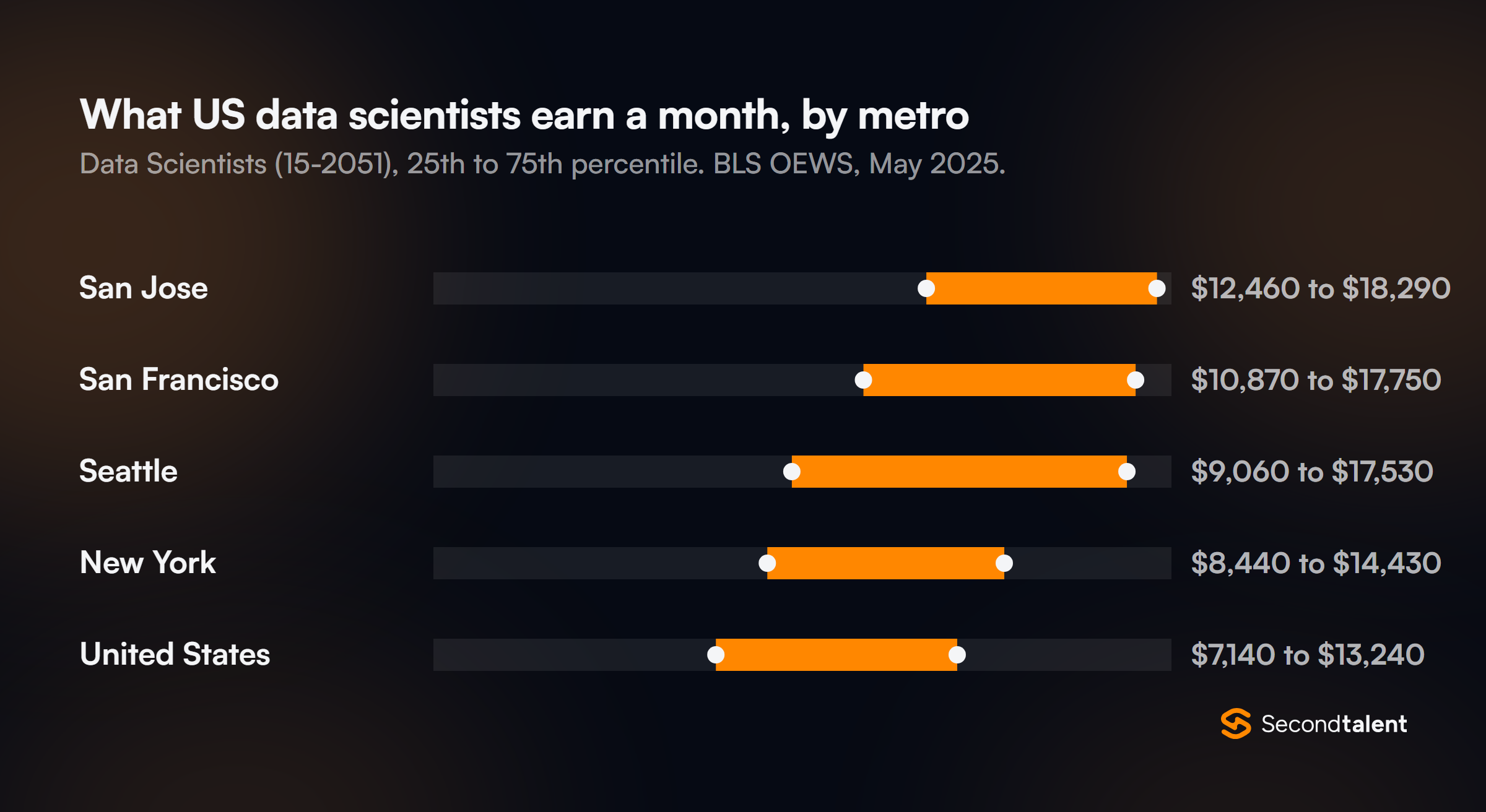
Salary is about 70% of what a US employer pays. In the BLS Employer Costs for Employee Compensation release for June 2026, private industry paid $46.89 an hour in total compensation, of which $14.07 (30.0%) went to benefits. If benefits on a median data scientist salary follow that average, the employer's cost comes to about $171,800 a year, or $14,310 a month (our estimate from the two BLS figures).
For project work, our data scientist cost-to-hire page puts US freelance data scientists at $92 to $145 an hour, before your own overhead.
Which data science skills should you screen for in 2026?
In the Microsoft paper that introduced CUPED, the authors note that most online experiments are flat or negative. A data scientist who reports a flat result as flat, rather than slicing until a segment turns significant, saves you from shipping noise. Python (58.0%) and SQL (58.4%) are close to universal among respondents to Stack Overflow's 2026 survey, so test the six areas below instead of the languages.
A/B test readouts and peeking
In Always Valid Inference, Johari, Pekelis and Walsh call fixed-horizon p-values "wholly unreliable" when users keep monitoring tests, and report that Type I error can increase fivefold even with 10,000 samples. Ask the candidate how they would let a product manager check a test daily without inflating false positives. Listen for a sequential method or a sample size fixed before launch.
Variance reduction with CUPED
Deng, Xu, Kohavi and Walker's CUPED paper uses pre-experiment data to cut metric variance. On Bing it cut variance by about 50%: the same power with half the users or half the duration. The same metric from the pre-experiment period tended to make the best covariate. Give the candidate a test on a noisy revenue metric and ask how they would shorten it without changing the metric.
Causal inference without an experiment
A pricing change, a policy launch or a national TV campaign often reaches all customers at once, with no control group. DoWhy structures effect estimation as four steps (model, identify, estimate and refute), and Amazon and Microsoft moved it into the PyWhy organization in May 2022, per Amazon Science. Ask for the causal graph behind the candidate's last observational estimate and the refutation test they ran on it.
Forecasting on correlated series
The M5 Accuracy competition asked teams to forecast 42,840 hierarchical Walmart unit-sales series. In the organizers' results preprint, most methods used LightGBM, and many teams failed to select their own best submission, probably because of misleading validation scores. Ask how the candidate built the validation window for their last forecast, and whether the store-level forecasts summed to the totals.
pandas 3.0 and the Python stack
The pandas 3.0.0 release notes change daily analysis code. Any subset now behaves as a copy, chained assignment stops working and SettingWithCopyWarning is gone. String columns infer a dedicated str dtype, and Python 3.11 is the minimum. The pandas team recommends upgrading to 2.3 and clearing warnings first. Hand over a notebook written for pandas 2 and ask which lines break. For pipeline and back-end work we also staff Python developers.
Reviewing AI-written analysis code
In the 2026 survey's list of AI mistakes, 69.3% of 13,648 respondents lost time to plausible but wrong code and 49.3% to missing context. In analysis work, plausible but wrong looks like a join that duplicates rows or a filter applied after an aggregate. Plant one in an AI-generated SQL query and time how long the candidate takes to find it.
How do you test a data scientist before you hire?
Use a take-home of three to four hours: an A/B test dataset with a pre-period, a planted sample ratio mismatch and a revenue metric with heavy outliers, plus a SQL query that joins orders to sessions and double counts. Ask for a notebook and a one-page readout a product manager could act on.
A strong answer includes:
- A sample ratio check before any effect estimate, with the mismatch flagged and the test called invalid until it is explained.
- A variance reduction step, such as CUPED on the pre-period metric, with the variance before and after.
- A confidence interval and a decision, not a p-value alone.
- The fixed SQL join, with row counts before and after to prove it.
- A readout in plain English that says what to ship, what not to ship and what to measure next.
Follow with a 45-minute live session on the candidate's own notebook. Ask when they would stop the test early, how they would estimate the effect if randomization had failed, and which pandas 3.0 change would break their code. If the role leans toward production models, add questions from our machine learning interview guide.
Should you hire a data scientist as a contractor, an employee, through an agency or with Second Talent?
Ownership of the work decides more than the hourly rate. Software is not one of the nine categories of commissioned work that can be "work made for hire" under 17 U.S.C. § 101, so a contractor's notebooks, feature code and trained models transfer to you only through a written, signed assignment under § 204(a). Name them in it, along with experiment analysis scripts and dashboards.
|
Full-time W-2 hire |
1099 contractor |
Staffing agency |
Second Talent |
| Who employs the data scientist |
You |
Nobody; they invoice you |
The agency |
Our entity in the data scientist's country |
| Cost basis |
Salary plus about 30% in benefits (BLS) |
Hourly rate, $92 to $145 for US freelancers |
Hourly bill rate including the agency's margin |
From $25 USD/hr, 160 hours for $3,999/mo |
| Who owns notebooks and models |
You, as work made for hire |
The contractor, until a signed assignment |
Set by the agency contract |
You; IP assignment and NDAs in the contract |
| Upfront cost |
Recruiting time or fees |
None |
Varies by agency |
None |
| If the hire fails |
You restart the search |
You restart the search |
Agency terms |
Free replacement under our guarantee |
A fixed-scope project, such as one churn model with a handover date, suits a contract. A data scientist who joins your weekly metrics review with standing warehouse access looks like an employee on the IRS tests of behavioral control, financial control and the relationship of the parties, set out in its guide to employees and independent contractors. A contractor based outside the US gives you Form W-8BEN instead of a W-9.
Through Second Talent the data scientist is our employee: we run payroll, taxes and equipment, and you direct the work and own the output. Our employer of record service covers the case where you pick the person yourself. This is a summary, not legal advice.
How many working hours overlap with ET, CT and PT?
We agree a schedule with each data scientist before the offer, and our placements get 4 to 6 hours of daily overlap with US business hours. ET runs three hours ahead of PT, so a shared block from 11:00 am to 3:00 pm ET covers 10:00 am to 2:00 pm CT and 8:00 am to noon PT.
Spend the shared hours on experiment readouts, metric definition questions and the weekly business review. Model training, backfills and forecast refreshes can run in the rest of the day, so the numbers are waiting when your team signs in. Keep test launches and readouts away from US holiday weeks, when traffic patterns skew the result.
How fast can you hire a data scientist with Second Talent?
The first shortlist of 6 to 8 pre-vetted profiles arrives within 24 hours of a complete brief. Our vetting covers stages 2 to 4 before you see a profile.
- Brief. You say whether the role runs experiments, builds forecasts, models causal effects or ships production models, and name the warehouse, the BI tool and the decisions the work feeds.
- Application review. We look for analysis that changed a decision: a test readout, a forecast in use, a model in production, with the metric and the sample size. Kaggle ranks alone do not pass.
- Skills assessment. The candidate analyzes an A/B dataset with a pre-period, applies variance reduction, flags a planted sample ratio mismatch and fixes a SQL join that duplicates rows.
- Live interview and references. A senior engineer reviews the notebook live, then we ask former managers which recommendations the team acted on and how the candidate handled a result that contradicted the roadmap.
- Your final round. You interview the shortlist, pick one, and the data scientist starts once their notice period ends.
Pricing, the replacement guarantee and the monthly terms are on our pricing page. Tell us what you need and the shortlist follows. For the pipelines behind the analysis we also staff data engineers and machine learning engineers.