TL;DR: LLM engineers from Asia earn $2,390 to $18,760+ a month working for international clients on our AI engineer rate cards, and we shortlist 6-8 candidates within 24 hours. The closest US benchmark, the BLS median for software developers, was $135,980 a year in May 2025.
Chroma tested 18 language models, including GPT-4.1, Claude 4 and Qwen3, and found that their performance became less reliable as input length grew, even on simple tasks. Its Context Rot report is the case for hiring an engineer who decides what goes into the prompt. A million-token window does not make that call for you.
Key takeaways
- Llama 4's licence requires a distributed model trained or fine-tuned with Llama materials or outputs to carry "Llama" at the start of its name.
- The vLLM paper reported two to four times the throughput of earlier serving systems at the same latency, by managing KV cache memory the way an operating system pages memory.
- China's AI engineer range starts at $9,680 a month, close to the ceilings in India and Indonesia.
- A 9:00 am to 6:00 pm day in Manila runs from 9:00 pm to 6:00 am in New York, so evaluation results from a run your team requests at close of business can be ready the next morning.
What LLM Engineers Earn Working for International Clients in Asia
Our rate cards carry no LLM engineer title, so the table uses our AI engineer rate cards, the closest match. China stands apart: its range opens above the ceilings of three other markets. The figure is what engineers in each market earn working directly for foreign companies, before any employer or platform costs.
| Market |
Monthly pay working for international clients (USD) |
| Philippines |
$2,390-$4,790+ |
| India |
$2,610-$10,150+ |
| Malaysia |
$3,690-$7,370+ |
| Vietnam |
$3,870-$7,730+ |
| Indonesia |
$4,540-$10,210+ |
| China |
$9,680-$18,760+ |
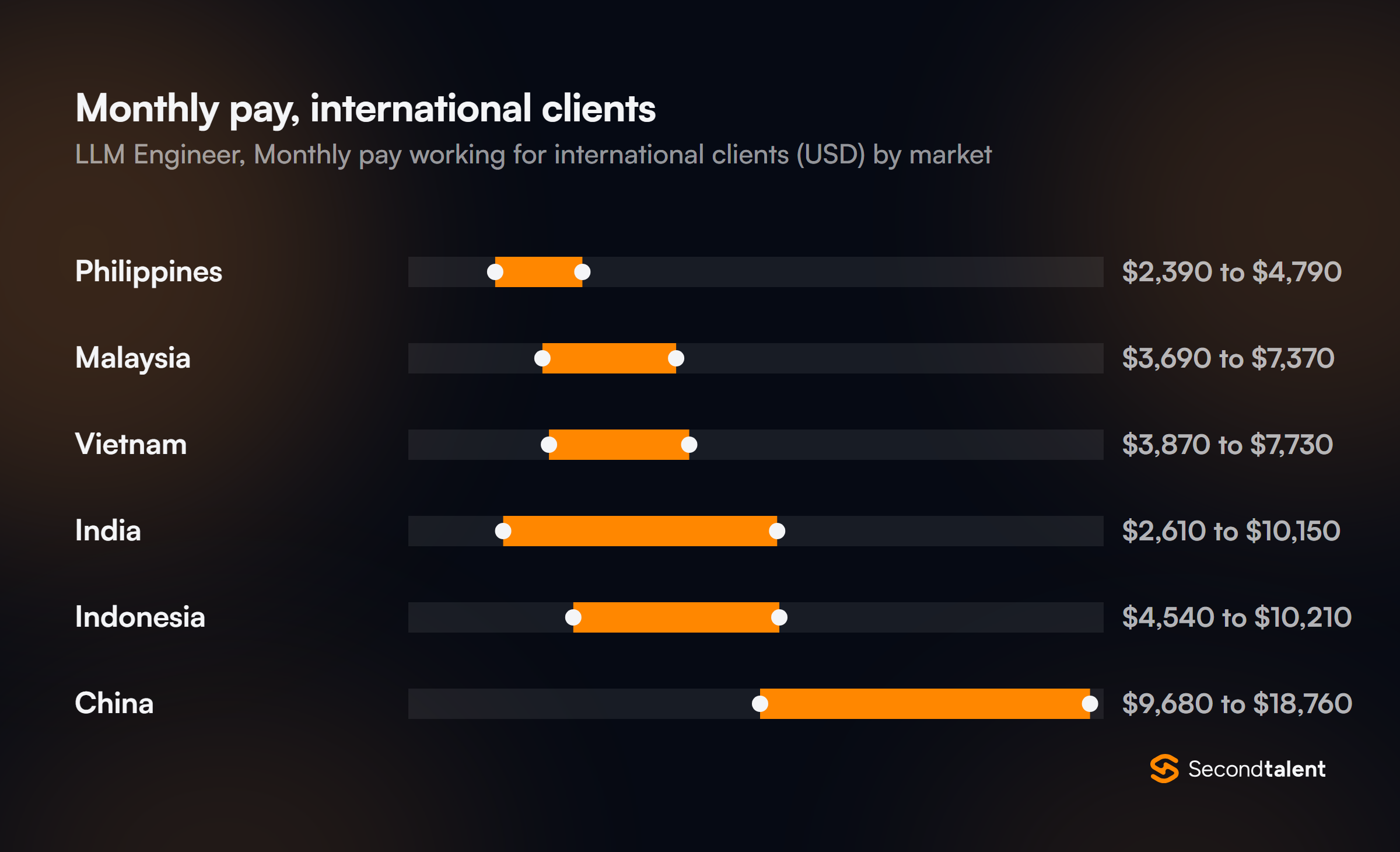
Monthly ranges from the Remote (Working for International Clients) figures on our rate cards for the Philippines, India, Malaysia, Vietnam, Indonesia and China, converted at ExchangeRate-API mid-market rates for 14 September 2026.
Compute sits on top of pay for this role. An engineer who fine-tunes or self-hosts models needs GPU time, and one who calls hosted models runs up token bills, so set both budgets in the brief.
For contract work, our LLM developer cost-to-hire page puts a mid-level US freelance or contract LLM developer at $119 to $185 an hour. Our pricing page explains how a Second Talent subscription bills a full-time hire. For a single market, see our Philippines LLM engineer page.
US Pay Benchmark for LLM Engineers
Most LLM engineers build products on top of models, and that work maps to Software Developers (SOC 15-1252). An engineer whose job is fine-tuning, training experiments and evaluation research sits closer to Computer and Information Research Scientists (15-1221), so the table shows both.
| BLS OEWS, May 2025, national |
Software Developers (15-1252) |
Computer and Information Research Scientists (15-1221) |
| Median annual |
$135,980 |
$140,300 |
| 10th percentile, monthly |
$6,870 |
$6,850 |
| Median, monthly |
$11,330 |
$11,690 |
| 90th percentile, monthly |
$17,890 |
$19,220 |
Monthly figures are the annual wages on the BLS OEWS profiles for 15-1252 and 15-1221 divided by 12, rounded to the nearest $10.
The two medians sit $360 a month apart. The research column pulls away at the top, where its 90th percentile runs $1,330 a month higher.
Salary is only part of the US cost. In the BLS Employer Costs for Employee Compensation release for June 2026, wages and salaries made up 68.5% of employer compensation costs for full-time private industry workers, and benefits the other 31.5%.
Time Zone Overlap with ET, CT and PT
Fine-tuning runs and evaluation sweeps take hours of GPU time and can run unattended. An LLM engineer in Asia can launch them at the end of a US day and hand over results by the next morning. US daylight time runs from 8 March to 1 November 2026, per NIST, and no city below changes its clocks.
| Engineer's city |
UTC offset |
9:00 am ET (EDT) |
9:00 am CT (CDT) |
9:00 am PT (PDT) |
| Manila, Singapore, Kuala Lumpur, Taipei |
UTC+8 |
9:00 pm |
10:00 pm |
12:00 midnight |
| Ho Chi Minh City, Jakarta, Bangkok |
UTC+7 |
8:00 pm |
9:00 pm |
11:00 pm |
| Bengaluru |
UTC+5:30 |
6:30 pm |
7:30 pm |
9:30 pm |
After 1 November 2026, every time in the table moves one hour later.
Two schedules fit two kinds of LLM work:
- Overnight training and evals, Manila, 9:00 am to 6:00 pm (01:00 to 10:00 UTC). That is 9:00 pm to 6:00 am in New York, with no overlap, and no night-shift premium for the engineer.
- Shared product work, Bengaluru, 2:30 pm to 11:30 pm (09:00 to 18:00 UTC). That covers 5:00 am to 2:00 pm Eastern: five hours of a 9-to-5 day in New York, four with Chicago and two with San Francisco.
Arithmetic for the first line: 9:00 am in Manila is 01:00 UTC, and 01:00 UTC minus four hours is 9:00 pm EDT the previous evening. For shared work we agree the schedule before the offer, which is how our placements get 4-6 hours of daily overlap with US hours.
A later Manila shift costs more for an employee. The Philippine night shift differential is at least 10% for work between 10 pm and 6 am (Labor Code Article 86), and Vietnam's Labor Code sets at least 30% for 22:00 to 06:00 (Articles 98 and 106).
LLM Engineer Skills to Screen For
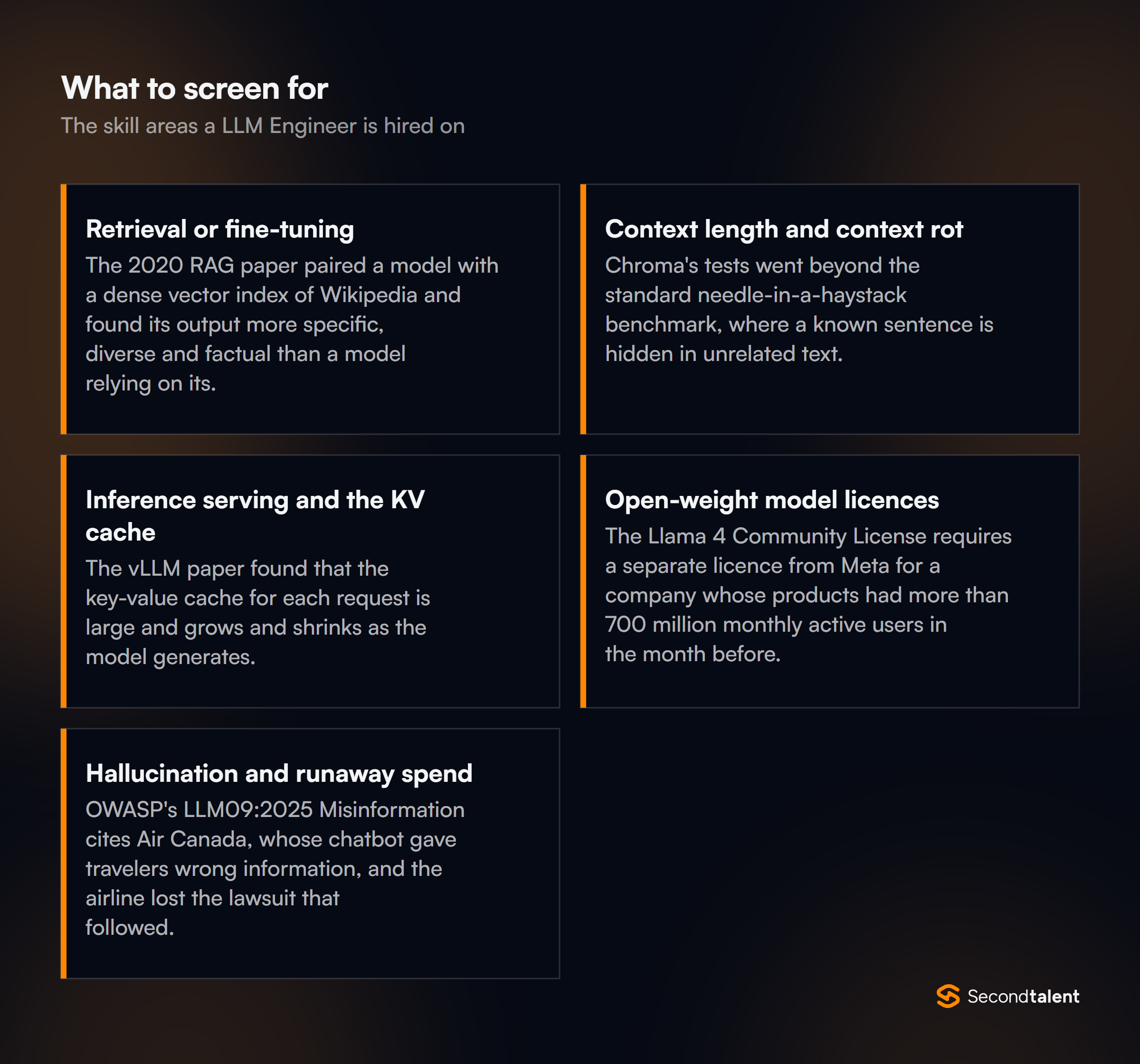
In Stack Overflow's 2025 survey, 81.4% of respondents had used OpenAI's GPT models for development work in the past year. Model families with open-weight releases trailed: Meta Llama at 17.8%, Mistral at 10.4% and Alibaba Qwen at 5.2%. Screen for the models you plan to run, then test the five areas below.
Retrieval or fine-tuning
The 2020 RAG paper paired a model with a dense vector index of Wikipedia and found its output more specific, diverse and factual than a model relying on its parameters alone. LoRA cut trainable parameters 10,000 times against full fine-tuning of GPT-3 175B, with no added inference latency. Give the candidate a use case and ask which they would build first, what data it needs and how they would tell it worked. Our fine-tuning engineer profile covers the training-heavy version of the role.
Context length and context rot
Chroma's tests went beyond the standard needle-in-a-haystack benchmark, where a known sentence is hidden in unrelated text. With semantic matches, distractors and a conversational memory task added, performance dropped as input grew, often in non-uniform ways. Ask how the candidate decides between a longer prompt and better retrieval, and what they measured the last time they cut context.
Inference serving and the KV cache
The vLLM paper found that the key-value cache for each request is large and grows and shrinks as the model generates. Wasted cache memory limits batch size. Its PagedAttention design improved throughput two to four times at the same latency, with larger gains on longer sequences and bigger models.
Ask a candidate who self-hosts models how they sized GPU memory for your peak concurrency, and what they traded when latency targets and batch size collided.
Open-weight model licences
The Llama 4 Community License requires a separate licence from Meta for a company whose products had more than 700 million monthly active users in the month before the Llama 4 release date. It also requires "Built with Llama" on a related website or product documentation when you distribute Llama materials, and a distributed model improved with Llama outputs must start its name with "Llama".
Licences differ across families. On Hugging Face, Alibaba's Qwen team lists Qwen3-8B under Apache 2.0, and DeepSeek lists DeepSeek-V3.2 under MIT. Ask the candidate which licence covers the model they propose, and what it asks of you when you ship.
Hallucination and runaway spend
OWASP's LLM09:2025 Misinformation cites Air Canada, whose chatbot gave travelers wrong information, and the airline lost the lawsuit that followed. LLM10:2025 Unbounded Consumption lists "denial of wallet", where a flood of requests runs up usage-based bills. Ask the candidate for the evaluation that catches a wrong answer before release, and the per-user rate or token limit they set on their last public feature.
Contractor or Employer of Record for a US Company
Software is not one of the nine categories of commissioned work that can be "work made for hire" under 17 U.S.C. § 101, and a copyright transfer must be in writing and signed under § 204(a). For an LLM engineer, name the fine-tuned weights, adapters, training and evaluation datasets, prompts and serving code in the assignment.
IRS Publication 515 says the place where someone performs the services determines the source of the income, so an engineer working from Manila or Shanghai earns foreign-source income. A foreign individual gives the payer Form W-8BEN to certify foreign status.
Local law applies its own test. Philippine courts use the four-fold test, and in Atok Big Wedge v. Gison the Supreme Court called the power of control the most important of the four. Article 13 of Vietnam's 2019 Labor Code treats an agreement under another name as a labor contract when it covers a paid job, wages and one party's management or supervision.
|
Independent contractor |
Employer of Record |
| Legal employer |
None; the engineer invoices you |
The EOR's local entity |
| US paperwork |
Form W-8BEN from the engineer |
Service agreement with the EOR |
| IP |
Written assignment covering weights, adapters, datasets and code |
Assignment in the employment contract and your EOR agreement |
| Local labor law |
Classification risk if you control hours and methods |
Night premiums, public holidays and leave apply |
| Pay currency |
Agreed in the contract, often USD |
Vietnam's Labor Code states wages in dong (Article 95) |
A one-off fine-tune with a fixed evaluation target suits a contractor agreement. An engineer who owns your model pipeline and holds access to training data fits the employment tests above, and our Employer of Record service employs that engineer in-country, with a separate China EOR page. India is not one of our 9 EOR markets. This is a summary, not legal advice.
English Level and Working Norms
LLM engineers write in English for machines as well as colleagues: system prompts, evaluation rubrics, model cards. On the EF English Proficiency Index 2025, the Philippines scores 603 for writing and 539 for speaking, against a global average of 488 across 123 countries and regions.
| Country |
EF EPI 2025 score |
World rank (of 123) |
IT job-function score |
| Malaysia |
581 |
24 |
590 |
| Philippines |
569 |
28 |
581 |
| Vietnam |
500 |
64 |
500 |
| India |
484 |
74 |
487 |
| Indonesia |
471 |
80 |
523 |
| China |
464 |
86 |
491 |
Scores come from EF's country pages, such as the Philippines and China. China's IT job-function score of 491 runs 27 points above its national score. Ask finalists to write an evaluation rubric for one of your prompts, then grade three model answers against it.
Holidays affect training schedules. Thanksgiving on 26 November 2026 is a working day in Asia, so an engineer there can run an evaluation cycle while your US team is off. Vietnam's Labor Code gives five paid days for Lunar New Year (Article 112), so plan GPU reservations around that week for a Vietnam-based hire.
LLM Engineer Hiring Process
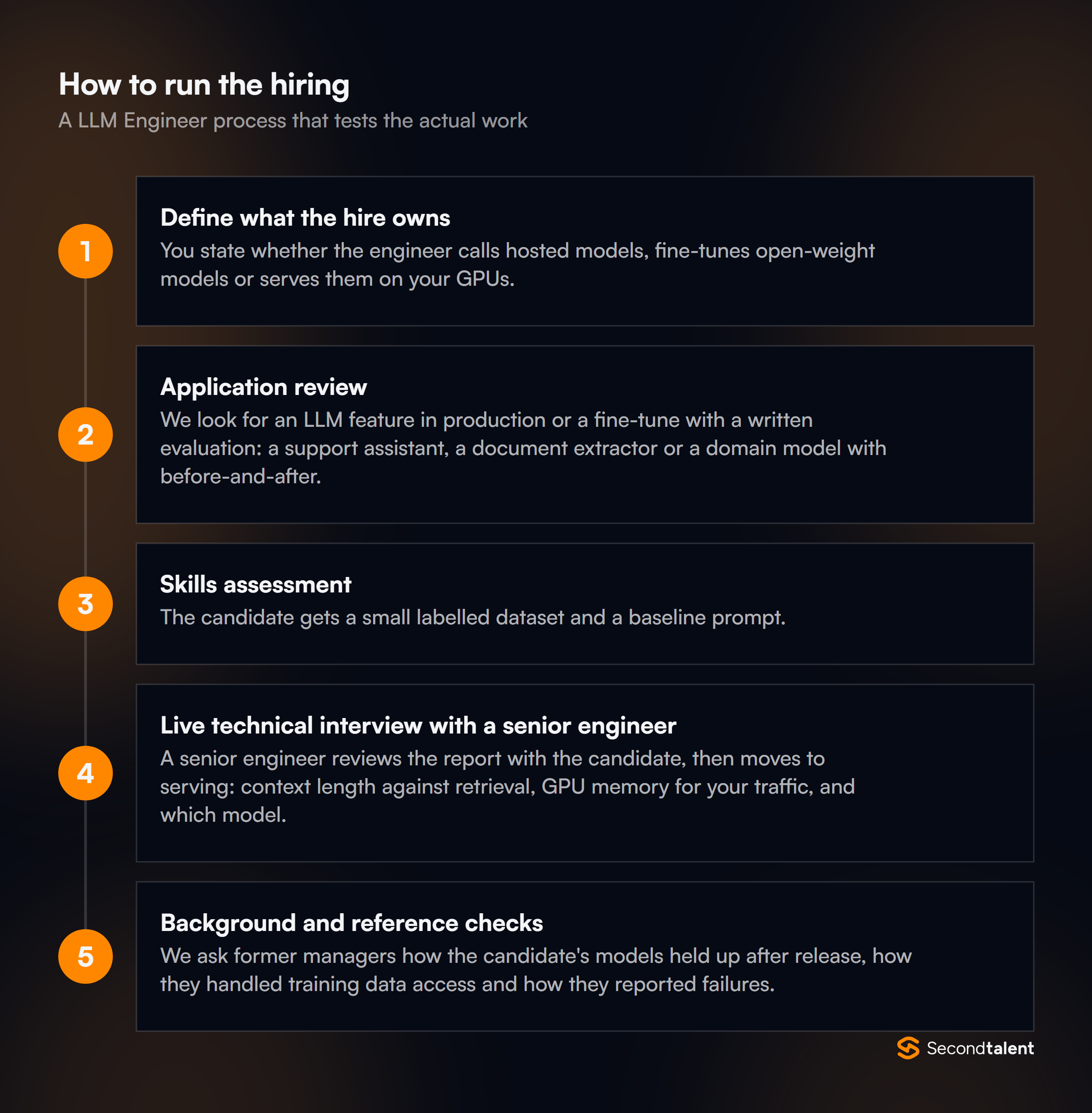
Second Talent's vetting covers stages 2 to 5 before you see a profile.
Stage 1: Define what the hire owns
You state whether the engineer calls hosted models, fine-tunes open-weight models or serves them on your GPUs. Add the data they may use, the compute budget and the metric that decides whether a model ships.
Stage 2: Application review
We look for an LLM feature in production or a fine-tune with a written evaluation: a support assistant, a document extractor or a domain model with before-and-after scores. A chatbot demo without evaluation numbers does not pass.
Stage 3: Skills assessment
The candidate gets a small labelled dataset and a baseline prompt. They improve the result with retrieval, a LoRA adapter or a better prompt, and write an evaluation report that explains the choice and its token cost.
Stage 4: Live technical interview with a senior engineer
A senior engineer reviews the report with the candidate, then moves to serving: context length against retrieval, GPU memory for your traffic, and which model licence fits your product.
Stage 5: Background and reference checks
We ask former managers how the candidate's models held up after release, how they handled training data access and how they reported failures. You then choose the contractor or EOR route above.
Hire LLM Engineers from Asia with Second Talent
We shortlist 6-8 candidates within 24 hours from 100,000+ pre-vetted engineers, accepting only the top 1% of applicants. LLM engineers come with $0 upfront, no lock-in and 4-6 hours of daily overlap with US hours. We handle contracts, payroll and equipment, with compliant EOR contracts and payroll in 9 Asian markets.
Our pricing page covers the subscription, and for retrieval and agent frameworks we also staff LangChain developers.