TL;DR: The three IT staffing engagement models differ on two questions: who directs the work day to day, and who carries the outcome if it fails. Staff augmentation puts a provider-employed engineer under your manager and leaves delivery risk with you. A managed service hands a whole function to the provider under service levels. A project under a statement of work fixes scope and price and leaves the deliverable with the provider until you accept it. Contract shape, what gets measured, and how the cost lands in your accounts all follow from that.
Picking the wrong model is the most expensive mistake in this category. You end up paying managed-service margin for what a single senior engineer would have covered, or running a fixed-price project through a roadmap that changes each sprint. This guide follows on from what IT staffing is and goes deeper on each model.
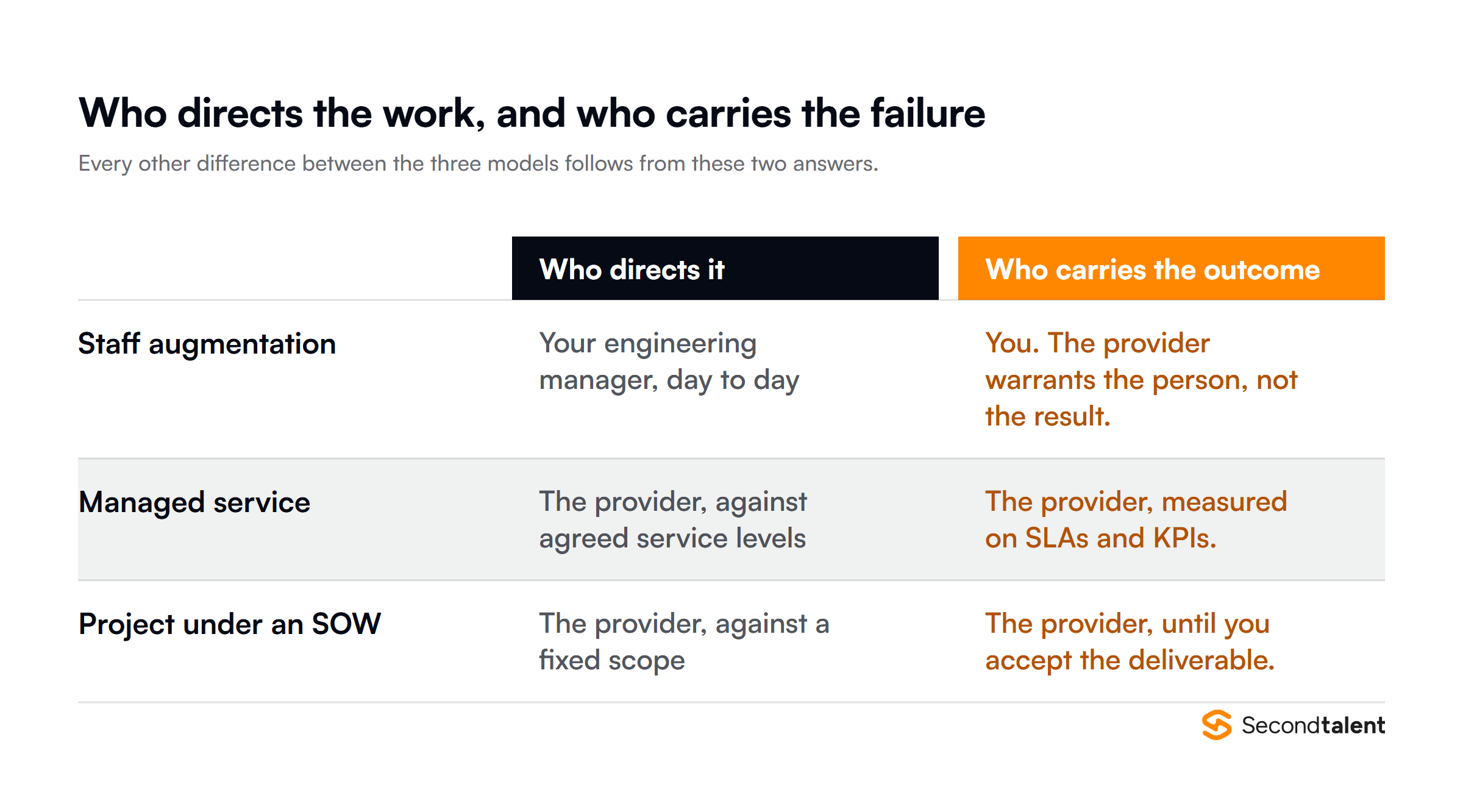
What is the difference between the three models?
Staff augmentation supplies people. Managed services supplies a running function. Project work supplies a finished deliverable.
Everything else follows from that. Who writes the ticket, what the contract promises, how you find out something has gone wrong, and whether your finance team books the cost as an expense or an asset all trace back to which of the three you signed.
Staff augmentation in detail
A provider-employed engineer joins your team and takes direction from your manager. You keep the roadmap, the sequencing and the code review.
When it fits. You know what needs building and lack the hands. A senior seat for six to twelve months, a sprint team for a quarterly push, or cover for a departing contractor.
How it prices. A blended hourly or monthly rate covering wages, employer taxes, benefits, administration and margin. Ask whether the quoted rate is blended or a base rate with extras on top, because the answer changes the comparison.
How it contracts. A master services agreement covering compliance, IP assignment, confidentiality and termination, plus a per-engagement work order naming the person, role, rate, start date and duration. Our breakdown of the 12 MSA clauses that shift risk covers what to negotiate.
Where it goes wrong. Scope creep past the work order, no knowledge transfer at the end, and a working relationship that starts to look like direct employment. That last one is a classification problem: the IRS common-law test turns on exactly the kind of control an augmentation engagement involves, which is why the provider needs to be the employer. Our guide to worker classification in cross-border IT staffing covers the detail.
Managed services in detail
The provider takes ownership of a defined function, staffs it as it sees fit, and reports against agreed service levels.
When it fits. The function is well defined, ongoing, and you have decided not to build the capability in house. Round-the-clock production support and a whole QA function are the common examples.
How it prices. A fixed monthly fee tied to scope, or per-resource pricing with service credits It prices above an augmentation rate because the provider is carrying management overhead and service-level risk, not just supplying a person. Here you might look for vendor pricing transparency with clear pricing terms make it easier to compare the true cos.
How it contracts. A managed services agreement covering scope, service levels, KPIs, service credits, escalation, change control, data handling and exit. Multi-year by default, because the provider needs to recover its ramp-up.
Data handling deserves its own read. Where the function touches personal data, the provider is a processor and GDPR Article 28 sets what the contract has to say, including the conditions for engaging any sub-processor. A managed service that quietly subcontracts part of the function is the case this is written for.
Where it goes wrong. Service levels set wide enough that no breach triggers a credit. KPIs that count activity rather than outcomes. Exit terms that make leaving cost more than staying.
Price the exit before you sign the entry. Managed services contracts are the ones buyers regret for years without saying so. Ask what termination for convenience costs, how long the notice period runs, and what you have to pay for knowledge transfer on the way out. A provider who will not put those numbers in writing is telling you what the renewal conversation will feel like.
Project work under a statement of work
An SOW fixes the deliverable, timeline, price, acceptance criteria and payment schedule. The provider assembles the team and owns the result until you sign it off.
When it fits. The deliverable has a hard edge and you care about the outcome more than the method. An MVP, a legacy migration, a defined data engineering build.
How it prices. Fixed price puts all overrun risk on the provider. Time and materials with a not-to-exceed cap splits it. Milestone billing ties payment to accepted phases.
Where it goes wrong. Scope creep through informal requests no one priced, and acceptance criteria too vague to enforce. Put each change through a written change order. An email agreeing to “just add” something is where fixed-price disputes begin.
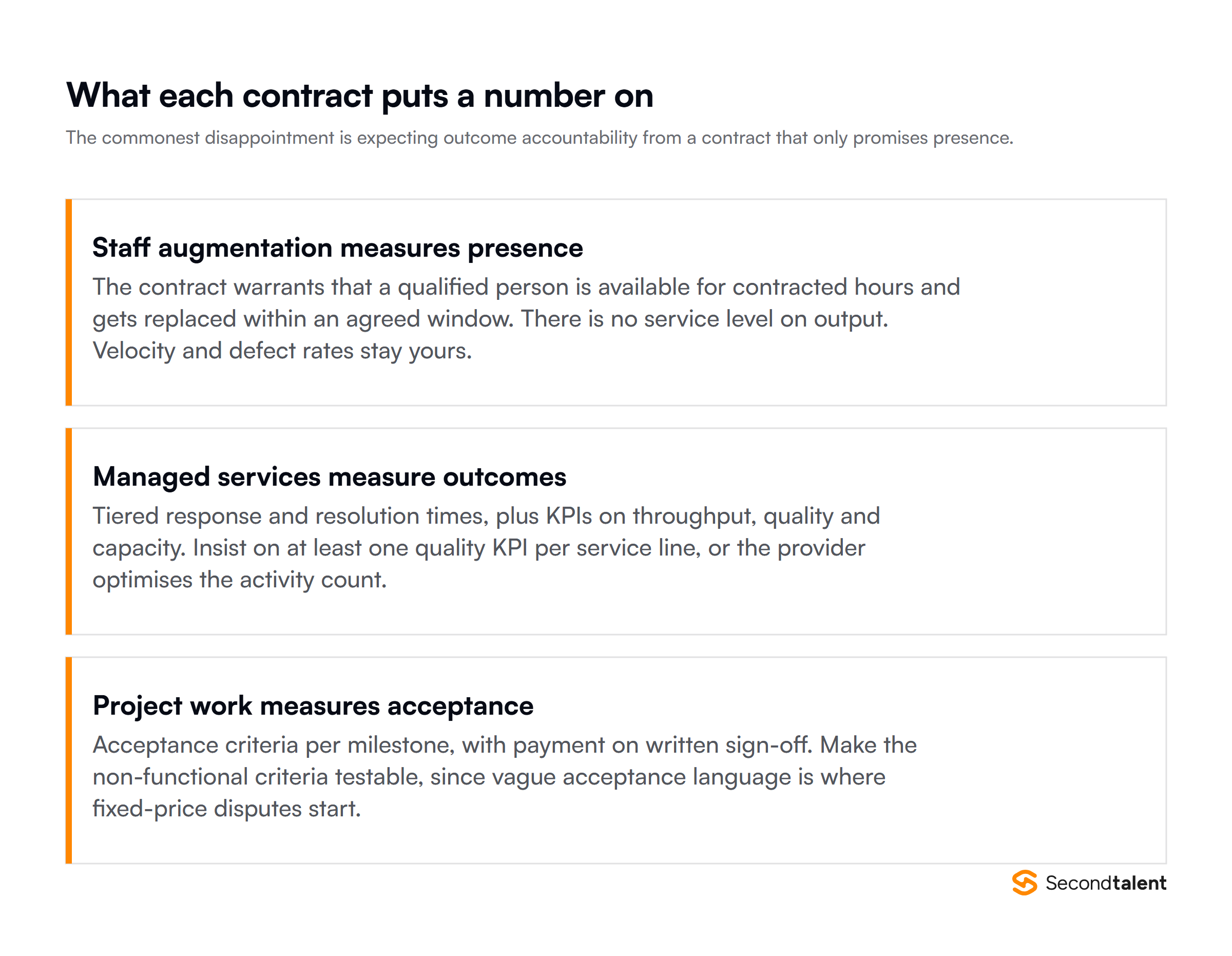
What does each contract actually measure?
Presence, outcomes, or acceptance. The commonest disappointment in this category is expecting outcome accountability from a contract that only ever promised presence.
Staff augmentation measures presence. The contract warrants that a qualified person is available for contracted hours and gets replaced within an agreed window if they leave or underperform. There is no service level on output. Sprint velocity and defect rates stay your problem, because you are the one directing the work.
Managed services measures outcomes. Tiered response and resolution times, plus KPIs across throughput, quality and capacity. Insist on at least one quality measure per service line. A contract that counts only tickets closed rewards closing tickets.
Where the function is security-sensitive, borrow the vocabulary rather than inventing it. The NIST Cybersecurity Framework added a Govern function covering supply chain and third-party risk, which gives you a ready-made structure for the oversight clauses instead of a bespoke list nobody can audit against.
Project work measures acceptance. Criteria per milestone, payment on written sign-off. Make the non-functional criteria testable, with named latency and availability targets and a defined security scan, or acceptance becomes an opinion.
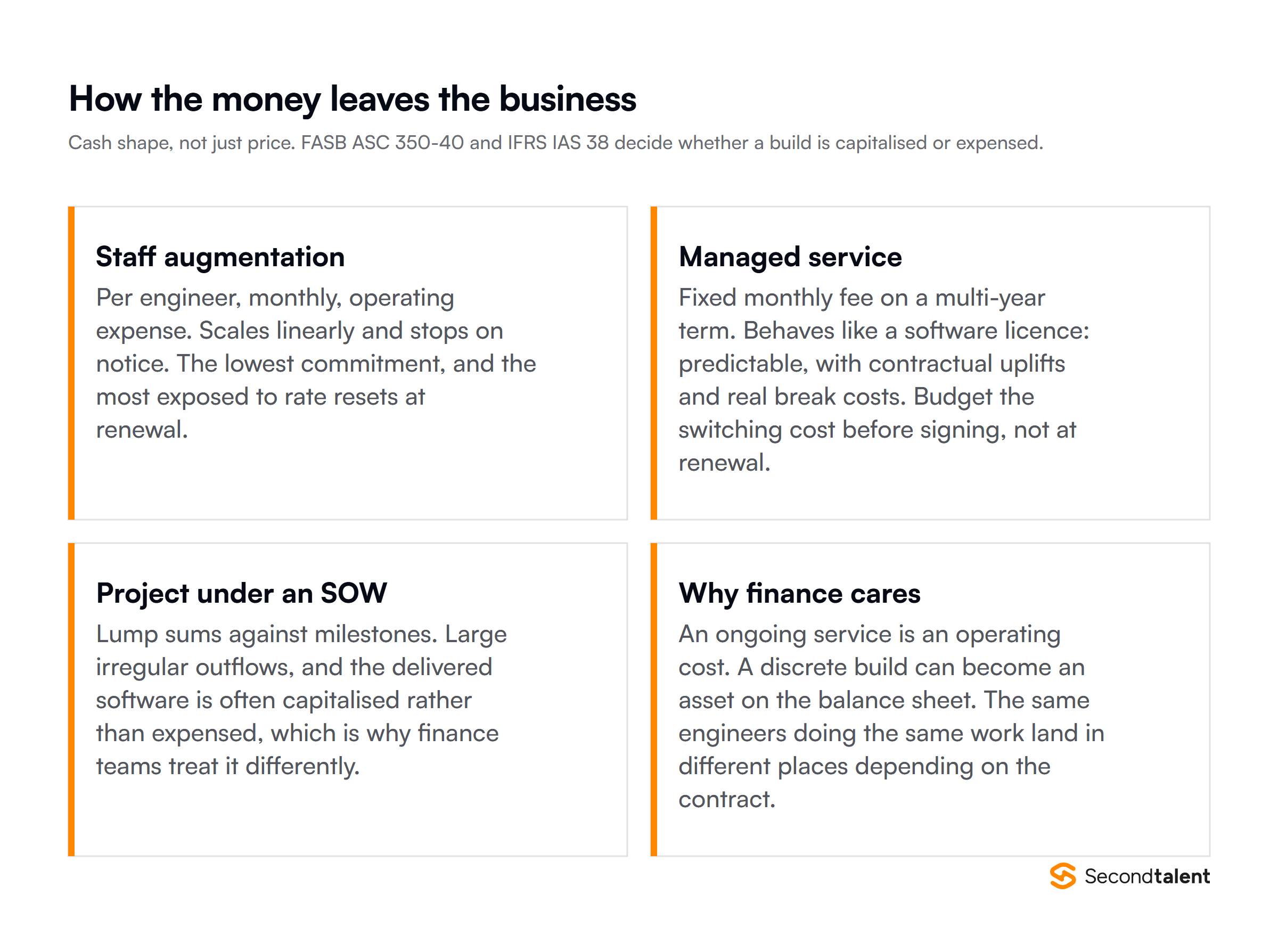
How the cost lands in your accounts
The three models produce different cash shapes, and finance often cares about that more than the headline rate.
Staff augmentation is a per-engineer monthly operating expense. It scales in a straight line, stops on notice, and is the easiest to model. It is also the most exposed to rate resets when the master agreement renews.
A managed service is a fixed monthly fee across a multi-year term, which behaves like a software licence: predictable, with contractual uplifts and real break costs.
Project work is lump sums against milestones, and here the accounting treatment can differ. Software built to a defined specification may be capitalised rather than expensed, under ASC 350-40 in the US or IAS 38 under IFRS. The same engineers doing the same work can land in different places on your accounts depending on which contract you signed, which is worth a conversation with finance before you choose.
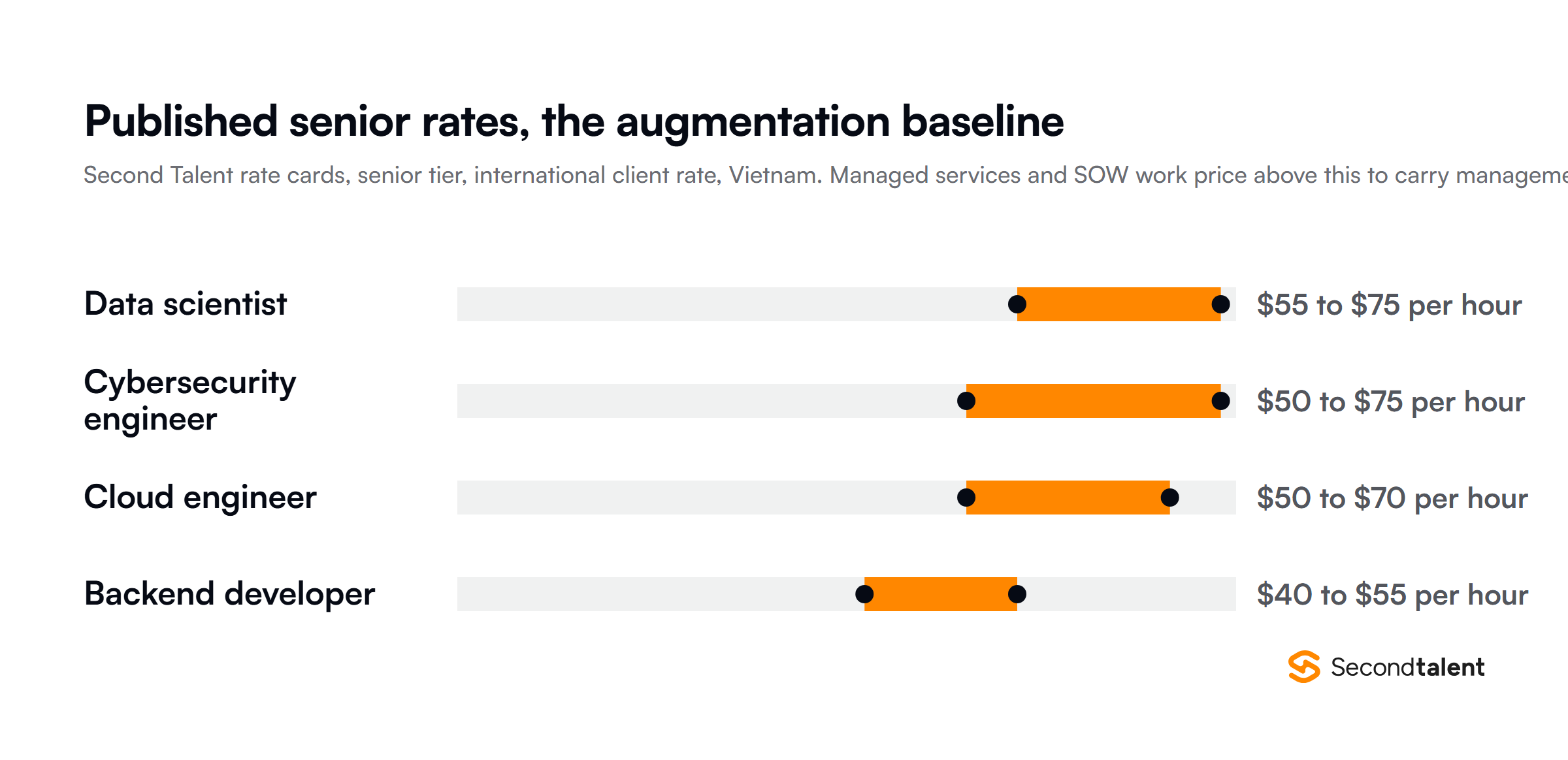
What do the three models cost?
Augmentation sets the floor, because you are buying labour with no wrapper. Managed services and SOW work price above it to cover management, service-level risk and delivery accountability.
Second Talent publishes senior international client rates by role and market in the developer rate cards: in Vietnam, senior backend developers run $40 to $55 per hour, cloud engineers $50 to $70, cybersecurity engineers $50 to $75 and data scientists $55 to $75.
Compare against the local alternative on fully loaded terms. The US Bureau of Labor Statistics puts the median wage for software developers at $135,980 in May 2025, but that is salary before employer taxes and benefits, while a provider rate already includes them.
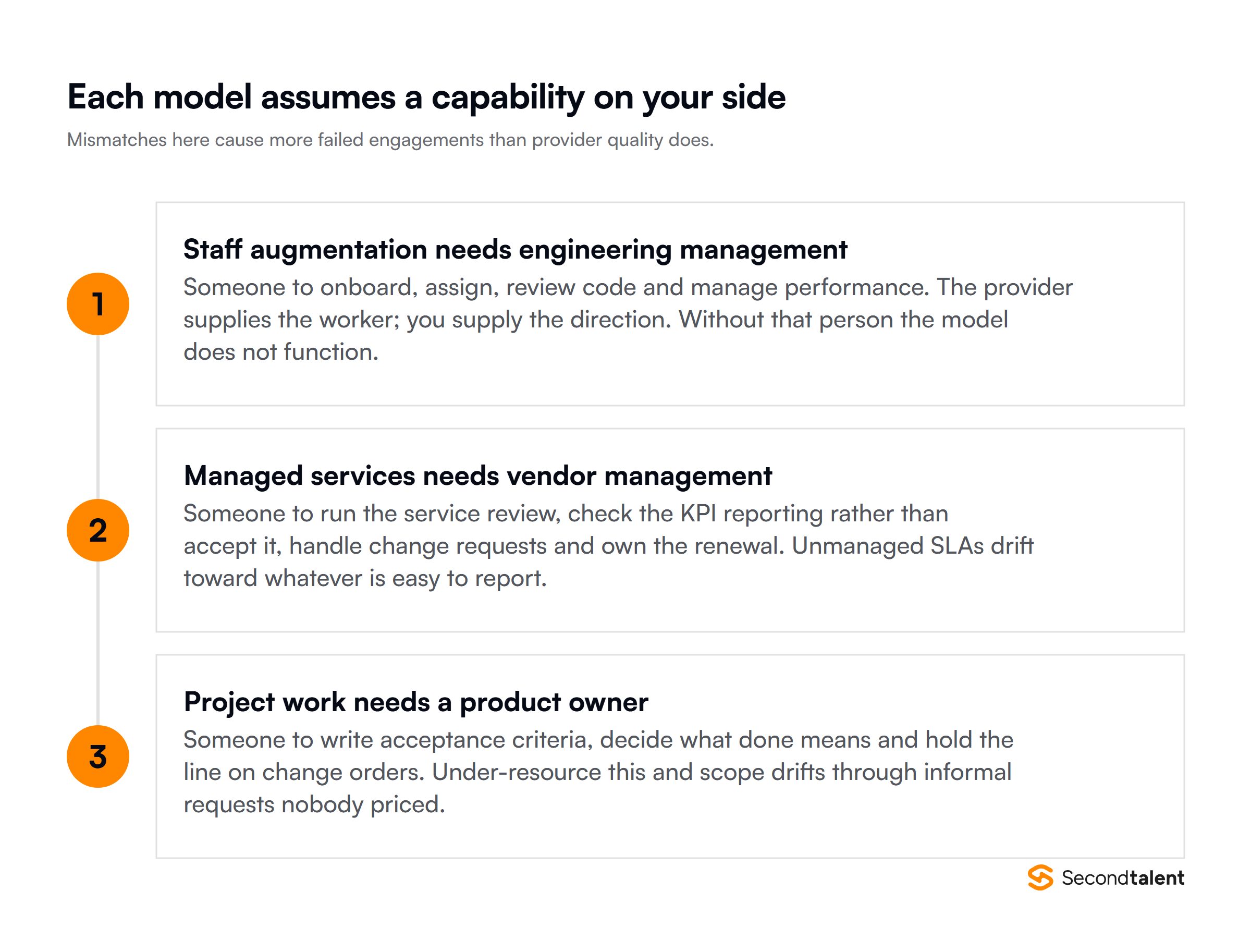
What each model demands from your side
Each model assumes a capability you have to supply, and a mismatch there causes more failed engagements than provider quality does.
Staff augmentation needs an engineering manager. Someone to onboard, assign, review and manage performance. The provider supplies the worker; you supply the direction. Without that person the model does not function, whatever you pay.
Managed services needs a vendor manager. Someone to run the service review, interrogate the KPI reporting rather than accept it, handle change requests and own the renewal. Unmanaged service levels drift toward whatever is convenient to report.
Project work needs a product owner. Someone to write acceptance criteria, decide what done means, and hold the line on change orders. Under-resource that role and the scope drifts through requests nobody priced.
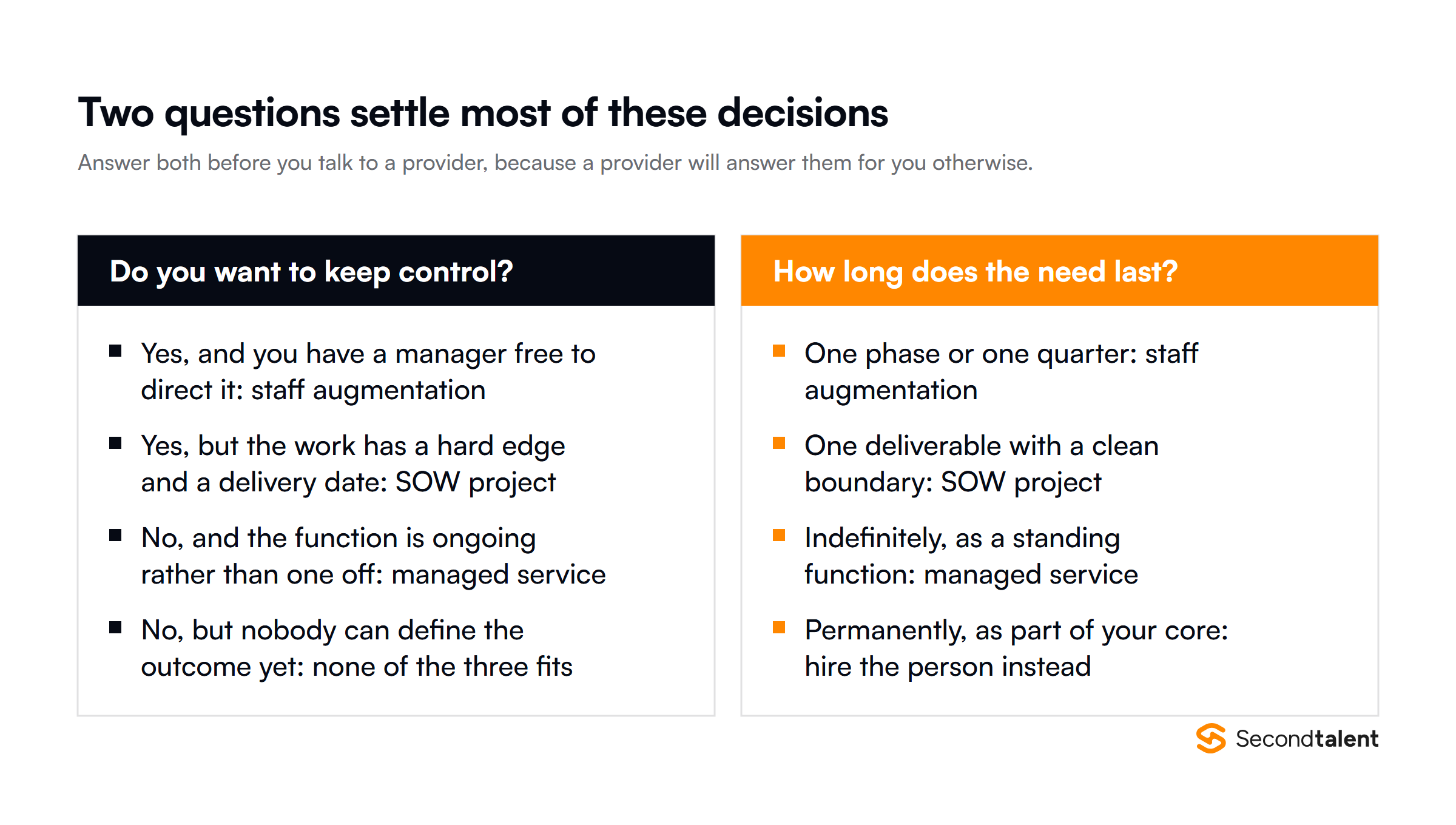
How do you choose between them?
Two questions settle most cases: do you want to keep control of the work, and how long does the need last?
If you want control and have a manager free to direct it, use staff augmentation. If you want control but the work has a hard edge and a delivery date, use an SOW. If you do not want control and the function has no end date, buy a managed service. If nobody can define the outcome yet, none of the three fits, and the honest next step is scoping rather than sourcing.
Our deeper comparisons cover the two most common pairwise decisions: staff augmentation versus managed services and staff augmentation versus outsourcing.
Engagement model FAQs
Can one provider deliver all three models?
Many do, and that is a reason to be precise about which one you are buying. The same vendor, the same engineers and the same invoice can sit under three very different sets of obligations.
Can you switch models mid-engagement?
Yes, and it means a new contract rather than an amendment in most cases. Moving from augmentation to a managed service transfers direction of the work, which changes liability, so treat it as a fresh negotiation.
Which model is cheapest?
Staff augmentation, per hour of engineering. That is not the same as cheapest per outcome, because you are absorbing the management and delivery risk yourself rather than paying someone to carry it.
What happens if the model turns out to be wrong?
Augmentation is the cheapest mistake to unwind, because the commitment is short and the notice period is measured in weeks. A managed service is the most expensive, since you are inside a multi-year term with break costs and a knowledge transfer bill. An SOW sits between the two: you finish the deliverable, pay the milestones and do not sign the next one.
Which model suits a startup?
Augmentation, in most cases. Startups change direction faster than an SOW can be renegotiated, and seldom have the vendor-management capacity a managed service assumes.
Takeaways
- Two questions decide it: who directs the work, and who carries the outcome.
- Augmentation warrants presence, not output. Do not expect delivery accountability from it.
- Price a managed service’s exit before you sign its entry.
- The contract shape changes whether finance expenses the cost or capitalises it.
- Each model assumes a person on your side: a manager, a vendor manager, or a product owner.
Where each model sits in a bigger programme
Large teams end up running all three at once, and the failure mode there is different. It is not picking the wrong model, it is losing track of which work sits under which contract.
Keep a single register of engagements listing the model, the directing manager, the notice period and the renewal date. Without it, a managed service quietly absorbs work that an augmentation contract already covers, and you pay twice for the same capacity.
Talk through the right model
Second Talent supports all three, with pre-vetted senior engineers across Asia, EOR cover, 24-hour matching and 92 percent retention.
Tell us what you are trying to ship, or read how to evaluate IT staffing companies before you choose a provider.