TL;DR: Staff augmentation gives you eight things: speed, lower fully loaded cost, specialty access, capacity without permanence, a trial before conversion, less recruiting overhead, compliance carried by the provider, and scope that flexes both ways. Each one comes from a mechanism you can check before signing. Second Talent returns matched profiles within 24 hours, saves clients $103,000 or more per hire, and keeps 92 percent of placements in seat a year later. It solves none of your founder-grade or leadership hiring.
Staff augmentation is the model most engineering teams reach for first, and the reasons are specific rather than general. This guide takes each benefit, names the mechanism that produces it, and states the catch, so you can tell in advance which ones apply to your situation and which do not.

What are the benefits of staff augmentation?
Speed, cost, specialty access, flexible capacity, a trial period, less recruiting load, compliance offload, and two-way scope flexibility.
None of them arrive on their own. Each depends on something the provider does, which makes each one a question you can ask before you sign.
1. Speed to a working engineer
The provider already holds a vetted bench, so sourcing and first-pass screening happen before you ask rather than after.
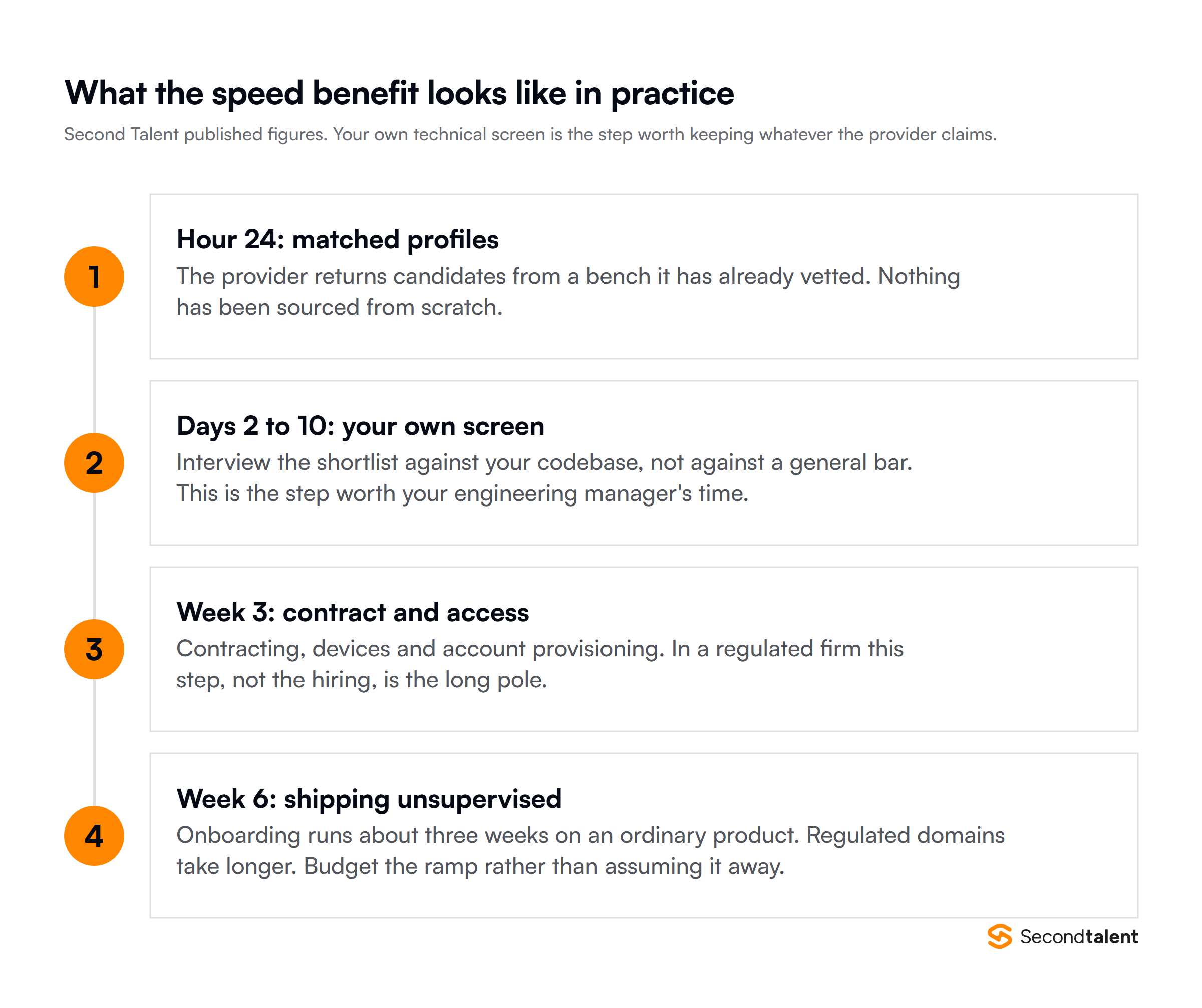
Second Talent returns matched profiles within 24 hours, because the bench was vetted before you called rather than after. Onboarding then runs about three weeks on an ordinary product, and longer in a regulated domain.
The catch sits after selection. Contracting, devices and account provisioning add days at an ordinary company and weeks at a regulated one, and none of that is under the provider’s control. Track it as its own line, or the plan slips somewhere the hiring timeline never showed.
Ask how the bench was built. A provider holding a pre-vetted bench returns names in a day. A provider who starts sourcing when you call takes as long as you would, and hides the delay behind an account manager. The difference shows up in the first 48 hours.
2. Lower fully loaded cost
One blended rate covers salary, employer taxes, benefits and provider margin, drawn from a market where senior supply costs less than it does at home.
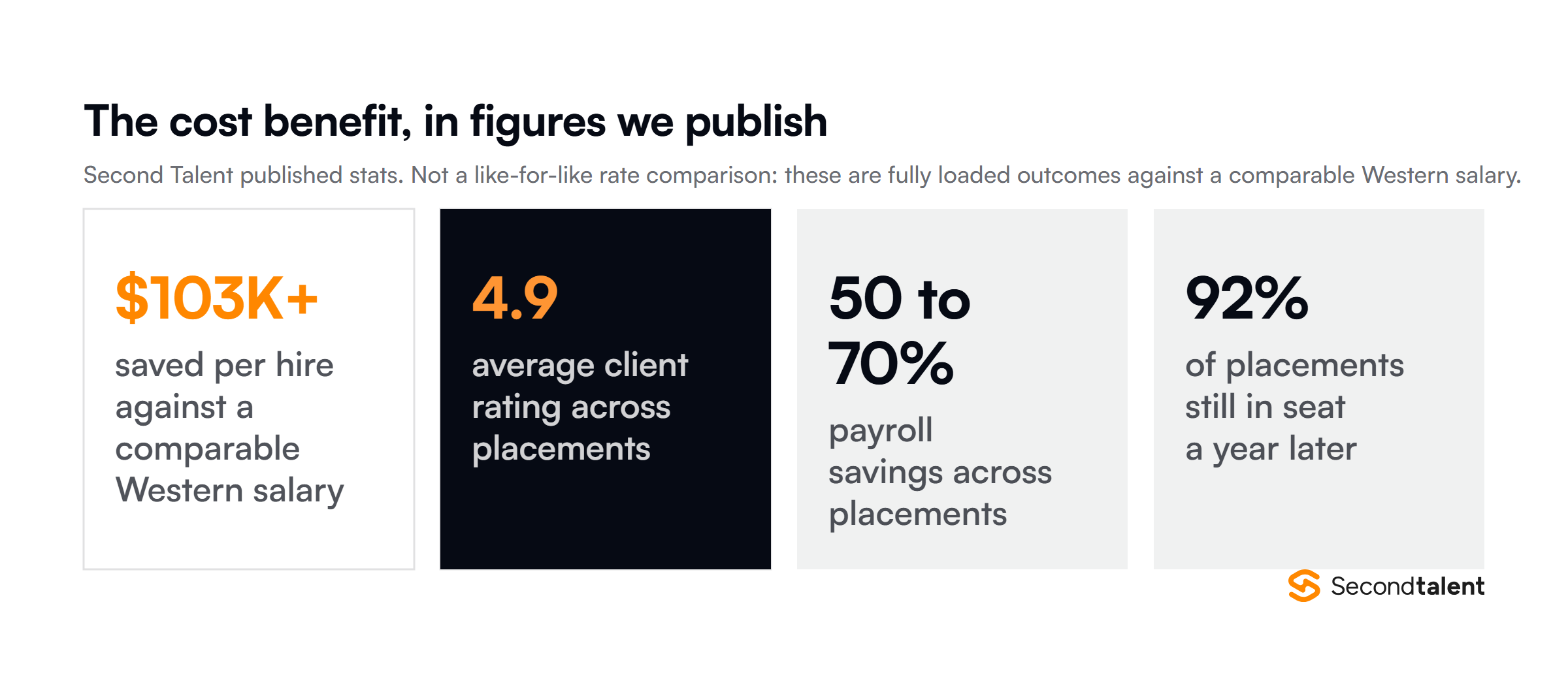
Second Talent clients save $103,000 or more per hire against a comparable Western salary, with payroll savings of 50 to 70 percent. The saving usually buys seniority rather than just cost: the same budget that reached mid-level candidates at home reaches senior ones through an offshore provider.
Set the comparison up on fair terms. The US Bureau of Labor Statistics puts the median wage for software developers at $135,980 in May 2025, but that is salary before employer taxes and benefits, while a provider rate is already fully loaded. Compare fully loaded against fully loaded or the gap will look larger than it is.
Our guide to measuring IT staffing ROI covers how to hold the number up after twelve months, and the developer rate cards carry the published rates by role and market.
3. Access to specialty skills
You buy from a global pool instead of your own city, which matters most in the specialties where local supply is thinnest.
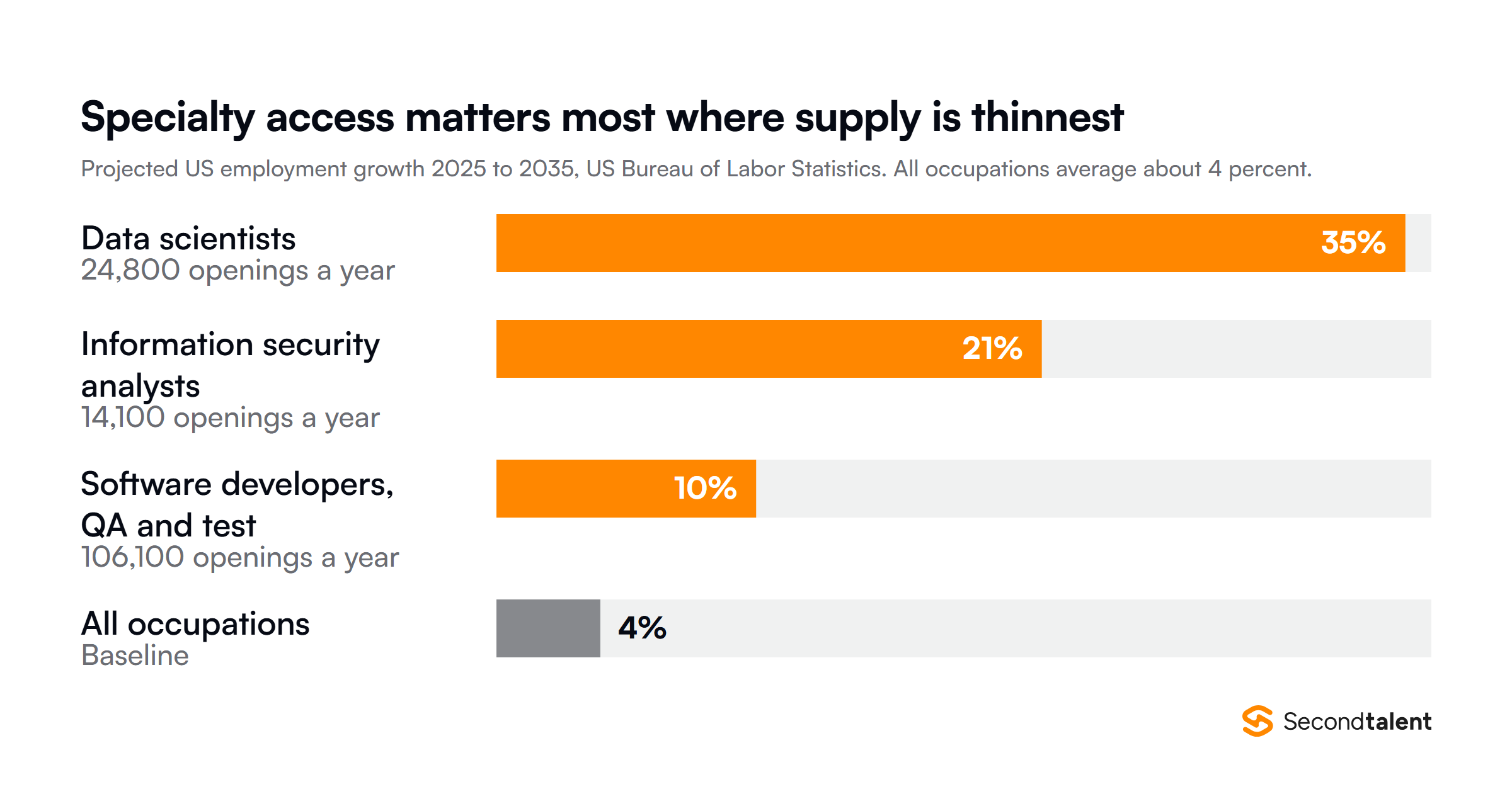
BLS projects data scientist employment to grow 35 percent between 2025 and 2035 with about 24,800 openings a year, and information security analysts 21 percent with 14,100 openings a year, against about 4 percent across all occupations. Those are the roles a local search stalls on.
AI fluency is now a layer on top of the specialty rather than a specialty of its own. The 2025 Stack Overflow Developer Survey found 84 percent of developers use or plan to use AI tools, so exposure no longer separates candidates. The same survey found 46 percent distrust the accuracy of what those tools produce. Brief for the judgment, not the tool list.
4. Capacity without permanence
Engagement length matches the work rather than the employment relationship. You stop paying when the work ends, with no severance and no idle seat.
This is the benefit that turns on your own forecasting. A quarterly push, a six-month migration or a pre-product-market-fit function all have a shape you can name. A permanent function dressed up as a project does not, and augmenting it converts a salary into a higher rate for the same permanence.
5. A real trial before you commit
You work with someone for months before deciding anything permanent. If the fit is wrong the engagement ends under the replacement terms rather than through a performance process.
Agree the conversion fee and the trigger before the engagement starts. Negotiating it once you have decided you want to keep someone puts you on the wrong side of the table, and the provider knows it.
Second Talent keeps 92 percent of placements in seat a year later, which is the number worth asking any provider for. A provider who cannot quote a retention figure is telling you something.
6. Less recruiting overhead on your managers
The provider absorbs sourcing, screening and reference checks. Your engineering managers interview a shortlist instead of running a funnel.
Keep your own technical screen regardless of what the provider’s vetting claims. It is the one step worth the manager’s time, and skipping it hands quality risk to a party who does not carry your delivery date. Our walkthrough of how IT staffing vetting funnels work covers what should already have happened before a candidate reaches you.
7. Compliance carried by the provider
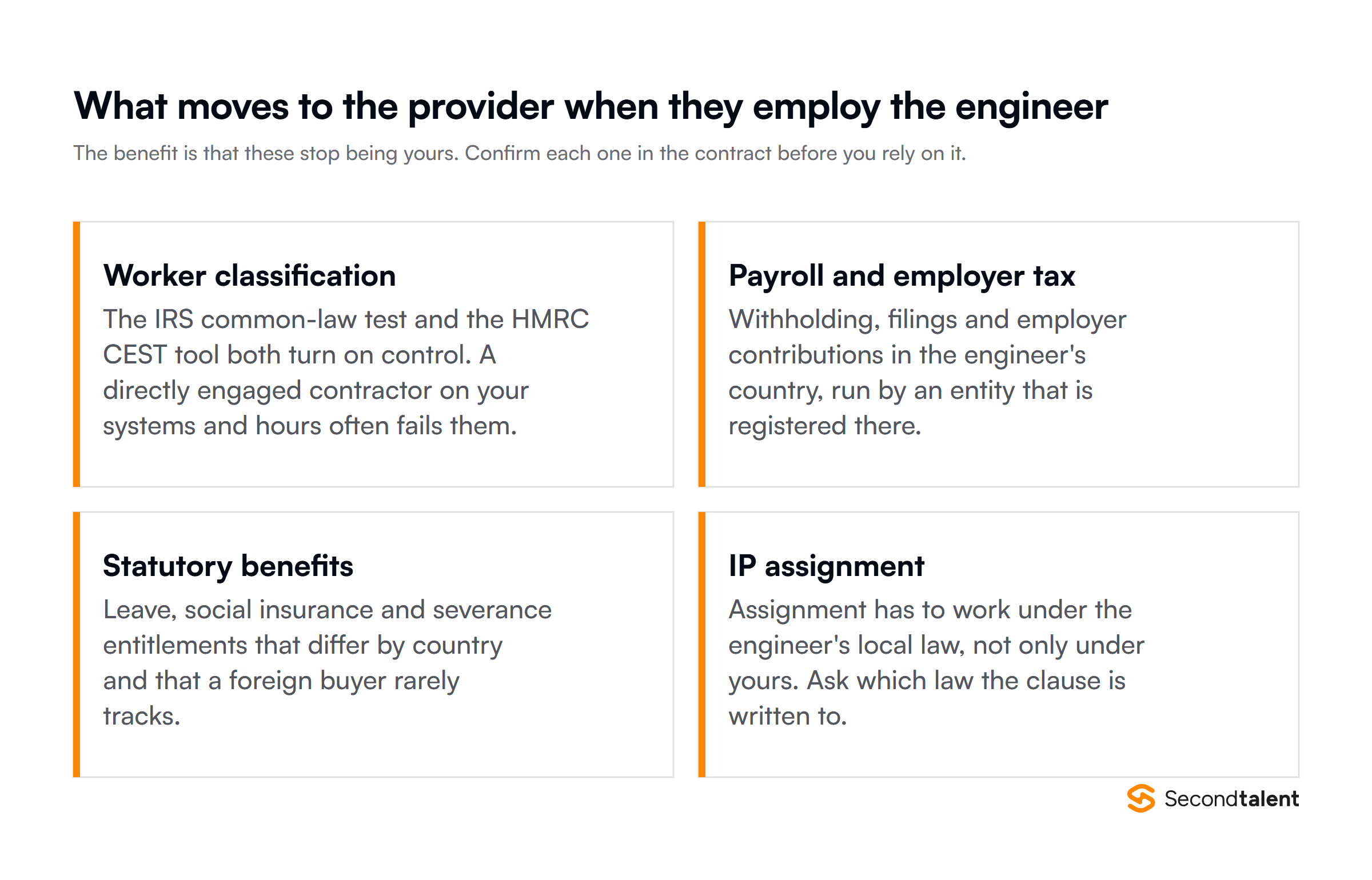
The provider’s legal entity employs the engineer, so worker classification, payroll, employer tax, statutory benefits and IP assignment sit with them rather than with you.
This is the benefit with the most substance behind it, because the alternative carries real exposure. The IRS common-law test and the HMRC Check Employment Status for Tax tool both turn on control, and a contractor you engage yourself, who works your hours on your systems under your direction, often fails them.
Verify it rather than assuming it. Ask which legal entity employs the engineer, in which country, and whether the provider subcontracts any part of the service. Undisclosed subcontracting is the gap that surfaces during an audit. Our guide to worker classification in cross-border IT staffing covers the detail.
Compliance offload is a contract term, not a property of the model. Staff augmentation only moves this risk if the provider actually employs the engineer through a registered local entity. A provider who is themselves engaging freelancers has moved the risk one step away from you, not off you.
8. Scope that flexes in both directions
Team size moves up and down on contractual notice rather than through a hiring round or a redundancy process.
Read the notice terms before you rely on this. Flexing up is easy, because it earns the provider money. Flexing down is the direction the contract has to govern, and a 90-day notice period on a three-month engagement removes the benefit.
How to test a provider against these eight benefits
Each benefit rests on something the provider either does or does not do. Eight questions turn the list into due diligence you can run in one call.
- Speed. How many vetted engineers are on the bench for this role today, and when did you last place one?
- Cost. Is the rate fully loaded, and what sits outside it?
- Specialty. Show me two engineers you placed in this specialty in the last six months.
- Flexibility. What is the notice period, and does it differ for scaling down?
- Trial. What are the replacement terms, and what does conversion cost?
- Overhead. What screening have you already done before a profile reaches me?
- Compliance. Which legal entity employs the engineer, in which country, and do you subcontract any part of this?
- Retention. What share of your placements are still in seat after twelve months?
The last two carry the most weight. A provider who answers the entity question with a sentence has an entity. A provider who cannot quote a retention figure has not measured one, and both answers tell you how the other six will go.
Our guide to evaluating IT staffing companies expands this into a full scoring framework, and the 15 questions to ask before you sign covers the contractual detail.
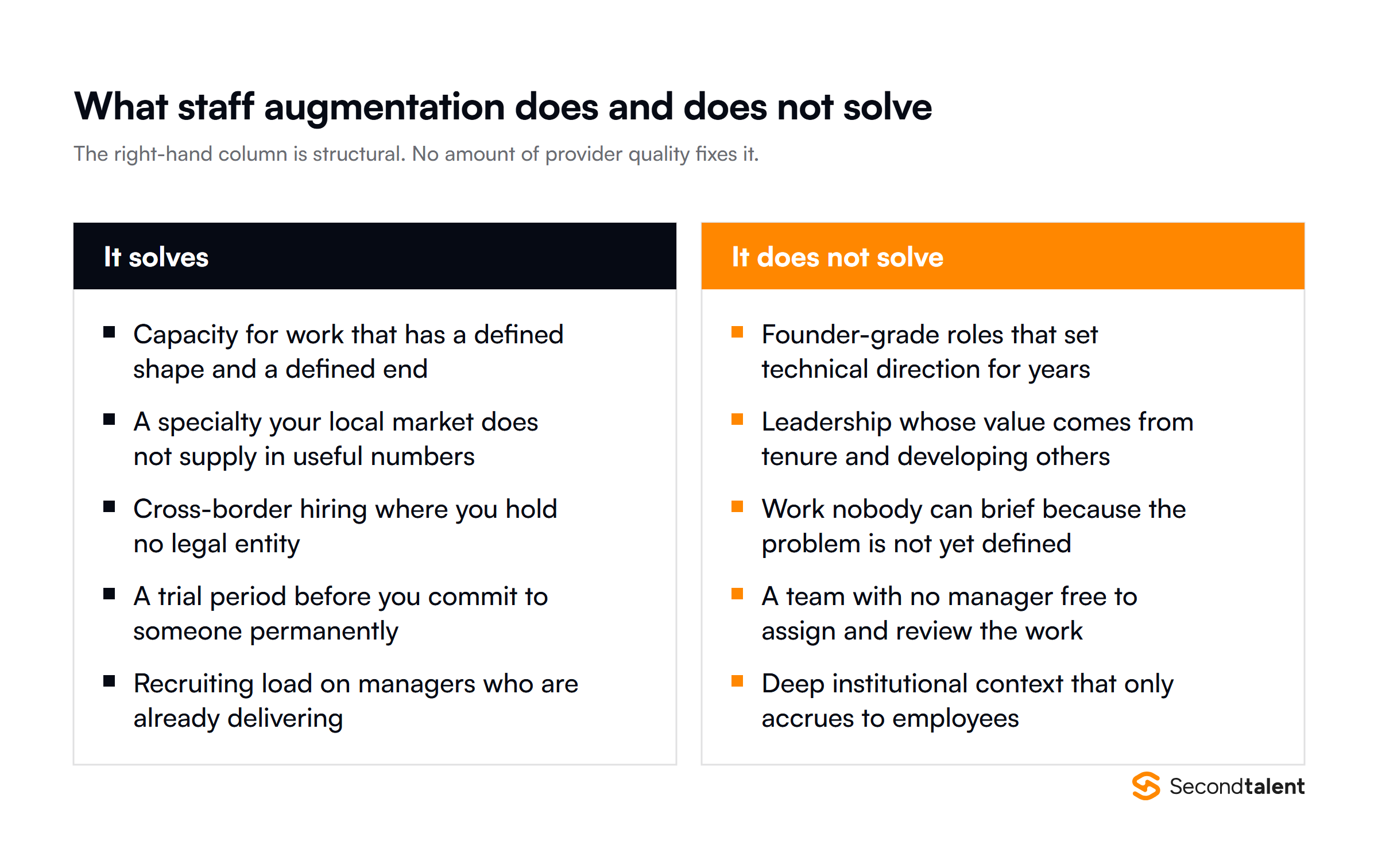
What staff augmentation does not solve
Two limits are structural, and no provider quality fixes them.
Founder-grade roles. A CTO, a VP of engineering, a founding engineer or a principal architect sets technical direction over years and usually carries equity. That is not augmentation territory.
Leadership whose value comes from tenure. Engineering managers and staff engineers who develop other people build value by staying. Augmentation is a poor fit for a multi-year investment in a person.
Neither gap is a reason to avoid the model. It is a reason to name which seats it fills, because a plan that leans on augmentation for a founding architect misses on quality and then blames the provider.
A third limit is about you rather than the model. Augmentation assumes someone on your side assigns and reviews the work. Without that manager, buy a managed service instead and accept the reduced visibility. Our comparison of staff augmentation and managed services covers where that line sits.
Staff augmentation FAQs
When do the benefits actually show up?
Speed, reduced recruiting load and compliance offload apply from week one, because the contract structure carries them. Cost efficiency and delivery gains wait for the ramp to finish, which takes about three weeks on an ordinary product and longer in a regulated domain.
Is staff augmentation cheaper than hiring in-house?
Per year of engagement, in most cases yes. Over a permanent multi-year seat, often not, because the rate carries provider margin that a salary does not. Match the model to how long you need the seat.
Can augmented engineers convert to employees?
Yes, under a contract-to-hire or EOR-managed conversion agreed up front. Get the fee and the trigger into the original contract.
What is the biggest risk?
Having no one free to direct the work. The model assumes a manager who assigns, reviews and unblocks. Engagements fail on that more often than on candidate quality.
Takeaways
- Each benefit comes from a mechanism you can test before signing. Ask about the bench, the entity and the notice terms.
- Compare fully loaded cost against fully loaded cost, not a provider rate against a salary.
- Specialty access matters most in data and security, where BLS projects 35 and 21 percent growth to 2035.
- Compliance offload only holds if the provider employs the engineer through a registered local entity.
- Augmentation does not fill founder-grade or tenure-based leadership seats. Hire those.
Put the model to work
Second Talent places pre-vetted senior engineers across Asia with EOR cover, matched within 24 hours, at 92 percent retention and $0 upfront.
Tell us which seat you need to fill, or start with what IT staffing is if you are still choosing between the engagement models.