TL;DR: Onshore, nearshore and offshore describe where the engineers sit. What you are choosing is time-zone overlap, cost and compliance load. Onshore costs most and has no friction. Nearshore keeps most of the working day shared. Offshore gives the largest cost advantage and needs async working plus an employment structure such as an EOR. Overlap decides this more often than cost, and it is the constraint you cannot renegotiate later.
Once you have picked an engagement model, the next question is geography. This guide follows on from what IT staffing is and covers what each option costs you in coordination as well as in money.
What do onshore, nearshore and offshore mean?
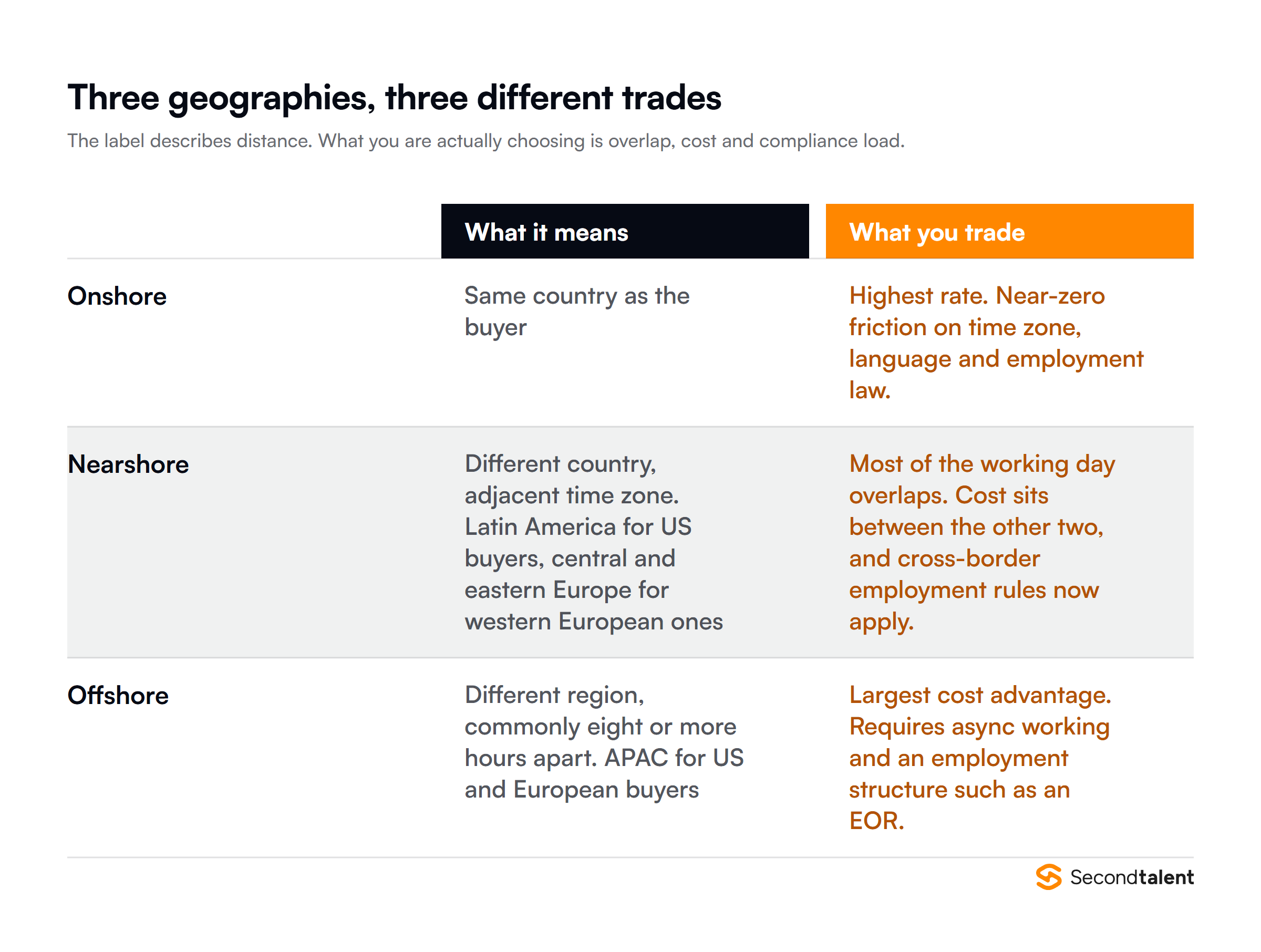
Onshore means the engineers are in your own country. Nearshore means a different country in an adjacent time zone. Offshore means a different region, commonly eight or more hours away.
For a US buyer, nearshore usually means Latin America and offshore usually means Asia. For a western European buyer, nearshore means central and eastern Europe, and the same Asian markets become a much easier offshore proposition because the gap is smaller.
The labels describe distance. The decision is about overlap, and those two are not the same thing, which is why a London buyer and a New York buyer reach different conclusions about identical Vietnamese engineers.
How much overlap do you actually get?
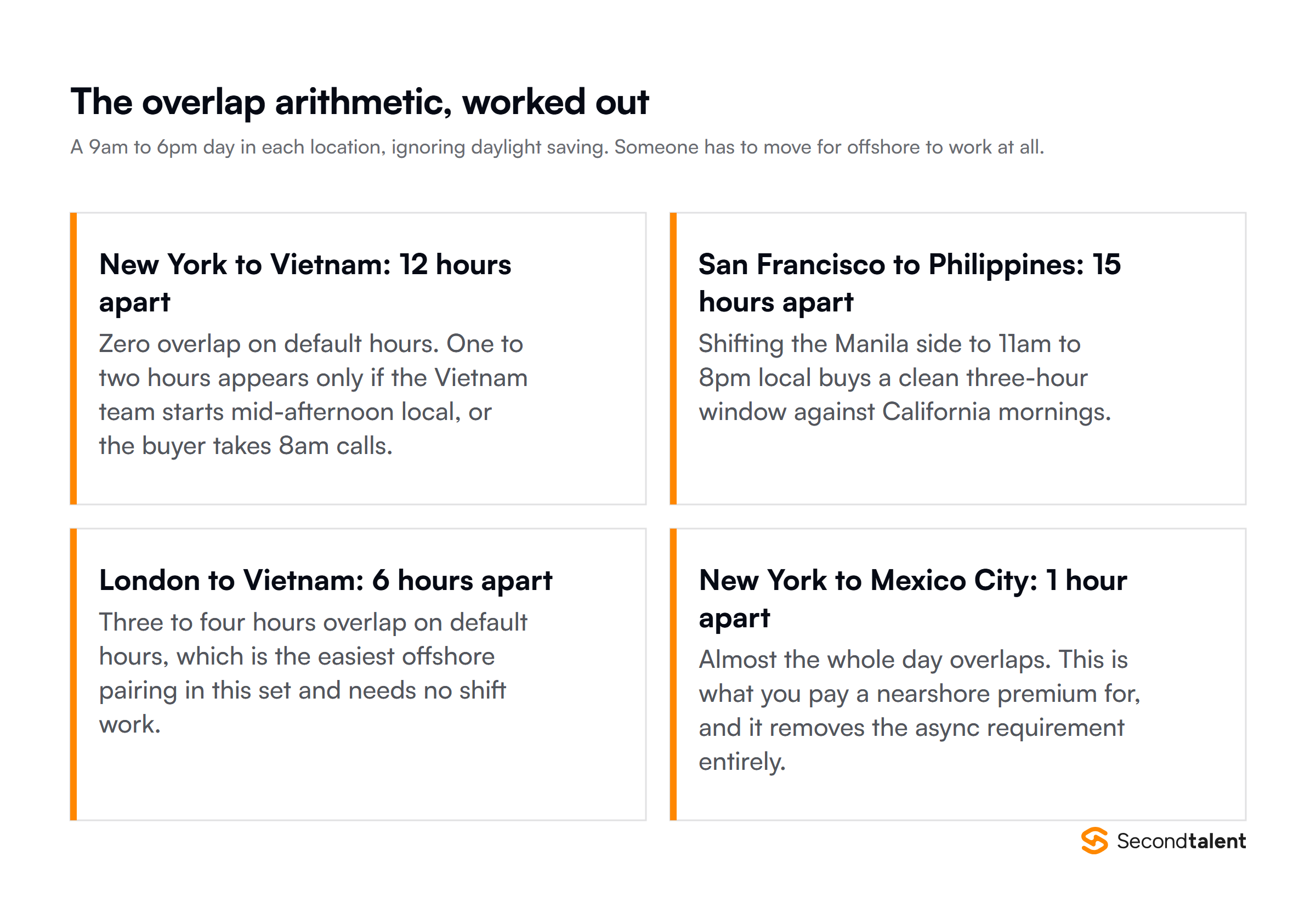
Work it out rather than assuming it. On a 9am to 6pm day in each location, ignoring daylight saving, the arithmetic is unforgiving.
New York to Vietnam is 12 hours apart, which gives zero overlap on default hours. One to two hours appears only if the Vietnam team starts mid-afternoon locally or your leadership takes 8am calls.
San Francisco to the Philippines is 15 hours apart. Shifting the Manila side to 11am to 8pm local buys a clean three-hour window against California mornings.
London to Vietnam is 6 hours apart and gives three to four hours of overlap with nobody changing their hours. This is the easiest offshore pairing of the three.
New York to Mexico City is one hour apart, so almost the whole day overlaps. That is what the nearshore premium buys.
Decide who moves before you sign. Offshore engagements with a real overlap requirement need one side to shift hours, and it is worth agreeing which side in the contract rather than discovering it in week two. A team that assumed the provider would absorb it, working against a provider who assumed the same of the client, ends up with two hours of overlap nobody attends.
The async question underneath the overlap question
Overlap only matters in proportion to how much your team needs to co-work in real time.
If decisions get made in meetings, reviews happen over a call, and context lives in people’s heads, then a two-hour window will not carry the load and offshore will feel slow regardless of engineer quality. If you already write things down, review asynchronously and keep decisions in issues rather than in conversations, the same two hours are plenty.
That makes async maturity a prerequisite rather than a nice-to-have. Teams that adopt offshore and async at the same time usually blame the geography for the difficulty. Our guide to managing IT staffing augmentation teams covers building the practice.
What does the cost difference look like?
The cost spread is the largest single financial lever in this decision, and it is what funds seniority you could not otherwise reach.
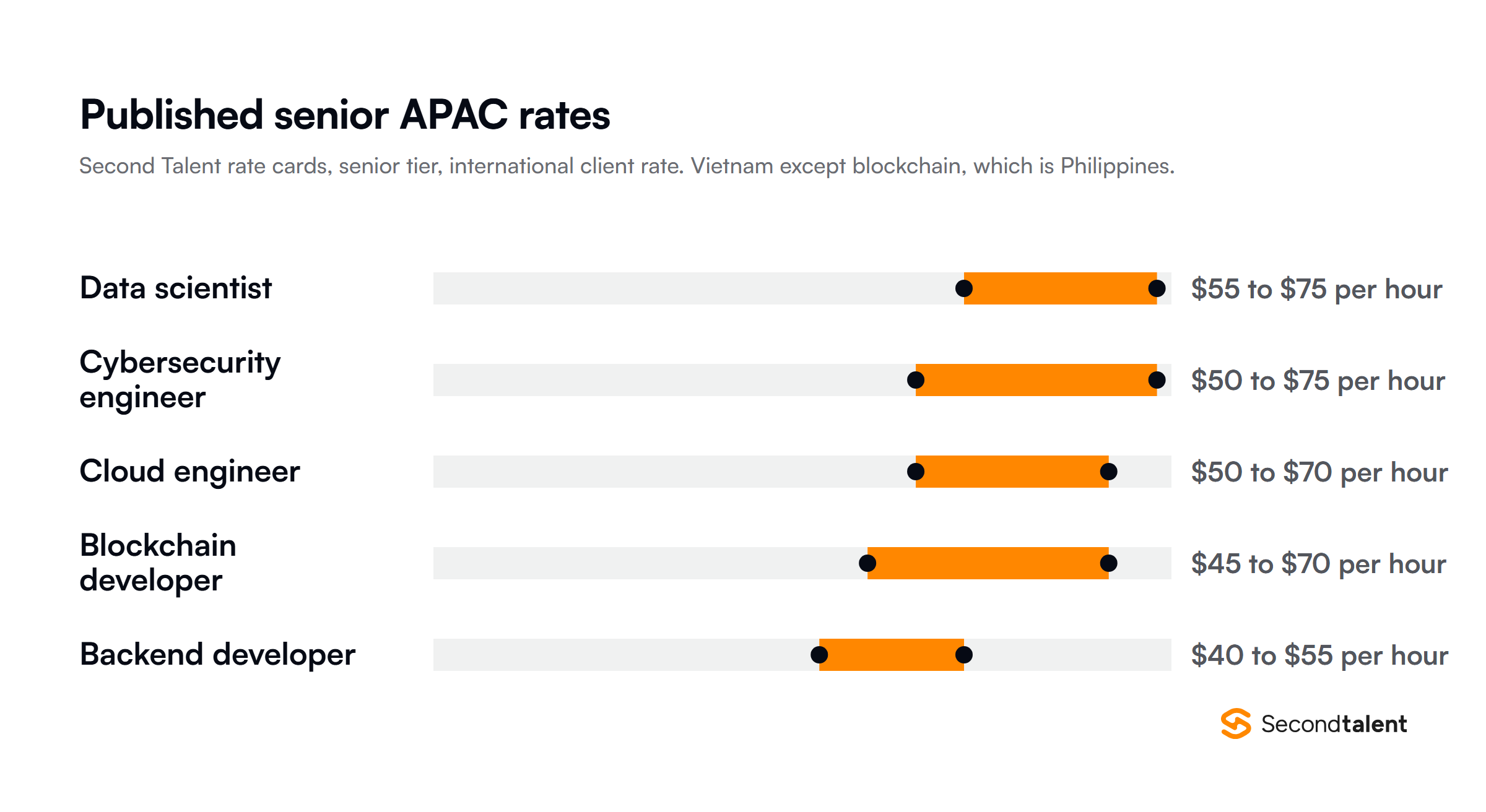
Second Talent publishes senior international client rates by role and market in the developer rate cards. In Vietnam, senior backend developers run $40 to $55 per hour, cloud engineers $50 to $70, cybersecurity engineers $50 to $75 and data scientists $55 to $75. Senior blockchain developers in the Philippines run $45 to $70.
Set the comparison against a fully loaded local figure. The US Bureau of Labor Statistics puts the median wage for software developers at $135,980 in May 2025, salary only, before employer taxes and benefits. A provider rate already includes those, so compare fully loaded against fully loaded. Across placements, clients save $103,000 or more per hire.
Language and communication
Written English carries more weight than spoken English in a distributed team, and the gap between markets is measurable.
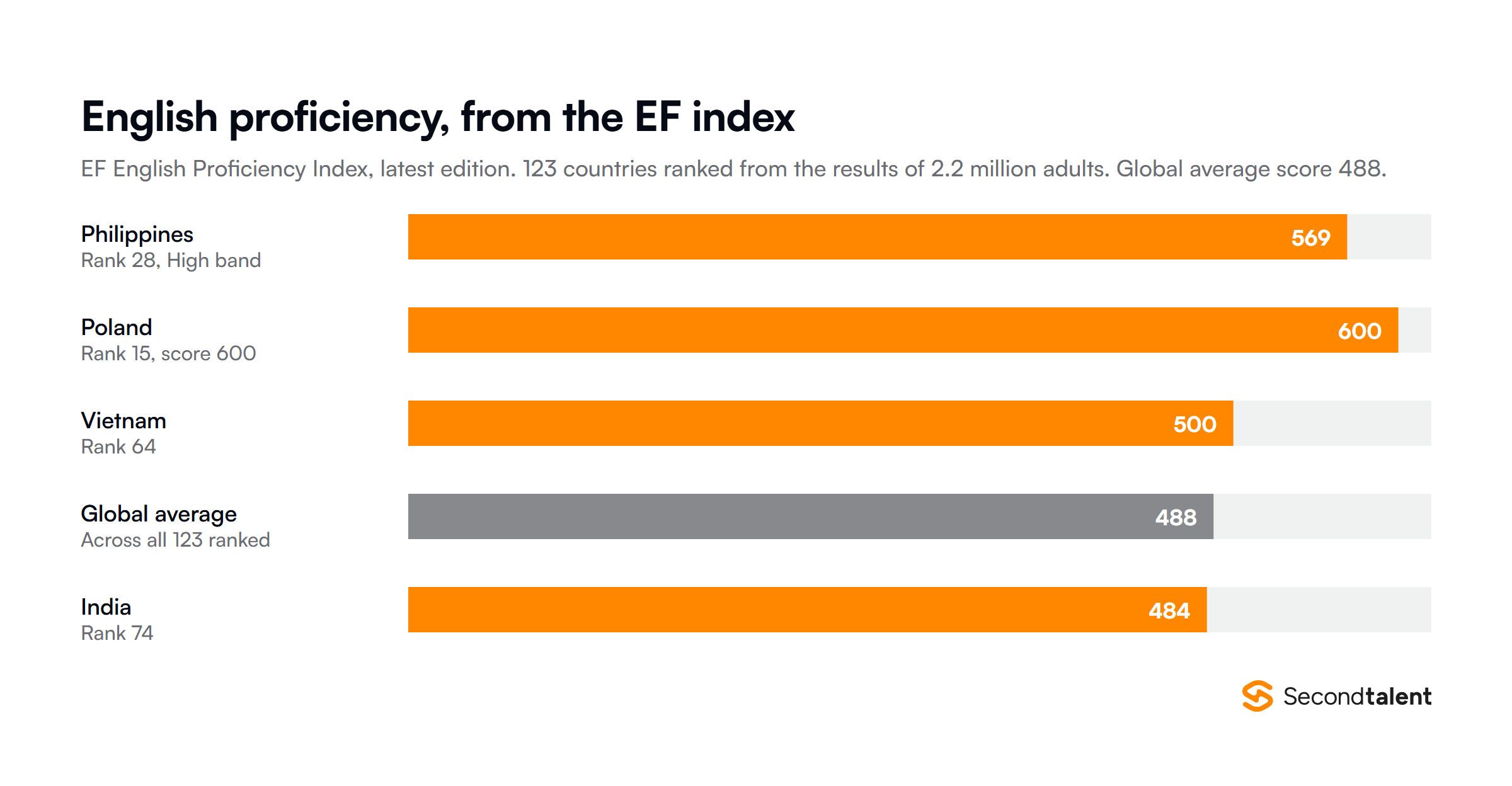
The EF English Proficiency Index ranks 123 countries from the test results of 2.2 million adults, with a global average score of 488. The Philippines sits at rank 28 with a score of 569, in the High band. Poland is rank 15 at 600. Vietnam is rank 64 at 500, above the global average. India is rank 74 at 484.
Read those as market averages rather than as a prediction about any individual. A vetted senior engineer from a mid-ranked market often writes better English than an unvetted one from a high-ranked market, which is exactly what a screening process is for.
What the index does tell you is where a role that depends on real-time spoken English, such as customer-facing engineering or live incident work, is easier to staff.
Where each market runs deep
Cost is the surface signal. What separates a workable engagement from a stalled one is whether the specialty you need has depth in the market you picked.
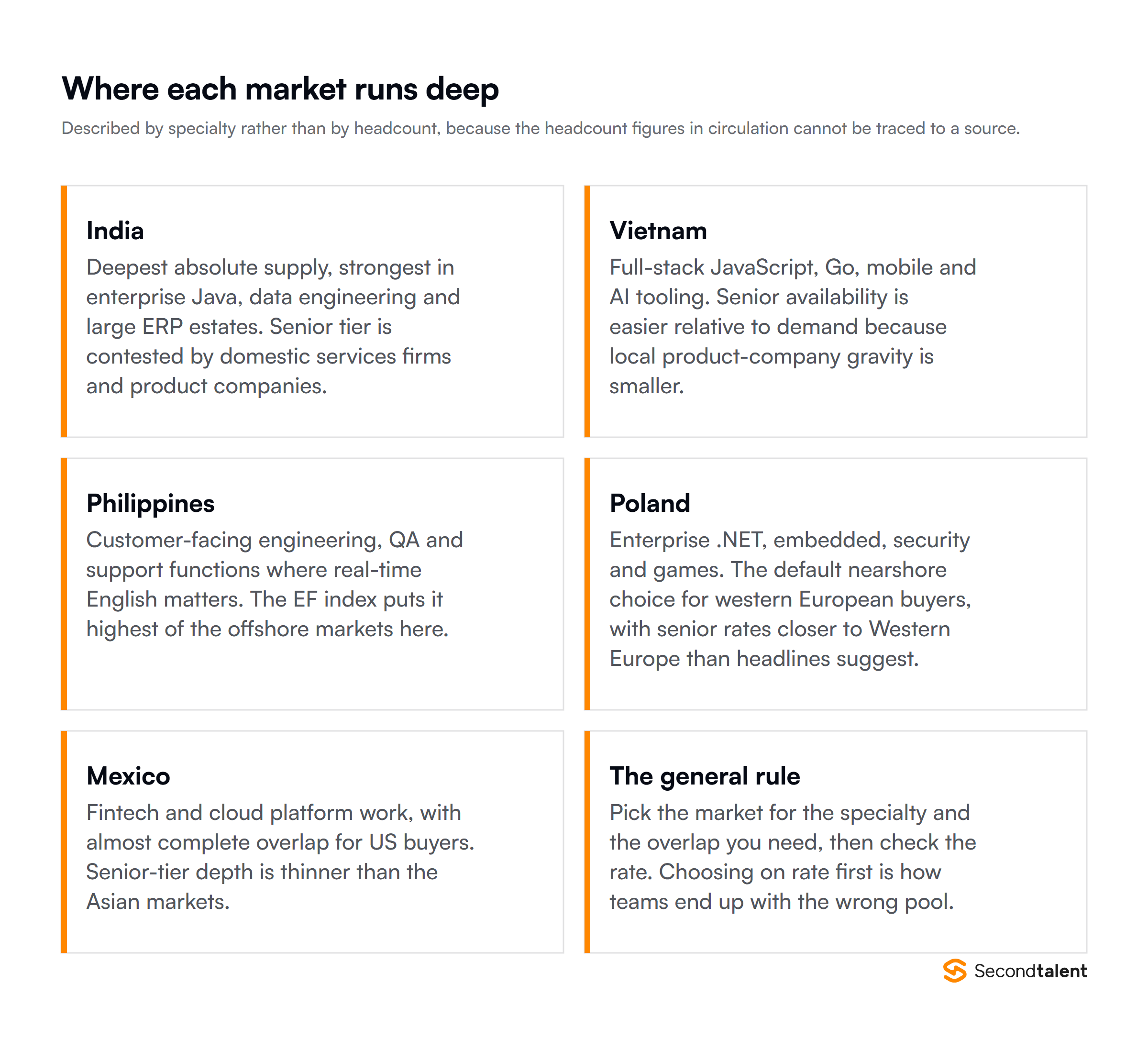
India holds the deepest absolute supply, strongest in enterprise Java, data engineering and large ERP estates. The senior tier is contested by domestic services firms and product companies, which compresses availability for outside buyers.
Vietnam concentrates around full-stack JavaScript, Go, mobile and AI tooling, with senior availability easier relative to demand because local product-company gravity is smaller.
The Philippines is strongest in customer-facing engineering, QA and support functions where real-time English matters.
Poland runs deep in enterprise .NET, embedded, security and games, and is the default nearshore choice for western European buyers. Senior rates there have converged toward Western Europe more than rate-card narratives suggest.
Mexico covers fintech and cloud platform work with near-total overlap for US buyers, though senior-tier depth is thinner than the Asian markets.
Pick the market for the specialty and the overlap, then check the rate. Choosing on rate first is how teams end up fishing in the wrong pool.
Compliance load by geography
Every step away from onshore adds employment complexity, and the question is who absorbs it.
Hiring someone directly in a country where you hold no entity puts classification, payroll and statutory benefits on you. The IRS common-law test and the HMRC CEST tool both turn on control, and a contractor working your hours under your direction often fails them.
An EOR arrangement moves that to a licensed local employer, which is why offshore and EOR usually arrive together. Our guide to worker classification in cross-border IT staffing covers where the structure breaks.
How to choose
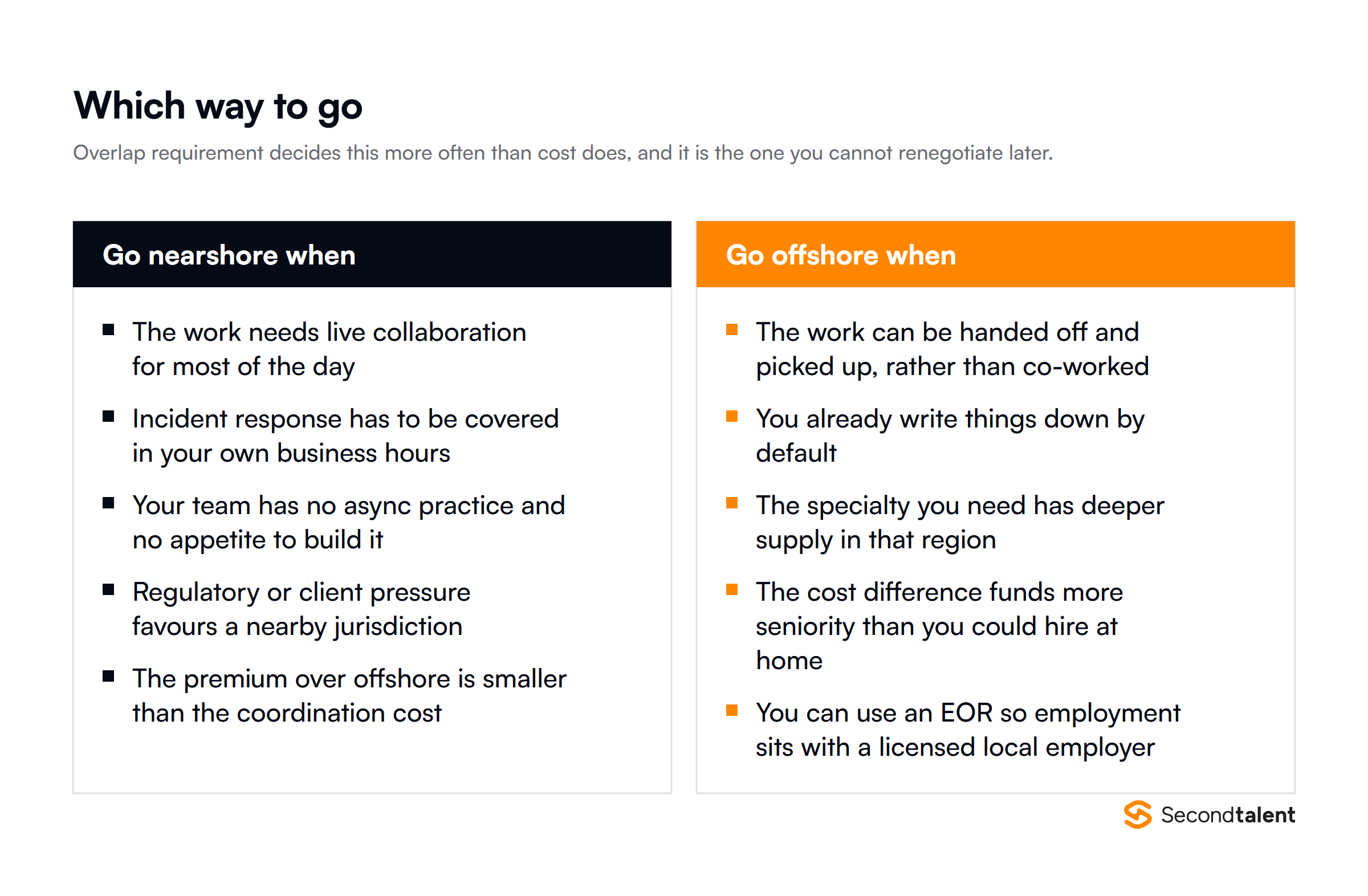
Start with the overlap requirement, because it is the constraint you cannot change later.
Go nearshore when the work needs live collaboration for most of the day, when incident response has to sit inside your business hours, or when your team has no async practice and no appetite to build one.
Go offshore when work can be handed off rather than co-worked, when you already write things down, when the specialty runs deeper in that region, and when the cost difference funds more seniority than you could hire at home.
Go onshore when the role needs to be physically present, when regulatory or client pressure requires it, or when the coordination cost of anything else would exceed the saving.
Where the demand pressure sits
Geography is a supply decision, so it helps to know which roles are hardest to fill anywhere.
The US Bureau of Labor Statistics projects data scientist employment to grow 35 percent between 2025 and 2035 with about 24,800 openings a year, and information security analysts 21 percent with 14,100 openings a year, against roughly 4 percent across all occupations.
Those are the seats where an onshore-only search stalls, and where widening the map buys you candidates rather than just a discount. For a role with deep local supply, the geography decision is mostly about cost and you can weight overlap more heavily.
Skill demand also moves faster than any market’s supply adjusts. The 2025 Stack Overflow Developer Survey found 84 percent of developers now use or plan to use AI tools, so that capability is no longer a geographic differentiator. Judgment about the output still is, and it is a vetting question rather than a location one.
What changes after the first six months
The geography decision looks different once an engagement is running, and two things tend to surprise buyers.
Overlap needs usually fall. Early on, a new engineer needs live time to absorb context. Once they have it, most teams find they can drop back to a shorter shared window, which means the overlap you need at month one is not the overlap you should design the contract around.
Coordination cost usually rises with team size rather than with distance. Two offshore engineers on a well-documented codebase are straightforward. Eight, across two markets, with no async practice, is hard regardless of where they sit.
Geographic model FAQs
Does a shorter overlap mean slower delivery?
Only where the work needs live coordination to move. Handoff-shaped work can run faster across a gap, because a question raised at the end of one day is answered before the next begins. Co-worked tasks stall, because each round trip costs a day. Split the backlog by which shape a task is before blaming the time zone.
Is offshore always cheaper than nearshore?
Usually on rate, not always on total cost. Add the coordination overhead, any shift premium for overlap hours, and the management time async working requires before deciding.
Can we mix models?
Yes, and larger teams commonly do: nearshore or onshore for roles needing live collaboration, offshore for work that can be handed off. Keep one register of who sits where and which contract covers them.
Does offshore mean lower quality?
No. It means a different vetting problem and a different working pattern. Quality tracks the provider’s funnel rather than the map, which is why how the vetting funnel works matters more than the country.
What is the minimum viable overlap?
It depends entirely on your async maturity. Teams that write things down operate on two hours. Teams that decide things in meetings struggle on four.
Takeaways
- You are buying overlap, not distance. Work out the actual window before you choose.
- Async maturity is a prerequisite for offshore, not a benefit of it.
- Pick the market for the specialty and overlap first, then check the rate.
- Language index scores are market averages, not a substitute for screening.
- Every step from onshore adds employment complexity. An EOR is who absorbs it.
Find the right market for the role
Second Talent places pre-vetted senior engineers across Vietnam, the Philippines, Indonesia and the wider region, with EOR cover and 24-hour matching.
Tell us which seat you need to fill, or compare markets directly in the developer rate cards.