TL;DR: Senior back-end developers from Asia start from $2,999 a month through Second Talent, matched in 24 hours. The closest US benchmark, the BLS median for software developers, was $135,980 a year in May 2025.
The top risk on the OWASP API Security Top 10 is broken object level authorization: an endpoint that confirms a user has signed in, then returns a record that belongs to someone else. Front-end code cannot fix that bug. The back-end developer you hire writes the ownership check, the database query behind it and the retry logic around payment calls.
Key takeaways
- Back-end developers already working for foreign companies earn from $1,200 a month at the Indonesian floor, and India's Node.js range reaches $7,530+, on our rate cards.
- A 2:00 am ET migration window falls at 1:00 pm in Ho Chi Minh City until 1 November 2026, inside a normal working day.
- Node.js 20 is already listed as end of life on the project's release page, so ask each candidate which runtime they last upgraded in production.
- Only 3.1% of developers in Stack Overflow's 2025 survey highly trust AI output, which makes code review part of the assessment.
What Back-End Developers Earn Working for International Clients in Asia
Indonesia has the lowest floor in the table, at $1,200 a month, and Vietnam's back-end range tops out at $6,500. The figures are what developers in each market earn working directly for foreign companies, before any employer or platform costs.
| Market |
Monthly pay working for international clients (USD) |
| Indonesia |
$1,200-$5,500 |
| Philippines |
$1,520-$4,630+ |
| Vietnam |
$1,800-$6,500 |
| India |
$1,880-$7,530+ |
| Malaysia |
$2,200-$6,500 |
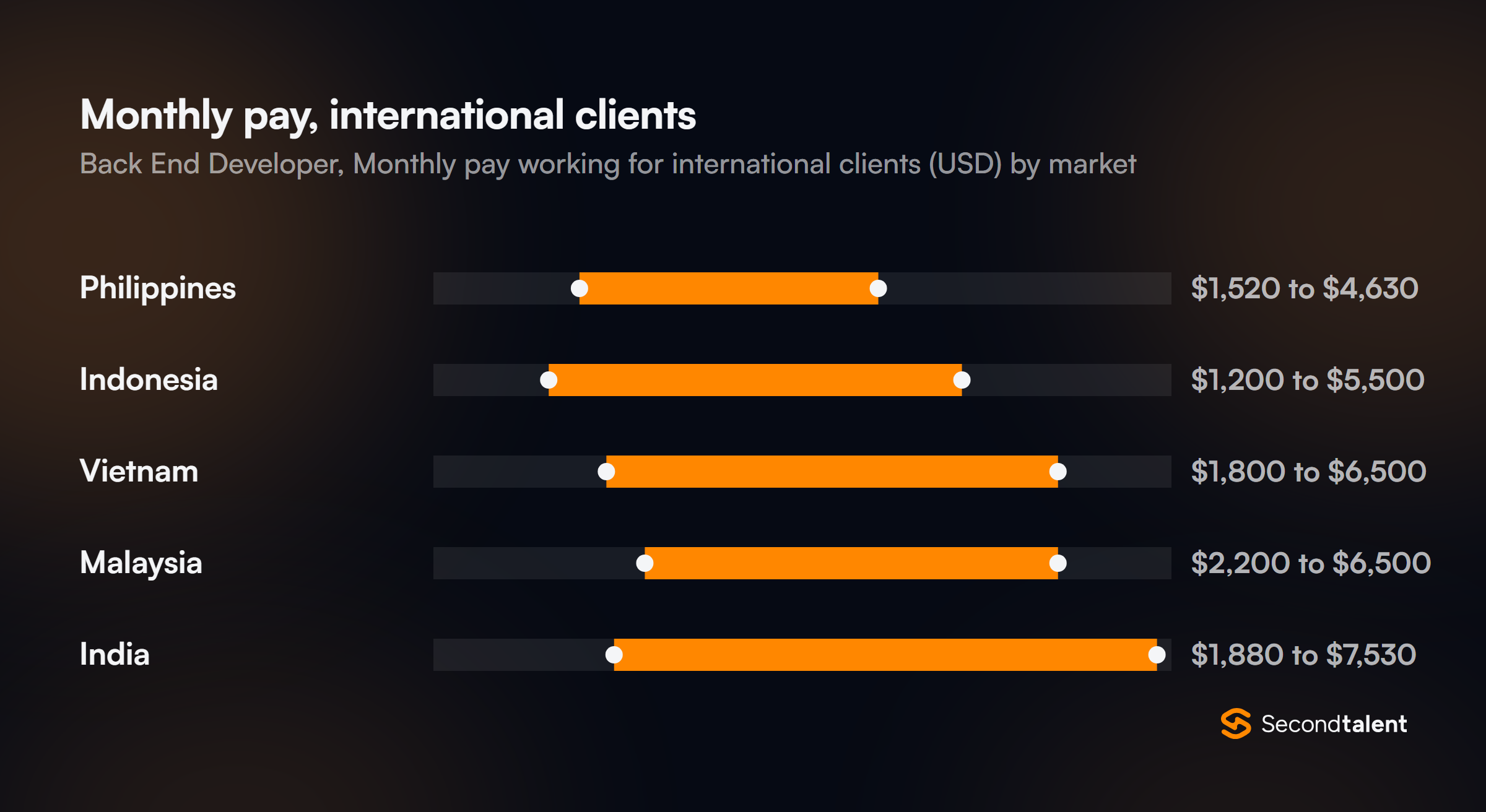
Monthly ranges from the Remote (Working for International Clients) figures on our rate cards for Indonesia, Philippines, Vietnam, India and Malaysia, converted at ExchangeRate-API mid-market rates for 14 September 2026. India and Malaysia have no back-end card, so those two rows use our Node.js developer rate card.
The Indonesian, Vietnamese and Malaysian cards quote US dollars. The Philippine and Indian ranges are converted from pesos and rupees, and both are open at the top.
Through Second Talent, a senior back-end developer starts from $2,999 a month: one monthly fee that bundles salary, payroll taxes, statutory contributions and our service fee. Our pricing page sets out the subscription, and our back-end cost-to-hire page prices the US freelance route.
US Pay Benchmark for Back-End Developers
The BLS definition of a software developer closes with a line that fits most back-end jobs: they "may maintain databases within an application area". BLS counted 1,687,890 software developers in May 2025.
Back-end developers map to Software Developers (SOC 15-1252), because the role builds application software and the data layer under it. Web Developers (15-1254) also lists server-side code among its duties, at a median of $92,650 a year.
| BLS OEWS, May 2025, national |
Software Developers (15-1252) |
| Median annual |
$135,980 |
| 10th percentile, monthly |
$6,870 |
| 25th percentile, monthly |
$8,770 |
| Median, monthly |
$11,330 |
| 75th percentile, monthly |
$14,330 |
| 90th percentile, monthly |
$17,890 |
Monthly figures are the annual wages on the OEWS profile for 15-1252 divided by 12, rounded to the nearest $10.
Salary is only part of the US cost. In the BLS Employer Costs for Employee Compensation release for June 2026, wages and salaries made up 68.5% of employer compensation costs for full-time private industry workers, and benefits the other 31.5%.
Time Zone Overlap with ET, CT and PT
A database migration scheduled for 2:00 am in New York runs at 06:00 UTC, which is 1:00 pm in Ho Chi Minh City and 2:00 pm in Manila while US daylight time lasts. None of the Asian cities below change their clocks, and US daylight time runs from 8 March to 1 November 2026, per NIST.
| Engineer's city |
UTC offset |
9:00 am ET (EDT) |
9:00 am CT (CDT) |
9:00 am PT (PDT) |
| Manila, Singapore, Kuala Lumpur, Taipei |
UTC+8 |
9:00 pm |
10:00 pm |
12:00 midnight |
| Ho Chi Minh City, Jakarta, Bangkok |
UTC+7 |
8:00 pm |
9:00 pm |
11:00 pm |
| Bengaluru |
UTC+5:30 |
6:30 pm |
7:30 pm |
9:30 pm |
After 1 November 2026, every time in the table moves one hour later.
The second row: 9:00 am CDT is 14:00 UTC, and 14:00 plus seven hours is 21:00 in Ho Chi Minh City. Two shifts that produce overlap, computed for September:
- Manila, 6:00 pm to 3:00 am (10:00 to 19:00 UTC) covers 6:00 am to 3:00 pm in New York: six hours inside a 9-to-5 ET day, five with Chicago and three with San Francisco.
- Ho Chi Minh City, 3:00 pm to midnight (08:00 to 17:00 UTC) covers 4:00 am to 1:00 pm in New York: four hours with ET, three with CT and one with PT.
Split the day by risk. Schema changes, backfills and dependency upgrades run in the Asian afternoon, while your US users are asleep. API design reviews and incident follow-ups go in the live hours. We set that schedule before the offer, which is how our placements get 4-6 hours of daily overlap with US hours.
Late hours cost more for employees. The Philippine Labor Code sets a night shift differential of at least 10% for each hour between 10 pm and 6 am (Article 86), so five hours of the Manila shift qualify. Vietnam's Labor Code counts 22:00 to 06:00 as night work and adds at least 30% (Articles 98 and 106), which covers the last two hours of the Ho Chi Minh City shift.
Back-End Developer Skills to Screen For
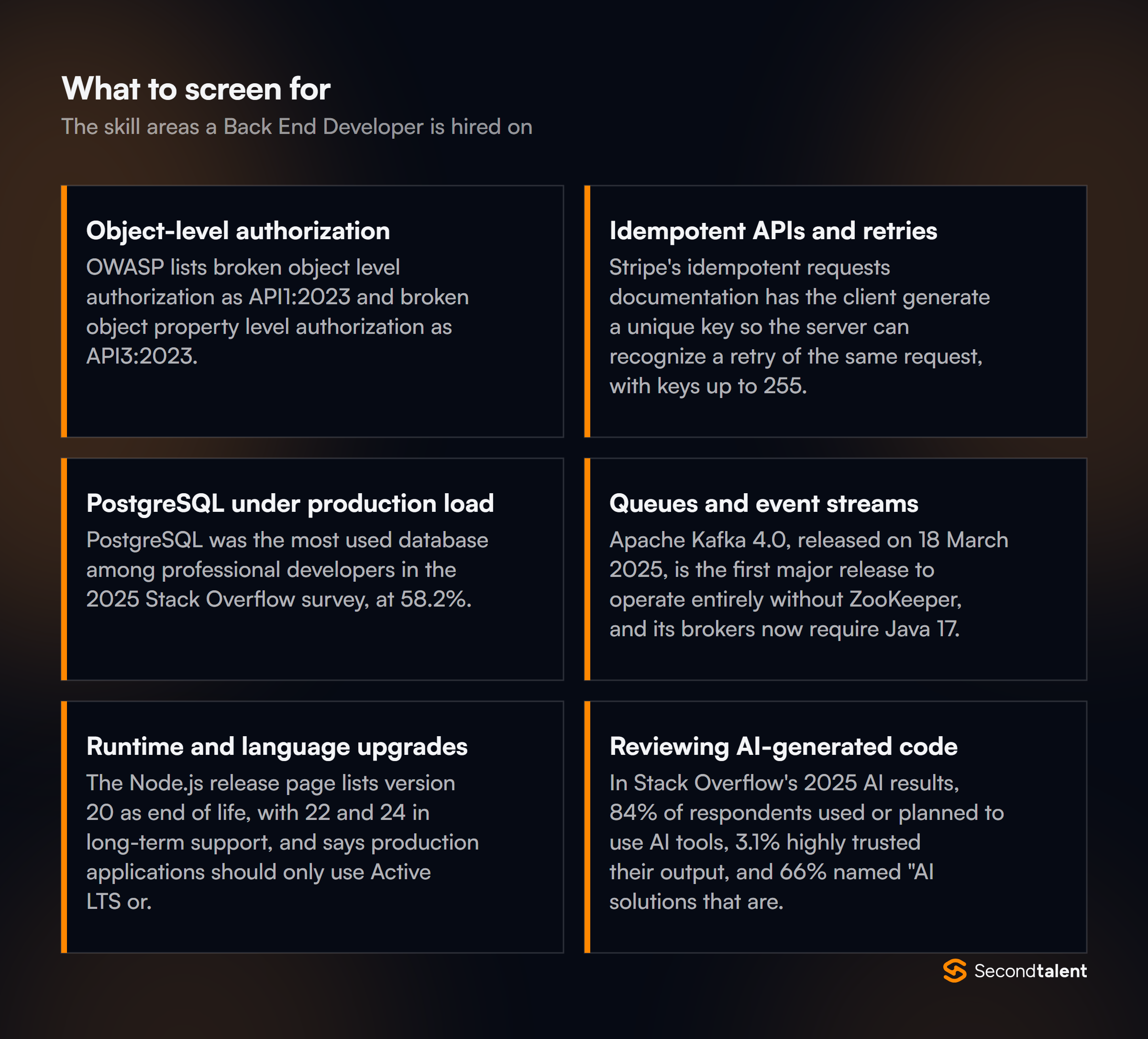
Screen for the failures that reach customers: leaked records, double charges, slow queries and unpatched runtimes. Each area comes with an exercise.
Object-level authorization
OWASP lists broken object level authorization as API1:2023 and broken object property level authorization as API3:2023. Both are ownership checks a framework will not write for you. Give the candidate an endpoint such as GET /invoices/{id} that verifies the session but not the owner, and ask for the fix and the test that proves it.
Idempotent APIs and retries
Stripe's idempotent requests documentation has the client generate a unique key so the server can recognize a retry of the same request, with keys up to 255 characters and V4 UUIDs suggested. A senior back-end developer applies the same pattern to your own webhooks and order endpoints. Ask what happens when the client times out after the charge succeeds.
PostgreSQL under production load
PostgreSQL was the most used database among professional developers in the 2025 Stack Overflow survey, at 58.2%. PostgreSQL 18, released on 25 September 2025, added an asynchronous I/O subsystem, with benchmark gains of up to 3x in certain scenarios. Hand the candidate a slow query plan on a table with live data and ask for the index, the migration and the rollback.
Queues and event streams
Apache Kafka 4.0, released on 18 March 2025, is the first major release to operate entirely without ZooKeeper, and its brokers now require Java 17. Redis was used by 30.7% of professional developers in the same survey. Ask how the candidate would stop a broker's duplicate delivery from shipping the same order twice.
Runtime and language upgrades
The Node.js release page lists version 20 as end of life, with 22 and 24 in long-term support, and says production applications should only use Active LTS or Maintenance LTS releases. Among professional developers, 54.8% used Python, 29.6% Java and 17.4% Go in 2025. Whatever the language, ask for the last major runtime upgrade the candidate shipped and what broke. Our Node.js developer page covers that specialism.
Reviewing AI-generated code
In Stack Overflow's 2025 AI results, 84% of respondents used or planned to use AI tools, 3.1% highly trusted their output, and 66% named "AI solutions that are almost right, but not quite" as a frustration. Almost-right back-end code passes the happy-path test and misses the ownership check. Give the candidate an AI-written endpoint with that flaw and score what they catch.
Senior back-end engineers: design reviews and on-call
A senior back-end engineer is judged by the systems that stay up after they leave the room. Two habits separate them from a mid-level developer: they write the design before the code, and they can run the service at 3 am. Ask for a one-page design for a webhook intake that must absorb a tenfold traffic spike without losing events: where requests queue, what is retried, which limits protect the database and how the team knows it is falling behind.
Then go through an incident from the candidate's last role. Ask for the timeline, the first alert, what they rolled back, and the change that stopped it happening again. Strong candidates name the service-level objective they were held to and the dashboard they opened first. If the hire will join your on-call rotation, test handoffs too: ask for the runbook entry they would write for the failure they just described.
Contractor or Employer of Record for a US Company
Software is not one of the nine categories of commissioned work that can be "work made for hire" under 17 U.S.C. § 101. Services, schemas and migration scripts a contractor writes stay theirs until they transfer them, and a transfer must be in writing and signed under § 204(a).
Tax follows where the work happens. IRS Publication 515 says the place where services are performed determines the source of the income, so a developer working from Ho Chi Minh City earns foreign-source income. The developer gives you Form W-8BEN to certify foreign status.
The developer's own country applies its own employment test:
- Vietnam: under Article 13 of the 2019 Labor Code, an agreement under another name that covers a paid job, wages and one party's management and supervision counts as a labor contract.
- Philippines: courts apply the four-fold test (selection, wages, dismissal, control), and in Atok Big Wedge v. Gison the Supreme Court called control the most important of the four.
A developer who takes your sprint tickets and joins your on-call rotation fits both descriptions.
|
Independent contractor |
Employer of Record |
| Legal employer |
None; the developer invoices you |
The EOR's local entity |
| US paperwork |
Form W-8BEN from the developer |
Service agreement with the EOR |
| IP |
Written assignment signed by the developer |
Assignment in the employment contract and your EOR agreement |
| Local labor law |
Classification risk if the work looks like employment |
Night premiums, public holidays and leave apply |
| Pay currency |
Agreed in the contract, often USD |
Local currency; Vietnam's Labor Code states wages in dong (Article 95) |
A fixed integration project suits a contractor agreement. A developer with standing access to your production database is the case an Employer of Record covers, and our Vietnam EOR page lists the employer contributions to budget for. This is a summary, not legal advice.
English Level and Working Norms
Philippine test takers score 603 in writing and 539 in speaking on the EF English Proficiency Index 2025. That gap favours back-end work, where most communication happens in writing: API contracts, pull request descriptions and incident notes. The index covers 123 countries and regions, with a global average of 488.
| Country |
EF EPI 2025 score |
World rank (of 123) |
IT job-function score |
| Malaysia |
581 |
24 |
590 |
| Philippines |
569 |
28 |
581 |
| Vietnam |
500 |
64 |
500 |
| India |
484 |
74 |
487 |
| Indonesia |
471 |
80 |
523 |
Scores come from EF's country pages, such as the Philippines and Vietnam. In Vietnam the IT job-function score matches the national 500, so test written English there during the assessment.
Ask for an OpenAPI description or a README for the assessment endpoint. It shows how the developer will explain a breaking change to your front-end and mobile teams.
Plan releases around both calendars. Thanksgiving on 26 November 2026 is a normal working day across Asia, so a developer there can watch error rates and queue depth while your US team is off.
Article 112 of Vietnam's Labor Code gives five paid days for Lunar New Year, in late January or February, so avoid schema changes that week with a Vietnam-based developer and name a US engineer on call.
Back-End Developer Hiring Process
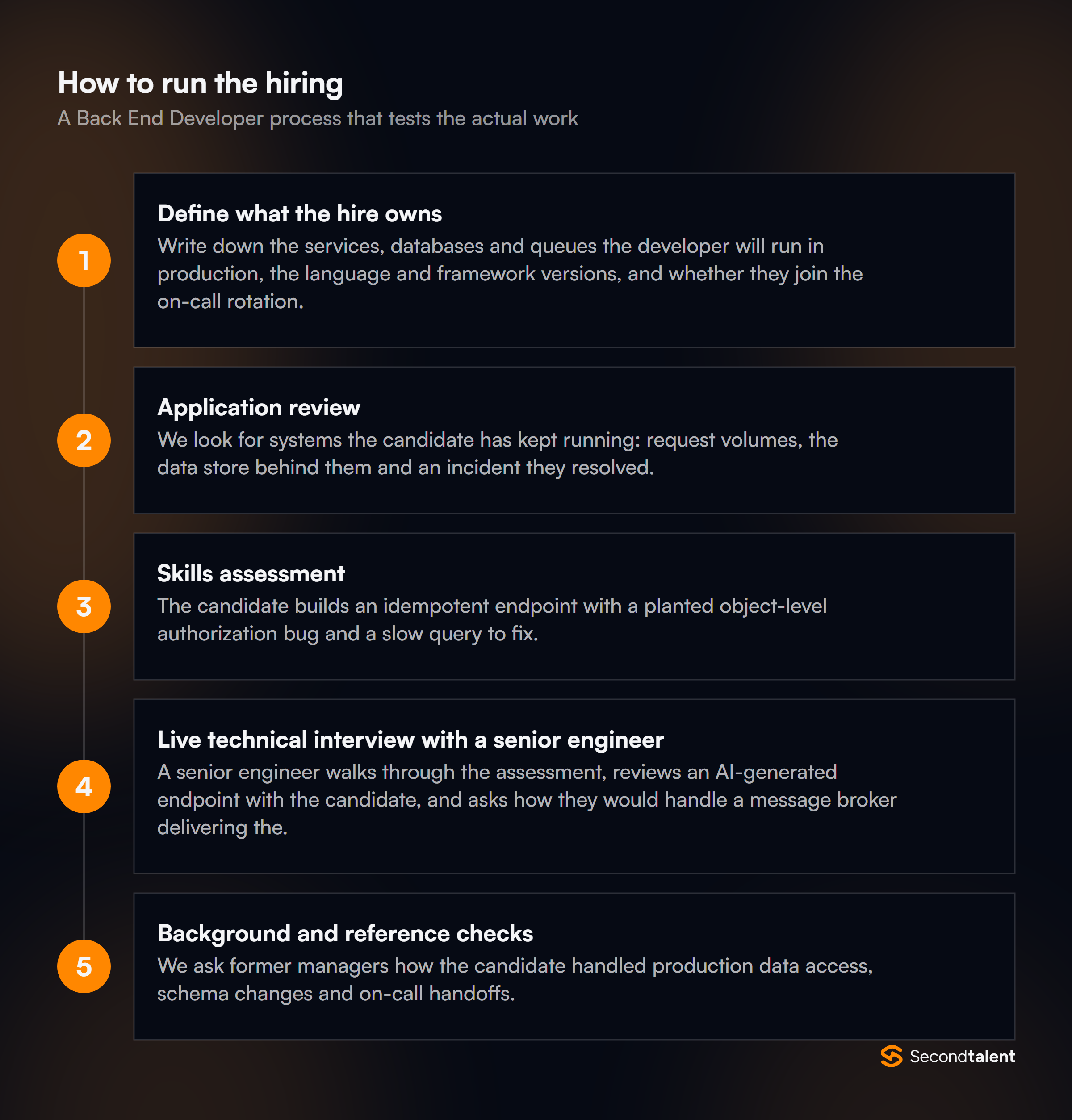
Second Talent's vetting covers stages 2 to 5 before you see a profile. Our back-end interview guide and API security interview guide have question sets for your own final round.
Stage 1: Define what the hire owns
Write down the services, databases and queues the developer will run in production, the language and framework versions, and whether they join the on-call rotation. A payments service and a reporting pipeline share the title and need different tests.
Stage 2: Application review
We look for systems the candidate has kept running: request volumes, the data store behind them and an incident they resolved. We ask who owned the service after launch.
Stage 3: Skills assessment
The candidate builds an idempotent endpoint with a planted object-level authorization bug and a slow query to fix. We score the migration and the written explanation as well as the code.
Stage 4: Live technical interview with a senior engineer
A senior engineer walks through the assessment, reviews an AI-generated endpoint with the candidate, and asks how they would handle a message broker delivering the same event twice.
Stage 5: Background and reference checks
We ask former managers how the candidate handled production data access, schema changes and on-call handoffs. You then sign with the IP assignment in place, as a contractor agreement or through an EOR.
Hire Back-End Developers from Asia with Second Talent
We shortlist 6-8 candidates within 24 hours from 100,000+ pre-vetted engineers, accepting only the top 1% of applicants. Senior back-end developers start from $2,999 a month, with $0 upfront, no lock-in and 4-6 hours of daily overlap with US hours. We handle contracts, payroll and equipment, with compliant EOR contracts and payroll in 9 Asian markets.
Our pricing page covers subscription, direct-hire and EOR pricing. Open Campus, the Web3 education protocol, was looking for front-end, back-end and QA engineers and hired 10 engineers in Vietnam within 2 months through us, as the Open Campus case study sets out.