TL;DR: Senior NodeJS developers from Asia start from $2,999 a month through Second Talent, matched in 24 hours. The closest US benchmark, the BLS median for software developers, was $135,980 a year in May 2025.
On 6 August 2026, Singapore's Cyber Security Agency warned that a Shai-Hulud malware variant had compromised over 1,300 npm package versions, with a combined 2 billion monthly downloads, including the caching libraries keyv and cacheable. A Node.js developer decides what enters your lockfile each week. Hire one who can show how they catch a poisoned version before it reaches production.
Key takeaways
- On our Node.js rate cards, developers working for foreign clients earn from $1,200 a month in Indonesia, and India's range reaches $7,530+.
- Node.js 26 moves to long-term support on 28 October 2026, and Node.js 22 reaches end of life on 30 April 2027.
- npm removed legacy access tokens in November 2025 and plans to end direct publishing with granular tokens in January 2027.
- Node.js was the most used web technology among professional developers in Stack Overflow's 2025 survey, at 49.1%.
What NodeJS Developers Earn Working for International Clients in Asia
India's Node.js range runs four times from floor to top, the widest spread below, while China's is the narrowest at 2.4 times. The figure is what Node.js developers in each market earn working directly for foreign companies, before any employer or platform costs.
| Market |
Monthly pay working for international clients (USD) |
| Indonesia |
$1,200-$4,500 |
| Philippines |
$1,520-$4,070+ |
| India |
$1,880-$7,530+ |
| Vietnam |
$2,000-$5,500 |
| Malaysia |
$2,200-$6,500 |
| China |
$2,500-$6,000 |
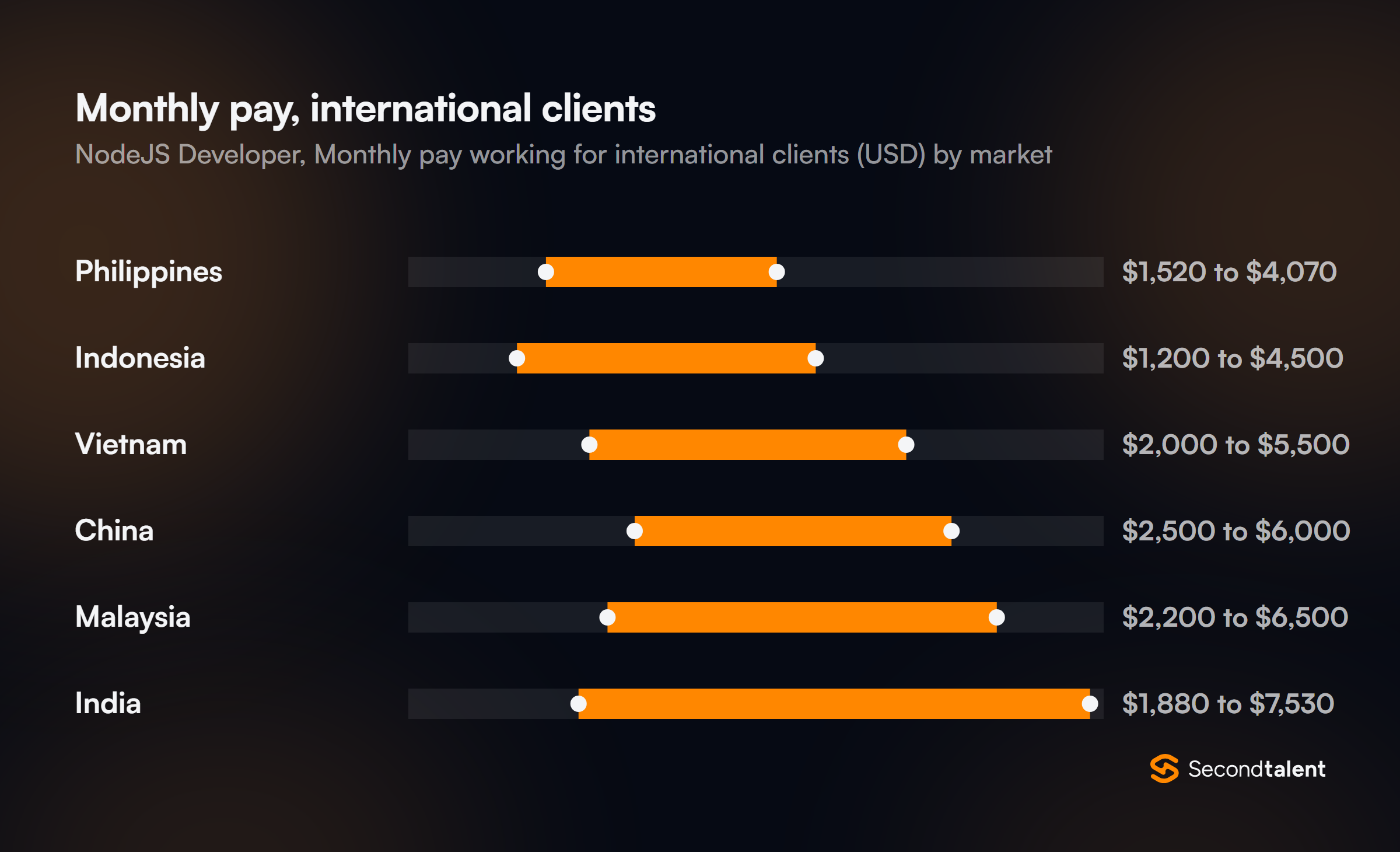
Monthly ranges from the Remote (Working for International Clients) figures on our rate cards for Indonesia, the Philippines, India, Vietnam, Malaysia and China, converted at ExchangeRate-API mid-market rates for 14 September 2026.
Four of the six cards quote US dollars with a fixed top, so no conversion applies. The Philippine and Indian cards quote pesos and rupees and leave the top open. Our Thailand card carries the same $2,500-$6,000 range as China.
Through Second Talent, senior NodeJS developers start from $2,999 a month: one monthly fee that bundles salary, payroll taxes, statutory contributions and our service fee. The pricing page explains how the subscription works.
US Pay Benchmark for NodeJS Developers
A mid-level freelance or contract Node.js developer in the United States costs $85 to $135 an hour on our Node.js cost-to-hire page, before payroll, insurance and leave. For a salaried hire, BLS publishes no series for a single runtime. Node.js developers map to Software Developers (SOC 15-1252), because the job is writing and running server-side application software.
| BLS OEWS, May 2025, national |
Software Developers (15-1252) |
| Median annual |
$135,980 |
| 10th percentile, monthly |
$6,870 |
| 25th percentile, monthly |
$8,770 |
| Median, monthly |
$11,330 |
| 75th percentile, monthly |
$14,330 |
| 90th percentile, monthly |
$17,890 |
Monthly figures are the annual wages on the OEWS profile for 15-1252 divided by 12, rounded to the nearest $10.
Salary is only part of the US cost. In the BLS Employer Costs for Employee Compensation release for June 2026, wages and salaries made up 68.5% of employer compensation costs for full-time private industry workers, and benefits the other 31.5%.
Time Zone Overlap with ET, CT and PT
Node.js services fail in ways that need a person awake: a memory leak that climbs overnight, a dependency update that breaks a webhook. An engineer in Asia is at work while your US traffic is at its lowest. US daylight time runs from 8 March to 1 November 2026, per NIST, and none of the cities below change their clocks.
| Engineer's city |
UTC offset |
9:00 am ET (EDT) |
9:00 am CT (CDT) |
9:00 am PT (PDT) |
| Manila, Singapore, Kuala Lumpur, Taipei |
UTC+8 |
9:00 pm |
10:00 pm |
12:00 midnight |
| Ho Chi Minh City, Jakarta, Bangkok |
UTC+7 |
8:00 pm |
9:00 pm |
11:00 pm |
| Bengaluru |
UTC+5:30 |
6:30 pm |
7:30 pm |
9:30 pm |
After 1 November 2026, every time in the table moves one hour later.
A worked shift: Kuala Lumpur, 5:00 pm to 2:00 am, is 09:00 to 18:00 UTC. Subtract four hours for EDT and the shift covers 5:00 am to 2:00 pm in New York: five hours inside a 9-to-5 day there, four with Chicago and two with San Francisco.
Use the hours before the overlap for work that should land while US users sleep: dependency bumps behind a canary, database migrations, heap snapshots of a leaking process. Keep the shared hours for API contract reviews with your front-end team and for rollback decisions.
We agree that schedule before the offer, which is how our placements get 4-6 hours of daily overlap with US hours.
Late hours raise pay for employees in two markets from the table. The Philippine Labor Code adds at least 10% for work between 10 pm and 6 am (Article 86), and Vietnam's Labor Code adds at least 30% between 22:00 and 06:00 (Articles 98 and 106).
NodeJS Developer Skills to Screen For

Among professional developers in Stack Overflow's 2025 technology results, 49.1% used Node.js, but only 20.3% used Express, 7.4% NestJS and 3.1% Fastify. Framework names on a CV say little. Test the runtime, the package supply chain and the code paths that break under load.
Release lines and security patches
The Node.js release page says that starting with Node.js 27, the release cycle becomes annual and every major version moves to LTS after its six-month Current phase. The project's release schedule puts Node.js 26 into LTS on 28 October 2026 and ends support for Node.js 22 on 30 April 2027.
Patches arrive between majors. The 29 July 2026 security release fixed 11 vulnerabilities across the 26.x, 24.x and 22.x lines, three rated High, two of them in HTTP/2 handling. Ask the candidate how long their last team took to roll a security release into production, and what they tested first.
TypeScript with type stripping
In the same survey, 48.8% of professional developers used TypeScript. Node.js marked type stripping stable in v25.2.0 and v24.12.0, so the runtime executes .ts files by replacing types with whitespace. It performs no type checking, ignores tsconfig.json, and throws on enums, parameter properties and namespaces with runtime code.
Decorators produce a parser error, and NestJS builds controllers from decorators, so a NestJS service still needs a compile step. Hand the candidate a TypeScript file with an enum in it and ask what the runtime does with that file.
Supply-chain attacks on npm installs
The first Shai-Hulud wave had compromised over 500 packages by CISA's alert of 23 September 2025. The malware harvested GitHub personal access tokens and cloud API keys, then published infected versions of other packages under the victim's npm account. CISA told organizations to review package-lock.json files, pin dependencies to releases from before 16 September 2025 and rotate developer credentials.
Do not accept the Permission Model as the answer. The Node.js permissions documentation calls --permission a "seat belt" that "does not protect against malicious code". Give the candidate a lockfile with one compromised version nested three levels deep and time how long they take to find it.
Publishing packages from CI
Teams that publish internal or open-source packages face a moving target. The npm access token documentation says npm has supported only granular tokens since November 2025, and direct publishing with a granular token ends in January 2027, replaced by stage-only tokens that a maintainer with 2FA must promote. Trusted publishing removes the token from CI through OIDC and requires npm CLI 11.5.1 and Node.js 22.14.0 or later. Ask the candidate to set up a GitHub Actions publish job without a stored secret.
Async errors in Express 5
Contributors opened the Express 5 pull request in July 2014. Ten years later, the Express Technical Committee released it on 15 October 2024 and dropped support for Node.js versions before 18. Express 5 forwards rejected promises from middleware and handlers to the error-handling middleware. It also removed regular-expression sub-patterns from route strings to close off ReDoS attacks, and the migration guide requires a named wildcard such as /*splat. Give the candidate an Express 4 router full of try/catch wrappers and an unnamed wildcard route, and review the migration.
Server-rendered React on Node
On 3 December 2025 the React team disclosed CVE-2025-55182, an unauthenticated remote code execution flaw in React Server Components rated CVSS 10.0. Next.js and React Router were among the affected frameworks. The React team warned that an app supporting Server Components could be vulnerable even with no Server Function endpoints.
Follow-up denial-of-service and source-exposure CVEs came through January 2026. For a developer who owns your Next.js server, ask how they would prove that each deployed build carries the fix. Our React developer page covers the front-end side.
What senior Node.js developers should diagnose
A senior Node.js developer is the one who finds out why p99 latency tripled when nothing in the code looks slow. The Node.js guide Don't Block the Event Loop sets the rule: every callback, await and .then should finish quickly, because one slow request holds up every other client. It names two common causes: a regular expression with nested quantifiers that opens a ReDoS path, and JSON.parse or JSON.stringify on large inputs, which the guide measured at 1.3 seconds to parse a 50 MB string.
Give the candidate an Express service with a synchronous parse of a large upload body, a vulnerable route regex and a memory leak in a module-level cache. Ask them to find each one with a CPU profile and a heap snapshot, then say which work belongs in a worker thread, a stream or a queue. Senior candidates should also explain how they carry a request ID through async calls without passing it by hand; AsyncLocalStorage is the built-in answer.
Contractor or Employer of Record for a US Company
Software is not one of the nine categories of commissioned work that can be "work made for hire" under 17 U.S.C. § 101, and a transfer of copyright must be in writing and signed under § 204(a). Name the services, internal npm packages and CI workflows in the assignment, and keep your npm organization owned by a company account rather than the developer's.
IRS Publication 515 says the place where services are performed determines the source of the income, so a developer coding from Jakarta or Kuala Lumpur earns foreign-source income. A foreign individual gives the payer Form W-8BEN to certify foreign status.
The developer's country runs its own employment test. Philippine courts use the four-fold test, and in Atok Big Wedge v. Gison the Supreme Court called the power of control the most important element. Article 13 of Vietnam's 2019 Labor Code treats an agreement under any name as a labor contract if it covers paid work, wages and one party's management and supervision.
A developer in your sprint planning, holding deploy rights and a place on the pager, fits both tests. That is the case an Employer of Record covers, and our EOR, PEO and contractor comparison sets out the trade-offs. This is a summary, not legal advice.
|
Independent contractor |
Employer of Record |
| Legal employer |
None; the developer invoices you |
The EOR's local entity |
| US paperwork |
Form W-8BEN from the developer |
Service agreement with the EOR |
| IP |
Written assignment covering services, packages and CI code |
Assignment in the employment contract and your EOR agreement |
| Local labor law |
Classification risk if you set hours and methods |
Night premiums, public holidays and leave apply |
| Pay currency |
Agreed in the contract, often USD |
Local currency; Vietnam's Labor Code states wages in dong (Article 95) |
English Level and Working Norms
Malaysia's IT job-function score of 590 on the EF English Proficiency Index 2025 is higher than its national score of 581, and Indonesia's IT score beats its national figure by 52 points. The index ranks 123 countries and regions against a global average of 488.
| Country |
EF EPI 2025 score |
World rank (of 123) |
IT job-function score |
| Malaysia |
581 |
24 |
590 |
| Philippines |
569 |
28 |
581 |
| Vietnam |
500 |
64 |
500 |
| India |
484 |
74 |
487 |
| Indonesia |
471 |
80 |
523 |
| China |
464 |
86 |
491 |
Scores come from EF's country pages, such as Malaysia and China. A Node.js hire's English shows up in writing: an OpenAPI description, a changelog entry for a breaking API change, an incident note your US team reads in the morning. Ask for one of those as part of the assessment.
Plan releases around both calendars. Thanksgiving on 26 November 2026 is a working day in Asia, so a developer there can watch error rates during your US holiday traffic. Article 112 of Vietnam's Labor Code gives five paid days for Lunar New Year, so freeze dependency upgrades that week if your only Node.js developer is in Vietnam.
NodeJS Developer Hiring Process
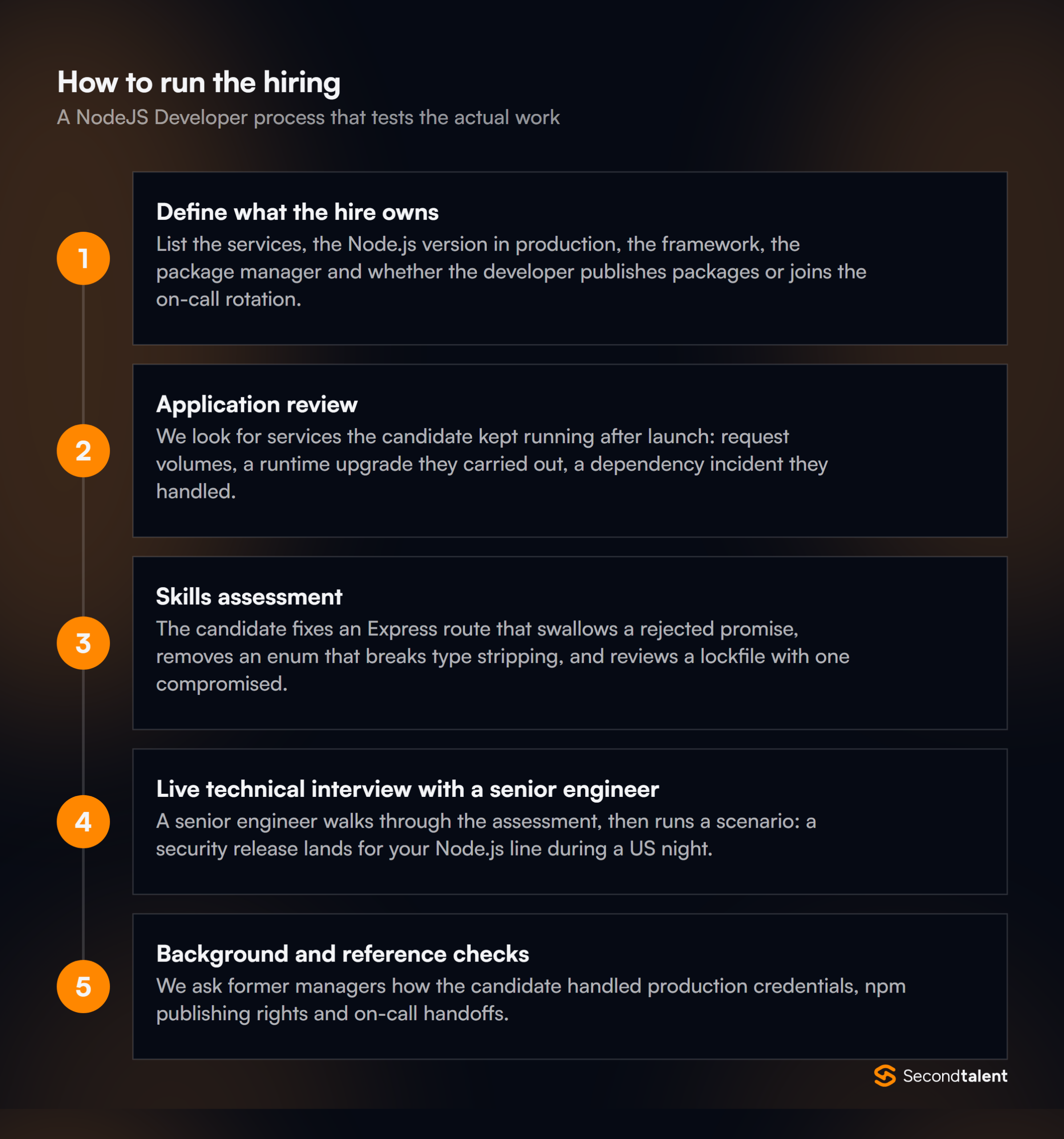
Second Talent's vetting covers stages 2 to 5 before you see a profile. Our Node.js interview guide has question sets for your own final round.
Stage 1: Define what the hire owns
List the services, the Node.js version in production, the framework, the package manager and whether the developer publishes packages or joins the on-call rotation. A NestJS API team and a Next.js server team need different tests.
Stage 2: Application review
We look for services the candidate kept running after launch: request volumes, a runtime upgrade they carried out, a dependency incident they handled. Tutorial repositories alone do not pass.
Stage 3: Skills assessment
The candidate fixes an Express route that swallows a rejected promise, removes an enum that breaks type stripping, and reviews a lockfile with one compromised package planted in it. We score the pull request description with the code.
Stage 4: Live technical interview with a senior engineer
A senior engineer walks through the assessment, then runs a scenario: a security release lands for your Node.js line during a US night. The candidate explains how they would test, deploy and roll back.
Stage 5: Background and reference checks
We ask former managers how the candidate handled production credentials, npm publishing rights and on-call handoffs. You then sign with the IP assignment in place, as a contractor agreement or through an EOR.
Hire NodeJS Developers from Asia with Second Talent
We shortlist 6-8 candidates within 24 hours from 100,000+ pre-vetted engineers, accepting only the top 1% of applicants. NodeJS developers start from $2,999 a month, with $0 upfront, no lock-in and 4-6 hours of daily overlap with US hours. We handle contracts, payroll and equipment, with compliant EOR contracts and payroll in 9 Asian markets.
Our pricing page sets out the subscription, and for a Philippine hire our Philippines Node.js developer page covers that market alone.