TL;DR: Five reasons account for most IT staffing engagements: capacity, specialty access, cost, speed and risk reduction. Companies usually arrive for one and stay for a second, which is worth anticipating in the contract. Naming which reason you are actually in decides the engagement model, the contract length and how you should measure it. Getting that wrong is what makes an engagement feel wrong even when the engineer is right.
IT staffing is rarely a single-purpose decision. This guide covers the five recurring patterns, what each is really about underneath, and how to tell which one applies to you. It follows on from what IT staffing is and pairs with the three engagement models.
Why do companies use IT staffing?
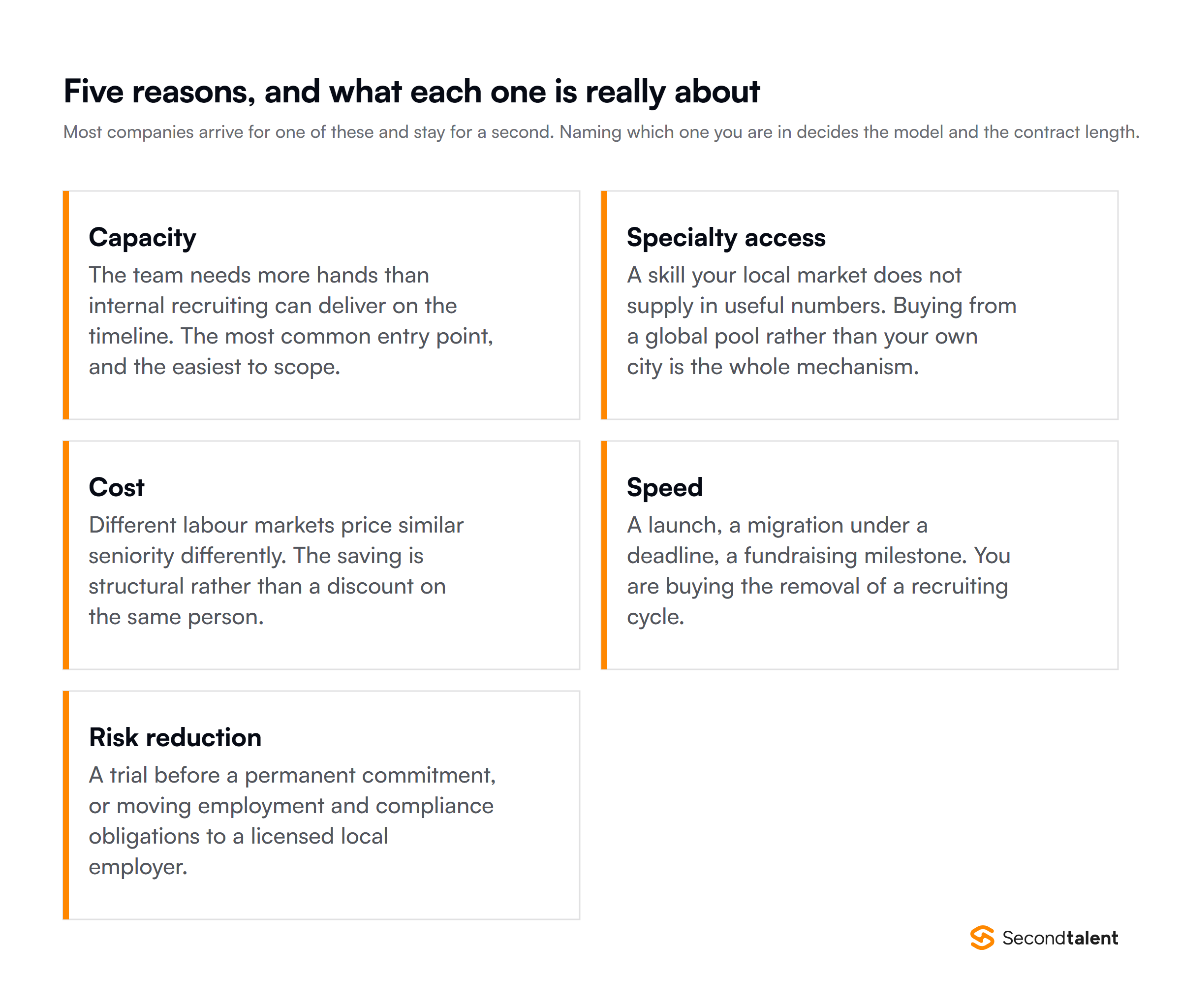
Capacity, specialty access, cost, speed and risk reduction. Those five cover almost every engagement.
They are not equally weighted for any given buyer. A startup extending runway and an enterprise covering a migration deadline are both using the same model for entirely different reasons, and they should structure the engagement differently as a result.
The useful discipline is to name your primary reason before you brief a provider. A provider will happily sell into whichever reason you present, and the one you lead with shapes what they propose.
Reason 1: capacity
The team needs more engineering capacity than internal recruiting can deliver on the timeline. This is the most common entry point and the easiest to scope.
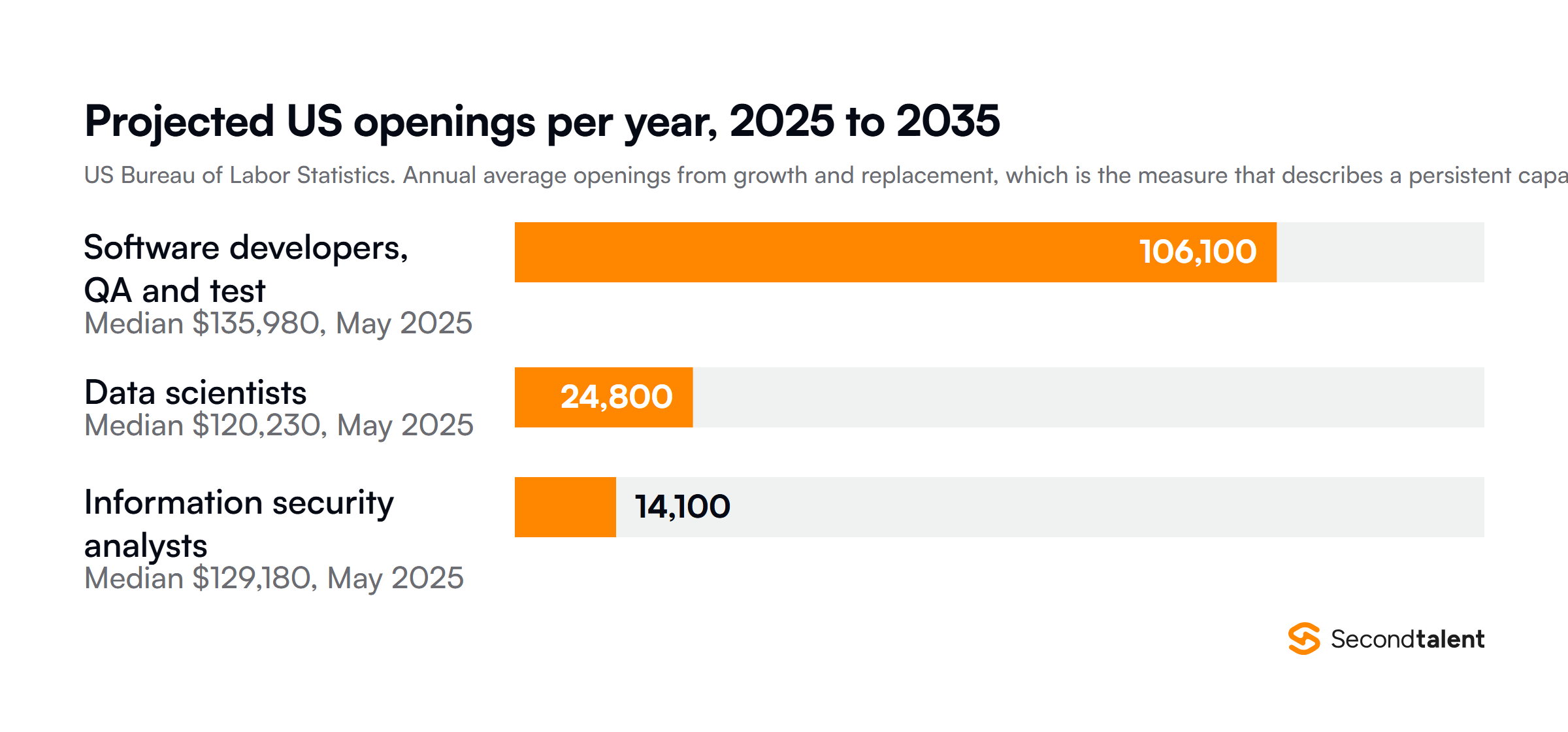
The gap persists rather than appearing occasionally, which is what makes it structural rather than a hiring failure. The US Bureau of Labor Statistics projects about 106,100 annual openings for software developers, QA analysts and testers, 24,800 for data scientists and 14,100 for information security analysts between 2025 and 2035.
Typical scenarios: scaling a sprint team for a quarterly push, covering a senior engineer who left mid-roadmap, or building toward a fundraising milestone with a fixed date.
The model fits because vetted engineers are available in days, contracts run short, and the engineer joins your existing workflow rather than requiring a separate operating model.
Reason 2: specialty access
A skill your local market does not supply in useful numbers. You are buying from a global pool instead of your own city, and that is the entire mechanism.
The BLS growth projections point at where this bites hardest: data scientists at 35 percent between 2025 and 2035 and security analysts at 21 percent, against roughly 4 percent across all occupations. Those are the searches that stall locally for a quarter and then stall for another.
Specialty engagements also end cleanly, which suits work that is genuinely a phase rather than a permanent function. A migration needs platform expertise for six months, not forever.
One caution on AI specialties. The 2025 Stack Overflow Developer Survey found 84 percent of developers use or plan to use AI tools, so listing them is no longer a specialty signal. Brief for judgment about the output, which the same survey shows is the scarce part.
Reason 3: cost
Different labour markets price similar seniority differently. The saving is structural rather than a discount on the same person, which is the distinction that makes the case defensible internally.
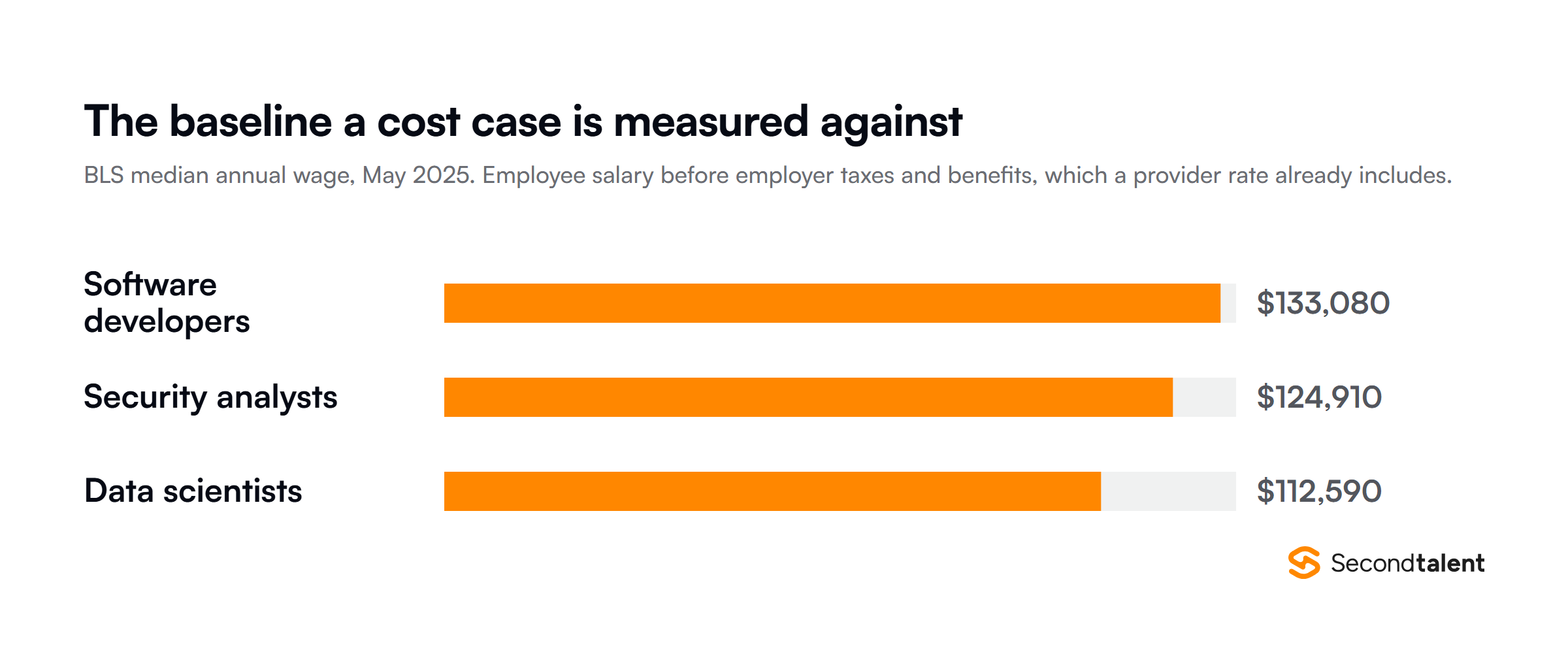
Set the baseline properly. BLS puts the May 2024 median annual wage at $135,980 for software developers, $129,180 for security analysts and $120,230 for data scientists. Those are employee salary before employer taxes, benefits, equipment and tooling.
A provider rate already includes all of that, so load the salary side before calculating any saving. Second Talent publishes senior international client rates in the developer rate cards, and clients save $103,000 or more per hire against a comparable Western salary, with payroll savings of 50 to 70 percent.
Cost is the weakest reason to lead with. It is real and it is also the one that produces the worst briefs, because a brief written to a budget rather than to a problem returns whoever fits the number. Lead with capacity or specialty, structure for cost, and you will get better candidates for the same money.
The companies most driven by cost tend to be startups extending runway, mid-market teams with thin engineering margins, and enterprises inside a cost-reduction cycle. Our comparison of onshore, nearshore and offshore covers where the differences come from.
Reason 4: speed
A launch, a migration under a deadline, or a milestone with a date attached. What you are buying is the removal of a recruiting cycle.
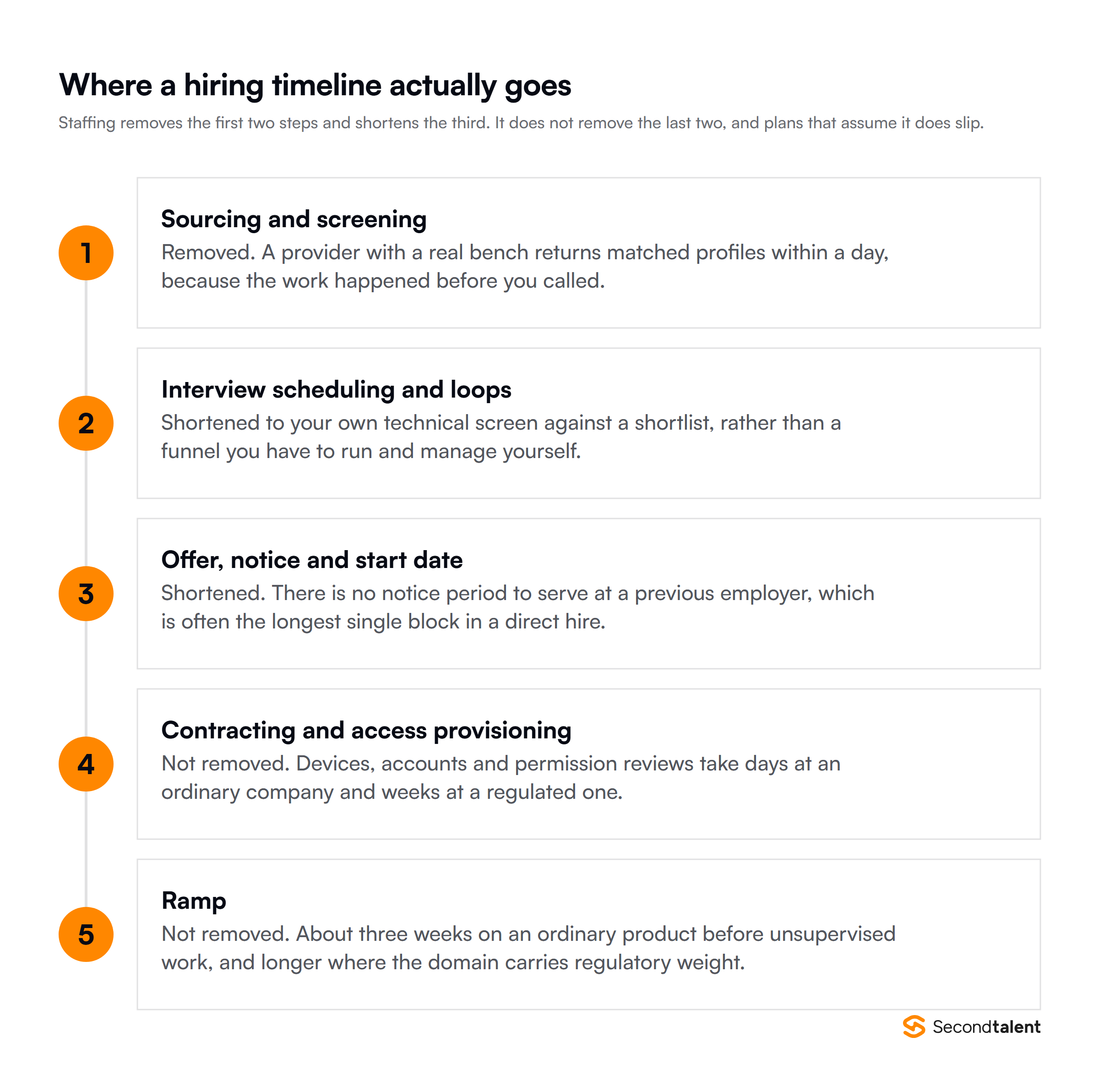
Be precise about which parts of the timeline actually compress, because this is where plans slip. Sourcing and screening disappear, since a provider with a real bench returns matched profiles within a day. Interview loops shorten to your own technical screen against a shortlist. Offer and notice periods disappear, and a notice period is often the single longest block in a direct hire.
Two steps do not compress. Contracting and access provisioning take days at an ordinary company and weeks at a regulated one, and they sit outside the recruiting process entirely. Ramp takes about three weeks before unsupervised work on an ordinary product, longer where the domain carries regulatory weight.
Second Talent returns matched profiles within 24 hours. Plan the two steps that follow rather than assuming they disappear with the rest.
Reason 5: risk reduction
The least-discussed reason and often the most valuable, in two distinct forms.
Hiring risk. A contract-to-hire arrangement lets you work with someone for months before committing permanently. If the fit is wrong the engagement ends under the replacement terms rather than through a performance process. Our guide to contract, contract-to-hire and direct hire covers how to set the conversion up.
Compliance risk. Engaging someone directly across a border puts classification, payroll and statutory benefits on you. The IRS common-law test and the HMRC CEST tool both turn on control, and a contractor working your hours under your direction often fails them. A provider employing through a licensed local entity moves that exposure.
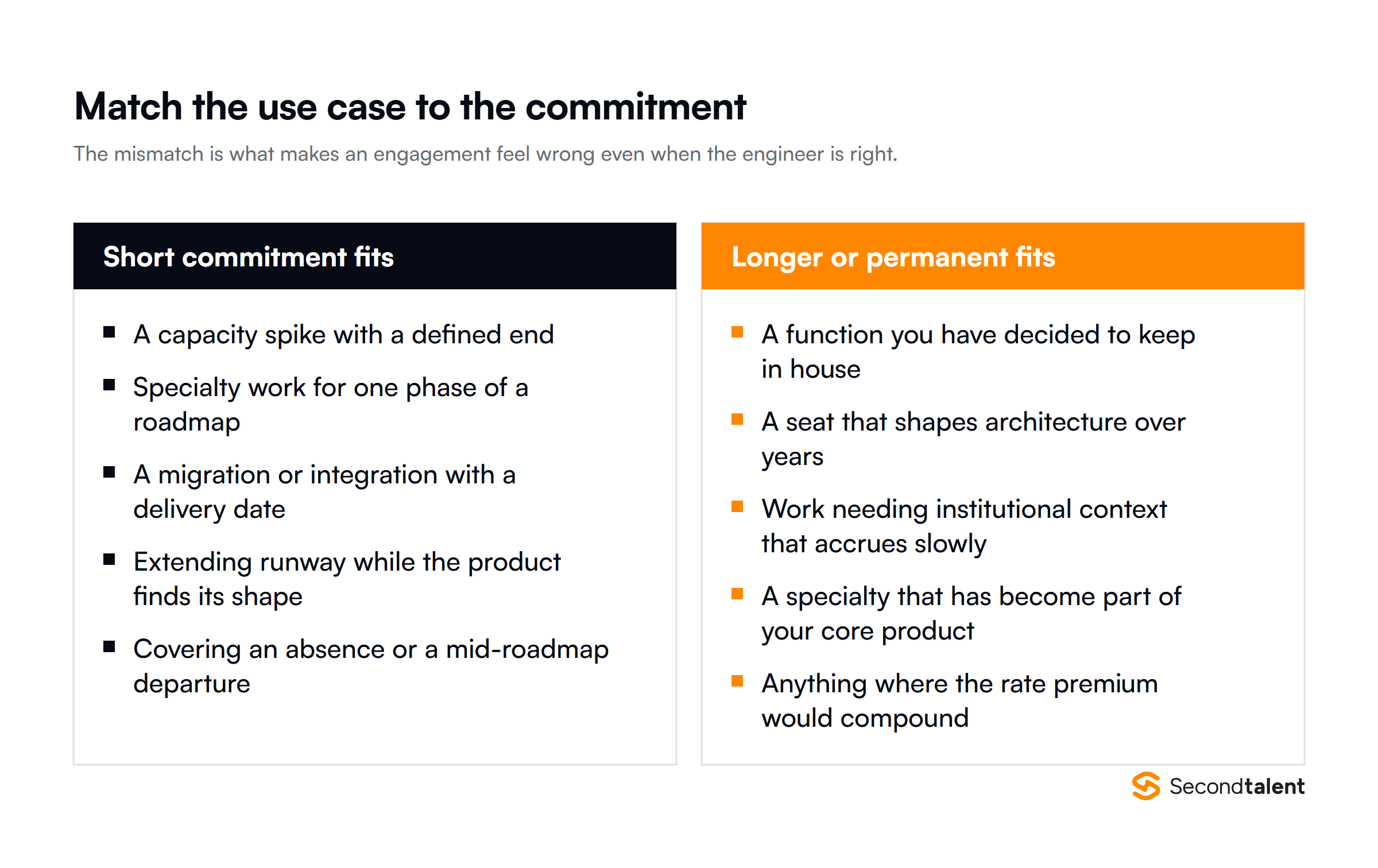
Matching the reason to the commitment
Once you know your reason, the contract length follows from it.
Short commitments suit a capacity spike with a defined end, specialty work for one phase, a migration with a delivery date, or covering an absence. Longer or permanent arrangements suit a function you have decided to keep in house, a seat that shapes architecture over years, or work needing institutional context that accrues slowly.
The mismatch is what makes an engagement feel wrong even when the engineer is good. A permanent function staffed on a rolling three-month contract creates constant renewal anxiety, and a six-week project staffed on a twelve-month commitment wastes the flexibility you paid for.
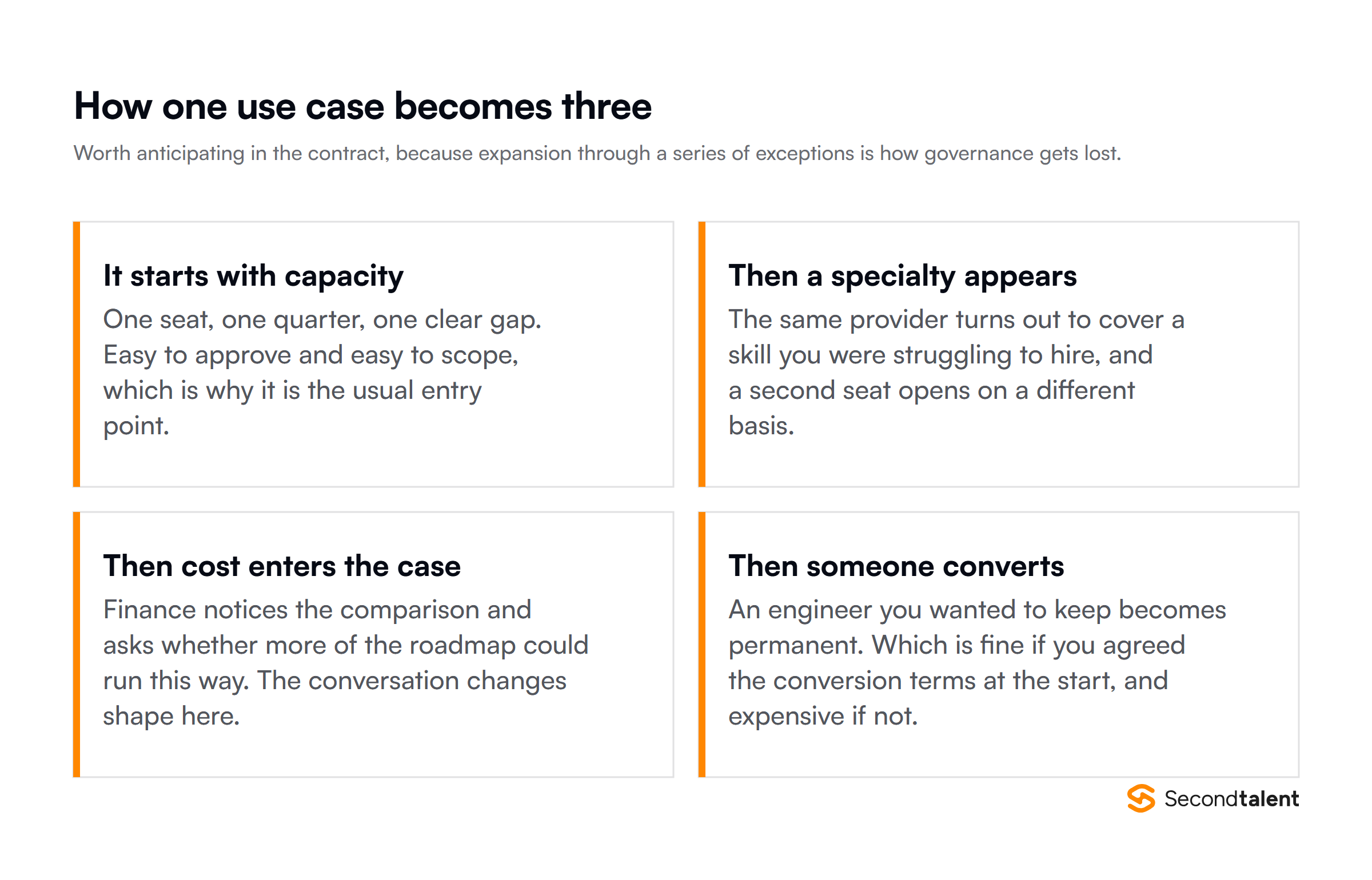
How one reason becomes three
Most engagements expand, and the pattern is predictable enough to plan for.
It starts with capacity, because one seat for one quarter is easy to approve. Then a specialty appears, because the same provider turns out to cover a skill you were struggling to hire. Then cost enters the conversation once finance sees the comparison. Then someone converts, because you want to keep an engineer.
None of that is a problem. It becomes one when expansion happens through a series of exceptions rather than through a structure, because that is how governance gets lost. Two things prevent it.
Agree conversion terms at the start, even when you are certain you will not use them. And set up one master agreement covering all the engagement models, so a new seat is a statement of work rather than a fresh legal cycle. Our agreement template covers the structure.
What each reason should be measured on
The reason decides the metric, and measuring the wrong thing is how a working engagement gets cancelled.
Capacity is measured on throughput against your own baseline, from month three onward. Measuring it during the ramp measures onboarding.
Specialty access is measured on whether the work happened at all. The counterfactual is often that the project stalled for another quarter, which makes a throughput comparison against an in-house team you never assembled meaningless.
Cost is measured fully loaded against fully loaded, including your own management time and the ramp you paid for at full rate.
Speed is measured against your own historic time to fill, not against a market average. If your recruiter fills that seat in eight weeks, the compression is against eight.
Risk reduction is measured on decision quality: did the trial produce a clear verdict, and did the compliance structure hold. Neither shows up in a throughput chart.
Our guide to measuring IT staffing ROI covers the calculation for each.
Reasons that should send you elsewhere
Three situations get presented as staffing problems and are not.
Nobody free to direct the work. Augmentation assumes a manager who assigns and reviews. Without one, buy a managed service and accept the reduced visibility, or fix the management gap first.
The problem is not yet defined. Open-ended research nobody can brief will not go better with more people on it. Scope it, then staff it.
The seat is founder-grade. Roles that set technical direction over years belong on your payroll whatever the rate comparison says.
IT staffing use case FAQs
Can one engagement serve several reasons?
Yes, and most mature ones do. Name the primary reason anyway, because it determines what you measure. A capacity engagement is judged on throughput; a risk-reduction engagement is judged on whether the conversion decision was good.
Which reason produces the best outcomes?
Specialty access, in general, because the alternative is often that the work does not happen. Cost-led engagements produce the most variable results, since a brief written to a budget attracts candidates who fit the budget.
Is IT staffing only for companies that cannot hire?
No. Plenty of teams with healthy pipelines use it for phase-shaped work they do not want to make permanent, which is a capability decision rather than a recruiting one.
When should we stop using it for a given role?
When the role stops being phase-shaped. If you have renewed the same seat three times for the same work, it is a permanent function and the rate premium is now compounding against you.
Takeaways
- Name your primary reason before briefing a provider. It shapes what they propose.
- Capacity gaps are structural: BLS projects 106,100 developer openings a year to 2035.
- Lead with capacity or specialty, structure for cost. Cost-led briefs return budget-fit candidates.
- Speed removes sourcing and notice periods. It does not remove access provisioning or ramp.
- Expect the engagement to expand, and agree conversion terms before it does.
Start from the reason
Second Talent places pre-vetted senior engineers across Asia with EOR cover, matched within 24 hours, at 92 percent twelve-month retention.
Tell us what you are trying to solve, or read when to use IT staffing versus in-house hiring if you are still deciding.